Tag: Media Partners Asia

  • DTH expands even as pay TV market saturates

    DTH expands even as pay TV market saturates

    Mumbai: Pay TV subscription revenue is expected to reach $7.6 billion by 2026 over $6.4 billion in 2021, stated Media Partners Asia in its latest report on India’s online video market, which also highlights the increasing market share of Direct-to-home (DTH) even as cable TV remains in structural decline.

    There are 127 million pay TV subscribers in India and DTH has been winning share from cable TV since 2019. While DTH grew its subscriber share from 42 per cent in 2019 to 47 per cent in 2021, the share of cable TV declined from 56 per cent to 52 per cent in the same period.

    According to the report, there will be one billion video screens in India by the end of 2024. There will be 47 million FTA households and 121 million pay TV homes. As many as 13 million homes will have hybrid set-top-boxes, 744 million users will have 4G connections and 155 million users will have 5G connections. In the long run pay TV homes will decline while FTA homes will continue to grow, the report indicated.

    By 2026, two-third of Indians will have access to high-speed mobile broadband reaching 899 million subscribers, out of which 34 million homes will be serviced by fibre, and three million homes will have wireline (digital subscriber line) connections. The report estimates that ~90 per cent of fixed broadband homes will be serviced through fibre.

    In terms of revenues, the video market scale will grow to reach $18 billion in 2026 over $11.6 billion in 2021. Pay TV subscription revenues may reach 7.6 billion, pay TV advertising revenues at $6.1 billion, OTT advertising-video-on-demand (AVOD) to reach $2.8 billion and OTT subscription-video-on-demand to reach $1.8 billion.

    D2C SVOD subscribers to reach 193 million by 2026

    Despite content supply bottlenecks, India’s OTT SVOD subscriptions continue to grow at a robust rate. This year OTT subscribers are expected to grow by 1.6 times over the previous year to reach 88.7 million. Most of these subscribers are expected to come through Disney+ Hotstar in Q4. As per the MPA’s estimate, Disney+ Hotstar subscribers is likely to reach 46 million, Prime Video to reach 21.8 million and Netflix to reach 5.5 million at the end of the year. These platforms will continue to account for 83 per cent of total direct-to-consumer subscribers in India.

    The OTT industry is also expected to invest $1 billion in content in 2021, according to the report. Their share of acquired and local content is 30 per cent and is expected to grow to 40-45 per cent in the near future. New D2C SVOD entrants are going to enter the market by 2022 including services from HBO and Comcast.

    The content strategy of the leading OTT players is diverse and has led to subscriber growth. For Disney+ Hotstar, the combination of sports and local originals has been increasing subscriber growth. It hiked its base plan by 25 per cent “which is justified given the value of its upcoming slate of premium sport and local original content”, said the company.

    Disney+ Hotstar, which is currently at the lower end of ARPUs (<$2), will see its pricing power improve after 2022, according to the report. Prime Video has benefitted from its regional content push and Netflix has invested heavily in original content with 41 original releases in 2021.  

    In 2022, the Indian Premier League (IPL) media rights will be up for grabs once again with TV and digital rights being sold separately. The report estimates that top bidders will include Disney, Amazon, Facebook, Jio and Sony.

  • Disney’s APAC head Luke Kang bats for regional content to push growth

    Disney’s APAC head Luke Kang bats for regional content to push growth

    Mumbai: The focus areas of the company in the APAC market have not changed much in the last one year, said Luke Kang, who was appointed as The Walt Disney Company, president – APAC, excluding India in 2020. Under his leadership, the APAC business has undergone restructuring with the appointment of a D2C head, spun off a division in Indonesia to grow the market and maximise the regional scale and in-market expertise in markets like Japan and China.

    Kang virtually addressed the APOS summit on media, telecoms, and entertainment industry in APAC organised by Media Partners Asia on Tuesday.

    The APAC market is critical to grow Disney+ 116 million SVOD subscribers globally, said Kang. The streaming platform has had a soft launch in Japan and will soon launch in South Korea, Taiwan, and Hong Kong. “The APAC market will contribute a sizeable share to the global subscriber base” he added.

    Even though most of their content is produced in the US, the audiences in the APAC market including Indonesia, Thailand, Malaysia and Singapore have embraced Disney+, noted Kang. “These markets have a strong affinity for global and regional content”, he said.

    “We’re not going to dabble in local content, but be a major player”, he emphasised when talking about the importance of producing content in local markets and supporting the creative economy in these markets. Kang said that first it would be important to understand the nuances about the customers in these markets. For example, he observed that consumers in Indonesia prefer to consume Korean or Japanese content. Those kinds of insights would enable Disney+ to make relevant investments to grow their subscriber share in local markets.

    “We are thinking differently, than we used to pre-D2C. We get a lot more data in real-time. We are learning that we need to be very broad,” said Kang, “We will be doing a lot of local and regional content across multiple markets, to make our service better, more exciting, more localised.”

    Speaking about the importance of SVOD business, he said, “SVOD is what you would call the ultimate scalable business. It is the one business in our portfolio where scale really matters. This technology allows us to bring the benefits of our global scale to consumers, especially, to consumers in APAC. Earlier, in the media industry, the content scale was global but it was difficult to scale distribution globally because you had a lot of walled garden ecosystems.”

    Earlier this year, Disney has decided to shut 18 TV channels in Southeast Asia and Hong Kong effective from 1 October. The reports indicated that the channels were closed as part of the media company’s focus on increasing its focus on the D2C business.

    Speaking about the move, Kang stated, “There’s a role for all media in the lives of consumers, although it changes over time. We’ve had to make tough decisions across the region when it comes to television. We’re making these decisions based on consumer demand, based on where the consumers are going. Consumers are telling us they want to engage with us on digital.”

  • India’s ad-revenue to rebound over 2020-25 with 13 % CAGR : MPA

    New Delhi: After a 27 per cent plunge in 2020, ad revenue in India is forecast to rebound strongly over 2020-25 with a CAGR of 13 per cent, said a new report released by Media Partners Asia (MPA) on Monday.

    According to the report- Asia Pacific Advertising Trends 2021, digital advertising is expected to benefit from India’s expanding digital economy across online gaming, ed-tech, food and delivery platforms, outgrowing television to become the largest advertising segment by 2024.

    Overall, APAC advertising expenditure is forecast to grow at 5.4 per cent CAGR to reach $245 billion by 2025, powered by growth across key markets such as China, India, Japan, and Korea, says the report.

    Digital ad-revenue most resilient

    According to the report, digital ad revenue remained most resilient through the pandemic, with consumers across APAC spending more time online and brands accelerating digitization efforts. The medium is projected to contribute 67 per cent of APAC ad revenue in 2025, eating into TV’s share (18 per cent), it said.

    The role of e-commerce in advertising surged in 2020, with e-commerce contributing an estimated 39 per cent of China’s ad revenues, while growing significantly, albeit from a small base, in India, Indonesia, Japan and Korea. Search and social advertising benefited as well. As per MPA’s projections, digital advertising’s share of net advertising spend is likely to grow from 59 per cent in 2020 to 67 per cent in 2025.

    TV ad-spend to rebound in 2021 growing 4.6 per cent Y/Y

    Television advertising faced further pressure in 2020 as advertisers accelerated their transition to digital, declining 15 per cent Y/Y to $43.3 billion.

    While the dips in TV ad spend are expected to be permanent in mature markets such as Australia and Japan, the medium remains important in key markets like India, Indonesia, the Philippines and Thailand where it retains its position as the largest ad segment as of end-2020. Overall, TV advertising is expected to rebound in 2021, growing 4.6 per cent Y/Y, before secular decline sets in again in 2023, according to the report.

    MPA projects total Asia Pacific TV advertising spend to grow at a CAGR of 0.7 per cent over 2020-2025 to reach $44.8 billion in 2025.

    Online video advertising to grow $ 33.3 billion in 2025

    TV broadcasters are growing online video ad market share through catch up and dedicated AVOD streaming services, particularly in connected TV markets such as Australia, Japan and Korea. MPA estimates online video advertising, led by YouTube, contributed 16 per cent to APAC digital ad revenue in 2020. With various local and regional AVOD and freemium platforms, including broadcaster-led platforms driving growth, online video advertising is forecast to grow to $33.3 billion in 2025, representing 20 per cent of the APAC digital ad pie while topping 40 per cent in emerging markets such as India & Indonesia.

    Ad-spend to exceed $ 200 billion by end-2021 in Asia-Pacific

    According to the report, net advertising expenditure in Asia Pacific, calculated after discounts, declined 4.3 per cent Y/Y in 2020 as Covid-19 ravaged the countries across the globe. Pandemic-induced macroeconomic uncertainty softened advertiser demand in the first half of 2020.

    However, as economies rebound, recovery is underway with ad spend forecast to exceed $200 billion by end 2021, topping pre-pandemic levels for the region. China was the single largest contributor to advertising expenditure, with 55 per cent share of APAC ad spend. The growth was largely led by digital advertising, which accounted for 70 per cent of China’s total ad spend, anchored to short video, live streaming, social, and e-commerce platforms. Ad markets in Korea and Vietnam will also return to pre-pandemic net ad spend levels by end-2021.

    Most other countries including India will follow in 2022, bolstered by the growth of digital advertising; TV advertising will return to pre-pandemic levels in India, Thailand and Vietnam, it said.

    KOREA: Ad spend fell one per cent in 2020, with a 9 per cent decline in TV advertising and bolstered by 12 per cent growth in digital advertising, led by mobile, display and search ads. The Korean advertising market is forecast to grow at 6 per cent CAGR over 2020-25. TV has bounced back strongly in Q1 2021 and digital advertising, including video, continues to maintain double digit growth levels.

    JAPAN AND AUSTRALIA: Ad spend is projected to grow by 2 per cent over 2020-25, led by digital. TV remains scalable in both markets. Video’s share of digital advertising is growing in both markets with global tech majors dominant though broadcasters are growing rapidly from low base through dedicated streaming platforms.

    SOUTHEAST ASIA (INDONESIA, PHILIPPINES, THAILAND AND VIETNAM): Ad markets are recovering rapidly with TV & online benefiting. Indonesia remains Southeast Asia’s largest advertising market and is projected to grow at 4 per cent CAGR over 2020-25, powered by digital (including video) and free TV.

  • Consumer spending on video grew 9% in APAC in 2020

    Consumer spending on video grew 9% in APAC in 2020

    New Delhi: Consumer spending on video in the Asia Pacific (APAC) region grew nine per cent in 2020 to reach $58.3 billion in aggregate, according to a new analysis and research released by Media Partners Asia.

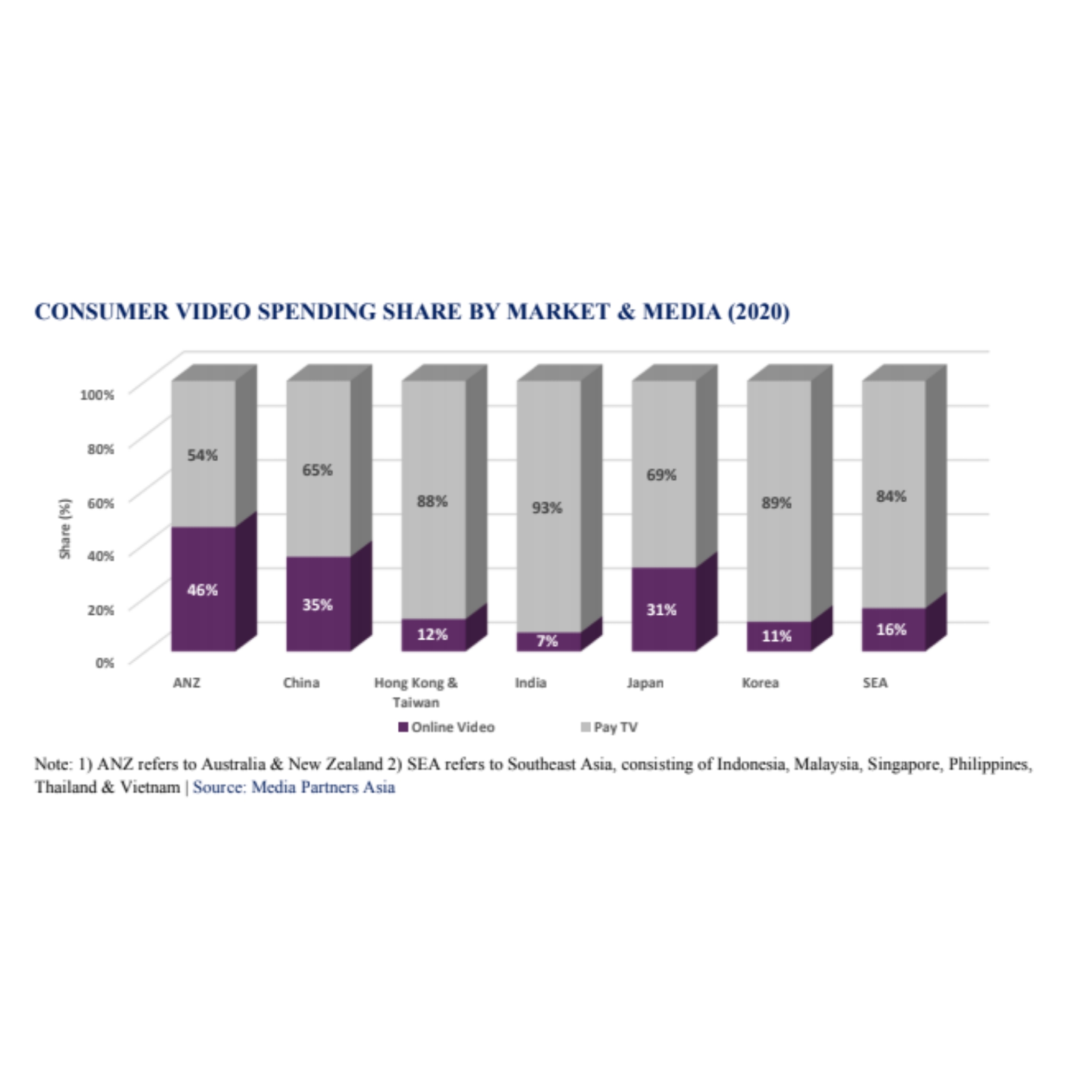
    The report projects growth to rise a further six per cent CAGR to $79.3 billion, led by the fast-expanding online SVoD sector. MPA forecasts that the online SVoD consumer spending revenue is likely to grow at 15 per cent CAGR over 2020-25 to reach $31.6 billion by 2025. This will represent a 40 per cent market share while consumer spends on pay-TV will grow at two per cent CAGR to reach $47.8 billion, representing a 60 per cent market share.

    The findings were released on the first day of MPA’s APOS Summit which was held virtually this year.

    All the markets increased spending on SVoD services with strong activity in peak pandemic periods during the first half of 2020, and robust spending in the second half of 2020 due to new launches from major players.

    China remains the largest market in APAC for consumer spending on video with $27.6 billion in revenue, led by SVoD and IPTV services. Japan comes in second with $9.2 billion with SVoD representing more than a third of consumer spend, while India is third with $6.5 billion with pay-TV contributing having greater than 90 per cent market share, it stated.

    Korea with $5.7 billion in revenue in 2020 and Australia with $2.9 billion remain formidable markets; Malaysia led southeast Asia with $962 million in revenue with pay-TV contributing more than 90 per cent of market share.

    “Consumer spending on entertainment and sports through video platforms was robust in 2020 due to growth of SVoD in a peak pandemic year along with new competition and consumer choice in many Asian markets,” said MPA executive director Vivek Couto. “

    While SVoD growth will decelerate in 2021, MPA sees "a bright future for the SVoD sector and the stacking of various services across sports, entertainment and deeply integrated local services.”

    According to Couto, China, Japan, India, and Korea will lead the way as the market for SVoD slowly deepens in the key markets across southeast Asia, led by Indonesia, the Philippines, and Thailand. Pay-TV will remain vital in Korea (led by IPTV), India, Malaysia, and the Philippines, he added.

  • The future belongs to creator-led franchises: James Murdoch

    The future belongs to creator-led franchises: James Murdoch

    New Delhi: Creator-led franchises will be more powerful and more profitable in the years to come if they can take a little more risk and own their IPs, said James Murdoch former chief executive officer of 21st Century Fox and now the founder & CEO of private holding company Lupa Systems.

    As the streaming war rages on, Murdoch said it will put a lot of pressure on the content creators, leading to a huge demand for their services in near future. “The real question is what the creative output is going to look like in these conglomerates. There will be more value for creators in the future, not just in terms of selling for a high price and on a work for hire basis,” he detailed while delivering the keynote address at the annual APOS conference which began virtually on Tuesday.

    According to Murdoch, author ownership will become common, as more creators would not want to sell their work forever and a day.

    Talking about the Indian market, he noted that while some multinationals may be frustrated by bureaucracy or having the wrong local partners, ultimately India is a transparent marketplace, not very top-down but driven by ideas and entrepreneurs, and a consumer economy that is going to grow for a long time.

    “I see a lot of opportunities there, especially when you get into towns and villages where distribution revolution is most profound. Digital connectivity will open vast opportunities for society, logistics, education and it is going to be exciting for entrepreneurs as well as customers if done right,” he said. “The broader media sector is continuing to grow, but it is going to be a chaotic and tumultuous few years in terms of how it shapes in India. There is cutthroat competition in down streaming, complexities of legacy distributions, it is a very disaggregated production environment. But it will be interesting.”

    The one-time scion exited his family's media empire to found his own holding company Lupa Systems in 2019. Early this year, he announced his new venture along with former chairman & CEO of Star India and president of Walt Disney Company Asia Pacific Uday Shankar, to explore technology and media opportunities in emerging markets.

    Highlighting how several big media companies have been seeking to scale to compete in the streaming environment, Murdoch said, the question is not if it's right to scale, but how many of these companies will be more profitable than they were in the past. “Avoiding the loss of value is great, but near survival does not create value. The downstream competition is going to be intense for a long time whether it's Amazon or Netflix. If you try to compete with the mass market, you have to have an amazing user experience and lots of good programming,” he added.

    On founding Lupa Systems in 2019, Murdoch said he wanted to explore areas of long-term consequences. “The more exciting opportunity was to do something entrepreneurial with a small team, but also focus on future questions, especially with all legacy businesses adopting digital,” he shared.

    Run by the regional consultancy Media Partners Asia, the three-day conference kicked off on Tuesday, with the keynote address by Murdoch. Asia's influential media and entertainment industry conference is traditionally organised in Indonesia, but is being held virtually this year due to pandemic restrictions.

  • Pay-TV revenue to grow at 7 per cent CAGR over 2020-25: MPA report

    Pay-TV revenue to grow at 7 per cent CAGR over 2020-25: MPA report

    New Delhi: India is among a handful of countries where there is great scope for further penetration of television. Since the turn of the millennium, pay-TV connections have more than doubled in Indian households, though data in the public domain indicates there still remain an additional 100 million homes to penetrate.

    Now, a new report published by Media Partners Asia (MPA) forecasts India’s pay-TV industry will grow at roughly seven per cent CAGR between 2020-25. The growth will be accompanied by a significant uptick in the total industry revenues, including subscription and advertising which will reach $12.3 billion by 2025, said the industry analysts.

    The report, entitled India Pay-TV Distribution 2021 released on Monday, predicts that more than 96 per cent of India’s pay-TV homes will be digitalised by 2025.  The total pay-TV subscribers will further expand from 127 million in 2020 to 134 million during the period.

    Distribution dynamics

    The MPA has pegged India’s active DTH homes to grow from 58 million in 2020 to more than 68 million in 2025. Meanwhile, cable’s share of pay-TV subscribers will decline from 54 per cent in 2020 to 46 per cent by 2025; IPTV will pick up a small share after rolling out later in 2021.

    MPA India vice president Mihir Shah said, “Robust backend systems, the ability to offer consumers flexibility in choosing channel packages under NTO and the exit of leading private channels from DD Free Dish helped the DTH pay-TV sector grow even after the new TRAI tariff regulations came into effect.”

    Going forward, DTH will be the key driver of growth fulfilling the needs of the majority of new TV households entering into the pay-TV ecosystem. “Premium cable subscribers in urban centers remain vulnerable to churn as uptake of quality fiber-based broadband services including IPTV grows in affluent pockets of urban India,” he added.

    Monetisation, investment and the outlook for broadcasters

    The total pay-TV industry revenue, including subscription and advertising, had declined 10 per cent year-on-year in 2020 to $8.9 billion as the economic downturn post-Covid eroded advertising. The projections show that the recommencing of fresh content and live sports together with improvements in consumer and economic sentiment will lead to a sharp recovery in 2021. Pay-TV advertising will grow at 12 per cent CAGR over 2020-25 after a 25 per cent contraction last year.

    During 2020, pay-TV broadcasters generated $4.4 billion in total revenue (62 per cent from advertising and 38 per cent from subscription), down 17 per cent year-on-year. A sharp recovery is expected over the next two fiscals with the channel business and advertising primarily driving this expansion.

    According to Shah, TRAI’s heavy spate of regulations in recent years depressed investment in pay-TV content, which could have a detrimental impact on the quality of content available for the mass market.

    “We expect that more consolidation will play out in the broadcasting industry as recent tariff amendments force incumbent broadcast networks to recalibrate existing channel portfolios. The economics of less popular channels and several niche channels are no longer viable. A new and less draconian regulatory framework will help revitalise content creation in the pay-TV industry while also helping to bolster pricing power for pay-TV platforms,” he stated.

  • Will going subscription-based improve news content on Indian television?

    Will going subscription-based improve news content on Indian television?

    NEW DELHI: As per a recent Media Partners Asia (MPA) report, India is going to be the most scalable pay-TV market in the APAC region, with a CAGR of 6 per cent, touching $15 billion by 2024. India will also contribute almost half of the net subscriber additions in the Asia Pacific over the next five years, it highlighted. The increase in consumer awareness, the choices they have, and growing disposable income are a few factors that are going to contribute to this. 

    More and more, Indian news channels are toying with the idea that if they go the subscription way, a course correction in terms of content they are serving will also happen. 

    Certain players like Times Network, Aaj Tak (SD), Zee News (SD), and News 18 Bihar Jharkhand have already made a successful transition from being FTA to pay-TV in the past few years, while still maintaining their viewership and ad revenues. And there are others who are willing to move to that model. 

    Times Network MD and CEO MK Anand also advocated the subscription-based model for news channels at the recent Indiantelevision.com News Television Summit.

    He had said, “When you go the subscription route, there is no need to be ratings-led. The current subscription numbers are 10X of what they were in 2014 when I joined the Times. We have to benchmark ourselves on net distribution income (NDI). When it comes to NDI, a news channel should look at the top of the population pyramid more.” 

    Anand had estimated that 54 per cent of the Times Network’s revenue in FY21 is going to come from subscription. “The total ratings-led business in our topline is less than 25 per cent. Earlier it used to be 90 per cent. Back then we didn’t have branded content or premium-led ground or digital business. Specifically, Times Now’s TRP-led business is less than 11 per cent of the total.”

    In a similar vein, ABP News Network CEO Avinash Pandey had shared in an earlier virtual fireside chat with Indiantelevision.com that he’s quite determined to make all the channels and websites in his network subscription-based – because anything free in this country is taken for granted. 

    “Our regional channels were already on a pay model. We only went FTA because of the uncertain environment caused by NTO 1.0. From a carriage perspective, NTO 2.0 is favourable. In today’s world when you have WhatsApp circulating all the videos you are likely to show in the evening and Twitter already debating views and counter views, before you discuss anything on TV it’s already discussed online. In this scenario, how to build a pay channel is the challenge,” he had remarked.

    Channels like BBC and CNN that have always been subscription-based also vouched for the success of the model, even from an advertising standpoint.

    BBC Global News MD – India and South Asia Rahul Sood noted that having more subscription-based news channels will move it to a point where the players will have to be conscious of which space they want to be in – serious, investigative journalism, or competing with TikTok and cat-and-mouse videos of Facebook. He insisted that going subscription-based will attract the niche audience, thereby helping the pricing. 

    However, the top marketing executives have mixed views on the pay-tv option for news improving editorial content. They were, however, more positive about the impact on ad revenues. 

    Wavemaker India chief client officer and head – west Shekhar Banerjee pointed out that merely shifting to a pay structure will not solve the content issue on TV news channels. He said, “We have seen such migrations in the past. While the subscription model brings in a bit of cushion for the business, the dependence of the channel on advertiser revenue still remains significant and so will be the pressure to top the viewership race. We will see a real impact in editorial content only when a news channel is brave enough to only earn from subscription and not chase popular journalism.”

    Dentsu International CEO – India Anand Bhadkamkar was a bit more optimistic on the impact of subscriptions on quality of content as he noted, “Yes, a course correction in the sort of content that we are seeing today will happen if more and more news channels start moving towards subscription-based entities. And the ad rates will also be reflective of that, considering bundled rates for websites and digital content. Also, it will provide a better return on investment to the advertisers as they will have more breadth to understand the sort of audience they will be getting.”

    As for advertising revenue, Pay channels are in a better position to demand a premium on ad rates because they will have the niche audience, who are also going to be better spenders, according to IdeateLabs MD Amit Tripathi.

    But does this entail that FTA channels will lose out on ad revenues? The industry doesn’t think so. 

    Bhadkamkar said, “I don’t think FTA channels will have anything to lose even if more channels start going subscription-based. The advertising revenues will still be dependent on the viewership that they are getting and if you see the likes of NDTV and Republic Bharat, they have really benefited from being FTA.”

    Hindi FTA news channels have enjoyed the privilege of quoting higher ad rates because the viewership is high there, Bhadkamkar observed. Meanwhile, it’s the opposite for English news channels. He insisted that it will depend upon the viewership in the future as well. 

    Tripathi also agreed with the sentiment, adding that the type of advertisers might see a little shift with more premium brands choosing to go for the subscription-based channels. However, the final trend will only be decided by viewership numbers as certain premium customers might still be watching FTA channels. 

    As advertisers and viewers alike repudiate toxic, tone-deaf content, the penny has finally dropped for news channels. They’ve realised it’s high time to switch gears and focus on editorial content, and whichever way they decide to go – whether pay or FTA – broadcasting responsibly should be their guiding principle from here on out; if news organisations serve the viewers (and not their own political agendas), they will come to the channels of their own volition.

  • MPA announces launch of APOS 2020 Virtual Series

    MPA announces launch of APOS 2020 Virtual Series

    MUMBAI: APOS, the defining voice and global platform for the Asia Pacific media, telecoms and entertainment industry, is shifting online in 2020 with two virtual editions on 21-23 July and 1-3 September 2020.

    Created and curated by Media Partners Asia (MPA), the APOS 2020 Virtual Series provides unparalleled conversations, insights and connectivity across global markets, uniting diverse industry leaders and players focused on addressing the challenges and future catalysts for growth and investment across media, entertainment, sports, telecoms and technology sectors. 

    “Bringing together TMT industry leaders across continents to provide strategic vision online with interactive and on-demand functionality, the APOS 2020 Virtual Series will be a definitive experience and knowledge platform, enabling key stakeholders to navigate the future of video globally with a special focus on Asia Pacific,” said MPA executive director Vivek Couto.

    KEY TOPICS

    Asia's Path to Recovery

    The world faces major economic challenges in the midst of the pandemic. What does the path to recovery look like and which countries have momentum as economic activity resumes? What policies need to be emphasized?

    Investment Dynamics

    With depressed valuations, markets are signalling downgraded views of profitability. How true is this narrative and what structural changes do key players need to embrace? How can consolidation across key verticals and geographies generate synergies and value? What are the potential sources of funding?

    Priming the Advertising Pump

    After more than three months of Covid2019-induced hibernation, brands and advertisers are re-engaging with consumers. What are the new priorities for marketers and advertisers? How are advertisers working with media owners to engage with audiences to accelerate growth?

    Rise of The Streaming Economy

    1H 2020 has witnessed unprecedented growth in online video consumption. Does this represent a fundamental change in behaviour or is it temporary? Has this accelerated OTT scalability? Will libraries be sufficiently deep and the consumer experience positive enough to retain users? What specific strategies need to be implemented to see that gains are expanded?

    The Future of TV

    With viewership higher than any time in recent history, traditional TV retains vitality. But ad revenues are shrinking and, in most markets, subscription revenues are under pressure as existing business models are stressed. How are key players managing the present and positioning themselves for the future?

    Connectivity and The Bundle

    The demand for broadband is stronger than ever. What are the implications for fibre broadband and 5G in emerging markets? What is the potential for new bundles and partnerships to meet consumer entertainment needs?

    Live Sport's Future

    With shortened or eliminated play seasons, dramatically reduced sports attendance, TV rights obligations under review, and pay-TV sports bundles under pressure, many issues are compressing professional league profits. How are leagues responding? Will an incremental bridge to next year surface or is a more radical approach required?

    Opportunities in Online Gaming

    A multibillion-dollar industry with its own ecosystem, from IP creation to distribution, has seen unprecedented demand over the last 6 months. What does the future roadmap look like for the online gaming ecosystem and which parts of the value chain will benefit most?

    The Creative Economy

    With unparalleled demand for video content and social distancing norms stressing traditional production processes, how are the current challenges for content creation being navigated and what is online video’s evolving impact on storytelling?

    Premium Video Advertising

    While consumption has spiked, low realization rates plague the sector. What are the strategies to fuel the growth of AVOD as global social video platforms, connected platforms and local broadcasters expand the digital video advertising pie?

    Theatrical Trends

    Theatres have been closed. Hollywood tentpoles delayed while other films go direct to VOD. Social distancing is the new normal. How are producers and exhibitors responding to this unprecedented environment?

    Phygitisation and the Video-First Future of E-commerce

    E-commerce is pervasive. Short video apps are starting to look more like commercials, but e-commerce apps may also have to become video apps as the lines between the two start to blur. In parallel, new hybrid ‘phygital’ models are developing in large scale emerging markets.

    CONFIRMED SPEAKERS

    Over two series (alphabetical company order): 

    .          Allen Lew, Chairman, AIS

    ·         Somchai Lerstutiwong, CEO, AIS

    ·         Mike Hopkins, SEVP, Amazon Prime Video and Amazon Studios 

    ·         Henry Tan, Group CEO, Astro

    ·         Nicholas Swierzy, Group Chief Strategy Officer, Axiata

    ·         Sunil Taldar, MD, Bharti Airtel DTH India 

    ·         Kishore Moorjani, Senior MD, Blackstone Group 

    ·         Kevin Mayer, CEO, TikTokand COO, ByteDance

    ·         Manuel Rougeron, EVP, APAC, Canal+

    ·         Peter Chernin, Founder and CEO, Chernin Entertainment

    ·         Jean-Briac (JB)Perrette, President and CEO, Discovery Networks International

    ·         Alvin Sariaatjama, CEO, Emtek

    ·         Ajit Mohan, CEO, Facebook India

    ·         Scott Lorson, CEO, Fetch TV

    ·         Patrick Delany, CEO, Foxtel

    ·         Ernest Cu, President, Globe Telecom

    ·         Ashutosh Srivastava, CEO, APAC, GroupM

    ·         Gong Yu, CEO, iQiyi

    ·         Xianghua Yang, SVP, iQiyiand President, Overseas Business Group, iQiyi

    ·         Joy Lee, CEO, Kakao Page 

    ·         Andy Kaplan, Co-Founder, KC Global Media Entertainment

    ·         Jae-Ho Song, EVP, Korea Telecom

    ·         Johannes Larcher, MD, Digital and VOD Websites, MBC

    ·         HaryTanoesoedibjo, CEO, MNC Group 

    ·         Michael Nathanson, Partner, Moffett Nathanson 

    ·         Vivek Couto, Executive Director and Co-Founder, MPA

    ·         Andre Kudelski, Chairman and CEO, Nagra

    ·         Juliet Dongwha Kim, Director, Business Development (Korea), Netflix

    ·         Hugh Marks, CEO, Nine Entertainment 

    ·         Patrick Tillieux, CEO, OSN

    ·         Janice Lee, MD, PCCW Media 

    ·         Alfred S. Panlilio, CEO, Smart and Chief Revenue Officer, PLDT

    ·         Joseph Ravitch, Co-Founder and Partner, Raine 

    ·         Arthur Lang, CEO, International, Singtel 

    ·         Jared Grusd, Chief Strategy Officer, Snap 

    ·         Nana Murugesan, MD, International Markets, Snap

    ·         Joonpyo (JP) Lee, CEO and Managing Partner, Softbank Asia Ventures

    ·         Soo Hugh, Executive Producer and Writer

    ·         Peter Kaliaropoulos, CEO, StarHub 

    ·         Maaz Sheikh, CEO and Co-Founder, Starz Play Arabia

    ·         Jinhee Choi, CEO, Studio Dragon 

    ·         Hyun Park, MD, Studio Dragon International

    ·         Abe Peled, Chairman, Synamedia

    ·         Jamie Lin, President, Taiwan Mobile

    ·         Harit Nagpal, CEO, Tata Sky 

    ·         Dan Brody, MD, International, Tencent Investments

    ·         David Goldstein, CEO, Towers AP

    ·         Afshin Mohebbi, Senior Advisor, TPG     

    ·         Robert Bakish, President and CEO, ViacomCBS 

    ·         David Lynn, President and CEO, ViacomCBS Networks International

    ·         Nancy Dubuc, CEO, Vice Media

    ·         Uday Shankar, President, The Walt Disney Company APAC and Chairman, Star and Disney India 

    ·         Gerhard Zeiler, CRO, WarnerMediaand President, WarnerMediaInternational Networks

    ·         Stephanie McMahon, CMO, WWE

    ·         Punit Goenka, CEO, Zee Entertainment

  • Disney+ Hotstar could garner 25% of total online video revenue pie by 2025

    Disney+ Hotstar could garner 25% of total online video revenue pie by 2025

    MUMBAI: Disney+ Hotstar could have 25 per cent of the total online video revenue pie by 2025, second only to YouTube, according to Media Partners Asia (MPA) projections for India’s online video sector.

    Such growth will be dependent on a number of key factors and growth levers, including:

    1.   The platform must sustain and accelerate the pace of its investment in product innovation, content creation and acquisition as well as retain its key sports rights in order to grow subscribers, drive viewership and stay ahead of aggressive global and local competition.

    2.   Develop new features and services including gaming & the aggregation of more local live and on-demand content as Disney+ Hotstar consolidates its position in the industry as the leading video platform for premium entertainment & sports.

    3.   Expand its technology and potentially brand to Southeast Asia, including large-scale emerging markets such as Indonesia and Thailand.

    Disney+ Hotstar could reach 93 million paying subscribers by 2025 at monthly ARPUs under US$1, as per MPA’s base case analysis. This equates to US$587 million in subscription revenue by 2025 while advertising sales could reach US$314 million. MPA’s advertising sales assumptions are volatile due to a challenging 2020 and the uncertainty on the sports calendar in the outer years over 2024-25. MPA analysis excludes any impact from new services such as gaming or expansion to Southeast Asia.

    Revenues will contract in 2020 because of the impact of Covid2019 on the advertising market with TV bearing the brunt while digital video will also come under pressure. Disney+ Hotstar’s advertisement packages are typically bundled with TV and this year is no exception.

    Meanwhile, subscription through 1H 2020 has benefited from the launch of Disney+ in April. Despite the absence of the popular IPL cricket tournament, Disney+ has contributed meaningfully to premium tier subscriber growth. As a result, the Disney+ Hotstar platform has remained churn positive through the 1H 2020 period, according to MPA analysis.

    Impact of Disney+ launch

    Disney+ arrived in India in March 2020 at a huge discount to its global price. Since launch, the service has seen traction across Disney+ Hotstar’s premium segment where Disney brand awareness (i.e. Marvel shows and movies) is high. In the larger, more mass VIP segment, there are caches of the Disney content (i.e. kids), which have found traction.

    Pricing strategy

    Pricing, content mix and tech are key pillars of the Disney+ Hotstar strategy. Pricing has been important given that India’s large pay-TV universe only pays US$4 per month for a wide range of live TV channels, including sports and entertainment. Low ARPUs do not justify shorter duration packs. Therefore, the key to creating an online subscription business at scale was always anchored towards annual offers at attractive rates, in line with Hotstar’s SVOD strategy prior to 2020.

    Netflix, for instance, has introduced a low-cost mobile pricing strategy to cater to the mass market, which has driven net additions since Q4 2020. MPA estimates that Netflix reached almost four million subscribers at end-April 2020 with significant growth across its mobile tier. Disney+ Hotstar’s major differentiation has been its vast aggregation of premium local and international entertainment and sports, driving its present-day addressable market to 100 million + subscribers.

    Quantifying Disney+ benefits. MPA estimates indicate that Disney+ is contributing 20 per cent to Hotstar’s premium subscribers in total with upside potential of 25-30 per cent. On the VIP side, the seeds are being sowed for a more bountiful harvest, but we estimate that Disney+ has already contributed to 20-30 per cent higher volumes. Last year in 1H 2019, Hotstar had launched its VIP service in conjunction with the IPL. This year, without IPL, bolstered by Disney+, new local originals (i.e. Special Ops), and a massive library of local & international content, Disney+ Hotstar remains churn positive.

    Marketing. In the absence of the IPL, marketing has been a challenge, especially because IPL has a reach of 400 million across TV and online (150 million alone on Hotstar on last year’s opening day). This year, Covid2019 has negated the impact of outdoor and print media. Digital platforms remain even more critical, and Disney+ Hotstar has relied heavily on digital marketing and Star’s own television network for targeted awareness building.

    Technology

    Hotstar’s tech and product has evolved considerably since its launch. Hotstar first launched in 2015 when it was owned by 21st Century Fox, a simpler time when online video only generated US$135 million in revenue and was almost entirely dominated by YouTube while the TV industry generated US$7.5 billion in revenue, including advertising and subscription. Today, internet video is on track to generate US$1.4 billion in India while TV is maturing at US$10 billion.

    Hotstar’s product tech was initially built to deliver professional, high-quality curated content at scale. Its first cricket broadcast of an India vs Pakistan cricket match in January 2015 generated five million CCUs. By 2019, cricket matches on Hotstar were generating CCUs of 25 million+. In addition, Hotstar originally had to contend with ubiquitous mobile phone distribution with different specs and varying quality along with data pricing. The latter was prohibitive back in 2015 though it has become more affordable now due to a Jio-led transformation.

    Subsequently, after Disney’s acquisition, Hotstar has grown personalization and search functionality as the platform has invested towards scaling its premium entertainment proposition. With the launch of Disney+, Hotstar has further retooled its platform UI and backend tech. Meanwhile, social media interactivity is growing on the platform across live sports and is set to be extended to entertainment soon.

  • Media Partners Asia: growth in video content  Investment across india, korea and southeast asia accelerates to 12% in 2018, up from 8% in 2017

    Media Partners Asia: growth in video content Investment across india, korea and southeast asia accelerates to 12% in 2018, up from 8% in 2017

    MUMBAI: Video content budgets across India, Korea and Southeast Asia climbed 12% in 2018 to reach ~US$10 bil., according to the latest edition of Asia Video Content Dynamics, published today by Media Partners Asia. Asia Video Content Dynamics tracks investment, production and consumption for TV, film and online video across India, Korea and Southeast Asia’s five biggest growth markets (Indonesia, Malaysia, the Philippines, Thailand and Vietnam).

    The 12% increase, up from 8% in 2017, highlights rising competition for audiences and production talent, especially in India and Korea, two of Asia’s most dynamic production and content hubs. Together, India and Korea accounted for more than 75% of video content spend across the report’s seven surveyed markets last year. 

    Of these, India was by far the biggest dynamo of growth with a 24% surge in video content spend in 2018 taking budgets up to US$3.6 bil. according to MPA estimates. This surge reflects a major outlay on premium sports rights in 2018, including a big price increase for IPL cricket, supported by continued growth and competition in TV, especially among regional languages outside the Hindi heartlands. Growth on TV entertainment is likely to soften in 2019, due to new regulations on channel pricing and bundling introduced earlier this year, although underlying trends remain strong.

    Video budgets in Korea expanded at a more modest but still respectable 7.2% to US$3.2 bil. in 2018, lifted up with increased investment on movies and pay-TV content in particular, characterized by rising film production costs and ever improving production values. Compared with India, there is more balanced competition between TV majors in Korea, helping foster creative diversity. Korea’s online video sector is underweight, due to a thriving TVOD market that captures a large slice of audience time and spend. Netflix is starting to drive growth in Korea’s online video sector however, with an eye on local, regional and global distribution.

    There are also notable pockets of growth for video content investment in Southeast Asia, especially in Indonesia, where budgets expanded 13% in 2018 to US$800 mil., and Vietnam, where investment grew 11% in 2018 to US$500 mil. The overall picture in Southeast Asia was more mixed, however. Video content costs in the Philippines fell 2.2% in 2018, reflecting declining audiences for free-to-air and pay-TV. There was minimal growth in Malaysia, as a result of revenue pressures for Media Prima, the free-to-air incumbent, and Astro, the country’s biggest broadcaster.

    Commenting on the findings from the report, MPA Vice President Stephen Laslocky said:

    “The outlook remains healthy across much of Asia for the video content industry, with aggregate budgets scaling up in TV, film and online video across our surveyed markets. Much of this growth came from India and Korea, two large production dynamos with deep pools of talent. There are pockets of pressure in other markets however, especially for incumbent free-to-air broadcasters in Malaysia and the Philippines, where TV budgets were reined in. Falls in TV viewership have been especially pronounced in Malaysia, Thailand and Vietnam, largely precipitated by digital competition as viewers flee marginal TV channels. Viewing data suggests that popular TV channels are relatively well insulated from online video competition, at least for now.” 

    Laslocky continued: “Meanwhile, investment in online video content continues to scale, up 60% in aggregate to reach US$858 mil. across the seven surveyed markets, powered by rapid growth in India, boosted by Amazon, Hotstar and Netflix in particular. Online video accounted for 14% of all video content spend in India last year, the highest proportion of all our surveyed markets. Growth in online video budgets is also accelerating from a low base across much of Southeast Asia, although investment remains underweight in Thailand and Vietnam. Online video budgets are also constrained in Korea, due to the popularity of VOD services from incumbent IPTV platforms.”

    A screenshot of a video game

Description automatically generated