Tag: media landscape

  • India Today Group sees revenue fall amid challenging market conditions

    India Today Group sees revenue fall amid challenging market conditions

    Mumbai: When a titan stumbles, the tremors are felt far beyond its own walls. Investor confidence wavers, markets shift uneasily, and a once-unshakeable reputation finds itself on thin ice. Such is the case for the India Today Group, which, in a jarring Q2 FY25 performance, posted steep declines in both revenue and profits. This downturn isn’t just a dip in the numbers; it’s a stark reminder that even the most formidable institutions can struggle against economic forces and the relentless pressure of an ever-changing media landscape. Despite efforts to trim costs and adapt, India Today’s latest results signal not progress, but troubling stagnation.

    For the quarter ending September 2024, the Group’s revenue plummeted to Rs 206.77 crores from Rs 311.79 crores in the preceding quarter, marking a sharp 33.7 per cent drop. This contraction becomes more severe when juxtaposed with the Rs 213.86 crores reported in the same quarter last year. Despite moderate operational adjustments, production costs grew by over 3 per cent, reaching Rs 24.35 crores compared to Rs 23.62 crores a year ago. Employee expenses also remained stubbornly high at Rs 81.41 crores, reflecting a challenging balance between workforce retention and profitability.

    Net profit for the quarter dwindled to Rs 8.35 crores, representing a staggering decline from Rs 51.43 crores reported in Q1 FY25. This downward spiral in profitability is exacerbated by a combination of rising costs and a limited revenue base, suggesting that the current strategic approach may lack the flexibility needed to weather industry-wide upheaval. Even more concerning is the dwindling cash flow, with net cash inflows from operations at a mere Rs 88.78 crores, down significantly from previous levels, limiting future investments and expansion.

    Television and media operations, traditionally a strong revenue stream, reported Rs 202.85 crores, down from Rs 309.22 crores in the previous quarter, reinforcing an overall industry-wide struggle to maintain viewership and advertiser interest. Radio broadcasting, a secondary but growing segment, failed to offset this decline, posting a minor increase to Rs 3.92 crores in Q2 FY25, underscoring limited diversification.

    While India Today Group continues to hold a respected position within the media industry, these financial indicators highlight urgent structural and strategic reevaluation. Moving forward, the Group must navigate the intricate dance of cost control and technological investments, all while addressing audience shifts in an age of digital-first content.

  • Interra Systems quality assurance tools aim to revolutionise OTT workflows

    Interra Systems quality assurance tools aim to revolutionise OTT workflows

    The Broadcast India Show’s opening day at the Jio World Convention Centre in Mumbai buzzed with excitement, as the broadcast media and infotainment sectors came together to celebrate innovation. In an industry where rapid technological advancements shape the future of content delivery, the event stands out as a rare opportunity to experience these cutting-edge developments firsthand. For more than 30 years, the Broadcast India Show has not only showcased groundbreaking advancements in infotainment technology but also fostered meaningful connections between attendees and the innovators driving these changes.

    In a rapidly evolving digital landscape, where quality control in broadcasting and streaming is becoming a cornerstone of content delivery, Interra Systems stands at the forefront. With a legacy spanning over two decades, the company has earned its stripes by championing the advancement of video and audio quality assurance. To dive deeper into their strategies and challenges, we sat down with Bibhas K Samanta, head of sales and presales for India & MENA at Interra Systems, to discuss how they navigate this dynamic industry.

    “We specialise in identifying what is inside the video quality,” Samanta begins, setting the stage for an in-depth look at the company’s unique approach. According to him, any entity utilising video or audio—from small cinema houses to large post-production studios—has a potential need for Interra’s products. Whether it’s a niche film production or a global OTT platform, video quality assurance is vital across the spectrum. “Everyone who is using any audio or video needs some quality checking tool, and they could be our potential clients.”

    Differentiating in a crowded market

    When asked how Interra’s offerings stand apart from other automated quality control (QC) systems, Samanta emphasises the company’s deep industry roots and technological capabilities. “Interra has been in the market for about 24 years,” he notes, “and if you talk about the highest number of quality checks, we are number one.” The company supports all major video and audio formats, with its solutions being deployed globally in over 700 client locations. This extensive experience allows them to understand and anticipate client needs accurately, offering superior performance and seamless workflow integration.

    Impact of shifting workflows

    The industry’s shift towards IP and OTT workflows presents both challenges and expanded opportunities. With the majority of traditional television channels migrating to OTT, Samanta sees an increased demand for quality assurance tools that can cater to both live and on-demand content. “For us, it is not really shrinking; it is rather an expanded opportunity,” he explains. As clients transition from file-based workflows to more dynamic OTT environments, the need for quality control solutions only intensifies, ensuring content meets audience expectations across various platforms.

    Addressing challenges in a competitive market

    Samanta acknowledges that while OTT offers immense potential, it is not without its hurdles. “In OTT, it is very difficult to make money,” he admits, citing intense competition for viewers’ attention and limited revenue models for smaller operators. This financial constraint creates a challenging sales environment for advanced technology solutions. To address this, Interra adapts its approach based on the client’s size and financial capabilities. “We work pretty much on a one-to-one basis,” Samanta says, providing tailored solutions that can grow alongside the client’s business.

    Staying ahead in an ever-changing industry

    As the media landscape evolves, staying updated on emerging technologies and trends is crucial. For Interra Systems, this involves a combination of close collaboration with clients and active participation in industry forums. “Whenever any new codec or decoder is getting developed, we are part of that,” says Samanta, underscoring the company’s commitment to innovation. This proactive approach ensures that their solutions are always at the cutting edge, meeting the demands of a rapidly changing market.

    Interra’s portfolio also includes ‘Vega’, a product widely used for developing new codecs and decoders. Through these innovations, the company works hand-in-hand with clients to co-create technologies that benefit both parties. “It’s a win-win situation for everyone,” Samanta concludes, reflecting the collaborative ethos that drives the company’s success.

  • RK Swamy Media Group releases ‘Media Pocketbook 2022’

    RK Swamy Media Group releases ‘Media Pocketbook 2022’

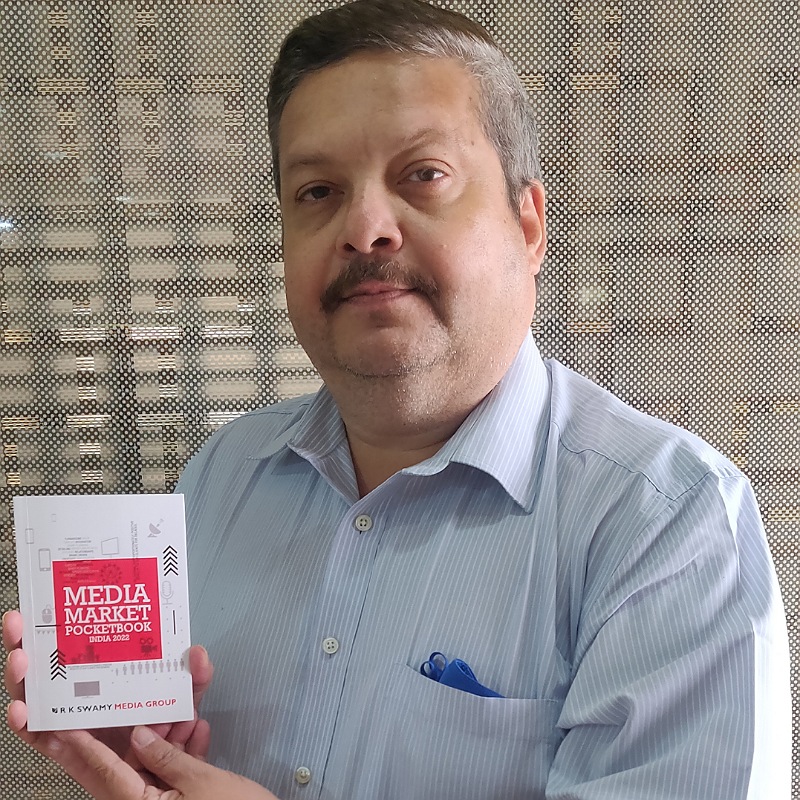
    Mumbai: RK Swamy Media Group has released its Media Pocketbook 2022, reflecting the changing media landscape post the Covid-19 pandemic. 

    The 13th edition of the pocketbook is a compilation of salient information on India’s ‘vast, complex, and evolving’ media landscape. “This pocketbook has been a ready reckoner for the marketing and media community for over a decade,” said the statement.

    “It’s been our endeavour to update this latest edition to reflect the changing media landscape post-Covid,” said RK Swamy Media Group president Sandeep Sharma. “Content truly became king and digital media equaled television. OTT came into its own during this period and connected TV and mobile have changed the way people consume content, movies, and music.”

    “Apart from conventional media, data has been included in the digital section on OTT, gaming, e-commerce, devices, app, updated and verified by our media experts with significant experience in their respective domains,” Sharma further said.