Tag: media coverage

  • Donald Trump secures historic return to White House as 47th president

    Donald Trump secures historic return to White House as 47th president

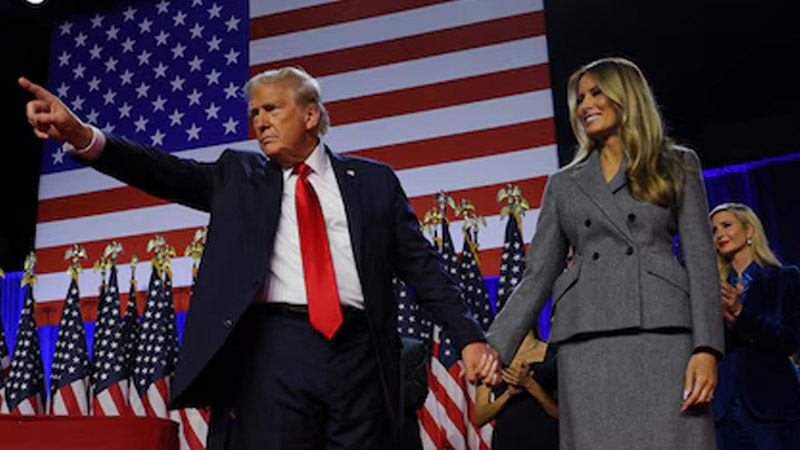
    Mumbai: “Sometimes by losing a battle, you find a new way to win the war,” Donald Trump once proclaimed. Today, that statement finds its proof in history as in a comeback that defies precedent and expectation, Trump has clinched the U.S. presidency for a historic second time, becoming the 47th president by defeating incumbent vice president Kamala Harris.

    Trump’s return to the White House, after a tumultuous single term, is more than a political triumph; it’s a testament to his unwavering grip on the American electorate. Amid a deeply polarised nation, Trump’s resurgence paints a vivid picture of ambition, resilience, and the fierce loyalty of his supporters, redefining what’s possible in American politics.

    Trump’s path to victory involved pivotal wins in key swing states. He secured Pennsylvania, Georgia, and Wisconsin, surpassing the requisite 270 electoral votes.   These victories reflect his campaign’s effective mobilisation of his base and successful outreach to undecided voters in these regions.

    The international community has responded with a mix of congratulations and caution. Israeli Prime Minister Benjamin Netanyahu extended his congratulations, while European leaders expressed concerns about potential shifts in U.S. foreign policy. Indian prime minister Narendra Modi tweeted, “Congratulations to my friend Donald Trump on his historic election victory. Looking forward to working together for global peace and prosperity.”  

    Financial markets reacted swiftly to the election outcome. The Indian stock market experienced a rally, with the BSE Sensex closing up by 1.13 per cent, and the Nifty rising by 1.12 per cent. Conversely, the Indian rupee depreciated to an all-time low against the U.S. dollar, reflecting investor uncertainty.

    Major U.S. media outlets have portrayed Trump’s victory through various lenses. The New York Times highlighted his ability to tap into voter economic anxieties and concerns over immigration, while The Washington Post emphasised the historic nature of his nonconsecutive terms and his status as the first felon to assume the presidency.

    In India, the ancestral village of Kamala Harris in Tamil Nadu expressed sorrow over her defeat, with residents acknowledging her fighting spirit and expressing hope for her future endeavours.

    Trump’s return to power is expected to bring significant policy shifts, particularly in trade and foreign relations. He has previously criticised China’s trade practices and indicated intentions to implement stricter measures.  Domestically, his administration is anticipated to focus on immigration reform and economic policies aimed at bolstering the working class.


  • India Today teams up with Amazon Alexa for UP elections coverage

    India Today teams up with Amazon Alexa for UP elections coverage

    Mumbai: Fight for political supremacy in the Hindi heartland of Uttar Pradesh is one of the most anticipated events in India’s political calendar. With all eyes glued to this political fervour unfolding ahead of the counting day, India Today has joined hands with Amazon Alexa to deliver election broadcast in the digital arena.

    The alliance puts the focus on delivering insightful analysis and updates through three special episodes of flagship show called “Trigger Point” hosted by Preeti Chaudhary.

    “As the seven phases of polling nearly comes to an end and exit polls being around the corner, this unique content partnership comes at the crucial juncture in the most anticipated political festival of Hindi speaking belt of India – Uttar Pradesh elections,” said the broadcaster in a statement.

  • Cable TV digitisation: Parliamentary standing committee meets TV trade in Mumbai

    Cable TV digitisation: Parliamentary standing committee meets TV trade in Mumbai

    MUMBAI: There’s been a lot of press and media coverage about the process of cable TV digitisation over the past year or so. Most of it stated has been a mixed bag with opinions about its progress swinging from disastrous to a fabulous rollout. Hence, the political class decided to find out on their own what digitisation has meant for the industry.


    The parliamentary standing committee on information technology – headed by Rao Bhirendra Singh – has been making a whistle stop tour of different regions where digitisation has been implemented. 22 October 2013 saw it landing in Mumbai. Prior to this, it has had stopovers in Rajkot and Ahmedabad as well.


    The various constituents of the TV ecosystem were summoned to update the committee on the pace of digitisation and their individual specific concerns. “Phase I and II have been completed,” says a government representative. “The committee wanted to be apprised of the learnings from the first two phases by the various players and their preparedness for the next round of digitisation which is slated to be completed by December 2014.”


    Each of the players had meetings in camera with the committee and presented their positions. First, the last mile cable operators (LCOs) or last mile operators (LMOs). The Maharashtra Cable Operators Association (MCOF) and Cable Operators and Distributors Association (CODA) represented the LMOs and spoke about the issues faced by them.


    Among the concerns they raised were the fact that they had put in physical labour repeatedly during the process of delivering and installing set top boxes. They stated that it is the LCO which bears the brunt of the cable TV viewer’s ire when channels are switched off by the MSOs. But they were optimisitic about their role in phase III and phase IV.


    “Our representatives said that we want to be active players in these phases and we are happy to know that the government seems to be intent on having a clear way forward,” says a cable TV operator.


    The main bugbear raised by the national and local MSOs – Hathway, DEN, Siti Cable and InCable, apart from others – was the issue of entertainment tax. (Maharashtra and Uttar Pradesh have the highest rates.) Their demand: that the LMOs should be made responsible for collecting and paying this levy. Earlier, in the analogue regime, it was the MSOs who had to carry the burden and it is crippling them.


    Says an executive from a leading MSO: “Once the billing system is in place in a digitised India, LCOs can collect the tax and pay it and give the remainder amount to MSOs.”


    However, an LMO says a better option would be “splitting of bills between MSO and LMO and LMO to subscriber to avoid double taxation for the TV subscriber.”


    Broadcasters and aggregators – represented by the  NBA (News Broadcasters Association), a representative from Sony Entertainment Television, Indiacast, MediaPro and TheOneAlliance. The aggregators strangely stayed mum, while broadcasters harped on the usual complaints of carriage fees, lack of subscription revenues and the heavy dependence on advertising. The conversation also drifted to talks about content on television and how channels need to be careful about their content. “This is a major issue as there is no clarity about how the viewer and broadcaster are going to get value out of digitisation. If there is no elbow room for channelising of money for broadcasters then how are they going to focus on better content,” says a broadcasting industry representative.


    More such meetings are being planned according to industry sources. “Finally, we will prepare a report and submit it to the parliament for review,” says a source close to the committee.


    Hopefully, their reports and inputs will make things easier for all concerned as India’s cable TV ecosystem gears up for its most challenging phase – that of rolling out almost 80 million boxes in small towns and rural India.
    (Inputs from Meghna Sharma and Seema Singh)