Tag: media and entertainment

  • TRAI: 35 companies control 243 operational FM channels, seven control 169

    TRAI: 35 companies control 243 operational FM channels, seven control 169

    New Delhi: Reliance Broadcast Network Ltd holds the largest number of FM radio channels with 45 Big FM channels in various cities.

    Figures released by the Telecom Regulatory Authority of India as part of its consultation paper on ‘Issues related to Radio Audience Measurement and Ratings in India’ shows that seven companies hold the largest number of FM channels (169) of the 243 channels currently operational after Phase II.

    Entertainment Network India Ltd through Radio Mirchi holds 36; South Asia FM Ltd through S FM has 23; Kal Radio Pvt. Ltd with S FM has 18; Music Broadcast Pvt. Ltd has 20 Radio City channels; D B Corp Ltd has 17 My FM channels; and BAG Information P Ltd runs ten Radio Dhamaal channels.A total of 28 companies run the remaining 74 FM channels in various parts of the country.

    Radio broadcasting services were opened to private sector in 2000 when the Government auctioned 108 FM radio channels in the VHF band (88 –108 MHz) in 40 cities in Phase-I of FM Radio. Out of these, only 21 FM radio channels became operational and subsequently migrated to Phase-II in 2005. In Phase-II of FM Radio, a total of 337 channels were put on bid across 91 cities having population equal to or more than 300,000. Of 337 channels, 222 channels became operational. At present, 243 FM Radio channels are operational in 86 cities.

    Phase-III auctions have begun to enable setting up of private FM Radio channels in all cities with a population of more than 100,000. As part of this Phase, auctions were done for 135 FM Radio channels in 69 cities where at least one channel of FM radio is already operational. Out of these, 91 FM Radio channels in 54 cities have been successfully auctioned.

    A total of 831 more FM Radio channels will be put up for auction in 264 new cities under FM radio Phase-III in addition to remaining channels of 135 FM radio channels put for auction recently.

    Terrestrial radio broadcasting which includes FM is a free-to-air service. A consumer can simply procure radio receiver equipment and tune into various radio channels available in that region. The business model of radio broadcasting service is based on advertisement revenue. Radio broadcasters are permitted to air commercials during their programme.

    The revenue of radio broadcasting sector in 2014 was Rs 1720 crore, with a year-on year increase of 18 per cent from 2013 to 2014, driven by increasing popularity of radio in smaller towns and cities. The radio broadcasting sector revenues are expected to grow at a CAGR of 18 per cent to reach Rs. 3950 crore by 2019.

    The total advertisement revenue of Media and Entertainment (M&E) industry was Rs. 41,400 crore in 2014, contributing approximately 31 per cent to the total M&E revenues. The advertisement revenue is expected to grow at a CAGR of 14.5 per cent to reach Rs 81,600 crore by 2019. Presently television and print media sectors corner the maximum advertisement revenue (approximately 80 per cent of the total revenues) spend in India. Though the radio broadcasting sector presently accounted for only 4 per cent of total advertisement revenue in 20143, it is however expected to garner 5 per cent of the total advertisement revenues by 2019.


  • TRAI: 35 companies control 243 operational FM channels, seven control 169

    TRAI: 35 companies control 243 operational FM channels, seven control 169

    New Delhi: Reliance Broadcast Network Ltd holds the largest number of FM radio channels with 45 Big FM channels in various cities.

    Figures released by the Telecom Regulatory Authority of India as part of its consultation paper on ‘Issues related to Radio Audience Measurement and Ratings in India’ shows that seven companies hold the largest number of FM channels (169) of the 243 channels currently operational after Phase II.

    Entertainment Network India Ltd through Radio Mirchi holds 36; South Asia FM Ltd through S FM has 23; Kal Radio Pvt. Ltd with S FM has 18; Music Broadcast Pvt. Ltd has 20 Radio City channels; D B Corp Ltd has 17 My FM channels; and BAG Information P Ltd runs ten Radio Dhamaal channels.A total of 28 companies run the remaining 74 FM channels in various parts of the country.

    Radio broadcasting services were opened to private sector in 2000 when the Government auctioned 108 FM radio channels in the VHF band (88 –108 MHz) in 40 cities in Phase-I of FM Radio. Out of these, only 21 FM radio channels became operational and subsequently migrated to Phase-II in 2005. In Phase-II of FM Radio, a total of 337 channels were put on bid across 91 cities having population equal to or more than 300,000. Of 337 channels, 222 channels became operational. At present, 243 FM Radio channels are operational in 86 cities.

    Phase-III auctions have begun to enable setting up of private FM Radio channels in all cities with a population of more than 100,000. As part of this Phase, auctions were done for 135 FM Radio channels in 69 cities where at least one channel of FM radio is already operational. Out of these, 91 FM Radio channels in 54 cities have been successfully auctioned.

    A total of 831 more FM Radio channels will be put up for auction in 264 new cities under FM radio Phase-III in addition to remaining channels of 135 FM radio channels put for auction recently.

    Terrestrial radio broadcasting which includes FM is a free-to-air service. A consumer can simply procure radio receiver equipment and tune into various radio channels available in that region. The business model of radio broadcasting service is based on advertisement revenue. Radio broadcasters are permitted to air commercials during their programme.

    The revenue of radio broadcasting sector in 2014 was Rs 1720 crore, with a year-on year increase of 18 per cent from 2013 to 2014, driven by increasing popularity of radio in smaller towns and cities. The radio broadcasting sector revenues are expected to grow at a CAGR of 18 per cent to reach Rs. 3950 crore by 2019.

    The total advertisement revenue of Media and Entertainment (M&E) industry was Rs. 41,400 crore in 2014, contributing approximately 31 per cent to the total M&E revenues. The advertisement revenue is expected to grow at a CAGR of 14.5 per cent to reach Rs 81,600 crore by 2019. Presently television and print media sectors corner the maximum advertisement revenue (approximately 80 per cent of the total revenues) spend in India. Though the radio broadcasting sector presently accounted for only 4 per cent of total advertisement revenue in 20143, it is however expected to garner 5 per cent of the total advertisement revenues by 2019.
  • Big Picture round up: Best time for M&E even as clear policies needed for TV & films

    Big Picture round up: Best time for M&E even as clear policies needed for TV & films

    NEW DELHI: This is perhaps the best time for the media and entertainment (M&E) industry as the sector is being seen for the first time as an exporter and major source of foreign investment.


    This was the general impression at various sessions of the Big Picture summit organised by the Confederation of Indian Industry (CII), where speakers also said that the promulgation of goods and services tax would be a great help.


    However, problems were raised about shortage of screens for the film sector and state governments and the centre were asked to offer whatever help they could to overcome this.


    Even as they were assured by Finance Ministry officials that the GST would be an anathema to their woes, the sector – particularly the film sector – appeared skeptic as it had to content with other problems such as piracy, shortage of screens and a lack of good content writers.


    In the session on Taxing Times for M&E at which Revenue Special Secretary Rashmi Verma and Member Service Tax and GST V S Krishnan sought to allay fears, Film Federation of India vice president Ravi Kottarakara said the film industry had at one time been the most powerful entertainment medium but had now lost its power despite making more than a thousand films in different languages every year. He said this was because the success rate was just five per cent and the competition from other screens had increased apart from the malaise of piracy and multiple taxation.


    The session was moderated by Network 18 advisor to the chairman A P Parigi. 


    Kottarakara said people tended to forget that 95 per cent of the films failed at the box office and lost money and only remembered films, which had created records. The share of the film industry in M&E has fallen from 60 per cent to 13 per cent, he said.


    He also regretted that the film industry was at a crossroads since development in other sectors was at the cost of the film industry and so it was going through one of its worst phases despite going global. In the mind of the government, cinema was akin to sins like lotteries or liquor. Even in Delhi, cinema houses came under the Shops and Establishments Act and not as an art.


    Even banks were wary of financing films and the filmmakers had to struggle for finance.


    Kottarakara described GST as a double-edged sword and said that assurance was needed that the states would not interfere once the new tax regime came in.


    Hinduja Ventures whole time director Ashok Mansukhani said that the media industry exists only on passion. He wondered why service tax was levied on this industry when it was entertaining people and said this appeared unrealistic.


    He said that the first multi system operator (MSO) had come in 1965 and taxes came in much later when the government found a new source of earning money.


    It was also unrealistic of the government to have digitised 30 million cable television homes in the last two years and was expecting to digitise 70 million homes in less than 15 months. “No other country has ever been able to do this,” Mansukhani said.


    Mansukhani wanted GST to be transparent and urged the government to clear transitional problems. “At present there are 24 types of VAT in the country,” he informed.


    Ernst and Young partner and markets leader Farokh Balsara called for a speedier decision on greater foreign direct investment (FDI).


    Zee Network’s legal expert Avnindra Mohan wanted to know if television was considered a media or a goods industry, considering the way it was treated. “The television industry needs equity and fairness, clarity, and a help in development. But all these are missing,” he lamented.


    As an example, Mohan said 50 per cent went into taxes in the direct to home (DTH) industry, 40 per cent into licence fee and only 10 per cent came to the operator.


    In comparison, the session on Increasing Exports was more positive as most speakers felt that this was the best time for the industry as the government was looking towards it as an exporter and foreign export earner.


    Viacom 18 executive vice president Ferzad Palia said Indian television serials had ample scope to travel overseas but were not available in as many as 140 countries.


    Motion Pictures Distribution MD Uday Singh was of the opinion that something had to be done about the low screen density in the country. However, he noted the growth in mobiles and said OTT will spur this growth.


    Wizcraft founder Sabbas Joseph said despite his experience of the International Indian Film Academy (IIFA) Awards, he had realised there were some success stories of Indian artistes overseas but no picture of a unified M&E industry. “There is a need for deep introspection and the dependence on the government is a mistake,” he voiced.


    In a third session on regional cinema conducted by Delhi film critic Shubhra Gupta, the filmmakers were unanimous that regional cinema contained the heart and soul of the country’s culture but that Doordarshan and other channels failed to encourage this.


    Ashoke Vishwanathan of Kolkata said cinema had gone global but had not reached other parts of the country. He wanted an educated National Film Policy. He was seconded by Kannada filmmaker P Seshadhri who said filmmakers had to act as entrepreneurs since there were few distributors for takers of serious regional cinema.


    Assam State Film Finance and Development Corporation chairperson Bobbeeta Sharma said the state government was now helping the industry in the state. She wondered why Doordarshan was not lending a helping hand.


    Drishyam Films CEO Shiladitya Bora related how the attempt was to depend less on the large screen and so made films that appealed to all kinds of audiences. 

  • MoF assures that GST will be a game changer for M&E and subsume service tax, entertainment tax & VAT

    MoF assures that GST will be a game changer for M&E and subsume service tax, entertainment tax & VAT

    NEW DELHI: In a major relief to the media and entertainment industry, two senior officials of the Finance Ministry assured the captains of the sector that VAT, service tax and entertainment tax would be subsumed in the proposed Goods and Services Tax.


    Terming GST as a game changer, Revenue Special Secretary Rashmi Verma said the rate was being worked out but she reiterated that it would be one and uniform for the entire country.


    Member Service Tax and GST V S Krishnan added that Infosys had been given the task of creating a special portal for GST collections and the progress was good.


    He said that three processes under way were in the public domain and the stakeholders and citizens could react. As all these were drafts, changes could still be made.


    These were the rate of taxation, the law relating to GST, and the technology. The fourth relating to returns would be put in the public domain today itself. Technology  was being taken care of by Infosys.


    He added that after GST came and the government got time to review its progress, it could be improved over time.


    They were responding to remarks made by some industry leaders on the second and final day of the two-day Big Picture summit organized by the Confederation of Indian Industry.


    Sector representatives included Farokh Balsara of Ernst and Young, Film Federation of India Vice President Ravi Kottarakara, Hinduja Ventures whole time Director Ashok Mansukhani and Zee Network’s legal expert Avnindra Mohan. A P Parigi, advisor to the Chairman of Network 18 moderated the session.


    Verma added that the problem of share of centre and states would be sorted out by the Ministry and need not worry the M and E industry which will just have to pay a single tax.


    There will be slabs, but that would be restricted to just two – higher and lower, she added.


    She said bringing the Centre and 29 states on one table had been difficult but most problems had been ironed out.


    The work of the portion of the state was being worked out but the citizens need have no doubt that he will have to pay just one tax. For the citizen, the apportioning was only of academic interest.


    She said there may be some tax levied by some local bodies in some states, but this would be between half per cent to two per cent. While ways were also being found to sort out this problem, it was clear that this would only relate to the manufacturing industry.


    She also clarified that the GST would apply both to services and goods.


    The M and E industry would benefit as the multiplicity of taxation would vanish.


    The entire information will be out on a GST portal by the third week of November, she said. The transitional problems were being worked out, she added.


    Answering a point made by one of the earlier speakers who asked whether the M &  E sector was being treated at par with sinful industries, she said this was not so. The only sinful industries for the Government were cigarettes and alcohol.


    Parigi suggested creation of a separate secretariat with representatives of industry and bodies like the CII. 

  • M&E cos plead government for rationality in taxation

    M&E cos plead government for rationality in taxation

    MUMBAI: The Media and Entertainment (M&E) sector is one of the most highly taxed sectors in India. The rollout of the proposed GST (Goods and Service Tax) is expected to be a major game changer as it will simplify the tax regime by combining a multitude of national, state and local taxes. However, whether it will ease the M&E sector’s tax burden or not, remains to be seen.


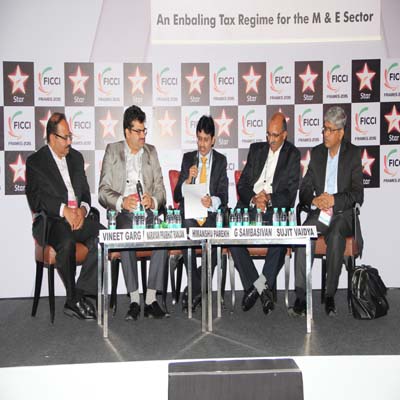
    A detailed panel discussion on the same was held in FICCI Frames moderated by KPMG executive director Himanshu Parekh with Viacom 18 CFO Narayan Prabhat Ranjan, Disney UTV CFO Sujit Vaidya, Tata Sky CFO G Sambasivan and Hathway Datacom deputy CFO Vineet Garg on the panel.


    The financial officers put up the issue of multiple taxation policy in India and inconsistency of the government, which makes scenario less business friendly. Other major issues bothering industry is lack of clarification and the biggest sufferer of that is consumer. Speaking on what the government should do, Ranjan said, “Whenever an amalgamation takes place and there is a loss, the carry forward of losses is allowed and that is something that the government should address with immediate effect. Moreover the issue of service tax VAT and excise duties should also be paid attention at. Why should one product be taxed numerous occasions with various nomenclatures?”


    Echoing Ranjan’s point of view, Vaidya added, “In other countries, if a consumer pays 100, 50 is devoted to the content. Whereas in India, due to the multiple taxation system, only 30 per cent is devoted to content. Service tax has been another pain point and entertainment tax, which varies from state to state and ranged anywhere between 10 to 40 per cent approximately is something government should look after.”


    The government in numerous occasions came on record and accepted the irregularities when it comes to taxation and GST has been portrayed as a solution. But again GST is also in experimentation stage and concrete figures are yet to be displayed in public forum. Sambasivan asserted, “Things which we expected to change did not change and there is no reason to be buoyed by GST. There is no clarity on whether entertainment tax will be subsumed or not. There is a cap of 16 – 27 per cent between which the tax will fluctuate and hence no matter how much ever we plead for a rational uniform policy, nothing of that sort comes out. Now we get 30 when someone spends 100 and if this phenomenon keeps sustaining then share holders will stop putting money as all expect high return.”


    “With digitization phase III and IV to follow, the opportunity of growth increases but at the same time there is a huge requirement of a consistent regulatory body, which has the intention to make scenarios business friendly. All the time we are suppose to devote on improvising and innovating our business model we are devoting on managing tax complacencies. AOP is an unnecessary hassle and hugely unwanted, my request to the government is to come to a consensus and make rational policy which is a win win for both the parties” concluded Garg.

  • I&B Ministry open to discussion with M&E sector: Rajyavardhan Singh Rathore

    I&B Ministry open to discussion with M&E sector: Rajyavardhan Singh Rathore

    MUMBAI: The India media and entertainment (M&E) sector is undergoing rapid changes and has huge potential to take its content across the globe. However, in order to achieve this, the sector will need the support of the Information and Broadcasting (I&B) Ministry.


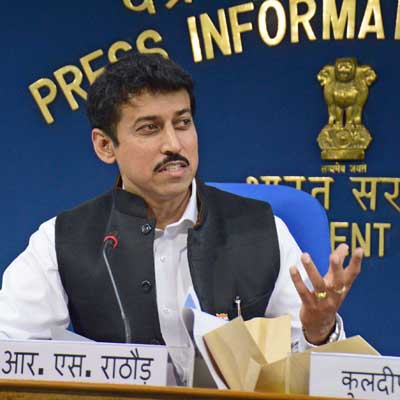
    “The country has the power to become a super power in M&E and as government, we want to interact with the different sectors in the M&E industry. We want to hear about the bottlenecks and the suggestions. We are keen to iron them out to do business,” said Minister of State Information & Broadcasting Rajyavardhan Singh Rathore.


    Rathore, who was talking at the just concluded FICCI Frames 2015, said that the Indian M&E sector had the ability to reach out to the world. “India is poised to be a global phenomena. We just need to come up with content that can create a foothold in any country,” said Rathore.


    He added that Indian content can be targeted at larger audiences and not just the Indian diaspora. “This we can learn from the US, which has been able to push across its culture across boundaries,” he said.


    The I&B Ministry, under the aegis of Prime Minister Narendra Modi’s government, has been working hard towards improving the media unit. “The Prime Minister has been able to popularize radio, which is now expanding. In a year or so, close to 800-900 cities will have either one or multiple FM Radio stations,” he informed.


    Talking about film certification, Rathore said that the Central Board of Film Certification (CBFC) has be a certification board and not censorship body. “They need to give certification based on content,” he said, adding that the Ministry has decided to have a re-look at the Cinematography Act.


    The Ministry is also looking at improving the Film and Television Institute of India (FTII). “Script is important for any movie and that is what is currently lacking. There is no structure. This facility needs to be improved. Film and TV industry should partner with FTII,” he said.


    Talking about the other initiatives, which the Ministry is undertaking, Rathore said that a National Centre of Excellence for the Animation, Visual, Gaming and Comic (AVGC) is being set up. “We want this centre to be a benchmark for all centres that come later. But to do this, the government will need the support of the industry. It is the industry, which can give life to this project. Become a partner with us,” urged Rathore.


    The MoS is of the view that the country’s culture can be promoted though the films. “The content that is being put out should carry our culture,” he said.


    Speaking on how the M&E sector could become a ‘Soft Power’ of the 21st century, Rathore said, “Currently, the M&E sector is working on individual efforts. We need to join forces and interact more to understand the strengths and move in a certain direction.”


    Rathore concluded by assuring the sector that the Ministry will, with open arms, help the M&E sector grow. “We need to develop a degree of trust to grow,” he concluded.


  • Entertainment industry needs a reality check in terms of economics: Venkatesh Roddam

    Entertainment industry needs a reality check in terms of economics: Venkatesh Roddam

    MUMBAI: Media and entertainment firm (known for its post production and VFX capabilities)  Reliance MediaWorks (RMW) CEO Venkatesh Roddam met us at the recently concluded FICCI Frames 2014. The man, who exuded a lot of positivity in his conversation infused with humour, seemed to be quite upbeat about the feat the company has just achieved of providing post production services to 400 Indian films so far.


    By the end of 2011, the number was 110. Roddam doesn’t think the meteoric rise is because of him. Roddam, who became RMW CEO in 2011, feels its growth is a result of the inclusive structure that it has in place. With enough humility, he confesses that while he takes all the money and business related decisions, it’s the team that keeps RMWL ticking.  “If you ask me specific questions, you will normally find me at a loss for answers,” he professes as he introduces Nishit Shetty, the company’s vice-president, operations who has a handle on what’s going on day to day.


    However, taking the conversation forward, he says, “In the entertainment business, creativity is just one part; it has to be backed by economics.” He puts forward an interesting example of Life of Pi. “Even as Rhythm & Hues the company was bagging a visual effects Oscar for it, its founders had decided to go ahead with a bankruptcy filing,” he says.  “That is not something that should happen. And at the end of the day the purpose of the business is to make money. The industry globally needs to have a reality check about the economics. ”


    Nishit decides to dive into the conversation as he talks about the VFX studio’s initial foray into post-production in 2008 with the film Sarkar Raj. “It was a gradual process. We were taking up projects slowly,” says Nishit. RMW has worked on visual effects for several international and domestic films. Transformers 3 – The dark of the Moon, Conan the Barbarian, Expendables 2, GI Joe Retaliation, Chennai Express, Queen, and many southern and Bengali films figure on its slate. In fact, in the time to come the company is looking to tap the regional film industry even more.


    Also, now Nishit says that RMW is reaching out to a new constituency: that of smaller film production houses and independent filmmakers. “There’s a lot of business potential in that segment as a lot of new filmmakers are coming up with great ideas and need better presentation,” he reveals.


    “At RMW we have always believed in adding value to the film making process by keeping up to date with the latest technology and techniques which has worked in our favour,” highlights Roddam.


    RMW is looking at expanding its Big Cinemas theatrical exhibition chain.  “So say, if right now we have 260 total screens, we may increase that by around 50 more in the next 12 to 18 months,” he says.


    “Our operating margins have continuously increased over the years. We have a distinct advantage of having a presence of screens both in semi-urban and semi-rural areas. We will continue to expand this year to offer an experience like none other to our patrons while at the same time keeping an eye for growth coupled with good profits,” remarks Roddam, adding that it doesn’t want to offer just a good cinema viewing experience to its patrons “but a holistic one with a strong focus on retail, food and beverage, gaming amongst others”.


    Another big development is the building up of studios (shooting floors) at the Film City in Mumbai. The company already has two fully functional studios there since the last two years, now Roddam informs that a major studio was commissioned this month which is positioned as the “largest studio in Asia” and four other stages are to be commissioned by the end of May.


    The company is also looking to expand its TV production wing – Big Synergy which is headed by the legendary Siddharth Basu – with path-breaking non-fiction programming. However, Roddam wants to keep the details for another conversation.

  • New technology to fuel the revenue growth for broadcasters in 2014

    New technology to fuel the revenue growth for broadcasters in 2014

    NEW DELHI: GAIAN Solutions India, a leading Technology and Consulting company that develops products and solutions for the Media and Entertainment industry, launches MAYA Platform for Satellite Broadcasters.


    The LIVE Demo of ‘Maya Platform’ can be viewed between 21st to 23rd January at  ‘Gaia TV’ Stall No.C-183, Upper Floor, Hall No. 18, Convergence India 2014, PragatiMadian, New Delhi.


    Intoday’s fierce and highly competitive broadcasting environment, sole revenue generating models of straight jacket spot selling are fast becoming redundant.


    A highly fragmented audience and an emerging class of smart advertisers exposed to the world of internet/world wide web are craving for a similar experience on TV as well since it’s the biggest screen in any household. This has made the industry look for a solution enabling localized content distribution and alternate possibilities of targeted advertising to create value for both broadcasters and advertisers.


    Addressing this need ofthe industry, Maya platform by Gaian Solutions is a technology that offers exciting real time localized cloud content services thus offering powerful tools to enhance Broadcasters programming content. This is done by delivering different broadcast content (Programs, Overlays, Advertisements, etc.) simultaneously across different locations at the same time. It has potential to change Satellite Broadcasters revenues by orders of magnitude.


    Chandra Kotaru, President and CEO – Gaian Solutions said “From the outsetwe have set the bar for technological innovation in digital TV, achieving an unrivalled array of industry firsts.Another such innovationMayais a breakthrough solution which has phenomenal potential to grow Indian TV industry by magnitude and it will increase value for all stake holders of Indian TV Broadcast ecosystem.”


    The Maya platform offers six never-before seen solutions to the challenges and opportunities facing today’s broadcasters.


    1. IP Free Edge Insertion: Maya’s localization technology integrates internet feeds and cloud content delivery mechanisms right into the uplink broadcast eliminating the need for internet connectivity at the edge devices. This liberates broadcasters from any kind of ecosystem challenges in commercializing localized data services.


    2. Platform Agnostic Localization: Maya is platform agnostic ensuring seamless localization across all delivery channels be it a satellite broadcast or an OTT platform.


    3. Satellite IRD Cloud Receiver: For the first time ever, Maya’s IRD integrates cloud and satellite reception into one device.


    4. Full Featured HD IRD Storage Streamer: Therefore this full HD IRD player and streamer ensure savings on broadcasters HD migration budgets.


    5. Full Featured Back Office & Self care Portal: Maya offers a full featured Back Office & Self-Care portal to automate the work flow of sourcing, delivery, approval, distribution, proof of play and billing of local advertisements


    6. Automated Social Media Feed Injection: Maya allows broadcasters to report breaking news, latest events and trending topics, as they happen on Social Media platforms.


    Thus Maya allows broadcaster to:-


    • Change the broadcast deferred by region and by time at a click of a button from central studio. Deferred Broadcast by Region


    • Enhance coverage of local events, rallies, and public meetings etc., on one part of the TV screen while the other part continues to run on the primary screen


    • Insert all overlays of the edge using MAYA Edge Insertion Device that is 3D ready


    • Supports local storage, advance audio options and unlimited regional language.


    • Grow engagements with minimum CAPEX wherein the investment can be made by region right for localization.


    • Go local on a global platform (GLOCAL Concept). ‘Maya’ is a Television broadcaster’s localization platform.


    In a nutshell, Maya platform provides an end to end seamless solution to Satellite Broadcasters’ various needs of management & controls of hardware, software, content & business services by advance usage of technology.  Prime aim is to increase more avenues for satellite broadcast industry to increase business intake, top line revenue as well as improve the bottom line profitability.


    Maya Platform has already found the partners in Indian Broadcast Industry, Information TV Private Ltd , the network which owns and operates 9x News and India News bouquet of TV channels and Spoorthi Communications Pvt. Ltd. which operates ‘10TV’a Telugu News channel from Andhra Pradesh,  have commissioned Gaian Solutions to install ‘Maya Platform’ for their channels.


    To speak about Maya Platform, Kartikeya Sharma, MD of ITV Network said, “There has always been a notion that news channels are not profitable, but I feel quite contrary to that. I think news channels can be profitable if we get our business models right. Things are changing rapidly and technology has a very important role to play, so if channels adapt and learn technology, then it can be really helpful in their growth and Maya Platform is the key.


    ‘We are really exited to adopt Maya Platform, as it opens various new ways to communicate with our viewers at grass root level where they are more concerned with local issues which directly affect and influences their life, Maya Platform helps us do so and monetize local advertising opportunities at the same time,” Quoted S. Prasad, COO of  10TV.

  • Hinduja Group appoints Prabal Banerji as CFO

    Hinduja Group appoints Prabal Banerji as CFO

    MUMBAI: Hinduja Group India Limited (HGIL) has appointed Prabal Banerji as group president – finance and CFO with immediate effect.

    Prabal Banerji will be responsible for spearheading the group’s strategic investments, media and acquisitions (M & A’s), new ventures and offer strategic financial planning advice to group companies. On behalf of the group he will interact with the financial community including analysts, fund managers and investors, according to an official release.

    A professional chartered accountant, Banerji brings with him over two decades of experience in strategic financial management developed across business environments ranging from automobiles, metals, healthcare, financial services and information technology. His expertise in financial planning and his strategic skills will give momentum to the Hinduja Group’s growth plans.

    He comes to the Hinduja Group from Mahindra & Mahindra Group, where he was group VP – finance & investor relations.

    The group has presence in automotive, IT/ITES, media and entertainment (M&E), banking and finance, energy and chemicals and real estate.