Tag: media and entertainment

  • US SEC closes perusal into Eros Media World with no enforcement action

    US SEC closes perusal into Eros Media World with no enforcement action

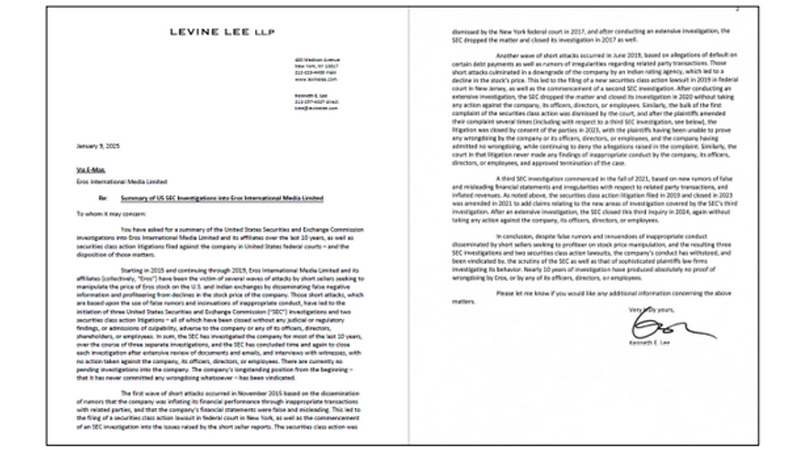
    MUMBAI: Eros Media World plc (EMW) can finally breathe a sigh of relief. Following a thorough internal review and multiple investigations by the United States Securities and Exchange Commission (SEC), the company has emerged unscathed, with the SEC officially closing its inquiry without recommending any enforcement action.

    An internal investigation by EMW’s audit committee concluded that the company’s accounting practices and internal controls were sound. The review found that:

    1    No revenues for the fiscal year ending 31 March 2020, were improperly recognised.

    2    No impairments existed in intangible assets or goodwill as stated in the company’s Form 6-K dated 31 March 2021.

    3    No material weaknesses were identified in internal controls over financial reporting.

    These findings marked a decisive end to allegations of inflated revenues, misleading financial statements, and improper related-party transactions, which had triggered three separate SEC investigations.

    Eros Media World has faced waves of criticism and short attacks from entities like Hindenburg Research, which itself recently announced its closure. However, the conclusion of these investigations without any adverse action underscores EMW’s commitment to transparency and compliance.

    “We are most pleased to have these issues behind us as we look forward to a new future for the company,” said Eros Media World group founder & ED Kishore Lulla.

    Lulla extended gratitude to the company’s legal team for their exceptional representation throughout this challenging period:

    1    Levine Lee LLP, Kenneth E. Lee led litigation and outside counsel.

    2    Cravath, Swaine & Moore LLP, Rachel G. Skaistis SEC counsel.

    3    Cleary Gottlieb Steen & Hamilton LLP Victor Hou.

    With the investigations closed and the company cleared of allegations, EMW is charting a new course for growth and innovation in the media and entertainment space. The closure of these cases allows the company to refocus on its core mission while reinforcing its commitment to ethical practices and transparency.

  • Shemaroo’s Q3 revenue: Adapting to digital and facing legacy trials

    Shemaroo’s Q3 revenue: Adapting to digital and facing legacy trials

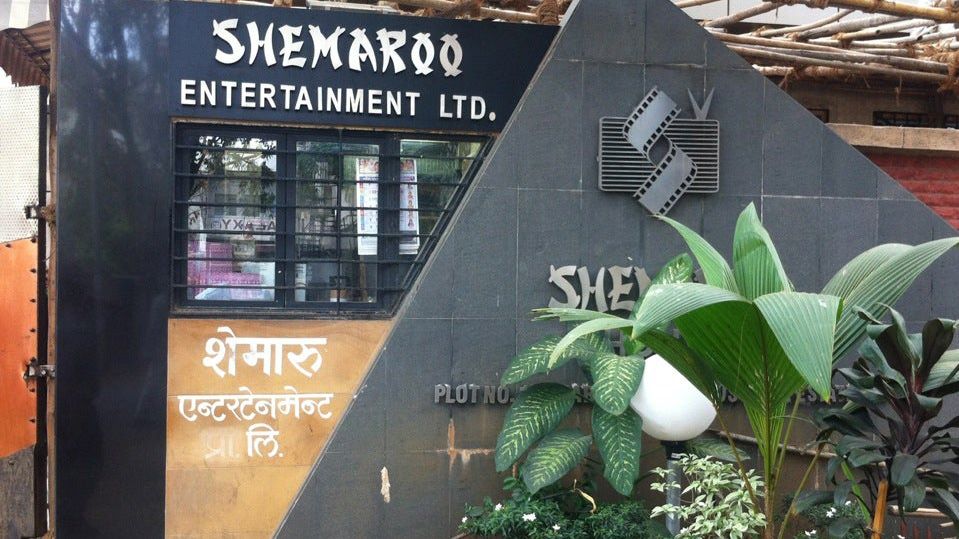
    MUMBAI: Shemaroo Entertainment Limited has rolled out its financial results for Q3 FY25 and the nine-month period ending 31 December 2024. Founded by the ever-visionary Raman Maroo in 1962 as a humble book library, Shemaroo has since performed an Indian cinema-style transformation into one of India’s foremost entertainment companies. With a current market valuation of approximately Rs 10,000 crore and a legacy spanning six decades, the company is proof that a great plot (and some brilliant foresight) can weather any twist. Maroo’s genius for spotting trends early—like assembling one of India’s largest content libraries—has cemented Shemaroo’s reputation as a box-office favourite in both traditional and digital media.

    Now, who says legacy brands can’t dance to a new tune?

    In today’s fiercely competitive market, where giants like Netflix, Amazon Prime Video, Sony and Zee vie for consumer attention, Shemaroo’s strategy is anything but passive. The company’s ability to repurpose its extensive Indian cinema and regional film library for streaming platforms, coupled with its focus on regional and niche content, is its secret sauce for staying relevant. Can a legacy brand like Shemaroo thrive in a world dominated by binge-worthy web series and blockbuster originals?

    Let’s dive deeper into the numbers and uncover the plot twists behind the balance sheet.

    Consolidated Performance

    For Q3 FY25, Shemaroo Entertainment reported consolidated revenue from operations at Rs 16,437.42 lakhs. Think of it as a steady performance—better than Rs 15,592.64 lakhs in the previous quarter but just a tad shy of Rs 16,206.08 lakhs in Q3 FY24. Adding Rs 296.45 lakhs in other income, the total income reached Rs 16,733.87 lakhs for the quarter. It’s not quite a standing ovation, but at least the audience has not walked out.

    Now, let’s talk about EBITDA (Earnings Before Interest, Taxes, Depreciation, and Amortisation)—the backstage crew of financial performance. For Q3 FY25, EBITDA stood at Rs 1,539.47 lakhs. Rising operational costs and tight advertising budgets played the villain here, but the show must go on! Meanwhile, Profit After Tax (PAT) took a dramatic dive, with a loss of Rs 3,652.75 lakhs, compared to a profit of Rs 1,228.94 lakhs in Q3 FY24. If this were a movie, we would call it a tragic second act.

    For the nine months ended 31 December 2024, consolidated revenue totalled Rs 48,082.93 lakhs. That’s down from Rs 50,834.08 lakhs in the previous year—not the kind of sequel numbers anyone hopes for. EBITDA came in at Rs 4,210.69 lakhs, while PAT posted a net loss of Rs 10,937.90 lakhs, compared to a loss of Rs 2,041.57 lakhs in FY24. It’s safe to say, the financial script could use a few rewrites.

    Despite these challenges, Shemaroo’s numbers reveal a company determined to stay in the game. With rising operational costs and shifting consumer preferences, the Q3 results underline the importance of resilience and adaptability in today’s cutthroat entertainment landscape. After all, every blockbuster needs a bit of suspense, doesn’t it?

    Standalone Results

    On a standalone basis, Shemaroo’s revenue from operations for Q3 FY25 was Rs 15,542.52 lakhs, edging up from Rs 15,226.01 lakhs in the previous quarter and Rs 14,773.76 lakhs in Q3 FY24. Total income, including Rs 253.41 lakhs from other sources, hit Rs 15,795.93 lakhs for the quarter. While it’s not quite a red-carpet moment, it’s certainly not a straight-to-DVD release either.

    EBITDA for Q3 FY25 clocked in at Rs 1,419.05 lakhs. Operational costs, which soared to Rs 14,792.44 lakhs, weren’t shy about stealing the spotlight. Meanwhile, PAT took a dramatic dive, delivering a loss of Rs 3,739.99 lakhs compared to Rs 2,732.39 lakhs in Q3 FY24. Let’s call this twist in the tale Shemaroo’s “Bollywood tragedy” phase.

    For the nine months ended 31 December 2024, standalone revenue reached Rs 45,506.20 lakhs, falling short of Rs 48,541.42 lakhs reported in the same period last year. Total income tallied up to Rs 46,058.52 lakhs, while EBITDA for the period stood at Rs 4,153.34 lakhs. PAT for the nine months delivered a loss of Rs 8,176.58 lakhs, more than doubling last year’s Rs 4,035.48 lakhs. These numbers suggest Shemaroo’s script might need some serious rewrites to avoid becoming a “box-office bomb.”

    Still, Shemaroo’s knack for juggling its legacy operations with a burgeoning digital portfolio shows promise. After all, every epic needs its moment of redemption—here’s hoping Shemaroo’s next act delivers the blockbuster twist we’ve all been waiting for!

    Shemaroo’s dual focus on traditional media and digital growth has been a defining aspect of its strategy. While revenue from legacy operations faces mounting challenges, the company’s investments in digital platforms are yielding promising results. Shemaroo’s partnerships with OTT players and its direct-to-consumer initiatives are driving audience engagement and revenue growth. The question remains: can Shemaroo go viral in the digital world while keeping its classic charm?

    The digital segment has shown significant traction, with increasing subscriber counts and higher engagement metrics. However, the competition in the OTT space is fierce, with new entrants vying for market share. Will Shemaroo’s robust content library and its reputation for delivering quality entertainment be enough to sustain long-term growth? Or will the digital world prove to be a tougher audience than expected?

    Shemaroo has long been a pioneer in India’s entertainment sector, leveraging its extensive content library to cater to diverse audience preferences. The company’s innovative marketing initiatives, such as regional-language content expansions and festival-centric campaigns, have strengthened its brand equity. However, the slight decline in revenue indicates that the path forward will require even greater innovation to compete in a market increasingly dominated by digital platforms.

    Can Shemaroo continue to build on its legacy while charting a new course in the digital age? The coming quarters will reveal whether this stalwart of Indian entertainment can transform challenges into opportunities and emerge stronger in a competitive landscape. For now, Shemaroo is writing its next chapter—and it promises to be an interesting read.

    After all, even legends need to adapt—no one wants to be a rerun.

  • Tyrell and Storj Advance the Media & Broadcast Entertainment Tech Stack, Producing Results with Distributed Cloud Innovation

    Tyrell and Storj Advance the Media & Broadcast Entertainment Tech Stack, Producing Results with Distributed Cloud Innovation

    ATLANTA: Today Storj and Tyrell announce a growing partnership taking media and entertainment to new heights through the distributed cloud. Tyrell’s commitment is to make media simple. They are a global technology distributor delivering leading solutions for broadcast, television production and live performance. Their focus is not just as a supplier, but as a partner in producing results and supporting future success.

    Storj is a game-changer in media storage, offering a revolutionary decentralised platform. By aggregating unused storage capacity from data centers worldwide, Storj empowers cloud providers to allocate a portion of this spare capacity to their networks. This innovative approach delivers several key benefits from sustainability and global accessibility to cost-effectiveness.

    storj

    Storj is a game-changer in media storage, offering a revolutionary decentralised platform. By aggregating unused storage capacity from data centers worldwide, Storj empowers cloud providers to allocate a portion of this spare capacity to their networks. This innovative approach delivers several key benefits from sustainability and global accessibility to cost-effectiveness.

    Customers in the UK and Ireland rely on Tyrell to deliver the best solutions to ever-changing needs from streaming, encoding and file transfers to graphics, VFX and OTT video workflow services. “Storj is proud to collaborate with Tyrell to deliver transformative solutions for production, post-production, broadcast and more. The best testament to this is the enthusiasm of Tyrell’s customers for what Storj delivers in efficiency, performance and global workflows that are unprecedented in ease of use and transfer speed,” said Colby Winegar, CEO, Storj.

    “Storj has broken the mold in cloud services. It’s rare that a technology comes along that allows you to see things differently, and that’s exactly what Storj has done. The workflow options that are now possible because of the Storj architecture, are resulting in a real shift in how media post-production can happen. Making the world smaller and greener- we’re thrilled to be part of the Storj story,” said Dan Muchmore, Sales & Marketing Director, Tyrell.

    He added, “Storj offers substantial cost savings compared to major cloud providers like AWS and Microsoft Azure, making it perfect for workflows where collaborators are located around the world. Unlike traditional providers, with Storj there’s no regional lock-in. Once files are distributed, they’re instantly accessible worldwide and users can access them from their desktops as files.”

    Together Tyrell and Storj are advancing distributed cloud solutions to accelerate the future of the media and entertainment industry. Storj increases the value of existing media workflow investments, making them faster, more global and more sustainable by leveraging spare storage space and GPUs available around the world, and bringing high-performance storage and compute to the edge to be accessed anywhere, anytime. Storj also helps businesses reduce the carbon footprint of storing and distributing data more efficiently.

    Storj has built the largest DePIN (Decentralized Physical Infrastructure) platform in the world. It is rapidly expanding due to strategic partnerships with forward-thinking companies like Tyrell.

  • Ashish Golwlkar announces exit from SPNI after a seven-year stint

    Ashish Golwlkar announces exit from SPNI after a seven-year stint

    Mumbai: Indian media and entertainment industry veteran Ashish Golwalkar has left Sony Pictures Networks India (SPNI) after a seven year stint. A company spokesperson confirmed the development.

    He joined in December 2015 as senior VP and creative director of content before heading programming at SPNI’s flagship channel, SET, in April 2018. In his latest role, he was heading content at both SET and the digital business, which is SonyLIV.

    Prior to this, he had stints in WWIL, Zee Entertainment, and Disney-Star. He was with  ZEEl for over 11 years. He has over 20 years of experience spanning sales and marketing, content syndication, brand management, and content creation. He wrote and co-wrote multiple award-winning non-scripted formats in various genres across Zeel, Disney-FoxStar, and Sony Pictures. He has built content teams at Zeel and Star Plus.

  • I&B discusses strategies for unleashing M&E’s potential with industry experts

    I&B discusses strategies for unleashing M&E’s potential with industry experts

    Mumbai: Development of the audio-visual sector requires industry-friendly policies, collaboration, and regular interaction between the government and industry stakeholders.

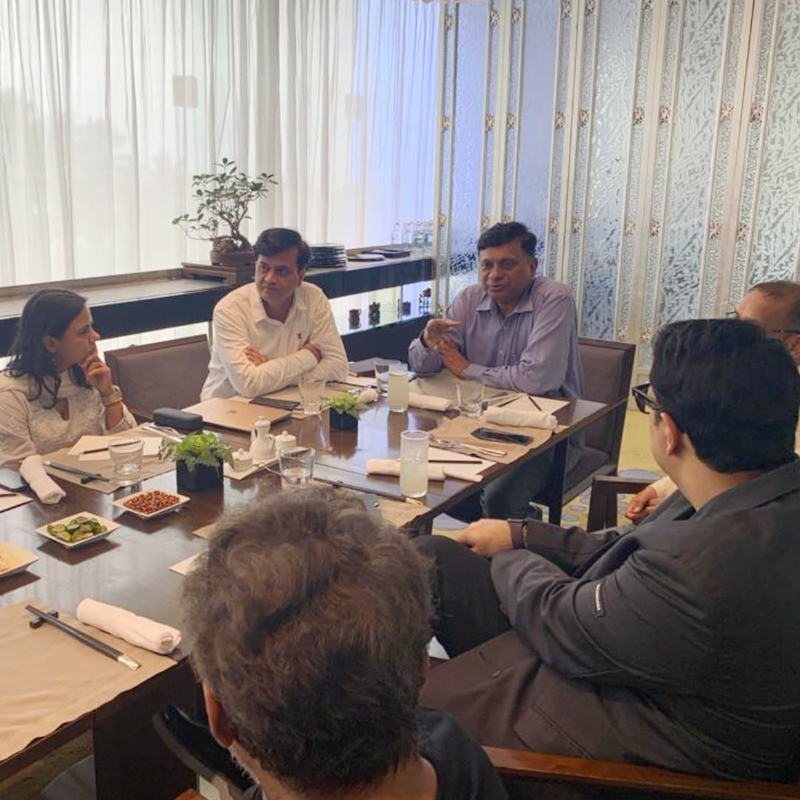
    On Monday, a meeting in Mumbai was organised by the National Film Development Corp. where acclaimed filmmakers and industry professionals marked their presence, namely, Maddock Films founder Dinesh Vijan, Dharma Productions CEO Apoorva Mehta, Ayan Mukerji, R. Balki, Abundantia CEO Vikram Malhotra, Amazon Prime Video’s Gaurav Gandhi and Aparna Purohit, Netflix’s Monica Shergill, PEN India chairman Jayanti Lal Gada, Balaji Motion Pictures CEO Bhavini Sheth, Producers Guild of India president Shibasish Sarkar, Nitin Tej Ahuja CEO Producers Guild of India, and producers Mahaveer Jain & Madhu Mantena.

    The deliberations centred around the strategic initiatives taken by the government to unleash the potential of the media and entertainment industries. The I&B ministry’s efforts at easing filming in India through the Film Facilitation Office and the onboarding of Invest India to expand its outreach to the domestic and international industry were highlighted.

    The recently launched incentive scheme for international productions and official co-productions was discussed in detail, including the benefits it would bring to content creation in India. The industry was urged to leverage the FFO ecosystem and their suggestions on the incentives were duly noted.

    The government’s efforts to make the forthcoming 53rd edition of the International Film Festival of India a success were emphasised, along with the opportunities being created for the industry. Feedback was sought on the amendments made in the Draft Cinematograph (Amendment) Bill, 2021. The feedback received from the industry participants was positive and they unanimously accepted the proposed amendments.

    The stakeholders were also apprised of the ministry’s recognition of the industry’s concern towards theatre density in India and the consequent development of a single window ecosystem and a model law for the ease of permission for construction of screens/theatres was in progress. The attention of the industry was drawn to many other interventions being made by the Ministry in the audio-visual sector.

    I&B secretary Apurva Chandra summed up the discussion as fruitful and said, “The engagement with industry served as a perfect opportunity to apprise the various stakeholders of the efforts being made by the ministry to give an impetus to the film industry. The response from the participants was encouraging and we have urged them to leverage these various platforms to support our endeavour to make India a global content hub.”

  • Exploring public-private partnership to prepare students for upcoming M&E technology fields: Anurag Thakur

    Exploring public-private partnership to prepare students for upcoming M&E technology fields: Anurag Thakur

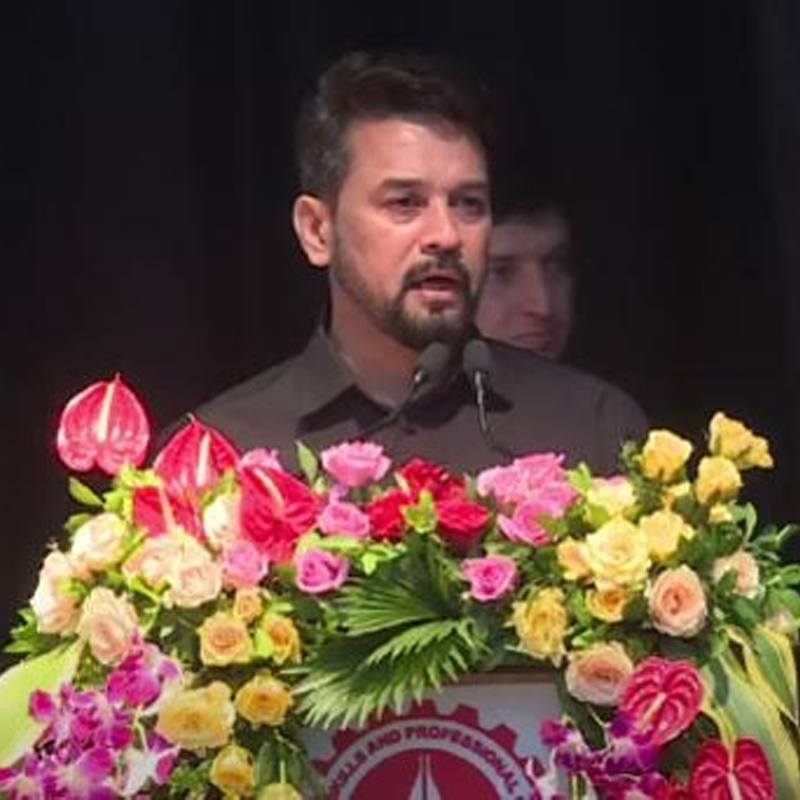
    Mumbai: Union minister for information and broadcasting Anurag Singh Thakur on Sunday announced that the Government of India is exploring partnerships with the private sector to ensure Indian students are in tune with upcoming technology trends in the media and entertainment sector.

    The minister was delivering a key-note address at the international conference on ‘Changing Landscape of Media and Entertainment 2022’ organised by Symbiosis Skill & Professional University in Pune. The main topics of the conference were the emerging field of opportunities in animation, VFX, gaming and comics, opportunities in OTT, TV and film production, augmented reality/virtual reality immersive media skills etc.

    He stated that “The radio, film and entertainment industry has a huge employment opportunity as we leapfrog into the digital era of quality content creation. Many job roles have emerged in the field – video editing, colour grading, visual effects (VFX), sound design, rotoscoping, 3D modelling etc. Each job role in this sector requires a specific set of skills and competencies. It is imperative for industry and academia to come together and design programs relevant to the needs of this sector.”

    Thakur highlighted that the Indian media and entertainment ecosystem is a sunrise sector that is expected to generate rupees four lakh crore annually by 2025 and reach $100 billion or Rs 7.5 lakh crore industry by 2030.

    He further added that the Government of India has designated audio-visual services as one of the 12 champion service sectors and announced key policy measures aimed at nurturing sustained growth.

    The rapidly expanding digital infrastructure in the country and ongoing advancements taking place in the AVGC (animation, visual effects, gaming and comics) sector have the potential to make India the preferred post-production hub of the media and entertainment industry, he observed.  

    To establish a solid digital foundation for the AVGC sector emerging across the country, the government has established a task force for the AVGC sector in order to develop world class creative talent to meet domestic and global demand.

    Thakur said that Prime Minister Narendra Modi’s enthusiasm for technology has provided an oasis of opportunities and given wings to the ambition of youngsters. The PM’s ambition to empower the youth has been realised by the Skill India Mission that aims to train 40 crore youth in market relevant skills.

    Thakur shared that the talents discovered during the ’75 Creative Minds of Tomorrow’ project undertaken during International Film Festival of India 2021, have been creative contributing to the media and entertainment sector and have established successful startups.

    Keeping in mind the growing start-up ecosystem in India, Thakur said that during the Covid pandemic period India added as many as 50 unicorn start-ups, which speaks volumes about India’s entrepreneurial spirit. The minister said he hopes to see more and more start-ups emerging from the talent pool produced by leading film schools like Film and Television Institute of India (FTII) and Satyajit Ray Film and Television Institute (SRFTI) too.

    The I&B minister noted that India’s content creation industry has undergone a massive uplift with ‘Digital India’. He said, “With quality content, easy access and an eager audience, India is ready to narrate its own success story and become a content creation hub”.

    Adding further, he impressed the importance of recognising the efforts of technical people behind the scenes of India’s content industry who should be adequately recognised and rewarded, moving beyond the current focus on lead characters.

  • Asianet News’ digital business turns profitable

    Asianet News’ digital business turns profitable

    Mumbai: Asianet News Media and Entertainment, one of the leading players in the Indian media industry has closed the financial year 2021-22 EBITDA positive for its digital business. The group has a multi-media presence across the country in multiple languages via its digital platform (asianetnews.com, indigomusic.com), TV channels (Asianet News and Asianet Suvarna News), print publication (Kannada Prabha) and radio channels (Indigo).

    On the back of significant revenue growth and cost optimisation, the digital business of AMEL delivered positive EBITDA for the first time. During the year, the company has re-organised many parts of its business with a focus on increasing ARPUs and on delivering positive unit economics.

    Executive chairman of the group Rajesh Kalra spoke about how tough times brought people together to deliver despite all odds. “It has been phenomenal to witness how our teams came together during the most trying times to optimize and grow at a record rate. The determination and discipline that our hands-on leadership team and our immensely talented colleagues have tirelessly demonstrated has resulted in this outstanding performance. I am confident that this is just the start of much greater things to come for the group,” he said.

    “FY-22 was a tough year on multiple fronts. Many of us lost near and dear ones, but the way our teams with complementary skill-sets have supported each other and remained focused towards our common goal was heartening to see,” commented Asianet News chief operating officer Ruchir Khanna. “Top/bottom line growth is only a reflection of a healthy ecosystem that we have been able to form in the last year. We will continue to pull on our P&L levers in the coming year, and launch several new products that will drive our audience reach, engagement and retention.”

    Commenting on this achievement for AMEL, chief business officer Samarth Sharma said, “The last FY posed several challenges at both personal and professional levels. The synergies drawn from the adversity that the teams witnessed last year have translated into our digital business delivering record revenue There have been several innovative revenue initiatives from our teams across the globe that contributed to this success and we’d like to thank our client, agency, data and intelligence partners for showing faith in us in our journey.”

    Besides strengthening its Indian language footprint across the country, Asianet News has also made significant investments in English and Hindi to extend its dominance pan India.

  • Women account for 28% of the country’s total app consumption, rural at 16.4%: Study

    Women account for 28% of the country’s total app consumption, rural at 16.4%: Study

    Mumbai: Indian women account for 28 per cent of the country’s total app consumption, with rural users accounting for 16.4 per cent. Together they drive over 70 per cent of purchasing decisions. Their purchasing power is reflected in key categories of app usage including social media apps, which increasingly convert sales, and e-commerce, according to a study from retention cloud platform CleverTap shared on Wednesday.

    Analysing the usage of over 300 different mobile apps with an average monthly user base of more than four million, the new study revealed opportunities in India’s mobile app market, led by women and rural regions.

    Women have major purchasing power, led by e-commerce

    Women in India drive over 70 per cent of purchasing decisions, with their purchasing power reflected in key categories of app usage including social media apps, which increasingly convert sales, and e-commerce.

    Based on the findings, the study suggests providers of ed-tech, social media, and fintech apps, in particular, consider marketing their apps to women. Women currently account for 37 per cent, 32.5 per cent and 31 per cent of usage, respectively, and are major consumers of products and services in these sectors.

    Indian women outpace men in E-commerce app usage, accounting for 54 per cent of all usage. Global e-commerce brands would do well to create highly personalised and relevant commerce experiences for Indian women in order to drive revenue growth and cement customer loyalty.

    Indian men account for a significant share of app interaction across several key verticals, including gaming (94 per cent), travel and transportation (84 per cent), on-demand services (78 per cent) and media and entertainment (77 per cent). Overall, men account for 72 per cent of mobile usage.

    Rural India – a massive opportunity

    Rural India is an underserved market on the cusp of seismic change. While app usage is currently 16.4 per cent, the split across verticals, CleverTap data shows consumers across cities and areas outside metropolitan centres gravitate to apps that can help them improve their education and quality of life.

    Edutech (19.2 per cent), media and entertainment (17.7 per cent) and fintech (17 per cent) stand out as verticals that attract a disproportionately large number of rural users.

    Adoption rates for health and fitness (13.2 per cent) are at the low end of the scale, but personalised strategies such as goal setting and reminder functionality can increase these numbers.

    Among urban users, adoption rates for health and fitness, e-commerce, and travel and transportation are nearing saturation levels (85 per cent and above). This dynamic underlines the importance of shifting focus to growth opportunities emerging in rural areas, where competition is lower, and returns are higher.

    User retention remains a challenge

    CleverTap analysis also confirms the pivotal importance of focusing on user retention. Uninstall rates are a challenge across all app categories, negating costly user acquisition (UA) campaigns and threatening companies’ potential growth. Uninstall rates are highest in the gaming (44 per cent) and social engagement (46 per cent) sectors.

    By contrast, sectors, where users perceive a high degree of value and convenience, have the lowest uninstall rates: On-demand services (21 per cent) and health and fitness (25 per cent). While these areas are better at retaining users, losing nearly a quarter of a subscriber base is still alarming. Data-driven offers, loyalty programs, and hyper-personalised marketing and messaging are just some of the ways brands and businesses can stem the attrition of these apps.

    “Global events have radically changed consumer behaviour, particularly among women, who now rely on apps as the go-to channel for all aspects of their lives,” said CleverTap global CEO Sidharth Malik. “Similarly, rural users have come to depend on apps to make transactions or continue their education, and now view apps as a means to improve their lives. Understanding the striking and significant differences among user segments and preferences is the critical first step for companies to connect, convert and ultimately grow retention and lifetime value.”

    Methodology

    A mobile-savvy country where apps drive commerce, communications, education and social interactions, India was the second-largest global market in terms of app downloads in 2021, according to a report by Data.ai. The CleverTap study demonstrates that mobile-first brands and businesses have an opportunity to reach underserved demographics in the world’s second-most populous nation and fastest-growing major economy.

    To understand mobile usage behaviour and identify trends in in-app consumption across India, the CleverTap data science team analysed over 300 mobile apps across different verticals, with an average monthly user base of more than 4 million. The usage behaviour was broken down by location (urban/rural); by gender across verticals (fintech, ed-tech, media and entertainment, health and fitness, travel and transportation, e-commerce, social engagement); by responses to engagement campaigns across different channels and verticals; and uninstall rates across verticals. More than 782 billion push notifications, 52 billion emails, and 10 billion in-app notifications were analysed for this study.

  • EPIC’s new philosophy- ‘Soch Se Aage’- keep the creators going

    EPIC’s new philosophy- ‘Soch Se Aage’- keep the creators going

    Mumbai: IN10 Media Network’s infotainment channel EPIC started its journey in 2014 with content focusing on Indian history, folklore, and mythology. And since then the channel has continued to recognize the opportunity for differentiated content and experimented with it.

    Despite endless challenges due to the pandemic and subsequent lockdowns, EPIC unveiled its brand new look on 16 December. Along with a fresh look, feel and a new tagline- ‘Soch Se Aage’, the channel announced a fresh programming line-up with the aim to rebuild the Indian infotainment space. From ‘Lakshya 1971- a story of 1971 war’ to ‘Raja Rasoi Aur Anya Kahaniyaan’- a show about the history and flavors of regional Indian cuisine, the platform has brought a host of news shows for its audiences.

    In this exclusive interview with Indiantelevision.com, the two production houses, Rangrez/FOODlooking founder Ashraf Abbas and MASS Studios creative director Richa Pant shared the process of producing content for EPIC, and how they overcame the challenges posed by the pandemic during the period. EPIC AVP – content and strategy Nisha Thakkar also joined the chat to share how the new content resonates with ‘Soch Se Aage’ philosophy.

    On exploring new territories and producing infotainment content

    Talking about her experience, MASS Studios creative director Richa Pant said that the year was a bit rocky for her. While the Delta wave left a devastating impact on people’s lives, Pant said she found consolation in work.  “One of my highlights this year has been ‘Lakshya 1971: Vayu Sena Ke Veer Yoddha’.  A documentary that showcases the stories of Air Force heroes and the seminal work they did in the 1971 war, a war that changed the face of the subcontinent,” she said while talking about her journey with EPIC.

    After working with EPIC, she feels she has explored different territories as a professional with the variety of new content offered on the platform. “I have been making documentaries for the last decade and channels as well as audiences are constantly pushing you to innovate.  With ‘Lakshya 1971’ we have delved into military history and this is a first for me as a Creative Director,” she said.

    On new shows and integrating the philosophy of ‘Soch Se Aage’

    “To think of it, the legacy shows such as ‘Raja Rasoi Aur Anya Kahaniyaan’ and ‘Lost Recipes’ formats were themselves ‘Soch Se Aage’ when launched. ‘Raja Rasoi Aur Anya Kahaniyaan’ beautifully presents history & food together while ‘Lost Recipes’ is re-living the long-lost traditions and recipes which were once very popular,” explained Thakkar. “In the past, many documentaries & movies have been made on the 1971 War, but our show, ‘Lakshya 1971: Vayu Sena Ke Veer Yoddha’ is the first of its kind made from the perspective of IAF.”

    On The Challenges & Limitations of Production During Pandemic

    Shooting and producing new shows during the pandemic was challenging. While the whole entertainment industry bore the brunt, EPIC managed to present fresh content to its audience, but the production team did face various challenges and limitations while shooting. Abbas shared that the risk of getting a virus was high. “To ensure a smooth production, our idea was to identify and isolate the people who are at risk,” he said, “But it became difficult when the cast and crew got infected. But we had hired formal agencies to take regular temperature checks and comply with other safety measures. At the same time, we had to reduce the number of people on the set due to social distancing.

    On What Kept Them Motivated to Produce Unique Content for Epic

    “In times of distress it is always art that becomes the food for the soul, our passion for ‘Raja Rasoi aur Anya Kahaniyaan’, the beautiful history of food in our country, drove us to keep working,” said Abbas.

    On the other hand, for Pant, it was her personal connection with the Defence and the freshness of ‘Lakshya 1971’ that kept her motivated throughout. She shared that her father was in the Army and she has done a large number of defense-related documentaries before. “This time I wanted to focus on the Air Force heroes. Many of them are in their eighties. It was the last chance to meet them and record their version of history. The team at EPIC heard my pitch and were excited too and backed me to the hilt to make this documentary,” she said.

    On Efforts For Keeping The Realism Alive In Content

    To make the shows look and feel compelling for the audience, they partnered with the Air Force. “We double-checked all our research with Air HQ. The film combined eyewitness accounts from our Air Force heroes, archive footage from that era, recreations at air bases, and 3D graphics to bring alive each of the battles we focussed on. We decided to keep the entire film black and white, with just the eyewitness accounts in colour and I think that worked very well,” she shared.

    Abbas, who is the founder of Rangrez / Foodlooking, said that theirs is a very selective production house and therefore they try to always pick shows that we will enjoy working on.

    On What Made The Channel Look For New Genres

    The new content lineup is a mix of legacy shows which have new seasons of ‘Raja Rasoi, Regiment Diaries’ & ‘Lost Recipes’, and new shows like ‘India Post – Dhaage Jo Desh Jode’, ‘Jugaad Mania’, and ‘The Homecoming – A Nation’s fight for its people’, shared Thakkar.

    Thakkar noted that EPIC’s ‘Soch Se Aage’ journey has taken its first few steps with an oath to think beyond imagination and like it said “journey of a thousand miles begins with a step”.  Sharing what made the channel look for these genres, Thakkar said that EPIC has a loyal audience base. “Viewers strongly resonate with EPIC’s content. From Food & History genres, which have a loyal set of audience, we are now reaching out to a new set of audiences with genres like Travel & History, Rescue missions, Innovations, etc,” she said.

    On Their Personal Favorite Shows On The Platform

    Talking about his personal favorites, Abbas said that ‘Raja Rasoi aur Anya Kahaniyaan’, ‘The Great Escape’ and ‘Adrishya’ are really close to his heart.

    Way back in Jan 2013, the EPIC channel signed it’s very first production agreement with Rangrez and the show was, ‘Raja Rasoi aur anya Kahaniyaan’ so we go back a long way. ‘Adrishya’ followed soon after and we’ve then had a great journey together. ‘Raja Rasoi with Ranveer Brar’ and ‘Tyohaar ki Thaali with Sakshi Tanwar’ too were hugely memorable for us, he shared.

    He also shared how after a point, the team felt exhausted as they covered all the significant food stories of India. But it is the EPIC’s dedication to always go “Soch Se Aage” that forced them to explore another dimension in the show. “We were forced to rethink the narrative and come up with the current season of ‘Raja Rasoi aur Anya Kahaniyaan’…we really do think this is our best so far, it’s poetic, has a greater emotional connect, and a lot more time with the Royal families,” he concluded.

  • Kumar Siddharath joins Madison Media to lead Mates

    Kumar Siddharath joins Madison Media to lead Mates

    Mumbai: Madison Media on Wednesday announced the appointment of Kumar Siddharath to lead its entertainment unit Mates.  Mates now will be integrated within Madison Media and will focus on brand solutions including in-film associations, celebrity associations, and other ancillary services related to entertainment, content and branding, the company said.

    In this role, Siddharath will report to Madison Media and OOH partner and group CEO Vikram Sakhuja. Former founder and CEO of Mates Sooraj Bhalla has decided to pursue other interests.

    With over 14 years of experience, Siddharath joins Madison Media with a multi-faceted understanding of content marketing, partnership & strategic alliances with a sharp focus on client servicing and business development. He has worked with companies like Endemol, UTV, Viacom 18, Reliance Broadcast Network, Optimystix Entertainment, and other production houses where he has produced big shows including “Roadies” and created AFPs for brands like  HUL, Hero, Idea and Woodland amongst other brands. 

    Apart from production houses, his exposure ranges from industries like broadcast (TV and radio) to films and OTT to print and events. He was also director brand solutions at Omnicom Media Group.

    “I am excited to have Siddharath join our team and provide our clients’ brands content solutions and further strengthen our Madison Media offering, all under one roof,” said Vikram Sakhuja.

    Prior to joining Madison, Siddharath set up his own e-sport and gaming company Oreka eSports.  He has also worked on brands like Daimler, Ford, HP Laptop and Hike over the years.

    “I am excited to join Madison and look forward to creating a lot of interesting brand solutions that help our premium roster of clients create magic and meet their business goals,” said Kumar Siddharath.