Tag: MEBC

  • Kamal Haasan roots for Bengaluru to hold FICCI MEBC in future

    Kamal Haasan roots for Bengaluru to hold FICCI MEBC in future

    BENGALURU: The fifth edition of the FICCI MEBC (Media and Entertainment Business Conclave) came to a new location this year to IT City Bengaluru. MEBC president and actor Kamal Haasan rooted for Bengaluru to be a recurring location for the conclave to be held.

    Among the people present at the inaugural function were Karnataka chief minister Siddaramaiah, Information and Broadcasting secretary Bimal Julka, Film Federation of India president Ravi Kottarakara, Karnataka Film Chamber of Commerce president H D Gangaraju, Karnataka government IT BT and S&T secretary Srivatsa Krishna and Association of Bangalore Animation Industry president and technicolor India head Biren Ghose.

    “Bengaluru is the second largest IT hub in the world after Silicon Valley and in the years to come we want to surpass even Silicon Valley to become the hub of innovation and convergence of media and entertainment,” said Krishna.

    Kamal Haasan said that Bengaluru has all the things needed to make it an IT hub as well as keep FICCI MEBC going in the city. “We will give a push to the digital medium,” he added.


    Siddaramaiah emphasised the need for building qualitative online content that will give advertisers innovative ways to reach out to people. “The industry should look at remaking old movies with good value and rich in vernacular content,” he said. He also urged the need for creating programming and growth friendly policies for industry.

    Issues that were concerning the film industry were also raised by Kottarakara such as service tax and lack of support from banks for movie funding. “Film making is put in the ‘sinful’ industry along with gambling, drinking and smoking. It is not so,” he said.

    The sessions for the two day event included ‘formulating and implementing a viable media and entertainment policy for a state’, ‘reshaping mobile entertainment in the era of digital revolution’, ‘the challenge of news: defining number one in the dizzying newscape’, ‘the broadcasting ecosystem in the digital era’, ‘customising global VFX for Indian cinema’, ‘emerging trends of Indian IP in animation and their exploitation’, ‘the emerging gaming industry in southern India’, ‘emerging technologies and the impact on media and entertainment industry’ and ‘changing trends in regional TV: ratings, content and formats’.

  • Indian animation needs a global outlook

    Indian animation needs a global outlook

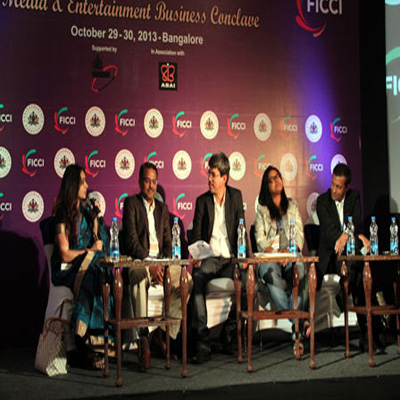
    MUMBAI: Among the key issues addressed by the recently concluded FICCI MEBC (Media and Entertainment Business Conclave) (South) in Bengaluru on 29 and 30 October was the state of the animation industry in India and what can be done to improve its lot.


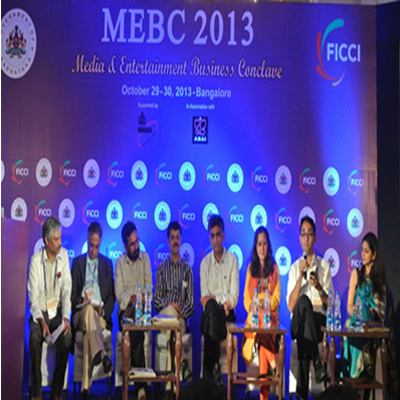
    The second day of the conclave saw a dedicated session titled ‘Emerging trends of Indian IP in animation and their exploitation’ with Turner International India senior director and network head for kids in south Asia Krishna Desai, Graphic India co-founder and CEO Sharad Devarajan, Shemaroo Entertainment director Jai Maroo, Krayon Pictures co-founder Nisith Takia and Greengold Animation founder and MD Rajiv Chilaka and Reliance Animation CEO Ashish Kulkarni as moderator.
    Devarajan began by highlighting the need for a cohesive ecosystem favouring the country’s animation industry.


    “Indian consumers today are used to seeing the best of the world and so, we need to transcend the national market and go to the international market,” he said, stressing the need to create content like that made by Stan Lee or Steven Spielberg. “Multi platform and global is how you have to think of stories today,” he said, pointing out how a version of Mahabharat was launched as 18 days, a re-imaging of the original by Graphic India at the San Diego Comic Con and went straight to Youtube.


    Chilaka made a special reference to Chhota Bheem as a kids’ icon while speaking of Greengold’s huge success in the field of animation. “We have grown from just four to over 300 in 12 years. No one knows which show will work, so we have to just give it a shot. Chhota Bheem started off as just 10 products and now it is available in more than 3000 across 30 country stores. We didn’t realize that it would be a phenomenon but now we are confident about making a movie every year,” he said, pointing out that while IP monetisation was happening, it was equally important to build good infrastructure around it to help harness IP better.


    Maroo said Shemaroo would help in distribution and marketing even though it wasn’t actively involved in the creation of animation. “There are people with great production and artistic capacity for whom we can work on aspects like music, distribution and marketing. The reason why characters like Bal Ganesh and Chhota Bheem work well is because of their sheer stickiness. We should have IP with an Indian soul but an international story. What the west has is sharp screenplay that translates across boundaries. That is what we lack,” he said.


    Desai opined there wasn’t enough investment in animation and pointed out the difficulties in creating animated content. “There is less advertising revenue for a kids channel (Turner), so we also have less money to invest in new content,” he said.


    Kulkarni said, “In India, animation is positioned as a kids’ genre,” to which, Devarajan gave an example of the Japanese, who have moved Anime from kids to a sophisticated audience. “Their characters have elasticity and a soul that appeals to various demographics. Why aren’t we creating any Clash of the Titans or Lord of the Rings?” asked Devarajan.


    Chilaka said they needed to come up with interesting ways of promotion to grab eyeballs, citing the example of Raju. “We timed Raju to release three weeks before the football world cup and on TV, we did a premiere during the semi-final,” he said.


    Maroo pointed out that very few screens were available across the country for animated movies, thereby restricting viewership. “This industry is the best when commerce meets creativity,” he said. Takia felt not many people understood the business even if they were superlative on the creative front. “We can call ourselves successful only when we galvanise the creative population,” added Devarajan. Maroo rounded off saying: “The future will be about how many different revenue platforms you build.”

  • MEBC 2013: Human capital challenges of the radio industry post Phase III

    MEBC 2013: Human capital challenges of the radio industry post Phase III

    BENGALURU: The Digital March-Media and Entertainment in South India – Deloitte-FICCI released a report at the FICCI-MEBC 2013 in Bangalore.


    On the impact of Phase III of licensing on South India, the report says that 229 of the 839 frequencies being auctioned are in 83 cities of the four Southern states. Phase III is expected to result in 294 frequencies (existing plus planned) in South India alone. About 90 per cent of the cities for which frequencies will be auctioned belong to Tier 2 or Tier 3 categories.


    This would help radio expand its reach to the masses.


    Phase III auction of licenses of radio frequencies, is expected to generate substantial employment across the country. Thus, with the launch of new stations in 283 cities across the country, experts in the industry foresee demand for people proficient in regional languages for which regional dialect and diction training may also be required.


    The radio industry will face human capital challenges. The industry believes that the skill gaps are largely owing to a scarcity of educational institutes offering programs for radio. This in turn limits the sources for recruitment. This leaves the industry with either hiring graduates and training them in-house or relying on alternative sources of hiring e.g. walk-in-interviews, theatre etc. The issue is only expected to escalate once Phase III licenses are auctioned across India.Quoting industry sources, the report says that retention is never a challenge for key management / leadership team. It’s the support staff that is a challenge. Currently, the industry relies on on-the-job training to compensate for the lack of training courses.


    External trainers from abroad are also commissioned to train people on creative thinking skills and show conceptualisation. Trainers are often hired to train sound engineers and technicians. Resources are also trained in-house on handling radio transmission equipment and software.

  • MEBC 2013: Radio rocks in South India – Deloitte Report

    MEBC 2013: Radio rocks in South India – Deloitte Report

    BENGALURU: The Digital March-Media and Entertainment in South India, a Deloitte-FICCI report was released at FICCI-MEBC 2013 in Bangalore.


    The report says that the radio industry in India enjoys greater acceptance in the South than in the rest of the country and thus stands out amongst its peers. This is indicated by relatively higher average radio listenership in cities like Bengaluru where people spend about 20 hours /week on radio while those in Delhi and Mumbai spend 13-14 hours/week.


    Radio has become an integral part of the entertainment industry in South India and thus has been used as a tool for promotions like film and TV. The film industry in Tamil Nadu (TN) has tied up with various radio stations with an aim to keep the listeners abreast with the music premiers and activities related to the film. Not just the filmmakers but also the broadcasters use this medium as propping up their new shows says the report.


    It also says that the South Indian Media and Entertainment (SIM&E) industry is slated to grow from its current estimated size for FY-2013 of Rs 23,900 to Rs 43,600 crore in FY-2013 at an CAGR of 16 per cent.


    Radio, which stands third behind new media and television in terms of growth, will rise at a CAGR of 19 per cent in the four southern states of TN, Andhra Pradesh (AP), Karnataka and Kerala, from an estimated present size of Rs 420 to Rs.830 crore by FY-2017.


    The report also goes on to say that the national and local advertisers are increasingly realizing the importance of radio.

  • Niche channels to dominate TV in future

    Niche channels to dominate TV in future

    BENGALURU: At the opening ceremony of the FICCI MEBC (Media and Entertainment Business Conclave) – South, which was held on 29 and 30 October, Ministry of Information and Broadcasting Secretary, Bimal Julka highlighted the fact that digitisation is at a growing trajectory in the country and by the end of the next year we shall all be living in digital homes.


    According to data provided by a FICCI Deloitte report on media and entertainment in south India, television constitutes 56 per cent of the market share with Rs 13,470 crore out of the total of Rs 23,900 crore. Digitisation is going to help the segment grow at a CAGR of 20 per cent in the next four years.


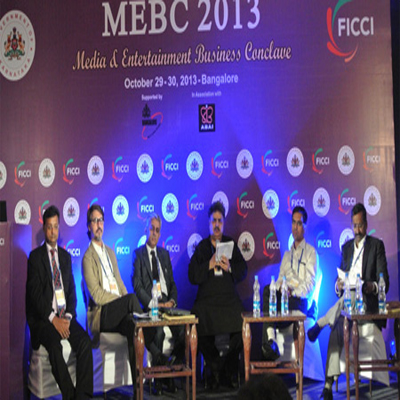
    While the digital world is changing phenomenally, we wonder how the broadcasting industry is adapting to the change. This, and various other points were discussed in a session on “the broadcasting ecosystem in the digital era” which included BECIL chairman K Subramanian, IBM global services head (media and entertainment) and ED Raman Kalra, Deloitte Coimbatore partner-audit C R Rajagopal, Amagi Media Labs co founder Srinivasan K A and Whats on India COO Sugato Banerjee formed the panelists, while MXM India CEO and editor in chief Pradyuman Maheshwari moderated the session.


    The session kick started with Subramaniam highlighting the humongous task that was undertaken in DAS (Digital Addressable System) phase I to install about 75 lakh STBs and led to nearly 95 per cent digitisation in 38 cities. Five out of 38 are in South India, according to the report. He added that in all this DTH had taken a backseat except for Chennai where the DTH penetration is about 40 per cent and digitisation is lagging due to political turmoil.


    Banerjee also supported it by saying that phase I and II saw DTH take a step back and digital penetrate strongly in Mumbai, Delhi and Kolkata.


    Banerjee also highlighted certain issues that popped up during the process of digitisation. “In a city like Mumbai where people live in buildings, having a cable run through the building is easy. With DTH, the dish needs to be facing the satellite. In places where houses are far away from each other, cost of running the cable from home to home is higher and more efforts are needed. If some of these places don’t even get electricity for hours why would they want to pay for STBs?” he remarked.


    There was a time when there was a scarcity of channels but now they are in abundance. According to Banerjee, there are about 700 working channels in the country but it is unrealistic to have so many channels in the digital arena. The rising number of channels has led to narrowing down of viewership. “Five years ago there was no food channel in the country and now there are five. The long tail will give more choice to viewers and fringe channels have benefitted due to digitisation especially in the urban cities,” said Banerjee.


    At the same time, the growing number of channels will put pressure on its visibility. “Now, the issue would be to bring one’s channel to viewers notice,” said Srinivasan.
    Viewership will be segmented leading to an increase in the number of niche channels.  “Broadcast is a term that doesn’t seem to suit the current scenario. Now it is time to ‘narrow-cast’,” said Srinivasan.


    According to Kalra, their IBM global survey on consumer insight has shown that people don’t want to be categorised in demographics. “Consumers want content tailor-made for them. The biggest challenge in the future will be to get direct content for people and then make them spend for it,” he said.


    At the inaugural session of the event, Film Federation of India president Ravi Kottarakara raised the issue of service tax being a big hindrance on the industry. The same was also brought up by Rajagopal at the session. “Not having enough capital is a challenge for the industry to create things. Taxation needs to be looked into as well as interesting financial modules need to open up,” he said.


    At the same time, there is also the issue of paying for individual channels in future as consumers are used to paying a small amount for a big pack of channels. But Kalra pointed out that a person who could pay Rs 300 for a movie now, as compared to Rs 25 a few years ago, will definitely have the capacity to pay more for TV.


    However, Banerjee chose to disagree and said, “There is a difference between making them pay and the willingness to pay.”


    Although carriage fees will disappear in the digitised world, Banerjee said it will reappear in another form of placement fees as to which channel will appear first. According to industry sources, carriage fees range from Rs 3-5 lakhs. The industry also lacks advertising funding as compared to print. “Print has about 2 lakh advertisers but TV has just 12,000,” said Subramaniam.


    TV consumption on multiple screens is also set to grow. As on March 2013, 143 million users in India were mobile internet users (according to the FICCI Deloitte report). Its analysis report also showed that video consumption had increased from two hours to three hours from 2010 to 2012. “There will be monetisation of content as more connected devices emerge. Only then we will know which genre is being seen and its statistics,” said Subramaniam.

  • News should be a paid asset

    News should be a paid asset

    BENGALURU: Whether it’s the political battle that’s unraveling in the country, or it’s a terrorist attack, news always interests people. But is news as interesting as a gossip piece about a celebrity? This and a lot of other points were raised at the first day of the FICCI MEBC (Media and Entertainment Business Conclave) that saw a session that discussed the news genre. The discussion brought up several points including viewership data, content that is being broadcast and the current situation of the genre as a whole.


    The panellists included BBC World News India COO Preet Dhupar, Udayvani group editor Ravi Hegde, Suvarna News editor Anantha Chinivar, Former CNN IBN journalist Veeraraghav, columnist Aakar Patel, NDTV resident editor Maya Sharma and IIM Bangalore dean Dr S Raghunath. The session was moderated by journalist Prakash Belawadi.


    After the entire discussion, the panelists concluded that the genre relies heavily on advertising, thus restricting the kind of content that can be produced. At the same time, viewership data such as TAM (Television Audience Measurement) is needed because advertisers depend on such data to pool their money where they want to. “Producing news is expensive and that is why all channels have panel discussions in their primetime slot. It is cheaper than sending an OB van to some far off place and spend huge amount,” said Sharma.


    Another point brought up during the discussion was about “sensationalising news”. The reason why many times news is sensationalised is because entertainment is more prominent than news. So, news journalists need to adapt to the entertainment form of style in order to grab eyeballs. But at the same time just getting viewers will not help because everyone is also looking for credibility of news, including the people watching it and the ones dispersing the news. Channels keep a close watch on other channels to know what they are reporting.


    However, Hegde differed as he remarked that “media was not entertainment but a serious job”. Hegde, who comes from a print background, said that it’s a newspaper’s job to clear the confusion that channels have created the previous night for the viewers.


    Talking about the revenue generated through advertising, Hegde said that most of the advertisements to newspapers come for the editions in the metros, making it difficult to distribute papers in the rural areas.


    To this, Chinivar pointed that in order to beat entertainment news, the need to sensationalise news comes up.


    Columnist Patel thinks that the standard of journalism in India is poor because of lack of good training and low salaries.


    Veeraghav brought to fore the speculative nature of the Indian viewers that the channels have to continuously face. He remarked how many people question news channels’ nature to delve into the future, but they always want to know the future not what has happened. “If I tell a viewer that elections are going to happen, the first thing he will ask me is can you tell me who is going to win?” he said.


    Although many channels have taken a strong stand against the TAM accusing it of fudging data to benefit advertisers, all the panellists agreed that there needs to be some kind of tracking to know the viewership for channels and newspapers because it is ultimately a business.


    The fact that news is free is what makes it so volatile. “When you have to pay for your news, it will be taken seriously and that’s when the kind of news you get will also become better,” said Sharma. With digitisation coming in, they hope that some system will come in to place to help them get more revenues. News will become a paid asset in the future. “As long as news is free you cannot live without TAM or IRS,” Veerraghav ended.

  • New media to lead growth for south Indian media and entertainment industry

    New media to lead growth for south Indian media and entertainment industry

    BENGALURU: The Digital March-Media and Entertainment in South India, a Deloitte-FICCI report was released on the eve of FICCI-MEBC 2013 in Bengaluru. The two day event commences on 29 October.


    Note: This is for the year ended 31 March 2013.


     The report says that the South Indian Media and Entertainment (SIM&E) industry is slated to grow from its current estimated size for FY-2013 of Rs 23,900 crore to Rs 43,600 crore in FY-2013 at an CAGR of 16 per cent.


    The internet continues to have a profound effect on consumers’ viewing habits and the proliferation of devices is altering their media consumption behavior. With the increasing popularity of mobile broadband (3G) and the impending launch of 4G LTE services, mobile phones are expected to emerge as the preferred platform for consuming content. India already has over 65 million smartphone users currently.


    In south India, new media, with an estimated size of Rs 690 crore in FY-2013 will grow at 23 per cent CAGR to reach Rs 1600 crore in size by FY-2017, followed by television which will grow at a CAGR of 20 per cent from a present estimated size of Rs 13,470 crore to Rs 27,960 crore.


     The television industry in south India is on a transformation path, driven by the government’s digitisation mandate, says the report. It is one of the most flourishing regional media segment in terms of availability of content, reach and distribution. Over the years, it has seen increased action from regional as well as national advertisers. In fact, regional advertisers now contribute almost 40 per cent of the TV industry’s advertisement revenues in states such as Tamil Nadu and Kerala.


     Radio will grow at a CAGR of 19 per cent from an estimated present size of Rs 420 crore to Rs 830 crore by FY-2017. The radio industry enjoys greater acceptance in the south than in the rest of the country and thus stands out amongst its peers. This is indicated by relatively higher average radio listenership in cities like Bengaluru where people spend about 20 hours / week on radio while those in Delhi and Mumbai spend 13-14 hours / week says the report.


    Films with a present estimated size of Rs 2,680 crore will grow at a CAGR of 12 per cent to reach Rs 4,220 crore by FY- 2017.  The report says that the south Indian film industry with 831 films, accounted for over 50 per cent of total films certified across India. The number of films certified increased by 36 per cent over 2011, primarily driven by a spike in cable  and satellite (C&S) rights’ prices. However, the number of films released increased by only eight per cent during the same period as some producers chose not to release their films due to the high marketing costs associated, and as a result of a correction in the C&S rights’ prices in some of the markets.


     Print, a laggard relatively, will grow at eight per cent from the present Rs 6,880 crore to Rs 9,020 crore by FY-2017. South India, driven by a high literacy rate and a sizable vernacular readership base (30 per cent of total readership in India) is one of the strongholds of the Indian print industry. Amongst the four regional states, Tamil Nadu and Andhra Pradesh account for about 58 per cent of the total revenue. Most of the markets in the region are dominated by English print in terms of revenue except Kerala, where vernacular prints accounts for nearly 90 per cent of the revenue. However, the advertising revenue from vernacular print in the region is estimated to grow at twice the pace of that of English, largely driven by local advertisers and increasing focus of national advertiser’s beyond tier I cities.


    Among the four southern states or southern sisters as they are known, Tamil Nadu with a FY-2013 SIM&E estimated size of Rs 8,420 crore will grow at a CAGR of 17 per cent to reach Rs15,850 crore by FY-2017. SIM&E in Andhra Pradesh with a FY-2013 estimated size of Rs 7,140 crore will reach an estimated size of Rs 12,740 crore by FY-2017 at a CAGR of 16 per cent.


    SIM&E in Karnataka with an estimated FY-2013 size of Rs 4,340 crore will grow at a CAGR of 15 per cent to reach Rs 7,710 crore by FY-2017. The smallest in terms of size of SIM&E, Kerala with a FY-2013 estimated size of Rs 3,350 crore will grow to Rs 5,7,30 crore by FY-2017 at a CAGR of 14 per cent.

  • FICCI – MEBC 2013 to kick off on 29 October at Bengaluru

    FICCI – MEBC 2013 to kick off on 29 October at Bengaluru

    BENGALURU: The Federation of Indian Chambers of Commerce and Industry (FICCI) annual Media and Entertainment Business Conclave (MEBC) will be held at the Garden City this year on 29 and 30 October. Previous editions of the conclave have been held in Chennai and Hyderabad.


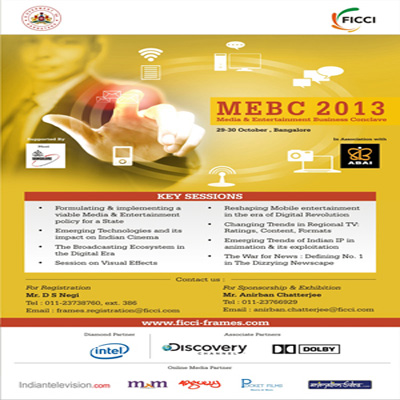
    Some of the key sessions of MEBC 2013 include (1) Formulating and Implementing a viable Media and Entertainment policy for a State: The panel comprising of state government representatives and industry stake holders will discuss various scopes to develop infrastructure, local skills, technology and explore possibilities on how to develop the media & entertainment eco system for a State.


     (2) Emerging Technologies and the impact on Indian Cinema? The Indian film industry enters its next phase of production and distribution where digital technologies are taking very important roles. In this session we bring in experts from the field of creative industry and technology to understand what the future lies for Indian cinema.


    (3) The Broadcasting Ecosystem in the Digital Era: What are the experts thinking after the implementation of Digitization of Cable TV in India? In the era of convergence with integrated Apps, Broadband, wireless, VOD, pay TV and Multiplatform distribution how will the ecosystem look like. Let’s discuss.  


    (4) Session on Visual Effects (5) Emerging Trends of Indian IP in Animation & its exploitation (6) The War for News: Defining No. 1 in The Dizzying Newscape: Are there any winners in the plethora of news be it TV or Print, despite the TAM, NRS/IRS figures? Is it all the same content packaged in different formats which finally just confuses the viewer? What are our news media’s aiming for – Ratings or Pure Journalism? Can we learn anything from the international newsgathering model in content and standards?


    (7)  Reshaping Mobile entertainment in the era of Digital Revolution:  A session on display of the upcoming latest Apps in Mobile Entertainment, the transformation from 3G to 4G redefining mobile entertainment (8) Changing Trends in Regional TV: Ratings, Content, Formats: Regional TV programming are constantly evolving in terms of contents and formats keeping in mind the audience tastes and the cut throat competition with national televisions channels. In this session let’s listen to the stalwarts giving their perspectives from GEC to news following a peek into the state of the much-debated ratings systems.  


    (8) Marketing & Distribution of films in Multiplatform Ecosystem (9) Making movie through Crowd funding – The case study of Lucia:  A case study on the Kannada Film Lucia will be conducted by Film Director Pawan Kumar. Lucia is the first crowd funded film in India. The case study will emphasise on how best new script and ideas can receive funds through social networking sites without depending on producers for fund (11) The Emerging Gaming Industry in southern India.

    Among the speakers  at the concvlave include Kamal Haasan, Chairman, Media & Entertainment Business Conclave, FICCI; Biren Ghose , Convener  MEBC & President ABAI & Country Head- Technicolor India; Srivatsa Krishna , Secretary , Department of IT , Bt and S&T , Govt. Of Karnataka;  Kumud Srinivasan , President , Intel India; Ashish Kulkarni ,Co  Chairman , FICCI AVGC Forum & CEO, Big Animation; Neeraj Roy , CEO , Hungama Digital Media;  Anup Chandrashekar , Business Head , Asianet & Star Suvarna ; Shruthi Naidu , Director TV serials; LV Krishnan , CEO , TAM India; Jawhar Sircar, CEO, Prasar Bharti; Preet Dhupar, COO India , BBC World News; Ravi Hegde , Group Editor, Udayvani among others
     

  • Ficci to commemorate 100 years of Indian cinema at MEBC

    Ficci to commemorate 100 years of Indian cinema at MEBC

    MUMBAI: The Federation of Indian Chambers of Commerce and Industry (Ficci) will commemorate the glorious and landmark occasion of 100 years of Indian cinema and deliberate upon the crucial and critical road ahead for films, broadcast digitization and content at the fourth edition of the annual Media and Entertainment Business Conclave (MEBC).

    Apart from rapidly evolving into one of the leading platforms for the sector in the country, MEBC has sessions by industry stalwarts on subjects related to the entire canvas of the media and entertainment industry.

    MEBC 2012 will bring about focused sessions on Digitization for the broadcast industry, celebrate 100 years of cinema with stalwarts like Kamal Haasan, Rajnikant, Mohanlal, Dileep, Jairam, Mamoothy and other stalwarts from the Indian industry. Oscar-award winning producer of The Lord of the Rings Trilogy, Barrie Osborne will also grace the occasion with his presence.

    The production part of films will be looked at closely in workshops and masterclasses such “A 360 degree approach to producing a global film by Barrie Osborne.

    A very important discussion on Making films and managing them effectively in the digital era will be discussed by leading filmmakers such as Santosh Sivan, Priyadarshan, film maker Unnikrishnan. And to give the digital perspective to film marketing for the first time they will be joined by the Asia Pacific Director for Content Partnerships in Google, Mr Gautam Anand.

    The other sessions where hand-on approach to the nitty gritties of film-making and screenwriting will be focused upon are : VFX session on Making of Harry Potter and the Deathly Hallows, Master class on post production of Harry Potter and the Deathly Hallows (Part 2) will be conducted by Nicolas Aithadi, Renowned VFX Supervisor from Hollywood and Digital Filmmaking workshop with RED, which focuses on removing the myth of complexity from acquisition to post when shooting with RED through hands-on demos.

    Special session titled on Digital Sound Technology titled ‘Story of Sound‘ will take the attendees through the Story of advancement in audio technology and will get a chance to hear from the Dolby cinema experts on the ‘Story of Sound‘ and the evolution of cinema sound from different sound formats to the new ground breaking Dolby Atmos.

    The session will have sound experts like Resul Pokutty winner of Academy awards Making of Enthiran – The Robot by Srinivas Mohan will see renowned VFX supervisor taking attendees through the journey of the making of the complex graphics and special effects of Enthiran, will also cover the basics of Computer Graphics (CG) and 3D Stereoscopic vision (S3D) along with the history and concepts of 3D stereoscopy and usage areas and how CG is used in industries like Print, Education, Electronic Media (Film, TV, Mobile) etc.

    For those wanting to learn the rudiments of the craft of screenplay writing from the experts in the field, Ficci has planned a 2 -day Screen writing workshop by Dr Kamal Haasan, Singeetam Srinivasa Rao, Rohan Sippy and Saurabh Shukla and Anurag Kashyap.

    For an overall understanding of the sector, there will be exhaustive presentations on the Taxation and regulatory landscapes and an overview of the current state of the sector as detailed in the FICCI Deloitte report which will be released at the conclave.

  • Regional television struggles to find its voice

    Regional television struggles to find its voice

    BENGALURU: What good would a FICCI MEBC event be in Bengaluru without a discussion on the current status of regional TV, ratings, content and formats? The session moderated by indiantelevision.com CEO and editor in chief Anil Wanvari saw four personalities – TAM CEO L V Krishnan, Asianet and Star Suvarna Business Head Anup Chandrashekaran, TV serials director Shruthi Naidu and actress Malavika Avinash – talk about the evolving genres in the south TV market and the tussle that that the industry has with the TAM ratings.


    According to the FICCI Deloitte report, the south Indian TV industry was valued at Rs 13, 470 crore in FY 2013 and is set to grow at an estimated CAGR of 20 per cent over the next four years. TAMs Krishnan added that it also accounts for 20 per cent of national viewership. To top it all, south Indian viewers are glued to their TV sets almost 30 per cent more than their northern cousins. The former spend 150-200 minutes a day watching soaps, series, movies, drama and non-fiction as compared to HSM viewers who spend 100-110 minutes disclosed Krishnan.


    Kannada TV is in a strange predicament and its viewership is eroded because of the fact that the state shares its borders with others such as Tamil Nadu, Andhra Pradesh, Kerala and Maharashtra which means viewers in these regions watch TV shows in the languages prevalent in those states. To make matters worse, only 35-40 per cent of Bengalurus populace speaks Kannada. This despite, Krishnan is optimistic that Kannada TV will do well. It has grown by 25 to 30 per cent in the last five years in terms of engagement and the next four years will see the viewership increase by 20 to 25 per cent, he says.


    Chandrashekaran said that the south TV industry is experiencing changing consumption patterns. Fiction consumption is growing here as compared to HSM where non-fiction is taking over, he said. There has been de-growth of film consumption in the states of Karnataka, Andhra Pradesh and Kerala. Movies are unviable on TV today everywhere else except in Tamil Nadu, he said. We pay Rs 2.5 crore to acquire a title; but we spend around Rs 70,000 to Rs 80,000 an episode for fiction and we get the same or better viewership. Then, big ticket formats are also slowly spreading such as the Kannada and Tamil versions of KBC, he added. Then ETV produced Bigg Boss in Telugu and Kannada.


    Both Avinash and Naidu bemoaned the fact that budget restrictions in Kannada have led to creativity and innovation being stifled in the region. The protagonists in most shows are becoming younger – in their late teens or early twenties, which leaves limited scope for actors like us who have been around for 15 years, wailed Avinash. She, however, added that her Oprah Winfrey-like conflict resolution show has given her a good platform for her to exploit her creativity.


    Chandrashekaran said that the younger protagonist strategy is being resorted to because broadcasters are trying to draw in younger audiences – apart from the plus 45 year olds – to watch television. Krishnan pointed out that the broadcasters strategy is on the button as TAM Media research has shown that boys 14 and above tend to follow what their fathers are watching, mainly sports while girls follow their mothers and watch serials.


    Chandrashekaran said the economics of programming dictate that higher budgets for shows will work in a broadcast network scheme. If we can produce and amortise our costs over various languages like Tamil, Telugu, Malayalam and Kannada it will make our shows viable, he explained.


    Naidu agonised over the fact that Kannada broadcasters are increasingly resorting to making adaptations of successful Hindi shows rather than encouraging and experimenting with original stories from Karnataka. Chandrashekaran said that this was happening because there is a paucity of scriptwriters in the region and the novelists and literature writers from the state tend to look down on TV as below their creative dignity. We do a lot of interactions with our viewers and we only focus on filling whatever our focus group studies throw up as viewing need-gap. Avinash pointed out that emotion and drama work very well with TV audiences which is why adaptations of Hindi shows in the form of soap, drama and series are working on regional television.


    The topic also shifted to the credibility of TAM with her asking whether TAM data is rigged due to inconsistent ratings as compared to the popularity and visibility of shows. To this, Krishnan said that they have checks and balances in place to prevent any penetration or doctoring of the data. Yes, I am honest enough to say, one can reach out to our people meter sample, but we have policing mechanisms in place which will immediately penalise anyone who is trying to do that, he emphasised.


    Niche genres are missing in the south with most of the channels being GECs or film channels. But Chandrashekharan says that the potential to harvest niche genres is there.


    With the 10+2 ad cap coming in, we will see a lot of advertiser funded programs (AFPs) specially in Tamil Nadu because its base is huge, he said. I am very optimistic about our future and I can only see rosy pickings for everyone.