Tag: MEASAT

  • Malaysian media baron Ananda Krishnan passes on

    Malaysian media baron Ananda Krishnan passes on

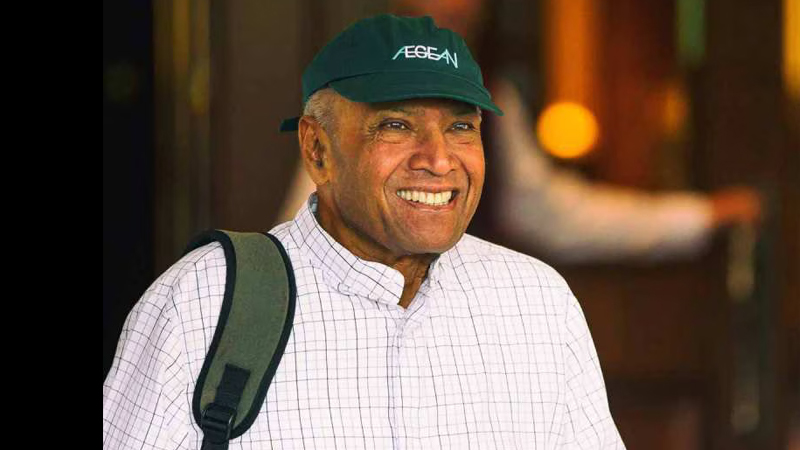
    MUMBAI: Another media baron passes into the great beyond. Malayasian billionaire Ananda Krishnan who set up the successful pay TV platform Astro in Malaysia  and established satellite operator Measat passed away on 28 November at  the age of 86.  

    Ananda was known to be close to Mahathir Mohamad who was Malaysia’s prime minister from 1981 to 2003 and 2018 to 2020. He persuaded him to build the famed Petronas twin towers in Kuala Lumpur.

    Ananda was the founder and chairman of Usaha Tegas, as well as the founder of Yu Cai Foundation. He also helped transform telecom firm Maxis into one of the largest operators in the country. He helped finance Bob Geldof’s  Live Aid concert in the eighties. He  was ranked Malaysia’s sixth-richest person and 671 wealthiest person globally in 2024, with an estimated net worth of $5.1 billion, according to  Forbes.  

    In India, Ananda unsuccessfully  invested an estimated $7 billion to set up telco Aircel which filed for bankruptcy protection in 2018.

    Ananda had three children, including his only son, Ven Ajahn Siripanyo who is a Buddhist monk.

    May he Rest in Peace!

    Astro Malaysia made the following post on its website:

    Astro Malaysia Holdings Berhad (Astro) mourns the loss of our shareholder, Ananda Krishnan Tatparanandam, on 28 November 2024, whose unparalleled contributions shaped the landscape of Malaysia’s media, telecommunications, and entertainment industries.

    Group Chief Executive Officer Euan Daryl Smith expressed profound sorrow on behalf of Astro, stating: “Mr Ananda Krishnan’s vision went beyond creating a company; he created a purpose. Through Astro, he touched lives—by providing jobs, nurturing talent, and fostering a shared sense of joy through the power of entertainment. His enduring commitment to excellence and humanity will continue to inspire us as we carry forward his legacy. We extend our heartfelt condolences to his family during this time of loss.”

    We join the nation in honoring a remarkable individual whose contributions will forever be etched in Malaysia’s history. Our deepest condolences go out to the family during this difficult time.

    We humbly request that the family’s privacy be respected as they mourn their loss.”


    (Pix courtesy Scott Jordan)

  • MEASAT & Sun TV partner for global multi-language channels distribution

    MEASAT & Sun TV partner for global multi-language channels distribution

    Mumbai: MEASAT Global Berhad (“MEASAT”) – Malaysia’s premier satellite solutions provider, has signed an agreement with Sun TV Network Ltd (“Sun TV”), one of India’s largest media conglomerates, to support the distribution of 37 TV channels via the MEASAT-3d satellite. These channels broadcast in seven languages, will reach over 140 million households in India and extend to audiences in the Asia Pacific, Europe, and Africa.

    “MEASAT is honoured to be selected by Sun TV to distribute their channels across multiple regions reinforcing our position as Asia’s preferred broadcast partner. With the state-of-the-art MEASAT-3d satellite at the 91.5°E hotslot, we are ready to deliver high- quality, reliable transmission services for one of India’s top broadcasters. This collaboration strengthens MEASAT’s industry presence and recognition in India, enabling us to expand our services to meet customer demands,” commented MEASAT chief commercial officer Ganendra Selvaraj.

    Sun TV chief technology officer S Kannan added: “We are pleased to partner with MEASAT for satellite distribution to reach our audiences globally, including the most remote locations. MEASAT’s flexibility, broad portfolio of solutions, and extensive reach make them an ideal partner for ensuring our content delivery. We look forward to exploring further opportunities with MEASAT to enhance our offerings.”

  • MEASAT to distribute Starlink services

    MEASAT to distribute Starlink services

    Mumbai: MEASAT Global Berhad (“MEASAT”) – Malaysia’s premier satellite solutions provider has officially signed with Space Exploration Technologies Corp (SpaceX) to become the official authorised reseller for Starlink Hardware and Services in the markets that MEASAT serves. The agreement was formalised in December 2023.

    The official authorised reseller status enables MEASAT to solidify its position as a one-stop provider for customers in pursuit of the most suitable satellite services and solutions that address their needs. Meanwhile, Starlink will be able to benefit from  MEASAT’s established market presence and strong on-ground customer service and technical support, including a 24×7 helpdesk operated by in-country personnel and onsite support and maintenance. MEASAT’s customers have long benefited from end-to-end inclusive packages for last-mile logistics and installation services, as well as repair and maintenance, which will now extend to Starlink products offered by MEASAT.

    “MEASAT is delighted to work with Starlink as the official authorised reseller in our markets. As the leading Malaysian satellite solutions provider, we have always been open to working with other entities to deliver the benefits of satellite technology to our customers which include government agencies, commercial enterprises and rural  residents via a diverse portfolio of solutions to meet evolving needs. For example, by infusing Starlink’s capabilities into MEASAT’s CONNECTme NOW satellite broadband service, we are able to further enhance high-speed Internet services for the last three per cent of Malaysians lacking terrestrial connections. In addition, our capacity to offer fit-for-purpose, high-availability services for MEASAT’s client base in the oil & gas, maritime, and enterprise sectors will be expanded,” said MEASAT chief commercial officer Ganendra Selvaraj.

    “Our new status as an official authorised reseller for Starlink marks a milestone in our ongoing growth journey, being the first non-geostationary orbit (“NGSO”) satellite products offered through our on-ground network, as we continue exploring other potential NGSO solutions for our suite of services,” he elaborated.

  • MEASAT recognised as Regional Satcom Operator of the Year 2023

    MEASAT recognised as Regional Satcom Operator of the Year 2023

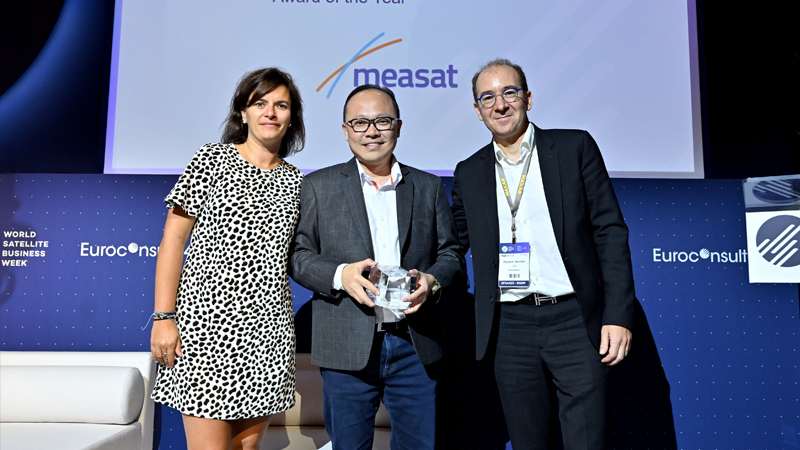
    Mumbai: MEASAT, Malaysia’s premier satellite operator was recognised with the Regional Satcom Operator of the Year 2023 award at the 26th Annual Awards for Excellence in Satellite Business. The awards ceremony took place in Paris on 13 September as part of the World Satellite Business Week conference. The prestigious event was organised by Euroconsult Group, the leading global strategy consulting and market intelligence firm specialising in the space sector and satellite-enabled verticals.

    The Annual Awards for Excellence in Satellite Business recognises the most forwardthinking businesses and innovators shaping the future of the global space sector. In each year, accomplishments by space and satellite companies that have distinguished themselves are celebrated, while people and entities that contribute positively to the space and satellite sectors are recognised.

    “MEASAT is deeply honoured to receive the Regional Satcom Operator of the Year 2023 award by Euroconsult at the industry-leading World Satellite Business Week conference. This recognises our team’s hard work that has benefited clients, communities, schools, frontline security forces, and the countries in which we operate. As Malaysia’s homegrown Satellite Solutions Provider and Rural Broadband Service Provider, we focus on bridging communications gaps across Asia-Pacific. We’ll continue leveraging the latest technologies to bring solutions for enterprise clients, expand mobility services, and ensure digital inclusion for underserved communities,” commented MEASAT chief operating officer Yau Chyong Lim.

    This is the third recognition for MEASAT by Euroconsult. In 2016, MEASAT received the Regional Operator of the Year award at the 13th Annual Awards for Excellence in Satellite Communications, while in 2008, the company received the Regional Satellite Operator of the Year award at the Excellence in Satellite Management Awards held in conjunction with the 12th World Summit for Satellite Financing.

  • MEASAT adds 3 channels from South Asia

    MEASAT adds 3 channels from South Asia

    MUMBAI: MEASAT satellite systems, on 2 July, expanded its video region in South Asia with the distribution of News24, Sagarmatha TV and Prime TV. The satellite system is a premium supplier of communication and video services to leading broadcasters, direct-to-home (DTH) platforms and telecom operators. MEASAT provides services to over 150 countries representing 80 per cent of the world’s population across Asia, Middle East, Africa, Europe and Australia, withcapacity across six communication satellites. MEASAT senior VP – sales Raj Malik said, “We are delighted to welcome and distribute News24, Sagarmatha TV and Prime TV via the MEASAT video distributionnetwork. The addition of these channels is testimonial to the trust broadcasters place on the strength of our distribution via our 91.5°E video hot slot.” Feeds of all the three channels are taken from Nepal. News 24 being the premium news channel shares ground breaking news of the region. Sagarmatha TV is thefirst Nepali news broadcast channel, dedicated to keep its audiences informed of events happening in Nepal and to display their culture to the multinational communities in America and around the world. Prime TV is one of the newest channel in Nepal which is designed to serve all genres from entertainment,infotainment, news and views. The 91.5°E prime video hot slot is home to the MEASAT-3, MEASAT-3a and MEASAT3b satellites, forming one of the region’s strongest video community.

  • MEASAT to display Next Generation Compression for UHD channels distribution

    MEASAT to display Next Generation Compression for UHD channels distribution

    MUMBAI: MEASAT Global Berhad (“MEASAT”) announced today a showcase in collaboration with NovelSat and V-Nova to demonstrate cutting-edge compression for Ultra High Definition (UHD) primary distribution over satellite. The new technology provides up to three (3) times bandwidth savings and will be demonstrated live at MEASAT’s booth in CommunicAsia 2018 from 26 – 28 June.

    MEASAT has also partnered with some of Asia’s leading UHD content creators for this must-see showcase. Fashion One 4K, Fun Box UHD, Insight UHD, Love Nature 4K and TravelXP 4K will display their UHD content on a stunning 86 inch 4K UHD TV sponsored by LG.

    The content will be encoded using V-Nova’s PERSEUS Plus codec at 50 fps, 4:2:0 8- bit colour depth and broadcast with DVB-S2 at 8 Mbps. The NovelSat NS4 based solution can deliver more information bit rates per MHz and raises the total transmission capacity. The feed will then be delivered via MEASAT-3 satellite at the 91.5°E orbital slot to CommunicAsia. This solution makes distribution of UHD channels more cost effective without compromising video quality.

    “One reason MEASAT is Asia’s preferred UHD partner is because of our commitment and belief in working with leading technology partners to provide innovative solutions to the market,” said Raj Malik, Senior Vice President – Sales. “With NovelSat and V-Nova, MEASAT continues to be on the cutting edge of broadcast technology and provide significant cost savings for UHD distribution across the Asia Pacific.”

    “Driven by more channels and more high resolution content, MEASAT is constantly on the lookout for solutions that help them manage increasing demand for satellite capacity,” said Ronen Sadan, AVP Marketing, NovelSat. “NovelSat NS4 offers the world’s most efficient satellite transmission technology, which makes it easier for MEASAT to expand their offering using much less bandwidth compared with other solutions.”

    “We are delighted to partner with MEASAT and NovelSat to deliver this monumental step forward in UHD primary distribution,” commented Guido Meardi, Founder and CEO of V- Nova. “Delivering live UHD at the quality consumers demand at just 8 Mbps is simply impossible with any other video codec and is another great showcase of how PERSEUS Plus can transform the economics of video delivery throughout the industry.”

  • Casbaa Satellite Industry Forum 2016: Seizing new growth opportunities amidst technological and economic changes

    Casbaa Satellite Industry Forum 2016: Seizing new growth opportunities amidst technological and economic changes

    MUMBAI:  The emergence of new technologies in the satellite industry, including the arrival of HTS GSO and NGSO systems, is prompting the industry to embrace a substantial shift – from offering one-size-fits-all capacity to creating value propositions better tailored to customers’ fast-growing, diverse demand and the price pressures in dynamic economic circumstances.

    This was a key focus at CASBAA Satellite Industry Forum 2016, attended by close to 200 industry leaders yesterday at Pan Pacific Singapore. Nine high-level panels discussed a wide range of topics – from the latest strategies in the challenging market landscape, the rise in NGSO systems, to developments in the launch market and perspectives on airline communications, broadband and enterprise solutions.

    Demand for superior value proposition

    In the Asia Pacific Satellite Leadership Roundtable, key industry leaders agreed that despite cyclical downturns in industries like oil and gas, there is still immense market potential in Asia. “These are cyclical forces that don’t fundamentally lead to long-term decline in demand,” said Mr. Jean-François Fenech, CEO of Eutelsat Asia. “Usage in data is continuing to pick up.”

    Panellists highlighted long-term fundamentals for sustained growth in video and broadband data connectivity, which lead to continued investments in growth across the region. These are manifested in initiatives to enhance satellite efficiency and launch new ones to expand capacity.

    Amidst intense competition in the industry, the second panel “Is the NGSO Revolution Coming?” discusses the arrival of the NGSO systems as a new alternative for delivering the optimal experience in the most cost-effective manner. Mr Mark Rigolle, CEO of LeoSat Enterprises, said: “Satellites are now better than terrestrial solutions. Our focus is to be the fastest, most secure network, do it better than fibre and do it better than what satellites have so far been able to do.”

    However, beyond debates on seemingly competing technologies – between NGSO and GSO, Ku and Ka bands, terrestrial and satellite – the discussion called for the industry to take a more customer-focused approach. “You want to offer end-to-end services; you don’t want to merely sell bandwidth and MHz. Ultimately, what your customers care about are the end benefits,” said Mr. Stéphane Chenard, Senior Associate Consultant, Euroconsult.

    Featuring updates from leaders in the launch market, the third panel underlined the need to focus on the economic calculus of satellite launches and not just the technology. Mr Jacques Breton, Senior Vice President, Sales & Business Development, Arianespace, said half of the company’s backlog comprises NGSO, but also added: “We are agnostic on any orbit; for us, it’s about providing the appropriate vehicles and solutions at the appropriate cost.”

    The discussion on cost is especially pertinent with the advent of new innovations that claim to offer greater efficiency and lower costs, unlocking industry-disrupting possibilities that make space more accessible.

    “We have been successful in changing the cost paradigm,” said Mr. Jonathan Hofeller, Vice President of Commercial Sales, SpaceX. “We will continue to see smaller satellites and newer constellations come online that couldn’t afford to previously. For small satellites, we have tapped on third party ride-share missions.”

    In addition, the panel cited reusability and automation as measures that are being adopted for enhancing efficiency.

    Aeronautical applications in ongoing evolution

    The fourth panel featured an exciting discussion on whether satellite applications in aeronautics and in-flight connectivity are merely a flash in the pan, especially given the challenges in monetising this service proposition. Panellists agreed that there is no singular model, as airlines integrate connectivity in different ways – from ‘freemium’ offering to pay-as-you-go amongst low-cost carriers.

    The panel also highlighted the fact that besides passenger and consumer connectivity, the aeronautics sector generates demand for satellite applications in aircraft operations. Even as antenna and satellite technology evolves, airlines are demanding options that are readily available to support their capabilities.

    Towards World Radiocommunication Conference (WRC) ’19

    In a rallying call, Mr. Gonzalo de Dios, Associate General Counsel, Intelsat emphasised that in the aftermath of WRC ’15, the industry needs to advocate for a vision of the critical role that satellite will play in an ever-connected world through close coordination between service providers, end users, and customers at domestic and regional levels. “This is about connectivity on a global level and the imperative to serve underrepresented areas.”

    Continued optimism amidst price pressures

    While demand for satellite capacity is rapidly increasing, pricing remains low. Panellists in the “The Customer is Always Right – Sometimes” discussion tackled growing customer expectations by advocating for more aggressive business models to attract and retain customers. They also identified video as an emerging opportunity for huge growth potential.  

    Mr. Vaibhav Magow, Regional Director, Asia-Pacific, Hughes Network Systems, LLC, said: “The industry is opening up many market segments that were not available to us in the past. With new technological developments, we are now starting to gain back a space in the traditional telecommunications world and fight back through innovation. That’s a really strong reason to be optimistic.”

    Meanwhile, panellists on the “CEO Panel – The Sharp End” responded to falling transponder prices by stressing the need for businesses to increase flexibility and quality of their services to remain competitive in the market. Mr Steve Collar, CEO of O3b Networks, said falling prices offer opportunities for the industry to innovate and deliver solutions that are more relevant to customers, and urged the satellite business to transform from a scarce, niche industry into a more accessible one.

    Indonesia as a growth market

    At the session “Focus on Indonesia”, panellists said weak economic fundamentals and the gap between rising operational costs and consumers’ ability to pay are key challenges for the satellite industry in Indonesia. Nevertheless, the fragmented archipelago heavily relies on satellite services, and demand for bandwidth in Indonesia has quadrupled in the last five years, said Mr. Henry Mulya, Sales Director, Asia Pacific, SES.

    The way forward for the satellite industry

    To close, CEOs of leading satellite businesses discussed the way forward for the satellite industry and the challenges it currently faces. Acknowledging the harsh stock market perceptions of the industry, the key business leaders emphasized that the business realities point towards long-term growth that can be accomplished through continuous innovation.

    Summing up the day’s discussions, Mr. Paul Brown-Kenyon, Chairman, CASBAA Satellite Industry Committee and CEO of MEASAT said: “We are at an important transformational place, and the world is changing dramatically. The amount of money we pay for data today is the same as five years ago, but the data we consume is ten times more. I think our business would change, and the role we play in the communications sector would change.”

  • Casbaa Satellite Industry Forum 2016: Seizing new growth opportunities amidst technological and economic changes

    Casbaa Satellite Industry Forum 2016: Seizing new growth opportunities amidst technological and economic changes

    MUMBAI:  The emergence of new technologies in the satellite industry, including the arrival of HTS GSO and NGSO systems, is prompting the industry to embrace a substantial shift – from offering one-size-fits-all capacity to creating value propositions better tailored to customers’ fast-growing, diverse demand and the price pressures in dynamic economic circumstances.

    This was a key focus at CASBAA Satellite Industry Forum 2016, attended by close to 200 industry leaders yesterday at Pan Pacific Singapore. Nine high-level panels discussed a wide range of topics – from the latest strategies in the challenging market landscape, the rise in NGSO systems, to developments in the launch market and perspectives on airline communications, broadband and enterprise solutions.

    Demand for superior value proposition

    In the Asia Pacific Satellite Leadership Roundtable, key industry leaders agreed that despite cyclical downturns in industries like oil and gas, there is still immense market potential in Asia. “These are cyclical forces that don’t fundamentally lead to long-term decline in demand,” said Mr. Jean-François Fenech, CEO of Eutelsat Asia. “Usage in data is continuing to pick up.”

    Panellists highlighted long-term fundamentals for sustained growth in video and broadband data connectivity, which lead to continued investments in growth across the region. These are manifested in initiatives to enhance satellite efficiency and launch new ones to expand capacity.

    Amidst intense competition in the industry, the second panel “Is the NGSO Revolution Coming?” discusses the arrival of the NGSO systems as a new alternative for delivering the optimal experience in the most cost-effective manner. Mr Mark Rigolle, CEO of LeoSat Enterprises, said: “Satellites are now better than terrestrial solutions. Our focus is to be the fastest, most secure network, do it better than fibre and do it better than what satellites have so far been able to do.”

    However, beyond debates on seemingly competing technologies – between NGSO and GSO, Ku and Ka bands, terrestrial and satellite – the discussion called for the industry to take a more customer-focused approach. “You want to offer end-to-end services; you don’t want to merely sell bandwidth and MHz. Ultimately, what your customers care about are the end benefits,” said Mr. Stéphane Chenard, Senior Associate Consultant, Euroconsult.

    Featuring updates from leaders in the launch market, the third panel underlined the need to focus on the economic calculus of satellite launches and not just the technology. Mr Jacques Breton, Senior Vice President, Sales & Business Development, Arianespace, said half of the company’s backlog comprises NGSO, but also added: “We are agnostic on any orbit; for us, it’s about providing the appropriate vehicles and solutions at the appropriate cost.”

    The discussion on cost is especially pertinent with the advent of new innovations that claim to offer greater efficiency and lower costs, unlocking industry-disrupting possibilities that make space more accessible.

    “We have been successful in changing the cost paradigm,” said Mr. Jonathan Hofeller, Vice President of Commercial Sales, SpaceX. “We will continue to see smaller satellites and newer constellations come online that couldn’t afford to previously. For small satellites, we have tapped on third party ride-share missions.”

    In addition, the panel cited reusability and automation as measures that are being adopted for enhancing efficiency.

    Aeronautical applications in ongoing evolution

    The fourth panel featured an exciting discussion on whether satellite applications in aeronautics and in-flight connectivity are merely a flash in the pan, especially given the challenges in monetising this service proposition. Panellists agreed that there is no singular model, as airlines integrate connectivity in different ways – from ‘freemium’ offering to pay-as-you-go amongst low-cost carriers.

    The panel also highlighted the fact that besides passenger and consumer connectivity, the aeronautics sector generates demand for satellite applications in aircraft operations. Even as antenna and satellite technology evolves, airlines are demanding options that are readily available to support their capabilities.

    Towards World Radiocommunication Conference (WRC) ’19

    In a rallying call, Mr. Gonzalo de Dios, Associate General Counsel, Intelsat emphasised that in the aftermath of WRC ’15, the industry needs to advocate for a vision of the critical role that satellite will play in an ever-connected world through close coordination between service providers, end users, and customers at domestic and regional levels. “This is about connectivity on a global level and the imperative to serve underrepresented areas.”

    Continued optimism amidst price pressures

    While demand for satellite capacity is rapidly increasing, pricing remains low. Panellists in the “The Customer is Always Right – Sometimes” discussion tackled growing customer expectations by advocating for more aggressive business models to attract and retain customers. They also identified video as an emerging opportunity for huge growth potential.  

    Mr. Vaibhav Magow, Regional Director, Asia-Pacific, Hughes Network Systems, LLC, said: “The industry is opening up many market segments that were not available to us in the past. With new technological developments, we are now starting to gain back a space in the traditional telecommunications world and fight back through innovation. That’s a really strong reason to be optimistic.”

    Meanwhile, panellists on the “CEO Panel – The Sharp End” responded to falling transponder prices by stressing the need for businesses to increase flexibility and quality of their services to remain competitive in the market. Mr Steve Collar, CEO of O3b Networks, said falling prices offer opportunities for the industry to innovate and deliver solutions that are more relevant to customers, and urged the satellite business to transform from a scarce, niche industry into a more accessible one.

    Indonesia as a growth market

    At the session “Focus on Indonesia”, panellists said weak economic fundamentals and the gap between rising operational costs and consumers’ ability to pay are key challenges for the satellite industry in Indonesia. Nevertheless, the fragmented archipelago heavily relies on satellite services, and demand for bandwidth in Indonesia has quadrupled in the last five years, said Mr. Henry Mulya, Sales Director, Asia Pacific, SES.

    The way forward for the satellite industry

    To close, CEOs of leading satellite businesses discussed the way forward for the satellite industry and the challenges it currently faces. Acknowledging the harsh stock market perceptions of the industry, the key business leaders emphasized that the business realities point towards long-term growth that can be accomplished through continuous innovation.

    Summing up the day’s discussions, Mr. Paul Brown-Kenyon, Chairman, CASBAA Satellite Industry Committee and CEO of MEASAT said: “We are at an important transformational place, and the world is changing dramatically. The amount of money we pay for data today is the same as five years ago, but the data we consume is ten times more. I think our business would change, and the role we play in the communications sector would change.”

  • Digital India is CASBAA India Forum 2016’s theme

    Digital India is CASBAA India Forum 2016’s theme

    MUMBAI: On March 22 CASBAA will host local and international speakers at the India Forum 2016, its annual discussion panel. The speakers will focus on the fast-evolving Indian broadcasting industry in the advent of the Digital India initiative.

    “The Government of India’s Digital India initiative has brought about a revolution in the country’s economy and has ushered in a plethora of opportunities for sectors to drive the overall digital revolution in India,” said  CASBAA CEO Christopher Slaughter. “We see that digital content in India is at an inflection point and the nation is at the top of digital and high-definition (HD) adoption. Further, we have observed that the content creators and broadcasters are increasingly evaluating new media and content delivery alternatives and are planning significant capital expenditure to upgrade their infrastructure in the coming years.”

    This year, corporate partners for the CASBAA India Forum 2016 include SES (Supporting Sponsor), AsiaSat, Diagnal, Eutelsat, MEASAT, Verimatrix, Videocon d2h and WWE Network (Sponsors).

    “Digital India – The Four Phases of Cable Enlightenment” is this year’s theme for the CASBAA India Forum 2016. A diverse roster of expert speakers will discuss India’s continued growth, including such topics as digitization challenges, security aspects, Indian OTT industry, advertising trends in Digital India, impact of digital advertising on traditional media, satellite industry in India among others.

    Several industry experts are expected to attend this event.   Trai chairman R.S. Sharma is expected to deliver the opening keynote address.  The inaugural address will be made by MIB Special Secretary J S Mathur and the industry keynote address will be delivered by  Tata Sky MD and CEO Harit Nagpal (Industry Keynote). Others attending the event include TRAi’s  Principal Advisor, Broadcast & Cable S K Gupta,  MIB Joint Secretary -Broadcasting R. Jaya, APT Satellite sales director for Indian and Middle East Thomas Antony ,   AsiaSat CEO William Wade,  BBC Global News COO Naveen Jhunjhunwala,  Disney India Media Networks vice president Nikhil Gandhi, Eutelsat UK MD  Nicholas Daly,  Google India Industry director   Nitin Bawankule,  Hathway CEO Jagdish Kumar, Media, Hinduja Group CEO Anthony D’Silva, Intelsat India country manager Gaurav Kharod, MEASAT CEO Paul Brown-Kenyon, MEC South Asia managing director T. Gangadhar and  Viacom18 Digital Ventures COO Gaurav Gandhi.  

  • Digital India is CASBAA India Forum 2016’s theme

    Digital India is CASBAA India Forum 2016’s theme

    MUMBAI: On March 22 CASBAA will host local and international speakers at the India Forum 2016, its annual discussion panel. The speakers will focus on the fast-evolving Indian broadcasting industry in the advent of the Digital India initiative.

    “The Government of India’s Digital India initiative has brought about a revolution in the country’s economy and has ushered in a plethora of opportunities for sectors to drive the overall digital revolution in India,” said  CASBAA CEO Christopher Slaughter. “We see that digital content in India is at an inflection point and the nation is at the top of digital and high-definition (HD) adoption. Further, we have observed that the content creators and broadcasters are increasingly evaluating new media and content delivery alternatives and are planning significant capital expenditure to upgrade their infrastructure in the coming years.”

    This year, corporate partners for the CASBAA India Forum 2016 include SES (Supporting Sponsor), AsiaSat, Diagnal, Eutelsat, MEASAT, Verimatrix, Videocon d2h and WWE Network (Sponsors).

    “Digital India – The Four Phases of Cable Enlightenment” is this year’s theme for the CASBAA India Forum 2016. A diverse roster of expert speakers will discuss India’s continued growth, including such topics as digitization challenges, security aspects, Indian OTT industry, advertising trends in Digital India, impact of digital advertising on traditional media, satellite industry in India among others.

    Several industry experts are expected to attend this event.   Trai chairman R.S. Sharma is expected to deliver the opening keynote address.  The inaugural address will be made by MIB Special Secretary J S Mathur and the industry keynote address will be delivered by  Tata Sky MD and CEO Harit Nagpal (Industry Keynote). Others attending the event include TRAi’s  Principal Advisor, Broadcast & Cable S K Gupta,  MIB Joint Secretary -Broadcasting R. Jaya, APT Satellite sales director for Indian and Middle East Thomas Antony ,   AsiaSat CEO William Wade,  BBC Global News COO Naveen Jhunjhunwala,  Disney India Media Networks vice president Nikhil Gandhi, Eutelsat UK MD  Nicholas Daly,  Google India Industry director   Nitin Bawankule,  Hathway CEO Jagdish Kumar, Media, Hinduja Group CEO Anthony D’Silva, Intelsat India country manager Gaurav Kharod, MEASAT CEO Paul Brown-Kenyon, MEC South Asia managing director T. Gangadhar and  Viacom18 Digital Ventures COO Gaurav Gandhi.