Tag: M&E industry

  • GUEST COLUMN: The role of AI and ML in the media industry

    GUEST COLUMN: The role of AI and ML in the media industry

    Mumbai: There is truly no such thing as “show business!” We have seen the world of entertainment and media shape shift over the last few years, and more dramatically ever since the world around us changed in the wake of the pandemic. The entertainment industry showed a massive fillip during the lockdown years, but not in the way that was expected. The new age of media and social media platforms have transformed the way entertainment is consumed today, and the role of technology has become far more intrinsic along the way too. Everything from how we create, publish, and share textual, audio, and video content to the increasing accessibility of production technologies such as high-resolution cameras, content development software, and smartphones is changing. The landscape is burgeoning with tech-driven innovation both from the delivery and consumption ends of the spectrum.

    With revenue expected to exceed $9.5 billion in 2022 when video ad tech is taken into account, the importance of AI and ML in the media and entertainment sector can no longer be dismissed. While it may not have been an obvious use case earlier, today, harnessing AI and ML to better target homes with advertisements, automate more operations, and secure the operators’ content and services is only the tip of the iceberg. AI has already demonstrated its promise in the music business by producing beautiful tunes and in the world of art with a strong aesthetic influence. It will be interesting to see how AI in entertainment is likely going to have a marked influence on how people interact with movies, television shows, videos, sports, and games.

    Glimpses of this shift are already apparent today. Media firms realise the growing competition they face with new players in the market, right from OTT platforms to social media platforms, vying for the consumer’s attention. There is a swelling urgency to not only produce more content more rapidly but also ensure that the quality and intrigue of the content produced remains top-notch.

    Enter AI and ML.

    There are myriad applications for these two cutting edge technologies, to enable a massive uptick for media and entertainment businesses, right from beta testing of content to gauge interest to creating interactive content to even assessing the right platform for maximum success and viewership. There is a role for AI and ML to play the hero that saves the day at every juncture.

    Some of the emerging areas of application for AI and ML are:

    Knowing your audience: With increased choices comes the problem of plenty too. Audiences that were previously limited to a few platforms for satiating their entertainment appetite are inundated with a plethora of choices. In such a landscape, knowing audience preferences becomes business critical, and media companies that can harness the power of machine learning to understand their audiences more keenly are going to have a definite advantage as we move ahead by being able to provide relevant and engaging content to each individual every single time.

    Feel with your audiences: It’s not enough to just know who your audience is. A step up from the data intelligence that AI and ML provide is understanding how audiences feel each time they view content that is produced by you. Testing your audience’s emotions can help you dive deeper into how the content was consumed and perceived in order to make future bets that are likely to help you win viewer share and also ensure stickiness in an era when customer/viewer acquisition costs are only climbing up.

    Deliver to your audiences: How many times have you heard the phrase “right place, wrong time”? Marketing leaders understand the critical importance of timing in reaching out to customers. The same content that finds resonance at a particular time can have a diametrically opposite response when you catch the consumer at the wrong hour. Emotion AI can help you not only understand how much of the content delivered is falling on the right side of the scale to ensure better results for your targeted campaigns. Retiring the spray and pray approach could be very possible if advertisers and marketers can tap into the hidden potential that emotion AI helps unlock for all the video content that is being produced for their brands’ success currently.

    Engage your audience: If only we could read the minds of our users to know exactly what they have understood and where the gap remains, all our efforts to produce better content in any context would be multiplied. This function is offered by all major corporations, like YouTube, Netflix, Spotify, etc., to improve the dependability and usability of their services.

    AI is also capable of adjusting video quality for internet speed. AI can analyse the internet connections of various viewers in various regions to handle this issue, and it can compress videos without sacrificing their quality to provide a buffer-free streaming experience.

    Advertising and the media

    Advertising, design, and content promotion are just a few of the marketing and trade applications of artificial intelligence in the entertainment industry. The greatest AI algorithms to use when developing solutions for advertising and marketing that are results-driven. With the use of AI-driven marketing software apps, companies may address the needs and preferences of their audience, develop marketing plans, and create efficient customer-centric digital solutions. For instance, AI in the media sector may quickly produce hundreds of eye-catching graphic designs for advertising. Thanks to such cutting-edge and revolutionary technology, manual labour has been substantially reduced, and productivity has increased. Using emotion AI, the advertiser can understand the best demographic to pinpoint their campaign towards to get maximum output.

    For example, if the emotion AI indicates that a person gets the feelings of passion and attachment while watching a football match, it can help the sportswear company understand that this particular audience and this medium work best to reach them through their campaign. By checking the pre-launch creative intelligence output and post-launch creative intelligence output, the campaigns will become more focused.

    Development of AR/VR

    As we are already seeing with the usage of AR in advertising, it’s important to note that in addition to the fundamental use of AI in entertainment, AR and VR app development will also make this area more compelling and immersive. We will be able to watch events from all angles, enabling us to have experiences that are richer and better. AI will assist us in comprehending the sensation of the actual, live event. AI may, however, be used to produce interactive content for AR and VR. With a set of goggles and AI technology, the entertainment sector may work miracles and produce magnificent scenes.

    Consumer interest is naturally drawn to the creation of virtual reality content for cooking shows, reality shows, and live events and programmes based on artificial intelligence. Watching television and movies with true emotional effects won’t be a pipe dream with all these modern technological advancements; it will certainly become a reality. To make this a reality and to understand the concrete effect of the content, Emotion AI will be a tool that will be pathbreaking and extremely important for advancements in terms of what kind of content would be precise for different pieces and scenarios.

    Harnessing Emotion AI

    For any piece of content to succeed, gaining and sustaining the attention of the audience in question is key. If the audience isn’t engaged from the beginning, one has already lost the plot. It, therefore, becomes imperative that the industry puts its best foot forward by testing creatives before the final launch—it helps to gauge the potential. Pre-testing content using Emotion AI helps empower the creators to better understand how pre-launch video creative intelligence can help drive better business outcomes. Emotion AI testing with a pre-defined target audience helps content creators ascertain whether the content is evoking the right kind of reciprocal emotional response. It empowers the creators to understand zones of high and low engagement and modify content for maximum engagement. The organisations can have the emotional AI response outputs mapped to multiple variables of age, gender, geography, time of day, etc., ensuring that the content is never out of flavour.

    Subtitles and automatic transcription

    International media companies should provide material that is relevant to audiences in different locations. As a result, businesses must offer precise and appealing multilingual subtitles for their video content platforms. It may take thousands of hours and effort to hand write subtitles for several films and TV series in a variety of languages. Additionally, finding the ideal applicant to accurately translate text into several languages is challenging.

    Thus, to bridge this existing gap, the powers of AI-based technologies like deep learning and machine learning are harnessed for natural language processing to transcribe movies, music videos, and TV episodes into many languages. To reach a larger audience and foster user engagement, the voice of the movie is translated into several languages with subtitles and audio commentaries.

    For instance, YouTube’s artificial intelligence helps its publishers easily access their material by automatically generating closed captions for videos posted to the platform.

    Metadata tagging

    With the huge amount of content being created every minute, making this content visible to viewers can be an unnerving task for media and entertainment companies. Distributors and media producers like CBS Interactive are utilising artificial intelligence-based video intelligence technologies to thoroughly analyse the footage by detecting and framing things in order to add appropriate tags in order to carry out this task on a wide scale. As a result, any content held by media firms is easily discoverable, regardless of its bulk.

    Due to the intense rivalry and the changing nature of the market, the economic and business models needed to flourish in the digital world are difficult and call for a considerable change in mentality and approach. Customers are the core of the media industry because they are now more powerful than ever. Organisations all across the world are realising that the customer is really the king and cannot be disregarded. By unravelling and experimenting with AI and ML, media and entertainment houses are maximising their business performance and enhancing the user experience and entertainment value with greater efficiency.

    The author of the article is Lightbulb.ai co-founder and CPO Vishal Soni.

  • “Sports to be a key focus area,” says Punit Goenka as talks move ahead on Zeel-Sony merger

    “Sports to be a key focus area,” says Punit Goenka as talks move ahead on Zeel-Sony merger

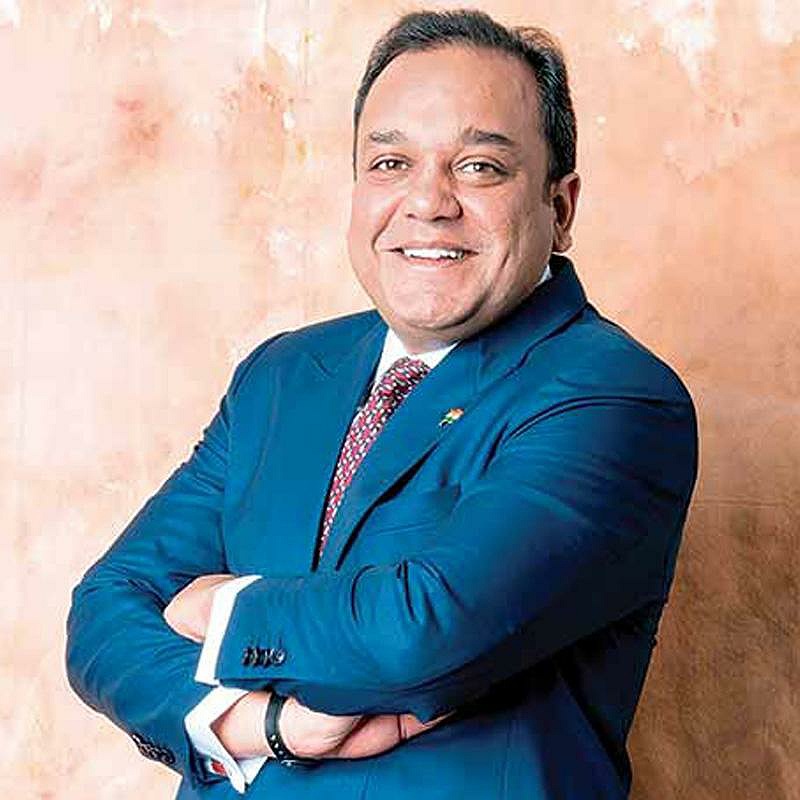
    Mumbai: Sports will be a key focus area for the Zeel-Sony merged entity, said Zee Entertainment Enterprises Ltd (Zeel) MD and CEO Punit Goenka, as the two media companies move forward in building one of the largest entertainment networks in the country. The mega merger announced in September is currently underway.

    “Certainly the merged entity will focus on sports. Zee on a standalone basis will not. We have just finished our non-compete with Sony on the sports side. While we will reconsider sports on a standalone basis, right now, my focus is to look at it from a joint consolidated basis with Sony,” said Goenka, elaborating on the merger. “A lot has changed since we exited the sports business and we sold it to Sony right. So, it is coming full circle. The opportunity is great because the digital landscape has opened up a new opportunity for monetisation which did not exist five years ago. The sector itself will see a lot more happening going forward.”

    The Zeel MD said the TV broadcasting industry has witnessed intense competition since Zee’s inception three decades ago and any consolidation will benefit the overall M&E industry. However, he highlighted that the decision on any kind of bidding will be taken by the board of the new merged company.

    Goenka was addressing the Apos India summit organised by Media Partners Asia, which began virtually on Tuesday. In a conversation with Media Partners Asia executive partner and co-founder Vivek Couto, Goenka also spoke about the role of technology in content creation, broadcasting and streaming, the scope of SVOD business and strategy for TV in a new regulatory environment.

    The Zeel MD said the vision is to create a media powerhouse, but reiterated that the content company thus formed, will remain ‘Indian’ and the focus will be on Indian content, language and culture. Speaking about the synergies with Sony, he said, “The reason I chose Sony is because the two businesses are complementary with minimal overlap. Across linear and digital platforms and genres, we will encompass an entertainment suite that the whole family can watch.”

    According to Goenka, Zeel’s strategy of being SVOD-first will give it the leverage to fight going forward. Even though India has more advertising video on demand users there are 45-50 million paid subscribers that will grow to 200 million in the coming years, he said. The company’s streaming platform Zee5 has also recently announced a content slate of 17-18 originals in H2 2021.

    “The audience watching content on streaming platforms in India are clearly a mobile-first audience looking at the sheer numbers from mobile platforms,” he said. “These audiences are spending 148 minutes watching on SVOD platforms whereas on AVOD it is less than 30 minutes on average.”

    He added, “Before the pandemic people didn’t think 40-50 million people would pay for content but that is the case today. They are not paying a great deal but they are paying. The Zee DNA is to nurture the best minds in the creative ecosystem, be language first, build national scale and we will replicate that on the digital platform,” he said.

    On entering new language markets like Odisha, Bhojpuri and Punjab with their TV channels, Goenka said, “Nobody thought these markets were relevant. We thought even though it is not a big market we can build it into one.”

    Goenka said that data will have a critical role in creation of content in the future. “We have upgraded a technology and innovation centre in Bengaluru which will transform the company’s content offering. At Zee, we are embracing technology. We are a bit late compared to global players but will catch up quickly,” he added.

  • The Big Shift: Where is digital taking the M&E industry?

    The Big Shift: Where is digital taking the M&E industry?

    NEW DELHI/MUMBAI: It’s a rainy afternoon in Delhi and 48-year-old homemaker Sunita is looking for recipes for fritters on YouTube on a smartphone she was recently gifted by her husband. She has made fritters a thousand times in her life and she knows the recipe to it by heart, but she likes to watch chefs online to “learn new tricks” for perfecting her already excellent culinary skills. Sometimes, she plugs in the firestick on her smart TV and scrolls through Amazon Prime and Netflix for old movies. Even her evening TV watching has shifted to apps like Hotstar and Voot, which she is still learning to use properly but nevertheless enjoys the ad-free entertainment on demand. 

    This is not just the story of Sunita, but a whole lot of other people from all age groups and interests. Her husband prefers watching news online rather than switching on the TV channels as it is more comfortable to watch it on his phone, though without earplugs. Their three-year-old grandson is learning his ABCs on yet another mobile app and doesn’t miss his Peppa Pig sessions every evening. And as the never-ending lockdown imposes its dark shadow on his probability to attend physical classes like his parents or grandparents, there are investments being made into paid subscriptions of many educational apps and sites, along with other digital tools. 

    Digital, as we know, is dominating all aspects of our lives. From grocery shopping to learning, to working out, to dating; everything has found a digital counterpart and in many cases a competition. 

    The media and entertainment industry is also not untouched from this trend. As per PwC Global Entertainment and Media Outlook 2019-2023, digital revenues are accounting for a larger share of the industry’s total revenue, year-on-year, starting at 40.7 per cent in 2014 and reaching 55.4 per cent in 2019. It is expected to reach 61.6 per cent in 2023. 

    India is not far behind from the global trends. In fact, it is one of the top markets to embrace this digital boom. As per EY-FICCI report 2020, digital media overtook filmed entertainment in 2019 to become the third-largest segment of the M&E sector. Digital media grew 31 per cent to reach Rs 221 billion and is expected to grow at 23 per cent CAGR to reach Rs 414 billion by 2022. 

    “Digital subscription revenues more than doubled from 2018 levels and digital advertising revenues grew to command 24 per cent of total advertising spend. The sector continues to grow at a rate faster than the GDP, driven primarily by growth in subscription-based business models and India’s attractiveness as a content production and post-production destination,” read the report. 

    The same report suggests that OTT subscription market will approximate 10 per cent of the total TV subscription market by 2020 and there will be over 40 million connected TVs by 2025. And while there is no concrete comparative data to see the growth of digital in comparison to traditional forms of media, there have been many agencies and people claiming that Covid2019 has only accelerated this process. Several reports by bodies like BARC, Nielsen and Kantar have hinted at the increased time spent on digital platforms during the lockdown. 

    So, is this big shift to digital indicating a slow demise of traditional media?

    Swastik Productions MD Rahul Kumar Tewary notes that while digital media has gained traction during the past few months, there is not going to be a takeover of the market space that television enjoys by it. Both the mediums may overlap to a certain extent, but in the end, these are two different market segments. 

    “I believe digital is growing but TV will remain the same. I don’t think there will be too much of an impact on TV programming. There is a certain age group of consumers for the digital content; there is a trend that the youth of India is moving towards the digital side,” he shares. 

    Locomotive Global co-founder Sunder Aaron adds, “We will come out of this pandemic at some time and the domination of pay television and the advertisement on pay TV will continue. But it will have a new balance with digital media and digital delivery of content. We still are a country where there is low penetration for digital consumption. Mobile consumption is actually high but if you look at wirelines into households, it’s still very low as compared to the rest of the world. Hopefully, we will see an increase in the wireline broadband penetration over several years and that will be a big game-changer for digital delivery and digital content consumption.” 

    But are there enough rigid lines between TV and digital anymore? Once, during an interview, someone had asked to define television and the gentleman then went on to elaborate that television is more than the idiot box we knew a few years back. It has camouflaged in a ‘smart box’ now, which also hosts traditional entertainment as well as the modern digital options. It also enables personal chatting and social media apps on the big screen and has a far bigger role to play as a shared screen as well.  

    And definitely, no one can deny the part of digital technologies in keeping this traditional form of entertainment up. In the past few years, almost all the big GECs and news channels have launched their own apps to keep pace with the digital age. Be it Hotstar, Sony Liv, Voot, or Zee5, all these applications first started as an inventory of television shows and then went on to host original content as well. 

    All the major telecom players are a part of the revolution as they were in the DTH era. With Airtel launching its own entertainment app and partnering with other OTTs to offer its consumers exclusive access to content, Idea offering live channels on its movies and TV apps and the very popular and Jio announcement Jio TV+ aggregating TV as well as OTT content, digital dominance seems to stay here. Even on the regulators’ side, TRAI recently launched a channel selection app to facilitate easy subscription modifications for users. 

    Digital technology is now everywhere and that’s what made it possible for the world to continue running even during the strictest of lockdowns for the past few months. 

    One of the biggest industries to benefit from it has been the online news industry. In an earlier story , Indiantelevision.com wrote on the movement of mainstream journalists like Vikram Chandra and Faye D’Souza to digital content curation. It showed how the democratic environment that digital offers as a medium allows journalists to be more true and free to express themselves. The added technological features and better reach are cherries on the top. 

    While Chandra admitted of being heavily reliant on AI-based execution of his editorial functions and being in advanced-level talks with some of the OTT players to push his content, Pankaj Pachauri said, “GoNews has been successfully able to converge satellite TV technology with digital technology as our product can be uplinked on any satellite channel digitally for broadcast. We have tried and tested this technology during the last general elections with APN news for its prime time broadcast,” highlighting the vast roles digital technologies are playing there. 

    All this, undoubtedly, has opened up the gates to great opportunities for digital marketers. Most of the functions of an agency have turned data-driven and are claiming to provide a never-attained-before hyper-targeted reach to advertisers. 

    Digitalkites sr. VP Amit Lall, a few weeks back, discussed s the ability of marketers to follow a consumer’s journey not just across platforms but also devices to provide them with a seamless experience and help advertisers understand user behaviour better. 

    Madison Media & OOH group CEO told Indiantelevision.com on Media Minds 2 that the entire digital renaissance has been a big part of his successful five-year-long journey at the agency, thus far. He shared that the share of digital in agency billings has increased from two to three per cent to 20-22 per cent in this time. 

    And this digital intervention is not only helping the programmatic, SEO, search, social and other digital aspects of marketing but also helping traditional options to be more targeted and improved. The whole lot of data collection that is done via digital media is used to chart out trajectories for mainline campaigns. 

    Additionally, the oldest mainline medium of traditional advertising, out-of-home (OOH), has begun its digital journey, again pushed by the Covid2019 lockdown. 

    Eyetalk Media Ventures MD Gautam Bhirani says, “Fuelled by technological advancements as more devices connect with the power of internet-of-things, location-based mobile data can bridge the gap between digital-physical worlds and converging them can give us holistic consumer insights. As we adapt to the pandemic induced lifestyle changes often termed as ‘The New Normal’, it is constantly impacting consumer behaviour, sentiment and journey which makes it imperative for us to learn and integrate these learnings in OOH planning. Detailed analysis of mobile data that determine brand affinity, interests, preferences, income size, gender, commute patterns, dwell time in the online and offline world can help identify locations for OOH placement and mobile device IDs can be used to retarget the consumer.” 

    Laqshya Media Group CEO Atul Shrivastava adds his own experience, “Our transformation from an OOH to a multi-media conglomerate has followed a carefully coordinated strategy of delivering the most optimised consumer-contact solution to our clients by combining digital, OOH and experiential. In order to make our OOH and experiential offerings more interactive, we added a digital marketing company to our network, which gives us the bandwidth to offer our clients an unbeatable offline-online combination.” 

    Digital dominance is clearly shaping up a distinct world, dominating the media and entertainment industry. While there are high chances that traditional platforms will survive this big shift, one can look forward to redefined versions of televisions and newspapers. 

    (With inputs from Anjali Thakur and Shikha Singh) 
     

  • I&B ministry to announce SOPs for M&E industry

    I&B ministry to announce SOPs for M&E industry

    NEW DELHI: Information and broadcasting minister Prakash Javadekar today announced that the government will soon come up with new bring standard operating procedures for shooting in a post-pandemic world and will provide incentives for production across TV, film, animation, gaming and co-production. The completed details will be announced soon, the minister said at the FICCI FRAMES first virtual conference for the media and entertainment industry.

    Javadekar also said that the government will help the M&E industry in every phase and will play the role of partners. He mentioned that the government has to harness the soft power of India for the progress of the country.

    He added that the ministry recently provided facilities to foreign filmmakers to shoot in India through a single-window clearance has helped around 80 producers. He mentioned that India is a cost-effective option for many. Netflix biggie Extraction and Christopher Nolan’s upcoming film Tenet were shot in India.

    Javadekar, in his address, said, "The importance of the media and entertainment sector cannot be stressed enough. The content we produce through TV,  films or digital originals, is consumed by 150 countries. The sector generates millions of jobs and significant revenues. Despite the impact of Covid2019, it is growing at a good pace. Our share in the global market is small but can grow phenomenally. Given India's cost advantage of 40-60 per cent for producing the same quality of content as advanced countries, we can achieve stupendous results if we work together. There is a need for more entrepreneurs, founders and leaders in the media and entertainment sector to steer the industry forward with more innovations, origination and ownership. The government of India stands shoulder to shoulder with the industry in achieving all this."

    Follow Tellychakkar for the consumer facing news & entertainment

  • Covid2019 impact on the M&E industry: A mix of pain, hope and opportunities

    Covid2019 impact on the M&E industry: A mix of pain, hope and opportunities

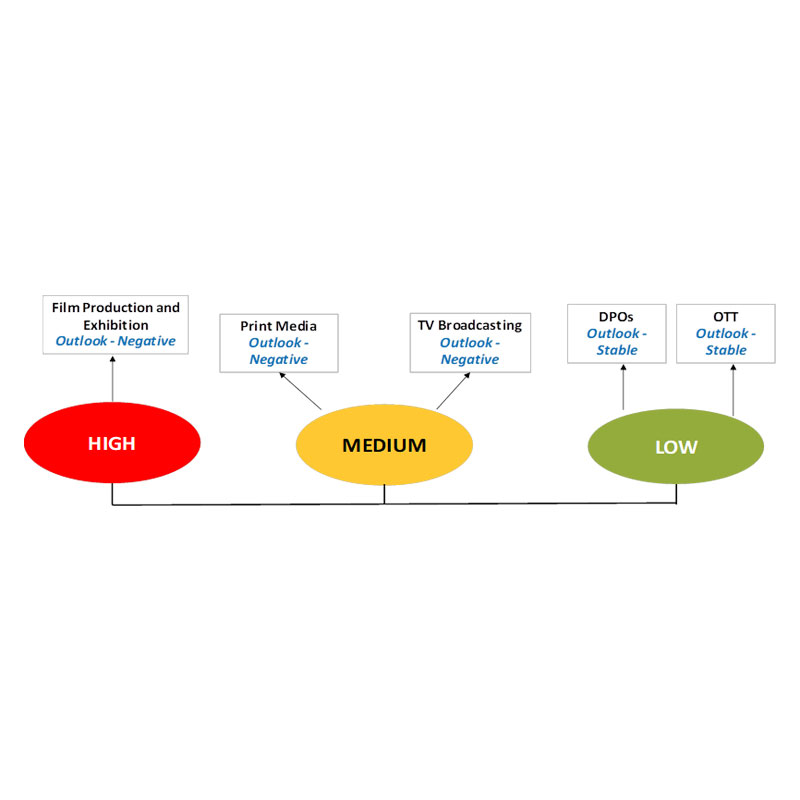
    MUMBAI: The Covid2019 outbreak has impacted the domestic media and entertainment industry, comprising of film production and exhibition, print media and TV broadcasting segments, besides DPOs and OTT Platforms.

    ICRA has a negative credit outlook for the film production and exhibition, print media and TV broadcasting segments of the Indian media and entertainment (M&E) industry. Besides the direct impact by way of lost sales due to the shut-down of cinema halls, given the adverse impact on the overall economy, sharp reduction in advertisement spends has been observed in April and May 2020, and is expected to continue over the short-term. This, in turn, will dampen the revenues and profit margins of the aforementioned segments of the Indian M&E industry in FY2021.

    ICRA assistant vice president Sakshi Suneja says: “Cinema halls were the first ones to shut down, even before the lockdown started, and are expected to be amongst the last segments to witness relaxations. This segment will thus witness a complete loss of revenues in Q1 FY2021. Even after the theatres resume operations post the lockdown, occupancy is expected to remain sub-par as consumers, as a means of caution, are likely to stay away from crowded places. Corporate advertisement spends will witness a decline, adversely impacting the advertisement revenues of film exhibitors. Overall, ICRA estimates a 60-65 per cent YoY degrowth in revenues in FY2021 for the entities engaged in the film exhibition industry. Furthermore, low footfalls once cinema halls resume operations will result in lower box-office collections, adversely impacting the revenues of the film producers”.

    Around 40-45 per cent of the total cost of the film exhibitors (primarily multiplexes) is fixed in nature, with lease rental being the major component accounting for 20-22 per cent of the total cost. To minimise the impact on losses and cash outflows, most of the multiplexes have invoked force majeure clauses in their rental agreements, so that they do not have to pay rental and common area maintenance (CAM) charges during the period of lockdown, and are also negotiating a variable rental structure with the mall owners, once the operations resume. Salary rationalisation and pay cuts have also been undertaken by the exhibitors. Overall fixed expenses have been curtailed on an average by 2/3rd (of earlier levels) during the Covid2019 pandemic.

    ICRA expects the credit metrics for the players in the film production and exhibition segments to weaken materially, though ICRA-rated portfolio has a healthy credit profile.

    For the print media segment, circulation revenues were adversely impacted by 40 per cent on YoY basis in April 2020, amid distribution challenges due to the ongoing lockdown restrictions. Furthermore, advertisement revenues, which were already pressurised during FY2020 amid subdued economic conditions, declined by 60-70 per cent YoY in April 2020.

    Advertisement revenues have also been adversely impacted for the TV broadcasting segment in April 2020. While news and movies genre are on the lower end of the spectrum, with an average decline of 25-30 per cent in advertisement revenues (vis-a-vis average monthly revenues), general entertainment channels (GECs) and sports channels have witnessed a sharp 55-60 per cent reduction in advertisement revenues in April 2020. This is in turn explained by the absence of fresh content (given the shutdowns and travelling restrictions) and deferment of high viewership driving sports events. Subscription revenues, comprising 30 per cent of the total revenues of TV broadcasters, are, however, holding steady as consumers have increased their TV viewing (led by movies and news genre) during the lockdown.

    ICRA vice president Kinjal Shah said: “Weakened advertisement revenues will moderate the revenues and profit margins for entities engaged in the print media and TV broadcasting segments in H1 FY2021, though some recovery in advertisement revenues is expected in H2. Expected normalisation in circulation revenues for the print segment in coming quarters as lockdown restrictions ease and low newsprint prices are some positives. For the TV broadcasters, steady state subscription revenues will provide some shield to revenues. However, fresh content production remains a key challenge. We expect the credit metrics of entities engaged in the print media to weaken in FY2021, though ICRA-rated entities have strong liquidity to weather the impact. The TV broadcasting segment will also witness moderation in credit metrics. The credit outlook for both these segments is negative.”

    ICRA has a stable outlook on the DPOs and the OTT platforms. The impact of the pandemic on the DPOs will be limited as subscribers are expected to hold on to their current subscription packages. New subscriber acquisitions have, however, been impacted as very few new installations are being carried out by DPOs, though the same is expected to resume once the lockdown restrictions ease. Prolonged lack of fresh content from TV broadcasters may, however, increase subscriber churn towards DD Free dish.

    The current lock-down has led to a surge in consumption of OTT platforms as consumers stay home. While currently OTT platforms have an advertisement revenue-dominated business model, the current crisis provides an opportunity to increase the proportion of paid subscription, led by the new habit formation of at-home OTT viewing. Furthermore, with the shut-down of cinema halls and expected aversion to outdoor viewing of films, OTT (especially large platforms) are also being considered by the film producers for their film releases. A shift in advertisers’ preference towards online platforms (vis-a-vis linear platforms) is also expected as they attempt to garner more eyeballs and especially, after the deferments and cancellations of various sports programmes, which were to be aired on linear TV. OTT platforms, however, are also facing dry up of fresh and quality content. Platforms with large content library are thus better placed to ramp up subscribers during the current crisis.

  • Over-regulation can hurt M&E industry: Viacom18 CEO Sudhanshu Vats

    Over-regulation can hurt M&E industry: Viacom18 CEO Sudhanshu Vats

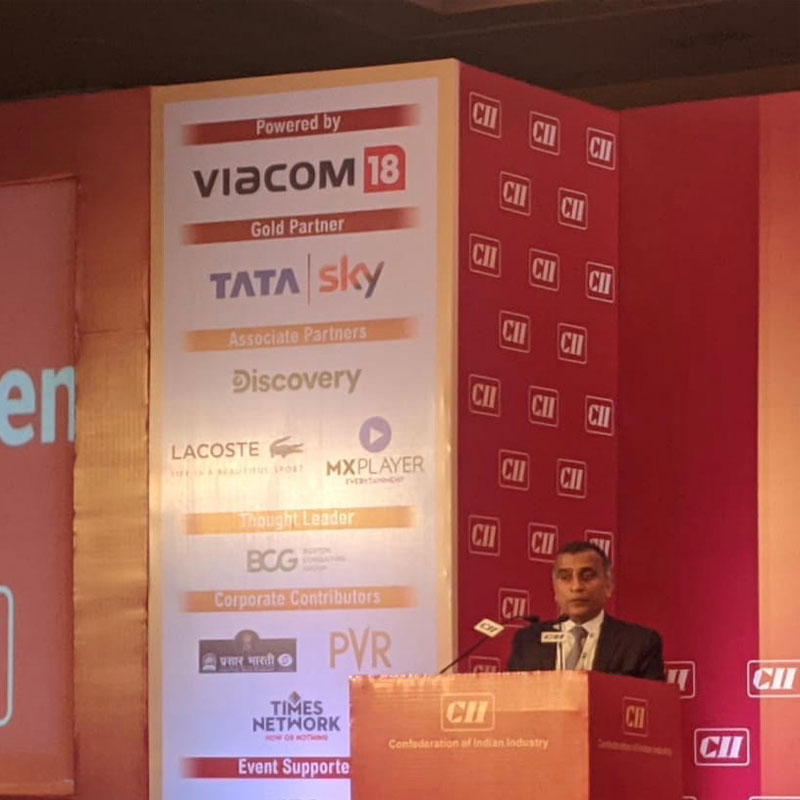
    MUMBAI: Indian M&E industry is on the cusp of a “transformational growth” trajectory and can be a huge driver for PM Narendera Modi’ dream of USD 5 Trillion Indian economy, provided the sector is not over-regulated, Viacom18 group CEO and MD Sudhanshu Vats said today, in his address to CII Big Picture 2019.

    Speaking on the topic ‘Create, Connect & Converge for Transformational Growth’ at the 8th edition of the CII Big Picture Summit in New Delhi, Vats warned against the dangers of over regulating a creative sector like M&E industry.

    Drawing an analogy between overprotective parents and over-regulative governments, Vats said that regulators and policy makers today might be making the same mistake as was made by parents in 1990’s when ‘helicopter parenting’ was popular.

    “It meant hovering around your children to ‘swoop’ in and help them in case they needed support. Over time, this led to over protective parents who actually stunted the ability of their children to transition into independent adulthood.”

     Addressing the policy makers, Vats added: “No one is doubting your intention, but the outcome could be different. This might be disastrous if you recall the…potential for transformational growth. ‘Over parenting’, like over regulating makes it impossible to ‘cut the (umbilical) cord.’ And there’s no way we can compete globally if we don’t cut the cord!”

    Suggesting, instead, a ‘free range’ parenting model, Vats said, “The methodology behind this parenting style is to avoid hovering like a ‘helicopter parent’ by letting children experience life as it happens. We need our policy makers to replicate a similar philosophy of regulation for us. Let us be. Let the dust settle. Yes, we will make mistakes. Yes, we will be naughty at times. But we will learn. And that will make us globally competitive.”

    Vats lauded the TRAI NTO, issued in February this year, but at the same time underlined the dangers of tweaking it frequently every now and then.

    “We’ve just witnessed the most landmark reform in the world of Indian Pay TV broadcasting, ever. Of course, it’s not perfect – but tweaking it every month and quarter will have disastrous consequences. Maybe, in ‘free-range’ style, taking a break for say 2 years – and watching us closely – will be more beneficial for us in the long run,” he added.

    Underlining the huge potential for growth in Indian M&E industry, Vats said that the sector, which currently provides employment to 5 million Indians, can employ more than 10 million people in next 3-4 years.

    “Our export potential is USD 10 billion – more than 10x of what it is today – and we don’t need exhaustive, difficult to negotiate multilateral agreements to get there. We just need the freedom to create, connect and converge,” he said, adding “this is totally in sync with PM Modi’s vision of maximum governance and minimum government.”

    Vats also commended the recent success of Andhadhun and Sacred Games in global markets and said that the Indian content has the potential to make ‘global dent’.

    “We are more or less diaspora focused, and our addressable market comprises (mainly) South Asian diaspora, but recent successes of India digital originals Sacred Games and Andhadhun in China demonstrate that we have the potential to make a global dent,” Vats said.

    CII Big Picture Summit is an annual gathering aimed at discussing, deliberating and decoding policy options to unlock the potential of our M&E sector.

    The summit will be held on 14 and 15 November in Le Meridian, Windsor Place, New Delhi.

  • PVR to launch first 12-screen property in Delhi

    PVR to launch first 12-screen property in Delhi

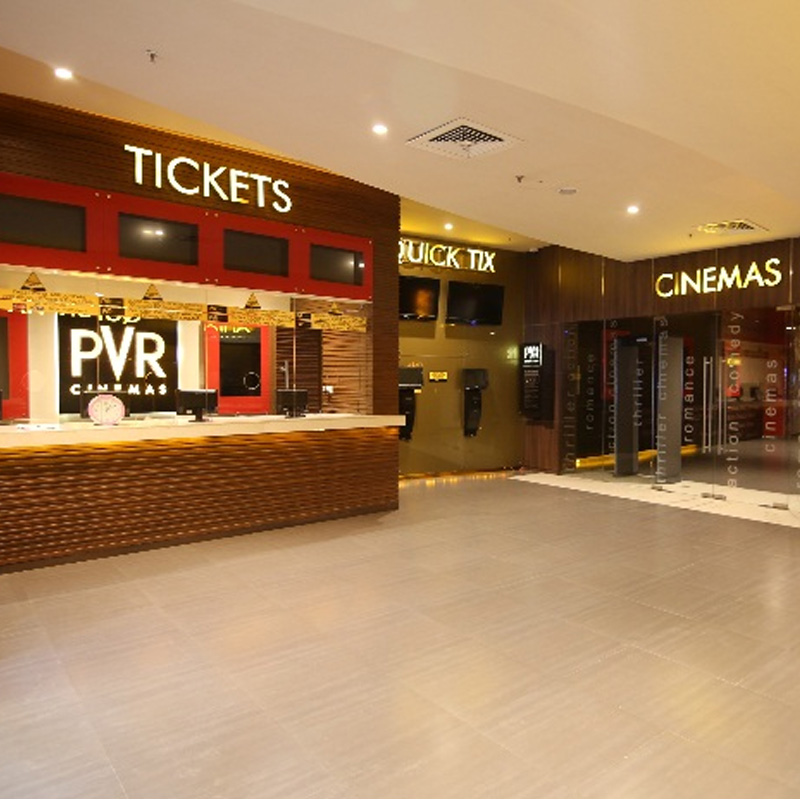
    MUMBAI: Banking on rising theatrical revenues, PVR, one of India’s biggest multiplex chain, will launch its first 12 – Screen Superplex at Vegas Mall, Dwarka, New Delhi, on Monday.

    The flagship property, biggest by PVR in India so far, will be launched in the presence of the starcast of the upcoming romantic action- Marjaavaan and Ajay Bijli, CMD, PVR Ltd, Sanjeev Kumar Bijli, JMD, PVR Ltd and Gautam Dutta, CEO, PVR Ltd. The multiplex will support all movie formats including IMAX and 4DX.

    The launch of 12 – Screen Superplex at Dwarka will also take PVR a tad closer to its aim of achieving the target of 1000 movie screens in India under its chain. Earlier in August, PVR has reached the milestone of 800 screens after it launched a new three-screen property in Sri Ganganagar, Rajasthan. Currently, PVR is present in 69 Indian cities.

    Multiplex business in India is booming despite the disruption caused by OTT in the M&E Industry. As per a recent report in ET, domestic theatrical revenues in India crossed the Rs 100 billion mark in 2018 and will continue to rise in the coming years.

  • India’s M&E industry likely to reach INR 3.07 trillion by FY24

    India’s M&E industry likely to reach INR 3.07 trillion by FY24

    MUMBAI: KPMG in India today launched the 11th edition of its Media and Entertainment (M&E) report, titled ‘India’s Digital Future: Mass of Niches’ that examines the evolution of India’s digital demography to 2030. It also covers the industry’s performance across segments, along with the key underlying themes and growth drivers.

    The M&E industry in India posted a solid growth of 13 per cent during FY19 to reach a size of INR 1631 billion with a CAGR of 11.5 per cent over FY15-FY19. Digital has been a recurring theme across all segments of M&E causing disruption in TV and print and fuelling growth in digital advertising and gaming. The digital market is poised to become the second largest segment in India after TV, and also attract the maximum advertising spend by FY22. There are favourable factors for both digital access (smartphone penetration and low data costs) and content supply (investments in original and regional digital content), which together will continue to drive up online consumption. The investments in regional content is an outcome of the growing importance of regional language markets in India, which is another key theme of the report this year. With the digital migration of English speaking audiences almost complete, most new users coming online – and there are expected to be 500mn of them by 2030 – will access the internet in a local language. 

    The 500mn new users by 2030 present digital businesses with an unparalleled market opportunity but not without some complexity. Segmentation will become important as the market evolves into a ‘mass of niches’. The report examines major consumer archetypes that together provide a framework to better understand the socio-economic profile as well as media and entertainment consumption patterns and preferences of the projected billion internet users.

    The greater monetisation of emerging digital business models, and a favourable regulatory and operating environment should continue to support the growth of the M&E industry in India, which is expected to post a CAGR of 13.5 per cent over FY19-FY24, to reach a size of INR3.07 trillion.

    Girish Menon, Partner & Head Media & Entertainment, KPMG in India, said, “The theme of the report this year is India’s digital future – and although the term ‘digital revolution’ has become somewhat of a cliché, there can be no other way to explain the extent of digital integration in our lives today. With no major constraining factors, digital is expected to be a dominant force going forward and in FY23, it is likely to be the second largest segment after TV and attract the highest marketing spend among all media formats. In 2019, as digital behaviour evolves, there seems to be a growing consensus that in the future, subscription models will have a greater role in monetisation of digital platforms. Further, evolving technologies are also presenting opportunities for companies in the media and entertainment industry to achieve greater operational efficiencies.”

    Girish added, “In the coming years, it will be hard to ignore the pessimistic signals emerging from global economies but they will not have long term impacts on the industry and are unlikely to alter the strong fundamentals and momentum of M&E consumption, especially digital, in India. As an industry, we will remain upbeat on the prospects for both.”

    Satya Easwaran, Partner & Head Technology, Media and Telecom, KPMG in India, said, “By 2030, we estimate that there will be a billion people in India who are connected to the internet. Our initial hypothesis is that the user will primarily be a non-English speaking, mobile phone user, from a developed rural area/ non-metro urban setting who is increasingly willing to pay for content online. But why is the profile of India’s digital demography relevant? The digital disruption has forced a pivot of business models in media and entertainment from an erstwhile B2B2C model to a D2C one. And therefore, segmentation and demographic, psychographic and behavioral profiling will all become increasingly important, as they have historically been in other consumer businesses.”

    Media and Entertainment: Segment Highlights

    Digital – Crossing the Rubicon:

    The Digital segment continue to be strong enabling factors encouraging greater consumption of content on the internet in India. It is reflected in the growth in broadband internet subscribers at 37% for FY 2019, which beats overall growth in internet users at 29%. Today, Internet access is also more equitable and the growth in rural users is almost three times that of the urban.

    TV – Waking to a new reality

    The television segment had a good year for the first three quarters of FY2019, but the challenges in implementation of the New Tariff Order (NTO) and the resultant uncertainty around viewership and subscription renewals affected both the advertisement and subscription revenues in the last three months of FY19. The market size this year includes advertisement revenues of INR251 billion and subscription revenues of INR463 billion.

    Print – The oldest pillar still standing

    The print media industry survived ups and downs over a period of FY2018 witnessing a rough patch due to disruptions caused by the implementation of the new GST regime, RERA regulations and demonetisation with the lowest growth in a decade at 3.4 per cent. Globally the print industry is on the decline with newspaper’s share of global advertising spend falling from 37 per cent in CY08 to 12 per cent in CY18, the Indian print industry continued to buck trends and grew at 5.6 per cent CAGR from FY15 to FY193.

    Films – Content triumphs

    It was a groundbreaking year at the Indian box office, which delivered its best box office performance in the past decade as content took centre-stage with movies of diverse budgets succeeding at the box office. A key ongoing change has been the growing contribution of digital rights, which has grown by 30 per cent in FY19 in line with the previous year driven by heavy demand by OTT platforms who consider new movies as a key differentiator. In FY2019, domestic box office collections grew by 14.7 per cent.

    Gaming, Animation, VFX and postproduction – Turning imagination into reality

    Digital revolution has been the primary contributor to the remarkable growth of online gaming in India. The estimates of the gaming industry in India indicates a growth of 26.4% in the CAGR of 2015 – 2019.

    Out of home – Embracing digital

    OOH (Out of Home) is a versatile advertising medium on account of various advantages it offers over other forms of media such as high coverage in terms of area, better brand positioning, given the larger size of image and higher target audience reach of almost 80 per cent. The OOH industry has witnessed close to 11 per cent CAGR over the last five years, growing from INR 20 billion in FY14 to INR 34 billion in FY19.

    Radio & Music – Waiting to be heard

    The industry saw impetus coming from the increase in spends due to elections. While the real estate sector continued to face slowdown, the sector spends on radio continued to liquidate existing inventory. The growth during the FY19 has remained weak at of 6.17 per cent.

    KEY THEMES OF 2019

    NTO – A paradigm shift: Post the new regulatory framework for broadcasting and cable services introduced by the Telecom Regulatory Authority of India (TRAI), viewership is likely to be concentrated across fewer channels aiding large broadcasters and channels with appealing content. They stand to benefit from higher subscription revenue as well as gain greater pricing power. Further, some of the large broadcasters have also taken a strategic call to move the Free-to-air (FTA) variants of their popular General Entertainment Channels to the Pay regime, with a view to ensure that subscribers pay for the content they wish to watch.

    Regional markets – Moving into the limelight: In FY19, the growth in advertising revenue for regional channels has been around 16-17 per cent. The large audience size combined with their preference to consume content in their preferred language has led to media platforms expanding their portfolios to offer dedicated regional language content. Consumers are also spending 35-43 per cent of time on regional videos on digital platforms.

    Skill development – The learning imperative: Owing to the digital disruption, the world of media and entertainment is changing with a new composition in the workforce. The India Inc’s capability to ideate, innovate and execute eventually leads to disproportionate value creation for the enterprise. This shift requires constant upscaling and upskilling of the workforce. The traditional job roles have either completely changed or have totally ceased to exist with a decrease of 8 per cent in online media, 9 per cent in print and 5 per cent in broadcast media.

    Digital privacy and content – Bridging the monetisation gap: In today’s marketplace, customised environment and recommendations are the norm and it provides organisations an edge over their competition. They are using Content Delivery Networks (CDN) to speed up content delivery on websites with high traffic based on location. In order to provide such services, media companies are now monetizing by collecting huge amounts of data to create customer profiles in a new and unique way.

    5G – Technology trends in M&E sector: 5G will increase media usage immensely. The revenue forecast over the next decade (2019-2028) is pegged at approximately USD 3 trillion which the M&E companies will be vying for and the revenue opportunity enabled by 5G networks will be approximately USD1.3 trillion. The year 2025 is expected to be the year when the industry will reach critical mass wherein 57 per cent of global wireless media revenues will be generated on the back of superfast 5G networks and devices. One of the key metrics of 5G performance is latency and since the technology promises latency of <1Ms live streaming and large downloads will happen at supersonic speeds.

  • OTT censorship not feasible: former DD additional DG Mukesh Sharma

    OTT censorship not feasible: former DD additional DG Mukesh Sharma

    MUMBAI: The censorship of OTT content in today’s dynamic world will not help much, according to Deviprasad Goenka Management College of Media Studies dean Mukesh Sharma.

    Sharma, who has also worked with national broadcaster Doordarshan in various capacities in the past and had an illustrious career, said, “What happens today is that with technology if you block one thing, something else pops up. Who knew about OTT five years ago? The government had censored films, TV and everything else, but this medium came up with new challenges. Tomorrow, if OTT is censored, some other platform will crop up.”

    He is of the view that the government needs to have faith in its people and can only caution them about the right use of the media instead of blocking content. Sharma contended that the onus also lies on the content creators who should be more sensible and alert towards public sentiments.

    Also present at the event was director and producer Anil Sharma, who echoed the same thoughts about censorship. He said, “The censorship of OTT is not in place today, but who knows it might be there in future. I believe that the first censorship comes from self, from within the people. That’s why proper education tools should be there to help people understand the just use of media, be it OTT or any other form.”

    Mukesh Sharma also briefed about the massive growth that the media industry is seeing these days. He noted that the M&E industry in India is going to worth around Rs 2.26 lakh crores in 2020. While all the media are growing simultaneously, digital is seeing a huge leap of 30 per cent year-on-year and it is only bound to grow. He feels that OTT definitely has an upper hand on content now.

    “At the moment, I do not find anybody going back to television. TV viewing has gone down considerably; film and digital are two platforms which are neck to neck now. But if good films are not made people will stop going to the theatres as well,” he said.

    Stating that the industry is getting smarter in terms of content generation, Sharma quipped, “I feel now there is a lot of scope to express oneself, in a way one wants to, in the creative industry. Look at how the movies are performing now. The Khans are tanking at the box office while movies made in tier 2 or tier 3 towns are earning well. Young filmmakers, young actors, people who nobody knew about are now household names. OTT is already making waves in the content sphere and other media are catching up.”

    But he feels that there is still a long way to go when it comes to creating good public service and science-related content. He noted that earlier Doordarshan used to broadcast public service announcements and that helped in creating awareness, but today the viewership of Doordarshan has gone down and no other medium has taken the responsibility of sharing these messages. “Earlier the brands were also very creative. For example, the ‘Jaago Re!’ campaign by Tata Tea was a great initiative. While a few brands today as well are trying to work in that space, they are not as extensive as earlier,” he said.

  • Digital trends that define 2018 & expectations from 2019

    Digital trends that define 2018 & expectations from 2019

    MUMBAI: The calendar year 2018 has been an eventful year for the media and entertainment industry. The Indian M&E industry is in the midst of a rapid change. Industry estimates peg the internet population of India upwards of 500 million. India emerged as one of the largest consumers of mobile data largely driven by the content consumption on mobile devices. Digital has transformed the access to content and participation in media, and the consumers have shown affinity towards great content on newer screens.

    Big trends of 2018

    Rise of tier 2 & tier 3 markets – Video based platforms have aggressively targeted users in tier 2 & 3 towns of India in 2018. This was predominantly seen amongst the Chinese & home-grown Indian companies and is a fairly different approach from ones implemented by traditional silicon valley based social platforms which start with metros and spread to smaller towns. This trend indicates that Indian language content has grown in popularity. From Southern languages to North/West regional languages – content creation and consumption across Non-Hindi Indian languages has seen a massive jump this year.

    Democratisation of influence – This year has also witnessed the explosion of content creation on short video platforms. Be it sing along songs, shorter forms of interactive videos or long format live content – there has been a massive outburst of content creation by users on different platforms. This has resulted in the rise of a newer breed of influencers. In the past all we knew were YouTubers, but this year saw the rise of Musers (derived from Musically, now TikTok) and Smulers (derived from Smule). Brands and movies are recognising the power of their reach, especially among the youth.

    Original Content Explosion – 2018 has been an inflection point in the history of OTT platforms. Indian and global OTT platforms have been extremely bullish on developing original content for consumers. To gain foothold in India’s highly competitive OTT segment, global players have increasingly signed content licensing deals with local players to expand their content library. While some platforms have chased Bollywood studios and actors to gain traction, some platforms have played it safe by banking on relatable Indian tales. All these platforms have employed aggressive marketing campaigns and promotional offers to feel the pulse of the audience. The verdict is far from out on the type of content that resonates with Indian audiences. Most industry figures suggest that number of people consuming original content on OTT platforms is a very small niche.

    Expectations from 2019

    Blind spots as we look ahead – With the launch of new platforms for short video content, risk of piracy and copyright infringement tags along. The content industry will have to pick and choose the right platforms to work with and ensure strict controls are put in place to protect the content.

    Future looks exciting – The digital ecosystem in India is very well positioned to grow in 2019 as most conditions indicate that India is currently at the position that China was 5-7 years ago. 2019 will continue to see a high rise of content creation and consumption in India, thanks to the increasing internet penetration and data availability at low cost. 2019 will hopefully be a year of new platforms emerging with local/hyperlocal appeal and growth of language content at a fast pace. The year will have more and more people paying for content online. Newer monetization models with in-app micro-payments and gamification will also boom in the coming years.

    (The author is senior vice president, investment operations at Times Bridge. The views expressed here are his own and Indiantelevision.com may not subscribe to them)