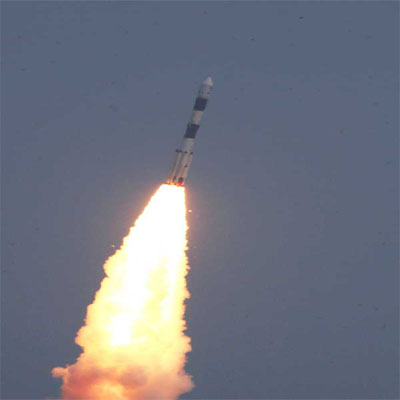
MUMBAI: The Indian Space Research Organisation (ISRO) aims to hand over Insat 4A’s 12 Ku-band transponders to Tata Sky on 1 February. It is in the process of bringing the satellite to the right polarisation position.
“We should be able to hand over the Ku-band transponders to Tata Sky on 1 February. Fine tuning of the ground antenna to match the correct polarisation is going on. This is a routine exercise as there are already a set of users at 83 degree East,” said Isro contract management and legal services director SB Iyer.
Tata Sky, the 80:20 joint venture between the Tata Group and Star India, plans to launch its direct-to-home (DTH) service in May-June. Speaking on the progress of the launch plans, Tata Sky CEO Vikram Kaushik said it was as per schedule. “We will do extensive testing after the transponders are handed over to us. Our launch plans are on track,” he added.
Along with the Ku-band transponders, the 12 C-band transponders will also be activated, Iyer said. As already reported by Indiantelevision.com, Private teleport operators Essel Shyam, Noida Software Technology Park (NSTP) and Lamhas have booked Insat 4A’s C-band transponders to facilitate transmission on multiple channels per carrier (MCPC) mode.
Among the other takers are Kerala’s Malayala Manorama and news channel Indiavision. While Manorama has booked half a transponder, Indiavision has gone for a quarter.
According to Iyer, Indiavision will be using 9 MHz space of one C-band transponder for its proposed entertainment channel, Indiavision Yes. The channel is expected to launch in the first half of this year.
Tag: MCPC
-
Isro to hand over Insat 4A Ku-band transponders to Tata Sky on 1 February
-

‘Digital compression has changed economics for channel distribution on a satellite’ : Peter Jackson – Asiasat CEO
For Asian satellite service provider Asiasat, the past year has been a period of expansion in a tight market. It recently announced the establishment of a new distribution platform. This new Multiple Channels per Carrier (MCPC) DVB platform will provide video, audio, data and IP based broadcast services on AsiaSat 2 from Asiasat’s Tai Po Earth Station in Hong Kong.
Utilising the full power of a 36 MHz C-band transponder on Asiasat 2, this MCPC platform can initially support up to ten digital television channels. The challenge for the company is that the trading environment for the satellite sector in at least for the first six months of this year continues to be dominated by intense competition and price pressure despite distinct indications of economic improvement in some Asia-Pacific markets. That is why though the company achieved a 14 per cent improvement in the overall utilisation of transponder capacity during the period, it was not possible to achieve a corresponding increase in revenue.
Indiantelevision.com’s correspondent Ashwin Pinto caught up with Asiasat CEO Peter Jackson who spoke about Asiasat’s plans, the state of the satellite industry, the risks involved as well as the potential that HDTV offers satellite service providers.
What are the main areas of Asiasat’s operations?
Asiasat is engaged primarily in leasing transponder capacity and we offer capacity to the broadcast and telecommunications industries. We also invest in other satellite related ventures that use our capacity for delivering services such as DTH, Vsat and broadband. Through our facilities at the Tai Po Earth Station, we also offer value added services including uplinking, turnaround and backup services.
Asiasat has stated that the outlook for this year is unpromising compared with 2004. By when do you expect to see a turnaround?
The market is recovering slowly and we have seen some new channels and services introduced into the region. However, the total volume remains small and we do not expect to see a big turnaround for the remainder of 2005. With the general improving economies, demand could well pick up from the beginning of next year.
Which are the markets that have most potential for growing the business? Kindly elaborate.
We see major growth from areas of television distribution and multiple location private networks providing closed user group telecommunication services. For these types of services, even with the reduction in the pricing of terrestrial networks, satellites, with their unique ability to deliver services over a wide area, remain the most cost effective and securest solution.
In terms of new applications, we see the development of video content such as real time news and sports events being shown on 3G mobile or other handheld devices being delivered to the terrestrial networks by satellite. In addition most content providers and service providers have indicated that they will be converting to HDTV channels in the very near future.
Can you give me an idea of the extent to which Asiasat’s operating costs have risen in the past five years?
The recent increase in operating costs was mainly attributed to the additional cost incurred running our Tai Po Earth Station which was fully operational in January 2004.
Intelsat recently announced its decision to buy Panamsat. Does this mean that the satellite industry is heading towards a period of consolidation?
Consolidation of our industry has started some time ago and we expect the process to continue.
‘The market is recovering slowly and we have seen some new channels and services introduced into the region. However, the total volume remains small and we do not expect to see a big turnaround for the remainder of 2005‘How will Intelsat’s acquisition of Panamsat affect players like Asiasat?
The acquisition leads to the formation of a bigger global player but it is more on the satellites covering the American continent. I don’t think it will have significant impact on us as we are focussing on the regional Asian business.
Since 1990, in what manner have AsiaSat’s satellites grown in mass, power and complexity?
Since the launch of our first satellite AsiaSat 1 in 1990, we have now grown to a fleet of three satellites all offering high power and wide coverage across the Asia Pacific region. In addition, we have been able to include new features.
For example, Asiasat 4’s Ku-band transponders are equipped with either linearisers or automatic gain control amplifiers that help to reduce the cost of uplink facilities and to provide improved uplink availability. In terms of beam coverage, the Ku-band FSS transponders of Asiasat 4 are designed with switching capability such that transponders on the East Asia beam and Australasia beam may be switched and reassigned for greater flexibility in network connectivity.
Are you planning to make additions to your satellite fleet?
We are currently planning for the procurement of a new satellite Asiasat 5 to replace Asiasat 2 at the orbital slot of 100.5 degrees East in 2008. AsiaSat 2 has been serving the Asia Pacific region since 1996. Based on the current estimate of remaining fuel on board, this satellite will retire in 2010. We plan the replacement for AsiaSat 2 well ahead of its retirement schedule is to ensure that we can continue to provide services to customers at that satellite location if its replacement is delayed for any reason.
Satellite service providers in Asia have found difficulty to generate revenue by selling more transponder capacity partly because of a glut of ku band transponders. Another reason is that a lot of broadcasters have gone digital. How is Asiasat coping with the challenge of anticipating demand for capacity?
It’s true that currently there exists an imbalance of supply and demand in Asia in particular for the Ku-band market and that will take some time to balance out. In the short term however, we believe there is still demand for quality C-band capacity from broadcasters who want to put their services on more popular and high quality satellites like Asiasat.
In a very competitive market with sensitive price points quality of service and performance becomes key. What would you say sets Asiasat apart from the competition in this regard?
It is quality that always kept us ahead of our competitors. Our satellites offer service at Asia’s best orbital locations with very good coordination and this differentiates our services from those provided by satellites that have an interference problem caused by poor coordination. In May this year, Asiasat was voted the ‘Best Asian Satellite Carrier’ at the ‘Telecom Asia Award 2005’ on the basis of financial performance, market leadership, technology innovation and corporate governance and this reaffirms our leadership position in the industry.
‘We are now offering value added services to our customers from our Tai Po facilities. For example, we are providing facilities to Star for hosting their backup broadcast and RF equipment for emergency uplinking to Asiasat satellites‘Which new channels recently came on board Asiasat? What contracts were renewed?
We have added a number of new services on our broadcast platforms that are coming from various parts of the world. These include Urdu language channels AJK TV, TV One, sport channel Real Madrid TV from Europe, Arabic service the Emirates Channel and Nile News and some radio services from the Middle East, as well as Club 977 Internet radio channels from the United States. We also renewed a number of contracts with existing Asian and Greater China customers.
What value added services has Asiasat come up with for its customers in recent times?
We are now offering value added services to our customers from our Tai Po facilities. For example, we are providing facilities to Star for hosting their backup broadcast and RF equipment for emergency uplinking to Asiasat satellites.
With our various teleport partners, we offer customers one-stop satellite turnaround services through the digital platforms on Asiasat, bringing customers’ signals from other parts of the world to Asia. We can also offer customers uplink and turnaround service from our Tai Po Earth Station if they could not find such service elsewhere.
Let us turn our attention to India. Do you have any plans for this market?
India is definitely one of the biggest TV markets in Asia and Asiasat 3S is already a household name to many cable headends and broadcasters in this market who wish to receive programming beamed in from outside India. Recently we have initiated a dual satellite reception campaign in India to promote the use of one single TVRO to receive AsiaSat 2 and AsiaSat 3S at the same time.
These two satellites which are only five degrees apart currently broadcast in C-band a total of 160 television channels. Dual satellite reception with one dish provides headends with greater flexibility and capability in accessing additional channels if they have limited space and resources to install an extra dish. This initiative is also expected to benefit our broadcast customers on those satellites as they only pay for the cost of transmitting to one satellite but they are able to enjoy the combined channel neighbourhood and audience penetration offered by the two satellites.
Since Isro does not have Ku-band capacity for DTH players in India, it has temporarily allowed NSS to offer them to DD and Dish TV. Has Isro sent out any signals for temporarily leasing out space?
We do not have very much spare Ku-band capacity available for India at this time. But we are hoping to correct that when we launch Asiasat 5.
What do you feel about the potential of DTH in India as an alternative to cable?
In any country, direct-to-home satellite service and cable television service compete in the urban areas but satellite offers service to areas not covered by the cable networks. In countries like India with a well developed cable network DTH can immediately offer a high quality digital television with multiple channels. Such competition usually results in the cable operators having to upgrade their systems if they wish to compete; we witnessed that in both the US and the UK.
The interesting dynamic for the urban area is the introduction of television being offered over broadband telephone lines, one more competitor to cable. For a country such as India DTH with its ubiquitous coverage will offer multi-channel television to previously un-served areas. Add the fact that there will be competition in the DTH market and it will undoubtedly be a very exciting era with customers getting the best of both worlds.
‘In any country, Direct-to-Home satellite service and cable television service compete in the urban areas but satellite offers service to areas not covered by the cable networks‘What are the new technologies emerging that Asiasat feels it can take advantage of?
Eventually all television will be recorded and broadcast in a High Definition format. To facilitate the introduction of the new format broadcasters will have to send out two signals, or dual illuminate on the satellite, one signal in standard definition and one in high definition.
To reduce costs, broadcasters will make use of the increased compression used in MPEG 4 to limit the extra capacity they will need. The real question for broadcasters will be how quickly will their customers change their receivers to HD. In some countries there is still extensive use of black and white televisions so in that situation the dual illumination in both formats may last some time.
To what extent is digital compression technology helping increase the number of channels that can be carried on a satellite?
Digital compression has changed the economics for channel distribution on a satellite. The reduction in cost has allowed content providers particularly the smaller players to distribute niche channels over large geographical areas.
In addition the compression allowed satellite platforms to carry large numbers of channels and thus be able to compete with cable and offer multiple channels direct to homes. For AsiaSat the transformation from analogue to digital is now complete and all channels on AsiaSat are digital.
One of the risks in the satellite business lies in the reliability of satellites being constructed. What are ways in which Asiasat has addressed this risk over the years?
Over the years, our satellites have increased in mass, in power and in complexity, but so has our dedication to product quality. To ensure the reliability of our satellites, we are very careful in specifying our satellite design to ensure they stay within the manufacturer’s design envelope.
While we require the best features we are very careful to insist, whenever possible, that we only use flight-proven designs and hardware. In addition we pay particular attention to monitoring the construction of our satellites by having our own staff on site and using consultants wherever necessary to ensure that we get the best satellite possible.
Should satellite manufacturers take more responsibility in the event of the failure of a satellite or degradation in performance?
Manufacturers performance bonuses have been in place for many years. These combined with the disastrous press that results from a manufacturing or design mistake have forced satellite manufacturers to pay particular attention once more on quality. The production line concept brought in to meet the operators demand for cheaper, faster and more capable satellites proved to be a disaster.
Now the manufacturers are once again concentrating on reliability. Only time will tell if the manufacturers with the best reliability record get the most orders. Some operators are still trying to force down the manufacturers pricing just because they can. As I frequently say “If you were buying a heart pacemaker for yourself would you buy the cheapest or the best.”
I would appreciate you thoughts on the space insurance industry which is facing difficult times.
The space insurance industry has recently seen difficult times principally because of multiple in-orbit satellite failures caused by design issues. As the spectre of these incidents fade and the reliability of satellites improves. I am sure the insurance industry will improve and we will see lower rates.
‘The greatest change will come from the increase in the number of operators allowed to provide DTH or cable systems as the Asian Governments allow more competition into the industry to enable the consumers to enjoy choice‘IP demand has not picked up as was originally expected. In this context do you think that broadband being delivered via satellite will pick up?
Undoubtedly the best way to provide broadband service is by using ADSL over existing telephone lines. As the cost of the ADSL electronics reduces and the capability increased, in terms of the distance over which it can operate, the areas in which it is economic to operate satellite reduced.
Where good quality telephone lines exist but they are too long to support ADSL then a satellite downlink with a slower speed terrestrial return path using the telephone line offers good value and a reliable service. In the very remote areas two way satellites are the only solution but in such circumstances conventional satellites are an expensive option for all but the very fast, high quality requirements.
For situations where no telephone lines exists, specialist spot beam satellites that reuse the available spectrum are an option as they offer greater through-put for only a marginal increase in price. However, to achieve the required volume in each of the spot beams service must be offered to remote areas where the population may be unable to pay for the service unless it is Government subsidised
In the long term what benefits do you think will accrue to satellite service providers like Asiasat from HDTV service providers?
More and more channel providers will use HD to differentiate their product. We see HD happening today in Asia and eventually most channels will become HD in a development not unlike the change from analogue to digital. Although HD channels require more bandwidth the providers will use more efficient compression systems to minimise the price difference.
What are the major changes happening in Asia’s satellite broadcasting business?
Satellite will continue to play a significant part in content delivery. We see development of new types of video content such as HDTV and the delivery of video content to mobile operators as well as growth in our traditional business of delivering content to the multitude of operators of delivery systems such as DTH, cable and IPTV broadband systems.
However, the greatest change will come from the increase in the number of operators allowed to provide DTH or cable systems as the Asian Governments allow more competition into the industry to enable the consumers to enjoy choice. The days when people thought a monopoly was necessary to ensure investment are over. One only has to look at what has happened in the United States to see the very positive effect competition has had on the industry.
What plans does Asiasat have as far as diversifying its business is concerned?
We have moved beyond simple provision of capacity by investing in other satellite related business and building new facilities. In 1999, we started with investing in Speedcast which has now become Asia’s leading broadband service provider.
We then continued to look at other businesses that utilise the real strengths of satellites and now we have also invested in other DTH and Vsat ventures. With our new facilities in Tai Po, we are able to further diversify our service portfolio by offering value added services to customers such as uplinking and turnaround services when our customers are unable to find such services elsewhere.
Finally are you looking at making any acquisitions?
We are constantly looking for opportunities but will only consider those that add value to our existing business.
-

Asiasat launches Asiasat 2 platform from Hong Kong
MUMBAI: Asian satellite operator, Asiasat, has announced that it has established a new distribution platform. This new Multiple Channels per Carrier (MCPC) DVB platform will provide video, audio, data and IP based broadcast services on AsiaSat 2 from Asiasat’s Tai Po Earth Station in Hong Kong.
Utilising the full power of a 36 MHz C-band transponder on AsiaSat 2, this MCPC platform can initially support up to ten digital television channels. Through its facilities at the Tai Po Earth Station, AsiaSat will provide a one-stop solution including signal downlink, turnaround and uplink services from Hong Kong onto AsiaSat 2, which is dedicated to video distribution and contribution services. The strategic location of Hong Kong will allow this platform not only provide a key element of a broadcasting solution for video signals to Asia but also form part of a broadcasters global distribution solution.
This type of platform enables the broadcasters to benefit from the higher effective power of a transponder. It enables the deployment of smaller dishes and translates into significant cost savings in terms of ground infrastructure for end users.
Asiasat CEO, Peter Jackson, said, “With the large number of receiving antennas already looking at Asiasat 2, this MCPC platform presents broadcasters and content providers with an ideal solution for programme and content delivery targeting all cable headends, terrestrial television stations as well as pay TV platform operators in Asia.”
“The addition of this platform further strengthens Asiasat’s portfolio of services and complements other AsiaSat 2 MCPC digital platforms operated by our teleport partners in the Middle East. It also augments our ability to provide more comprehensive and innovative satellite services to meet changing customers’ needs in the future.”
AsiaSat 2 operates at an orbital location of 100.5 degrees East. The satellite is a Lockheed Martin Series 7000 model and carries twenty 36 MHz and four 72 MHz C-band, as well as nine 54 MHz Ku-band linearised transponders. Its C-band footprint covers 53 countries embracing Asia, the Middle East, Australasia and the C.I.S. AsiaSat 2 also has a high-power Ku beam serving the Greater China region, Korea and Japan. AsiaSat 2 currently serves many regional and international broadcasters, wholesale news agencies, video service providers, teleport service providers for video and news distribution and contribution services, as well as governments and corporations for Vsat network services
-

Real Madrid TV launches on Asiasat
MUMBAI: Satellite operator Asiasat and Satlink Communications which provides end-to-end solutions for content transmissions over satellite platforms have announced the launch of Real Madrid TV on the Multiple Channels per Carrier (MCPC) digital platform on Asiasat 2.
This digital platform brings television and radio services from Europe to Asia through Asiasat 2’s huge C-band coverage beam and Satlink’s turnaround and transmission facilities in Israel.
The launch of this new channel to Asia makes Real Madrid TV the first soccer channel to be available globally and enables Real Madrid to reach an avid soccer viewer market which is developing very rapidly in the region.
-

Asiasat’s new platform enables European b’casters to expand coverage into Asia Pacific
MUMBAI: Asiasat and Satlink Communications have launched a Multiple Channels per Carrier (MCPC) digital platform on Asiasat 2 satellite’s C-band coverage beam.
Satlink provides end-to-end solutions for content transmissions over satellite platforms
The new platform offers connectivity from Europe to Asia and Australasia. The new platform will enable European broadcasters to expand their potential coverage to the Asia Pacific region through Satlink’s turnaround and transmission facilities in Israel. AsiaSat 2 offers C-band coverage that stretches from Turkey and Egypt to Australia and New Zealand.
Satlink will provide broadcasters with a single-hop transmission solution to distribute their channels to cable head-ends, rebroadcasters and individual home viewers in the region. The footprint also allows European corporations to establish connectivity with their offices in Asia and Australasia.
Asiasat CEO Peter Jackson said, “This partnership supports our strategy to further develop neighbourhood and penetration. We anticipate that the addition of this cost effective platform will attract more broadcasters and corporate users to enjoy the power, coverage and access offered by AsiaSat 2.”
-

Sahara commissions domestic uplinking earth station
MUMBAI: Even as Star India’s licence for uplinking Star News from Indian shores gets short shrift, Hindi entertainment channel Sahara TV looks to have stolen a march over it. The Subrata Roy-owned Sahara group successfully launched its own earth station in the country at Noida, near New Delhi, according to an official release.
The release adds that Sahara TV has already started to uplink using the station, earning it the distinction of being the first Hindi entertainment satellite channel to do so directly from India.
The first-of-its-kind earth station will enable the channel to concurrently uplink stream of 8-plus satellite channels directly from India, the release stated. This will go a great way in facilitating Sahara’s news channels plan when it gets operational. Recently, NDTV – which is expected to split with its partner Star and launch its own branded news channels – got a clearance for FII investment and also for its uplinking plans.
The Indian government had liberalised the uplinking policy to allow the country to develop as a centre for broadcasting in 1999. Following that shift in policy, eight Indian companies had been permitted to set up their uplinking hubs in India and 36 television channels were permitted to uplink their programmes from India using VSNL’s and DD’s facilities. Earth stations cost a packet and hence not too many of them have come up as yet.
To attract companies to invest in earth stations, the finance minister had reduced basic custom duty rates on import of certain specified equipments for setting up of an earth station for broadcasting, from 35 percent to 25 percent with effect from 1March 2002.
Among the companies, which have set up earth stations, figure Sun TV, Eenadu and Zee TV. The last has been uplinking its language channels using its earth station close to Noida.
“We had promised the government of India that we shall set-up our own earth station. Today, we are happy that we have a unique earth station in India one which we can be truly proud of,” the head of Sahara TV Sumit Roy was quoted as saying in the release.
The release also stated that the state-of-the-art earth station, had the most modern teleport and playout facilities assigned to any Hindi satellite entertainment channel. It consists of a huge 9.3 metre antenna system with computerized auto-tracking to transmit signals to Asian hot bird AsiaSat 3S.
Sahara TV’s captive earth station is equipped with high-end encoding devices from Tandberg incorporating statistical multiplexing to deliver a concurrent stream of 8-plus channels, according to the release. With this Multiple Channel per Carrier (MCPC) capability, the earth station has scope for quick upgradation to accommodate additional channels, as and when required.
The release also mentioned that the earth station has high power amplifiers of 2.2 kw capacity from leading manufacturer CPI. The system has a 100 percent back up and is serviced by uninterrupted power supply systems with extra capacity.
The release added that Sahara TV’s earth station has the most-modern playout facility with equipment controlled through user-friendly software incorporating the latest digital technology.
It comprises of two injest stations with multiformat injest possibilities using Sony IMX VTRs, Leitch noise reduction and colour correction devices, Orban audio processors, Bow’s 10 channel disk based logging recorders, Oxtel system for channel branding, Tektronix test and measuring equipment, and Leitch video servers (with 80 hours of storage at 12 Mbps), Louth device controllers and a host of latest Sony monitors. The software, which runs the injest, playlist and the adschedule, is supplied by Harris/Louth Automation.
-

Sahara TV switching to digital 10 December
MUMBAI: Free-to-air Hindi general entertainment channel Sahara TV is going digital from Tuesday, 10 December. Sahara has also set up its own multiple channel digital uplink earth station at Noida with both playout and uplinking facility.
The digital feed will be available on transponder 10-V of AsiaSat 3S from 10 December from 7 pm onwards.
With the digitalisation as well as uplinking facilities in place, the stage looks to be set for the launch of Sahara’s proposed bouquet of news channels, including one national and 30 city-based news channels, in early 2003. While Sahara officials were not forthcoming on a launch date, it could well be 26 January 2003 – Republic Day. This would also fit in well with the nationalistic image that the Subrata Roy-promoted group is strong on.
Sahara TV head Sumit Roy was quoted in an official release as saying: “The preparation work is already done. We have already commenced our analogue services on transponder 10-V and 1-V of AsiaSat 3S in order to facilitate switchover by our sanchar saathis (cable operators).”
While the channel will be switching to digital on 10 December, the analogue feed will continue on transponder 1-V during the seeding of digital receiver boxes. Sahara plans to continue with the simultaneous telecast of digital and analogue feeds for a month after 10 December.
All playout and uplink for both digital and analogue services of Sahara TV now originates from Noida, with infrastructure comprising high-end digital encoding equipment with statistical multiplexing in MCPC (Multiple Channel Per Carrier) domain,
Digital Feed Technical Specifications
Mode: Free to Air
Satellite : Asia Sat 3S
Orbital Location : 105.5
Downlink Frequency : 4020 Mhz
Polarisation : Vertical
Orbital Location : 105.5
FEC :
Symbol rate : 27.25M-SYM/SECAnalogue Feed Technical Specifications
Downlink Frequency: 3660Mhz
Polarisation : Vertical
Audio Sub-carrier: 6.3 MhzInformation about the digital receiver boxes for cable operators is available at the following numbers:
Mumbai : 022-56901310
Delhi : 011-23704100
Kolkata : 033-22827137
Bangalore : 080- 5321640 -

VSNL extends uplinking services to digitally encrypted channels
Overseas communications carrier and sole uplinking service provider Videsh Sanchar Nigam Ltd is working on providing digital uplinking facilities to encrypted channels from Indian soil. As part of that the company has selected a range of Taridan Scopus Codico platforms which are to be installed in Chennai, Delhi and Mumbai. The service will initially be available from Chennai’s Ambattur uplink site where playout rooms will be provided at a price. It will be extended to the two other cities as and when the facilities are upgraded. No rates have been decided for the Multiple Channel Per Carrier (MCPC) services.
Prior to this, in nine different cities, Scopus had installed digital SCPC (Single Channel Per Carrier) systems that improve signal reach and quality.
The current installation covers the three major metros and Scopus has installed a number of MCPC systems. VSNL is using a Conditional Access System provided by Irdeto. Scopus digital platforms also enable VSNL to provide IP data services over these networks.
“VSNL is a very large part of the changing media landscape in India and now that we are part of their overachieving team, I am convinced that our digital tools will propel them even further,” says Arie Vered, Scopus Sales and Marketing Director. “VSNL’s selection of Scopus advances our growing interests in Asia and is a major confirmation for Scopus’ technology and reputation.”
The cornerstones of Scopus’ SCPC and MCPC systems are the CODICO E-1100 Professional Encoder and and CODICO IRD 2520 (Integrated Receiver / Decoder). The CODICO RTM-3600 Statistical Multiplexer / Re-multiplexer is behind the MCPC.
The E-1100 Professional Encoder operates at 50 Mbit/ second and support both MPEG-2 4:2:0P@ML and 4:2:2P@ML encoding levels. The E-1100, housed in a single unit rackmounted enclosure, uses an advanced video pre-processor to deliver flexible encoding capabilities and high quality pictures at any given bit rate and with a very low delay. The Encoder operates either at constant bit-rate (CBR) or at variable bit-rate mode (VBR), to support Scopus’ statistical multiplexing process.
The RTM-3600 is an MPEG-2 DVB compliant Statistical Multiplexer / Re-multiplexer that provides cost-effective MPEG-2 DVB stream multiplexing and efficient re-multiplexing. It is capable of multiplexing up to 15 MPEG-2 transport streams, re-multiplexing video programs and has a statistical multiplexing mode.
The Scopus systems also include an Network Management system, the NMS-4000.
Scopus has teamed up with MCBS (India) for project implementation and technical support.