Tag: Max

  • Sony Entertainment Network & Times TV Network pull the plug on TAM; others to follow?

    Sony Entertainment Network & Times TV Network pull the plug on TAM; others to follow?

    MUMBAI: It‘s official. At the time of writing, two leading Indian TV networks, Multi Screen Media (which runs Sony Entertainment TV, Sab, Max, Pix and Six) and Times Television Network (which runs ET Now, Movies Now, Times Now and Zoom) had officially written to TAM Media Research informing its CEO LV Krishnan that they were stopping their subscription to the weekly TV ratings service from 6 June 2013. Hitherto, it had been reported that Sony was only mulling taking this step. TAM Media CEO confirmed that he had received the cessation notices from both the broadcast networks.

    MSM CEO Man Jit Singh: his network is the first to stop subscribing to TAM‘s weekly TV ratings service

    Apparently, more letters from the broadcast industry are likely to follow as many more members of the Indian Broadcasting Foundation (IBF) have decided to stop their subscriptions to TAM‘s ratings, if sources are to be believed.

    Says IBF president & MSM CEO Man Jit Singh: “There is a great deal of concern over the credibility and reliability of TAM. Seeing the fluctuations, which are happening since IPL and before that, we have decided to stop subscribing to TAM. The GEC market has shrunk by 20 per cent, which again puts a question mark over the reliability of TAM. Why would I pay for this? The entire IBF has complained and expressed their frustration. They even asked for a suitable explanation but we did not get one.”

    Both Star India CEO Uday Shankar and Times Television Network CEO Sunil Lulla refused to comment when indiantelevision.com tried to get their viewpoint on the issue.

    TAM‘s LV Krishnan: The show will go on; we will continue measuring TV viewership

    But the fact is that TV ratings in India have always been a hotly debated subject. Now more

    fat is likely to be added to the fire with this development with the doomsayers saying “I told you so, TAM‘s ratings are suspect, they are rigged and it will get its comeuppance some day. And that day has come.”

    Krishnan, however, is taking the broadcasters‘ decision in his stride. Says he: “If anybody has any concerns we are always open for discussion. Our job is to provide quality and clean data and we will continue to do that irrespective of who subscribes or not. Our parent companies have funded us in the past whether there were subscribers or not. We will continue to measure viewership.”

  • IPL6: Controversies drag down average TVRs to lowest in history

    IPL6: Controversies drag down average TVRs to lowest in history

    MUMBAI: The verdict is out and it clearly shows that this time around the cash rich league which was in the news for all the wrong reasons appears to be losing its brand value.

    The tournament – if ratings made available to indiantelevision.com by a channel are to be believed – generated an average cumulative (both Max and Sony Six) TVR of 3.1 in Hindi speaking markets (HSM) and 3 in C&S 4+ all India. This was much lower than the 3.45 HSM average TVR it reported last year, and probably the lowest in its six year history. In 2010, the average TVR was 4.65, and in the inaugural year the number was 4.81 TVR.

    There is much more in store. The IPL final between CSK vs MI also saw a dip in ratings this year as compared to last year. It recorded a TVR of 5.4 on Max alone; the cume rating (with Six and Max included) looks a lot more respectable at 7.3 for HSM and 6.9 all India CS 4+.

    As a comparative, the 2012 final between KKR and CSK registered a TVR of 8.92; the 2011 final between RCB and CSK saw a 6.44 TVR; the 2010 final between MI and CSK reported 10.48; the 2009 final between DC and RCB ran up a 9.92 TVR and finally the first season final between RR and CSK had a very healthy rating of 9.81 (The ratings for the previous year‘s are for Max only and do not include Six as there was no such channel in the Sony Entertainment Network then).

    What goes? Is the loaded with money league beginning to sag? Madison Media CEO Karthik Lakshminarayan believes it is. “The brand and the image of the IPL has definitely taken a beating. The rating numbers that have been thrown up are very surprising.”

    “The IPL ratings have certainly not come up to our expectations,” expounds Vivaki Exchange CEO Mona Jain. “The controversy surrounding the IPL this time around also is a cause for the same.”

    Max executive VP & business head Neeraj Vyas says the Sony Network management is fairly satisfied with the ratings the tournament has generated.

    “I am not over the moon,” he expresses. “But I am fairly satisfied. Let me state that it would be grossly unfair to compare this year‘s ratings with earlier years. It would be rather silly. Remember LC1 has been given a 25 per cent weightage by TAM earlier this year. These LC1 towns have power cuts 12-14 hours a day. Then the TAM universe changed about a month or so ago. All these factors make it appear as if you are comparing watermelons and lemons.”

    “Last year the tournament witnessed a strong viewership base of 162 million, we had managed to increase that number to 176 million viewers halfway into the tournament and it could well have crossed the 200 million barrier had TAM not changed its universe a month ago on 5 May,” he further states.

    Other views that are being put forth to explain the dip in ratings include the fact that ennui is developing among cricket watchers on account of the cricket glut on TV.

    Another view is that the spot-fixing controversy put off many viewers from the action on the field.

    The third perspective that is being silently spoken of is that the switch off and switch on in phase I and II of the government mandated cable digitisation process has dampened the ratings.

    Be that as it may, it remains to be seen whether advertisers‘ annoyance with lower ratings leads to any other action from their side.

  • Hindi GECs make a comeback; Star plus continues to lead

    Hindi GECs make a comeback; Star plus continues to lead

    MUMBAI: The Hindi general entertainment channels (GECs) have roared back in week 18 (28 April-4 May 2013) of the Tam ratings roster. Last week, Max had taken them to the cleaners by registering a 32 gross rating points lead over leader Star Plus. But in week 18 Max shed some points and Star Plus gained nine points to come level with it with 224 GRPs.

    As per TAM data (HSM including 5 new LC1 markets, C&S, 4+) sourced from a channel, the new Star Plus talent hunt-cum-reality
    show India‘s Dancing Superstar notched up a 2.6 TVR even as fiction shows such as Ek Hazaaron Mein Meri Behna Hai and Diya Aur Baati Hum showed improvements in their ratings from 1.2 to 1.4 and from 3.7 to 4 TVR respectively.

    Despite shaving 16 GRPs, Zee TV continued to occupy the second spot on the Hindi GEC charts with 175 GRPs. Zee TV‘s top performer was the fiction series Sapne Suhane Ladakpan Ke (it scored a TVR of 3) which also occupies the No 2 spot amongst all Hindi fiction shows. Its reality talent hunt India‘s Best Dramebaaz showed a growth in viewers on Sunday from 1.4 to 2.4 TVR even as it delivered lower ratings of 1.9 on 4 May Saturday (2.4 last week). Most of the other Zee TV shows had ratings being nibbled off them.

    Colors added a couple of GRPs to close the week with 166 GRPs (last week 164). It aired a special event Sitaare Zameen Par which notched up a 1.2 TVR even as fiction show Sasural Simar Ka went up by marginally.

    Sony too gained four GRPs at 154 on the back of a good showing of its non-fiction shows such as CID Chote Heroes and CID Mahaepisode (1.8 TVR), CID (2.2 vs 2.0), Crime Patrol (2.0 vs 1.8) and Comedy Circus (1.5 vs 1.2). Its fiction shows either stagnated or dipped marginally during the week.

    Sab gained six GRPs as it ended the week at 131 GRPs. Its leading fiction show Taarak Mehta Ka Ooltah Chashmah inched up marginally (2.9 vs 2.8) and Chidiya Ghar gained (1.5 vs 1.4).

    Meanwhile, Star India‘s second rung Hindi GEC Life OK closed the week with 102 GRPs (last week 101).

    Sahara One with 15 GRPs (last week 20) remained at the bottom of the GEC heap.

    Hindi movies seemed to have become a hit with viewers last week as viewers sought entertainment other than cricket and drama series, with channels such as Zee Cinema (110 vs 105) and Movies OK (60 vs 52) showing healthy gains.

  • Puma shifts marketing focus from lifestyle to performance; cuts spend by 30 per cent

    MUMBAI: Sports lifestyle brand Puma India is shifting its marketing focus from lifestyle to performance this year. It has launched ‘The Nature of Performance’ campaign. This is to push new products that have been launched in the performance portfolio in the running, training, fitness, cricket and football categories.

    One new product launched is the Mobium Elite shoe in the category of performance running. There will a bigger focus on digital marketing this year. Also marketing spends for the year will be cut by 30 per cent. But Puma India MD Rajiv Mehta says that this is not due to the economic slowdown but because the company realised that it did not need to spend so much money.

    “We realised that we could make do with less. We used to partner with two IPL teams but we have now discontinued that association. We are associated with Sunrisers Hyderabad as a kit supplier. We do not pay a fee. The challenge we faced was that the IPL is just a 45 day activity. After that it becomes difficult to sell merchandise. Unsold inventory became an issue. That is because team loyalties are not yet sufficiently present. Also Puma wanted to spend more money on marketing activities in other countries. We are focussing more on digital marketing this year and outdoor.”

    As far as the shift in focus to performance is concerned Mehta says that when the company came to India it focused on lifestyle to beat the traditional competitors. “We turned profitable in the third year of operating in India. Now that we have gained good lifestyle share we are focusing on performance to compete better with Nike, Adidas and Reebok. People are moving to a performance lifestyle from casual attire. That is why we decided that this is the year where we will focus on our performance umbrella. The ‘performance‘ tag cuts across all sports whether it is cricket, soccer, motorsports”

    Puma‘s Nature of Performance platform is a red thread that unifies all of the company’s performance categories with a consistent voice, look and feel. Grounded in nature and the athlete‘s innate desire to perform at their best level, The Nature of Performance aims to take consumers on a journey that is at once personal and universal.

    Created in collaboration with advertising partner Droga5, the Nature of Performance campaign, for above the line and below the line, features the product as a hero in each treatment, with a minimalist deconstructed “set” using a simple gray background, exposed staging and technical features, and athletes in motion showcasing the ‘epic moment‘ of athletics. Stylistically new for the company, the Nature of Performance creative is designed to evoke a visceral reaction and tap into the consumers’ nature as performance athletes.

    Mehta adds that 20 per cent of the companies marketing budget is for above the line. The remaining is spent below the line. “In digital we have taken over the Youtube homepage. Tomorrow we are taking over Yahoo!s homepage. These are the kinds of innovations we will be doing this year. You will be able to see an AV. Around half of our above the line spends this year will be in digital. Serious runners spend a lot of time online. So we need to connect with them there. On our own site we have information. We also create content through blogs. We are also doing outdoor activities in Mumbai, Delhi and Bangalore. In terms of below the line experiential marketing is crucial for us. So we have tied up with gyms and running clubs.”

    An innovation that the company is doing is augmented reality. In a store if you point a smartphone at the shoe you will see click a 3D image.

    In terms of pushing its lifestyle portfolio Puma will continue to be associated with Bollywood films. In the past it has tied up with films like ‘Student of the Year’ and ‘ABCD’.

    “We are talking to a few productions to have our products featured in the film. Bollywood works better for us compared to cricket as it has a longer shelf life. Once a film finishes its theatrical run it will be aired on a channel like Max, Colors. The issue with cricket is that it alienates women and children for the most part. That is a key segment for our lifestyle portfolio”. He however adds that company will continue its association with Yuvraj Singh who is one of its brand ambassadors.

  • Sony bowls a fast one with ‘made for TV’ cricket

    Sony bowls a fast one with ‘made for TV’ cricket

    Ever thought of making an eminent cricketer dance with a click of a computer mouse or a phone call? Chucking them in and out of a one-day cricket match as and when one wished if he’s messing up on the field. That’s precisely what Sony Entertainment Television has promised to cricket buffs while announcing its entry into what CEO Kunal Dasgupta termed a new genre of television programming with cricket as its centrepiece.


    Close on the heels of Zee Telefilms announcing its entry into reality television with POW, Sony is brewing its own unique version of reality television centred around cricket, whose driving force would be a great level of interactivity with the viewing public.


    Something akin to the rolling substitutions in hockey, here the public would be able to decide who should be on and off the field during timeouts seems to be the general drift of what is being conceptualised.


    Bidding to dispel media talk that Sony was planning a new version of masala cricket a la Kerry Packer in the early eighties, Dasgupta said the matches would be held only during the off season. There was no question of taking on any national cricket boards by putting together rebel teams, Dasgupta said. He, however evinced the hope that the endeavour will “generate unparalleled entertainment for the cricket loving public so that the cricket establishment will recognise Sony’s innovation and contribution to the game.


    The programme is to be aired over a 10-15 day period per season over three seasons in a year live on MAX. It is aiming for a nationwide audience and says it is hopeful people would participate in this made for television cricket game. According to Dasgupta, they were working with a group of associates to develop an innovative, transparent “made for television” cricket format using the latest available technology. Subject to their availability, Sony was planning to rope in the best national and international cricketers, Dasgupta said.


    Dasgupta was unable to provide details of the format, who were the players who had signed on, or even when it would take off other than saying that it would be sometime in April or May.


    A problem Sony will have to get around is the problem of uplinking. Sony has no uplinking facility in India but uplinks from Singapore. For the live feel of viewer interactivity this will have to be addressed. Anand Desai, senior vice-president corporate development, who is responsible for the show, admitted as much and said they were working on it. Desai, however, gave a categorical assurance that the programme would be real time live.


    Referring to the interactive element of the game, Dasgupta said one of the top cricket portals would be hosting details on the match through which viewers could participate. Dasgupta admitted that Sony was entering uncharted territory with this effort but said it was worth a shot anyway.

  • ‘Max will see 15-20% ad growth this year’ : Executive Vice-President and Business Head of Max and Sony Mix Neeraj Vyas

    ‘Max will see 15-20% ad growth this year’ : Executive Vice-President and Business Head of Max and Sony Mix Neeraj Vyas


    Neeraj Vyas, the Executive Vice-President and Business Head of Max and Sony Mix, is excited with the way the year went for Max, the Hindi movie channel from Multi Screen Media (MSM) stable.


    As the head of Max and Mix, Vyas has two challenges before him. The first is to take Max to the top position. The channel‘s strategy will be to acquire as many blockbuster movies as possible but at the same time remain judicious with the acquisition prices.


    The second challenge for Vyas is to grow Sony Mix, the music channel that was launched last year to widen the bouquet. The key for Mix, which operates in a tough genre, is to differentiate itself from other music channels through its programme offering while at the same time control costs to become viable.


    In an interview with Indiantelevision.com‘s Javed Farooqui and Urvi Malvania, Vyas shares his thoughts about the two channels and the way forward.


    Excerpts:


    Has the rise of Star Gold and the launch of its sibling channel affected the existing movie channels?
    Strictly from the ratings point of view, barring the first two months and post the IPL, it has been good for us. If you look at the ratings that were available three weeks back for the first 8-9 weeks, there is very little difference between the three of us – Star Gold, Zee Cinema, and Max. We have also had a successful movie acquisition year.


    How dependent is Max on big-ticket movie acquisitions as it has a premium positioning?
    Movie channels are completely driven by the library they have. Max has managed to have a premium image. It‘s completely by design and not by default because it‘s the way we want the channel and it‘s the way we present the channel. It‘s everything that you see on-air — the entire movie experience and our packaging. We want to set ourselves apart from others and hence did Extra Shots last year, a property where you get your trivia during the break and also put that into a half-an-hour show. This year we did something called Dirty Khabar.


    Does the premium positioning help Max get higher ad rates?
    It has helped us to extract premium from the advertisers. There are a lot of lifestyle brands, a lot of brands that are very conscious of the kind of environment they are seen in from an imagery point of view. If the advertisers have a choice between two or more channels, then Max will always be preferred.


    Did the ad slowdown have an impact on Max‘s revenues?
    There was no ad slowdown. In fact, we will see at least 15-20 per cent growth this year. The ad market for Hindi movie genre is a little under Rs 1,000 crore (Rs 10 billion).


    ‘The music genre accounts for about Rs 4 bn and is growing at 15% annually mainly due to new channel launches. We have set a 3- year period to break even‘

     
    What is driving this growth?
    There is money in the market, brands are being launched, and there are marketing activities. So there is no slowdown in my opinion. It (the slowdown) was a myth that was being created. At least till November or probably mid-December, we are tight on our inventory and are completely sold out.


    But there are broadcasters who have felt the pinch of ad slowdown?
    You tell me which broadcaster has slowed down in terms of content. Has anybody pulled back any shows? Despite no ratings, every GEC is going ahead with their biggest shows. There are two-three reality shows running on all the channels which are hugely expensive properties to produce. GECs are doing one-hour specials of their fiction shows and movie channels like us are marketing and putting more blockbusters on-air. Why would people do all these things if there was no money in the market? Give me a reason. I think the same people (who talk about a slowdown) need to answer this question.


    After a lull last year, has there been a spate of movie acquisitions this year?
    Yes, there was a lull. The way it (acquisition) works is if I have to acquire a film, I have to do it a good year-and-a-half before the film is released. If a producer doesn‘t get the price he wants, he waits for the box office performance of his film. Depending on the success or failure of the film, the price gets decided. The trend these days is strange as you have to acquire movies upfront. It sometimes works for you and sometimes it doesn‘t, so you have to be judicious.


    Has there been a price correction in acquiring movies?
    Unfortunately, what happens is that this industry is driven only by seven to eight stars. Unless we have more stars it will continue to be dominated by these 7-8 stars and it‘s essentially these men who lead the prices — the Khans, Akshay Kumar, Ajay Devgn and Ranbir Kapoor. If the price is going to be determined by these 7-8 stars, then their films will be sold at a premium.


    But a large number of movies go unsold?
    That is because the films of only these 7-8 guys get the ratings. For example, a film like Vicky Donor was liked by many but on television it won‘t get you a rating of even 1.5 TVR. Ratings for most GECs and time spent for channels like us come from the interiors of the country and the audience in the interiors is for films like Singham and Rowdy Rathore. That‘s the reality.


    Do you think acquiring movies on the basis of box office success is the criteria to follow?
    Honestly, that can be misleading. For example, Barfi is a brilliant film but put it on TV… probably it will get a rating of 2-3 TVR in the first airing, but it‘s not a movie that will get sustained ratings. Movie channels have a different model. When a film airs on television 10 times a year it has to give a certain yield and it has to give certain GRPs. As I said, the viewership comes from the interior.


    Zee walked out of the Barfi deal because at such high price point the monetisation becomes impossible. A correction is needed. It‘s a no-brainer. Zee‘s refusal to acquire Barfi rights was a step in the right direction. It also serves as a wake-up call for the producers or the corporates producing high-budget films. They have to get the pricing right irrespective of the box office collection because that is not connected to the success of the film on TV.


    Many networks have also experimented by premiering movies on GECs rather than the movie channel?
    That is a calculated gamble. Sometimes it pays off, sometimes it doesn‘t. It‘s a high-risk game because the price points of both the genres are hugely different. A GEC would trade at a certain level. Unfortunately movie channels have been under-priced since the beginning. By the time we start doing corrections, it is going to take time. The kind of money we recover on GECs will be far higher than on a movie channel. The yield is higher on GEC which is why we as an organisation have taken a decision to air certain movies like Paan Singh Tomar on Max but movies like Ek Tha Tiger and Rowdy Rathore will always be on Sony from a monetary point of view and its working for us. Once Sony has its one or two runs, it comes to Max and it really doesn‘t make a difference. What this does is safeguard our revenues and we manage our ratings better.


    How long does it take for a broadcaster to recover costs?
    For us it probably takes a little lesser time because we premiere on Sony. Our recovery is higher. It takes anywhere between two to three years to recover the costs. We acquire movies for a minimum of five years. We have a library of 800 movies and all of them are exclusive.


    Next year, IPL won‘t be there on Max since it will move to Sony Six. So what is your strategy going to be?
    We are a Hindi movie channel and we are happy that IPL is moving out. IPL moving out is a blessing for Max since we will get an opportunity to do a lot of things in the Bollywood space.


    Most Hindi movie channels also have dubbed content. How is it working?
    Almost 25-30 per cent of the content is dubbed and it is working. The prices of dubbed movies have also gone up although I can‘t give a number. The dubbed content adds variety to the channel. People in UP and MP don‘t know the actors but they love the action. Most of the South Indian films are in the realm of vendetta, revenge, high octane action, family values and so on. These are qualities that fit very well with the sensibilities of the heartland. Indian movies are Indian movies. People might look different but the basic ethos will always remain the same. The trend in Bollywood is that every big film that is going to come will be a remake of some or the other Southern language film. Everyone has acquired remake rights whether it is Salman Khan, Akshay Kumar or Aamir Khan.


    What implications will digitisation have on the genre?
    We are governed by the reality of libraries that we own. We will be able to run a large number of movies that we have not telecast. Hopefully, we will also get the opportunity to reach out to slightly more premium audiences. Also films like Silsila, Kabhi Kabhi, Rocket Singh and Saawariya which are rotting in our library will be able to see the light of the day.


    Coming to Sony Mix, how do you differentiate the channel from the other players in the genre?
    We decided to be a channel that is musical and understands the mood of the people. Our programming corresponds to the time of the day. So we have Surili Subah in the morning, Ishq Vishq in the afternoon, Mix Adda in the evening right up to Raina Beeti Jaaye, which is the slot for the retro songs. The promise of the channel is that we understand viewer‘s mood at different times of the day. We also went ahead and bought more music than anybody else simply because we wanted variety. So when other channels were playing the free plays and the new music launches, we went ahead and did deals with Yash Raj and Sony Music.


    What about your original content?
    We have a property called Mix Solos which has singers like Javed Ali, Roop Kumar Rathod and Shafqat Amanat Ali doing acoustic solos for the channel between songs. Then we have something called Mix Tippani where the channel suggests which song to listen to in which situation. We also have a show called Picture Abhi Baki hai. Here we take bytes from the actors, directors, music composers, singers etc — all with focus on the music and nothing else. It is like a sneak peak with focus on the music of the movie.


    These are the things that set us apart and we want to continue doing them. We want to do Harmony again which was on Sony 10 years back. We would love to revive that and have a show that has pure unplugged music. We also had a show “Yun Bana Yeh Song” with Swanand Kirkire where he explained how a song was made and took the viewers through the journey of the song. We have also brought back a lot of videos from the 90s that were huge back then. You see, you have to have a Mix of music for a music channel to be called a music channel.


    What is your primary TG? And what was your strategy when you launched Mix?
    Our primary TG is 15-24 age group, while our secondary TG is the 25-34 age group. We would never dilute our focus on the secondary TG. We firmly believe that you can‘t just cater to the youth which is why we have a Raina Beeti Jaaye at night. Music transcends age and we are going against the grain and not doing what everyone else is doing in the genre. Our belief is that it will pay off with digitisation and people wanting to make a choice.


    How tough is it to sustain a Hindi music channel?
    If you control your costs, then it is viable to have a music channel. But it is a tough game. We make use of our synergies with Sony Music and YRF. The challenge lies in how you programme your day as everyone has the same content in this genre. The brick of three songs before you go into an ad has to be so strong that it appeals to the audience.


    How is the revenue split between distribution and advertising?
    Distribution is negligible as a source of revenue right now. It‘s completely dependent on ad revenue. We have a wide range of advertisers come to us due to our programming. We have a broad base of viewers and though we are packaged as young and happy, our appeal is across age groups. You have to build the proposition based on the core values. The music genre accounts for about Rs 4 billion and is growing at 15 per cent annually mainly due to new channel launches. We have set a three-year period to break even.

  • Max gears up to promote ‘Rowdy Rathore’ premiere

    MUMBAI: Max, the Hindi movies and special events channel by Sony Entertainment Network, is carrying out a 360 degree marketing campaign to promote the premiere of ‘Rowdy Rathore‘.

    The movie starring Akshay Kumar and Sonakshi Sinha will be airing on the channel on 4 November 2012 at 1 pm and 9 pm.

    The campaign for ‘Rowdy Rathore‘ includes promotional spots across television channels and radio promotions in Mumbai and Delhi. The channel is also running an outdoor campaign in 30 cities across the states of Gujarat, Uttar Pradesh and Maharashtra and print promotions in all leading publications across India.

    Additionally, Max is also creating a web game on their Facebook page to engage all ‘Rowdy Rathore‘ and Kumar fans.

    On 3 November, the channel has planned consumer activation at Nirmal Lifestyle Mall in Mulund, Mumbai. Consumers will witness an act by a Kumar look-alike who will present himself in the ‘Rowdy Rathore‘ avatar and will be seen doing some stunts, performing on music tracks from the movie and deliver some dialogues in “Rowdy style”.

    MAX SVP marketing and communications Gaurav Seth said, “MAX is known for its innovative and engaging marketing and on-ground initiatives. Consumer activations are a good way to engage our audiences. The Rowdy Rathore activity promises to be a fun and exhilarating experience for all our consumers present. Seeing professional stunt men carry out death defying acts in front of them will be quite a treat.”

  • Aurora Comms creates a new ‘reality’ in Max New York Life’s campaign

    Aurora Comms creates a new ‘reality’ in Max New York Life’s campaign

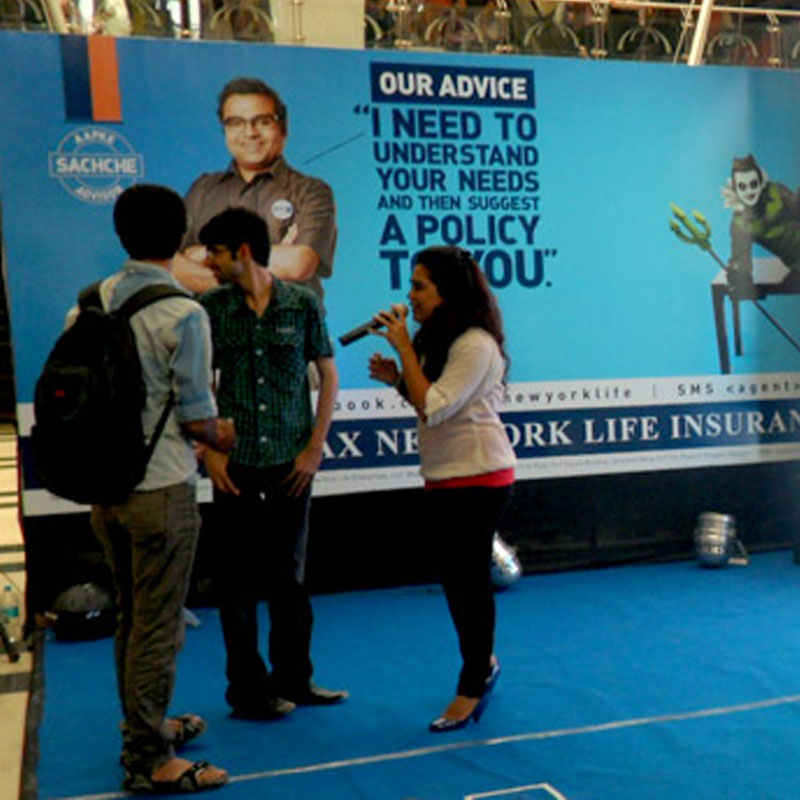
    MUMBAI: Retail media network, Aurora Comms, has carried out a campaign using the technology called augmented reality for insurance provider Max New York Life.

    Taking over the prime ground floor area at Mumbai’s InOrbit mall, Aurora Comms brought to the fore some ‘augmented reality’ to create a buzz. The same was also executed at DLF Promenade in Delhi where it brought to life the ‘devil and the insurance agent’, virtual characters from the brand’s TV commercial. It created a separate area inviting the mall’s many visitors to step into a new experience.

    Once someone is in the square area created for this experience, the devil and the agent would appear in front. The person would be prompted to punch and destroy the devil in many ways, with the agent interacting and advising too. This was coupled with a background score making it an engaging experience for the participant and the hundreds of onlookers.

    The idea was to communicate that Max New York Life Insurance gives the right advice to audiences. Also, the activity being scheduled at major Indian metros and B towns in-sync with the TV commercial being on air means that this campaign is helping to reach out to thousands of targeted customers.

    Max New York Life director and CMO Anisha Motwani said,, “Max New York Life has always thought of communicating to its audience in an effective and innovative medium. The AR initiative is an extension of our new brand campaign ‘Aapke Sachche Advisor’.” Vishakha Singh, Executive Director from A Comms adds “Augmented reality has the capability to engage audience in real size yet virtual world and this is what we designed for Max New York Life consumers. We’re glad this campaign is delivering the communication to the consumers.”

  • Max to spend Rs 100 mn on marketing IPL

    Max to spend Rs 100 mn on marketing IPL

    MUMBAI: Max, the official broadcast partner of the Indian Premier League, has unveiled its 360-degree pan-India marketing campaign themed ‘Aisa Mauka Aur Kahan Milega’ to celebrate the ‘mauka’ (opportunity) which IPL brings for millions of cricket fans in every walk of life.

    Max has upped its marketing budget by 20 per cent from the previous year and is expected to spend around Rs 100 million, say sources.

    The campaign has a series of four short films. Each of these films has a light hearted humorous theme and describes what IPL provides to different people. The final film shows how a town in India gears up to watch the IPL.

    “The theme that we have taken for the IPL this year is ‘Aisa Mauka Aur Kahan Milega’ because the IPL has always been about opportunity. What we have done is we have taken a more humanistic, consumer and viewer kind of approach,” Max Senior VP Marketing and Communications Gaurav Sheth told Indiantelevision.com.

    Sheth said a lot of consumer research has gone into designing the campaign, “Every year we do a lot of consumer research which is both quantitative and qualitative like how is the brand IPL doing and what viewers think of it. The insights derived from the research played a key role in creating each of the films. A case in point is that of a grandmother who said how the IPL was an opportunity for her to see her entire family come together.”

    Stretching across a period of six-weeks till the launch of the tournament, the campaign will have a rollout across mass media including print, radio, Internet, outdoor, mobile, BTL and out of home apart from the commercials on television.

    “The focus area is television channels across genres like news, general entertainment, music, and regional. There will be a lot of front page print ads as we draw closer to the event. There will be a major outdoor blitz before the IPL,” Sheth added.

    The marketing has also been designed keeping in mind the flavour of the local markets. The company is also looking at the digital medium in a big way and is currently engaged in talks with Internet and mobile operators who can provide customised ideas to engage with users.

    Max‘s creative agency JWT created the campaign while Keroscene Films is the production company.

    JWT VP and senior creative director Priya Pardiwalla said, “For this edition of the DLF IPL, we have created a campaign that‘s very real and based on strong human insights. Whether it‘s Phuphaji, the friends’ film or India accumulating outside a TV showroom, the campaign reflects true life experiences.”

  • Max’s new campaign tells viewers to relax on weekends

    Max’s new campaign tells viewers to relax on weekends

    MUMBAI: Multi Screen Media (MSM)‘s Hindi movie and special events channel Max has launched a new campaign highlighting its weekend programming. The campaign promotes the idea of taking a much deserved break in weekends after slogging for the whole week.

    Created and conceptualised by Max‘ creative agency JWT, the theme of the campaign is ‘saare hafte lagey raho…weekend pe padey raho‘.

    The communication is targeted at promoting viewership on Max on weekends when the channel claims of showcasing some of the “best family entertainers” of all times.
     
    Max EVP and business head Neeraj Vyas said, “At Max, it is our endeavour to come up with extremely relatable and life-like themes for all our communication campaigns. With our latest weekend campaign ‘Saare hafte lage raho…weekend pe pade raho‘, we are trying to relieve the monotony of daily life by creating a complete entertainment package on the weekend for our viewers thus making Max the ultimate movie destination.”

    To promote this, three films will be released over the next few days across television, social media and online forums. Each of these films bring alive the central communication theme that says after a hectic week at work the best way to recharge yourself is to overdose on blockbuster movies on Max over the weekends.