Tag: Mathrubhumi

  • Breaking youth drug codes with Mathrubhumi’s parent-focused campaign

    Breaking youth drug codes with Mathrubhumi’s parent-focused campaign

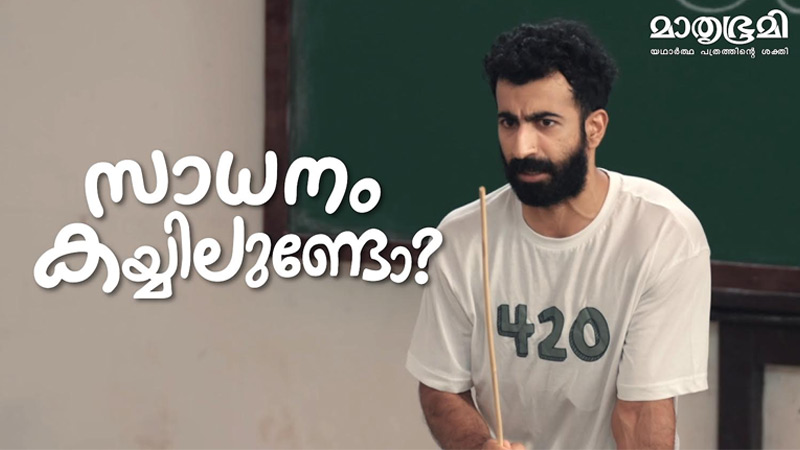
    MUMBAI: When it comes to tackling substance abuse, Mathrubhumi is proving that knowledge is the ultimate weapon. The media house’s latest anti-drug campaign, featuring youth icon Roshan Mathew, isn’t about moralising or over-dramatising, it’s about arming parents with the tools they need to spot trouble before it escalates.

    Titled simply yet powerfully, the campaign takes a realistic, engaging approach to the complex issue of youth drug use. It dives straight into the world parents rarely see, decoding the slang, secret codes, and even the pricing of substances that school-going children might encounter. By blending hard facts with practical guidance on monitoring financial transactions and recognising behavioural red flags, the initiative goes beyond typical warnings.

    “We aim to go beyond mere warnings and public appeals. The goal of this campaign is to arm parents with the specific knowledge they need to win this fight,” said Mathrubhumi managing director M.V. Shreyams Kumar. The approach shifts the focus from scaring young people to equipping the adults closest to them parents, families, and teachers with actionable insight.

    Maitri Advertising managing director Raju Menon of which conceptualised the short film, emphasised the strategy behind the realism. “While most anti-drug campaigns target the users themselves, we wanted to speak to those most likely to identify the issue early. Sure, kids might adapt their slang after seeing this, but at least we give parents a headstart.”

    The short film’s reception has been electric, sparking conversations across social media and in households alike. Its appeal lies in its authenticity: instead of bombarding viewers with fear-inducing images or exaggerated scenarios, it presents knowledge in a digestible, relatable format. Parents are shown not just what to look for, but how to interpret subtle signals from behaviour, conversations, and even financial patterns, a roadmap for proactive engagement.

    By leveraging Roshan Mathew’s relatability among the youth, the campaign bridges the generational gap. It reminds parents that influencing children about the dangers of drugs isn’t about confrontation, it’s about connection, awareness, and timely action. Every code word decoded, every price point revealed, and every practical tip shared is a small but crucial victory in the fight against substance abuse.

    Mathrubhumi’s initiative stands out for transforming anti-drug messaging from abstract warnings into tangible, everyday tools for parents. It’s a campaign that proves education and awareness can be both accessible and compelling, encouraging adults to step into the roles they’re naturally equipped for guides, protectors, and early responders. In a world where quick fixes and shortcuts often dominate, Mathrubhumi reminds us that vigilance, knowledge, and parental involvement remain the most effective measures.

    With this campaign, the message is crystal clear: the first line of defence against youth drug abuse isn’t law enforcement or peer pressure, it’s informed, attentive parents, ready to decode the hidden signals before it’s too late.

  • Mega Star Mammootty Inaugurates MBIFL 2024

    Mega Star Mammootty Inaugurates MBIFL 2024

    Mumbai: Verstile actor Mammootty inaugurated the fifth edition of the Mathrubhumi International Festival of Letters (MBIFL 2024) at the Kanakakkunnu Palace on Thursday. The veteran actor noted that literary events like MBIFL are essential in an age where public spaces are shrinking and reading has transpired from flipping real pages to social media posts.

    “Just as the sun acts as a natural purifying agent against germs in the atmosphere, literary fests and dialogues help remove the germs from our mindset and the society at large,” he said, adding that smaller editions of such festivals could be held in the countryside as public spaces are shrinking.

    “Instead of limiting our world to ourselves, let us use these platforms to share our emotions. It will help remove many poisonous thoughts from society,” said Mammootty. “When there are no public spaces, we tend to cocoon ourselves and that is when poisonous thoughts creep in, keeping us from interacting with one another or share our emotions.”

    He also underscored the role of Mathrubhumi in the renaissance movements of Kerala and the development of language and literature.

    During the inaugural ceremony, Egyptian writer and journalist Mansoura Ez-Eldin said she never takes writing for granted and believes in the power of the written word. “We live where literature is very important. The visions present before us are often clouded and literature is a bridge that can help us cross various barriers and see the world as it really is.”

    “We writers should resist any kind of inequality; we should speak against injustice,” she said, adding that most of us are prisoners of fixed ideas.

    Writer Sarah Joseph delved into the significance of plurality and the need of creating pluralistic spaces at a time when voices of dissent are subdued and silenced. Democracy is in danger, and such public spaces of dialogues are where the protest against autocracy begins, she added. The author said India has always celebrated plurality and Kerala has a special role in it.

    M.V. Shreyams Kumar, chairman of MBIFL and Mathrubhumi Managing Director said in his speech the world is lacking plurality in current times. One is losing the freedom to make an opinion or to disagree with another. “This festival discusses the need for plurality in such times,” India is a pluralistic nation and anything that goes against its grain will destroy its culture. “MBIFL focussed on plurality keeping this in mind,” he said.

    Mathrubhumi Chairman and Managing Editor P.V. Chandran said the newspaper has been at the forefront of promoting art, culture and literature right from the days of its inception. “We used words as a weapon in the fight against the British,’’ he said.

    Mathrubhumi Joint Managing Editor, P.V. Nidheesh welcomed the gathering and Manoj K. Das, Editor, Mathrubhumi daily and digital, proposed a vote of thanks.

  • Real Image empowers Mathrubhumi’s digital expansion with Wildmoka

    Real Image empowers Mathrubhumi’s digital expansion with Wildmoka

    Mumbai: One year after integrating Backlight’s Wildmoka platform into their digital workflow, Mathrubhumi has effectively more than doubled its digital footprint.  Real Image, a leading media solutions provider, played a pivotal role in helping Mathrubhumi  embrace a digital-first strategy.

    The impact of Wildmoka on Mathrubhumi’s digital presence was evident within weeks of its  adoption in 2022. Mathrubhumi digital business – director Mayura M S remarked,  “As  we celebrated our centenary, we sought solutions to expand our digital reach without  significantly increasing our operational costs. After a comprehensive evaluation of available  options, the cloud-based Wildmoka platform emerged as the natural choice. Over the past year,  Wildmoka has not only boosted our digital rankings but has also fuelled non-linear growth in  viewership, all the while significantly enhancing productivity. Real Image’s enthusiastic  involvement added to our overall satisfaction.”

    Wildmoka empowers broadcasters and rights owners to produce and deliver content from any  source, to any destination, in any format, at speed and at scale. The solution simplifies most  operations with a ‘Single Click,’ making publishing workflows intuitive and efficient. This  includes automating tasks like adding overlays such as logos and watermarks, pre-post rolls,  thumbnail decoration, selecting destinations with pre-filled metadata and outputting content in  the relevant aspect ratio.

    Mathrubhumi social media head Joseph Kumpail highlighted, “In addition to  enabling rapid publishing, enhanced live streaming and efficient editing, Wildmoka helped us manage the churn through its quick onboarding, reducing the learning curve for our social  media teams. Using Wildmoka, our story publishing time has decreased by two-thirds, resulting  in a remarkable 120% increase in viewership.”

    Real Image product management head  S. Shankar Bhat noted, “Through Wildmoka, Real  Image has empowered several prominent broadcasters to adopt a digital-first workflow,  facilitating swift and efficient content dissemination across all digital platforms. We are  delighted to witness Mathrubhumi achieving its desired results and experiencing a substantial  return on investment as our partner.”

    In an ever-evolving digital content creation and consumption landscape, innovative digital  solution providers must adapt swiftly to industry trends and set new standards.

    Backlight director – channel sales Jakob Hummes shared, “The Backlight team engages  in continuous dialogue with customers and closely monitors industry developments. We are  committed to pushing the boundaries of what can be achieved with our Wildmoka product line.  Post-IBC, we have introduced exciting enhancements, particularly including our live stream  production capabilities.” 

  • Mathrubhumi International Festival of Letters to begin from 2 February

    Mathrubhumi International Festival of Letters to begin from 2 February

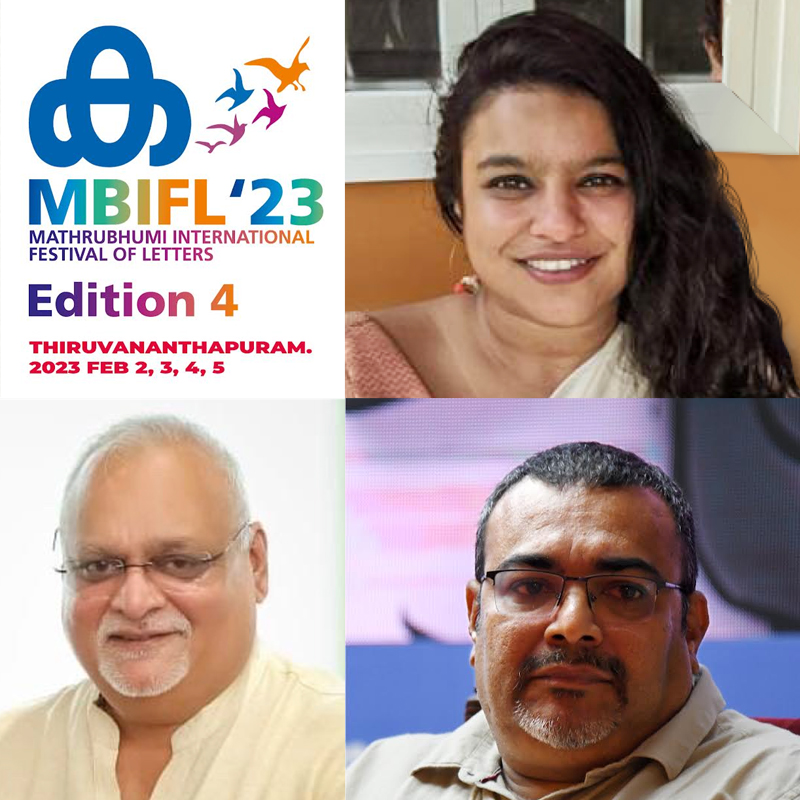
    Mumbai: The Mathrubhumi International Festival of Letters was started in 2018. After the critically and popularly acclaimed staging of three editions, the pandemic disrupted this signature event in the cultural calendar of India. Now, 2023 will witness a rebirth with renewed vigour and vitality.

    The latest version will be held in Thiruvananthapuram from 2 to 5 February. MBIFL’23 will provide a platform where discussions on the arts, gender, history, media, politics, religion, science, sports, technology, and other contemporary issues will lend a spicy tang to four days and nights.

    “A galaxy of universally renowned writers and speakers will grace this iteration, including last year’s Nobel laureate Abdul Razak Gurna and Booker Prize winner Shehan Karunathilake, from neighbouring Sri Lanka,” revealed festival curator Sabin Iqbal.

    “The theme of ‘Ka’, as it is known locally after the first consonant in our mother tongue Malayalam, is ‘Shadows of history. Lights of the future,’” said festival director Mayura Shreyams Kumar.

    “We chose this particular trope, conflating it with our voyage through a century of rendering yeomen service to society,” added Mathrubhumi, director of digital business.

    MBIFL chairman M. V. Shreyams Kumar explained the rationale behind the festival of letters: “Being at the forefront of all progressive movements in our state, we deemed it incumbent on us to celebrate the role of letters in contributing to the moral arc of a nation, by conceiving the Mathrubhumi International Festival of Letters.”

    Mathrubhumi’s managing director went on to say: “In our centenary year, it is also a tribute to the vision of my late father, the writer M. P. Veerendra Kumar, who guided our corporate fortunes for more than four decades as the chairman and managing director of Mathrubhumi.”

  • Mathrubhumi to organise a one-day event on World News Day

    Mathrubhumi to organise a one-day event on World News Day

    Mumbai: Mathrubhumi on Monday announced plans to host an event on World News Day on 28 September at the Uday Palace Convention Centre, Kowdiar Gardens, Thiruvananthapuram.

    Speaking of the event, Mathrubhumi managing director M. V. Shreyams Kumar, who will deliver the presidential address, elaborated on why the centurion institution was associated with the international event, said, “World News Day is a global campaign to display support for journalists and their audiences organised by the Canadian Journalism Foundation and WAN-IFRA’s World Editors Forum. By associating with this event, organised as a part of Mathrubhumi’s centenary celebrations, we intend to reinforce our identity as the custodian of credible and fact-checked journalism.” 

    Media mavens, eminent journalists, and owners will deliberate on the way ahead for practitioners of credible journalism in our age of disruption. The subject is “Sacred Facts: Media in a Post-Truth World.”

    The Hindu former chief editor N. Ram, the doyen of Indian journalism, will deliver the inaugural address. The keynote speech of the first session on “Fact Punch: Curated Media and its Challenges” is by the Indian Express’s former editor Arun Shourie. The event will start at 10 a.m. with a welcome address by Mathrubhumi vice president of operations Devika Shreyams Kumar.

    The Times of India, Tamil Nadu resident editor Arun Ram; Outlook former editor Ruben Banerjee; senior journalist Seema Chisti; and Frontline editor Vaishna Roy are the discussants, with The Hindu, Delhi resident editor Varghese K. George moderating the session.

    The post-lunch session between 1.45 p.m. and 3.15 p.m. will be on “Counter Media: Narratives, Lapses in Reporting, and Self-Critique,” to be moderated by N. Open Magazine executive editor P. Ullekh. The keynote address will be given by India Today TV consulting editor Rajdeep Sardesai.

    Senior journalist Hari S Kartha will be on the panel, as will Madhyamam editor V. M. Ibrahim, social media activist Kiran Thomas, Asianet News Group editorial advisor M. G. Radhakrishnan, and media critic advocate Sebastian Paul.

    The concluding session between 3.45 p.m. and 5.15 p.m. will be on “The way forward: Is fact-based journalism a winning proposition?” featuring ABP Network CEO Avinash Pandey; Kairali TV managing director John Brittas MP; The News Minute editor-in-chief Dhanya Rajendran; Boom Fact Check managing editor Jency Jacob and Ananda Vikatan managing director B. Srinivasan. While the keynote speech will be delivered by The Indian Express executive director Anant Goenka, the session will be moderated by Mathrubhumi director of digital business Mayura Shreyams Kumar.

    All three sessions will be followed by audience-discussant interaction.

  • Mathrubhumi celebrates its 100-year anniversary with anthology film

    Mathrubhumi celebrates its 100-year anniversary with anthology film

    Mumbai: Mathrubhumi, one of the oldest newspapers in the country has rolled out arguably the first-ever anthology of brand films in the history of Indian advertising, to mark the beginning of its centenary celebrations.

    Conceptualised by Kochi-based Maitri Advertising Works, these films have recreated and showcased some of the meaningful social interventions the newspaper has initiated since its inception through its editorial content and aims to highlight the brand’s social stature as a responsible media house.

    “When we decided to bring out audiovisual content in connection with our centenary celebrations, a run-of-the-mill corporate documentary talking about the commercial growth of the brand in numbers and growth charts was the last thing we wanted to do,” stated Mathrubhumi managing director MV Shreyams Kumar. “I wanted the agency to come up with something meaningful and different.”

    “In the last 100 years, Mathrubhumi had positively impacted society in the realms of environment conservation & protection, infrastructure development, education, agriculture and gender equality to name a few. My brief to the agency was to highlight these aspects in an interesting and aesthetic way without any chest-thumping or forced product placement. The audiovisual was to be screened in front of a large audience and it had to have the scale and impact. It had to be done quickly too because the prime minister of India had agreed to attend the function on a particular date,” he further said.

    “It was exciting to work on this very clear brief and thrilling too because Mathrubhumi always gave us the creative freedom to think big and think different,” remarked Maitri Advertising executive creative director Venugopal Ramachandran Nair. “Our first task was to arrive at a creative device that would make storytelling entertaining and impactful. We struck upon the idea of our protagonist, a young man, who would carry forward the entire storyline. He would never age and through different periods of time he would voice his strong and clear opinions.”

    “When we put together the basic idea in a piece of paper and presented it, the client gave us an immediate go-ahead. However, choosing the most relevant topics to portray in the film posed a big challenge, since there was a problem of plenty,” stated Maitri Advertising managing director Raju Menon. “Apart from the topics suggested by Shreyams Kumar, there were so many cover stories, features, articles and editorial content in the Mathrubhumi archives, each addressing relevant and time-sensitive social issues.’’

    In consultation with the newspaper’s editorial team, the agency finally handpicked the six most relevant topics to be portrayed in the film series.

    “Execution of the project was not an easy task. There were constraints of time. The research process was enormous and a precisely set deadline was looming large behind us every day,” said Maitri Advertising branch director Jayakumar N, who is also in charge of managing the Mathrubhumi Account. “We decided to work with six versatile directors meticulously selected based on their ability to interpret the agency script and their expertise in visual storytelling. The next task was to find out the lead actor. The directors, after long hours of auditions finally settled down on Adil Ibrahim, a promising young actor in Malayalam cinema.”

    The opening film in this anthology narrates the birth story of Mathrubhumi as a catalyst to India’s freedom movement in 1923, followed by another five shorts, showing the audience how the editorial contents carried out by the newspaper has positively impacted society.

    The film has been released across various digital media platforms. Stand-alone edits of each film in this anthology would also run as television commercials later, across various channels.

    Maitri Advertising ideation executive Ajeesh Raman, who was in charge of scripting and supervision remarked, “Working with six highly talented directors on this anthology film was very exciting and indeed a great learning experience. Our brief to them was simple –  Make every film interesting and engaging yet when compiled together, the audience should see it as a seamlessly blended single film, with proper optical and acoustic connect between each of them.”

    “We are extremely happy that the anthology film, probably first of its kind, is getting tremendous response on social media. People don’t see it as branded commercial content. More than commercial property, we believe that it got the potential to become a social property sooner than later,” commented Mathrubhumi director of digital business Mayura Shreyams Kumar.

    “A project of this magnitude wouldn’t have been possible without the wholehearted support of Shreyams Kumar. He is a gem of a client every agency would love to have in their portfolio who realises the power of simple ideas the moment he hears one,” said Maitri Advertising executive director C Muthu. “For over two decades, we were able to churn out memorable and award-winning creative works for Mathrubhumi because of this.”

  • Mathrubhumi News makes near accurate post-poll predictions in Kerala

    Mathrubhumi News makes near accurate post-poll predictions in Kerala

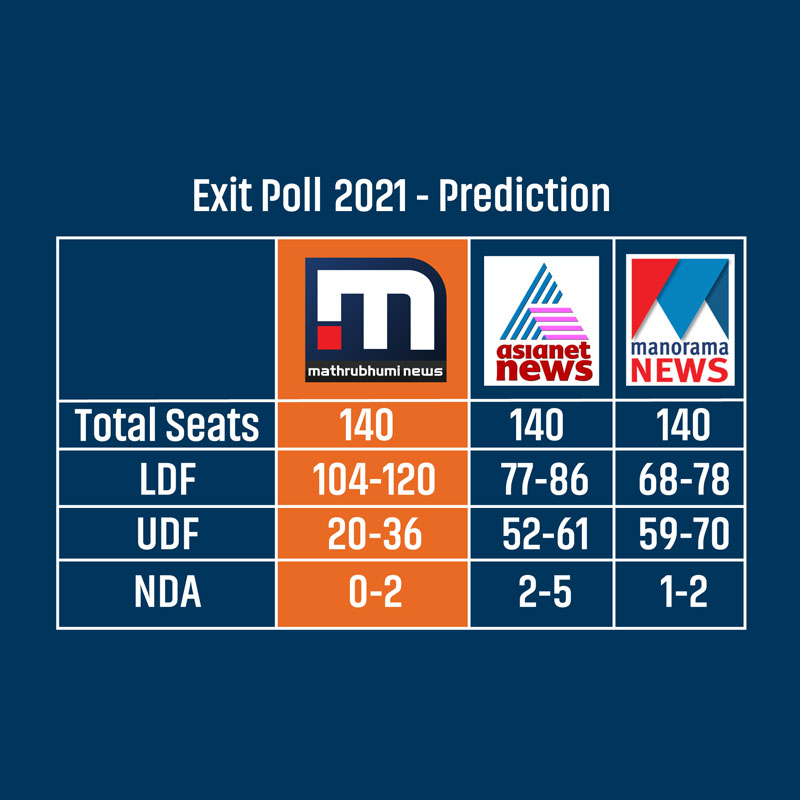
    NEW DELHI: The legislative assembly election results in Kerala were declared on 2 May, and the ruling Left Democratic Front (LDF) created history by procuring 99 of the total 140 seats, beating anti-incumbency to return to power; the opposition United Democratic Front (UDF) had to settle for the remaining 41 seats while BJP was left empty-handed.

    Prior to the election results, several Malayalam channels had broadcast their post-poll predictions, and Mathrubhumi News has emerged as the only Malayalam channel which managed to predict the mood of the people of Kerala almost perfectly. 

    The 98-year-old media group predicted 104 to 120 seats for LDF and 20 to 36 seats for UDF. Interestingly, Mathrubhumi also predicted that BJP will get 0 to 2 seats in God’s own country. 

    “Everything had to be right if we were to put out a prediction, right from choosing the agency, Axis My India, to agreeing on a statistically valid sample size and the methodology including the various groups’ representation on the research,” said Mathrubhumi managing director MV Shreyams Kumar. “While we had other options, what we preferred was face-to-face interactions with the voters. When the final numbers came out, we had no hesitation in making a bold proclamation of our finding as we knew we got the voters sentiments clearly etched on our research sheets.”

    The media group’s had made a bulls-eye election prediction during the 2016 Kerala assembly polls too.

  • Asianet News drives Covid awareness as anchors appear on air with masks on

    Asianet News drives Covid awareness as anchors appear on air with masks on

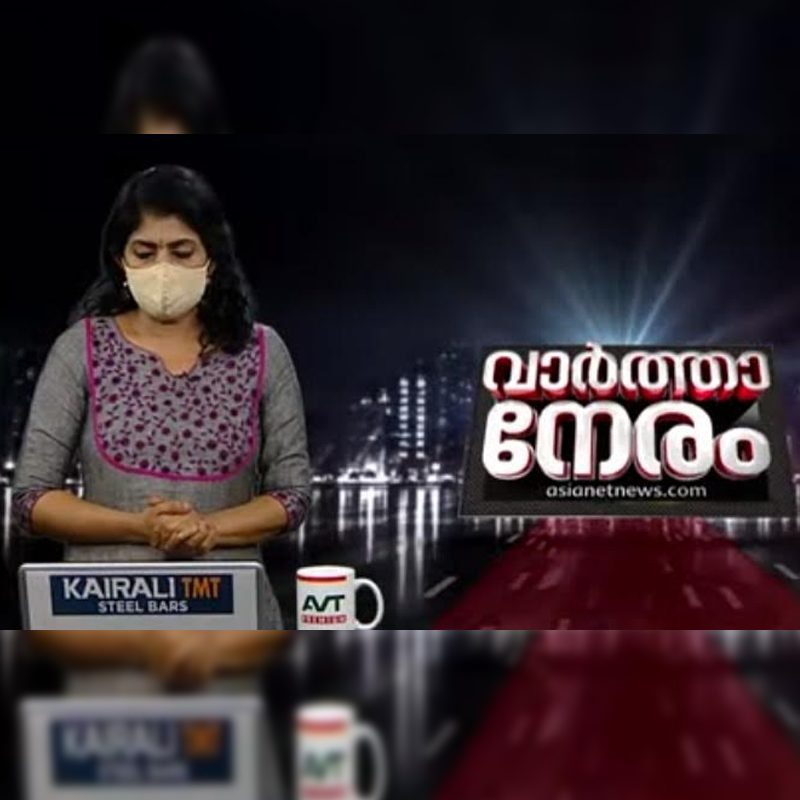
    MUMBAI: In an attempt to raise awareness among the general public regarding the usage of face masks to combat the spread of Covid2019, Asianet News anchors have been using face masks while on air over the past few days. The move by Asianet is now receiving positive responses from all corners, as this is for the first time in Indian television that all the news anchors in a channel are appearing on screen with their masks on. 

    “The primary aim of this move is to create awareness among the general public. We have been discussing for a long time that all reporters and news anchors should wear masks, as it will give a positive message to the public. Moreover, we are also giving masks to guests who are attending the news shows without a face mask. This message has to go deep down, and that was the intention behind this mask-wearing campaign,” said Asianet News editor-in-chief MG Radhakrishnan. 

    Following Asianet’s lead, a few other Malayalam news channels are also planning to make their news hosts wear masks when they go live. 

    “I am very happy about the fact that a message has been conveyed to people regarding the vitality of wearing masks. Moreover, I feel glad that Mathrubhumi News has also followed our path after two days since our news anchors started wearing masks,” added Radhakrishnan. 

    Talking about the challenges of wearing face masks while news reading, the media veteran said, “We pretty much know that news reading is all about communicating with the general public. Some people told me that communication is not effective when news anchors are wearing masks. However, we have a bigger message to convey, especially at this time of pandemic, and I believe we have succeeded in our attempt.” 

    Radhakrishnan also underscored the necessity of giving journalists the status of frontline workers who should get priority in the vaccination rollout program. 

    “The government should do something to classify journalists as frontline workers, as media people have been working from the front since the day of the pandemic outbreak. Media personnel are getting infected by Covid, and it is very much necessary to classify the entire community as frontline workers. The government should consider us as frontline warriors, and should give vaccination,” he concluded. 

  • PubNation: Actually, local languages are not a discovery of digital era

    PubNation: Actually, local languages are not a discovery of digital era

    NEW DELHI: It was in 1492 that Columbus, with his three ships – the Nina, the Pinta, and the Santa Maria – set out from Spain to seek the riches of the Indies. He sailed towards the west for days altogether, his crew getting restless with no land in sight. It was nearly a month later that they reached a new continent, America. What followed were three more tips and lots of exploration. Columbus believed that he had discovered America. But that was certainly not the case. He had only introduced the new world to western Europe. 

    You must be wondering how that story matters here. Well, it does, because for the past few months, many marketers and experts have been claiming that they have discovered the potential regional languages have in India; to promote businesses and increase sales. But is that really the case?

    Vikatan Group MD B Srinivasan (Srini) opines that the saga of the industry discovering regional languages and its potential is quite similar to the tale of Columbus discovering America. “It is not something new. We Indians have always been doing our own thing and we are really good at some of them. The advertisers or the agency can’t really say that they discovered it because there is already some great work happening in that space,” he said at the recently concluded PubNation, hosted by Indiantelevision.com in partnership with Quintype and Gamezop. 

    He aired this view during a panel discussion on the state of the local language market in India. Moderated by Wavemaker India chief growth officer and south head Kishankumar Shyamalan, the session was also attended by Punjab Kesari Group of Newspapers director Abhijay Chopra, Lokmat Media Ltd editorial director Rishi Darda, Mathrubhumi director – digital business Mayura Shreyams Kumar, and Eenadu general manager – marketing Sushil Kumar Tyagi. 

    Srini added, “India has always been a land of multiple diversity and we have been doing a fabulous job (in the regional markets). I am very happy that brands are now beginning to see that with print too. It was always very different when TV came in. Regional television has always taken the lead when compared to English channels. However, that still hasn't changed with English newspapers.”

    It was rightfully pointed out by Srini. The Broadcast Audience Research Association (BARC) report stated that the viewership of regional channels grew from 15 per cent in 2016 to 23 per cent in 2019. Meanwhile, Hindi channels saw a viewership increase of 31 per cent in the same period. 

    Tyagi supported Srini’s thoughts while also sharing some insights. “We launched our Telugu-language news channel in 1995 and penetrated around 30 per cent of overall India. In Andhra Pradesh, we claimed 90 per cent of the audience. Similarly, when we were planning to launch ETV Bangla in 1999, everyone told us that it will not work as Bengal is a prominent part of the HSM (Hindi-speaking market). But we got a phenomenal response from there too.” 

    He added that with Eenadu.net, they are getting great engagement from the NRI community, which goes to show how important regional languages are for Indians. 

    Darda chipped in, “You can look at some interesting data points from a global perspective. If you look at the largest news consumption area, which is the United States, and then look at the top 10 news sites there, eight of them are actually part of either a newspaper group or a television group. Whether it is CNN, Wall Street Journal, or Washington Post. Only two, Huffington Post and BuzzFeed, are independent. Of course, they both are now owned by the same company. Now when you look at the top 10 most read newspapers in India, there's only one English newspaper. The other nine are actually regional local language newspapers. So the future is very clearly going to be with that credible language.” 

    He advised that for any brand, it is extremely important to understand the local nuances and culture. In between the pages is where the opportunity lies in the form of hyperlocal targeting.

    Chopra agreed and noted that Punjab Kesari Group is now decentralising its language offerings with hyperlocal content. “We have been in the market since 1948 and the audience was always there. Now, with digital, we are getting even deeper into the markets. If we just talk about Hindi, there are so many different dialects depending upon the region. So, I have hired a Haryanavi-speaking jaat for our digital channels, who reads the news for that region. I can’t even understand fully what he is saying, but the audience numbers went through the roof. Similarly, we are getting someone native from Himachal Pradesh, who will read the news for the region in their own language.” 

    All these people will be working from their home states permanently, creating a new form of organisational structure that is more agile. 

    In the same vein, Kumar pointed out that Mathrubhumi, too, is diversifying its digital presence as the importance of regional content is amplified now. “We are playing around with a lot of audio and video formats, which is getting us a lot of engagement. User-generated content and network-driven insights, both remain in our focus. We are not digital-first yet, as 85 million people still subscribe to our papers, but the transformation is really happening.”

    The panel opined that marketers and agency personnel should really spend more time in discovering and investing in the hyperlocal capabilities that these digital arms of print publications are equipped with. This will help them in connecting better with their consumers. 

  • PubNation: How print players expanded digital operations amid Covid

    PubNation: How print players expanded digital operations amid Covid

    MUMBAI: The process of the digital transformation of the print industry has been ongoing for a while now, but the Covid2019 crisis accelerated the need for news publications to realign their objectives and operational model, and to look toward creating new avenues to diversify offerings. More than ever, media businesses will have to act now in order to capitalise on this current growth and ensure success in this new landscape and beyond. 

    Different news organisations came forward to discuss the effect of pandemic and how it accelerated their business at the two-day-long summit – PubNation (print and digital), organised by Indiantelevision.com in partnership with Quintyoe Technologies and Gamezop. The panel was moderated by Omdia content strategies senior principal Tim Westcott and included ET Online editor Deepak Ajwani, Moneycontrol editor Binoy Prabhakar, HT digital streams chief content officer Prasad Sanyal, Amar Ujala Ltd state editor Uttrakhand Sanjay Abhigyan, The Hindu strategy & digital editor Sriram Srinivasan and Mathrubhumi assistant editor-online K A Johny.

    During the pandemic a lot of publications were forced to take the digital route to stay in business. As the movement of people, transport and delivery came to a complete halt owing to lockdown, and readers unsubscribed due to economic constraints or risk of contracting the virus off of newspapers, the e-paper played an important role in these tough times.

    Starting off, Srinivasan revealed that The Hindu was among the first few publications to go digital and adopt a subscription-based model two years back. It is also among first few organisations to launch a paid version of the website. He added, “We have an e-paper, we provide dozens of newsletters. So, everything that is required for a digital publication is there. Then there are our sister publications also, including Business Line, political magazine Frontline and a sports magazine.”

    Amar Ujala, which has a very strong presence in Hindi heartland and is among the top five newspapers in the country, has shifted its focus towards creating digital content. The organisation is present in eight to nine states with more than 250 print editions. Amar Ujala has a very vibrant digital presence in the form of a website, YouTube and Facebook. 
     
    Echoing the sentiment, Sanyal mentioned that Covid20919 has accelerated the digital journey for Hindustan Times and the brand is looking forward to expanding its offering. “All the three outlets Hindustan Times, Hindustan and Live Mint are digitally present. During the pandemic, the company has launched three new segments HT automobile, HT tech and HT Bangla,” he added.

    A large number of media groups were already digital first and working towards ensuring that the customer experience is right and they were abreast with the content trends. Ajwani revealed that in March 2020, ET doubled its viewership. Said he: “We were effective, productive and were making a difference with whatever content we were producing from home. A lot of technology, collaboration with our print team has been around for the last three-four years. We have been connected with each other via multi-modes of technology. So, using our feet on the ground, and the skills of technology and the skills we have built online, we have had a very integrated approach from day one.”

    He further added, “Somewhere in the month of July, we saw that Covid2019 pandemic has accelerated our offerings. I believe there is no transition from print to digital. They both work in synergy. It is an omnipresent world, we are present wherever the reader wants us to be.”

    When the novel Coronavirus arrived in India, it came with more than its fair share of misinformation and fake news. People were in desperate need of verifiable, trustworthy news and they turned to print publications and their digital arms for it. In this regard, Prabhakar mentioned that Moneycontrol was focused on reaching out to its audiences and providing all the necessary information related to the pandemic. “Seeking viewer attention was never a problem for the organisation. Today, the lockdowns have been lifted and many of our readers have gone back to their daily routines, now the challenge once again is to how to seek the user’s attention,” he rued.

    The brand had diversified its offering to acquire and retain new users by expanding into the regional language space. It has three subscription-based products — Moneycontrol Pro, Moneycontrol Hindi and Moneycontrol Gujrati. 

    HT is also doing something similar, said Sanyal, and offers products for Gujarati and Hindi speaking audiences. The network closely works with all partners to deliver content.  

    K A Johny disclosed that it has a very powerful presence in both print and TV. He also shared that the driving force for Mathrubhumi is the trust of people. Covid2019 has only revived things for the organisation. Irrespective of the medium, he thinks that a platform of trust and credibility is the need of the hour.