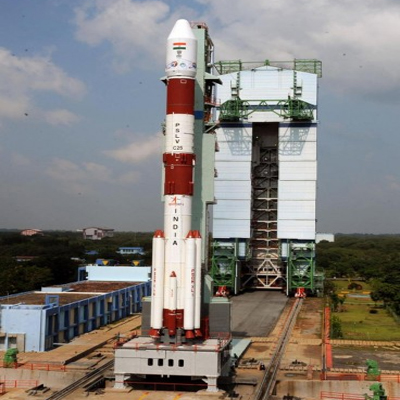
NEW DELHI: Doordarshan will telecast live the launch of the India’s Mars Orbiter Mission (MOM) – which will conduct a detailed study of the Martian atmosphere and is the nation’s first ever mission to the Red Planet.
The telecast PSLV – C25/Mars Orbiter Mission will be telecast live on DD National from 1410 hrs from Sriharikota today afternoon. Prior to that, there will be a ten-minute curtain-raiser on the mission.
The countdown commenced on 3 November in the morning at 6.06 hrs, according to an official statement from the Indian Space Research Organization (ISRO).
India would become only the fourth nation or entity from Earth to survey Mars up close with spacecraft, following the Soviet Union, the United States and the European Space Agency (ESA). Past attempts to reach the Red Planet from both China and Japan have failed.
MOM is the first of two new Mars orbiter science probes from Earth set to blast off for the Red Planet this November. Half a globe away, NASA’s MAVEN orbiter remains on target to launch barely two weeks after MOM on 18 November from the Florida Space Coast.
MOM is on schedule to lift off atop the powerful, extended XL version of India’s highly reliable four stage Polar Satellite Launch Vehicle (PSLV-C25).
The 44 meter (144 ft) PSLV will launch MOM into an initially elliptical Earth parking orbit of 248 km x 23,500 km. A series of six orbit raising burns will eventually dispatch MOM on a trajectory to Mars around 1 December.
Following a 300 day interplanetary cruise phase, the do or die Mars orbital insertion engine will fire on 21 September 2014 and place MOM into an 366 km x 80,000 km elliptical orbit.
MOM arrives about the same time as NASA’s MAVEN orbiter. They will significantly bolster Earth’s armada of five operational orbiters and surface rovers currently investigating the Red Planet.
MAVEN and MOM will “work together” to help solve the mysteries of Mars atmosphere, the Chief Bruce Jakosky of MAVEN told Universe Today. Although there are no NASA instruments on board MOM, NASA is providing key communications and navigation support to ISRO and MOM through the agency’s trio of huge tracking antennas in the Deep Space Network (DSN).
The $ 69 million 1,350 kilogram MOM orbiter, also known as ‘Mangalyaan’, is the brainchild of ISRO.
‘Mangalyaan’ is outfitted with an array of five indigenous science instruments including a multi colour imager and a methane gas sniffer to study the Red Planet’s atmosphere, morphology, mineralogy and surface features. Methane on Earth originates from both biological and geological sources.