Tag: marketing

  • Samsung introduces latest innovations at Consumer Electronics Show 2021

    Samsung introduces latest innovations at Consumer Electronics Show 2021

    NEW DELHI: Samsung opened the Consumer Electronics Show 2021 with a crisp, 30-minute keynote, sharing its vision for the future and introducing a slew of new products at the virtual press conference. Among fresh launches is its new range of bespoke refrigerators that you can mix, match and combine into different configurations. Samsung has also launched its first MicroLED TV, which will be commercially available in a couple of months in a whopping, 110-inch avatar. 

    The South Korean electronics conglomerate also detailed its AI ecosystem and smart home software, as well as its sustainability efforts. Alongside the catchy demos of its smart home gizmos, two of Samsung's sustainability efforts caught the eye. The first is its shift to its DRAMs and SSDs in its data centres and servers, which can apparently make a 7TWh (Tera-Watt-hour) difference in energy consumption. The second is its proposed software updates to older Galaxy range of smartphones, which can turn them into specific use-case devices such as baby monitors or long-range remotes for appliances.

    Samsung Electronics president and head of Samsung Research Sebastian Seung said, “Our world looks different, and many of you have been faced with a new reality–one where, among other things, your home has taken on a greater significance. Our innovations are designed to provide more personal and more intuitive experiences that express your personality. We’re hard at work to bring you next-generation innovation, with AI as the core enabler, for your better tomorrow.”

    Here are a few highlights and launches at the Samsung event:

        Samsung Bespoke 4-Door Flex: The latest version of the Bespoke refrigerator features changeable panels that come with a choice of colours and materials that made the original a success, allowing consumers to adjust their fridge for form and function. The new four-door model will be available in North America this spring.

        110-inch MicroLED: This new screen features self-lit inorganic LED with a slim and nearly bezel-less Infinity Screen design that seamlessly blends into the living space. The result is a spectacularly immersive viewing experience with astounding picture quality. The 110-inch MicroLED also adds “4Vue” (Quad View), a four-way viewing option—so you can keep up with multiple sports at once, or stream a tutorial while playing a video game. Also, for US consumers, more than 160 free channels1 are available through Samsung TV Plus. MICRO LED will be rolled out globally beginning this spring.

        Lifestyle TV: Samsung’s cutting-edge lifestyle TV lineup includes The Serif, The Frame, The Sero and The Terrace—a recently launched 4K QLED outdoor TV—as well as Samsung The Premiere, a cinema-like quality 4K laser projector.

        SmartThings Cooking: A new service from Samsung SmartThings is designed to make your culinary journey seamless. An automatic Meal Planner powered by Whisk’s Food AI recommends meals for the whole week, makes shopping lists with the ingredients you need, and connects to grocery retailers for one-stop shopping straight from the Family Hub refrigerator or your mobile screen. Recipe instructions can be sent directly to synced Samsung cooking devices to minimize hassles and mistakes.

        Samsung Health Smart Trainer on Samsung 2021 TVs: Samsung Health seamlessly transforms the home into a personal gym, and the new Smart Trainer4 feature tracks and analyses posture in real time, just like a personal trainer. During and post-workout, Smart Trainer provides feedback on form, helps you count your reps, and estimates calories burned. Also includes video and interactive training via Bixby-enabled voice control.

         JetBot 90 AI+: Coming to the US 1H 2021, this new vacuum cleaner uses object recognition technology to identify and classify objects to decide the best cleaning path. LiDAR and 3D sensors allow JetBot 90 AI+ to avoid cables and small objects, while still cleaning hard-to-reach corners in your home. Also outfitted with a camera, JetBot 90 AI+ is integrated with the SmartThings app to assist you with home monitoring.

        Samsung Bot Care: Designed to use AI to recognise and respond to your behaviour. It will be able to act as both a robotic assistant and companion, helping to take care of the details in your life. It will also learn your schedule and habits and send you reminders to help guide you throughout your busy day.

        Samsung Bot Handy: Will rely on advanced AI to recognize and pick up objects of varying sizes, shapes and weights, becoming an extension of you and helping you with work around the house. Samsung Bot Handy will be able to tell the difference between the material composition of various objects, utilising the appropriate amount of force to grab and move around household items and objects, working as your trusted partner to help with house chores like cleaning up messy rooms or sorting out the dishes after a meal.

    Samsung is continuing to build on its Samsung Bot Retail, which would guide users outside the home in retail environments, and GEMS, its health-focused exoskeleton as mobility aide. These innovations allow robots and robotic devices to co-exist with humans, enhancing their lives and catering to a variety of lifestyles and different environments.

  • Dettol & Treebo Hotels team up to ensure safe stays for guests

    Dettol & Treebo Hotels team up to ensure safe stays for guests

    NEW DELHI: With the outbreak of the novel Coronavirus, Indians were beset with a zeal for personal and home hygiene products. Hand sanitisers and anti-germ wipes, besides face masks, became mandatory carry-on items for anyone venturing outdoors to combat the deadly pathogen. But like all things, fear, too, passes. People resumed activities that had been put on hold at the height of the pandemic – such as traveling. But Covid is still very much present and poses a threat. A research by Global Monitor indicates that consumers have heightened concerns regarding hygiene on their journey, and trust in cleanliness standards is an extremely critical element when it comes to travel. Clearly, it has become essential for the hospitality sector to implement an effective system to ensure standardised hygiene practices. To this end, Dettol has partnered with Treebo Hotels to facilitate safety and hygiene in domestic travel and create awareness about out of home disinfection and safety.

    The partnership program will ensure the use of Dettol products proven effective against the Covid2019 virus to elevate the disinfection and hygiene levels of the hotel premise, and drive regular training of the hotel staff among various other initiatives to ensure that guests enjoy an even cleaner and safer stay at Treebo Hotels.

    Dettol will also introduce its recently launched suite of innovative cleanliness products at select Treebo Hotels that will be conferred with the ‘Platinum Hygiene Shield’ for maintaining the highest standards of cleanliness and hygiene.

    A Reckitt Benckiser spokesperson said, “As India’s #1 trusted hygiene brand, we aim to partner with our consumers to ensure a healthier environment not just inside, but outside of home as we are at crossroads with the ‘new normal’. We are thrilled to announce our partnership with Treebo hotels in India, as our ethos and priority seamlessly align with one another; providing the safest environment to the Indian population. Through this partnership program we will aim to create a safe, hygienic, and enjoyable experience for its customers with the use of Dettol range of products which are effective against the Covid2019 virus. With this promise, Dettol will continue to drive the organisational purpose and fight in action – to protect, heal, and nurture in the relentless pursuit of a cleaner, healthier world.”

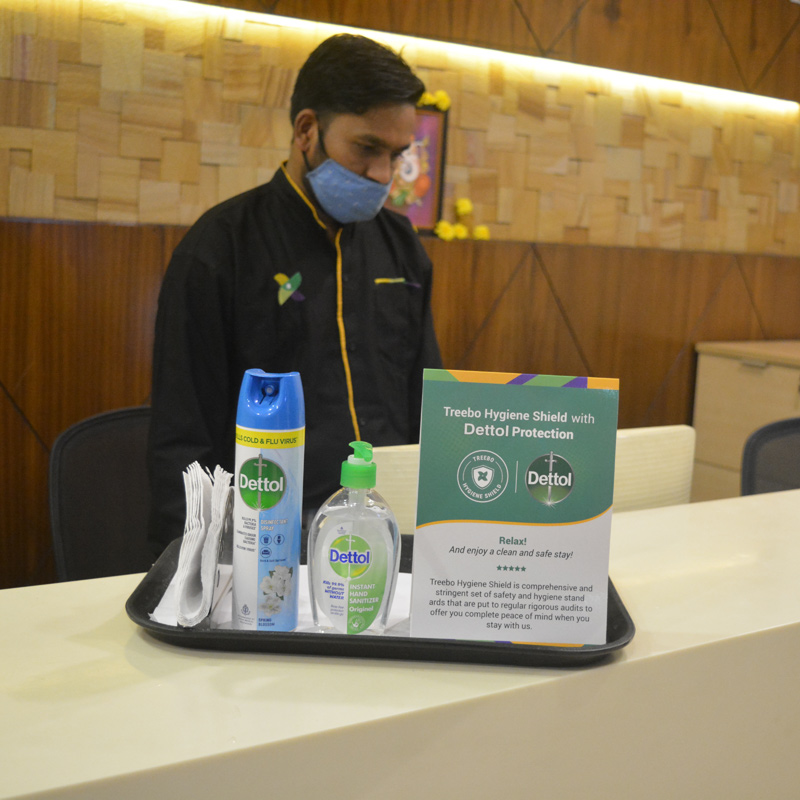
    The Treebo Hygiene Shield covers all aspects of safety. Disinfection and safety checks at arrival to contactless check-in, fully disinfected rooms, hand-sanitisers accessible across the property, in-room dining / dining with limited seating in the restaurants, social distancing at the lobby and reception, etc are just some of the aspects of providing guests with completely secured and safe stays. All of these safety and hygiene checks are audited regularly and rigorously by internal and third party experts to arrive at a score of the Treebo Hygiene Shield with Dettol Protection. Based on these scores, the properties are awarded bronze, gold and platinum badges.

    Treebo Hotels has also launched the web check-in feature which will further minimise the need for any human interaction at the time of checking-in at a Treebo Hotel. The web check-in feature allows guests to upload ID cards, furnish arrival details, select rooms, and place any other special request up to 48-hours prior to the check-in. Upon arrival at the hotel, guests who have already done a web check-in can just verify their ID cards and collect the keys to their rooms at the reception desk.

    Treebo Hotels co-founder Sidharth Gupta said “Dettol is India’s leading hygiene brand. Their partnership with our Covid safety program – Treebo Hygiene Shield – is a great validation of the quality assurance processes we follow, and our obsession about guest experience and safety. Despite the reducing numbers of new cases in India and the hope of mass vaccination on the horizon, we are not taking our eyes off the road and continuing to follow strict hygiene standards at our hotels.”

    Treebo hotel partners are optimistic and welcoming of Dettol’s partnership with Treebo Hygiene Shield. Sanket Wetal, who owns and operates three hotels under the Treebo brand across Maharashtra, said, “Dettol usage at Treebo gives the reassurance that our hotel premises are safe and hygienic for guests, visitors and even our own staff. The Dettol protection will become one more reason and a strong validation for guests to pick our hotel.”

  • Saloni Arora Nanda moves on from Forever21

    Saloni Arora Nanda moves on from Forever21

    NEW DELHI: Forever21 general manager and head of marketing Saloni Arora Nanda has moved on from the organisation. She announced the development on her social handle.

    Nanda was leading marketing activities on the Indian front, including digital and social media strategy, store launches, strategy execution, and CRM programme. She spent over three-and-a-half years with the high street brand.

    With over 15 years of industry experience, Nanda has worked in the marketing function of several brands such as Landmark Group, Fossil, GroupM, Radio City, and Weber Shandwick.

  • TV Today’s Amit Sinha joins India TV

    TV Today’s Amit Sinha joins India TV

    NEW DELHI: TV Today GM strategy planning and research Amit Sinha has moved on from the organisation and is set to join India TV in the capacity of VP strategy and research.

    He worked at TV Today for over five years and was responsible for reviewing and analysing weekly numbers, providing strategic inputs and handling programming, strategy and content, weekly analysis of chrome and RWP distribution data.

    Additionally, he provided inputs to the distribution team, and was also involved in promo planning, performance analysis, analysing weekly advertiser trends, monitoring field marketing budgets, implementing a suitable merchandising strategy for the trade, budget planning, market research, as well as developing and maintaining P&L.

    Sinha has over 15 years of industry experience in the media industry and has worked at Total TV, SITV, Teammate Media Research content and communication India. 

  • Flipkart strengthens vernacular language offerings, app now available in Marathi

    Flipkart strengthens vernacular language offerings, app now available in Marathi

    NEW DELHI: Flipkart has further strengthened its vernacular language offerings with the introduction of Marathi, the third most widely spoken language in India. With this, the Flipkart app is now accessible in six major languages including English, Hindi, Marathi, Tamil, Telugu and Kannada for Indian consumers.

    The e-tailer has utilised a mix of translation and transliteration of over 5.4 million words to offer a personal and colloquial e-commerce experience for millions of Flipkart users. Built on Flipkart’s ‘Localisation and Translation Platform’, customers can now enjoy an easy end-to-end e-commerce experience in Marathi.

    The expansion of the platform’s vernacular capabilities is in line with Flipkart’s continuing innovations to address the pain points of Indian consumers who are transitioning to e-commerce, reducing the access barriers to e-commerce for millions of native language speakers.

    According to industry reports, Indian-language internet users are expected to account for nearly 75 per cent of India’s internet user base by the end of 2021, and over 50 per cent of all Flipkart users come from tier-2 and tier-3 cities, necessitating the need for an expanded regional language offering.

    Flipkart chief product and technology officer Jeyandran Venugopal said, “As part of our continuing efforts to innovate and bring e-commerce closer to customers in Bharat, we have significantly expanded our vernacular language universe over the past two years. The addition of Marathi on the platform as one of the six language offerings reflects our commitment towards making e-commerce more inclusive and will play a crucial role in removing language barriers. These developments are a part of our continued efforts towards further expanding the vernacular language universe on Flipkart, thereby making e-commerce more accessible and convenient for millions of consumers a across the country and will be key to democratising e-commerce in India.”

    Flipkart has launched numerous initiatives under its three pillars of video, voice and vernacular. Since 2019, 95 per cent of users who opted to interact with the platform in a regional language have continued to use it, serving as a testament to the acceptability of regional languages on the digital platform.

  • Soumitra Karnik quits dentsu India

    Soumitra Karnik quits dentsu India

    NEW DELHI: Dentsu India chief creative officer Soumitra Karnik has moved on from the agency, six months after taking on the new role.

    Karnik was leading the agency’s creative output nationally and was responsible for maintaining client-agency relationships for the agency across its offices in Bangalore, Mumbai, Chennai and Kochi. He was handed the additional responsibility of dentsu India CCO in July 2020.

    Karnik has been associated with the network since 2012, and was previously the chief creative officer at Dentsu Impact and mcgarrybowen India. He has worked with leading creative agencies like JWT, Lowe and Percept in the past.

    Some of his memorable campaigns include Pepsi – Yeh Hai Youngistaan Meri Jaan, Slice – Aamsutra, and the ‘What Makes Us Click’ campaign for Canon, to name a few.

  • Mahindra hikes prices of personal & commercial vehicles

    Mahindra hikes prices of personal & commercial vehicles

    MUMBAI: Mahindra & Mahindra (M&M), part of the Mahindra Group, has increased the prices of its personal and commercial range of vehicles by around 1.9 per cent, resulting in an increase of Rs 4,500 to Rs 40,000, depending on the model and variant.

    The new prices will be effective 8 January 2021.

    For instance, in the case of All New Thar, the current price increase will be effective for all bookings done between 1 December 2020 and 7 January 2021. All fresh bookings for All New Thar, effective 8 January 2021, will have prices as applicable on the date of delivery.

    M&M CEO – automotive division Veejay Nakra said the price hike was necessitated due to unprecedented increase in commodity prices and various other input costs over the past many months. “We have made all efforts to reduce our costs and deferred price increase for a significant duration, but due to the quantum of input cost increase, consequently we are taking this price increase effective 8 January 2021,” he added.

    Mahindra is the latest automaker to raise prices to offset input costs. Last month, Tata Motors announced an increase in retail price across its commercial vehicle range, effective 1 January 2021. Maruti Suzuki, Ford India, Honda Motors have also raised their prices with the onset of the new year. 

  • #Forecast2021: E-commerce industry set for a massive uptick

    #Forecast2021: E-commerce industry set for a massive uptick

    NEW DELHI: Remember the good ol’ days when we could go to the corner store and buy essentials without fear of catching some newly fangled disease? All that changed with the outbreak of the novel Coronavirus. Lockdown was imposed, and only a minimal number of mom and pop stores and modern trade outlets were allowed to open with a specified in-store limit. This led to the quick adaptation of digital medium by people for fulfilling their daily needs. The adaptation was so fast and in such huge numbers that many of the companies did not have the infrastructure ready to cater to such a high need. For instance, online grocery players were working overtime to deliver orders, yet in the early days of the lockdown, there was a delay of nearly three to five before one’s order reached their doorstep. Local kirana that always dealt in ‘cash only’ quickly adopted e-wallets to ensure that business works as per routine.

    It seemed like the Covid2019 pandemic poked a hole in time and the global e-commerce industry just sped through it, landing in an era that was yet to arrive. Several industry leaders, observers and think tanks pointed out that the digital adoption which would have otherwise taken five years was achieved in a matter of months. While the Indian side of it struggled to find its foothold in the initial few months, it managed to attract a swarm of takers, both in terms of investors and consumers, throughout 2020. According to a Goldman Sachs report released in July last year, the e-commerce growth rate for 2020 is expected to be 18 per cent. It also estimated growth rates of over 33 per cent and 28 per cent in 2021 and 2022, respectively. 

    The report further suggested that online grocery is going to be the biggest driver for e-commerce in India, accelerating with an 81 per cent annual growth rate. This was proven throughout the lockdown when people developed the habit of ordering groceries online. Coming close on the heels will be fashion, mobile & electronics, general merchandise, personal care and home furnishings, as indicated by the marketing industry. 

    This has given a huge boost to the e-comm players who are now thriving with a bigger and active community than before. Their bellies are filled with investments from global giants and investor presentations are shining with the bright future of this domain in the Indian market.

    The silver lining is that e-commerce has also spread vertically and horizontally in the non-metro regions. The number of pin codes has increased and these players are covering more ground than ever.

    As part of their omnichannel strategy to cover more ground, e-commerce players are adding and will continue to add kirana stores and local shops to their network. Amazon and Flipkart have been the torchbearers of this rapid expansion.

    “E-commerce players are also looking to increase the number of consumer touchpoints to gain higher customer mindshare. In the next five years, over 60 per cent of e-commerce volumes are likely to come from tier-2 and tier-3 cities, making it imperative for e-commerce businesses to build their seller base and delivery reach in smaller towns,” Starcom CCO Rajiv Gopinath interjected[L1]  added.

    Headless commerce

    Many experts have mentioned that people are moving towards headless commerce. This would mean a lot of investment in technology and the integration of different functions to create a seamless experience. A result of this would be the reshaping of retail stores, a drive-through model of shopping and experiential showrooms for the sake of enhancing user experience.

    Logicserve digital founder and CEO Prasad Shejale highlighted, “Headless commerce is evolving, and we will surely see more of that soon. We will also see more and more adoption of virtual or e-trial rooms and cashless payments. Buying online and picking up in-store (BOPIS) is also a phenomenon that might soon become popular.”

    “While the infrastructure for it is in its infancy, we can expect auto-checkout, curb-side pickup, order-online-pickup-offline and tap-and-pay experiences to become the norm in the coming months,” 22feet Tribal Worldwide president Preetham Venkky suggested.

    This will also result in 2021 laying the foundations of a touch-free world. 

    Digital  transformation for the retail industry means automating and digitalising their existing systems, adopting DevOps (a set of practices that aims to shorten the systems development life cycle) for modernisation and sustenance, and using cloud and everything as a service added Gopinath. “Digital ecosystems that combine their core e-retail business with sticky customer services, such as video streaming, gaming, booking and payments, in a single platform, will grow.” 

    While the integration of technology in e-commerce has been going on for a few years but the pandemic has given a huge fillip to its adoption. Try-n-buy, cashless payments, personalisation and applications have all become a part of online shopping.

    The platforms are investing to ensure one-on-one communication with customers and offer personalised offerings.

    For years, the allied beneficiary of e-commerce growth is the logistics and warehouse category. However, the next step in their evolution is the digital transformation of these two categories.

    dentsu Asia Pacific (APAC) chief data & product officer and dentsu Programmatic – south Asia CEO Gautam Mehra opined that warehouses will be centralised and home deliveries will pick up sharply. “In the automotive segments, real estate is a huge cost for dealerships, this will definitely come down. With VR headsets and a car in the parking, one can turn a mall activation into a dealership with a test drive option.” 

    The rise of online shopping has led to greater digital spends over the last couple of years, a trend which will only gain further traction. If e-commerce volumes rise, it is conceivable that investment is focused on digital advertising to facilitate the path to purchase, particularly in the channels that are closest to consumer decision-making.

    Brands will advertise heavily on e-commerce platforms. “Brands are responding by investing more in e-commerce advertising. Marketers are looking to create an optimised combination of media used for advertising in order to maximise ROI,” shared Gopinath.

    The industry will continue to advertise heavily in 2021 as well; digital and TV being the preferred channels. TV advertisements are ideal to raise awareness among the masses and build brands, which e-commerce embraces. In Shejale’s view, television will remain a popular medium among the masses and TV ads will continue to generate higher advertising demands in the immediate future as well.

    In order to tap into this massively viable growth environment, brands will have to focus primarily in four areas: smooth, expected and fast user experience; value addition over marketplace offerings; digital experience befitting the brand; and last but not the least – better customer service (than marketplace), suggested Venkky. 

    Clearly, e-commerce players and its various stakeholders will have a lot to contend with this year. As consumers’ buying behaviour undergoes a sea change, with preferences tending to simpler, more interactive, and quicker ways to shop, the forward-thinking e-tailer will be wise to keep the aforementioned pointers in mind.

  • Vijay Thomas to head Hero Motocorp marketing for premium segment

    Vijay Thomas to head Hero Motocorp marketing for premium segment

    NEW DELHI: Hero Motocorp has brought on Vijay Thomas to lead marketing for its premium segment range. 

    Thomas joins the organisation from Harley Davidson where he was last serving as lead marketing for the Indian market. During this time, he was leading demand generation, public relations, lead acquisition and management, brand building and marketing, product planning, new dealer onboarding, and experiential marketing.

    Thomas was associated with Harley for nearly 10 years and served in multiple roles such as customer experience, and assistant manager marketing.

    This was Thomas’ longest stint.

    He has over 16 years of industry experience and has worked at Virgin Mobile, Radio Mirchi and Southern Spice Music Television.

  • Ixigo’s Ashish Pratap Singh joins Rehlat

    Ixigo’s Ashish Pratap Singh joins Rehlat

    NEW DELHI: Online travel booking platform Rehlat.com has named Ashish Pratap Singh as its chief marketing officer. He will be leading brand, growth, partnership and alliances at the company that was founded in 2012.

    Singh was last serving as head of digital marketing at ixigo.com, where he spent nearly four years.

    At ixigo, Singh was leading brand, content, creative, acquisition, and attribution initiatives. He was responsible for new user acquisition, growing organic traffic, repeat visits and managing analytics.

    This was Singh’s second stint at ixigo. He was previously associated with the organisation between 2012 and 2014.

    He has over 10 years of industry experience and has worked at multiple brands such as Zopper, Karyaah, and Stellar Information Systems.