Tag: marketing

  • A must-read ad & marketing book

    A must-read ad & marketing book

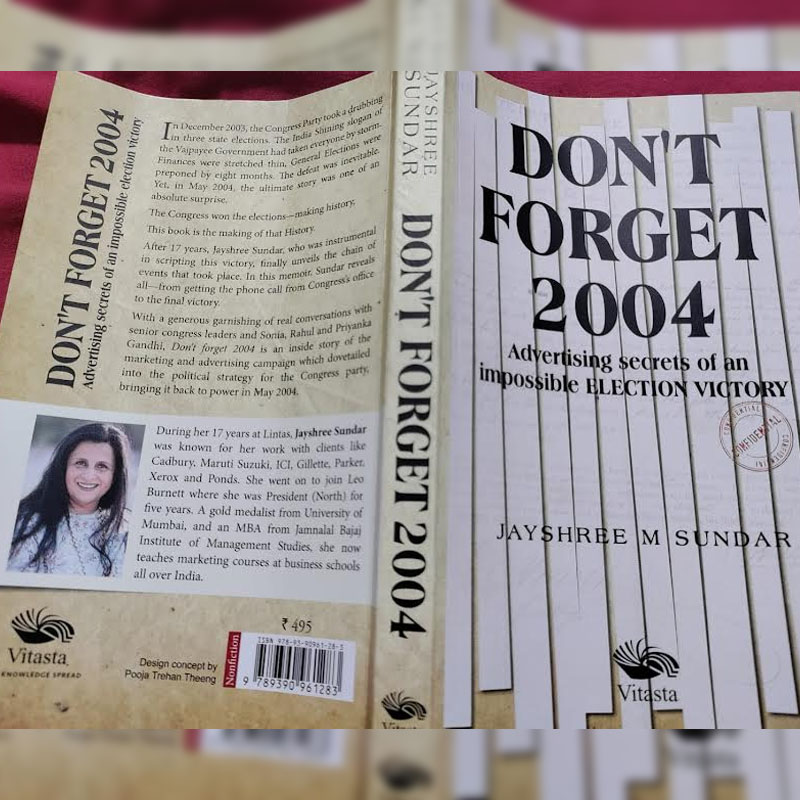
    Mumbai: Political advertising and marketing case studies might be a bit of a bore for many. But once you pick up ‘Don’t Forget 2004 – Advertising secrets of an impossible ELECTION VICTORY’ by Jayshree M Sundar and start flipping through its pages, you can’t put it down. Written in the manner of a fast-paced diary and personal narrative, it keeps you thirsting for more, and it hardly feels like you are reading. The pages flip by so fast, and before you know it, you are at the end of the book, a lot richer in your understanding of what politicians think like,  how ad agency executives can interact with them, and what it takes to draw up a winning election strategy and brand campaign.

    Jayshree should know. The senior advertising executive was heading the Delhi office of Leo Burnett India (once Chaitra Advertising founded by Walter Saldanha) when she got a call from Congress (I)’s senior leader Salman Khurshid’s office. The voice at the other end informed her that her agency was in the running to help the Congress (I) as it sought to make a comeback in the 2004 hustings at the Centre. The party had been out of power for more than a decade and a fierce opposition BJP was riding high with top media expecting it to win again by a thumping margin.

    Some of us may have a recollection of the savage campaign by Saatchi & Saatchi titled “Labour is not working” which swept Margaret Thatcher’s conservatives to power in 1979. Jayshree, along with her team, took a similar tack, working against impossible deadlines for a client which had no idea about the political marketing direction it should take. What made it even more challenging was that the BJP was looking smug as hell, splurging top dollar on ads all over the nation talking about how India was shining.  

    The Congress (I) mandarins provided no brief and they had limited budgets. Jayshree and her team had to come up with the communication that would position the Congress (I) right and yet show up the failures of the outgoing BJP government. Agency executives had to work and communicate with political heavyweights like Sonia Gandhi, Salman Khurshid, Ambika Soni, Jairam Ramesh, Ahmed Patel, Rahul, and Priyanka Gandhi, Motilal Vora – folks who commandeered a lot of respect, and whom they had only seen on TV.

    Through the book, you find out how she and the agency’s creatives pivoted to get quick answers through cheap and cheerful primary and secondary research. That and the fact that it approached the assignment as a regular brand campaign helped it come up with a pitch presentation that was bought by the steeped-in-the-old-ways-of-working Congress (I) senior leaders. The riposte to BJP’s India Shining slogan was “Aam aadmi ko kya mila?” “Congress Ka Haath aam aadmi ke Saath” and addressed the heartlands of India, against the former which was more focused on the urban Indian. The B&W visuals featured farmers, unemployed youth, the middle class and children, women as against the BJP’s well-dressed urban Indians.

    The book details how the agency came up with the four phases of the campaign, the steps it took to maintain utmost secrecy while creating the campaign, and later when ads and TVCs were released to publications and TV channels in various languages all over the country.

    Jayshree’s effort is not just all about words; she has peppered the book with advertising artwork which made it to the newspapers over the various phases of the campaign.

    The Leo Burnett team’s communication and marketing strategy did work well if you recollect. Despite the BJP’s bigger advertising war chest, it and its allies managed to retain only 185 seats (1999 count 298). The Congress (I) however celebrated as it individually captured 145 seats (against 112 seats in 1999) and 220 seats (as against 135 in 1999) with its allies. It of course came to power, and the rest they say is history.

    ‘Don’t Forget 2004’ is a must-read for students and practitioners of marketing and advertising as well as those in the political ranks, given that there is very limited literature available on political advertising. It is rich in detailing the learnings the agency had while working on the Congress (I) campaign. Be sure to pick up a copy.

    (Don’t Forget 2004- Advertising secrets of an impossible ELECTION VICTORY – Jayshree M Sundar, pp284, publisher Vitasta Publishing, Rs 495)

    You can buy it on Amazon too by clicking on this link: https://www.amazon.in/-/hi/Jayshree-M-Sundar/dp/9390961289

  • GUEST COLUMN: The all-pervasive role of technology in new-age marketing

    GUEST COLUMN: The all-pervasive role of technology in new-age marketing

    Mumbai: It was October 2020 when a Cadbury campaign featuring the Bollywood star Shah Rukh Khan (SRK) caught my attention. Christened as a ‘NotJustACadburyAd’, the campaign blended SRK’s image and voice using AI to create customised ads for local shops by directly naming them.

    This idea to promote local businesses when they had taken a big hit during the pandemic was widely appreciated. Also, from a creative angle, the campaign went viral. This level of hyper-personalisation could only be possible with the use of AI-led innovation and technology. This reflects two defining developments:

    1.      How new-age marketing is developing a deep understanding of the latest technology tools now playing a key role in developing meaningful customer relationships, and delivering friction-free, cross-channel experiences for consumers.

    2.       ‘Unified Analytics’ will replace ‘analytics by channel’ and customer groups will see an elevated level of strategic measurements and a much more holistic view of the customer.

    The chances are that while browsing through any marketing guide today, you will find it peppered with tech jargon. That’s how ubiquitous technology has become to the very essence and practice of marketing. As a result, brand campaigns have become more personalised and immersive than ever.

    While technology has exploded and there are hundreds of versions vying for space in the market, here are the ‘Top five most transformative technologies’ that will reshape marketing in times to come:

    1.      Increasing use of Chatbots

    This AI-led software can simulate meaningful conversations with internet users in a natural language through a combination of text and voice messages. Its popularity is increasing by the day due to its 24×7 role in solving customer queries. Bluebot, the chatbot of KLM Royal Dutch Airline, reported in excess of 1.7 million messages from 500,000 passengers.

    According to Salesforce, 69 per cent of the US consumers prefer using chatbots when engaging with brands since it often leads to a prompt response. As per estimates, ~40 per cent of big organisations are already using chatbots, and in the next few years, ~80 per cent of communication between the customers and organisations will be done through chatbots.

    2.      The rise of Voice Assistants

    Voice assistants like Amazon’s Alexa and Apple’s Siri have greatly altered the way users search for information on the web, fast gaining popularity in the voice search feature of search engines due to two important factors;

    -Average typing speed of 41.4 words per minute is far less productive than the speed at which we speak, i.e.160 words per minute

    -The Natural Language Processing (NLP) technology has gotten very advanced, making it easier for voice assistants to pick up and dissect queries accurately.

    Recent statistics reveal that one-third of 3.5 million searches on Google are voice searches. Therefore, from a marketer’s point of view, the voice search SEO strategy becomes important by updating content and becoming mindful of keyword research tools to come up with more voice search questions.

    3.      Fast growth of Virtual Reality

    The rise of Virtual Reality (VR) is mainly due to two reasons. Firstly, the hardware is relatively inexpensive. A Google Cardboard VR headset and a smartphone are enough for you to immerse yourself in another world. Also, many VR applications available on smartphones are completely free to play.

    Secondly, the unique user experience is visceral, the controls are far more intuitive, and the characters more relatable. That’s why it has been dubbed as the ‘ultimate empathy machine.’

    Taking a few examples from the retail sector, Tanishq partnered with Milestone Brandcom to install augmented reality (AR) kiosks (termed as ‘MirrAR’) for elevating the jewellery shopping experience. On the other hand, Lenskart offers 3D face modelling by measuring and mapping the user’s face from multiple angles, thereby providing a 360-degree view of the glasses. Similarly, Sephora’s AR beauty app lets users try makeup by superimposing certain lipstick shades and eyeliner looks using users’ selfie poses.

    4.      The imminent rise of Web 3.0

    Web 3.0, which is being built on blockchain technology [underlying bitcoin and other cryptocurrencies], aims to eliminate all-controlling intermediaries and provide the key benefit of a single login across social media accounts for seamless browsing, networking, engagement, and data security.

    This blockchain-led tech has the potential to re-invent the digital marketing industry. With users having direct control over their data and privacy, companies will have the opportunity to become highly user-centric and transparent by :

    -Analysing customer buying habits across platforms

    -Gathering previously unobtainable data on how consumers interact with devices and products

    -Gaining deeper insights on where a customer is in the buying journey.

    International luxury brands such as Balenciaga and Adidas are ahead of the curve and have started experimenting with Web 3.0, but time will tell how such virtual interactions can become stickier, and translate to potential sales. Even everyday brands like Taco Bell, Coca-Cola, McDonald’s, Gucci, and Warner Music are using non-fungible tokens [NFTs], thus introducing more and more audiences to the process of buying, owning, and selling digital collectibles. A great way for marketers to leverage NFTs is to use the technology for tickets and souvenirs.

    5.      AI-led Hyper-Personalisation

    The concept of a hyper-personalised experience is based on the use of AI in understanding and learning from human responses to communication by using data, such as recent purchases etc. This hyper-accurate segmentation of AI engines is a marketer’s delight in providing improved customer experience beyond assumptions and practices by using Customer Data Platforms (CDPs) as solutions for data architecture, integration, and reliability problems.

    Starbucks is an excellent example of hyper-personalisation. It took its already personalised menu to the next level by adopting a real-time personalization engine [primarily pulling data from their loyalty app] that produces individualized offers for their customers based on their previous behaviour and preferences.

    Most organisations utilise only ~15 per cent of the technologies and capabilities they are already paying for. Therefore, the number of technologies adopted is not as important as ‘applying’ them to solve business needs. Today, marketers are at the critical junction of integrating human experience and technology. They have forever been trying to demystify the customer’s mind. Thanks to technology, now we have endless ways of knowing!

    (The author is executive vice president – global marketing at Wadhwani Foundation. The views expressed in this column are personal and Indiantelevision.com may not subscribe to them.)

  • Gillette India commences marketing and selling of Braun in India

    Gillette India commences marketing and selling of Braun in India

    Mumbai: Gillette India announced on Thursday that it has commenced marketing and selling of Braun® in India.

    With this latest addition, Gillette India (GIL) now has a holistic portfolio of grooming brands including Gillette®, Venus®, Braun®, and King C Gillette®. A subsidiary of Procter & Gamble, Braun was founded in Germany in 1921 and is a known brand in the field of electric grooming appliances across the world.

    The addition of Braun adds an extensive range of both male and female grooming products like electric shavers, trimmers, epilators, Intense Pulse Light (IPL) hair removal devices, and hair care devices to the company’s existing portfolio.

    “Our continued focus has been to understand and meet the evolving needs of our consumers with superior and newer propositions. The latest addition of Braun, world-renowned for incredible precision, good design, and innovative technology, will enable us to better serve the Indian consumers with devices that help in creating a perfect look,” GIL managing director Madhusudan Gopalan said.

  • We want to be the poster boy for Web 3.0-led marketing in India: WATConsult’s Sahil Shah

    We want to be the poster boy for Web 3.0-led marketing in India: WATConsult’s Sahil Shah

    Hybrid digital agency, WATConsult from the Isobar India group celebrated its 15th anniversary this month by launching an NFT (Non-fungible Token) in the form of digital artwork. Titled ‘Once a WATizen, always a WATizen’, it contained the names of all its 1500+ employees- past and present- to commemorate the milestone. The digital-first agency, which saw some downs but mostly ups due to the pandemic, brought 2021 to a wrap with double-digit growth and a host of new client wins including 59 new mandates. These include brands like Cricbuzz, Licious, Sava Herbals, UB Group’s Kingfisher Radler & Heineken, Joy Cosmetics, Lead School, India Circus, Dr Oetker, BIAL to name a few.

    A key founding member, Sahil Shah has been with the agency for the last 13 years, and is credited with playing a significant role in shaping and building it.. Having joined the agency as a social media executive in 2009, Shah moved from being chief business officer- to managing partner in September 2021. He credits the agency’s recent successful run to the fact that post-2020, with client businesses bouncing back, everybody wanting to get into digital. He, however, does not discount the effort that went into building the brand up over the years, which he says has played its part in influencing the adoption of digital in the country to a large extent.

    As we tread into 2022, IndianTelevision’s Anupama Sajeet caught up with the WATConsult head Sahil Shah spearheading the agency’s India operations for an extensive conversation on the agency’s foray into the metaverse and what it hopes to achieve by being a first-mover in the NFT space. He also shares forth on the rollercoaster of a year that 2021 was, his expectations from the new year, and insights on the trends that will dominate the digital marketing industry in the months to come …

    Edited excerpts:

    On the concept behind NFTs and how can marketers use NFTs as an opportunity for growth?  

    NFTS, in the simplest terms, is digital real estate that cannot be replicated and is owned by an individual or entity i.e. digital ownership. It’s on the blockchain in the Web 3.0 world, which of course on the internet itself, but a highly decentralised form of it. So, there you have this NFT marketplace such as the Opensea, on which you can list your NFT creative and it can be monetised by selling. And that’s the reason there is a humongous commerce opportunity with NFTs for even Brands, and brands need to realise this.

    Another usage of NFTs for Brands is as memorabilia or collectibles by using the power of its user community. Anything that’s ownable can be marketed this way- brand mascots or advertising creatives, or a public figure’s legacy in sports, entertainment or Bollywood. The collection would be unique – it is digital art and people want to own a piece of that art. For example, a brand like Amul, which has some iconic creatives, can list them on an OpenSea and get die-hard fans to actually auction for it and trade, resell and make a business of it! So the uses are many – as CSR, business, promotions, public figure marketing- the possibilities are endless.

    On celebrating the 15th anniversary with NFT

    As an agency, we have been known for doing a lot of new-age stuff. We have dabbled in and got into areas which the majority may not be cognisant of. So the thought behind such an initiative was to commemorate the 15-year milestone by actually building something that remains on the internet forever, and can be owned by each and every WATizen- past and present. And the answer was NFT because they are, by nature, “non-fungible” and the ownership lies within the people, the community, or the person who uploads or lists it on the marketplace.

    We came up with the idea of etching everybody’s name on the creative and making it a part of history and keeping it on the OpenSea marketplace Ethereum blockchain forever. So that way each and every one of us is a part of it and everybody has a part to play in it. Essentially, it’s a way to thank each and every person who built this company over the years by making them a part of our history forever.

    In fact, the same day we launched our NFT, one of our clients actually gave us a written brief on exploring something with an NFT for them. They want to be the first-movers in their industry in this space. So I’m excited about moving towards building not just “India-class” but “world-class” solutions for marketing in a Web 3.0 world. It’s of course early days, but we want to be the poster boy for everything related to Web 3.0-led marketing in India. In that sense, WATConsult has been the “blueprint” for other competing agencies to watch and learn, as we’ve been able to lead changes in the industry over the years. And with the NFTs we continue to do so.

    On his priorities since taking over as managing partner last year

    My priority is to make sure that we get three to four things very right: One, is everything that’s centered around the creative use of digital for, that’s the core of what WATConsult was, is, and will be. Second, we want to be extremely high on everything that’s around client delight and customer focus and make sure we deliver on it, which’s in a way linked to our revenue, growth, P&L, etc. Third, we always want to be the first movers and the early adopters, while continuing to be in the news for the innovations that we bring to the table. Additionally, ‘Talent’ and ‘People’ for me is a big focus area, besides revenue and recognition, and I want to make sure the company gives back to its people by different ways and means.

    On the industry’s new emerging categories

    I think one of the new and emerging categories is everything ‘new-tech’- so anything that’s born out of digital, such as financial tech or fintech, e-commerce, food tech- for instance, brands like Licious, Edtech, and so on. The kind of categories that are coming up are very exciting because they understand digital innately, being fully digital themselves.

    Having said that, while that’s one domain where digital businesses are booming and scaling up, there are also the businesses that are legacy brands but are wanting to embrace digital. For eg: One of our big wins in e-commerce solutioning was the UB Group, where we acquired the mandate for their entire commerce duties last year, which’s online selling of its Kingfisher Radler & Heineken non-alcoholic beverage category. We’ve been scaling up their business on Amazon, Flipkart, etc which has given great returns to a client whose business was 99 per cent offline. If we are able to move that metric from 99 to even 95 per cent and create like a 400 per cent growth in e-commerce sales then it would be a huge validation for both the client and us.

    On any major trends that the digital marketing industry witnessed this past year / is witnessing

    One big trend that sparked in 2020 was the fact that India woke up big time to short videos. For the TikTok revolution that started around 2018-2019 and then scaled up in 2020, 2021 has been by far the year for content consumption in a short format- which is a 5-20 seconder clips and visuals- that everybody from Facebook, Instagram to YouTube adopted. That was one clear shift in consumer content consumption that was happening. At the same time, users are also hooked on long-form web-based content on OTTs and online. The bottom line is that video in both short forms as well as the longest forms- kept on growing and it continues to do so as a primary piece of content consumption.

    The second was definitely ‘Bharat’, with the growing internet penetration in India’s hinterlands, which we were fortunate enough to latch onto and build a multi-lingual and regional/ localised service solution around it.

    Third is data-tech or data-led solutions. One of the things the industry is moving towards is everything that technology can aid. Technology today has the power to create a life-size, 3-D version of anything we want it to be, like a ‘Virtual Influencer’. This trend has already been explored in markets like the US, Korea, or Japan, and is an example of how Tech is going to influence a lot of content creation and even creatives per se, and this is just the beginning.

    Another thing that the world started opening up to towards the end of 2021 (the Oct-Nov-Dec period) was the idea of Web 3.0 with NFTs, Cryptos, the Metaverse etc. It’s still early stage and an up-and-coming trend, but I think in the next few years it will change the way we interact.

    On Expectations from 2022

    From the industry, my expectation is to continue the digital growth at around 40 per cent Y-O-Y. I know we are at scale but there is a lot that digital can still do for brands and marketers are realising it. So I just hope the digital part of the pie continues to grow.

    Secondly from a 2022 perspective and maybe for years to come, I think the world is going to be hybrid- the way we work is going to be hybrid. I don’t see the culture of people in offices from 9 to 5 for five or six days a week coming back. And it’s honestly okay and maybe even a good thing- it’s a healthy way to operate where people connect in groups, as well as, detach and work by themselves. So hybrid is here to stay, possibly even post-Covid.

    Additionally, adoption into Web 3.0 while we continue to do our campaigns in the Today. At least for WATConsult, I wish that we continue to think into the future while we execute in the present. So our focus will be to keep pushing the bar for creative use of technology in the marketing communications space and continue being the blueprint for others to follow.

    On any personal learnings, you will take into the next year

    Although I have seen various changes in the last 13 years with the agency, the last one and half to two years have been a huge shift in the way of working, and in my personal & professional beliefs. So one of the major learnings I want to take forward is to make sure I declutter from all the noise around and focus simply on just two or three things that I want to move towards, personally as well as professionally.
  • GUEST COLUMN: The harm that good ads do

    GUEST COLUMN: The harm that good ads do

    Mumbai: If you want to greet somebody in the morning, two things are essential. First, you have to say ‘Good Morning,’ not ‘Good Night’ or ‘Good Afternoon.’ And second, you should say it pleasantly. If this combination goes haywire, you won’t get the other person to say ‘Good Morning’ to you, and with a smile.

    What to say is the ‘strategy’. How to say is the ‘creative’. Effective communication is a perfect blend of content and presentation.

    The job of strategy is to set the message right. And to do that, it has to get the objective right. It should be a precise and well-defined objective. The objective must be in terms of a shift in feeling with reference to the brand in question. And then, to achieve that, the specific message has to be precise like the tip of an arrow. Sharp.

    A creative’s job is to say ‘Good Morning’ but in a way that is interesting and engaging. Saying it with a blank face and with a serious voice won’t cut any ice. At the same time, a creative cannot say ‘Good Night’ in the morning howsoever enchanting the way it is said in. Your audience will like the smile and the charm but won’t get that you wanted to greet them with a ‘Good Morning.’

    When the strategy is right, it may be basic, it may be obvious, but if it is right, the job of the creative is to engage the audience in a powerful manner. And only an emotional approach can engage the audience in a powerful way. Emotions can be of any kind, including humour, which is one of the most powerful emotions used for communication.

    Things start behaving like life when we forget this basic principle. When we create ads that are very engaging but they don’t say ‘Good Morning’ or ‘Good Afternoon,’ they might confuse people but in a very engaging and charming way. The road to disaster is paved with charming ads.  God forgive them for they know not what they were supposed to convey.

    And while they don’t communicate what they were supposed to, they obviously don’t get the right result, which is primarily contributing to the brand image and secondarily, helping sell the product. When the batsman doesn’t score the runs in spite of hitting some beautiful shots, the selectors start believing that those shots must not be used again. While the real culprit is the strategic miscalculation while executing these shots.

    Clients start believing that since these charming ads aren’t working in the long run, charming ads don’t work. They don’t see the bigger picture and become wary of ads that are highly creative. And they go back to dull and boring ads which they believe work for the brand.

    We need to understand and distinguish between four kinds of ads:

    1.     Boring ads based on wrong strategies.

    2.     Boring ads based on the right strategies.

    3.     Highly engaging ads based on the right strategies.

    4.     Highly engaging ads based on wrong strategies, and

    No 1) Boring ads based on wrong strategies are certified and guaranteed disasters. Nothing can save them. Everything is wrong with them. Life looks quite pointless after watching them. Something immediately dies inside you.

    No 2) Boring ads based on the right strategies are mediocre and will bring average results for the image. Look around, the world is full of them. These are donkeys walking in the right direction. But they are donkeys.

    No 3) Highly engaging ads based on the right strategies are the darlings of the industry. Everybody wants them. Though, not everybody recognizes them. There is no debate on these. They build factories.

    No 4) These are highly engaging ads based on wrong strategies. These are the good-looking villains which do the real harm. They are like ‘Asurs’ in the guise of ‘Apsaras’.  Because of them, you don’t get the message right. They say “Good Evening” in a beautiful voice at 7 am, leaving the audience charmed, confused, and lost.

    These ads give a bad name to the really good, charming, engaging, and creative ads. Clients become wary of all creative and clutter-breaking ads. Once bitten, twice shy. The Cred Rahul Dravid ad is the epitome of this category. Highly engaging and disruptive, but leave the audience asking “Arre kehna kya chaahte ho bhai?”

    (Kapil Mishra is a brand and creative Consultant at Indiassetz, where he oversees the entire marketing, social media communication, and advertising. The views expressed in this column are personal, and Indiantelevision.com may not subscribe to them.)

  • We want to grow our user base two-fold & daily rides by 3X in 2022: Rapido’s Amit Verma

    We want to grow our user base two-fold & daily rides by 3X in 2022: Rapido’s Amit Verma

    For those of us who have spent precious stretches of time stuck in traffic jams during rush hour, the thought of getting on a bike and zipping through the traffic has definitely looked appealing. It is this everyday challenge that Rapido, a bike taxi service seeks to help overcome. The company which was among the first to introduce the concept of bike taxis in India in 2015, has over one million ‘Captains’ (bike taxi drivers) today, out of this, nearly 15 per cent are women.

    Over the years, Rapido has emerged as a key player in India’s ride-hailing industry by focusing its operations on the two-wheeler taxi segment. The Bengaluru-based startup has expanded its presence to 100 cities across the country that include tier 1 to tier 3 cities. But faced challenges post-2020, as the pandemic forced most commuters to work from home. Things began to look up in 2021, as cases subsided, only to return to the same routine with a new wave of infections.

    As we roll into 2022, IndianTelevision’s Anupama Sajeet caught up with Rapido head of marketing and growth Amit Verma to talk about the seven-year-old startup’s advertising and marketing for the year amid the pandemic. An avid marketer with a decade-plus experience in performance & growth marketing, Verma was previously with self-drive car rental company Zoomcar, and took over the role of marketing head at Rapido right at the outset of the pandemic. In an extensive conversation, he shared the learnings of the past year and his insights on the trends that might dominate the commute and ride-sharing industry in the new year, including the two latest campaigns featuring actor Ranveer Singh and Allu Arjun.

    Edited excerpts:

    On Looking Back at 2021 as a year of disruption or opportunity for Rapido

    Looking back, last year was a blessing in disguise as we got plenty of time to introspect. Since we were not able to run our bike taxi business, because of the pandemic, we focused on launching new verticals like auto and C2C (Consumer-to-consumer) hyperlocal delivery services. On both fronts, we are doing really well and we have a presence in auto & C2C in more than fifty cities today, and it contributes to 30 per cent of our overall business. So that was really helpful to sustain operations amid the disruption in demand for bike taxis.

    From a business numbers point of view, we succeeded in resetting the 1 ½ years of the pandemic. But, today we stand at the same position where we were about two years back when the pandemic hit (in 2020) and our operations went for a toss. So, to be honest, 2021 was about trying to regain our pre-pandemic numbers, of which we have recovered 100 per cent. If you talk of daily levels, we are doing about four lakh rides every day. So apart from the three to four months of lockdown, 2021 has been a good year overall for us. We spent more than 150 cr in the past year on performance marketing, branding et al, which will again go up by 200 per cent this year. We now have close to a 25 million user base, which we plan to grow two-fold this year. 

    On the brand messaging or marketing strategy in 2021

    The two major campaigns we launched in March and November in 2021 were with the aim to sharpen our messaging of  ‘affordable, convenient, and time-saving commute’ options. Even in our previous brand campaigns, we have tried to highlight these three value propositions, and this time too, with our first celebrity campaign, ‘Smart ho, toh Rapido’ campaign featuring Ranveer Singh and Allu Arjun, we aimed to position Rapido as a customer-centric brand and highlight its key USPs, while doing the relative comparison with the different mode of commute, like bus and auto.

    On the response to the ‘Smart ho, toh Rapido’ campaign

    We got a pretty good response on both these campaigns. When we did the first campaign in March we got an approx. 50 per cent jump in upper funnel numbers, and it helped us to garner new users at a faster rate. But unfortunately, then Corona came into the picture and we were not able to fully reap the benefits of the ads. Again, in November we got tremendous results for the Ranveer-Allu Arjun ad campaigns.

    Although Rapido has a pan-India presence, within India one has to accept the fact there are different regions that talk in different languages and with different celeb-affinities. To encash that affinity, and increase the reach of our campaign so as to get good ROI out of it, we chose these two celebrities for the HSM (Hindi speaking market) & the non-HSM markets. Additionally, they also went well with our brand image of ‘young, vibrant and smart’ as they have a similar kind of value proposition as the brand.

    We have also taken up big properties like the recent T20 World Cup that happened in November which has been partially instrumental to bring really good ROIs. We have seen more than 100 per cent uplift on upper-funnel numbers, even the week-on-week growth which we witnessed during this campaign was more than 20-25 per cent.

    On the brand’s ad spend allocation across media: TV, digital, print, OOH

    We are a digital-first brand. Our 100 per cent revenue comes from online bookings, as we don’t do offline bookings. So digital is our first priority. But, we rely heavily on TV for branding. In terms of ad-spends on the campaign we launched to create awareness about the brand, then we spent 65-70 per cent on TV, 15 per cent on OOH, and the rest on Digital. Previously, we have explored Print too, but we did not get a good ROI out of it essentially because we are a non-seasonal brand, and for us, as a commuter category brand that never comes out with a seasonal or festive sale, it did not make sense. So apart from Print, we are using every other media.

    On tapping into influencer marketing

    Although we have not used influencers for the brand campaigns, from our overall marketing expenditure, nearly 5-10 per cent spend goes into micro-influencers and micro-bloggers. With the advent of short video platforms, a new set of micro-influencers have come up, and they have a pretty good reach. As a brand we are in the process of fully exploring influencer marketing, having seen that it not only increases brand awareness, but one can get a really good ROI from these influencer marketing campaigns.

    On the brand’s target audience and consumer demographic

    From a demographic point of view, we have bifurcated the category into two different sections – T1 and T2. In T1 we are mainly talking to those users who fall into the age group of 18-28 years, which is our primary TG and 80 per cent of our business comes from there. These are guys who don’t fall into the high-income bracket. In T2, 60 per cent of business comes from state capital cities- of which we have pretty good coverage. And then we have a long tail of tier 3 cities. We have witnessed really good growth from tier 2, tier 3 cities during the last two campaigns, so certainly we see a reasonable potential over there. Right now we are not looking at expansion into newer regions so much, as we are trying to capitalise on our presence in each and every city and garner good numbers from the growth point of view.

    On plans to cater to the female demographic in the near future

    We have female captains in multiple metropolitan cities like Hyderabad, Delhi, Bangalore etc, only their percentage might be lesser for the simple reason that you do not get female riders very easily. But we are focusing on increasing their numbers going ahead. Unfortunately, when you talk about travel or commute as a category, you’ll get 80-85 per cent of users who are predominantly male. Just because of that, whenever one is drafting one’s brand communication you have to focus more on your TG which is male-centric, due to which regrettably, there has not been much female-centric communication from our end. But in the near future, you will certainly see some communication go out from our brand which will cater to the female consumer also.

    On Looking Ahead at 2022 and goals for the brand

    We don’t have a major expansion plan with regards to new cities. But, we want to increase our user base by 2X and our overall daily rides by 3X, which means we will spend a lot of money on user acquisition and on the repeat users so that we can get more users to take rides, and increase their ride frequency. Also, with what we have witnessed over the last two years, the influencers and micro-influencers have started creating a lot of impact on the user base. So, we plan to leverage that by increasing spend there. So approx. 6-12 per cent spend might go on a regular basis on influencer marketing this year.

    On the key trends that you think might dominate in the industry this year

    I think the next big thing we are betting on is the EV ride, because of the environment-friendly and cost-cutting factors. Everyone in the industry, I think, is trying to enhance their EV capability and general EV mobility in the commute segment. We will also be focussing more on EVs, and on how we can increase the adoption of EVs in the overall commute and bike taxis. As of now, we do have some electric vehicles and we have also done a couple of partnership rides. Recently, we entered a tie-up, where we are providing EVs to our delivery boys that are being used to fulfill deliveries of Swiggy and Zomato.

    On any personal learnings, you would be taking into the new year

    If the last two years have taught us anything it is that- be it an organisation or individual- one should be quick, adaptive, and volatile. With the odds changing constantly, that’s the only way one can survive. That’s the lesson I have learnt and certainly going forward too, we will try to replicate all these qualities so that we can grow further and at a really good pace.

  • 7Up brings festive cheer to Tamil Nadu, launches limited edition packs ahead of Pongal

    7Up brings festive cheer to Tamil Nadu, launches limited edition packs ahead of Pongal

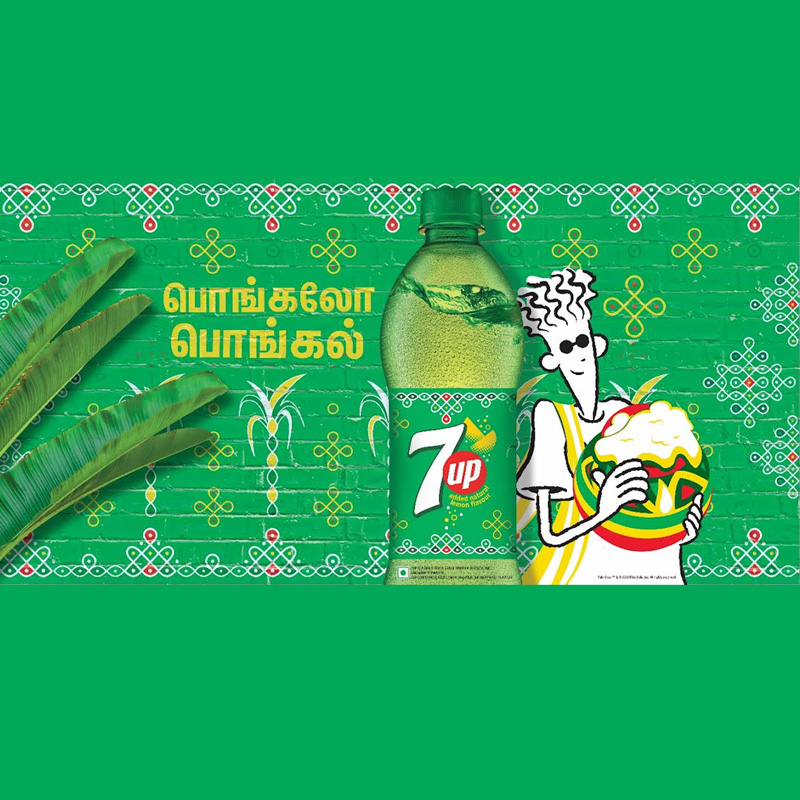
    Mumbai: Marking the celebrations for the auspicious harvest festival of Pongal in Tamil Nadu, 7Up has unveiled its all-new limited-edition festive packs featuring the quirky, curly-haired mascot Fido Dido.

    Pongal is widely celebrated in Tamil Nadu with people across the state marking the end of winters and expressing gratitude for a good harvest. The limited-edition 7Up packs are a tribute to the spirit of Pongal and take inspiration from the various elements that define the festival in its true essence. Right from the intricate art of Kolam to the use of sugarcane and pot to cook delicacies – the packs are a multi-faceted representation of all things Pongal.

    PepsiCo India senior marketing director Naseeb Puri said, “7Up is privileged to have been part of the rich Tamil Nadu culture, and this time, we really wanted to celebrate Pongal in a special way. The limited-edition packs are our endeavor to bring alive the festive spirit and add some freshness to the celebrations as people continue to stay home to mark the occasion this year.”

    The vibrant new Pongal-inspired labels will be used across 600 ml, one liter and 2.25-liter packs of 7Up and will be available across all modern trade outlets and select e-commerce channels. In a bid to spread the festive cheer across the state, the celebratory branding will also be showcased across hoardings and posters across public spots in select cities to engage the audiences, said the brand in a statement.

  • Eggoz appoints Samarth Wadhwa as head of marketing

    Eggoz appoints Samarth Wadhwa as head of marketing

    Mumbai: Eggoz, a Gurgaon-based integrated farmer egg brand has appointed Samarth Wadhwa as the company’s new head of marketing.

    Wadhwa carries nine years of experience in marketing, brand management, product promotions, and digital marketing. The company termed the appointment as a strategic move to capitalise on its recent success and the vision to grow. Wadhwa will be responsible for directing the marketing function and defining the short-term and long-term strategies of the brand, it said in a statement.

    Eggoz co-founder Abhishek Negi said, “Samarth is an expert in the field of marketing as well as a strategic thinker. He provides a varied set of abilities and a wealth of expertise to help Eggoz expand in India. His enthusiasm and dedication to his work will be invaluable in helping Eggoz shape and develop new opportunities.”

    Wadhwa oversaw Brand and Digital Marketing roles at Ford India and Honda Motorcycle & Scooter India before joining EGGOZ. He has completed his bachelor’s degree in Computer Applications from Bharati Vidyapeeth University Institute of Management & Research in New Delhi, as well as an MBA in Marketing and Finance from the same institution.

    “It is an honor to be a part of EGGOZ, the first consumer-focused and integrated farmer egg brand in India, and promote their mission of supplying chemical-free eggs fully integrated from farms in every corner of India. I am confident that EGGOZ’s products, services, and strategies will quickly propel it to the top of India’s business landscape,” said Wadhwa.

  • GUEST COLUMN: Paradox of Choice – How to influence consumers to pay attention to your brand

    GUEST COLUMN: Paradox of Choice – How to influence consumers to pay attention to your brand

    Mumbai: Twenty-four hours in a day and a zillion media choices to be made! This is the new regular day in the life of a consumer.

    From numerous apps to dime a dozen platforms along the consumer journey, audiences and advertisers are facing a present-day that is rife with limitless choices. Why? But of course, thanks to the internet, data, technology, and personalisation – things we have all become accustomed to. But there is a subtle undercurrent these trends ride on the back of – a paradox of choices!

    The internet has increased connectivity, and penetration is only expected to scale higher with time. The pandemic is accelerating pre-existing industry trends and altering consumer behaviours. In the context of the visual culture, we live in, courting the consumer with packaged and positioned choices is the first step, in the series of many, on the path to forging long-term relationships with them. And this journey is full of the subtle art of choosing.

    Evolving M&E landscape

    With the growth of the Indian digital segment, Television, online video, and social media are emerging as the top entertainment media. According to IBEF, internet browsing has gone up by 64 per cent with increased uptake of news, music, and AVGC. There is a marked shift from offline to online consumption for news with 45-minutes to an hour spent on news on social media and apps.

    Content to Commerce is the new consumer purchase journey. With cumulative time spent over two and a half hours per day, Indians are flocking to their social media accounts and consuming content in genres of news, comedy, the art of cooking, and culture. Then there is influencer-led content and shoppable ads here to delight consumers through the journey of content consumption across social channels.

    OTT Triggered Growth

    OLV and OTT platforms have witnessed a meteoric rise as the new entertainment destination. As per a report by Deloitte, popular platforms have garnered a 45-55 per cent increase in paid subscriptions after the outbreak of the pandemic with audiences spending 95-minutes daily on OTT channels. Rising demand for content and affordable subscription packages has triggered this growth. AVOD segment is anticipated to grow more by 2025. Vernacular adoption has also been accelerated during the pandemic and the momentum is here to stay with more than 13 per cent growth as compared to pre-Covid-19 levels, mostly from the hinterland of India.

    E-commerce Search Engines

    E-commerce and social apps are changing how consumers discover new products. Influencers have emerged as the new brand ambassadors and have evolved as a new marketing channel from discovery to conversion. Video commerce and social commerce are key and emerging conversational commerce-enabling brands are driving their D2C model through messaging apps like WhatsApp that the consumer is already acquainted with and uses extensively.

    The influx of short-form video apps is a testimony to this growth. Current statistics show that Indians spend five times more time on homegrown short video apps than global Instagram reels and YouTube shorts. Apps like Trell, Chingari, Sharechat, Roposo, etc. trail only Google and Facebook ecosystem in terms of time spent by Indians. Voice-based technology is breaking the literacy barrier in India. Searches on voice are expected to grow to 50 per cent, a 10x Increase in multilingual voice assistants is expected.

    All of the above trends indicate that the touchpoints to expose a probable consumer to a product have exploded. Meticulous decisions are required by industry mavens to validate the choices they make on one end. On the other, the consumer is scavenging for informed, yet simple choices to make better decisions, faster.

    For instance, at OMD, we balance the act with attention planning. In a world that is chaotic with choices, brands and advertisers need to be present on platforms their audiences are – adapting to consumer sentiment, being nimble, and providing a media mix of digital solutions to brands not hinged on a tall order but realistic metrics – distinctive packaging to cut through the clutter with creativity. After all, with the impact that the pandemic has had on inventory and ad rates, 2022 in the advertising world is going to be more about influencing the consumer to pay attention to your brand versus competitors and the journey will be interesting.

    (Sulina Menon is the chief client officer at OMD India. The views expressed in this column are personal and Indiantelevision may not subscribe to them.)

  • upGrad to offer online courses worth Rs 1.5 cr to job creators on ‘Shark Tank India’

    upGrad to offer online courses worth Rs 1.5 cr to job creators on ‘Shark Tank India’

    Mumbai: Homegrown higher edtech major upGrad announced on Monday that it will offer ‘online courses worth Rs 1.5 crore’ to the entrepreneurs pitching on Sony’s new reality show – ‘Shark Tank India’.

    The show which premiered on Monday night will have aspiring entrepreneurs from across the country pitch their business models to a panel of investors and persuade them to invest money in their idea. upGrad is also the presenting sponsor for the show.

    “At upGrad, we stand for job seekers as well as job creators. The entrepreneurs on ‘Shark Tank India’ today, can potentially create thousands of jobs in Bharat tomorrow. Assessing their business pitch and identifying possible lacunae, we are offering them need-based courses. This is our crusade to empower the entrepreneurial community – the job creators of tomorrow, to upscale their businesses,” said upGrad CEO – India Arjun Mohan.

    Throughout the first season of ‘Shark Tank India’, the edtech major will be awarding programs on a need-gap basis, across domains including Product Management, Masters of Business Administration, Supply Chain Management, Data Science, Digital Marketing, Business Analytics, and Operations & Finance to the ‘pitchers’.

    According to upGrad, the Indian chapter of the ‘Shark Tank’ serves as the perfect platform for the it to showcase to its audience the significance of upskilling and lifelong learning. “With an audience mostly comprising working professionals seeking to positively pivot their careers or nurturing their entrepreneurial zeal, this association will go a long way in improving upGrad’s deep India penetration plans and building an ecosystem of a skilled workforce,” the brand said in a statement,