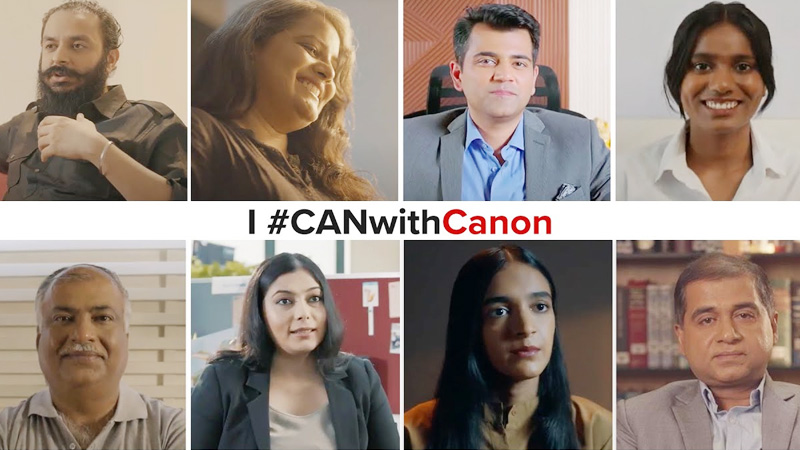
MUMBAI: Canon India has just given storytelling a powerful new lens with the launch of its latest campaign, ‘I #CANwithCanon’, proving that when it comes to real impact, technology isn’t just about pixels and prints—it’s about possibilities. This campaign doesn’t just celebrate Canon’s products; it highlights how its solutions empower individuals, businesses, and communities to achieve the extraordinary. And yes, it’s all based on real-life stories—not just glossy advertisements.
Canon, which has been a household name in India for nearly three decades, is using this campaign to underscore its role not just as a tech leader, but as a partner in progress for its consumers, businesses, and society. With six compelling videos spanning consumer, SME, enterprise, government, and social sectors, I #CANwithCanon delivers proof that innovation is not just about gadgets—it’s about making lives better.
Kicking off the campaign, Canon India president & CEO Toshiaki Nomura remarked, “For over two decades, Canon India has been at the heart of countless success stories across the nation. I #CANwithCanon is our tribute to these partnerships and milestones, showcasing how Canon’s solutions have empowered individuals and businesses to unlock their full potential.”
Adding to this, Canon India senior director- product & communication, C Sukumaran stated, “This campaign brings alive Canon’s philosophy of enabling excellence in business and everyday life. These stories demonstrate how our solutions address real business challenges and creative aspirations.”
Canon’s technology has turned businesses into powerhouses. Just ask Wee Prints, a major player in digital printing. Before Canon stepped in, their print volume was 1.5 lakh pages—impressive, but not enough. With Canon’s cutting-edge solutions, they’ve now ramped up to 2.5 lakh pages, meeting increasing client demands with ease and efficiency. Their business performance? Sharper than ever.
Printers and copiers are great, but what’s even better? A trusted partner. That’s what Wheelzy Spot (an authorised JK Tyre dealer) discovered when they sought Canon’s help. More than just technology, they needed efficiency, reliability, and—most importantly—support. Canon delivered all three. With a dedicated service team ensuring smooth operations, Wheelzy Spot’s business is running smoother than a newly paved highway.
Beyond business, Canon’s skill development & livelihood program is changing lives. Tanu and Karina, two individuals who were once struggling to find stable employment, are now thriving professionals, thanks to Canon’s initiatives. Their stories are a testament to the company’s commitment to real progress and meaningful change.
Canon India has built its brand not just on its technology, but on its customer-first approach and social commitment. As this campaign rolls out, more real stories of growth, success, and transformation will be unveiled in the coming weeks.
Because at the heart of every great achievement, there’s someone who once said, “I CAN.”
MUMBAI: Television advertising in 2024 wasn’t just background noise—it was prime-time gold, stealing the spotlight from even the most dramatic soap operas. According to TAM AdEx – 2024 Television Advertising Recap, TV ad volumes surged 14 per cent compared to 2020, proving that the battle for consumer eyeballs is still raging.
Globally, television ad spending is expected to touch $177 billion, with India alone seeing a nine per cent rise in TV ad expenditures compared to 2023. The second quarter alone saw a six per cent growth over the first, while the fourth quarter took a six per cent dip—probably because people were too busy binge-watching holiday specials to pay attention to ads.
But who poured in the most cash? Which industries turned up the volume? And which brands refused to be skipped? Buckle up—this one’s a wild ride through the world of TV ads.
Who was buying all that airtime?
If you turned on your TV in 2024, you were likely bombarded with ads from the food & beverages sector, which took a massive 21 per cent share of ad volumes, proving that snack cravings and screen time go hand in hand. Not far behind, personal care/personal hygiene lathered up with 16 per cent. The household products sector scrubbed in at 9 per cent, because apparently, nothing pairs better with your TV drama than a cleaner floor.
But who ruled the ad wars? Hindustan Unilever dominated with 16 per cent of all ad volumes, closely followed by Reckitt Benckiser (India), which boasted five out of the top ten most advertised brands. If you feel like every other commercial was selling you a soap or detergent, you weren’t wrong.
If you thought soap operas were dramatic, the real drama happened in the soap advertising department. Toilet Soaps dominated the charts yet again, refusing to be flushed away. Laundry detergents, toothpastes, and floor cleaners scrubbed into the top 10, proving that cleanliness is next to advertising greatness.
Quarterly showdowns
2024 was a tale of peaks and dips. The second quarter flexed its muscles, rising by six per cent over Q1, only for Q4 to slump by six per cent compared to Q3. Maybe by year’s end, consumers had perfected the art of muting commercials.
Despite the dips, 92 per cent of all TV ad volumes came from just five channel genres—dominated, unsurprisingly, by general entertainment channels (GECs) and news. If nothing else, advertisers know exactly where the eyeballs are.
Which brands stole the spotlight? The award for most persistent ad on TV goes to Harpic Power Plus 10x Advanced, which climbed over 60 spots to claim the top brand of the year. It was followed closely by Dettol Toilet Soaps, Dettol Antiseptic Liquid, and Jiocinema App. Because what’s better than watching ads? Watching ads about an app that shows more ads!
Surprisingly, digital brands also made a larger impact, with e-commerce and fintech stepping up their ad spends. The TV ad game isn’t just about FMCG anymore; the tech world wants a piece of your screen time too.
Co-branding went bonkers. Indian cinema blockbusters and brands continued their love affair in 2024, with Pushpa 2 leading the charge, accounting for 21 per cent of co-branded ads. The film with the most brands fighting for screen time? Fighter, which partnered with a record 13 brands—making sure even if the movie didn’t knock out box-office records, it definitely conquered ad slots.
Who surprised us?
While the usual suspects stayed strong, some underdogs made surprising leaps. Paints saw a 51 per cent increase in ad secondages, because who doesn’t love a fresh coat of paint before their favourite reality show? Travel and tourism ads doubled, surging by 100 per cent, as people started daydreaming about vacations rather than just watching them on TV. But the real showstopper? Beauty accessories/products grew a jaw-dropping 303 times, proving that looking good isn’t just for movie stars anymore.
And the exclusive advertisers? Over 4,010+ new advertisers joined the television ad game in 2024. Leading the pack was Velnik India, proving that fresh faces aren’t just for reality TV anymore. From fintech to online shopping platforms, new players saw TV as the ultimate stage to make their mark.
If you thought TV ads were taking a back seat, think again—because brands are still duking it out for your attention like it’s prime-time gladiator combat. As long as there are eyeballs to mesmerise and remotes to misplace, ad makers will be there, squeezing their pitches between your favourite shows. Industry experts predict that 2025 will bring even smarter AI-driven ad placements, hyper-personalised content, and interactive ads that might just talk back if you ignore them.
So, buckle up for more soaps (literally and figuratively), more snacks (because snack ads are never going away), and an avalanche of co-branded spectacles. If 2024 was a preview, 2025 is shaping up to be the full-length feature film of advertising dominance.
Mumbai: There is no denying that digital marketing in the modern era is an essential part of brand building and expansion. Not only does digital marketing open doors for brands to connect personally with their customers, but it also enables interactions across countries and cultures. Ad spending in the digital advertising market is projected to reach $565.20 billion in 2022. While digital marketing has several effective techniques that have made it the most influential form of promotion, one particular branch that stands out is influencer marketing.
Influencer marketing is a form of marketing where brands choose certain ambassadors or people, who are not celebrities in the actual sense but have a high social media following, to promote their products or services. Due to the boom of social media in recent years, this form of marketing has seen a tremendous rise with every brand, little or large, opting for influential people on social media to promote their products and services. According to the Digital Marketing Institute, an online forum that teaches various digital marketing techniques, around 70 per cent of the younger audience worldwide tend to trust influencers while making purchases.
Findings by the research firm MarketsandMarkets reveal that influencer marketing is set to become a $24.1 billion industry by 2024, globally. Seeing this exponential growth it is only fair for brands to know the latest trends in the sector in order to expand their reach and generate higher revenues.
Rise of nano & micro-influencers
The rise of nano & micro-influencers is a trend that seems to be at an all-time high in recent times. As per the Financial Express, high-end celebrities accounted for only about 27 per cent of the influencer marketing spend while the remaining 73 per cent was spent entirely on micro and nano influencers in India. The primary reason for this is that the engagement that comes with micro-influencers exceeds that of high-end celebrities by about seven times.
Nano and micro-influencers have a smaller base, generally one that they are familiar with and interact quite frequently with their followers. This makes the customers feel a personal connection with the figure causing building of trust. Through these influencers, brands can execute focused campaigns cost-effectively.
Short-form videos will continue to rule social:
As attention spans shift from minutes to seconds, short video promotions will always remain the king of social media. Features like Instagram’s Reels and YouTube Shorts are made to cater to the short attention span of the modern world.
Brands tell their stories via a number of video formats, including product teasers, explainer videos, behind-the-scenes and user-generated content. Connecting with Bharat by partnering with creators on Indian short-form video platforms is a big opportunity that is yet to be tapped on.
Regional content will thrive:
In recent months, there has been an exponential rise in the regional content that brands generate for promotional purposes. As per a report published by Financial Express, there are about 210 million monetizable internet users who speak vernacular languages in India.
This demand for vernacular content has caused regional content-creators to carve out a strong niche for themselves. Consumers feel a strong connection with the influencer and the familiarity of the lingo gives the influencers a high trust and reliability index.
The shift from ‘one-off’ campaigns to ‘always on’ strategy
The industry is shifting from experimental influencer marketing spending to planned budgets. Brands are more focused on building long-term partnerships with creators who can be the voice of the brand across all stages of the marketing funnel.
Rise of B2B influencer marketing
B2B influencer marketing is one dominant trend that will emerge in the influencer marketing sphere in the times that lay ahead. In a recent article carried out by Garner, it was reported that around 80 per cent of sales in the B2B spaces are now being made digitally.
B2B brands are for sure to leverage key opinion leaders and content-creators on platforms such as LinkedIn & Twitter in order to shape and spread their brand narrative.
Given that now, a national advertising regulator like ASCI is issuing guidelines for influencers, the industry is being given its due and influencer marketing is being treated as a force to be reckoned with. Going forward, influencer marketing will only become a stronger part of digital marketing strategies for brands.
The author is Opportune Ventures founder Kanishk Kanakia.
Mumbai: Its that time of the year when brands across categories serenade the fairer sex with the customary promotional offers and endless freebies. And if that isn’t enough, there are campaigns launched with themes raking up every possible ‘women’s issues’ one can think of. Yes, it’s the 8th of March and with yet another International Women’s Day (IWD) upon us, the annual trend of a marketing blitzkrieg continues unabated. The occasion today has become as big as a festival, and one of the prime events in a brand’s marketing calendar.
Brands and marketers using special days to connect with their TG is, of course, as old as advertising lore. And with women comprising nearly 50 per cent of a target consumer group, while also being principal stakeholders when it comes to critical purchases and decision-making in a household, brands, naturally, are keen to serve their cause. Advertising, however, is just one aspect of a brand. True commitment means investment of time, money as well as resources.
So just, how much are brands actually investing on Women’s Day?
“Lifestyle and fashion/apparel brands are one of the biggest spenders, spending in crores leading to the day,” notes Tonic Worldwide national strategy director Anjali Malthankar. “On the other hand, you have high impact influencers, collaborations, contests and giveaways – these activities are spent in lakhs.” So, it’s either a performance campaign to drive sales or an impact campaign to participate with a point of view in the Women’s Day conversation.
“We anticipate the advertising budgets for Women’s Day to be similar to last year and not significantly higher,” say Lyxel&Flamingo co-founder, CEO Dev Batra and creative director – copy Nishant Singh. “As a practice, Women’s Day narratives tend to be longer and thus the majority of the brands will end up advertising only on digital formats only and not that much on television,” add the duo.
This is also a time when brands try to up the engagement quotient by running contests and giveaways. Some even indulge in banter with other brands on social media as a way to garner share of voice or grab attention.
“There has been a shift in thinking by many brands whose core target audience are women,” believes White Rivers Media head of client partnerships Darrell Fernandes. “While most are still trying to communicate offerings, for some brands it’s an opportunity to create an emotional connect with women. It also allows us to deliver a far more engaging message which is not possible otherwise in the product campaigns.”
“What a brand should not do is force fit their business agenda in something that doesn’t land well on the brand philosophy or product,” Fernandes asserts.
This thought is echoed by Jayshree Sundar, the advertising veteran and author of “Don’t forget 2004” – a book on crafting a blockbuster marketing strategy for a political campaign. “The consumer today is able to see through shallow messaging that makes him/her buy something by offering freebies. They know when it’s a gimmick,” she says, adding that, “I think the way for brands to make a significant mark is by using the day to announce something more long-term that you’re doing for women, or how your brand supports women- What’s being done regarding women’s issues or to empower them, to make equality happen- things like that- if brands can dig a little deeper and it’s not a message just for that day.”
Sundar cites examples of brands like Dove and Tanishq which have been doing amazing campaigns around relevant themes for women, not only around Women’s Day but throughout the year. “If such a brand does something on Women’s Day, It will be accepted with open hands because that’s what they have been doing consistently. That’s the key to long-term returns,” she remarks.
While several leading brands have released video content focusing on women-related themes apart from recognising their contribution- while directly or subtly integrating their products in it, a very small percentage of brands practice such focused curated content as a consistent feature.
“The number of women-focused D2C brands who have grown astronomically in the last two years or so, could have taken the lead and become flag bearers of such campaigns but the expected action hasn’t yet taken place with IWD already upon us,” affirm Dev Batra and Nishant Singh. “However, we still witness a lot of brands doing tactical interventions – like a post or rolling out an offer closer to International Women’s Day. Sadly, they continue to simply acknowledge the day without doing much beyond.”
According to Mankind Pharma general manager – sales and marketing Joy Chatterjee, generating campaigns that are relevant in the day-to-day lifestyle of consumers helps the brand to connect and be more relevant to them. “For us, our target audience is not only women but rather every member of the household. We believe in connecting to households while spreading awareness, intense market penetration and a strong social media presence,” he says.
The company has released a Women’s Day campaign for its brand Prega News #SheCanCarryBoth. The campaign video depicts a relatable conversation between four women at different stages of life talking about balancing motherhood and a demanding career. “Our Women’s Day campaign 2022 showcases how society at large assumes that it’s difficult for women to nurture motherhood and be working professionals at the same time.”
He further adds, “Our budget for the entire campaign has been kept minimal, maintaining our focus on the content that was being produced and its amplification.”
The brand has onboarded four celebrity influencers and 15 macro-influencers who are mothers themselves and who share their stories to help the brand reach a wider audience. For better reach and mass society penetration the campaign has been launched in several regional languages.
For many of the women-centric brands, days like women’s day are not targeted towards amplifying their sales but rather in generating brand awareness. “Our actual ROI through the campaign will be more aware and sensitised to the masses. Being category leaders we believe that it’s our responsibility to educate the masses and talk about our consumer’s issues,” says Chatterjee.
With social media being the new normal, most brands also try to maximise use of that space by collaborating with Instagram or YouTube influencers and content creators to touch base with their customers and also create more customer base in the time to come. Marketers believe these campaigns and initiatives undertaken on special occasions helps garner more attention from the prospective audience, resulting in increased sales. “These initiatives help create awareness. Therefore, it is better and more beneficial than an advertisement in the long run,” says The Haelli founder Neha Sahu. “The unique content curated for the customers increases customer engagement and is shared further with family and friends with similar interests, helping us expand our peripherals.”
Fynd, a tech-first omnichannel platform, has crafted a campaign called #LeadLikeHer that aims to shed a spotlight on the leaders behind the brands on the platform. “Through this campaign, we wanted our audience to have a sneak-peek into the stories of the women who create the products that make them look fabulous.” says the Fynd co-founder Farooq. “The impact of a campaign such as #LeadLikeHer is beyond mere ROI and profitability. The power & authenticity of women in leadership roles is something Fynd truly believes in. Through this campaign, our aim is to start a conversation on the disproportionate male to female ratio in leadership roles. And act as a catalyst to push for gender equality and close the gap.”
To mark the occasion of Women’s Day, Candere by Kalyan Jewellers has come out with an inclusive campaign for its latest ‘Aadya’ collection, featuring diverse women, regardless of their age, size or appearance. The film is a shoutout against ageism and body shaming, signifying that every woman should celebrate and embrace themselves. The brand is also taking initiatives to celebrate real women on platforms such as Linkedin. “We are also getting in touch with platforms and are celebrating the women who have dared to keep their heads high and took charge of their own journey reaching for the stars,” says founder and CEO of the jewel-tech brand Rupesh Jain.
The brand believes its ‘Return on Investment’ is through its marketing standpoint. “When the communication of our campaign reaches our TG and when our audience connects with our Vision and Mission.” He adds, “Our brand vision is first to create understanding and relatability for our audience, engage them with our brand, and then create communication with them, which keeps them connected with our brand for the long run.”
So how can brands ensure a deeper connect with their TG on Women’s Day?
“First of all, don’t miss the trees for the woods,” says Tonic Worldwide’s Anjali Malthankar. “If you are a brand celebrating her only for a day to ride on a marketing opportunity and ignoring her issues for the rest of the year, then this can damage a long-term relationship with her. Stay focused and sincere.”
“I think slowly the brand world is opening up to campaigns which raise awareness and solutions about real issues like property ownership rights or breaking the bias in hiring etc and recognition campaigns, celebrating real women heroes- and not limited to doing gimmicky promotions only,” she adds.
Today women have become more conscious and they want brands that think like them. Especially younger millennials and GenZ respond to brands that are more humane, more empathetic and those who take a stand on pressing social issues. While sweepstakes and offers may come and go, and depending on the category, it may even increase sales, but scratching the surface runs the risk of either being forgotten or not noticed at all or worse – being called out.
Campaigns that are curated to start a genuine conversation and not just to jump on the marketing bandwagon give the consumer a deeper understanding of what the brand is and what it stands for. It all boils down to whether the brand can really walk the talk or not, believe the marketers.
MUMBAI: Be it the hilarious ad of its permanent markers that showed a dead man resuscitating back to life because of its indelible power or an emotional and sensitive ad of a little school kid sharing his colour set and sketchbook with a poor boy, Camlin India had once been in the race of most iconic ad maker brands. But for quite some years, the story of the brand’s marketing tactics has seen a massive shift. There are no more such stories that stay with the viewer and a growing focus on digital is in the loop.
Indiantelevision.com recently interacted with Kokuyo Camlin CMO Saumitra Prasad to know more about this shift in the approach. He shared, “Camlin has been investing in developing superior products far more than investing in TV campaigns and that differentiates it from other players.”
On being quizzed what is his strategy to make the brand visibility grow without focusing much on the TV ads, Prasad noted, “We have tried to create strong communication for markers and mechanical pencils in the past which has served its objective. Currently, social media has become our main source of communication. Our Facebook page has more than 8 lakh fans. We have even created applications to promote products and the brand’s promise of making learning fun. Also, Camlin is an active partner of Kidzania in both Mumbai and Delhi to organise a brand experience to its consumers and it has given us great visibility.”
He added, “Camlin being the oldest brand in stationery has a legacy and thus it’s both a privilege and a challenge to manage the brand in its transition of contemporising it without losing its old qualities. While past generations have grown using only Camlin and would always prefer us, today’s children have too many choices and they will not accept our brand just because it’s their parent’s favourite brand. And today’s children are not only very discerning but also strongly influencing the decisions of purchase so they need to be on the side of the brand. Camlin is now a part of the global Japanese company Kokuyo which makes it rich with systems and processes.”
The brand is extensively focusing on making its products more contemporary and visually appealing by placing a lot of effort on branding and packaging. But only this might not be enough for the brand to top the charts in the stationery market, which Prasad predicts is expected to grow at 9-10 per cent in the coming years.
He shared, “Camlin has a very high-aided awareness but we will have to accept that when it comes to the top of mind awareness there are many brands which are taking away that share. There are categories in which we have a dominant share like crayons, water colours, poster colours, geometry box, mechanical pencils, markers but at the same time there are categories where we are not the lead brand, like pens and notebooks.”
The focus is now on the notebook category by developing great products and supporting it with communication and activation support to increase trials and market share.