CANNES: Forget your boxsets. Forget your hour-long dramas. Audiences are ditching long-form television for something far more intoxicating: episodes that fit in your pocket and demand your full attention in under ten minutes.
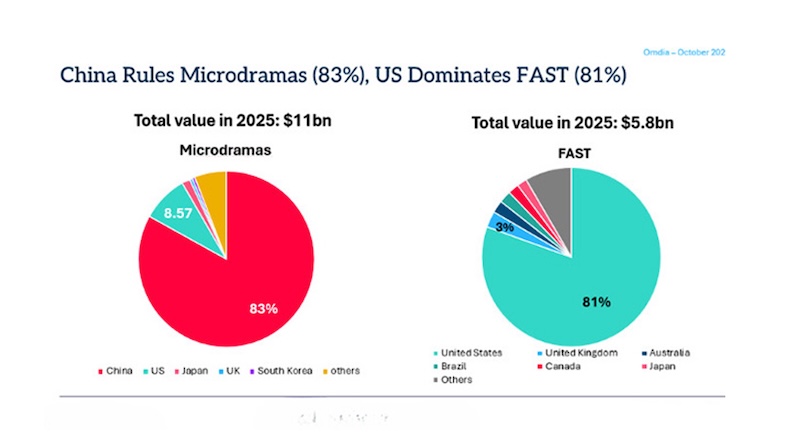
Microdramas—those addictive mini-narratives designed for mobile consumption—are redefining entertainment. And the numbers are staggering. According to Omdia, the consultancy that presented its findings at Mipcom, Cannes, this genre will nearly double the revenue of Fast channels, which are projected to pull in just $5.8bn next year.
“Viewers are willing to pay for content that captures them emotionally in seconds,” said María Rua Aguete, head of media and entertainment at Omdia. “Microdramas demonstrate that attention spans may be shorter, but engagement is deeper and more valuable.”
The monetisation model is brutally simple: hook viewers with free episodes, then charge them through subscription or pay-per-episode channels. This approach accounts for more than 60 per cent of total revenue. The payoff is formidable. Average revenue per user can reach $20 per week—or up to $80 per month—making microdramas extraordinarily profitable.
China dominates the space, generating 83 per cent of global revenue, fuelled by a colossal audience and a mobile-first culture. Beyond China, the US claims half of international revenue, with Japan, South Korea, the UK and Thailand emerging as hungry new markets.
“Microdramas are redefining what it means to tell premium stories in the digital age,” Aguete said. “They combine the immediacy of social media with the emotional depth of dramatic television. They are short, addictive, and irresistible.”
This isn’t a fad. As consumer habits shift inexorably towards mobile and short-form content, microdramas are poised to become the centrepiece of digital entertainment—a seismic fusion of social video and traditional storytelling that will reshape how the world consumes drama. The wave is here. And it’s only just begun to crest.