Tag: Margarita with a Straw

  • ‘Bombay Velvet’ collects Rs 15.8 crore in opening weekend; ‘Piku’ picks up

    ‘Bombay Velvet’ collects Rs 15.8 crore in opening weekend; ‘Piku’ picks up

    MUMBAI: Bombay Velvet has turned out to be the disaster it was predicted to be. From casting Ranbir Kapoor as a Tommy gun totting criminal to the way the film’s promotion was handled, especially the publicity material, went against it. From the film’s posters to promos, nothing inspired viewer confidence or curiosity.


    The film’s opening weekend collections are a terribly poor at Rs 15.8 crore. Kapoor has his fan following and, to an extent, so does Anushka Sharma, yet the film failed to garner decent footfalls on its opening day. The emerging word of mouth publicity from those who caught the movie early happened to be so negative that the film failed to better its Friday figures even on Saturday, which is a normal trend howsoever bad a film may be. It is strange that thanks to social media discussions, those who still went to watch the film thereafter did so mainly out of curiosity as to what was so wrong with this film?


    On the other hand, Piku is going great guns. Having had a lukewarm response with the opening day reporting a mere Rs 5.32 crore, the film went to double its opening day figures with Rs 11.2 crore on its first Sunday and continued the good run through the rest of the week till Thursday to put together a first week tally of Rs 41.42 crore. The film added another Rs 14.6 crore for its second week to take its 10-day total to Rs 56.02 crore.


    Kuch Kuch Locha Hai saw poor collections of Rs 3.55 crore for its opening week.


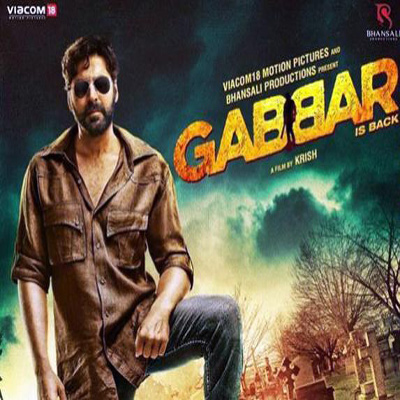
    Gabbar Is Back held well in face of little opposition and managed to collect a handsome Rs 18.1 crore in its second week to settle at Rs 74.5 crore after its second week run.


    Margarita With A Straw added about Rs 15 lakh in its fourth week to take its four-week tally to Rs 5.95 crore.

  • ‘Gabbar Is Back’ earns Rs 36.6 crore at BO

    ‘Gabbar Is Back’ earns Rs 36.6 crore at BO

    MUMBAI: Akshay Kumar’s oft repeated theme of anti-establishment Gabbar Is Back, has benefitted thanks to it being a kind of solo release for the audience starved of  commercial mass film with a popular star this year so far. 


    The film will enjoy a four day weekend in many states while it has a three day holiday run in other states (May Day on 1 May and Buddha Purnima on 4 May). The film opened to average response, dropping further on Saturday. 


    The collections got better on Sunday ending its first three days with Rs 36.6 crore. The negative word of mouth seems to have caught up with the film, which will limit its prospects as the week progresses.


    The other release of the week, Sabki Bajegi Band, remained a nonstarter with five to 10 occupants in the audience on the opening day.


    Jai Ho! Democracy proves to be a major disaster managing to collect just about Rs 18 lakh in its first week.


    Ishq Ke Parinde goes unnoticed causing heartburns to both, the makers as well as the exhibitors.


    Kagaz Ke Fools, it seems, marks the end of Vinay Pathak kind of comedies. The film manages just about Rs 40 lakh for its first week’s run.


    Mr X suffered due to its mediocre script and treatment and dropped to about a little less than 10 per cent of its first week figures in its week two. The film managed a bare Rs 2.4 crore to take its two week tally to Rs 20.95 crore.


    Margarita With A Straw sustains on the lower side, though. The film collects Rs 1.75 crore in its second week, taking its two week tally to Rs 5.25 crore. 


    Ek Paheli Leela adds Rs 30 lakh in its third week to take its three week total to Rs 21.14 crore.


    Dharam Sankat Mein has added Rs 25 lakh in its third week taking its three week tally to Rs 9 crore.


    Detective Byomkesh Bakshy has collected Rs 40 lakh in its fourth week to take its four week total to Rs 27.08 crore.

  • Not much collection at the box office

    Not much collection at the box office

    MUMBAI: Mr X paid for its poor content and the resultant negative word of mouth. Having opened to below par collections on day one, it failed to better its opening day collections on Saturday and Sunday and ended its opening weekend with Rs 12.45 crore.


    Margarita With A Straw, despite limited screens release, put up a poor performance at the box office. Except Kalki Koechlin, who earned some plaudits for her performance, nobody looks likely to benefit from this enterprise. The film collected Rs 1.9 crore. NH 8 Road To Nidhivan is starved of audience and has no hope at the box office.


    Nanak Shah Fakir carried lots of hope coming as it does after a very successful Char Sahebzaade, another film on the Sikh saga, but fails to even get a decent opening.


    Ek Paheli Leela, with Sunny Leone’s skin show being the draw, had a limited appeal, which wears out after its opening weekend. The film added little over Rs 7 crore for the rest of the four days to end its first week with Rs 18.7 crore.


    Dharam Sankat Mein proves that best of performers can’t carry a film if the content is poor. The trio of Paresh Rawal, Naseeruddin Shah and Annu Kapoor could do little to salvage this poorly crafted film, which opened to weak response and remained that way through its first week. The film could manage just about Rs 7.6 crore for its first week.


    Detective ByomkeshBakshy, despite its deficiencies, managed a reasonable second week thanks to poor oppositions. The film collected Rs 5.2 crore to take its two week tally Rs 25.17 crore.


    Dum Laga Ke Haisha, the best performer at the box office so far this year, added a symbolic Rs 5 lakh in its seventh week to come to the end of its run at the box office with total of Rs 30.37 crore.

  • ‘Margarita With A Straw’: Limited appeal

    ‘Margarita With A Straw’: Limited appeal

    MUMBAI: Margarita With A Straw is one of the five projects chosen in the Work In Progress Lab section of the Film Bazaar 2013. 

    This can be called a personal film in the sense that it is the story of an individual who is very talented but physically challenged. And unlike My Name Is Khan, it does not have an agenda or a depiction of heroics of a fictional character who suffers from autism. This film is more real and true to life. Its protagonist’s character has a close resemblance to the American stand-up comedian and actress, Geri Jewell, who has cerebral palsy and later discovers that she is  lesbian.

    Kalki Koechlin suffers from cerebral palsy and is wheelchair bound. She can’t stand on her feet nor are her hands under her total control. She just about manages to make her words discernible. But she is intelligent and talented. In her mid-teens, she also has urges like all normal people. At home and at college in Delhi University where she studies, her life is made easier and happier by her friends and the caring family, especially her mother, Revathi, for whom Kalki has to be treated like a child all her life. 

    Her friends in college treat her as they would any normal fellow collegian. She is part of her college band and their star lyric writer. But it is that age when Kalki’s sexual urges start working on her. She starts with watching porn and later indulging in self-gratification and then is bold enough to take another wheelchair bound friend to a secluded college corner for a huge smooch. She has no inhibitions and, with her college friend, even goes shopping for a vibrator. 

    Everybody around Kalki has made her feel normal. She chats with them late at night and falls in love with one of her band members. But she is soon brought down to earth and shown her place when she is told that her college won the first prize at a music competition because the judges tweaked the decision in their favour because a physically challenged Kalki had written the words. Later, when she declares her love to her band member, he does not acknowledge it.

    But, Kalki’s disillusion with the world around her doesn’t last long as her admission to New York University is confirmed. Hers is a mixed marriage family, a Maharashtrian Revathi married to a Sikh and living in Delhi. The father is docile and mother’s word is the last. Kalki gets her way. 

    New York is an all new world to Kalki where she discovers herself. The fact that she is an intelligent student despite her drawbacks remains but what is more important to her, her sexual leanings, are revealed to her. Here she meets a blind girl, Sayani Gupta, an offspring of a Bengali-Pakistani parentage, and a lesbian. Sayani has an inherent instinct and feels the sexual urges of Kalki and soon initiates her into her kind of sex: lesbian love. Kalki finally learns of her orientation and true love. It is a match made out of need and belonging. 

    Soon Kalki returns home on a vacation, with Sayani tagging along. It is time to confide in her mother, who is shattered to know what her daughter is up to. But, Revathi is counting her days and she must come to terms with her daughter’s choice. After all, what she wants is her daughter’s happiness. 

    But, soon, Kalki’s grim life catches up with her as Revathi gives into a sickness and Sayani leaves her. She is back to her old friends. 

    This is a tricky and brave subject and the scripting is taut. Direction by Shonali Bose is excellent. The songs are purely situational. Dialogue is true to the script. Cinematography is complementary. This is a Kalki vehicle all the way and, despite some discrepancies in her movements and manners of a challenged person, she excels and makes a strong claim for some awards. Sayani Gupta provides a perfect foil. Revathi, the seasoned artiste that she is, underplays effectively. Rest of the actors are good too because of a good casting. 

    Margarita With A Straw is a film purely meant for the discerning audience in India and for the festival circuit. 

    Producers: Shonali Bose, Nilesh Maniyar.

    Director: Shonali Bose. 

    Cast: Kalki Koechlin, Shonali Bose, Revathi. 

    ‘Mr X’: Old wine in a new bottle

    Mr X is a fantasy film that everybody from a child to a grown up would identify with. The film was made by Nanabhai Bhatt in 1957 and has been made again quite a few times again ever since. This time, the difference is that, Nanabhai Bhatt’s son, Mukesh Bhatt, attempts to make it.

    The last film one remembers abiout a man going invisible, is Mr India with Anil Kapoor playing the invisible hero. The latest Mr X stands up to none of the earlier versions.

    Emraan Hashmi is an ace officer in an anti-terror outfit and is in love with his colleague, Amyra Dastur, also a top-rated officer. The romance is blooming but on one of the operations, where the duo along with their team is out to rescue a bus load of passengers taken hostage by a terrorist, Emraan risks his life to save the hostages while a bomb is ticking. This has shaken up Amyra who suggests that they had better part since Emraan could have killed himself in the process.

    The lovers’ tiff does not last as Emraan soon proposes marriage using a plastic bottle neck ring. Sure, it would be replaced by a real ring the next day. The occasion calls for a song. That done, the couple fix their marriage date.

    Though both are on leave from their jobs, one day before the marriage, they are assigned an important mission. The Chief Minister is due to give a speech at a hotel hall where a terrorist is hiding on the fourth floor preparing to assasinate him. Amyra is supposed to hear the conversation being taped by her colleagues in the next room and Emraan is supposed to look after the safety of the CM.

    Emraan soon realises that he has been trapped. The CM is going to be shot and Emraan has to do it; Amyra is at a gunpoint. Either he can save her or the CM. The deed is done in view of the audience and the media, shooting the incident live. The perpetrators are his own people and they can’t let Emraan stay alive to tell the story. Emraan is taken to a deserted building, which is blown up along with him.

    Emraan has survived though his body is fully singed and hair gone. Someone whom Emraan had helped returns the favour by taking him to his sister, who is a scientist. Emraan’s body has been affected by atomic reaction and can only be saved by an antidote the lab is working on. It is untested but Emraan is willing to take the risk. The potion cures his burns but makes him turn invisible in the dark though he can be seen in lit areas.

    The stage is set for revenge. Emraan changes his name to Mr X who can’t be seen and starts with killing one of the three men who trapped him.

    Mr X is the poorest of all the Mr X films. The script is insipid. The first half is spent on romance and is boringly slow. The second, half when excitement is supposed to begin, is grossly predictable. There is no thrill at any time. While such a film would be expected to have some fun for children, this has none. Songs have no appeal though background score is good. Heavy editing could have helped. 3D effect does not help much as it is forced.

    With the script not holding much promise, writer-director Vikram Bhatt can do little to salvage the film. There is no scope for performance nor do any of the three main artistes, Emraan, Amyra and Arunoday try to, though Amyra lands some freshness with her presence. The end has been kept open for a sequel but that seems unlikely.

    Mr X lacks in major aspects of an entertainer. The film has had a below par opening and promises no prospects of improving.

    Producer: Mukesh Bhatt.

    Director: Vikram Bhatt.

    Cast: Emraan Hashmi, Amyra Dastur, Arunoday Singh.

    ‘Court’: Worth a watch

    Films winning a National Awards are often mired in controversy. Not everyone is happy with the choice. In the case of this year’s Best Film award winner, Court, there seems to be total consensus of the jury and audience alike. Court has already made its mark in the international festival circuit, being honoured at the 71st Venice International Film Festival and having won many more awards thereafter. Though this is a fictional film, it comes across as a very real life drama.

    A court room drama, this film is very different from all court room dramas and sequences seen so far in Indian films. It is more about how the police functions and how the archaic British era laws are implemented (while the newly enacted laws have no implementation). It is about how the cops interpret the laws and consign a person to custody and frame charges around the set laws with no inclination to build a case around it.

    The film revolves around a person from the scheduled caste and not even the police (in Mumbai) seem to care to go deeply into the case. The police thinks its job is over as soon as the case is handed over to the court. The public prosecutor is in a hurry for the alleged criminal to be put behind bars for 20 years so that the case does not linger, justice notwithstanding.

    Vira Sathidar is a shahir, a Marathi folk singer whose forte is to present songs that evoke deprived masses’ feelings and prod them to rise and do something. He is an on the spot singer who starts singing and the crowds gather around him when he starts.

    One day, the police pick him up for inciting a Mumbai sewer worker to commit suicide through a song he sang outside his chawl. The song allegedly provokes all sewer workers to commit suicide. The fact that many a sewer worker die in Mumbai gutters while cleaning because they are contracted labourers, are poorly paid and provided no safety equipment, does not matter to the police nor to the court. They follow the Penal Code. In this case, a law laid down by the British Raj in 19thcentury. While the law has always been about the logic of the time, logic never finds a place in the deliverance of justice by law.

    Vira is lucky to get a lawyer, a Gujarati, Vivek Gomber, who metes out free service through his NGO for such people. He takes up Vira’s case. He is faced with a by-the-book public prosecutor, Geetanjali Kulkarni, who only quotes laws and wants to be done with the case soon as she can; her idea of ending a case is to deliver the accused to a jail. To Vivek’s credit, he is never frustrated nor exasperated by Geetanjali’s ways.

    The case lingers on and on as it happens in Indian courts. The judge, Pradeep Joshi, also goes by the book and does not think the accused deserves bail, so what if he is a senior citizen. The police regularly fails to produce witnesses.

    After years of contesting, Omber finally manages to get a bail for his client. The surety is Rs 1 lakh, which even the judge knows this poet and singer can’t manage but which his benevolent lawyer arranges. Vira, by now, is a sick man suffering from multiple ailments.

    Within a few days of his bail, the police visit him again and arrest him on another charge.

    Court is a grim film when in court room scenes. But the script and direction have made sure it does not remain all grim. The film is about juxtapositions all the way: between the law and the outside world, between the way of life of Maharashtrian schedule caste and literate Maharashtrians, between Maharashtrian and Gujaratis, and between lawyers and government prosecutors deciphering the same laws.

    Though the script is well written, the film takes too much footage to narrate it. Surely, some leisurely shot portions can be edited for better effect. Though Chaitanya Tamhane, may have been indulgent at times, this is a triumph for him as a first-time feature film director. The Marathi inspirational songs are exactly that: inspiring. What Tamhane has done is to bring in families of the lawyer, Omber, as well as the prosecutor, Geetanjali, and these aspects prove to be respites after court scenes rather than distractions. His account of the afterhours of a Marathi family taking to a typical thali restaurant followed by a Ravindra Natya Mandir Marathi drama on an off day compared to the Gujarati lawye’s visit to an upmarket South Mumbai thali joint makes a statement on their way of life. The film deals mainly in Marathi but has some major scenes in Gujarati, English and Hindi.

    While Omber is excellent despite his faulty Gujarati, Geetanjali is fine as a mannequin-like public prosecutor. Vira excels despite limited footage. Pradeep as the judge sends you a message: avoid courts!

    Watching Court is an experience worth having.

    Producer: Vivek Gomber.

    Director: Chaitanya Tamhane.

    Cast: Vira Sathidar, Vivek Gomber, Geetanjali Kulkarni, Pradeep Joshi.

  • IFFLA: ‘Chauranga’ wins Best film award, ‘Kaaka Muttai’ bags audience choice

    IFFLA: ‘Chauranga’ wins Best film award, ‘Kaaka Muttai’ bags audience choice

    NEW DELHI: Filmmaker Bikas Ranjan Mishra’s Chauranga won the Best Feature (Grand Jury) award at the 13th annual Indian Film Festival of Los Angeles (IFFLA).


    M. Manikandan’s Kaaka Muttai won the Best Feature award (Audience Choice) at the festival, which was held from 8 to 12 April at the ArcLight Hollywood.


    Actresses Kalki Koechlin and Shweta Tripathi were in a tie as winners of the Best Actress award for Margarita with a Straw and Haraamkhor respectively. 


    Chauranga, co-produced by Sanjay Suri and Onir, stars Suri and Tannishtha Chatterjee. It is a fictional account of six days in a dark corner of India, telling a story of violence of class oppression that still exists in rural India.


    Onir tweeted, “Super Proud that our film #CHAURANGA won the BEST FEATURE – GRAND JURY prize at #IFFLA :). (sic)”.


    “Thrilled ! #CHAURANGA wins Best Feature (GRAND JURY) prize at #IFFLA2015 @bikas @IamOnir @TannishthaC @ArpitaCP,” Suri tweeted.


    The Best Short Film (Audience Choice) award was given to Safar by Pratyusha Gupta, while the Grand Jury prize in the same segment went to Dandekar Makes A Sandwich by Leena Pendharkar.


    A total of around 25 films including sixteen features – among them the opening filmHaraamkhor by Shlok Sharma and several shorts including Jai Ho on A R Rahman by Delhi-based filmmaker Umesh Aggarwal – were screened at the Festival.


    Starring Nawazuddin Siddiqui, Haraamkhor has been produced by Anurag Kashyap and Guneet Monga.


    The closing film was Dhanak, a coming-of-age film directed by Nagesh Kukunoor. The centerpiece film was the British comedy One Crazy Thing directed by Amit Gupta. The movie stars Ray Panthaki and Daisy Bevan and centers on a man struggling to overcome the notoriety from his sex tape. 


    Actor-producer Abhay Deol was a member of the jury and the other narrative jury members were filmmaker Sean Baker, HFPA member and frequent board director Yoram Kahana, Warner Bros EVP – physical production Ravi Mehta and author and film curator Berenice Reynaud.


    The shorts jury include actor Danny Pudi, Outfest director of programming Lucy Mukerjee-Brown, Sundance shorts programmer Lisa Ogdie and Heather Morris Washington, manager of the Emerging Writers Fellowship at Universal.


    The festival saw four world premieres, seven North American bows, two American and 10 Los Angeles premieres from not just India, but also the US, the United Kingdom, France, Germany and Cuba, in 10 languages including English, Spanish and German.