Tag: Marathi

  • Samsung moves into 9 Indian languages for its Smartphone and tablets

    Samsung moves into 9 Indian languages for its Smartphone and tablets

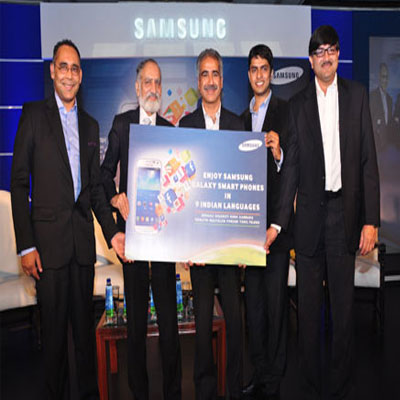
    MUMBAI: Smartphone and tablet manufacturing giant Samsung has decided to offer user interface and access to content for its users in nine Indian languages. These will be supported on Galaxy Grand, Galaxy S4 and Tab 3. These nine languages will be Hindi, Punjabi, Bengali, Tamil, Telegu, Kannada, Malayalam, Marathi and Gujarati.

    The languages will be available on more affordable phones within this month itself. This initiative has been created especially for the Indian market. Applications from the Samsung store such as Bharat Matrimony, India Property, Times of India will be available in the vernacular languages. Select phones will also have Facebook, Gmail and the likes in the nine languages.

    Samsung Mobile and IT, India Head, Vineet Taneja said “We clearly sense a need and a demand amongst users to communicate in local languages using their mobile devices. That is the reason, as an industry leader, we are taking the lead by offering users the ease of accessing regional language content in their preferred language.”

    More devices will be added as well as more languages.

  • Shah Rukh debutes with Shekhar Ravjiani for a Marathi musical

    Shah Rukh debutes with Shekhar Ravjiani for a Marathi musical

    MUMBAI: Venturing into a new foray Bollywood‘s Baadshah Shah Rukh Khan (SRK) is about to make a musical debut in the regional language space with a Marathi movie. It is confirmed that SRK will shoot for a song with the music composer and singer Shekhar Ravjiani. Apparently it didn‘t take a lot of convincing for Ravjiani for his music single, Saanvlias the proceeds from this song will be donated to an NGO.

    Saanvli will also feature Sunidhi Chauhan and the songs refreshes the concept of first love which is why SRK has been roped in since he is synonymous with romance.

    A source from the industry revealed “Shekhar met him (SRK) at a studio and played out the single for him. He connected with the song instantly and agreed to feature in the video.”

    The music video has been directed by Ravi Jadhav (who has won a National Award forNatrang) and the lyrics are written by Amitabh Bhattacharya. The song video will feature Shah Rukh reciting the verse that reads ‘Parchhayi Teri Saanvli SiNatkhat Thodi Baavli Si‘.

    When contacted, Shekhar who is also one of the judges for Indian Idol Junior confirmed the story and said, “His thoughtfulness and love has made this video very special to me.” Shekhari‘s credibility in the regional language was much appreciated last year in his album Saazni.

  • UFO bags best Digital Cinema Solutions award at Chhattisgarhi film award ceremony

    UFO bags best Digital Cinema Solutions award at Chhattisgarhi film award ceremony

    MUMBAI: Satellite delivered Digital Cinema network UFO Moviez has won the ‘Best Digital Cinema Solutions’ award at the Chhattisgarhi film award ceremony 2013.

    Averred UFO Moviez director Satish Jain, “UFO Moviez has brought about a major revolution in the Chhattisgarhi film industry. The number of Chhattisgarhi films releasing in the last three years has increased sharply from just 1 or 2 each in 2007, 2008 & 2009 to 14 in 2010, 18 in 2011 and 14 in 2012, thanks to UFO’s Digital Cinema solutions.

    In the pre-digitization era, hardly one Chhattisgarhi film used to release every 2-3 years, but the numbers have shot up to 12-15 films annually in the post UFO era. Today, Chhattisgarhi films are only shot digitally thanks to the availability of UFO’s Digital Cinema exhibition technology.”

    Said UFO Moviez India COO Pankaj Jaysinh, “We are thankful for this recognition and proud to be associated with a forum supported by a State Government body as well as local film industry stakeholders. UFO Moviez is a leader and pioneer in converting existing theatres in Chhattisgarh into digital ones so that film producers and distributors can showcase the latest local language films on a first-day-first-show basis to wider set of audiences in the state and even across India.

    UFO Moviez has been bridging the geographic divide and increasing the number of Chhattisgarhi films on its digital network over the years. Digital medium of film exhibition has not only benefitted the Chhattisgarhi film industry, but also other regional film industries like Bhojpuri, Gujarati, Marathi, Assamese, Punjabi to flourish. Theatre owners are also reaping the benefits of the digitization of films including higher footfalls in the theatre premises, more ticket collections and enhanced advertising revenue earnings. It’s a win-win situation for all stakeholders of the Chhattisgarhi film business and the industry benefits the most.

    Chhattisgarhi film ‘Mayaa’, which was directed by Jain and produced by Rocky Daswani, released in June 2009 and was the first blockbuster Chhattisgarhi movie to release on the digital platform through UFO. As a matter of fact, Mayaa even crossed the collections of Aamir Khan’s Ghajini in Maa Bhuwneswari Talkies, Vinay Talkies and New Raj Talkies.

    UFO’s platform has enabled filmmakers to get the maximum revenue which wasn’t possible earlier. Toora Rickshawala, which was produced by Dawsani and directed by Jain was also a blockbuster. The film released on the UFO platform on 4 June 2010 and completed 100 days in Apsara Talkies (UFO Cinema) in Durg.

    The ceremony was organized by Filmi Chhattisgarh and sponsored by Credible Chhattisgarh, Cultural Division, Government of Chhattisgarh and Bhatia Film Production. The third edition of Chhattisgarhi Film Award Ceremony 2013 was held on 30 January.

  • ‘Future bright for only right TV news players’ : ZNL CEO Barun Das

    ‘Future bright for only right TV news players’ : ZNL CEO Barun Das

    It’s the festival of lights. And for many the festival of noise courtesy exploding fireworks. In the hope of reducing the number of those belonging to the latter tribe, we, at indiantelevision.com, decided to put a display of firecracker articles for visitors this Diwali. We have had many top journalists reporting, analysing, over the many years of indiantelevision.com’s existence. The articles we are presenting are representative of some of the best writing on the business of cable and satellite television and media for which we have gained renown. Read on to get a flavour and taste of indiantelevision.com over the years from some of its finest writers. And have a happy and safe Diwali!

    (Written By Sibabrata Das in 2012. He continues to write on the cable TV industry)


    Subhash Chandra could end his long wait to expand his television news empire in the two main language segments of the business. After slimming Zee News Ltd’s (ZNL) balance sheet by demerging the regional-language entertainment channels from the bouquet in 2010, he is now planning to launch an English general news channel towards the exit quarter of the fiscal.


    The main reason behind the timing: digitisation in the four metros by 1 November. ZNL, which runs a clutch of seven news channels, has also grown to a turnover of Rs 3 billion while its Ebitda stands at Rs Rs 533.5 million for FY’12.


    Shepherding ZNL’s growth has been Barun Das, the chief executive of the company. His key strategy: staying profitable while being true to the identity of the fourth estate.


    Das, thus, took the bold step of cutting ad cut the commercial time of ZNL‘s flagship Hindi news channel, Zee News, by 30 per cent from April while upping the ad rates by 40 per cent. The move followed the change in positioning of Zee News as it shed trivial news content to differentiate itself. His belief: viewership for serious news and ad rates will rise in tandem.


    Das could possibly follow the Zee News model for the English news channel. He believes there is space for a less opinionated and more research-driven kind of reportage.


    He is optimistic about the future of TV news in India but cautions that “it is bright only for the right players”. He warns news broadcasters of not repeating the mistake of paying unrealistic carriage by masking it under placement fees in a digital environment.


    In an interview with Indiantelevision.com’s Sibabrata Das, the ZNL CEO also talks about the growth of regional news markets and the challenges that they face in each language space.


    Excerpts:


    Q. Will TV news broadcasters have to expand their bouquet to scale up revenues as growth engines of flagship news channels are aging across the sector?
    Yes, flagship channels are maturing in revenues. And it is difficult for established existing channels to post ad revenue growth beyond 10 per cent unless there is a repositioning or reinvention of the brand. Expanding the bouquet and strengthening it is key to a TV news broadcaster’s growth strategy.


    Q. Sources say ZNL is planning to launch an English-language general news channel towards the exit quarter of the fiscal. Are you waiting for digitisation to come into force in the four metros before you join the ring?
    We have been planning to launch an English general news channel for some time. The approval process is not yet formalised. Any launch plan will, however, be linked to digitisation as distribution cost will ease to a large extent with there being no capacity constraint on digital cable networks.


    Q. So ZNL is now in a position to take the load of a new channel that would consume large capital in the gestation period?
    After demerging the regional general entertainment channels from ZNL in 2010, we decided to consolidate before firming up big expansion plans. We did launch a few regional news channels just before the demerger, but then slowdown started biting the industry. Our focus was to stay profitable rather than build scale. Now that our balance sheet has grown in size and our turnover has touched Rs 3 billion, we are in a position to make heavy investments.


    Q. In the past interactions, you have always maintained that the prime business model that you follow is protecting the Ebitda margins. Will the English channel not erode the margins and make ZNL operate in the red for at least some years?
    We want to maintain the 18-20 per cent Ebitda margins. While growing in size, we have a guiding time target to return to those margins.

    ‘There are three-and-a-half English news channels. People may think it is a crowded space to be in, but we see it as an opportunity. With the kind of content that is being currently broadcast, we feel there is a lacuna and void for us to fill the gap and exist profitably. There is space for a less opinionated and more research-driven kind of reportage‘


    Q. But wouldn’t you require to make investments of Rs 3 billion over three years and wait for a longer break-even period?
    I wouldn’t like to comment on how much we plan to invest. But yes, the break even period of an English news channel is normally 4-5 years. But there is cash flow coming in before that. So it is not like we have to wait for that long to correct the Ebitda erosion. It is too early, though, for me to give a target date when we have not even launched. But there will be a significant drop in distribution payouts for all TV news broadcasters in a digitised environment. The other channels in the bouquet will also post growth. So it’s not red ink all over.


    Q. How much would you expect distribution expenses to fall for news broadcasters in a digitised environment?
    There is nothing set as a rule. But as per the former Trai chairman (JS Sarma), carriage should fall by 90 per cent. We are expecting a formalisation of that in a digitised environment.


    Q. That is a figure hard to digest. But when you launch your English channel, it is only the four metros (Delhi, Mumbai, Kolkata and Chennai) that would have digitised if the government sticks to the 31 October sunset deadline for analogue cable. How much of carriage payout is doled out by English news broadcasters to cable networks in these metros?
    It is tough to guess but it should be around 60-70 per cent of their distribution budgets. The focus of the English channels is the metros. Distribution expenses are bound to fall for these channels.


    Q. There are five English news channels jostling for a share in the Rs 5.5-6 billion ad market. So will it be a market share fight for you or there is scope for expanding the ad revenue size substantially?
    I don‘t know how you are coming to five English news channels. To my mind, there are three-and-a-half of them.

    People may think it is a crowded space to be in, but we see it as an opportunity. With the kind of content that is being currently broadcast, we feel there is a lacuna and void for us to fill the gap and exist profitably. The thumb rule in media, and even in TV news in every genre, is that the top three channels can be profitable. Even the fourth player can make money if run and managed efficiently.


    Q. ZNL weighed the option of consolidating the English TV news market and even looked at swallowing NewsX. Why did the deal fall through during the due diligence process?
    The buyout would have given us a lead time of at least six months as it is a running channel. But we did not find it a viable proposition.


    Q. ZNL cut the commercial time of its flagship Hindi news channel, Zee News, by 30 per cent from April while upping the ad rates by 40 per cent. The move followed the change in positioning of Zee News as it shed trivial news content to differentiate itself. So will the English channel follow the Zee News model of serious news?
    Most definitely. However, I can’t talk about the positioning and other specific details now. We will work out those operational details when we have finalised the launch plan. But from a personal point view, I think there is space for a less opinionated and more research-driven kind of reportage. There is scope for significant differentiation to model upon and we hope that will make an impact in the marketplace.


    Q. Flagship channel Zee News is not in the top three even after changing its positioning to a serious Hindi general news channel. Now that you have also reduced the ad time, how long do you think it will take to drive in more viewership?
    The success criteria for a media product should not be the viewership rankings. The business of TV news is primarily about profitability while being true to the identity of the fourth estate. I am sure that in both these counts Zee News channel has significant lead over its nearest competitors.

    However, viewership raking numbers is also important which I believe we should be able to improve in the near future. We have also started rolling out content initiatives. The strategy seems to be working for us at this stage, albeit a bit slower than what we had expected.


    Q. Will you also scale back on commercial time for your other six channels?
    There is no such plan. The other channels are not under so much of inventory pressure.


    Q. Are you revamping Zee Business and isn’t slowdown in the financial services sector going to affect the Hindi business news channel?
    Zee Business is one channel with which we have never stopped our revamping work. I think that our content team will come out with at least one game changing idea in every 15 days. It is possibly the most dynamic news channel.

    There is undoubtedly a pressure on airtime advertising. But we are doing events and sponsorship programmes to tide over this tight situation. Besides, it is a strong subscription-driven channel.


    Q. Akash Bangla, the Bengali infotainment channel where ZNL holds 18 per cent stake, is loss-making and you had to provide for Rs 166.7 million. Will ZNL exit from the JV as it runs a successful channel, 24 Ghanta, in that market?
    Akash Bangla channel and our joint venture for 24 Ghanta are two different arrangements. We made strategic investment in Akash Bangla channel in 2009 and given the current circumstances, we decided to provide for that funding. 24 Ghanta is a strong No. 1 Bengali news channel with strong financial performance as well.

    Bengal, after all, is a news hungry market. The advertising size for TV news is around Rs 1.20 billion, and growing.


    Q. Isn’t the Marathi TV news market a sharp contrast?
    Unlike the GEC space, the Marathi news market has not yet not grown as per its potential. There is a lot of news consumption happening in English and Hindi. In fact, the Marathi TV news market is half the size of the Bengali market. The potential, though, is very high and it should catch up to the Bengal market sooner or later. We have Zee 24 Taas and are pushing it aggressively.


    Q. Won’t the Andhra market be the toughest for ZNL to crack as it is flooded with news channels?
    While it is the largest TV news market in terms of ad revenue, it is a weird market too. There are many politically motivated channels in that market and are, therefore, not run as typical business outfits. Thus, it is a difficult market, but we do have specific plans for that too.


    The advertising size is pegged at Rs 1.40 billion, and growing. Zee 24 Ghantalu has not yet steadied in that market but we hope that our positioning as a non politically aligned channel should work .


    Q. How is Zee News UP faring?
    It is the No 1 channel there, though it is a small market with combined ad revenues of around Rs 300 million. However, we are on course with our break-even target.
     

    Covering social issues of the area is important. Being close to Delhi, national news channels are an important part of television viewing in that region. So there is need for content differentiation.


    Q. When will ZNL’s new channels turn profitable?
    There are only two of them under the new channels category. We expect them to turnaround next year.


    Q. What is the future of TV news channels in India?
    Extremely bright, but for the right players.


    Q. What do you mean by right players?
    One thing which had ailed news channels to my mind is that we have consistently converted potential revenue sources into our cost heads. That is one of the first mistakes to be classified and corrected if you want to be the right player in the market. As an example, carriage is one of the largest cost heads for TV news operations while subscription is a miniscule part of that.


    Q. Aren‘t the news channels themselves to blame for burdening themselves with such high carriage costs?
    Possibly, I tend to agree with that. However, it is a long discussion that we can have later. Bye!


    Q. Just one last related question. Won‘t news channels replace carriage with what can be termed as placement fee in an addressable digital environment?
    I wouldn‘t like to answer this question. However, in general at a philosophical level, repetition of any mistake is an offence.

  • Comic version of Sholay now in Marathi

    Comic version of Sholay now in Marathi

    MUMBAI: Vickey Kharat is set to remake Sholay in Marathi. However, he claims that his film will be an out-and-out comedy.

    “The original Sholay cast a deep spell on our minds. We can’t change that. So I am presenting a serious story in a comic form and it is called Marathi Sholay,” says the director.

    However, Kharat isn’t worried about buying the rights to the film as he does not want to retain any elements from the original plot in the remake.

    “It’s not a copy. Even if the original makers see it, they won’t have any objection. Although the character names are the same, they all have different professions. In the original, Jai and Veeru were thieves; in this film, they are police officers. And Basanti rows a boat in a lake near her village, instead of riding a horse carriage,” adds the director.

    While Siddharth Jadhav and Bharat Jadhav will play Jai and Veeru in the Marathi remake, Ashok Sharaf will play the role of Thakur that was essayed by Sanjeev Kumar. And playing the role of Gabbar Singh would be Makarand Ansaspure.

    Kharat, who has assisted Madhur Bhandarkar on Chandni Bar, Satta and Aan: Men At Work, made his debut as director with the Marathi film Thamb Laxmi Thamb (2007), followed by Bhaucha Dhakka last year.

    Marathi Sholay is expected to go on the floors in mid-April this year.

  • Marathi cinema in high gear

    The Marathi movie market is set to enter into a new phase of growth as Star, Reliance ADAG and the Sakaal Group plan to launch general entertainment channels in this langauge space.

    Marathi film producers suddenly see a fresh demand for their content, which was being consumed largely by Zee Marathi and to a lesser extent by ETV Marathi.

    Satellite TV telecast rights for Marathi movies have surged, encouraging producers to increase their production pipeline. “The average purchase of these rights for the popular movies have more than doubled,” says a trade expert who is involved in such transactions.

    There are also more outright purchase of movies and at higher prices. Zee Marathi is said to have spent Rs 4.6 million for the perpetual rights of Tingya, much more than a hit Marathi movie would have cost two years back.

    Some movie rights holders are hanging on to their library with the expectation that prices will further escalate. Says Video Palace owner Nanu Bhai, “I have some 30 Marathi superhit movie rights along with Everest Video. But we are in no hurry to sell them. Let prices further increase.”

    Top five grosser of 2007-08
    Films Total Collections
    De Dhakka RS 60 million
    Saade Maade Teen RS 45 million
    Valu RS 30-35 million
    Tingya RS 15 million
    Aamhi Satpute RS 12.5 million

    It is only after 2004, when Shwaas (which literally means breathe) gave a fresh lease of life to Marathi cinema. Even though Shwaas was sent to Academy awards, the producers had to hunt for money through charity shows to present the film there.

    Post Shwaas, however, the market started expanding. The awareness about Marathi cinema increased considerably with creativity in subject, promotion, distribution and technical advancements. Also in Maharashtra, the state government’s rule that every multiplex has to run Marathi movies has changed the fate of this market.

    But what has fuelled the growth is the entry of corporates into the market. The roster includes Zee Entertainment Enterprise Ltd (Zeel), Reliance and Mukta Arts.

    Zee has been the most aggressive player. Zeel director of regional channels Nitin Vaidya had earlier told Indiantelevision.com that it would be investing RS 300 million for a slate of 15 Marathi movies in two years.

    Mukta Arts has also chalked out its production plans. The Subhash Ghai promoted company released Sanai Choughade on 20 June; another flick Prarambh is slated for August release.

    With the pumping in of more money, the industry is going to see more movies being made. In 2006, around 45 movies were released in theaters while the number rose to 67 in 2007. In 2008, more then 80 movies are expected to hit the theatres.

    The size of the market is expanding. Says Akhil Bharatiya Marathi Chitrapat Mahamandal president Ajay Sarpotdar, “The Marathi movie market (theatrical) was not more than RS 50 million in 2006. It managed to touch RS 160 million last year with the government‘s screening rule for multiplexes. In the first six months of this year, we have already crossed RS 220 million and expect to over Rs 350 million by the end of the year.”

    The major problem with Marathi cinema was its promotion and distribution wherein a lot depended on word of mouth publicity. Even though a Marathi movie costs not more than RS 6-7 million, producers did not have enough cash to put in money for promotions.

    That game is fast changing. As per market estimates, Zee Talkies has invested over RS 15 million in promotion of De Dhakka, a budget earlier unheard of. The movie has reaped over RS 60 million in collections so far.

    “With the kind of publicity we can do through our network, we already have an advantage over our rivals. We are bullish about the Marathi movie market,” says a senior executive in Zee Talkies.

    Mukta Arts is also planning to invest in scripts, marketing and promotion. “We are in search for good scripts as content is what drives the audience,” says Mukta Arts CEO Ravi Gupta.

    Adds senior Marathi producer Mahesh Kothare, “With the right kind of money, promotions and marketing, the Marathi movie market is growing very fast. Corporatisation is an added boon as they can easily spend over Rs 10 million in promotions.”

    Being made on as low as Rs 6-7 million budgets, the business dynamics has turned favourable as Marathi general entertainment channels grow in number and are keen to lap up movie content.

    Sums up Galgale Nighale‘s director Kedar Shinde: “We are currently in the first gear. Very soon, we will be driving in high gear.”

  • Marathi GEC space: Zee Marathi winner in numbers game

    First the good news. The Marathi general entertainment space is expanding. The market is currently estimated to be above Rs 2 billion for 2007-2008. Now the bad news (for the current players). New entrants are eying a share of the pie.

    At present, there are just four players in the space – Zee Marathi, ETV Marathi, Sri Adhikari Brothers Mi Marathi and public broadcaster DD Sahyadri.

    A point of note is that apart from GEC, Marathi broadcast arena also includes three players in news – Star Majha, Zee 24 Taas and new entrant IBN-Lokmat. Additionally, there is Zee Talkies which enjoys a monopoly of being the only Marathi movie channel.

    Backgrounder:

    In the first phase of launches in this space there was DD Sahyadri, Zee Marathi, ETV Marathi, Tara Marathi and Prabhat.
    DD Sahyadri was launched in 1998 followed by Zee Marathi in 1999. Later ETV Marathi, Tara and Prabhat joined the arena between 2001-02.

    By 2003, Tara Marathi and Prabhat channels had gone off air.

    In 2007, Mi Marathi entered the fray.

    Position as of now:

    In the fiscal 2007-2008, If we check the Tam data for Maharashtra market in cable and satellite homes (4+ TG, 1st April 2007 to 29 March 2008), it has clearly been a two-horse race between Zee Marathi and ETV Marathi, as 1st and 2nd respectively. Though ETV Marathi got the better of the ratings in the period June-August 2007, it started losing ground after that and Zee Marathi emerges the clerar winner in the numbers game. (See the table).

    Channel share %
      Zee Marathi ETV Marathi DD10 Sahyadri (Marathi) MI Marathi
    Apr ‘07 51 28 13 8
    May ‘07 45 39 9 6
    Jun ‘07 41 41 12 6
    Jul ‘07 39 43 13 5
    Aug-07 41 43 12 5
    Sep-07 44 39 12 5
    Oct-07 52 36 8 4
    Nov ‘07 45 38 11 6
    Dec-07 48 35 11 6
    Jan ‘08 51 32 11 7
    Feb ‘08 51 32 12 6
    Mar-08 48 33 12 6
    Source TAM:- Market: Maharashtra Mkt TG: CS 4+ years Period: 1 April 2007 to 29 March 2008

    ETV chief producer Manvi admits, “We were on top from June till August in 2007. However, because of some connectivity and distribution issues we have fallen behind. Zee Marathi is doing well and it is not easy, but we are trying hard, to regain the lost position.”

    Among the other players, DD Sahyadri is maintaining its channel share of 12 in the market. However, also ran MI Marathi has not shown any growth and is stuck with an average channel share of 5. MI Marathi, despite having 3,000 hours of content and boasting of strong brand value among Marathi people, has not managed to get significant viewer eyeballs.

    All year performance:

    Zee Marathi is leading in this market with an average of almost 46 per cent channel share. At the beginning of April, it was holding 51 per cent market share, but slid after that to a low of 39 per cent in July, wherein ETV surged ahead. On the back of movies, reality and soaps, Zee Marathi had regained its lead position by September and has remained close to an average of 48 per cent ever since. ETV Marathi, meanwhile, has a channel share of 33 in March 2008. The average channel share of ETV Marathi is around 37 for the fiscal 07-08.

    DD Sahiyadri had average channel share of 11 for the whole year. While 6 per cent went to MI Marathi.

    Content:

    So what is it that clicks with the viewer? Is it a feature film, reality show, or fiction based daily soap?

    From Tam top 100 programmes for the period under review, Marathi feature film Subh Mangal Savadhan has got the highest TRP of 7.85 on Zee Marathi in April. Second and third were reality shows based on comedy (Hasyasamrat) and dance (Eka Pekshya Ek). Event show Swartarang was fourth while ETV Marathi serial Hya Gojirvaanya Gharat made it to fifth in the Top 5.

    Data from the month of march depicts that apart from dance reality show Eka Pekshya Ek, soaps from Zee Marathi like Avghachi Sansaar and Vahini Saheb are also getting an average rating of 5 and 4 respectively in the All Maharashtra Market.

    Zee Entertainment Enterprise Ltd (ZEEL) director (Zee regional channels) Nitin Vaidya told Indiantelevision.com, “Zee Marathi is offering viewers variety with quality and continuity. Viewers are very smart and demanding, so we are offering them a mix of reality and fiction. This explains why we are on top.”

    Talking about content, here it is interesting to note that Marathi soaps do not focus on so much on saas-bahu tussles and kitchen politics like Hindi GECs.

    “Maharashtra is a state of progressive minded people. They don‘t like the typical Hindi saas-bahu sagas. Viewers can see completely different programming on Zee Marathi,” explains Zee TV programming head (till recently Zee Marathi VP) Ajay Bhalwankar.

    That makes sense. But are daily soaps or reality shows the ticket to success? Bhalwankar says, “For Zee Marathi both the genres are working.

    For ETV Marathi however, it is the soaps that are working. Its soaps Char Diwas Sasuche, Hya Gojirvaanya Gharat and Kata Rute Kunala are getting decent TRPs of 4, 3.3 and 2.6 respectively.

    But to be on top, Manvi believes that his channel will have to ramp up its reality quotient. “Reality shows are in. Audiences like to watch dance and music shows rather than fiction. So we are putting emphasise in this genre.”

    Will reality help ETV turn the tide in its favour? Time will tell.

  • Time for global news in Marathi

    With national news broadcasters feeling the need to expand into regional markets, it is the Marathi space that is grabbing their attention.Joining Zee 24-Taas and Star Majha in the fight for the 120 million TV viewers of Maharashtra will soon be IBN-Lokmat, the Marathi news channel from the GBN-Lokmat joint venture (JV) company.

    So, is the Marathi TV news market getting cluttered or will there will be a slice of the cake big enough for them?

    For starters, let us look at the fight between the two existing channels – Zee 24-Taas and Star Majha, the eight-month-old channel from the JV between the ABP group and Star.

    Star Majha is leading the race by far, stepping ahead since its second month of launch (See table for channel share).

    Channel Share 2007 (%)
    Channel Jun Jul Aug Sep Oct Nov Dec
    Star Majha 30 56 56 58 59 63 58
    Zee 24 Taas 70 44 44 42 41 37 42
    Source: TAM Peoplemeter System, Maharashtra Market, CS 15+

    The gap has widened in 2008 with Star Majha enjoying a higher channel share (See table).

    Channel Share 2008 (%)
    Channel WK 1 WK 2 WK 3 WK 4 WK 5 WK 6 WK 7
    Star Majha 70 69 69 65 77 78 75
    Zee 24 Taas 30 31 31 35 23 22 25
    Source: TAM Peoplemeter System, Maharashtra Market, CS 15+

    Zee 24-Taas explains its slip to distribution issues. “In terms of reach, we are less than half of that of Star Majha. There are issues that involve revamping the deals with cable operators,” says Zee 24-Taas news head Ravikant Mittal.

    Mittal, however, claims viewers spend more time on the channel than on Star Majha. “Though our reach is limited, a viewer spends about 33 minutes on our channel as compared to the 26 minutes on Star Majha. We have faith in our content,” he adds.

    In terms of content, Zee 24-Taas claims of being a regional channel with national outlook and an international look, whereas Star Majha says it is a national news channel in Marathi.

    “The reason for our growth is that we know our viewers like to see global news in their mother tongue. That is what we are providing them – world-class news in their own language,” maintains Star Majha editor Rajiv Khandekar.

    IBN-Lokmat is looking at a different positioning. Says editorial director Nikhil Wagle, “Ours will be a global news channel in Marathi language; we are not regional players.”

    IBN-Lokmat is banking on a large infrastructure network to cover the state. Says Wagle, “We will have 13 bureaux spread across the state. We are also going to have the latest technology to support our news flow.”

    Zee 24-Taas has a network of eight bureaux and 30 stringers across Maharashtra while Star Majha has six bureaux. For news outside Maharashtra, both rely on their national news networks.

    The Marathi news channels agree that the needs of the local viewers are different. They cannot be fobbed off with infotainment; what they look for is hardcore news – be it regional, national or international. For informative entertainment, they have the option of tuning in to other Marathi and Hindi general entertainment channels.

    “More competition will prompt us to bring quality to our viewers,” says Wagle.

    As far as revenue is concerned, Zee 24-Taas and Star Majha claim to have roped in a long list of advertisers. Says Mittal, “We have every big advertiser with us. Maharashtra being a big and financially important state, it is natural to see ad growth.”

    Agrees Khandekar, “30 per cent of all the GRPs of national Hindi news channels come from Maharashtra. With the kind of ratings and programming we have, revenue is kicking in.”

    The climate may get spoilt with the entry of IBN-Lokmat. The size of the Marathi TV news market isn‘t big enough, with estimates putting it at under Rs 600 million. Besides the two dedicated satellite news channels, there is ETV Marathi which runs a popular band of news slots and DD Sahyadri.

    The channels, however, feel that the size of the pie will only grow with more entrants. Says Mittal, “The space is not cluttered; it can fit in more players.”

  • Television woos Marathi Manus

    SABTNL vice chairman and managing director Markand Adhikari assures us that his long-in-the-pipeline channel ‘Mi Marathi’ will finally be making its appearance in February 2007.

    With just two players in the GEC market – Zee Marathi and ETV Marathi – and one public broadcaster – DD Sahyadri – struggling to keep up with the onslaught of private players, the time is just right for more players to enter the niche Marathi regional market.

    It’s an open field and almost every television network has set sights on it. Like one industry gentleman mentions, “We’ve looked and looked until our eyes have watered.”
    That’s one of the more cautious players checking the scene. But what catches our interest is the launch of two new channels on the anvil. Zee News Limited is about to launch Chouvees Tas (25 January is the date that is doing the rounds), a 24 hour news channel in Marathi while Adhikari brothers Mi Marathi should launch soon too.

    Other players who are evaluating the market include TV18 and Star, although both networks declined to make any specific comment, insisting that the regional market is an unexplored territory, whether in Maharashtra or the other regional segment fast gaining interest – the south.

    BACKGROUND

    This is not the first time that channels have wooed the Marathi Manus. The first wave of Marathi channels saw DD Sahyadri, Zee Marathi, ETV Marathi, Tara Marathi and Prabhat fighting for eyeballs. DD Sahyadri was launched in 1998 and was followed by Zee Marathi in 1999. ETV Marathi, Tara and Prabhat were launched in the period between 2001-02.

    While the Rathikant Basu led Tara Marathi and Prabhat channels have long since shut shop, Zee Marathi and ETV have not only managed to hold on but have since established themselves, pushing DD Sahyadri to the third position.

    DD Sahyadri tried to resurrect itself in 2003 and even raced ahead of the two private players for a brief period. But recent figures suggest another role reversal.

    THE NUMBERS GAME

    Take into account the figures for last the three months (Oct-Dec 2006), in the CS + 4 Yrs by Tam. ETV Marathi is leading the channel share in Maharashtra by a narrow margin ahead of Zee Marathi, while DD Sahyadri is lagging behind with just 11 per cent share.

    In Mumbai, however, Zee Marathi pipped ETV Marathi to the post with a 50 per cent share.

    Two weeks into the new year (with CAS having been implemented in south Mumbai and Tam introducing its new, expanded peoplemeter panel), the data throws up a few surprises. And this time Zee Marathi is seen beating ETV Marathi by a high margin. In fact, it competes with Star Plus in the Hindi GEC and emerges a winner.

    Channels GRP
    ZEE Marathi 351
    Star Plus 319
    ETV Marathi 258

    Channel GRP in GEC
    Market:All India
    TG: CS 15+Yrs
    Source: TAM Peoplemeter

    Zee Marathi business head Nitin Vaidya is elated as he brings out the week two results. “Zee Marathi has surpassed Star Plus in the overall channel market share. Both Mumbai and all Maharastra categories show a significant lead for Zee Marathi,” says Vaidya. The data he details is clearly reflective of the channel’s hold over its Marathi speaking audiences; whether during prime time viewing or the afternoon band with a predominance of women oriented programming.

    “I’m not bothered about the Kyunki’s and Kahaani’s of the world. My competition is not restricted to the Marathi market. I want to compete at equal par with all other entertainment channels. For instance; Sa Re Ga Ma Pa hosted by Pallavi Joshi on Zee Marathi is as popular as the one on our Hindi network,” reiterates Vaidya. In fact, the channel is so confident about its show that the time slot of 10 pm coincides with Star Plus’ popular K-sagas. Despite this, the channel claims to have wide viewership amongst its Marathi viewers. While one of the reasons for Star’s slump could be attributed to Tam having increased its peoplemeter sample size to more cities and updating the number of C&S homes, the interest in Marathi market by established networks is an indicator of its mass appeal.

    The numbers also show that Marathi channels, once considered a slow moving market, are undergoing a paradigm shift. The competition is no longer restricted within the niche Marathi channel market but has spilt over to all GECs. According to industry sources, the Marathi market growth rate in 2003 was a modest 8 per cent. Compare that to the 13 to 14 per cent growth rate touted today and we get an idea of why other channels are waiting to jump into the fray.

    The general bonhomie over the Marathi market growth is also shared by other industry watchers. Vaidya estimates that the size of the Marathi regional market is Rs1 billion and will be about Rs1.2 billion by year end.

    CONTENT IS KING

    Zee Marathi has clearly ridden the success wave on the back of its programming. Zee Marathi spruced up its programming act last year with the introduction of many new shows. Currently, 11 of the top 15 shows on Marathi regional channels is by Zee Marathi. Zee Telefilms head network sales Joy Chakraborthy believes that the Zee Marathi success was due to its shift from a ‘cost centric’ to a ‘content and marketing centric’ strategy.

    Doordarshan director Satish Sonkar, who has recently replaced an unceremoniously transferred Mukesh Sharma, is confident about DD Sahyadri. “Our terrestrial reach cannot be duplicated by the private channels. Hence the CAS situation does not bother us too much.”

    DD Sahyadri:Losing the numbers game?
    Source:www.ddindia.com

    Sonkar is also gearing up to revive the sagging fortunes of Doordarshan. “Plans are on to launch a new breakfast show in the time slot between 7 to 8 in the morning moulded on the popular Subah Savere format. The emphasis throughout our programming content will be on infotainment.” The channel also wants to experiment with ‘parallel programming’; although current infrastructure does not permit it do so. Sonkar is also eager to do away with repeats on the channel and replace them with documentaries or feature shows “showcasing cultural aspects of Marathi culture like the history of Lavani”.

    Award events like Zee Gaurav Puraskar on Zee Marathi to be held on 3 February will see over 10,000 people in attendace. Sahyadri’s Hirkani Puraskar also claims a loyal viewership every year.

    Adhikari’s ‘Mi Marathi’ is likely to give the general entertainment channels a run for its collective money with its ‘bank of 3,000 programmes’. “With a tagline of Aaplya Maansanchi Aapli Vahini (our channel for our own people) and the experience of producing the most popular shows on Doordarshan we will certainly do well,” maintains Adhikari.

    AD REVENUE

    On a rough estimate, Zee Marathi takes in ad revenues to the tune of Rs 400 million to Rs 450 million while ETV Marathi would be in a similar range. DD Sahyadri claims to have already raked in Rs 300 million, the target set for 2006-2007.

    Sahyadri also switched from a sponsored to commissioned model starting Oct ’06 to eliminate the middle man. While this is on an experimental basis right now across its regional kendras, the Sahyadri channel has started this on 3-4 of its programmes and aims to extend it to all its programming by the end of this fiscal. The channel is confident that this policy called SFS (self financing scheme) will bring in the much needed ad revenue.

    But Marathi channels will have to woo the advertisers more intently. Most of the biggies in terms of advertising in Marathi channels are the FMCG companies like HLL, Reckitt, J&J, Marico, Wipro and they continue to dominate the top advertisers list over the last three years. Most of the new entrants are also from the same category with players like ITC & L’Oreal.

    GOOD ‘NEWS’

    The general news market will see the addition of a new player as Zee News’ Chouvees Tas. Zee News Limited CEO Harish Doraiswamy says, ‘Unless someone else pips us to the post, we are all set to become the first 24-hour Marathi news channel. There is certainly an equity in the Marathi news market since what is now available to a Marathi viewer is only hour on hour news at Zee Marathi, ETV Marathi and DD Sahyadri.’ The channel, which will be launched in a phased manner, is slated to cover all Maharashtra and will enter the market as a free-to-air channel.

    Does the rural- urban divide amongst Marathi viewers still exist and will this be a critical factor for Marathi channels? Doraiswamy says, “The content on the news channel will have to be tweaked to suit different categories of Marathi viewership. But by and large, the aspirations of the Marathi people are similar across geographical boundaries. In India, we may call a Latur or Sangli a small city, but judging by the population size these would be large cities had they been in the States. Going by the argument, we don’t see a disparity in our viewership. We will have agri-based programming or news specific to the community. The genres of programming will however be consistent throughout.”

    ETV Marathi focus on news
    Source:www.etv.com

    ETV Marathi first saw the potential of well packaged news and has three news bulletins – ETV Marathi news, Maharashtra Maaza and Aapli Mumbai. The channel also has an issue based talk show Vrutt Vaidh. Sahyadri also has a news bulletin in the evening called Batmya. Zee Marathi’s Zee News Marathi is now airing at regular intervals during the day along with hour-on-hour headlines, which will also be withdrawn in the run up to its 24 hour news channel.

    Clearly, the latest battle lines amongst these channels will be drawn around news since most of these channels agree that they can never match the programming budgets of some of the bigger channels. Roping in the Marathi viewer through events, awards shows, interactive game shows can be seen across the channels already.

    GRAPPLING WITH CAS

    Starcom India’s Girish Upadhyay brings in the media planner’s perspective when he says, “If we just see the one week data we have post CAS implementation one sees regional channel shares increasing by 20-25 per cent whereas some of the big mass channels have reduced in terms of share, but still these are early days.”

    He further states, “The general understanding is that niche & local regional channels do well in a CAS environment, since in such an environment people take channels which they are passionate about. But there won’t be space for too many channels to survive because a consumer ultimately has to shed money for every extra channel he takes.

    “This could give rise to two scenarios: The first entrant in the market would have an upper hand, since viewers have a habit of sticking to whatever they start watching first.

    “Consumers will also be tempted to buy a bouquet which has a mix of everything-news, movies, mass, regional. So these smaller news channels will do well if they become part of a good well-rounded bouquet of channels.”

    WAY AHEAD

    What is clear is that the ad revenue pie of the news market, with the entry of these players, is not going to increase much; in fact it will fragment the market further. Also, the big players are entering into news not because of revenue but more because they want to create an impact. Under the Cas regime, the network that offers the most variety in its bouquet is likely to win. That is precisely why one sees some of the news channels nowadays getting into the entertainment channel space which could be an added source of revenue.

    So is there room for more regional news channels? The language preference by the masses could just tip the scale in its favour. It is similar to newspaper readership across markets where vernacular is preferred over English/Hindi publications. The fact remains that in Mumbai, many of the Marathi households buy two newspapers – an English daily and a Marathi newspaper.

    Upadhyay does a comparative on the Bengali news market, which has Star and Zee amongst its players. “If we had to take the West Bengal a figure in terms of news, Star Ananda is currently ruling with a share in the range of 3 per cent while Zee’s Choubees Ghanta is in the range of 1.5 per cent, followed by the other all India players.”

    Although it would be tough to judge the Marathi market on the same basis, regional channels do have an upper edge purely due to language and cultural preferences.

    This could very well mark the second wave of Marathi regional channels and news will be the genre to watch out for.

  • Reuters in tie up with Airtel to offer commodity price service

    Reuters in tie up with Airtel to offer commodity price service

    MUMBAI: Reuters and mobile operator Airtel are working jointly on a pilot project to provide commodity prices through text messaging service.

    Aimed at the farmer community, subscribers can receive quick updates on the commodity market.

    The pilot project is slated to kick off in August for the Maharashtra region, Reuters South Asia managing director Samir Shah said on the sidelines of a press conference.

    The messaging service will be provided in the Marathi language. The farmers will have access to real-time information on commodity prices. This will enable them to make informed choices about when and where to sell their produce.

    “The aim is to link farmers and traders and also provide them reports on commodity prices from all major markets. By using the mobile messaging service, the farmers can obtain the market updates. They can also be informed about the international prices in their own language,” Shah said.

    Reuters is targeting early next year to launch this service on a national scale by tieing up with various mobile operators.

    Earlier addressing the press conference, Shah said Yes Bank has chosen to make prices on Reuters Trading for Foreign Exchange (RTFX).

    The bank has also signed up for Reuters leading edge pricing engine technology, Reuters Electronic Trading for Automated Dealing (RETAD), to automate its FX transactions in a real time environment over the bank’s intranet.

    Recently, Reuters had signed in Union Bank of India, the first public sector bank in India to become a market maker on Reuters Trading for Foreign Exchange (RTFX) and Reuters Trading for Bullion.