Tag: Manoj Joshi

  • Gujarati greats shine at star-studded awards

    Gujarati greats shine at star-studded awards

    MUMBAI: It was lights, camera, and plenty of Gujarati action as Mumbai played host to the glittering Gujarati Entertainment & Gujarati–Marwari Excellence Awards 2025, a night that sparkled with talent, tradition, and triumph.

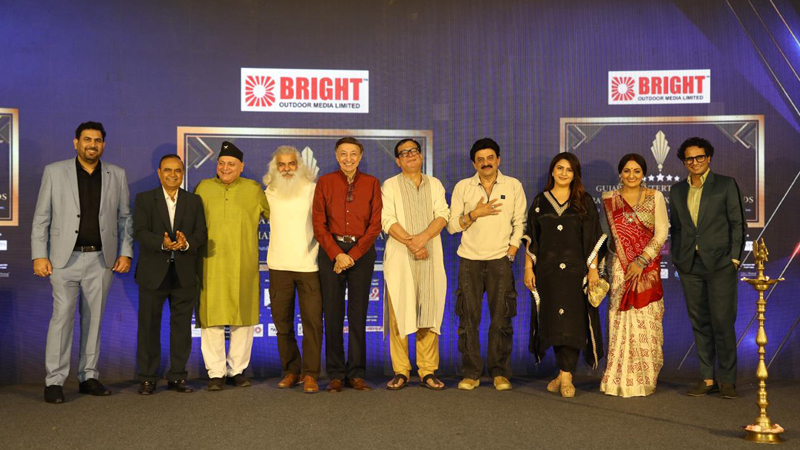
    Held at The Westin, Mumbai, the inaugural edition of the awards, curated by Bright Outdoor Media Limited, brought together the who’s who of entertainment and enterprise to celebrate creativity, culture, and business brilliance across 60 categories.

    The evening opened with a lively panel discussion on “Future of Gujarati cinema – building visibility & growth beyond boundaries”, featuring film and television stalwarts like Manoj Joshi, Hiten Kumar, JD Majithia, Ojas Rawal, Bhakti Rathod, and Abhilash Ghoda, moderated by TV9 Gujarati’s Chirag Shah. The discussion explored how the industry can take Gujarati storytelling to global audiences.

    The red carpet glittered with stars including Anang Desai, Rashmi Desai, Manasi Parekh, Manav Gohil, Urvashi Upadhyay, Hemant Kher, Komal Thakkar, and Sana Sultan, turning the evening into a true celebration of Gujarati pride.

    The evening’s top honours celebrated a mix of cinematic excellence and inspiring personalities. Manoj Joshi was bestowed the lifetime achievement to Indian cinema Award, while Hiten Kumar was recognised as iconic actor in Gujarati cinema (Male). JD Majethia earned the outstanding contribution to Indian cinema award, and Manav Gohil won excellent performance of the year for his role in Jalebi rocks. Rashmi Desai bagged most popular actor for Mom tane nai samjay, and Komal Thakkar was named Inspiring personality of the year. Other notable winners included Urvashi Upadhyay, Sana Sultan, Ojas Rawal, and Bhakti Rathod, who each took home major accolades for their outstanding contributions.

    The event also saluted visionary business leaders from the Gujarati and Marwari communities, recognising their contributions to innovation, trade, and entrepreneurship.

    Powered by Sejal Realty, with Zamin Pvt. Ltd. as Land Deal Partner and Malabar Gold as exclusive jewellery partner, the evening shimmered with style, spirit, and substance.

    “Gujarati entertainment and business communities have always stood for excellence and enterprise,” said Bright Outdoor Media Limited CMD Yogesh Lakhani. “This platform celebrates their contribution and marks the start of something much bigger.”

    Echoing the sentiment, CEO Mukesh Sharma added, “This is just the beginning. Our vision is to make these awards a marquee annual event celebrating culture, talent, and success across India.”

    With over 60 awards presented and spirits running high, the first-ever Gujarati Entertainment & Gujarati–Marwari Excellence Awards 2025 proved that when it comes to creativity and commerce, the community knows how to shine, brilliantly and proudly.


  • ShemarooMe premieres ‘Sanghavi and Sons’, a warm tale of family and bonds

    ShemarooMe premieres ‘Sanghavi and Sons’, a warm tale of family and bonds

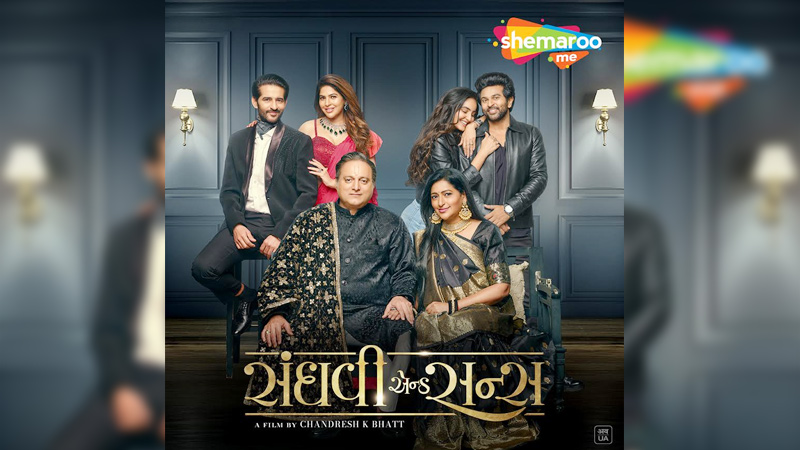
    MUMBAI: Some films are meant to be experienced together. With Sanghavi and Sons, ShemarooMe invites audiences to enjoy a story that honours family, love and the ties that keep us close. This world digital premiere offers a chance to gather with loved ones, celebrate a heartfelt entertainer and revisit the values that make everyday life worth cherishing.

    Directed by Chandresh Bhatt, the film features Manoj Joshi, Dharmesh Vyas, Hiten Tejwani, Komal Thacker and more. At its heart is Navneet Rai Sanghavi, the guiding presence of his household, who navigates the balance between tradition and change. Alongside him are his sons Asmit and Aditya and daughter-in-law Komal, with the shifting family dynamics forming the emotional core of the narrative. The story unfolds through small yet powerful moments such as disagreements, reconciliations and gestures of quiet care that hold a family together.

    On the film’s world digital premiere, Manoj Joshi shared, “I believe our family makes us who we are. Parents often provide the calm when everything else feels unstable. I was moved after hearing the story and was excited to play this role as it reminded me of my own experiences. I immediately knew the audience would connect with this, as every viewer will see a part of their own family in this story.”

    Hiten Tejwani added, “We all have differences and arguments with those closest to us, but it is these very moments that make our relationships stronger. In uncertain times, it is our loved ones who give us strength. Sanghavi and Sons is special because it shows how generations can think differently yet still stay united.”

    Sanghavi and Sons is a reminder that the greatest moments are the ones we share. Celebrate the joy, challenges and unbreakable ties that make every family unique and watch the world digital premiere only on ShemarooMe.


  • ‘Match Fixing’ to release in theatres on 15 November

    ‘Match Fixing’ to release in theatres on 15 November

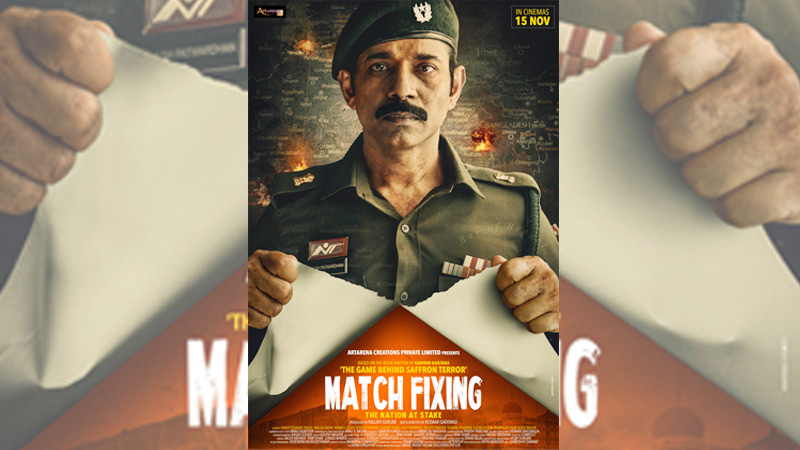
    Mumbai: Directed by Kedaar Gaekwad, the political thriller Match Fixing will hit theatres on 15 November. The makers unveiled a motion poster of the film to announce the same.

    The film stars Vineet Kumar Singh, celebrated for his compelling performances, alongside Anuja Sathe and Manoj Joshi, with a script penned by Anuj S. Mehta. Produced by Pallavi Gurjar under Artarena Creations, the film draws inspiration from Kanwar Khatana’s controversial book, The Game Behind Saffron Terror.

    The film explores the murky world of political conspiracies and alleged collusion between India and Pakistan’s intelligence agencies.

    A gripping tale inspired by real events, Match Fixing sheds light on a series of blasts and terror attacks that, as the book suggests, were orchestrated under a ruling political dispensation to implicate a few prominent members of the opposition parties.

    With a release date locked for 15 November, Match Fixing will certainly appeal to audiences interested in political thrillers, especially those intrigued by the complex dynamics between India and Pakistan.

  • CINTAA meets Maharashtra governor to discuss rule restricting senior actors

    CINTAA meets Maharashtra governor to discuss rule restricting senior actors

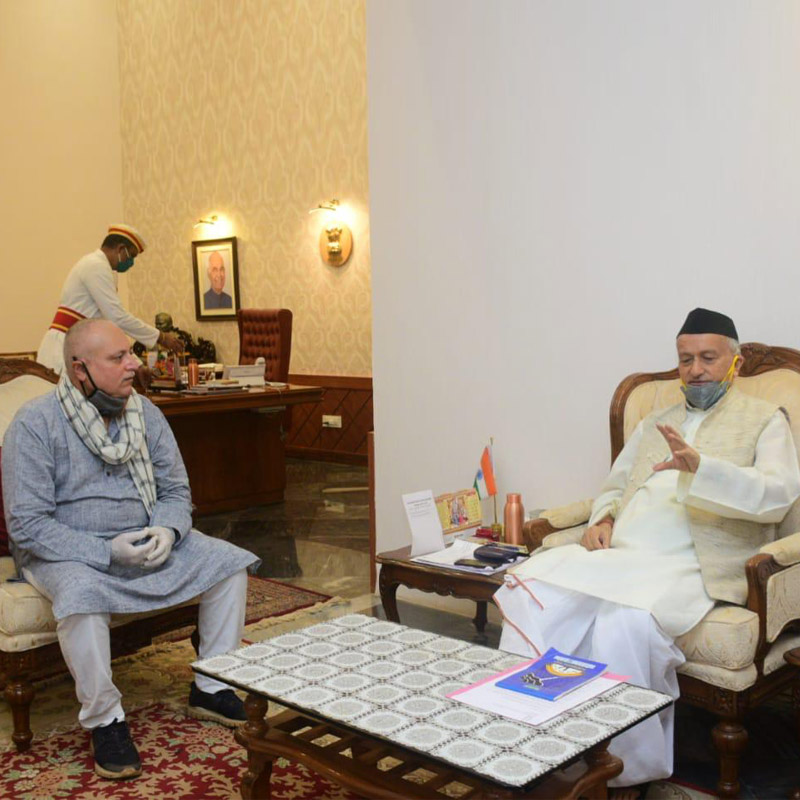
    MUMBAI: The Cine and TV Artistes’ Association (CINTAA) senior vice president and actor Manoj Joshi met with the governor of Maharashtra Bhagat Singh Koshyari today. They discussed the issue of senior actors, above the age of 65, not being allowed to shoot. The governor assured of necessary co-operation.

    In the meeting Joshi briefed the governor on CINTAA, its history, members, senior citizens who are members of CINTAA on whom their family depends for livelihood, and that they already have had no work from three months. He elaborated that the number of working seniors was not very large, but apart from that, there are continuity issues and producers cannot replace them.

    "The governor gave us a patient ear. It was a good 40-minute meeting. He was very positive and assured that he would help us in the best way possible. He had received the letter we sent him," elaborates Joshi.

    CINTAA had also sent letters to chief minister Uddhav Thackeray, minister Subash Desai and former chief minister Devendra Fadnavis besides the governor.

    "We are glad the meeting with the governor  was an eventful one and are hopeful that the outcome would be a positive one. The meeting was indeed reassuring," he concludes.

  • Gadkari unveils Marathi edition of Subhash Chandra’s ‘The Z Factor’

    MUMBAI: Maharashtra celebrated the birth anniversary of its most beloved poet Kusumagraj as ‘Marathi Bhaasha Diwas’ on 27 February, 2017. Extending the celebrations, prominent political leaders of the country hailing from Maharashtra came together on 2 March to express their love for Marathi Bhaasha and Maharashtra.

    On this auspicious occasion, Essel Group chairman and Rajya Sabha MP Dr. Subhash Chandra released the ‘Marathi Edition’ of his best-selling autobiography ‘The Z Factor – My Journey as the Wrong Man at the Right Time’ as his small contribution towards the Marathi language. The glittering ceremony held at the ITC Grand Central Hotel in Mumbai was graced by eminent politicians including Minister of Road Transport & Highways and Shipping, Govt. of India Nitin Gadkari, CM Devendra Fadnavis, former CM and Rajya Sabha MP Sharad Pawar, and former CM Prithviraj Chavan.

    Stalwarts from the Marathi Film & Television industry including Madhur Bhandarkar, Sonali Kulkarni, Manoj Joshi, Sai Tamhankar, Sunil Barve, Mahesh Kothare and Sidharth Jadhav, were also present at the function.

    The English edition of Dr. Chandra’s best-selling autobiography was launched by PM Narendra Modi in January 2016 followed, by the launch of the Hindi edition by the Nobel Peace prize recipient Kailash Satyarthi in September 2016. The book has greatly influenced the minds of students and aspiring entrepreneurs across the country, encouraging them to pursue their dreams and ambitions.

    Paying a tribute to the city of Mumbai and Marathi culture, Dr. Chandra said, “While Haryana is my ‘janmabhoomi’ (homeland), Mumbai is my ‘karmabhoomi’ (land of work). After living and working in Mumbai for the last 35 years, I feel that I have been accepted as a Maharashtrian. Mumbai is the land of dreams, where like me, millions of people strive to make their dreams come true. At Essel Group, it has always been our endeavour to preserve and promote the true essence of Marathi culture through our various ventures such as Zee Marathi, Zee Talkies, Zee Yuva, Zee 24 Taas and our Marathi films like ‘Natarang’, ‘Fandry, ‘Killa’,‘Lay Bhari’, ‘Natsamrat’ and ‘Sairat’.”

    Unveiling the Marathi edition of ‘The Z Factor – My Journey as the Wrong Man at the Right Time’, Gadkari said:

    “My association with Subhashji has extended for over 30 years. His most striking feature is that he never hides behind his words. It was on my recommendation that he stepped into the infrastructure sector. However, for one road project, I felt that he would lose Rs. 250 crores, so I recommended him not to continue with that project. He then told me that once I have put my hand into a project, I will see it into completion, whether or not there is any loss. And with this resolve and determination, Dr. Chandra has completed more than 2000 kilometres of road projects in the country over the years.”

    Fadnavis said: “Subhash Chandra is a person who has shown us that a common man can do extraordinary work. It is a miracle that Subhashji came to Delhi with only Rs. 17 in his pocket and now he has established such a successful empire.”

    Pawar said: “When I read his book, I got to know various aspects of his personality. The most important aspect of his life is that he is never scared of challenges, he faces all the problems with full determination.”

    Chavan said: “Subhash Chandra’s life is a direct inspiration. Each youth and Marathi person must read his autobiography. Subhashji left his education mid-way but he never got defeated.”

    Even today with his busy schedule, he manages to share his experiences with students and guide them for a better life.”

    From the book:

    It was 14 December 1991 when Ashok Kurien of Ambience ad agency and I reached Star TV’s office in Hong Kong. There were 10 to 12 senior and junior executives in the room. Richard Li, head of Star TV, was not there. So we waited awhile. It was like waiting for the king to come in and give his blessings.

    Richard walked in suddenly and sat opposite me. ‘OK, Indian channel… Hindi channel. Where is the money in India?’ Richard was very dismissive. ‘I am not interested in a joint venture.’

    Most of us in the room, including his executives, were shocked. It appeared that Richard had already made up his mind about the futility of the project.

    So I addressed him directly. ‘Mr Li, if you are not interested in the joint venture, can you consider leasing the [satellite] transponder to us?’

    ‘There is no transponder available for less than $5 million per year,’ Richard said. It was a haughty statement to put me off. ‘That is fine. I will pay $5 million!’ It was a spur-of-the-moment decision. I did not realize the implication of what I had said…

  • ‘Ghayal Once Again:’ Much mellowed

    ‘Ghayal Once Again:’ Much mellowed

    Ghayal Once Again can be termed as a true sequel as the film connects with Sunny Deol starrer Ghayalreleased in 1990. In that era, a suppressed common man’s outburst against a mighty criminal (Amrish Puri inGhayal) who has the politicians and the system at his command was palatable.

    Sunny is back after serving 14 years in prison. He gets flashbacks of past which Soha Ali Khan, a doctor keeps in control with instant medication. Sunny has now turned a vigilante, runs a newspaper called Satyakam, which publishes real news sans sensationalism. He has a loyal team around him, which shares his spirit and purpose. Sunny is now a much admired person with a great following among youth.

    Om Puri is now a retired cop who has become an RTI activist. Puri has come across some material, which can virtually destroy the tycoon, Narendra Jha, who accumulates wealth through illegal means. Jha has the local home minister and, through him, the entire police force in his pocket. Puri is called for a meeting where an argument ensues and Jha’s drug addict and violent son, Abhilash Kumar, shoots down Puri. This is made to look like a road accident. 

    Unknown to Jha and company the whole shooting incident has been shot on a cell phone of a bunch of students out to take pictures and videos of some rare birds. But, the guardians of the kids know how powerful Jha is and handover the video to him.

    However, one of the girls from this group of four, thought it prudent to make a copy of the video, which they plan to handover to Sunny. But, it seems Jha has the entire city under video surveillance as well as the phones taped of anybody who can harm him. As Sunny and the students decide to meet up, Jha lets loose his foreign mercenaries, no less, on the kids. There is a long chase through the city roads in cars and later through a shopping mall. All beamed live in Jha’s room. But, Sunny reaches in time and saves kid. 

    A lot follows, the students are now kidnapped and kept under vigil at Jha’s fortress like mansion surrounded by Jha’s own army as well as the entire police force of the city. Now it is for Sunny to get them out. And, as Sunny is wont to do, he becomes a one man army, as usual, preferring hand to hand fight against multiple guns.

    The problem with Ghayal Once Again is that it follows the same theme that worked in 1990 when a lot of anti-establish feelings prevailed. Also, Sunny was the leading action hero around as his contemporaries, Anil Kapoor and Jackie Shroff, did varied roles. Now, just about everybody does action films thanks to technology. The story is old-fashioned about one powerful man calling shots in a major metropolis like Mumbai; it does not convince anymore. 

    From the moment film begins till the chase sequence the film holds only to become predictable thereafter. The action scenes become repetitive. Cinematography by veteran Ravi Yadav is competent. Editing wise, the film needed some sharp trimming. Music, having no scope, does not quite work. Performance wise, the Sunny – Soha pair is odd despite their love being silent. Sunny is his usual self doing Ghayal again while Soha has little scope. While the students all do well, Ramesh Deo, Manoj Joshi, Tisca Chopra, and Sachin Khedekar are okay. The villain duo, Jha and Abhilash, is effective. 

    Ghayal Once Again hasn’t had an encouraging opening. It caters to single screen masses mainly of which not many are left.

    Producer: Dharmendra
    Director: Sunny Deol
    Cast: Sunny Deol, Soha Ali Khan, Om Puri, narednra Jha, Manoj Joshi, Tisca Chopra, Sachin Khedekar, Nadira Babbar, Abhilash Kumar

    ‘Sanam Teri Kasam:’ Of unseen villain

    An early cancer as a part of a love story was Dil Ek Mandir, a Meena Kumari, Rajendra Kumar, Rajkumar film. There it was a love triangle. However, the Hollywood hit, Love Story (1970), based on Erich Segal’s novel of the same name, set a trend for star-crossed romances where one of the protagonists is afflicted by cancer. Immediately thereafter in 1971, there followed a film with cancer as the main theme in Hrishikesh Mukherjee’sAnand, though this was not a love story or a triangle. Love Story finally inspired Rajshri’s musical hit, Ankhiyon Ke Jharokhon Se in 1978.

    Hrishikesh Mukherjee’s other foray in this theme, Mili, failed despite a memorable musical score and the reigning stars of the day, Amitabh Bachchan and Jaya Bachchan, in the cast. There may have been a few more films on the theme but none made a mark. 

    In Sanam Teri Kasam, Harshwardhan Rane inherits a flat from one Julie aunty in a building society occupied by creatures from era gone by. No explanation is offered for the deceased aunt’s largesse. Rane is projected as some sort of a stud for he has a new woman in his bed each night and they are Page 3 girls. How, why? 

    Rane is like a 1950s romantic hero. He is never seen making a living. All he does is guzzle alcohol, chase romance and is busy suppressing his past tragedies. He has spent eight years in jail for being accused of a murder at the age of 14. Cinematic liberty allows you to consign a 14 year old to eight years in prison. 

    Luckily for him, there lives a Tamil-Brahmin family in his society, the head of which also lives in 1950 or probably before that. The family has two daughters of which the older one, Mawra Hocane (Mawra Hussain originally) looks like what we call a geek today. She is bespectacled, with a figure like a walking stick, and her father adds to the unpalatable look by rubbing incense stick ash on her forehead. She works as a librarian. 

    To cut a story short, Mawra’s younger sister can’t marry till Mawra does, but there are no takers for her. She promises her sister that she will clear her way and visits Rane at 4 am in the morning to seek his help to get her a makeover from one of his girls who figures as a top rated makeover artist. What follows is a scandal. Mawra is branded for being in a debauch’s house at an unearthly hour. She is disowned by her family! 

    Rane now becomes her caretaker.

    The rest of the film is like a silent movie since none of the characters say what they want to say but say everything else. It is hackneyed to say the list. Mawra is supposed to be a very intelligent girl, well read, but can’t read Rane’s feelings for her. Rane has been with numerous girls but can’t express his love for Hocane. He even works on getting her married to an IIT-IIM guy because that was what her family wanted! 

    Finally, when they realize they are in love, cancer plays the villain. Mawra has limited time to live. Hence, in what has become traditional now, Rane marries her before she dies.

    The script of the film is like a remix thing as is done with music albums. It borrows from a number of films from the past. This is not limited to just the script; direction also follows the beaten path, hugely clichéd. For this film with newcomers with little of known supporting cast, its 155 minute run is not justified and, what is more, makes it feel like never-ending. Dialogue is mundane except on two occasions. With limited locations, the cinematography is average. The one positive with the film is the musical score by Himesh Reshammiya if it can help at all. Editing is non-existent. 

    While Mawra is a perpetual wronged crybaby in the film, Rane refuses to either cry or laugh; he prefers to carry one single expression throughout. Rest in the cast are incidental.

    Sanam Teri Kasam is an insipid movie with scant appeal.

    Producer: Deepak Mukut
    Directors: Radhika Rao, Vinay Sapru
    Cast: Harshvardhan Rane, Mawra Hocane, Murli Sharma, Vijay Raaz, Sudesh Berry

  • ‘Ghayal Once Again:’ Much mellowed

    ‘Ghayal Once Again:’ Much mellowed

    Ghayal Once Again can be termed as a true sequel as the film connects with Sunny Deol starrer Ghayalreleased in 1990. In that era, a suppressed common man’s outburst against a mighty criminal (Amrish Puri inGhayal) who has the politicians and the system at his command was palatable.

    Sunny is back after serving 14 years in prison. He gets flashbacks of past which Soha Ali Khan, a doctor keeps in control with instant medication. Sunny has now turned a vigilante, runs a newspaper called Satyakam, which publishes real news sans sensationalism. He has a loyal team around him, which shares his spirit and purpose. Sunny is now a much admired person with a great following among youth.

    Om Puri is now a retired cop who has become an RTI activist. Puri has come across some material, which can virtually destroy the tycoon, Narendra Jha, who accumulates wealth through illegal means. Jha has the local home minister and, through him, the entire police force in his pocket. Puri is called for a meeting where an argument ensues and Jha’s drug addict and violent son, Abhilash Kumar, shoots down Puri. This is made to look like a road accident. 

    Unknown to Jha and company the whole shooting incident has been shot on a cell phone of a bunch of students out to take pictures and videos of some rare birds. But, the guardians of the kids know how powerful Jha is and handover the video to him.

    However, one of the girls from this group of four, thought it prudent to make a copy of the video, which they plan to handover to Sunny. But, it seems Jha has the entire city under video surveillance as well as the phones taped of anybody who can harm him. As Sunny and the students decide to meet up, Jha lets loose his foreign mercenaries, no less, on the kids. There is a long chase through the city roads in cars and later through a shopping mall. All beamed live in Jha’s room. But, Sunny reaches in time and saves kid. 

    A lot follows, the students are now kidnapped and kept under vigil at Jha’s fortress like mansion surrounded by Jha’s own army as well as the entire police force of the city. Now it is for Sunny to get them out. And, as Sunny is wont to do, he becomes a one man army, as usual, preferring hand to hand fight against multiple guns.

    The problem with Ghayal Once Again is that it follows the same theme that worked in 1990 when a lot of anti-establish feelings prevailed. Also, Sunny was the leading action hero around as his contemporaries, Anil Kapoor and Jackie Shroff, did varied roles. Now, just about everybody does action films thanks to technology. The story is old-fashioned about one powerful man calling shots in a major metropolis like Mumbai; it does not convince anymore. 

    From the moment film begins till the chase sequence the film holds only to become predictable thereafter. The action scenes become repetitive. Cinematography by veteran Ravi Yadav is competent. Editing wise, the film needed some sharp trimming. Music, having no scope, does not quite work. Performance wise, the Sunny – Soha pair is odd despite their love being silent. Sunny is his usual self doing Ghayal again while Soha has little scope. While the students all do well, Ramesh Deo, Manoj Joshi, Tisca Chopra, and Sachin Khedekar are okay. The villain duo, Jha and Abhilash, is effective. 

    Ghayal Once Again hasn’t had an encouraging opening. It caters to single screen masses mainly of which not many are left.

    Producer: Dharmendra
    Director: Sunny Deol
    Cast: Sunny Deol, Soha Ali Khan, Om Puri, narednra Jha, Manoj Joshi, Tisca Chopra, Sachin Khedekar, Nadira Babbar, Abhilash Kumar

    ‘Sanam Teri Kasam:’ Of unseen villain

    An early cancer as a part of a love story was Dil Ek Mandir, a Meena Kumari, Rajendra Kumar, Rajkumar film. There it was a love triangle. However, the Hollywood hit, Love Story (1970), based on Erich Segal’s novel of the same name, set a trend for star-crossed romances where one of the protagonists is afflicted by cancer. Immediately thereafter in 1971, there followed a film with cancer as the main theme in Hrishikesh Mukherjee’sAnand, though this was not a love story or a triangle. Love Story finally inspired Rajshri’s musical hit, Ankhiyon Ke Jharokhon Se in 1978.

    Hrishikesh Mukherjee’s other foray in this theme, Mili, failed despite a memorable musical score and the reigning stars of the day, Amitabh Bachchan and Jaya Bachchan, in the cast. There may have been a few more films on the theme but none made a mark. 

    In Sanam Teri Kasam, Harshwardhan Rane inherits a flat from one Julie aunty in a building society occupied by creatures from era gone by. No explanation is offered for the deceased aunt’s largesse. Rane is projected as some sort of a stud for he has a new woman in his bed each night and they are Page 3 girls. How, why? 

    Rane is like a 1950s romantic hero. He is never seen making a living. All he does is guzzle alcohol, chase romance and is busy suppressing his past tragedies. He has spent eight years in jail for being accused of a murder at the age of 14. Cinematic liberty allows you to consign a 14 year old to eight years in prison. 

    Luckily for him, there lives a Tamil-Brahmin family in his society, the head of which also lives in 1950 or probably before that. The family has two daughters of which the older one, Mawra Hocane (Mawra Hussain originally) looks like what we call a geek today. She is bespectacled, with a figure like a walking stick, and her father adds to the unpalatable look by rubbing incense stick ash on her forehead. She works as a librarian. 

    To cut a story short, Mawra’s younger sister can’t marry till Mawra does, but there are no takers for her. She promises her sister that she will clear her way and visits Rane at 4 am in the morning to seek his help to get her a makeover from one of his girls who figures as a top rated makeover artist. What follows is a scandal. Mawra is branded for being in a debauch’s house at an unearthly hour. She is disowned by her family! 

    Rane now becomes her caretaker.

    The rest of the film is like a silent movie since none of the characters say what they want to say but say everything else. It is hackneyed to say the list. Mawra is supposed to be a very intelligent girl, well read, but can’t read Rane’s feelings for her. Rane has been with numerous girls but can’t express his love for Hocane. He even works on getting her married to an IIT-IIM guy because that was what her family wanted! 

    Finally, when they realize they are in love, cancer plays the villain. Mawra has limited time to live. Hence, in what has become traditional now, Rane marries her before she dies.

    The script of the film is like a remix thing as is done with music albums. It borrows from a number of films from the past. This is not limited to just the script; direction also follows the beaten path, hugely clichéd. For this film with newcomers with little of known supporting cast, its 155 minute run is not justified and, what is more, makes it feel like never-ending. Dialogue is mundane except on two occasions. With limited locations, the cinematography is average. The one positive with the film is the musical score by Himesh Reshammiya if it can help at all. Editing is non-existent. 

    While Mawra is a perpetual wronged crybaby in the film, Rane refuses to either cry or laugh; he prefers to carry one single expression throughout. Rest in the cast are incidental.

    Sanam Teri Kasam is an insipid movie with scant appeal.

    Producer: Deepak Mukut
    Directors: Radhika Rao, Vinay Sapru
    Cast: Harshvardhan Rane, Mawra Hocane, Murli Sharma, Vijay Raaz, Sudesh Berry

  • Film artists and intellectuals march to Rashtrapati Bhavan, decry charges of India becoming intolerant

    Film artists and intellectuals march to Rashtrapati Bhavan, decry charges of India becoming intolerant

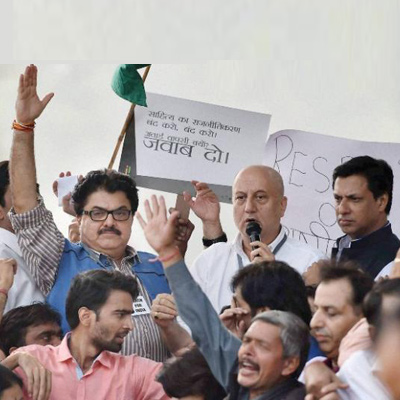
    New Delhi, 7 November: A large number of filmmakes, intellectuals and artists led by vetran actor Anupam Kher – who had earlier questioned the logic of returning awards – today marched in Rajpath to Rashtrapati Bhavan to counter the protests by those who have been alleging “rising intolerance”.


    Kher said the “award-wapsi” campaign was to defame the country by projecting a “wrong” picture of the situation.

    A small delegation which also included Madhur Bhandarkar and some others presented a memorandum in this regard at Rashtrapati Bhavan. Prime Minister Narendra Modi is also meeting a small delegation this evening from amongst those who came for the march.


    “India is a very tolerant country. Some people have coined the term ‘growing intolerance’. They are very few. Not every Indian thinks like that. We are secular people. We do not believe in pseudo-secularism, selective outrage or selective patriotism,” Kher, whose wife Kirron is a Bharatiya Janata Party member of Parliament. 


    “We had a meeting with a lot of writers, artistes, filmmakers and they also believe that there is no intolerance in the country… This march is a symbolic gesture on part of a lot of people over here who say India is one and free of intolerance,” the 60-year-old said.


    Many filmmakers and artistes from the fraternity including Madhur Bhandarkar, Ashoke Pandit, Priyadarshan, Manoj Joshi, Abhijeet Bhattacharya, actor-director Bijoya Jena and writer Madhu Kishwar joined the march to hand over a memorandum signed by more than 40 personalities including actress Raveena Tandon.


    Bhandarkar, a National Award winner, alleged that those involved in the protest over intolerance had opposed Prime Minister Narendra Modi before he was elected, which raised questions about their intention.


    Kher asserted that they were not associated with any organisation or political party. “This march is led by Indians and for Indians.”


    Film-maker Priyadarshan said the act of returning the awards is “childish”. He said these people should use the power of pen. Instances of intolerance have always been there. It is not something that happened yesterday. 


    Shah Rukh Khan never said he is returning his award, Priyadarshan said, but he said he disapproved of those critical of Khan who had said that there was extreme intolerance in the country.

    The march also saw some disgruntled voices. Some National Award winning filmmakers and actresses who did not want to be named told indiantelevision.com that tjey felt let down because it was initially meant to be a march of ntellectual National Award Winners and not an Anupam Kher march.


    At least 75 members of the intelligentsia have returned national or literary awards in an escalation of protests by writers, historians, filmmakers and scientists over “growing intolerance”, voicing fears that the country’s robust democracy might be “coming apart” in the current atmosphere.


    The BJP-led government has dismissed the protest as “manufactured rebellion” and “politically” motivated.

    “Nobody has the right to call our country intolerant. We are secular people and don’t believe in selective outrage,” Mr Kher said this morning. “I have right to go to the President and say that we don’t feel India is intolerant. These talks can’t happen only on twitter/ Facebook, they need a personal presence,” the actor has said.


    The march follows the decision of a host of filmmakers, including Dibakar Banerjee and Anand Patwardhan, as well as writers and historians to raise voice against the rising intolerance under the BJP-led government and to return various government awards and honors. 

  • Love Recipe to release on 25 May

    Love Recipe to release on 25 May

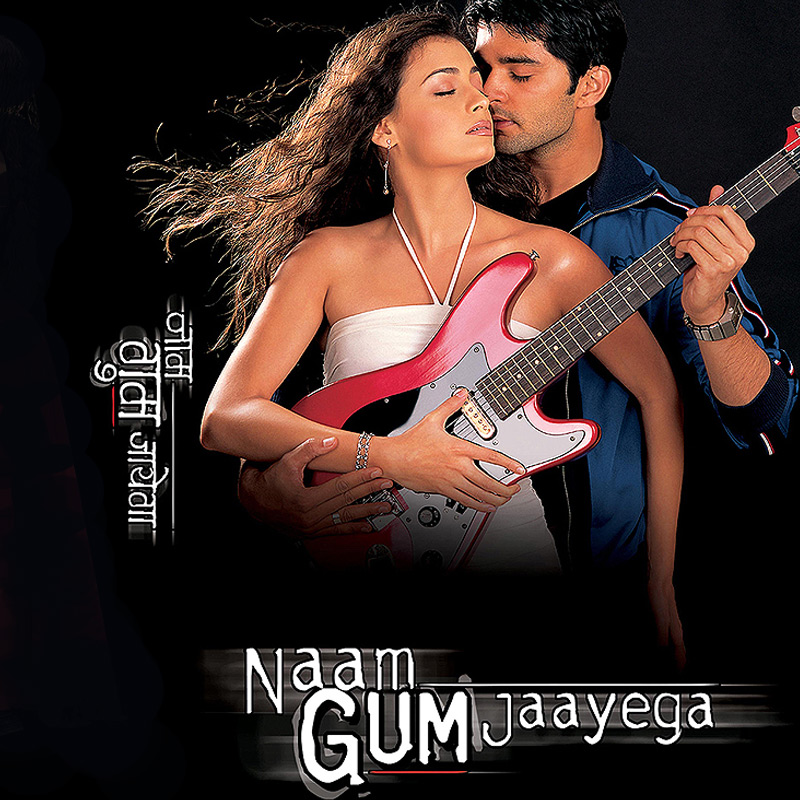
    MUMBAI: Having directed films like Naam Gum Jayega , Gunaah, Kabhi Kahin and Aboli for which he won a National award, Amol Shetge is gearing up to release his upcoming film Love Recipe on 25 May.

    Love Recipe, as the name suggests, is a fun-filled film about a D.J, Rahul Kher, who is in love with Tia, a bubbly girl who happens to be the daughter of retired I.G. of police Pratap Singh, who post-retirement has suddenly decided to become Hindustani in every sense of the word.

    He has suddenly shifted from his starched uniform to traditional kurta pyjamas, does not like the use of English words while conversing. Since Kher does not fit into this profile, he tries his best to woo Tia‘s father to approve their relationship and learns how to become the real Hindustani in his eyes. All ends well and Pratap Singh ultimately agrees Hindustaniyat is not about clothes and language after all; the heart has to be that of a Hindustani.

    Produced by Noor Bano Khot, the film stars newcomers Suhail Karim and Rani Agarwal along with Manoj Joshi, Upasana Singh, Vrijesh Hirji, Sanjay Narvekar, Atul Parchure, Avantika Kamat, Imran Khan, Suzanne Bernert , J. Brandon Hill and Dawood Khot.

  • StarOne unveils Milind Soman production ‘Ghost Bana Dost’

    StarOne unveils Milind Soman production ‘Ghost Bana Dost’

    MUMBAI: Star One has launched Ghost Bana Dost, produced by model Milind Soman’s Face Entertainment, the show will premiere on Tuesday, 19 December at 8.30 pm.

    As general entertainment channels seem to be inclined towards introducing children’s programming to their weekly line up, this story runs along the theme of a rich orphan kid, Dabboo aka Adil Baadshah. Living under the care of his uncle, Vichittar aka Manoj Joshi and his wife Tejo ji aka Sushmita Mukherjee, the boy is ill treated and their only interest is towards his money. Dabboo’s saviour emerges in Ni Ke (Nikhil Kedarnath) aka Manish Paul – the friendly ghost who helps him in time of need. Togther they pull off loads of other fascinating stunts … as everyone watches him wonder struck, states an official release.

    Star India Pvt. Ltd. senior creative director Shailja Kejriwal said, “We are very excited to launch Ghost Bana Dost as we have all been curious about ghosts as kids and this show captures the child within each one of us. This is a show that will appeal to everyone with Ni.Ke as the endearing lonely ghost who becomes the ‘super-bhoot’ and makes a meek child a ‘super-boy’. We hope it will win the hearts of our audiences!”

    Sharing details on the show, Face Entertainment producer Milind Soman says “We are thrilled to be launching our first show on Star One. Ghost Bana Dost is about a frightened little boy whose life changes when a “cool dude” ghost befriends him. Every child has a Dabboo in him and deep inside also longs for a magical friend like the “full of life” ghost in this show. As a child I always looked for fun, magic, and fantasy and through Ghost Bana Dost with it’s marvelous special effects and compelling narrative I think we have succeeded in bringing this to Indian television in a way never been seen before.”