Tag: Manisha Kapoor

  • ASCI reveals dark patterns used by digital platforms that cause consumer harm

    ASCI reveals dark patterns used by digital platforms that cause consumer harm

    Mumbai: An extensive discussion paper released by the Advertising Standards Council of India (ASCI), the self-regulatory body of the advertising industry, has highlighted how UI/UX deployed by digital platforms could manipulate consumer choices and consumption patterns.

    According to the paper, these manipulative tactics or dark patterns come in many forms and are present across multiple platforms. Practices like drip pricing, trick questions, nagging, disguised ads, bait and switch, among others, are just some of the commonly found dark patterns on the internet.

    With online commerce growing rapidly, consumers’ vulnerability to such practices is increasing. In FY 2021-22, 29 per cent of the advertisements processed by ASCI were disguised by influencers as regular content, which is also a part of dark patterns in advertising. Categories found to be major violators were cryptocurrency, personal care, fashion and e-commerce.

    Taking note of the growing global concerns around such practices, ASCI formed a 12-member task force comprising stakeholders from different tech platforms, legal experts, civil society and domain experts. The task force examined key issues related to dark patterns to understand which of these practices potentially violate the ASCI code which inter-alia states: “Advertisements shall not be framed so as to abuse the trust of consumers or exploit their lack of experience or knowledge.”

    Not all dark patterns fall under the domain of advertising and hence may be out of ASCI’s remit, however, they could amount to unfair trade practices which compromise consumer interest. ASCI hopes that in the near future, such dark patterns will be addressed by the regulators as they see appropriate in the interest of consumer protection.

    ASCI has outlined 4 key practices that it intends to address through expanding its code: namely drip pricing, bait and switch, false urgency and disguised advertising. ASCI has invited comments from all stakeholders and the members of the public on this proposed expansion of the ASCI code. One could send their comments to contact@ascionline.in; the last date to receive these comments is 31 December.

    ASCI CEO and secretary general Manisha Kapoor said, “There is a thin line between dark patterns and legitimate targeting and persuasion tactics. Dark patterns cause consumer harm and with the ever-increasing presence of advertising on digital platforms, these are now under sharp scrutiny of ad-regulators around the world. Eventually dark patterns ruin consumer experience and increase abandonments, and make the consumer suspicious of the online space. By choosing fair practices that enhance both consumer and shareholder value, brands can develop sustainable ways of consumer engagement. ASCI continues its investment in technology to track and monitor digital advertising to help keep the online experience safe for consumers.”

    The paper cites examples provided by UX experts of alternative practices that are fair to consumers and that can be adopted by brands. These alternatives can clean up the online space of malicious patterns and build consumer confidence in the digital world.

  • It’s very disappointing that this wasn’t caught before going live: ASCI CEO on suspended Layer’r Shot’s ad

    It’s very disappointing that this wasn’t caught before going live: ASCI CEO on suspended Layer’r Shot’s ad

    Mumbai: Deodorant ads have not exactly been known to propagate gender sensitivity values. However, two recent controversial advertisements from deo brand Layer’r Shot probably take the cake in offending gender sensibilities. The latest ad film from the brand raised a stink on social media with several netizens flagging the commercials, accusing them of promoting rape culture, trivialising sexual violence against women, and being plain creepy. So much so that even the MIB (ministry of information and broadcasting) sat up and took notice.

    The ministry on Saturday wrote to social media platforms, Twitter and YouTube to remove the offending video commercials of the deo brand for their alleged obscene content.

    The move came after the advertising self-regulatory body, Advertising Standards Council of India (ASCI) found the ads to be in serious breach of its code and against the public interest, and ordered its suspension.

    Following the ministry’s action, the channel Sony ten 1, which originally aired the ad during a sports telecast, has pulled it down.

    Coming right on the back of the Asci updating its code to prevent new areas of possible discrimination or derision, the council was alerted to the offending ad for the deodorant product on the morning of 3 June 2022, ASCI CEO & secretary general Manisha Kapoor told IndianTelevision.com. After seeing the ad, which was in serious violation of Chapter II of the ASCI code against offensive advertising, the council immediately invoked a special process called “Suspended Pending Investigation (SPI)”.

    On the same day, the industry body informed the advertiser of the decision to suspend the advertising and invited the advertiser’s response, which would be tabled before the Consumer Complaints Council in the coming days, Kapoor added.

    The SPI, Kapoor informed, is invoked, in exceptional circumstances, when it appears prima facie that an advertisement is in serious breach of the ASCI code and its continued transmission on any medium causes public harm, injury, or its continuation is against the public interest. In which case, the company would, pending investigation, forthwith direct the advertiser/the advertising agency/the media buying agency and the media concerned to suspend the advertisement with immediate effect.

    The first of the ads features a couple getting intimate in a bedroom. Four of the guy’s friends barge into the room, sneer at the couple and ask a seemingly loaded and crude question. After a few moments of suspense, wherein the girl is seen visibly getting alarmed at what the guys’ true intentions are, the ad reveals that the friends were simply asking if they can use the Shot deo kept in the room!

    Layer’r shot deo ad #1


    The second ad plays out along similar lines, where the four men are showcased indulging in an animated conversation at a supermarket. A woman is shown in the forefront, while they discuss who will take the “shot” since there are four of them and just one of “it”. Again, the ad plays on the fear factor of the woman, as she looks back in alarm at the four men, only to find that they are talking about the single bottle of the Shot deo left in the store, while the ad makes it look as if they are talking about her.

    Layer’r shot deo ad #2


    Needless to add, such casual propagation of sexual violence is alarming and completely unacceptable in a country like ours, which’s already reeling under the problem, as was pointed out by several netizens.

    Does the ad industry watchdog need to be more proactive in weeding out such ‘bad apples’ before they hit our screens, we ask Kapoor.

    She responds that everyone in the ecosystem has a role to play, including the advertiser, agency, production partners, and endorsers. “An ad goes through many layers of discussions and approvals, and it is very disappointing that such ads were not weeded out,” Kapoor said.

    Adding that ASCI takes action on already-released ads, she points out, “We do offer a pre-production advisory service which responsible advertisers can use in order to ensure that their ad does not have objectionable or misleading content. Due diligence done can prevent this sort of incident from being repeated.”

    Kapoor also noted that the channel has stopped airing the ad after the intervention of ASCI and the MIB. “We expect the ad being played on YouTube to be pulled down shortly.”

    Layer’r Shot’s mother company Adjavis Venture was incorporated in 2013. Its current portfolio includes body deodorants, body spray and perfumes.

    The same brand had released a ‘woke’ commercial in 2018, featuring actor Varun Dhawan. Which is in stark contrast to, and seems to go completely against the grain of its own messaging propagated by its recent ads. The slogan for the earlier ad went (believe it or not!): ‘Gandi soch ki badbu no more, soch ho khushbudar’ in regards to misogynistic, petty and shallow thoughts of people. The creative was credited to Triton Communications agency.

    Watch the 2018 Varun Dhawan ad here:

    The latest set of offending ads, however, are not conceptualised by Triton, Kapoor clarified. “To the best of our knowledge this is an in-house ad,” she added.

    Well, going from its latest creatives, it looks like the brand could do with a dose of its own product for some “khushbudaar soch”, even as it is in dire need of some fresh ideas to remove the stink kicked up by its recent ads.

  • ASCI appoints Manisha Kapoor as CEO

    ASCI appoints Manisha Kapoor as CEO

    Mumbai: Manisha Kapoor has been elevated as the new chief executive officer of the Advertising Standards Council of India (ASCI), according to her Linkedin profile.

    Kapoor has been serving as secretary general at ASCI since 2020. “I’m happy to share that I’m starting a new position as Chief Executive Officer (CEO) at The Advertising Standards Council of India!,” reads her LinkedIn post.

    Kapoor has been working in the industry for 25 years now. Over the years, she has worked with many notable brands such as Hindustan Unilever, Johnson & Johnson India and Kotak Mahindra Bank.  

    She has helped many companies to establish their brand. Her expertise includes brand building, new product development, marketing and strategy development.

    She said in her post,  “It is my absolute privilege to lead a rocking team that has relentlessly pushed itself to deliver better, and adapted itself to the transformation we are in the midst of at ASCI.”

  • ASCI frames guidelines for virtual digital assets’ advertising and promotion

    ASCI frames guidelines for virtual digital assets’ advertising and promotion

    Mumbai: Noticing a significant uptick in advertising for Virtual Digital Assets (VDA) like NFT and Crypto, the Advertising Standards Council of India (ASCI) has come up with guidelines for their advertising and promotion, effective from 1 April.

    Even as the Indian government continues to work on the framework for virtual digital assets, commonly referred to as crypto or NFT products, advertising for these products has been quite aggressive over the past few months.

    ASCI noted that several of these advertisements do not adequately disclose the risks associated with such products. In order to safeguard consumer interest, and to ensure that ads do not mislead or exploit consumers’ lack of expertise, ASCI has extensively consulted with different stakeholders including the government and the virtual digital asset industry to frame guidelines for virtual digital asset advertising.

    Advertisers and media owners must also ensure that all earlier advertisements must not appear in the public domain unless they comply with the guidelines post 15 April, said the association.

    These guidelines interpret, for virtual digital assets, Chapter 1 of the ASCI code, particularly clauses 1.1, 1.4 and 1.5. that require ads to be truthful, and not mislead consumers by implication, ambiguity, exaggeration or omission, and are not framed in a way that abuses their trust or exploits their lack of knowledge.

    It is important to note that these guidelines do not amount to any legal recognition or endorsement of the industry or the sector, as that is a matter of government policy. ASCI only provides self-regulation for content of ads that are permitted by law.

    All advertising for virtual digital assets and services needs to adhere to the following guidelines: 

    (1.1)         All ads for VDA products and VDA exchanges, or featuring VDAs, must carry the following disclaimer.

    “Crypto products and NFTs are unregulated and can be highly risky. There may be no regulatory recourse for any loss from such transactions.”

    Such a disclaimer must be made in the following manner so that it is ‘prominent’ and ‘unmissable’ by an average consumer:

    (a)    In print or static, equal to at least one-fifth of the advertising space at the bottom of the advertisement in an easy-to-read font, against a plain background, and to the maximum font size afforded by the space.

    (b)   In video, the disclaimer should be placed at the end of the advertisement against a plain background. A voice over must accompany the disclaimer in text. The voice over should be at a normal speaking pace and must not be hurried. In the case of long format video of over two minutes, the said disclaimer should be repeated at the beginning and at the end of the video. The disclaimer must remain on screen for a minimum of five seconds.

    (c)    In audio, the disclaimer must be spoken at the end of the advertisement. The voice over should be at a normal speaking pace and must not be hurried. In the case of long-format audio of over 90 seconds, the said disclaimer should be repeated at the beginning and at the end of the audio.

    (d)   In social media posts, such a disclaimer must be carried in both the caption as well as any picture or video attachments. The disclaimer within the caption must be placed upfront at the beginning of the post. Where social media posts or advertisements  have restrictions on text in the static picture, the disclaimer must be carried upfront in the caption before the fold.

    (e)    In disappearing stories or posts unaccompanied by text, the said disclaimer will need to be voiced at the end of the story in the manner laid out in points (a) or (b) above. If the video is 15 seconds or lesser, then the disclaimer may be carried in a prominent and visible manner as an overlay.

    (f)    In formats where there is a limit on characters, the following shortened disclaimer must be used “Crypto products and NFTs are unregulated and risky”, followed by a link to the full disclaimer.

    (g)   The disclaimer must be made in the dominant language of the advertisement

    (h)   In addition to the above, all disclaimers must meet the minimum requirements laid down in the ASCI guidelines for disclaimers.

    (2) The words ‘currency,’ ‘securities,’ ‘custodian’ and ‘depositories’ may not be used in advertisements of VDA products or services as consumers associate these terms with regulated products.

    (3) The information contained in advertisements shall not contradict the information or warnings that the regulated entities provide to customers in the marketing of VDA products from time to time.

    (4) Advertisements that provide information on the cost or profitability of VDA products shall contain clear, accurate, sufficient and updated information. For example, ‘zero cost’ will need to include all costs that the consumer might reasonably associate with the offer or transaction.

    (5) Information on past performance shall not be provided in any partial or biased manner. Returns for periods of less than 12 months shall not be included.

    (6) Every advertisement for VDA products must clearly give out the name of the advertiser and provide an easy way to contact them (phone number or email). This information should be presented in a manner that is easily understood by the average consumer.

    (7) No advertisement for VDA products or exchanges may show a minor, or someone who appears to be a minor, directly dealing with the product, or talking about the product.

    (8) No advertisement may show that VDA products or VDA trading could be a solution to money problems, personality problems or other such drawbacks.

    (9) No advertisement shall contain statements that promise or guarantee future increase in profits.

    (10) No advertisement may show that understanding VDA products is so easy that consumers do not have to think twice about investing.  Nothing in the ad should downplay the risks associated with the category.

    (11) VDA products may not be compared to any other asset class which is regulated.

    (12) Since this is a risky category, celebrities or prominent personalities who appear in VDA advertisements must take special care to ensure that they have done their due diligence about the statements and claims made in the advertisement, so as not to mislead consumers.

    “We had several rounds of discussion with the government, finance sector regulators, and industry stakeholders before framing these guidelines,” said ASCI chairman Subhash Kamath. “Advertising of virtual digital assets and services needs specific guidance, considering that this is a new and as yet an emerging way of investing. Hence, there is a need to make consumers aware of the risks and ask them to proceed with caution.”

     “We have seen a spate of advertising for virtual digital assets which could compromise consumer interest in the absence of some guardrails. Use of celebrities and high decibel advertising would attract consumers to these offerings, without full disclosure of the risks,” ASCI secretary-general Manisha Kapoor pointed out. “Given that this is, as of now, an unregulated space, it is even more important for advertising to be upfront regarding the risks associated with these products. Globally, this is an emerging technology and products in the virtual digital asset industry have seen significant volatility. We believe with these guidelines, advertisements would be fairer and more transparent.”

  • ASCI secretary-general Manisha Kapoor named VP, ICAS executive committee

    ASCI secretary-general Manisha Kapoor named VP, ICAS executive committee

    Mumbai: Advertising Standards Council of India (ASCI) general secretary Manisha Kapoor has been appointed to the executive committee of the International Council for Advertising Self-Regulation (ICAS). She will be one of the four vice-presidents on the executive committee. Set up by the European Advertising Standards Alliance in 2008, ICAS is a global platform of self-regulatory organisations (SROs).

    Until April this year, ASCI served on the executive committee as a member for a two-year term. Now, Kapoor will play a leadership role  on the committee till 2023.

    In her role as part of the ICAS leadership team, she will take forward the agenda of self-regulation globally. Some priority areas of ICAS for the next couple of years are:

    ●        To promote advertising self-regulation as an optimal mechanism for consumer protection

    ●        To strengthen ICAS as a global alliance

    ●        To facilitate knowledge sharing among SROs to establish best practices

    ●        To support emerging SROs across the globe

    ●        To monitor global trends in the advertising ecosystem that impact self-regulation

    ●        Work closely with established and emerging digital platforms to make the online space more transparent and fairer for consumers

    Kapoor said, “This appointment is  a recognition of ASCI’s growing global standing  and influence in the narrative of responsible advertising, as well as the importance of Indian advertising industry itself at a global level. This offers us a chance to  exchange learnings and best practices. With the Indian advertising industry evolving fast and  digitalisation boosting growth, ASCI’s leadership of  the ICAS executive committee will add  new perspectives to the agenda of responsible advertising.”

    ICAS is a globally established organisation with members comprising national and regional SROs, associations and international industry associations representing advertisers, the media and creative agencies, all working to ensure that advertising and marketing communication is legal, honest and decent.

    The three other vice-presidents are one each from Canada, the USA and the World Federation of Advertisers. The ICAS president is from the United Kingdom.

  • Depiction of women in ads matters, but their absence also tells a story: ASCI’s Manisha Kapoor

    Depiction of women in ads matters, but their absence also tells a story: ASCI’s Manisha Kapoor

    MUMBAI: The Advertising Standards Council of India (ASCI) and Futurebrands have announced the launch of their first-ever deep, immersive dive into gender depiction in Indian advertising. The study titled ‘GenderNext’ aims to provide actionable insights that can positively shape the gender narratives in advertising. It is the first of several initiatives that ASCI will undertake this year. The full report is expected to be out by September.

    In a free-wheeling discussion with indiantelevision.com’s Anupama Sajeet, ASCI secretary-general Manisha Kapoor talked about the skewed portrayal of women, gender roles in Indian advertising and the idea behind the initiative.

    Edited excerpts:

    On the objective of the study.

    We wanted to examine the portrayal and the narratives around women in advertisements and their roles, the vocabulary that is used – whether they are shown to be with family, friends, or alone, at home or at work. Then, use this information to bring about a much more positive depiction of the narrative. We felt that advertisers need to be given a different starting point to explore gender narratives in advertising, in a more relatable way that’s also inspirational and progressive. It is not just for advertisers, but policymakers, for academia, the government, and civil society. The study is not an audit. We are not trying to audit advertising, we are trying to learn through observations of what could be a better way of saying things and open up newer ways this conversation could be taken ahead.

    On whether the ad industry is losing connect with consumers with changing times.

    Advertisers and brands do realise that consumers have changed. However, the change is complex, it is not simple to understand. To illustrate my point, why is it that every time we need to show something traditional we resort to showing a homemaker – a homemaker today may not necessarily see herself as traditional. This points to an indirect manner in which advertising has thought of women. Some brands have tried to break the mould and succeeded.  There is a larger shift that’s happening globally and the idea is to bring that larger shift into focus. Society and ads- both influence each other. Ads will show the truths that they pick up from societal changes and vice-versa. So, there is a need to be more responsible as well as progressive. 

    On plans to deal with the continued objectification of women in ads.

    ASCII already has guidelines that say that ads cannot be derogatory or demeaning to women. So in cases where it is quite evident, we process complaints against these ads. Depending on what has been said or depicted we could uphold the complaint against such an advertisement. Now the challenge lies in what is permissible and what’s not outright derogatory.  So within that, what are the positive narratives that we can pick up?; it's not just about correcting a wrong, we are trying to move the needle in terms of more aspirational, relatable, positive depiction. We want advertisers to make better ads.

    On tackling ingrained, stereotypical gender roles in Indian ads.

    There are five enquiry frameworks that we are using in the study. First, we will culturally decode advertisements. We will look at ads from different regions and different categories over some time and try to understand what is the gender dynamics that are being depicted in the ad. This involves decoding advertisements that are already out there in the public domain. Second, we will talk to consumers about how they perceive certain ads. We’ll do in-depth qualitative research across 10 centres with groups of consumers to this effect. Next, we’ll talk to the creators of the ads- to the brands, advertisers, leading creative voices in the industry, to understand their perspective. The fourth part will be to talk to the policymakers, social activists and those who have worked in the gender space.

    Finally, we will look at what our partner in this initiative – Futurebrands – brings to the table. Futurebrands has an ongoing primary study for 11 years now, which has covered more than 200 small and large towns in India. It’s called Bharat Darshan and it maps the changes in Indian society. This will provide the foundation on which we will review some of the information which we assimilate now.

    On guidelines for the ad industry post the study.

    We may draft certain guidelines in future which could be helpful to advertisers to navigate this space. Our code already provides for the fact that advertising should not be derogatory to women, but we may offer more by way of explanation, examples and illustrations and certain more specifics. We are looking at a broad spectrum of categories, it includes categories that have traditionally spoken to women, as well as, those which have not. Thus, even the absence of women in certain categories of ads is something to be noted. While the presence of women and their depiction matters, the absence also tells a story. Hence with GenderNext, we hope to provide an insight that will help advertisers navigate these conventional tropes.

    On ASCI’s plan to focus on gender initiatives.

    Gender is the big focus and our flagship initiative this year. To further this agenda, we are looking at the formation of more alliances and collaborative efforts with other organisations, like the kind we have done with Futurebrands, which will be revealed in time. This is only a beginning. We will have much more coming up as the year goes by. Companies have stepped forward to fund the study. Nobel Hygiene is one of our principal sponsors. GenderNext is a first-of-its-kind study and expected to be of significant value to advertisers and creative agencies, as well as academia, policymakers and advocacy bodies.

  • Education, healthcare topped list of misleading ads in 2020: ASCI

    Education, healthcare topped list of misleading ads in 2020: ASCI

    MUMBAI: Advertising Standards Council of India (ASCI) has said that the third quarter of 2020 witnessed a surge in number of consumer complaints after an initiative driven quarter by the Ad industry regulator to increase consumer awareness.

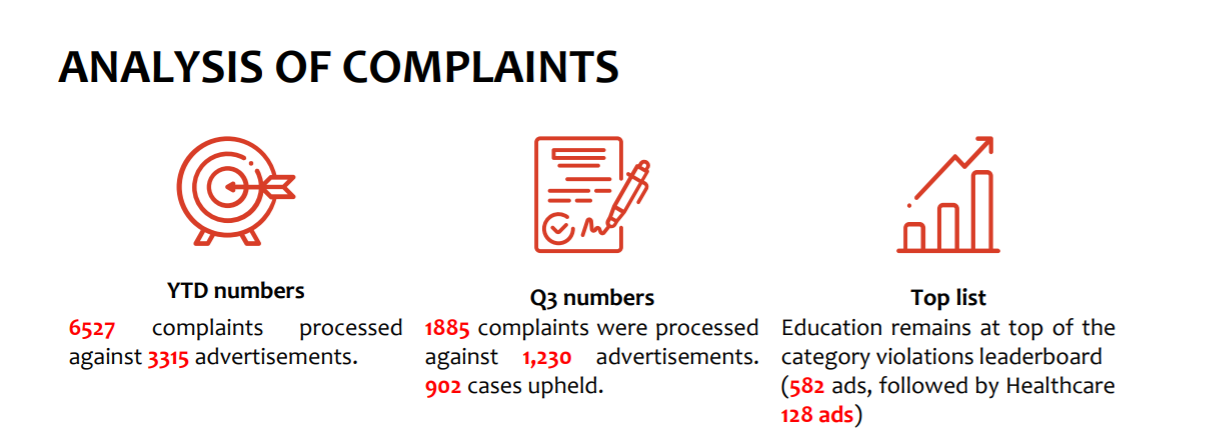
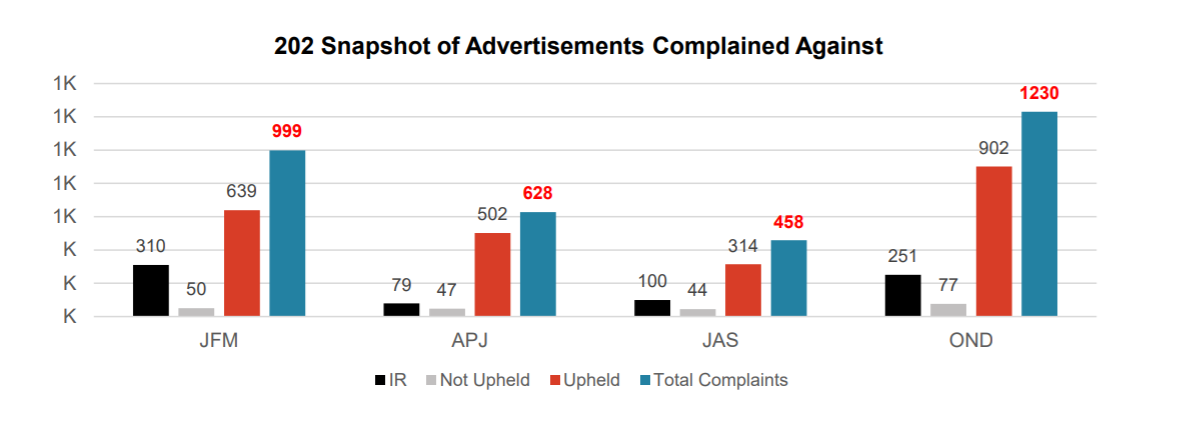
    Between October and December, the ASCI team received 1,885 complaints originating from 1,230 advertisements, the regulatory body said in its Complaints Analysis Report – Q3 FY (2020-21). It noted that the Industry focused initiatives it led for consumer protection and streamlining of processes for effective self-regulatory practices had had a high impact.

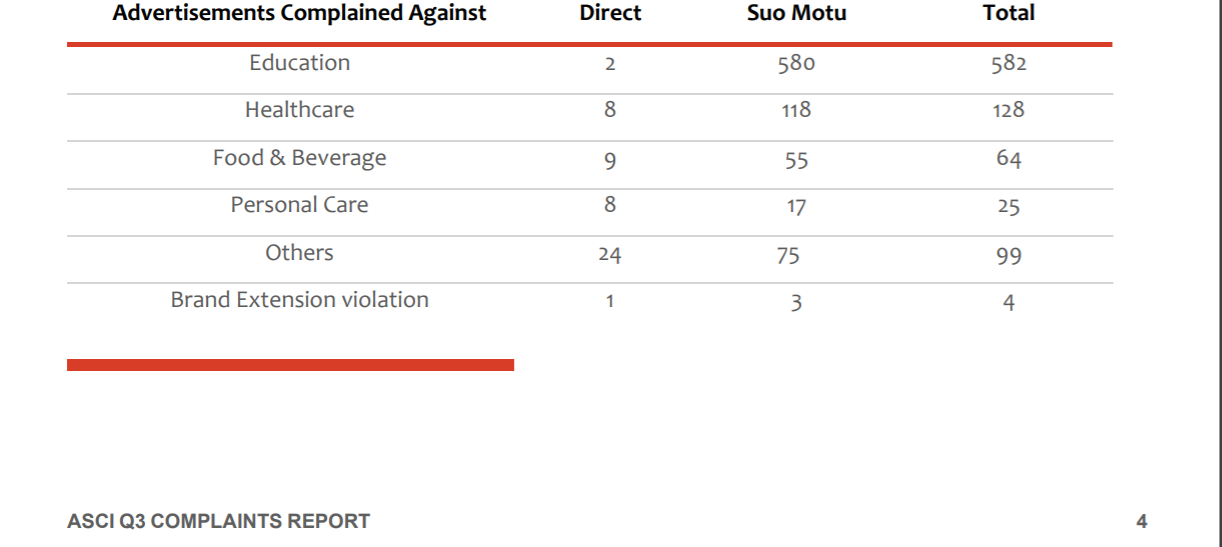
    251 of the 1,230 advertisements were either withdrawn or amended by the advertisers on receipt of communication from ASCI. From the remaining advertisements, ASCI’s independent Consumer Complaints Council (CCC) upheld complaints against 902 advertisements. Of these, a whopping 582 or almost 65 per cent ads belonged to the education sector and 128 from healthcare, 64 from food and beverages, 25 from personal care, 99 from other categories. Complaints against 77 advertisements were not upheld as these advertisements were not found to be in violation of the ASCI code.

    Some of the key themes of false claims or code violations that emerged during the quarter October-December were:

    – Education ads with false claims of job guarantees, placements, etc.

    -Healthcare ads with false claims about Covid2019 cures and preventions advertising.

    Other complaints included those against brands issuing comparative advertisements while prominent cases against honey brands were also in the spotlight. During the third quarter, complaints regarding surrogate advertising also picked up post the IPL.

    In October 2020, ASCI introduced the Covid2019 advisory for advertisers, to protect consumers from being misled during the pandemic. Soon after, in November 2020, ASCI introduced guidelines for online gaming for “real-money winnings”, to protect audiences from risks associated with games involving real money. The guidelines received much appreciation and backing from the ministry of information and broadcasting. Earlier in 2020, the council had also introduced guidelines for usage of awards/rankings in advertisements by brands. Early September, it expanded its national Advertising Monitoring Service (NAMS) to add digital advertising to its suo motu screening. More than 3,000 digital platforms are being currently tracked by the regulatory body.

    The initiatives sparked conversations in the media, on social media and various other forums, which further helped drive consumer education and awareness. Additional impact of the constant buzz on various channels was the spike in the number of complaints processed by ASCI for the quarter.

    Overall in 2020, ASCI looked into 6,527 complaints that were registered against 3,315 advertisements, of which 2,357 were upheld. Education (1,062) and healthcare (827) topped the list for the year as well. Some of the numbers for other categories, 117 food and beverage advertisements were complained, 63 against personal care, 17 violations of guidelines for brand extension, 22 against real estate, 10 against visa and immigration services and 239 against ads from other categories.

    ASCI secretary general Manisha Kapoor said: “The third quarter of the financial year involved initiatives leading to positive impact on the industry and stakeholders. The quarter recorded the highest numbers in terms of complaints processing, compared to the previous two quarters which were a direct outcome of the pandemic. We hope to continue this momentum in the year ahead.”

  • ASCI announces Covid-2019 advertising advisory

    ASCI announces Covid-2019 advertising advisory

    MUMBAI: The Advertising Standards Council of India (ASCI) has directed brands to ensure that their adverts do not proliferate unsubstantiated claims related to Covid2019 that mislead and misinform the people.

    The self-regulatory industry body has issued a new set of guidelines on Covid2019-related ads that advertisers must adhere to, in a move to shield consumers from false and/or misleading information and products in the midst of the pandemic.

    As per the advisory: "Advertisers should be able to substantiate (direct or indirect) claims of immunity against or treatment for Covid2019 supported by either technical support recognised or approved by health authorities such as WHO, ICMR, Health Ministry, Ayush Ministry, DCGI, CDC (USA), or health organisations of similar stature or by well-recognised medical/technical literature or by regulatory-approved clinical research conducted by a recognised medical institute/laboratory."

    It further warned advertisers not to distort facts or mislead consumers by means of implications and omissions, abuse their trust or otherwise exploit their lack of experience and knowledge.

    ASCI also issued a firm reminder to manufacturers of Ayurvedic, Unani and Homeopathic products to abide by the guidelines set in place by the Ministry of Ayush regarding Covid2019 advertisements.

    The advisory is in line with Chapter 1 of ASCI’s code related to truthfulness and honesty of representation and, thus, the creation of consumer confidence in advertising.

    ASCI general secretary Manisha Kapoor said the pandemic is a difficult time for people and brands alike, but it cannot be a pretext to mislead consumers.

    “We want advertisers to be more mindful in creating advertisements and making claims related to Covid-19. Given the pandemic and the extended lockdowns, people are obviously concerned. Manufacturers and brands have also responded to consumer needs arising out of the pandemic. However, we want these products and advertisements to stick to claims and promises that are well backed by adequate substantiation. The advisory to advertisers is meant to safeguard consumers as well as to ensure the highest standards for advertising,” she said.

  • ASCI appoints Manisha Kapoor as its new secretary-general

    ASCI appoints Manisha Kapoor as its new secretary-general

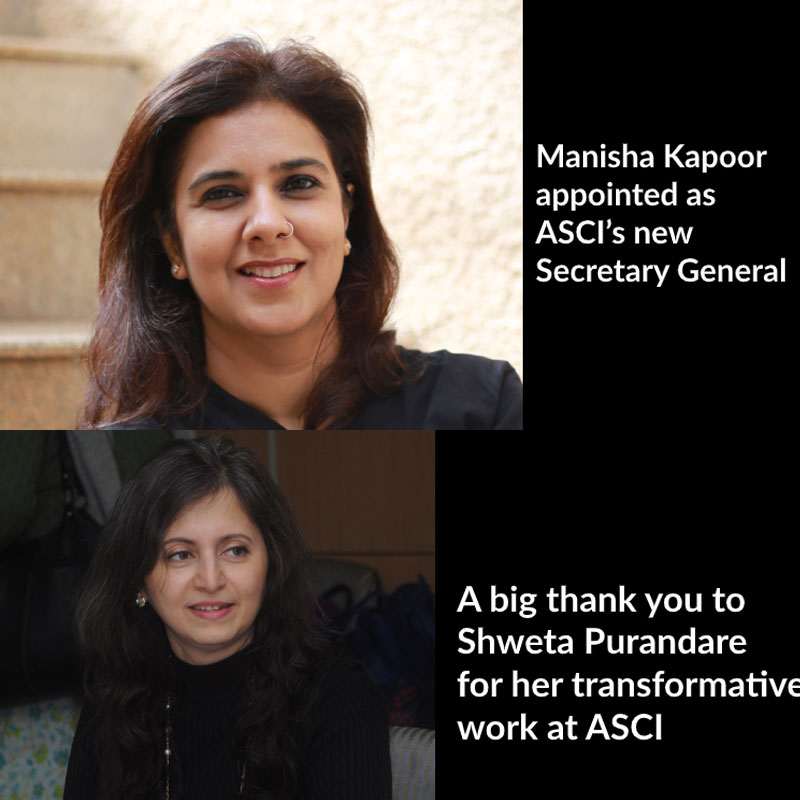
    MUMBAI: The Advertising Standards Council of India (ASCI) has named Manisha Kapoor as its new Secretary-General. From September 1, Kapoor will take over ASCI’s secretariat responsibilities, including the consumer complaints redressal process as well as the marketing, public relations, and social media initiatives.

    Kapoor has been part of ASCI’s consumer complaints council for the past five years and is, therefore, closely associated with the advertising industry’s self-regulatory body. She will take over from Shweta Purandare.

    Purandare joined ASCI eight years ago as chief complaints officer and took over in 2014 as the Secretary-General.  During her tenure, ASCI became bigger and better. It launched its WhatsApp number and set up new complaint redressal and review processes. She also was instrumental in increasing ASCI’s vibrant presence on social media. Over the years, she became the public face of ASCI with various stakeholders and represented it with distinction in various fora.

    ASCI chairman Rohit Gupta said: “We thank Purandare for her work in achieving our vision and her belief in our goals and motto. She was instrumental in enabling ASCI’s closer engagement with the regulators resulting in ASCI signing MoUs with the Department of Consumer Affairs, the Food Safety and Standards Authority of India, and the Ministry of AYUSH. As she embarks on the next phase of her career, we wish her the very best. We are delighted that Kapoor will take on the role now. We look forward to her valuable inputs and leadership.”

    Purandare said: “It has been an extremely enriching experience professionally through which I could contribute to ASCI’s transformation in terms of capacity, capabilities, and stature. As I move on to undertake a new journey, I wish Kapoor the very best.”

    Kapoor has more than 25 years of experience in building brands and businesses. Having worked with companies like Hindustan Unilever and J&J India, she has also consulted with corporations on brand development and strategy for the past 15 years – first with MarketGate Consulting and more recently with Futurebrands Consulting. She has also worked with several non-profits and the government on development sector projects.