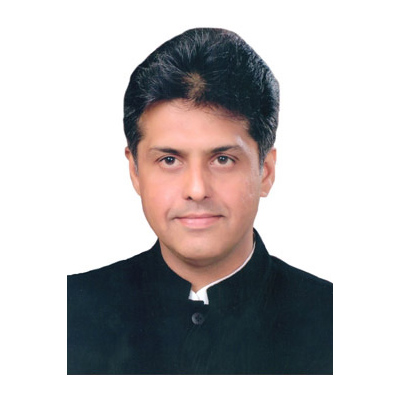
Tag: Manish Tewari

  • India and Japan agree to enhance co-operation on media content

    India and Japan agree to enhance co-operation on media content

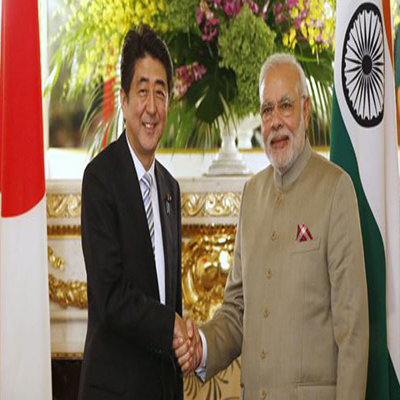
    NEW DELHI: India and Japan have agreed to expand co-operation in the films sector, particularly in co-production of animation films.

    In a joint statement issued after the meeting, both the countries have agreed to form a Joint Working Group in order to tap the huge business potential in the co-production of films and animation, skill development, exchange programs between training institutes and such other areas which are mutually beneficial to both sides.

    The agreement was signed by Information and Broadcasting Minister Manish Tewari and visiting Japanese Minister for Economy, Trade and Industry (METI), Toshimitsu Motegi in New Delhi today.

    During the discussions, Tewari extended the invitation for Japanese partnership in setting up of the proposed National Centre for Excellence in Animation, Gaming and Special Effects (NCOE) in Mohali, Punjab. He also welcomed Japanese expertise in developing special training courses at the Film and Television Institute of India, Pune and the Satyajit Ray Film and TV Institute (SRFTII), Kolkata.

    Welcoming Japan’s decision to be the Focus Country in the International Film Festival of India to be held in Goa this year, the Minister extended personal invitation to the Japanese Minister to attend IFFI, 2013.

    Motegi affirmed full Japanese cooperation in the media content industry of India. He said that a beginning has been made by way of co-production of films, particularly animation films. The Minister said there is a significant potential for growth in the media sector in India as the country is making rapid economic progress.

    Bimal Julka, Secretary I&B welcomed the initiatives outlined and stated that immediate steps would be taken to establish the Joint Working Group.

  • I&B ministry’s ad cap succor for broadcasters

    I&B ministry’s ad cap succor for broadcasters

    MUMBAI: On the one hand, the Telecom Regulatory Authority of India (TRAI) is putting the squeeze on broadcasters. On the other, the ministry of information and broadcasting (I&B) is proving to be an angel in disguise all ready to provide it with some succor. At least in the area of the 12 minute cap on advertising per hour allowed on television which TRAI activated earlier this year, and which is to be implemented next month.

    Reports are that the ministry is collecting data from broadcasters to ascertain the loss that they would incur on account of the TRAI-mandated ad cap.  It is then expected to prepare a consultation paper within the next 10 days, say these reports.

     
    Broadcasters – especially news broadcasters – have been yelping about how any reduction in air time would lead to a shriveling of revenues for them; in fact it might make it unviable for them to sustain their operations. Their constant wailing caught the attention of I&B minister Manish Tewari who last month requested the TRAI to post-pone the ad cap to end-2014 to coincide with the inflow of subscription revenues which are expected to accrue to broadcasters post the completion of cable TV digitisation.

    The Telecom Disputes Settlement & Appellate Tribunal (TDSAT) concurred with the news broadcasters’ appeal and put a freeze on the applicability of the ad cap, till their plea was heard on 11 November 2013. General entertainment channels have, however, agreed to comply with TRAI’s directions and have even gone ahead and reduced their commercial advertising air time.

    Says a media observer: “All the players – TRAI, I&B, broadcasters – need to get together to have a road map for the reduction of the ad cap gradually and periodically over time and not in one fell swoop as TRAI has been suggesting. It’s good that the I&B ministry and TDSAT have been supporting the broadcasting sector as far as the ad cap is concerned. It is imperative for its survival.”

  • Spirit of inquiry amongst media must not morph into a campaign of calumny, cautions PM

    Spirit of inquiry amongst media must not morph into a campaign of calumny, cautions PM

    NEW DELHI: Prime Minister Manmohan Singh on Saturday called for caution as mediapersons executing their responsibilities in a vibrant democracy which revels in free enquiry and quest for answers.


    He said the media industry had a special role in assessing, tackling and overcoming the challenges that two decades of socio-economic change have brought about. “But a spirit of inquiry must not morph into a campaign of calumny. A witch-hunt is no substitute for investigative journalism. And personal prejudices must not replace the public good.”


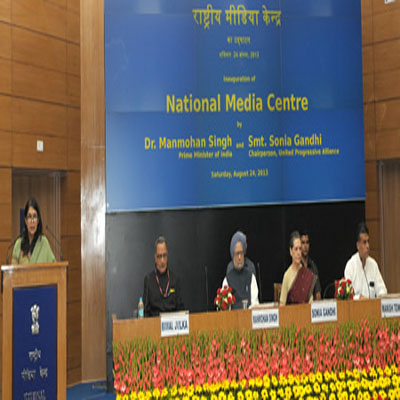
    Dr Singh was speaking after he and UPA Chairperson Sonia Gandhi inaugurated the National Media Centre in the capital this morning. Information and Broadcasting Minister Manish Tewari, I&B Secretary Bimal Julka, and Press Information Bureau Principal Director General Neelam Kapoor were also present.


    Singh said “It is a reality that journalism cannot be divorced from the business of which it is a part. The responsibilities of a media organization are not limited to the viewers and readers alone. The companies also have an obligation to their investors and shareholders. The tussle between bottom-lines and headlines is a fact of life for them. But this should not result in a situation where media organizations lose sight of their primary directive, which is to hold up a mirror to society and help provide a corrective. ”


    He said “This Centre showcases our ability to keep pace with similar state-of-the-art facilities across the world. It symbolizes the vibrant mood of the existing media landscape in our country. As a ‘Communication Hub’ and a ‘Single Window’ facility, I am sure it will fulfill the needs and requirements of our media fraternity, many of whom are present here today.”


    In her address, Gandhi said “The government and the media have the shared interest in disseminating programmes, policies, decisions and information. This is where an institution such as the National Press Centre assumes importance. I hope that it will represent a partnership in which both sides will be able to discharge their designated responsibilities.”  


    “In any society undergoing dramatic and rapid transformation there is constant need to renew and rebuild. This facility represents that evolution. I hope very much that it will become an effective nerve centre and a duct and an information bridge between the Government, the Media and the People,” she added.


    “I want to be quite clear we don’t favor propaganda or publicity campaign simply in order to score points for the government, but the people have a right to know their legal and other entitlements. They have a right to information. They have a right to be able to make informed decisions. Only an aware and conscious citizenry can be expected to make this system work well and hold governments and political parties to account.”


    Referring to the National Media Centre, Gandhi said “This beautiful building is not just brick and mortar. It is up to you media professionals, officials of Information and Broadcasting Ministry and others who will inhabit it to infuse life into it by making it an instrument to serve the people and empower them.”


    The Centre at 7E Raisina Marg in the proximity of Shastri Bhavan which presently houses the Press Information Bureau was inaugurated 21 years after it was first conceptualized during the 8th five year plan (1992-97).


    Tewari said: “We live in an era of an information overload. The media landscape has transformed exponentially over the past two decades. This transformation has brought its own set of challenges to the media industry. India today mirrors the world in global cross media consumption patterns.”


    He said a ‘very unfortunate collateral of this epoch making change’ is the print industry globally. It was distressing to learn that iconic newspapers and magazines around the world were ceasing to print. However, India appeared to have changed this trend. The Indian newspaper market will be the only one to grow at a double-digit CAGR [Compounded Annual Growth Rate] of 10 per cent and would emerge as the world’s sixth-largest newspaper market by 2017 as per industry reports on media and entertainment. The regional and vernacular print sector is growing on the back of rising literacy and low print media penetration as well as the heightened interest of advertisers wanting to leverage these markets.


    Tewari said according to industry sources, print has a combined market penetration of a ball park of 14 per cent. Thus, the print industry has the potential to expand its footprint and readership across the national canvas. This sector thus would be able to weather the shifting sands of technology at least in the Indian context.


    The Indian broadcasting sector had grown from one channel in 1991 to 852 at the last count.  After statutory rationalization the number now stood at 795 odd channels, he added. While this had brought about plurality, it had resulted in market fragmentation as well.


    “There are 15.4 crore TV households in India. Unfortunately the news and current affairs genre makes up only seven per cent of the total television viewership, according to TAM CS4+ all India weekly average for 2012. The remaining 93 per cent of this universe is occupied by general entrainment channels despite there being 395 odd news and current affairs channels.


    He said this generated hope that there is an exponential potential for growth, provided the news broadcasters and Multi System Operators (MSO’s) are prepared to re-imagine their content and carriage paradigms respectively.


    In both the print and television genres, he said the revenue model remains heavily dependent on advertising. As the advertisement cap requires a migration path synchronous with the roll out of digitization For the news broadcasting industry, Tewari hoped that the Telecom Regulatory Authority of India would re-consider its deadline.


    To give consumers the benefit of better quality of service and correct the skewed revenue models in the broadcasting sector government launched a massive digitization exercise in 2012.  With 10 million set top boxes seeded in Phase–I, another 20 million in Phase–II and yet another 80 million scheduled for Phase–III & IV, by the end of 2014 no one in the Broadcasting Sector can really say that bottom-lines and balance sheets in August 2013 are not looking better than in October, 2012.  


    The MSME sector must also endeavour to leverage this unique business opportunity and convert it into the India digitization story even in manufacturing terms.  


    India had 86.7 crore mobile phones, 12.4 crore Internet users with an expected growth up to 37 crore by 2017, eight crore people on Facebook and 1.8 crore on Twitter.


    The government had recently taken a decision to create a New Media Wing in the Ministry to have an institutional presence in this virtual civilization.


    He said the radio, till a decade back considered, was a casualty of the tectonic technological shifts but now stood poised on the threshold of a new wave. High mobile penetration and cheap call rates in our country had brought this renaissance into replay.


    The film industry had completed a century of existence. This industry had grown but still had tremendous potential. As per an industry estimate, about 14 million Indians go to the movies everyday. As per another report, the film industry is valued at Rs 112.4 billion [$1.741 billion], and is estimated to grow to about Rs 193.3 billion [$2.994 billion] by 2017, a compound annual growth rate (C.A.G.R.) of about 11.5 per cent. The regional film industry is a steady contributor to this growth process.


    The media sector had grown by a CAGR of over nine per cent between 2007-2012 and was projected to grow at 15 per cent between 2012 and 2017, Tewari added.


    But there were some paradoxes that all stakeholders in this sector must try and collectively resolve to find the elusive golden mean. These included flawed Revenue Models qua Questionable Revenue Generation practices; TRPs qua truth; Media Trials qua a Fair Judicial Trail guaranteed by article 21 of the Constitution; and anonymity masquerading as privacy in the new media space – the spectre of the ‘hidden’ people, apart from Last mile neutrality among carriage providers so that content providers get a level playing field and are able to reap the benefits of convergence.


    The National Media Centre (NMC) was initially conceptualized by the Press Information Bureau in 1989 to facilitate greater interaction between the Government and the media with a state-of- the-art equipped media centre. The Centre has been planned on the model of media centres in some of the capitals of the world such as Washington and Tokyo. It will have offices of the PIB as well as special facilities for the media to enable the Government to interact closely with the media.


    The Centre has a Press Conference Hall for 283 media persons, a briefing room for about 60 persons, 24 Work stations for the media, a library, media lounge and cafeteria. The press conference hall and media lounge are Wi-Fi enabled.


    Major Highlights:

    World Class Media Center, Ground + 4 Floors + 2 basements, Press Conference Hall with seating capacity for 283 persons, Media Lounge – Work area facilities for media personnel, Committee Room with video conferencing facilities, Library, Cafeteria, IT and AV Infrastructure in NMC.


    Facilities provided:

    Optic fibre internet backbone with redundancy, Mini Data Centre for application development and hosting, Webcast, including live webcast, Video feed to TV channels outside the building, Network with redundancy and expandability to 500 nodes, IT facilities to media persons in work area/Lounge, Internet Telephony, AV Video Wall.·        


    The NMC has been constructed by the National Buildings Construction Corporation (NBCC) over a period of three years with a total covered area of 13867 sq m. The plot size is 7787.46 sq m (1.95 acres).
  • NBA welcomes Tewaris proposal to delay ad cap

    NBA welcomes Tewaris proposal to delay ad cap

    NEW DELHI: The News Broadcasters Association (NBA) is a happy lot and why shouldn’t it be? After all its demands are being heard and openly expressed in public meetings by the Information and Broadcasting Minister Manish Tewari himself. As reported earlier by Indiantelevision.com (Tewari reaffirms his support for extension of ad cap implementation) the minister has come out in support of the news channels who for long have been asking for an extension to the implementation of the 12 minute ad cap.


    Welcoming his recent statement that news channels should get an extension on the 12 minute ad cap “at least till the final phase of digitisation is complete”, the NBA said that the industry is in a dire financial condition, like many other sectors of the Indian economy, with ad revenues being slow, carriage fees continuing to be burdensome and credible subscription revenues being out of sight.


    Reinstating its earlier argument on the need for delay in implementation of ad cap, NBA today said that a forced curb on advertising will have a catastrophic impact on revenues of news broadcasters forcing many to take drastic steps that would have an unavoidable and adverse impact on quality of service and jobs.


    The association has estimated that if the ad cap were indeed implemented at this stage, the revenue loss across news channels would be in excess of Rs 500 crore, forcing cuts of at least that amount in costs, if channels have to survive.


    The NBA agreed with the minister that the 12 minute cap on advertisements per clock hour be kept in abeyance and such restrictions “kick in only when the benefits of digitisation are apparent so that broadcasting companies can make good their advertising losses with subscription fee.”


    It also urged that the burdensome and crippling nature of carriage fees which have no business to exist in a truly digitised environment is also addressed urgently.


    NBA requested the minister and the Telecom Regulatory Authority of India (TRAI) to come out with a final notification keeping the ad cap for news channels in abeyance as above in the next 10 days as any delays beyond that will have an irreparable impact on the industry.


    Now with the I&B minister himself coming out in open to support the news channels, will TRAI melt and give in to the demands of the news channels is something which is worth a wait.

  • UNI news agencys Urdu news website launched

    UNI news agencys Urdu news website launched

    NEW DELHI: The Urdu service of the United News of India news agency has been lauded for its efforts to promote the language.


    Union Ministers Oscar Fernandes, K Rahman Khan, Srikant Jena and Manish Tewari were speaking after launching the Urdu website of the UNI Urdu service, which remains the only national news agency to have an Urdu service.


    The ministers and other eminent speakers resolved to give full backing to the news agency’s efforts to popularise the Urdu language.


    The UNI Urdu news service was launched two decades ago for bringing Urdu newspapers into the mainstream, becoming the first in the world to launch a service in that language.


    UNI Urdu news service was launched in 1992. The agency disseminates its news services in three languages–English, Hindi and Urdu.

  • Tewari reaffirms his support for extension of ad cap implementation

    Tewari reaffirms his support for extension of ad cap implementation

    NEW DELHI: The news channels have found a big supporter to push their demand for an extension in the implementation of ad cap. And this comes from none other than Information and Broadcasting Minister Manish Tewari himself. In a statement made today, the minister has reinstated his support for the news channels and asked the Telecom Regulatory Authority of India (TRAI) to extend the time frame for news channels to implement the 12 minute ad-cap.


    “TRAI can give the news channels an extension at least till the final phase of digitisation is complete,” said Tewari who was addressing a symposium on News Media Education in India organised by CMS Academy at the India International Centre in New Delhi.


    “The regulator can seriously look into some of the issues which the news channels have raised and see if they can give them a road map which is synchronous with digitisation, so that we can have a seamless implementation of both digitisation and the statutory remit.”

    Tewari questions if we have freedom of the press or freedom of the owner of the press


    Tewari commented that apart from protecting consumer interest, TRAI should also look at the industry situation so that downsizing does not become the rule rather than the exception. He said manufacturing Set Top Boxes (STBs) “is not rocket science” and digitisation has been a “huge missed opportunity” for the medium and small scale industry. He said Indian industry should utilise the opportunity of providing STBs for third and fourth phase of digitisation.


    The minister in his address not only spoke in the favour of the news channels but also took a dig at the current media scenario. Commenting on last week’s lay off by a television news channel and the legal recourse against the Wage Board recommendations for the print media by one of the promoters he said, “Media is a business today.”


    Tewari also said that there was a need to reflect on whether it is a business as defined under the Indian constitution or any other activity – a “question germane to the media.” He was referring to over 300 job cuts that include some of the well known names, in a news channel last week.


    The minister said the rights of the citizens and the rights of the media barons “fall in different tracks with the twain not destined to meet.”


    Describing the question as a classic chicken and egg situation, Tewari commented that the “Conundrum bedevilling the media landscape today in India is – Do we have freedom of the press or freedom of the owner of the press?” He hoped media professionals would “introspect” on the issue.


    Commenting on the challenges faced by the print, broadcasting and new media (internet) he said, “The challenges are unique, distinct and require different treatment.” He further stated that it was time for the print media, which has more or less tried to keep rates low over the years, to “reflect and rationalise tariffs.”


    He said the heavily advertisement-dependent model of newspapers was “not the way forward” and called for “serious introspection” in the print media on how far the advertisement model can sustain them.


    On the broadcasting sector, he said of the 798-odd channels, 415 are news channels, and they too are “hugely” dependant on advertisements for revenue. “This has led to addiction of sensationalism, manufactured anger and media trials,” the minister added. The situation leads to violation of privacy and that the issue needs to be addressed.


    Tewari also said his ministry had sent a proposal to the law ministry to incorporate provisions against paid news in the Press and Registration of Books (PRB) Act, providing for penal provisions. He said it was proposed that paid news would be made an offence which would have provisions of penalty and suspension of license.


    He said the media industry should consider holding a common exam for journalists, on the lines of that conducted by the Bar Council, after which they could be given licence to pursue the profession.


    “A good starting point would be that rather than prescribing a curriculum which is then standardised across institutions, possibly the media industry could think about at least having a common exam.”


    Tewari said there were good institutions to train journalists, but there were also “fly-by-night” operators in the media education sector “Professionals from diverse fields would not resent the idea of a common exam.”


    Press Council of India Chairperson Justice (Retd) Markandey Katju had earlier raised the demand for minimum qualifications for journalists.

  • Postpone 12-minute ad cap deadline to Dec 2014: I&B minister Manish Tewari

    Postpone 12-minute ad cap deadline to Dec 2014: I&B minister Manish Tewari

    MUMBAI: He could well be labeled the messiah of the broadcasting industry if his suggestion is heeded. Minister of Information & Broadcasting Manish Tewari has recommended that the 12 minute per clock hour advertising cap deadline be moved ahead to December 2014 from 1 October 2013 suggested by the Telecom Regulatory Authority of India. (TRAI)


    “The final phase of India’s cable TV digitization is likely to be over by September 2014,” he is reported to have said. “And the broadcast industry would be in a position to generate a substantial dividend from the digitized cable TV ecosystem which could well compensate them for the loss of air time revenues on account of the reduction in advertising air time. We, at the I&B, have hence suggested to the TRAI that ad air time reduction should follow the completion of digitization.”


    TRAI had in May 2013 mandated that general entertainment TV channels (GECs) and news TV channels should reduce their advertising air time per hour to 16 minutes and 20 minutes respectively from 1 July 2013 and to 12 minutes by 1 October 2013. The reason: GECs were booking and telecasting around 18-20 of ads per hour while for news channels the figure was 25-30 minutes. The advertising clutter was resulting in a poor viewing experience for TV watchers; hence TRAI had ordered the broadcast ecosystem to cut back around a year ago, but had delayed enacting the order until to May 2013.


    Broadcasters – specially news TV channels – had immediately protested this move, saying it could impact their financial viability. The news channels had also asked the Telecom Disputes Appellate Tribunal (TDSAT) to intervene a month or so ago after the headless body found itself a chief.


    However, both GECs and news channels had – for the large part – complied with the TRAI ad cap mandate and reduced their air time to 16 minutes and 20 minutes from 1 July 2013. The major Indian GECs had managed to increase their advertising air-time rates between 12-30 per cent, but news channels have said this has been difficult for them. They have also complained that high cable TV carriage fees have been a drain on their resources.


    The ball is now in TRAI’s court. Will it concur with the minister and his ministry’s recommendation? Will it do so for only the news TV channels or for all genres? Will the other genres of TV channels accept the largesse being doled out to the news channels alone? Will they also join the chorus and implore the government to help them out too? Questions that beg answers!

  • Broadcasters delighted; want I&B minister to push through ad cap delay

    Broadcasters delighted; want I&B minister to push through ad cap delay

    MUMBAI: With just a little more than two months left for the 12 minute per clock hour advertising cap to be implemented, the broadcast industry is applauding Minister of Information & Broadcasting Manish Tewari’s recommendation. The minister has reportedly stated that the ad cap deadline should be moved ahead to December 2014 from 1 October 2013 as suggested by the Telecom Regulatory Authority of India (TRAI).


    Times Television Network MD and CEO Sunil Lulla feels that the recommendation is in sync with reality. “From a news broadcasters’ point of view, we have put forward similar thoughts many a times with concerned bodies. Considering the difference between cost of production and the revenue generated, it would be better if news broadcasters’ were allowed to self regulate. We hope that the request is heard,” he anticipates.


    Similarly, a senior official from the News Broadcasting Association (NBA) agrees and adds, “Look at the cost for each broadcaster;  if he has to increase eight minutes of content per hour that is close to three hours of more content a day. Where will a broadcaster get so much money from when his ad revenue is going down? Even producers are going to demand more money as to produce a minute of content takes up a good one hour. There are 10,000 things that need to be done depending on the final decision…”


    The NBA official further elaborates, “As broadcasters we don’t know what to do. Everyone is saying different things, so who do we believe? What if a channel actually starts implementing changes and then they extend the date, it’ll be in a mess.”


     “We are happy that he’s understood our problem which is a genuine one and we hope that he will be able to convince TRAI. And we need take a decision soon,” say both the broadcasters.


    But what about other channels/genres? “One shoe for all is what I believe rather than two which might create confusion,” Lulla clarifies.


    To put forward advertisers’ viewpoint on the issue, Advertising Agencies Association of India (AAAI) president Arvind Sharma elucidates, “AAAI has always supported the thought implementing the ad cap after we know what is the full impact of digitisation is known.”


    However, when we contacted a senior official from TRAI, he told us that they too haven’t received any official “recommendation” from the ministry about postponing the deadline, but have only read about it in new reports.


    In May 2013, TRAI had mandated that general entertainment TV channels (GECs) and news channels should reduce their advertising air time per hour from16 minutes and 20 minutes respectively to 12 minutes by 1 October 2013. The reason given by the authority was that the advertising clutter was resulting in a poor viewing experience for TV watchers.


    Industry is hoping the minister follows up his suggestion with a formal appeal to the TRAI. “The bullet has left the gun…,” says an official from the Indian Broadcasting Foundation who was caught in surprise by the minister’s statement that TRAI should posptone the ad cap until cable TV digitsation is completed in September 2014.


    “We haven’t received any communication from the ministry regarding this. And if we go by the communication we have received in the past few days, there seems to be a conflict,” he says sounding puzzled.


    In the past too, there have been many ups and downs in the broadcasting industry. The whole ratings tamasha which went on for a fortnight was resolved when the three stakeholders – Indian Broadcasting Foundation (IBF), Advertising Agencies Association of India (AAAI) and Indian Society of Advertisers (ISA) – finally came up with a solution of providing the television viewership in thousands (TVT) to media and public.


    We at Indiantelevision.com can only hope that the recommendation doesn’t boil down to another controversy, but has a happy ending. However, one does wonder why the statement was made. Do up-coming elections have anything to do with it? Let’s just wait and watch…

  • Around Rs 12.5 cr spent on flagship promotional programmes till now for 2013-14

    Around Rs 12.5 cr spent on flagship promotional programmes till now for 2013-14

    NEW DELHI: The Information and Broadcasting Ministry has spent a sum of Rs 12.48 crore during 2013-14 so far on promotional shorts publicising the flagship programmes of the government.


    I&B Minister Manish Tewari said that a sum of Rs 103.203 crore had been spent on similar promotional shorts during 2012-13.


    The Minister was answering questions after unveiling a comprehensive multi-media initiative “Glimpses of the India Story” – Phase II intended to capture the journey of India’s development through various programmes and policies launched by the government during the last ten years. The first phase was unveiled in May and was actively run from 14 May to 4 June.


    The first phase of the ‘India Story’ informed the people about the initiatives taken by the government during the recent years and the tangible benefits that had accrued in sectors such as education, health, telecom, rural and urban infrastructure. In the second phase, a 360 degree communication model has been adopted across media platforms focusing on the new initiatives of the government and the upcoming reforms aimed at improving the lives of the common people.


    Giving figures, the Minister said the figure in 2007-08 was Rs 17.87 crore, Rs 46.92 crore in 2008-09, Rs 35.08 crore in 2009-10, Rs 48.48 crore in 2010-11, and Rs 87.78 crore in 2011-12.


    He said that the social media was also being used in a major way and ‘content agnostic platforms would be created’.


    He claimed that the second phase comprising around ten shorts was rights-based, and had also referred to certain rights that the government had planned for and which were pending in Parliament. The objective of the current phase of the India story is not only to communicate the benefits of the reforms, but to develop a sense of ownership for these initiatives among the people.


    The multimedia initiative would be put across on traditional, print, outdoor publicity, special outreach programmes focusing on new media platforms with the objective of informing and apprising the public of the new policy initiatives undertaken by the government recently. For the print and visual media, the content is being developed in 11 languages.


    The Ministry has adopted a 360 degree multi-media approach concentrating on six broad themes. Creatives have been developed highlighting the broad features of each of these initiatives. The print media initiative would be covering 539 newspapers across the country which would include regional papers, small and medium papers as well as the dominant groups at the national level.


    The outdoor publicity has been planned in 195 cities/towns with 750 sites. Besides this, 216 private FM Stations and prominent TV channels in the news and general entertainment segment would also be covering the Glimpses of India Story.


    In the second phase, the various shorts have used Priya as a key figure communicating the intent of the government, while some creatives on the Right to Information had used a look-alike of cartoonist R K Laxman’s ‘Commonn Man’.


    For the first time, a special video for the theme song “Meelon Hum Aa Gaye, Meelon Humien Jana Hai” has been developed. The video highlights the need to continue on the path ahead to ensure that the country has able to achieve high economic growth as well as social equity. A key highlight of the audio visual content will also be the special song on “National Integration” of two minute duration focusing on India’s innate strength in “Unity in Diversity”.


    The India Story during the second phase will also be positioned on the New media platforms. The focus of attention would be to reach out the younger audience who use this medium on a 24×7 basis. Within the ambit of social media, content would be loaded on YouTube, Twitter, Facebook and Blog. A dedicated portal highlighting the India story is being developed to provide content/updates on all relevant issues related to the dissemination and outreach programme.


    Rural communication would also be one of the corner stones of the current phase of the India Story. Press Information Bureau, through its Public Information Campaigns (PICs) would be taking the message of the new initiatives to the grass roots. PIB is planning 106 Public Information Campaigns (PICs) during the financial year 2013-14. For this initiative, PIB has designed specific content in the form of booklets covering the new initiatives of the government.


    The Song and Drama Division and Directorate of Field Publicity would be integrating their efforts for enhancing the outreach to the rural areas through PICs and vertical programmes across the country. The Song and Drama Division would be organizing five Jamunia Programmes concurrently with PICs and 144 other shows based on rural folk culture and theatrical formats within the next two months. Directorate of Field Publicity will be organizing programmes in 195 towns/cities within the next two months.

  • I&B minister wants the industry to define self-regulation levels

    I&B minister wants the industry to define self-regulation levels

    NEW DELHI: Information and Broadcasting minister Manish Tewari has said the process of mainstreaming self-regulation as a statutory mechanism should be led by the industry and not the government.


    Speaking at a panel discussion on Media Regulation: Is status quo the option?, the minister emphasised that the government’s approach towards the media was an ‘essay in persuasion not regulation’.


    The stakeholders within the industry would have to define the equilibrium levels to ensure that the paradigm of transparency, fairness, sobriety and avoidance of sensationalism becomes the key driver of the national discourse in the media space, Tewari stated.


    He said digitisation as a process could be leveraged to augment sample sizes by re-engineering every Set Top box to function as a virtual people’s meter. Out of the box innovation and creative thinking by media entrepreneurs could surmount the current challenges by a technological leap that could transform the dynamics at the back end of the media sector. Industry could then utilise the data and develop business models that were transparent and workable.


    This process would ensure an alternative to the ongoing conflict surrounding TAM / TRP that the Broadcasting industry held responsible for much of its woes. He emphasised that the way forward was also to fast track Broadcasting Audience Research Council (BARC) as an industry led body that would provide a reliable measurement of popular viewership patterns and help broadcasters overcome corrosive narratives.


    The minister also referred to the growing importance of the new media space which had revolutionised the media landscape. The growth of the internet had led to a situation where there could be a conflict between the physical and virtual civilisation. It was important to comprehend the fact that the power of expression and dissemination through the internet had added a new dimension to innovations in information dissemination. While the opening up of the virtual space had led to democratization of the information paradigm, it had also led to technology becoming a leveller.


    Tewari added that these developments could also lead to a situation where one could also face “Balkanization of the Internet” if agreed rules of international engagement did not emerge as a binding international compact that encompassed states and other entities who controlled the underlying hardware. This situation needed to be avoided at all costs so as to ensure that no artificial divisions are created in the World Wide Web on ideological entities and Westphalian lines.


    The minister also discussed critical paradoxes within the media space that would need to be reconciled. These included proliferation of numerous mediums of communication as qua a growing intolerance to an opposite viewpoint, right to a fair trial qua trial by the media, presence of flawed revenue models qua questionable methods of revenue augmentation, TRP qua the truth and the raging debate between self regulation and statutory regulation.