Tag: Manish Tewari

  • Tewari issues clarification on Sardar Patel ad releases by govt

    Tewari issues clarification on Sardar Patel ad releases by govt

    NEW DELHI: The Government gave out 2164 newspapers advertisements on the occasion of the birth anniversary of Sardar Vallabhbhai Patel between 1998 and 2003.


    Interestingly, the Information and Broadcasting Ministry said in a statement in response to statements by certain political leaders that no advertisements were released during the years 1999, 2000 and 2001.


    However, 20,915 newspapers were given the advertisement between 2004 and 2013. No advertisement was given in the year 2008.


    The Ministry said the Directorate of Advertising and Visual Publicity had been regularly releasing advertisements on the birth anniversary of prominent national leaders including Sardar Patel.


    In this context, I and B Minister Manish Tewari said: “The Ministry of Information & Broadcasting has always followed a policy to acknowledge the contribution of prominent national figures in nation building by releasing advertisements. The advertisements released on the birth anniversary of Sardar Patel are part of the continued policy of this Ministry of expressing gratitude to great leaders for instilling confidence and inspiration in the young minds.” 

  • The TRAI, TDSAT and the ad cap story: Waiting for Godot?

    The TRAI, TDSAT and the ad cap story: Waiting for Godot?

    So everyone has bought themselves some more time. The Telecom Disputes Settlement and Appellate Tribunal (TDSAT) decided to postpone till 11 November the date of hearing for the 10+2 ad cap case filed by the News Broadcasters Association (NBA), music channels as well as the regional channels on grounds of lack of information. The extra fortnight gave it more days to ruminate over what has clearly proved to be a major thorn in almost everyone’s side whether it is the government or broadcasters or agencies or advertisers.


    The Telecom Regulatory Authority of India (TRAI) started it all when under the quality of services rules it decided to force broadcasters to limit commercial air time to 12 minutes per hour a year or so ago. The decision was postponed and rolled over until mid-2013 when it decided enough is enough and passed an order which would see general entertainment channels first reduce advertising airtime to 16 minutes per hour, while the news channels were to cut it down to 20 minutes per hour from 1 July till 30 September. Following this, the GECs from 1 October had to reduce the advertising airtime to 12 minutes per hour and the news channels to 16 minutes per hour.


    The decision was postponed and rolled over until mid-2013 when it decided enough is enough and passed an order which would see general entertainment channels first reduce advertising airtime to 16 minutes per hour, while the news channels were to cut it down to 20 minutes per hour from 1 July till 30 September.
    _____****_____________________________________________________

    Broadcasters – especially the news one – saw red instantly and screamed as if their life was being squeezed out of them. They obviously did not think about the viewer who was at times being inundated with almost 30 minutes or more of ads on TV to watch news. They went ahead and appealed to the TDSAT that what was being called for was draconian and unacceptable. Their claim that news could not have fixed time duration such as TV shows and hence such a restrictive law would sound the death knell for them. However, syncing it with the completion of digitisation was that found favour with them.


    The GECs seemed unperturbed and said that they were all right with the TRAI diktat and announced that they would compensate the inventory reduction by raising per 10 second rates by 20-30 per cent. They seemed a very united bunch until one day the management at Multi Screen Media (Sony) woke up and said it would walk its own path and not reduce air time. The music channels too followed and filed an appeal with TDSAT.


    In the meanwhile, the Information and Broadcasting Ministry too got into the act with minister Manish Tewari stating categorically that the reduction of air time should happen as digitisation gets completed by December 2014, giving the broadcasters some much needed support. The mandarins at Shastri Bhawan were asked to evaluate how the reduction of air time would impact the TV channels.


    Advertisers and agencies sucked in their collective breaths and protested as loudly as they could that the broadcast industry was unilaterally trying to raise rates without any rationale despite having contracts in place and that they would not allow that.


    The noise continued for weeks until the hearing date came up on 31 October morning. Everyone was expecting that the TDSAT would be supportive and would rule in favour of the broadcasters. Hence, the postponement of the hearing was quite anti-climactic, though many expected it to follow that course..


    The GECs seemed unperturbed and said that they were all right with the TRAI diktat and announced that they would compensate the inventory reduction by raising per 10 second rates by 20-30 per cent.
    _____****_____________________________________________________

    The argument that the NBA needs more time seems a little specious, but it worked with the TDSAT. They were anyway slated to be heard on 11 November itself but their case got advanced as the number of cases went up, so for them it is back to base one.


    The networks – Star India, Zee TV, and Viacom18 (who had earlier stated that they would toe the TRAI line) now filed an intervention with the tribunal but have been asked to come back with a separate case.


    Now what after 11 November? What are the various scenarios that could play out? One, the TDSAT will turn down the appeal and tell everyone to obey the TRAI. Right now and pronto!. Two, it could postpone the hearing further, thus giving everyone more time. Third, it could decide that the reduction of air time is a good move but needs more time to be implemented. Fourth, broadcasters, advertisers and agencies could file further cases and a decision could well be put in abeyance until all the cases get sorted. The TDSAT on its part could give a ruling in one case and say that it is applicable to others, but that does not look feasible because each television channel genre has its own set of challenges.


    The question on everyone’s minds is whether it would give rope till 2014 December. This is something that can be debated and be seen as wishful thinking. But who knows the TDSAT may well end up playing the fairy godmother.


    Now, let’s say the TDSAT rules against the broadcasters, it is quite likely that they will head to the higher courts. And knowing Indian courts, it won’t be easy to reach a quick decision. Industry experts expect the air time cap to take its own course and time. That it will happen is a given, but predicting how soon is like attempting to play Russian roulette. Welcome to the world of television which has become more of a gamble in recent times.

  • And now a 3D mobile game for Colors’ 24

    And now a 3D mobile game for Colors’ 24

    MUMBAI: It has been three weeks since Indian audiences have been introduced to a new fictional TV format in the form of real time story telling through the first international adaptation of the American hit 24. With a 360 degree marketing campaign – almost like that used for full length feature films – to help create the buzz around the series, host channel Colors has decided to perk it up by throwing in a sparkling digital ingredient for viewers.


    And it’s coming in the form of a 3D interactive mobile game for iOS and Android phones. Developed by Gameshashtra Solutions, it is targeted at those who want to have the thrill of playing Jai Sing Rathor (Anil Kapoor) – the main protagonist of the show – while on the go. Called ‘Safari Storme 24-The Game, it is available for download only in India. It will allow gamers to go through three maps of Worli, Dadar and Parel with 30 levels of two minutes each. As of now only the Worli route is available while the other two will be launched in the coming weeks.The first map of Worli is a rooftop setting.


    Four and a half months went into creating the 3D game. Fans will keep going through levels, scoring points, winning ammunition and then checking scores with others on the ‘leader board’ through their Facebook or Twitter accounts.
    India has a great potential to become a destination for film shooting but the current system of multiple clearances at various levels make it an unattractive destination for filming, says Manish Tewari


    “The three locations in the game are also there in the series,” says Colors digital head Vivek Malhotra. “We kept the game in the spirit of the show by taking the concept ‘race against time’ rather than the political drama in it,” he adds.


    Explaining the game technique Malhotra says that players have two ways of surviving – hit and survive or duck and survive. As the game levels progress, the enemies come in hordes and ammunition also stacks up.


    Coming up with a 3D game has probably cost sack fulls of money, apart from what has already been invested in the expensive show. But the channel seems to not be too worried about it.


    “For the first season it is not about making money,” says Malhotra who is aiming at getting 1 million downloads for the free game. However, advertisements will be inserted into the game that would give them some amount of revenue.


    24 is Colors biggest fiction property created by Anil Kapoor Productions and RDB. Delly Belly director Abhinay Deo is the series director while Rensil D’Silva is the scriptwriter.


    The show is presented by Safari Storme while Next is one of the associate sponsors. The launch day saw it garner 3.4 million viewers with most of it coming from the urban areas while the second week saw it get an average of 2.6 million viewers.


    “Television executives in India are increasingly understanding that you can take a TV show into other experiences for viewers. Look at KBC which has a game which allows fans to test their general knowledge skills online and on the mobile. And now Colors has developed a 24 game which will allow youngsters and old alike to shoot, and kill while rising up in levels,” says a media observer. “The fact that it is primarily for the mobile will bring in a lot of fans who will play the game when they have a few minutes to spare, whether in the bus or the train or in between meetings. It’s a great move. Hopefully, some of the gamers who are not viewers of the series will be lured to watch it after playing the game.”


    Another media observer says that there is little hope of 24 ever becoming a massy series along the lines of soaps and dramas. “It’s great to flog the horse, but the horse only has that many backers,” says she. “Colors has gambled with 24 and it is to be lauded for the effort especially in terms of taking TV production and narrative to a different level. But it should bear in mind that 24 is going to be a niche affair for some time. So it should not expect too many incremental gains from the game as well.”

  • Single window service for film shooting to become operational shortly: Tewari

    Single window service for film shooting to become operational shortly: Tewari

    NEW DELHI: A single window service for promoting cinema tourism is all set to become operational shortly.


    Speaking at the Cinemascape 2013 conclave in Mumbai today, Information and Broadcasting Minister Manish Tewari observed that India with its rich heritage and diverse geography has great potential as a destination for film shooting but the current system of multiple clearances at various levels made it an unattractive destination for filming.


     “Increasingly therefore, most Indian filmmakers have gravitated towards foreign destinations for outdoor shoots. Any lost opportunity is a revenue loss for the country,” he remarked.


    Tewari said the government has now decided to address the issue by establishing a single window service for granting clearances for film shootings in India. He informed that a Committee on Promotion and Facilitation of Film Production in India has been set up. It is chaired by the secretary in the ministry, with senior representatives from the Ministries of External Affairs, Home Affairs; Tourism; Culture; Railways; Civil Aviation; Defence and Department of Revenue etc.


     The state governments have been asked to nominate the nodal officers for film clearance. The minister said Standard Operating Procedures are being developed to accord clearances for film shooting by domestic and foreign producers in India.


    Tewari stressed on the need for a sound legal architecture for promoting cinema as a form of creative expression. While conceding that law and order is a state subject, he said film certification falls in the central domain. He said, “There is an urgent need to update laws relating to film certification and exhibition and I am happy to inform that the committee headed by Justice Mukul Mudgal has submitted its recommendation along with a model bill to replace the existing Cinematograph Act 1952.”


     He said the recommendations of the committee as well as the model bill will be published on the website of the ministry to seek wider public consultation. The minister assured the film fraternity that by the middle of 2014, India would have a contemporary law to deal with cinema.


     Dwelling on the issue of taxation and fiscal incentives for the film and entertainment sector, the minister called upon the industry representatives to set up a committee of experts to draw a comprehensive strategy, which could then be submitted to the Finance Minister on behalf of his ministry.


    Participating in a panel discussion, noted film maker Mukesh Bhatt said 76 different permissions have to be obtained for film shooting in India, while Indian producers are given a red carpet welcome in some of the cine-tourism nations like Switzerland, New Zealand, South Africa, Thailand, Malaysia and Singapore. Bhatt acknowledged that the Ministry’s effort is a welcome first step.


  • Ad Cap: The Story continues….

    Ad Cap: The Story continues….

    MUMBAI: That both music channels and news channels had approached the Telecom Disputes Settlement and Appellate Tribunal (TDSAT) against the 12 minute ad cap ruling by the Telecom Regulatory Authority of India (TRAI) is known.

    We had also reported that while the TDSAT hearing for music channels was scheduled for 21 October, that for news channels had been brought ahead to 31 October from 11 November.

    We want status quo, no matter which way the verdict goes, says Rohit Gupta

    But there’s one more twist in this tale for music channels too will now have to wait, much like their news counterparts, till 31 October to hear the TDSAT ruling on the matter.

    And it doesn’t end there. Industry sources reveal there is still confusion regarding the ad cap with nearly 50 per cent of television channels not implementing it, a few of which are following the earlier mandate of 16 and 20 minutes advertising, and still others ‘flouting the rule completely.’

    In fact, a source states the number of antacid pills being consumed by planners and buyers in agencies and by ad sales executives in TV channels has gone up thanks to the constant bickering between the two of them.

    Indeed, Sony Entertainment Television took everyone by surprise when the network unanimously decided not to follow the 10+2 mandate. Network CEO and Indian Broadcasting Foundation president Man Jit Singh had then said: “There should be status quo and there should be one law for all channels from all genres.”

    Till date, Sony stands by its CEO’s statement. “We will wait for the verdict from TDSAT, which comes out at the end of this month. We want status quo, no matter which way the verdict goes,” says MSM president network sales, licensing and telephony Rohit Gupta.

    On the other hand, representatives of Star Network and Viacom 18, which have been happily following the ad cap, maintain that their respective managements will take a call after the TDSAT ruling. “We will follow the law,” they say.

    Meanwhile, Zee has an entirely different take on the issue. “We will continue with the 10+2 ad cap no matter what the TDSAT decides,” says Zeel chief sales officer Ashish Sehgal.

    He justifies this stance saying: “Not that we are too happy with the scenario, but we need to bring in discipline. We are now going to the international norm of 12 minutes of advertising per hour. The network has already created its business plan around the new rule. A lot of planning has gone into this. We have increased our content and decreased the inventory and revising this again is not on our agenda.”

    We will continue with the 10+2 ad cap no matter what the TDSAT decides, says Ashish Sehgal

    On their part, advertisers are unhappy with the few networks that are implementing the mandate voluntarily and charging high rates. The big question facing them is what if TDSAT overrules TRAI’s diktat. “Will the channels revert to their earlier air time allocation as everyone else is doing or will they further hike the rates?” one of the advertisers questioned voicing his apprehensions on condition of anonymity.

    As far as the industry is concerned, an IBF member says: “Let’s say the TDSAT quashes the TRAI order. The ruling will be valid for everyone and every broadcaster (even those who are complying with the 12 minute ad cap) can go back to the old system. Or news and music channels lose the case in TDSAT. They can approach the Supreme Court for succour. Then let’s say the Supreme Court puts a stay on the ad cap, it will then be back to the way the world was operating before this ad cap announcement by TRAI.”

    News broadcasters say that if the verdict is in support of the ad cap, it will be implemented by end-November, if not earlier. “With Diwali round the corner, we are unsure how many days the court will take to come up with the verdict. Though if it is implemented, it is bad news for news channels,” says a member of NBA (News Broadcasters’ Association). Asked if the NBA will then appeal to the Supreme Court, the member dismisses it as a hypothetical question.

    Some advertisers believe that the new ad cap regime could take longer to roll out completely. Some expect it to spill over to mid-2014. Or it could be even later, if things go back and forth in court as they are wont to do.

    For the industry, however, what could be the best outcome is that Union I&B Minister Manish Tewari’s suggestion (that ad cap be implemented post completion of digitization in December 2014) is taken seriously and becomes a reality.

    But then there are the cynical observers. Says one of them: “Don’t get into the politics. Ministers say something and do something else. After all, where did the request for the ad cap come from…”

  • Manish Tewari does not endorse internet policing

    Manish Tewari does not endorse internet policing

    NEW DELHI: Information and Broadcasting (I&B) minister Manish Tewari feels that those who insist on privacy and the right to use new media on the internet should understand that while the government does not favour policing, the users themselves have to show a certain sense of responsibility while going on the social space.


    Speaking on freedom of expression in the internet age at a function here last night, Tewari said that there is a need to draw a line between policing and freedom of speech and expression adding that the right to online privacy and anonymity should come with accountability. He also defended the government for policing of online content that it deemed “defamatory”.


    The minister also feels that there should be agreed global rules of engagements in this new media space to prevent misuse.


    “We do not believe there should be a regulation or policing of the internet but common rules of engagement need to emerge in the new media space also because it is a virtual civilisation which has its own dynamics,” said Tewari


    He referred to the recent riots in Muzaffarnagar where he claimed that a video posted on YouTube had flared up the entire incident. He also referred to the mass exodus from Bangalore of people hailing from the northeast from southern states last year after rumours of attack on them spread.


    The rules of engagement are important because hardware responsible for dissemination of information over the Internet may not be under the control of a state at whom it is targeted. He said this as he noted that the cyber world has the potential to inflict destruction though it enables grassroots democratisation.


    He sought the views of stakeholders on the role that a government can play when people fan violence through new media.

  • Empowered Committee recommends re-drafting of Cinematograph Act 1952

    Empowered Committee recommends re-drafting of Cinematograph Act 1952

    NEW DELHI: The empowered Committee under the chairmanship of retired Punjab and High Court Chief Justice Mukul Mudgal has submitted a fresh draft of the Cinematograph Act 1952 to incorporate its recommendations related to certification of films and piracy issues.


    In its report submitted to Information and Broadcasting Minister Manish Tewari today, the Committee has also dealt with issues such as advisory panels, guidelines for certification and issues such as portrayal of women, obscenity and communal disharmony, classification of Films and jurisdiction of the Film Certification Appellate Tribunal (FCAT).


    The Committee also gave its views on advisory panels in different parts of the country to the Central Board of Film Certification; apart from ways to deal with video piracy.


    A thorough review of the Cinematograph Act has also been undertaken in the light of developments over the last six decades.


    The Censorship Guidelines were last amended on 6 December 1991. The Board presently consists of non-official members and a chairman (all of whom are appointed by Central Government) and functions with headquarters at Mumbai. It has nine Regional offices/Advisory Panels, one each at Mumbai, Kolkata, Chennai, Bangalore, Thiruvananthapuram, Hyderabad, New Delhi, Cuttack and Guwahati. The Regional Offices are assisted in the examination of  films by Advisory Panels. The members of the panels are nominated by Central Government by drawing people from different walks of life for a period of two years.


    The committee was constituted by the Ministry on 4 February 2013 and held several meetings during its eight-month tenure with various stakeholders. These meetings were held in Chennai, Delhi, Mumbai and Kolkata. Eminent persons connected with the film sector were invited by the Committee to present their views. The Committee also held discussions with members and officials of CBFC, officials of the Animal Welfare Board of India, Chairperson of BCCC, representatives of the Film Federation of India, the Films and Television Producers Guild of India and the Multiplex Association of India.

    Other members of the Committee are former I and B Secretary Uday Kumar Varma; FCAT Chairman Lalit Bhasin; former CBFC Chairperson Sharmila Tagore; eminent film lyricist Javed Akhtar; CBFC Chairperson Leela Samson; South Indian Film Chamber of Commerce Secretary and former Film Federation of India President L Suresh; Supreme Court advocate Ms Rameeza Hakim, and I and B Joint Secretary (Films) Raghvendra Singh who was the member convener.

  • V Narayansamy and Manish Tewari launch docu films on good governance

    V Narayansamy and Manish Tewari launch docu films on good governance

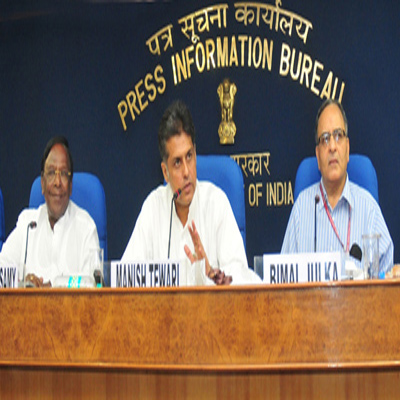
    New Delhi: Documentary films on seven good governance initiatives were launched by minister of state in PMO & ministry of personnel, public grievances & pensions V Narayanasamy and the information and broadcasting minister Manish Tewari.

    The films have been produced by the department of administrative reforms and public grievances (DARPG) and the department of pensions and pensioners’ welfare (DPPW).

    Narayanasamy said these initiatives highlight the innovative efforts of the civil servants who have been instrumental in ensuring that the policies and programmes of the government reach the beneficiaries. He said these initiatives are to be suitably documented and disseminated through all possible channels of communication to enable their adaption, replication and further innovation, for the betterment of the common man.

    DARPG secretary Sanjay Kothari said the Department has been producing the documentary films with the objective of promoting and dissenminating the successful initiatives. He said so far, sixty-one documentary films have been produced including the films being released on the occasion.

    The seven films on the initiatives from different parts of the country in various sectors are (i) e-Sugam, a self policing system for tax compliance, Karnataka; (ii) pensioners, portal, government of India, (iii) electronic service level agreement, government of Delhi, (iv) health management information systems, Tamil Nadu, (v) crop pest surveillance and advisory project, Maharashtra, (vi) Aarogyam, Uttar Pradesh, and (vii) integrated Odisha treasury management system, Odisha. The initiatives demonstrate as to how information and communication technologies can be leveraged to simplify the processes and procedures and deliver various government services to larger population.

    The documentary films are meant for diverse audiences such as probationers & other officers in national academies and State training institutes; delegates in conferences, seminars and meetings at central, state, district, panchayat levels; and for telecast on national network of Doordarshan or other television channels for general public. These films have been produced by the department through the directorate of advertising and visual publicity.

    I&B secretary Bimal Julka was also present on the occasion.

  • Govt. studying ways to ensure greater responsibility in social media

    Govt. studying ways to ensure greater responsibility in social media

    NEW DELHI: Information and Broadcasting Minister Manish Tewari, while regretting that the new media had been used without any sense of responsibility in events like the Muzaffarnagar riots, feels that one way out of this is to put more credible information in public space ‘to counter mis-information’.

    The Minister told the National Integration Council in a meeting today that while this was causing concern, the United Progressive Alliance’s policy over the last nine years had been ‘an essay in persuasion rather than regulation as far as the media goes’.

    He said that the government is working on how misuse of the new social media can be prevented and said that he would like to hear from all stakeholders at the Council meeting.

    He said it was now possible for any individual to reach out to the world with any news within a second, often ‘without responsibility and restraint’.

    He added: ‘Every individual has become a broadcaster in his own right without editorial control.’

    The social media had empowered the people but this power should be used with responsibility, he said.


  • Absence of regulation is as bad as over regulation :Uday Shankar CEO Star India

    Absence of regulation is as bad as over regulation :Uday Shankar CEO Star India

    All of us took stewardship of our companies in the last two decades, when robust economic growth created an air of optimism and confidence in the country, and about India in the world. We gather today in the midst of an extremely turbulent time for the Indian economy. Beyond shrinking GDP growth and falling currency, what is truly remarkable is that the spirit of optimism seems to have been replaced by one of apprehension and despondency.

    It is therefore appropriate that this industry forum has as its theme, renewal and innovation. In my mind, the forces that unleashed our exciting growth story are the very same as those that can inspire innovation and renewal in our industry. And at its heart is our willingness to be resolutely open to the world, to new capital and to new talent. But no renewal can happen, either in our economy or in our industry, if we are not brazenly open to new ideas.

    It is in this context that I had made the point a few months ago that there is no media industry without free expression. If anything, the last few months have proven to us that there is no Indian growth story without free enterprise. Because free expression and free enterprise go together. Our ability to improve the lives of millions of Indians is firmly tied to our ability to unshackle businesses; in allowing them the space and the imagination to create new products and services.

    Every time we have made it a bit easier for entrepreneurs to conduct business, we have generated enormous dividends through growth and new jobs. Every time we have made it easier for investors to bring in capital, we have created new markets and services.
    _____****_____

    In many ways, the dramatic economic reforms of 1991 were accidental. It did not emerge from a strong national consensus that we needed to change the direction of our post-independence path. It came from a shocked polity that opened the country for business only when there was no other conceivable option left on the table. And, yet, that accidental moment created the space for a new generation of Indian entrepreneurs whose enterprise and initiative not only created wealth but resulted in millions of new jobs. It also helped India achieve a near double digit annual growth triggering a social transformation the pace of which, if sustained, was capable of lifting India out of poverty in a generation. Today, there is a vociferous debate in play on whether India can afford a $22 billion food program. 

    What is truly remarkable is it is evidence of how much distance we have moved. Two decades ago, the topic would not even have come up!

    Of course, business cycles can ebb and flow. But, what stalled India’s growth and employment creation was our remarkable ability as a country to create a web of processes, regulations and norms that make it extremely difficult for entrepreneurs to conduct business. And in a hyper competitive global economy, where countries actively nurture promising sectors and constantly renew themselves to attract new investments, we really run the risk of being left behind.

    While skepticism about reforms could have been justified 20 years ago, what is surprising is that we are still debating the value of reforms and unshackling businesses when our own recent history is the most compelling testimonial to the power of entrepreneurship. Every time we have made it a bit easier for entrepreneurs to conduct business, we have generated enormous dividends through growth and new jobs. Every time we have made it easier for investors to bring in capital, we have created new markets and services.

    Nowhere is this dichotomy more prevalent than in the media and entertainment industry. Twenty years ago, the real face of liberalisation for most Indians was the appearance of dish antennas on roofs. It was a compelling signal to the world outside that India was open for business. We were ready to embrace new ideas, wherever they originated. And we were confident enough in our own identity to be open to new worlds.

    (L-R) Walt Disney India MD Ronnie Screwvala, Star India CEO Uday Shankar, I&B Minister Manish Tewari, CII Director General Chandrajit Banerjee

    And in that period, the industry saw a remarkable transformation in its size and in its scale. From one state run broadcaster with limited reach and less than five hours of daily content, we now have over 800 channels telecasting more than half a million hours of original content to 700 million viewers. From around 3,000 newspapers in 1991, we have grown to more than 80,000 newspapers today, with most of the growth coming in the vernacular languages. Our movie industry has grown 20 times. The industry has evolved from a disorganised community dominated by a few players to a highly competitive sector that is increasingly better organised and better run. From 750 million in 1991, it is now an industry worth 15 billion dollars. It supports six million jobs directly and probably twice more indirectly. It has both facilitated and absorbed new technologies. And, it has created a compelling platform to showcase India to the world. So much so that last year we set ourselves an ambitious target of $100 billion for the sector.  And, yet, this spectacular success in serving the Indian consumer and in creating employment has not been met with more reforms and more openness. Surprisingly and frighteningly, we seem to have regressed in many ways. Successive governments have created a web of policies and regulations which while they may have had the honorable intent of protecting the consumer has had exactly the opposite effect.

    Today, I would like to call out two big challenges the combination of which have had stifling impacts on innovation in the industry.

    Our television viewers today have easy access to global content, whether through online portals, through network broadcasters who are airing shows closer and closer to global launch dates, or simply through piracy. This has brought about a burning need for innovative, original content. However, for an industry that boasts of over half a million hours of original programming every year, how much of it is innovative content that we are proud of having brought on to the screen?

    The reason is simple. Our ability to charge for content has nothing to do with the scale of our investments in it. If a bold producer does decide to risk capital on cutting-edge, new idea, today he has no liberty to price his creative work. Why then should he take a risk when he stands no chance of getting a decent return on his investment even if his production becomes a blockbuster success? The result is tired, stagnated, insipid content for the consumer. No policy has done more damage to this industry than that of price controls on television content.

    What is amazing is that we have compelling evidence in the same industry that shows that abolishing price controls can dramatically improve consumer choice. Freeing up ticket pricing in cinemas created the foundation for a dramatic improvement in the quality and diversity of movies that came to the market. Without raising costs substantially for the price conscious consumer, it has financed a generation of content that has appealed to both niche and mass audiences.

    It is difficult today to avoid the persistent debate about the quality and health of news channels. But, there is no question at all that it is the restrictive tariff regime that has prevented news broadcasters from producing high quality content for an audience that is much smaller than that available for general entertainment or sports. Ironically, a regime that was brought to protect the consumer has ended up doing the most damage to consumer choice and quality.

    Even more frightening than price control is the creeping controls on free speech. For a country that prides itself on its deep democratic ethos, the last decade has been characterised by a creeping inclination to impose controls on speech and expression. It may have started with opposition to a book but controls on expression seem to mark new grounds every year. Small film makers who decide to invest in off-beat movies are plagued by having to defend their movies in litigation because a minority is offended by it. Films cleared by the censor board are banned by state governments, and often blocked by non-state actors under the threat of violence. TV shows attempting to break through the clutter find their characters’ voices beeped out. Even the titling of a movie as the Dirty Picture seems to be an open invitation to trouble. The result is work that is so mundane that it sparks no questions, elicits no debate and pushes no creative boundaries.

    This month, Star will launch Mahabharat on television. It is a show that we have made with a lot of passion and on a scale and grandeur that has never been seen on television to date. And, yet, a few days before the launch, what worries me the most is not the quality of the series. What keeps me awake is that some lunatic fringe somewhere in the country would raise some absurd objection to the show.

    It is no surprise then that this tyranny of the minority has now reached the central halls of Parliament. Today, a small but vocal group can claim both the moral high ground and have the political legitimacy to hold to random India’s legislature for a session, a day and sometimes more. This should not come as a shock at all. For, behind this practice, is the very same culture that we have nurtured and indulged for too long. The culture that grants legitimacy, cover and sometimes state protection to the very few who are offended or bothered by the expression of another group, and who can take to the streets and can vandalise private and public property with impudence. It should not be surprising that when we start putting limits on new ideas and free expression in our cultural space, they will find their way into our political and economic spaces too.

    It is difficult today to avoid the persistent debate about the quality and health of news channels. But, there is no question at all that it is the restrictive tariff regime that has prevented news broadcasters from producing high quality content for an audience that is much smaller than that available for general entertainment or sports.
    _____****_____

    The collective impact of regulation and the creeping tyranny of the minority have stifled innovation in our industry and, dare I say, in the economy as whole. At 15 per cent, we may grow at thrice the rate of the GDP but that is more a reflection of our topline economic growth than the health of our industry. At this rate, it will take us another 15 years to hit $100 billion in value and by then, we will be just three per cent of the world media market. This is just unacceptable.

    Make no mistake. I am definitely not arguing for a world without regulation. History has taught us that free enterprise is well served by clear rules and policies. Absence of regulation is as bad as over regulation.

    But what is desperately needed is a consensus on what to regulate and how much. It is this lack of consistency in regulation that is impacting multiple industries. At exactly the moment when our economy is poised for the next big leap, we have found a way to make it harder and harder for our companies to innovate, to create new products and services, and to find new markets.

    Ladies and gentlemen, I do hope that over the next two days, as we explore new ways to grow our sector, the resounding message from this Summit is that, as a sector and as a country, we will remain stubbornly open to new ideas and committed to expanding the spaces for free expression.