Tag: Magna Global

  • Magna revises Indian Adex growth in 2016 from 18.4 to +16.2 percent

    Magna revises Indian Adex growth in 2016 from 18.4 to +16.2 percent

    MUMBAI: Going by the recently released half yearly Adex report by IPG Mediabrands India, the Indian advertising industry is growing at a rate of +16.2 percent in 2016. The size of the industry is expected to touch $ 9 billion or Rs 564 billion (Rs 56,400 crore) equivalents by this financial year. Magna Global, an IPG resource that puts together this industry recognized report has revised the rate from its earlier prediction of 18.4 per cent in 2015, to 16.2 percent in the current report. Magna also predicts that Indian Adex will see a slight dip in 2017 and grow at a rate of +15.7 per cent.

    On  revising the forecast,  Magna Global – India director of intelligence practice EVP S Venkatesh  said, “Basis our initial read of the emerging trends we had envisaged a stronger headwind across digital formats on the mobile platform while the real numbers for H1-2016 suggests a lesser significant acceleration”

    From a global perspective, India has overtaken Italy and made space for itself in the top ten list of advertising markets, and estimated to move up 4 ranks to become the 6th largest advertising market by 2020.

    http://www.indiantelevision.com/sites/drupal7.indiantelevision.co.in/files/styles/large/public/meghna1.jpg?itok=nAzHVEH8

    On India’s performance as an advertising market, IPG Mediabrands CEO Shashi Sinha said, “The outlook is extremely positive as globally India remains one of the fastest growing markets. In fact, India is now one of the top ten advertising markets in the world.”

    http://www.indiantelevision.com/sites/drupal7.indiantelevision.co.in/files/styles/large/public/meghna2.jpg?itok=wwjk769f

    Breaking the report further into media sectors, Television with 42 per cent market share will grow +17 percent. The biggest revenue growth drivers in the sector would be the T20 World Cup, Indian Premier League (IPL) and non-cricketing leagues buttressed by E-commerce, Telecom, Auto and CPG advertising. Addressable television and expansion of the measurement into rural India equips advertisers to reach more consumers and broadcasters to monetize now counted audience. Measurement will evolve to include addressable TV audience and though connected TV currently doesn’t pose a threat to linear advertising, it will open doors for more on demand content access. Mushrooming of both domestic and international OTT (over-the-top) players will eventually fragment TV viewing time.

    Print will continue to be the second biggest medium in India with 35 percent market share and ad sales growth of +8 percent. Conventionally print heavy advertisers in CPG, BFSI, Automobile and now E-commerce will contribute to the segment growth.

    Digital formats continue to disrupt traditional with the highest growth at +40 percent and increasing its share of market by 2 points to 13 percent. Videos will be the fastest growing format driven by consumption on mobile devices. Screen time will only increase as smartphones get bigger with better displays and faster bandwidth. Trailing this trend expect advertisers to ear mark higher promotional budgets. 

    Radio through foot print expansion along with increase in volume is estimated to grow +18 percent in 2016, whereas OOH will grow +15 percent in 2016. Both these segments will hold onto their market share of 4 per cent and 6 percent respectively.

    http://www.indiantelevision.com/sites/drupal7.indiantelevision.co.in/files/styles/large/public/meghna3.jpg?itok=4D6kB7Yw

    The report also shared that India will retain its position as the fastest growing economy with real GDP (gross domestic product) growth of +7.5 percent in 2016. According to International Monetary Fund (IMF), India is likely to maintain the same GDP growth in 2017 as well. Consumer inflation slightly outside of target will force the central bank to hold onto its policy rates.

    However the earlier reduction in rates gave the much needed impetus to automobile, housing, durables and education sectors. The farm sector, if favoured with a good monsoon, will set to rebound its output. The report estimates private consumption to mirror the growth rates and push for higher marketing spends.

  • Magna revises Indian Adex growth in 2016 from 18.4 to +16.2 percent

    Magna revises Indian Adex growth in 2016 from 18.4 to +16.2 percent

    MUMBAI: Going by the recently released half yearly Adex report by IPG Mediabrands India, the Indian advertising industry is growing at a rate of +16.2 percent in 2016. The size of the industry is expected to touch $ 9 billion or Rs 564 billion (Rs 56,400 crore) equivalents by this financial year. Magna Global, an IPG resource that puts together this industry recognized report has revised the rate from its earlier prediction of 18.4 per cent in 2015, to 16.2 percent in the current report. Magna also predicts that Indian Adex will see a slight dip in 2017 and grow at a rate of +15.7 per cent.

    On  revising the forecast,  Magna Global – India director of intelligence practice EVP S Venkatesh  said, “Basis our initial read of the emerging trends we had envisaged a stronger headwind across digital formats on the mobile platform while the real numbers for H1-2016 suggests a lesser significant acceleration”

    From a global perspective, India has overtaken Italy and made space for itself in the top ten list of advertising markets, and estimated to move up 4 ranks to become the 6th largest advertising market by 2020.

    http://www.indiantelevision.com/sites/drupal7.indiantelevision.co.in/files/styles/large/public/meghna1.jpg?itok=nAzHVEH8

    On India’s performance as an advertising market, IPG Mediabrands CEO Shashi Sinha said, “The outlook is extremely positive as globally India remains one of the fastest growing markets. In fact, India is now one of the top ten advertising markets in the world.”

    http://www.indiantelevision.com/sites/drupal7.indiantelevision.co.in/files/styles/large/public/meghna2.jpg?itok=wwjk769f

    Breaking the report further into media sectors, Television with 42 per cent market share will grow +17 percent. The biggest revenue growth drivers in the sector would be the T20 World Cup, Indian Premier League (IPL) and non-cricketing leagues buttressed by E-commerce, Telecom, Auto and CPG advertising. Addressable television and expansion of the measurement into rural India equips advertisers to reach more consumers and broadcasters to monetize now counted audience. Measurement will evolve to include addressable TV audience and though connected TV currently doesn’t pose a threat to linear advertising, it will open doors for more on demand content access. Mushrooming of both domestic and international OTT (over-the-top) players will eventually fragment TV viewing time.

    Print will continue to be the second biggest medium in India with 35 percent market share and ad sales growth of +8 percent. Conventionally print heavy advertisers in CPG, BFSI, Automobile and now E-commerce will contribute to the segment growth.

    Digital formats continue to disrupt traditional with the highest growth at +40 percent and increasing its share of market by 2 points to 13 percent. Videos will be the fastest growing format driven by consumption on mobile devices. Screen time will only increase as smartphones get bigger with better displays and faster bandwidth. Trailing this trend expect advertisers to ear mark higher promotional budgets. 

    Radio through foot print expansion along with increase in volume is estimated to grow +18 percent in 2016, whereas OOH will grow +15 percent in 2016. Both these segments will hold onto their market share of 4 per cent and 6 percent respectively.

    http://www.indiantelevision.com/sites/drupal7.indiantelevision.co.in/files/styles/large/public/meghna3.jpg?itok=4D6kB7Yw

    The report also shared that India will retain its position as the fastest growing economy with real GDP (gross domestic product) growth of +7.5 percent in 2016. According to International Monetary Fund (IMF), India is likely to maintain the same GDP growth in 2017 as well. Consumer inflation slightly outside of target will force the central bank to hold onto its policy rates.

    However the earlier reduction in rates gave the much needed impetus to automobile, housing, durables and education sectors. The farm sector, if favoured with a good monsoon, will set to rebound its output. The report estimates private consumption to mirror the growth rates and push for higher marketing spends.

  • India set to be 7th biggest advertisement market by 2020 : Magna Global report

    India set to be 7th biggest advertisement market by 2020 : Magna Global report

    MUMBAI: In its latest report on the global advertising marketplace, Magna Global estimates that media owner advertising revenues grew by +3.2 percent in 2015 to $503 billion. This is lower than the previous forecast (+3.9 percent in June 2015) and represents a slowdown compared to the 2014 growth (+4.9 percent).


    In 2016, advertising revenues will be boosted by economic stabilization and the incremental spending generated around non-recurring even-year events (US Presidential and General elections, UEFA Football championship in Europe, Summer Olympics in Brazil). Magna Global is thus predicting ad sales to grow by +4.6 percent, marginally less than its previous forecast. Neutralizing the impact of non-recurring events (NREs) in 2014, 2015 and 2016 (generating approximately 0.9 percent of extra growth in even-numbered years), the global ad market would have grown by +4.1 percent in 2015 and +3.7 percent in 2016, which suggest no real 2016 acceleration in the underlying ad demand, beyond the cyclical drivers.

    In terms of geographies, Asia-Pacific emerged as the most dynamic region with a growth rate of 6.5 per cent. As China is slowing down (slightly), India has become the most dynamic economy among BRICs and among all the large nations monitored by Magna. Real DGP grew by 7.3 per cent in 2015 and will grow again by 7.5 per cent in 2016 according to the IMF. In that context advertising spending grew by 16.3 per cent in 2015 to approximately $8 billion allowing India to become the 12th biggest ad market in the world at the expense of Russia.

    Looking at India specifically, Magna reports that advertising revenue will increase by Rs 68 billion (Rs 6,800 crore) and is expected to touch Rs 487 billion (Rs 48,700 crore) in 2015. Television revenue on the back of increased volume will add +18.5 percent (December 2014 +11.9 percent) to reach Rs 200 billion (Rs 20,000 crore). While the television market’s share is up by a percentage point (41 per cent), print goes down from 41 per cent to 38 per cent to touch Rs 183 billion  (Rs 18,300 crore) with a growth of 7.7 per cent. In 2016 television and print is estimated to grow at +15.1 percent and 8.2 per cent respectively.

    Digital formats will continue to grow the maximum at 49 percent to touch Rs 57 billion (Rs 5,700 crore), increasing their market share to 12 per cent. Ad sales generated from video and social increasingly will be through mobile impressions while the desktop in the near future will still be the domain for search and display. Share of mobile will increase from 32 per cent to close to half the pie in 2016.

    Newer formats and revenue streams after Twitter and Instagram opening up new advertising and influencer management platforms, bandwidth expansion through 4G launch and traditional advertisers increasing their digital budgets, will contribute to the growth of 67.3 per cent in 2016.

    Radio, with a market share of 4 percent will also grow at 14 per cent in 2015. Through the expansion of foot print, and there by volume, is estimated to add 16 per cent in 2016. Last but not the least, OOH will grow at 11.9 percent in 2015 and by another 10.4 per cent in 2016.


    Magna Global estimates total advertising revenue to touch Rs 576 billion (Rs 57,600 crore) in 2016. The T20 World Cup, encouraging response from audiences to non-cricketing leagues, state elections, 4G launch are some of the drivers for the advertising economy in 2016 in India. E-commerce will continue to pursue GMV’s, most action will be seen in the telecom sector followed by auto and FMCG advertising.


    Digital television and expansion of the measurement panel will allow advertisers to reach more consumers and broadcaster to better monetize their audience in 2016. While so far India is bucking the global trend of declining spends on Print by growing at a high single digit rate, Digital market shares are projected to equal Print by 2020.


    Hope 2016 round of data will get the currency out of the data dark period and aid the category to fight market share erosion. The second round of the Phase III auction, commissioning of the new stations won in the first round of bidding will keep radio top of mind.

  • Global media economy set to accelerate in 2014: Study

    Global media economy set to accelerate in 2014: Study

    MUMBAI: The year is coming to an end, and it’s time to introspect. Various studies will be done to review how the years went by. Was it good, bad or ugly?

    As far as media owner advertising is concerned, the revenue grew by 3.2 per cent in 2013 to $ 489.6 billion at a global level, even though the economic environment remained weak throughout 2013, according to the study by Magna Global.

    Around the global average growth of +3.3 per cent for advertising revenues in 2013, Latin America once again showed the strongest growth (+9.5 per cent), followed by Eastern Europe (+7.9 per cent) and Asia Pacific (+6.3 per cent). On the other end, developed markets showed little or no growth: North America +1.5 per cent, Western Europe -0.8 per cent.

    “That level of economic activity is not particularly impressive by historical standards but confidence indices keep improving and we believe advertising spending will reflect and amplify that economic trend,” said Magna Global India director intelligence EVP Venkatesh S in the report.

    Asia Pacific advertising revenue grew by an average of +6.3% in 2013 to $148.7bn. Television continues to remain the largest media category in APAC, and will grow by +5.1% in 2013, up from +4.3% in 2012 to reach market share of 42.3% of total spend in the region. However, it will gradually fall below 40 per cent share in the next five years.

    Digital is the fastest growing category and will grow by +22.4% in 2013 to reach $33.6bn, as per the study. Newspaper and magazines continue to lose ground at -1.4% and -3.1% CAGR through 2018, respectively, and together print will only represent 21.8 per cent of total spend in 2013, down from 32.2 per cent of total spend as recently as 2008. As a whole, the APAC region now represents approximately 30 per cent of total global spend.

    Within APAC, China and Japan represent nearly two thirds of the total APAC advertising revenues. However, China is growing quickly and will surpass Japan for the top spot in APAC as soon as 2015. But the development of the markets within APAC varies significantly with some very advanced markets such as Australia and some much underdeveloped markets like India. This disparity can also be seen in the share of digital spend, with India’s digital market share at 7.4 per cent of total spend in 2013 vs. Australia’s at 32.7 per cent of total spend.


    Rise of social media

    The biggest game changer, this year, has been the rise of social media and, more specifically mobile social media. In the last 18 months, social media usage has migrated towards portable devices and platforms at a faster rate than most anticipated.

    The impressive success of tablets in the Western world and the rapid penetration of feature phones and smartphones in the developing world have contributed to this rapid shift in consumer usage. At the same time, social media owners (Facebook and Twitter most significantly) have introduced ad formats specifically matched to those portable devices that have met with instant success among marketers without alienating users.

    Globally, the social media advertising grew by 58 per cent this year, to $9.1bn, of which $2.9bn came from mobile social (+ 300 per cent), the forecast company said in the report.

    Looking forward

    The company predicts the economic conditions to improve for good in 2014. It expects the global advertising revenue to grow by +6.5 per cent (previously: +6.1 per cent) to reach $521.6bn, which will be the strongest year-on-year growth since 2010 (+8.4 per cent, following the 2009 recession).

    Said Magna Global’s director of global forecasting EVP Vincent Letang in the report, “The combination of an improved economic environment and stronger-than-usual cyclical drivers is bound to unlock marketing and branding budgets in 2014. This will primarily benefit television and digital media where new formats and opportunities are being explored for activation and branding campaigns”.

  • Magna Global says Indian ad market should grow 11.9% in 2014

    Magna Global says Indian ad market should grow 11.9% in 2014

    MUMBAI: Folks in advertising, there’s reason to cheer. The Indian advertising market is going to grow at a healthy 7.8 per cent in 2012-2013, outpacing its GDP growth, is the prediction of Intepublic group’s strategic global media unit Magna Global. Television and print are expected to contribute two thirds to this growth with television advertising growing at 6.6 per cent, Digital media at 31 per cent (faster than any other category with mobile and video outgrowing traditional display), newspapers (expanding in language and regional pockets) should grow at six per cent, while magazine advertising growth is expected to be flat. Radio and out-of-home advertising will grow +8.0%.

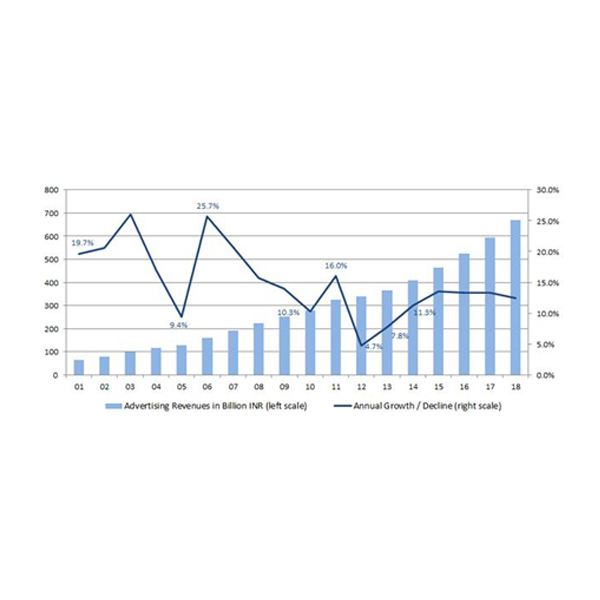
    India Advertising Market (Media Owner Revenues)

    Magna says this is relatively good highlights that this will happen at a time when India suffered it worst near decade slowdown in 2012, with real GDP growing by +4.0% compared to +7.7% in the previous year (source IMF). It adds that India’s economic outlook was downgraded by ratings agencies, which dampened investment sentiment. The impact of the corrective measures that the government took like reducing subsidies, opening up FDI in retail, and a plan to introduce targeted subsidies through direct transfers to reduce expenditure, remains uncertain in the short to medium term, says Magna And it cautions that in its April report, the IMF has forecast 5.7 per cent of real GDP growth this year and 6.2 per cent in 2014.

    India advertising revenue by media category 2012-2013

    Magna believes the Indian advertising market is going to show further buoyancy in 2014 by growing 11.9 per cent. The reason: the investment climate is expected to warm up and demand from external economies backed by solid domestic consumption will boost the Indian economy.

  • Indian ad revenue to grow by 8.7% in 2013: Magna Global

    MUMBAI: The Indian ad revenue market is projected to grow 8.7 per cent in 2013 with internet leading the growth at 31.2 per cent, says Magna Global’s ‘Global Advertising Forecast Report December 2012’ report.

    As per the report, Indian advertising revenue grew by 2.6 per cent to a total of Rs 334 billion in 2012. The growth was led by Internet which saw a 68.1 per cent growth and Television that saw growth of 4.53 per cent.

    Internet has moved up to third largest media category with 6 per cent market share after television and newspaper.

    “Internet has been the clear beneficiary of decelerating Print. Growth is driven by mobile devices which have leapfrogged PC penetration. Online video is considered more and more by TV driven categories like FMCG and Automobile. Paid social and rich media formats continue to keep the display market invigorated,” the report said.

    It also said that mobile and video advertising is expected to double its revenue while paid search and display will consolidate further. Television will see change in delivery mechanism with the digital foot print increasing to 38 cities. With Government of India opening up Radio stations for private players in 227 cities, the category will see a growth of 4.6 per cent.

    Newspapers, the report believes, will benefit from political advertising due to state elections.

    The Magna Global has also revised its forecast for media owners advertising revenue which is expected to grow by 3.1 per cent in 2013 as opposed to its earlier projection of 4.5 per cent in June this year.

    “This is 1.4 per cent less than our previous forecast published in June 2012 (4.5 per cent). The revision is mostly caused by a slow-down in economic growth and continued economic uncertainty in Europe and the US, as well as the cautionary marketing spend that took place in the second half of this year,” the agency said.

    On a global basis, 2013 will be a seventh consecutive year of decline for newspapers’ ad revenues (3.4 per cent) as fewer emerging markets now record enough growth to offset the rapid decline otherwise observed in developed markets. Magazines will decline by 4.3 per cent, still suffering from the combined pressure of television and the growing targeting capabilities of digital media.

    The report also predicts that television advertising growth will slow down to 2.3 per cent, mostly due to the US market (US television represents about a third of global television: $62 billion in a $202 billion global market). Out-of-home ad sales (including cinema) will increase by 3.4 per cent while Radio will grow by an average 1.5 per cent.

    Digital media revenues will increase by 13.5 per cent. The study said that the PC display format (banners, sponsorship) are now barely growing (6 per cent) as more investment shifts towards online video and mobile-based formats, and Paid Search remains robust (14 per cent).

    Magna Global EVP, director of Global Forecasting and author of the report Vincent Letang said, “Tablets have been the fastest device ever to reach 50 million users in less than three years. As they become more affordable, we are seeing an explosion in the volume and the nature of mobile media usage. Marketers are gradually embracing the new marketing and branding opportunities: mobile advertising already represents $6 billion globally, i.e. 6 per cent of digital advertising and 1 per cent of total advertising. Magna Global is predicting the format to grow to $24 billion by 2017, reaching 14 per cent of global digital advertising and 4 per cent of overall advertising revenues.”

    The study revealed that in 2012, media companies around the world saw their advertising revenues grow by 3.8 per cent to total $479.9 billion (constant USD 2011 basis). This new estimate is slightly lower (-1.0 per cent) than the agency’s previous prediction in June 2012, with most of the difference coming from Western Europe (from -0.2 per cent to -2.8 per cent).

    Amidst slow economic growth and weak advertising demand, the “quadrennial” events of 2012 were a minor driver for advertising expenditure globally, but provided mixed results regionally. The London Olympics were a huge audience success in the US, and the rights-holder NBC maximised monetisation across television and digital platforms, stealing share from direct competitors but increasing national TV spend as a whole. However, in most other markets the event was neutral or even detrimental for television.

    The research company expects more robust advertising growth from 2014, as global economy stabilises, they have slightly reduced their mid-term forecasts. The company now expects 2014 to grow 6.0 per cent (previously 6.3 per cent) and 2015 by 4.9 per cent (previously 5.3 per cent). “Slowing-down factors are still at work however. Among them the switch to digital and the deflationary pressure it creates. Our 2012 Magna Global Media Cost Study showed that cost-per-thousand impressions (CPMs) are on average $39 in newspapers and $21 in magazines, across the 40 markets analysed. That’s more than television costs and five times more than online display.”

    Meanwhile online advertising is becoming cheaper still as programmatic buying is developing. A recent Magna Global study forecast that 43 per cent of total online display will be traded through programmatic mechanisms (or exchanges) in the US by 2017. At the same time expensive premium formats like online video are starting to reduce their premium and align their CPMs with those of broadcast TV.

    A deflationary digital media space means that, as marketers switch budgets from traditional media towards digital media to follow their consumers, they also take advantage of a media mix that comes cheaper. And unless they find themselves in a growing or highly competitive market, they are not likely to use the savings to increase the advertising pressure or share of voice. That mechanism is very much at work in the developed world and it will gradually affect some of the emerging ad markets over the 2014-2017 period, as digital media reaches a 20 per cent market share or more and programmatic buying tools become widespread, the company report stated.