Tag: Magazines

  • ConsCent.ai unveils its intelligent e-reader solution for publishers

    ConsCent.ai unveils its intelligent e-reader solution for publishers

    Mumbai: ConsCent.ai has introduced an e-reader solution. It is a future system that combines intelligence, engagement, retention and payments, enabling publishers to increase their subscription business by utilising their e-papers and e-magazines.

     ConsCent’s e-reader solution aims to restore publishers’ control over their data, and enable them to improve subscription conversions and lifetime value of users using ConsCent’s suite of paywalling, recommendation and engagement suite, bridging the innovation gap in e-publishing services currently used for publishing e-papers.

    The product is launched with a goal to reduce cost and increase productivity for publishers by providing them with a full stack solution for all their content offerings in which data is unified, visualisation is simplified, and decision making is faster.

    In India, at present e-papers account for about 80 per cent of all digital subscriptions sold, which makes it vital for the digital reader revenue strategy. With these figures, the tool is quite relevant for the upcoming times.

     The tool reduces the time required to publish, organise, and maintain e-papers and e-magazines by uploading PDF pages with a single click. It also controls sharing and minimises leaks. It lets the user segment readers, retarget them and connect with them. Other key features of this solution include using information derived from a centralised dashboard and diversifying revenue streams, select, customising and implementing various paywalls (hybrid, dynamic). The tool ensures that users have a pleasurable experience. 

    For an understanding, 50+ news publishers and OTT platforms in India use ConsCent to maximise user revenue. India Today Group (India Today, Cosmopolitan, and Business Today), Outlook India Group (Outlook India and Outlook Business), MidDay, Jagran News Media, Amar Ujala, Udayavani, Amar Chitra Katha, EPIC On, Tinkle Comics, and are amongst some of the company’s key partners.

    ConsCent has surpassed seven lakh users who can access premium content on ConsCent’s partners without creating multiple logins and can unlock premium content with a single click. The firm’s partners have not only increased their paying user base 10X in a year, but have also assisted publishers in making their premium content more discoverable through recommendations, engaging with users through audience segmentation-based targeting, and even retaining them through a host of marketing tools – all through one single dashboard.

    ConsCent co-founder and CEO Sunny Sen shared, “Newspapers are the most valuable and editorially rich content produced by publishers. However, if it is limited to print, it loses the ability to develop, maximise brand recognition and truly monetise its content. As readers and advertisers rapidly migrate online and to mobile devices, publishers have little choice, but to adapt.”

    However, a digital presence is not sufficient. A publisher must be able to effectively monetise their valuable editorial content, which is essentially a result of how well they can understand their audience and use the information about their preferences, reading habits, reading behaviour, propensity to pay, etc. to deliver them with a personalised experience.

     “The option to consume anything at any time with the choice of what time of day you would like to consume your content has made capturing user data an essential requirement for publishers in the internet age. Existing E-publishing software gives publishers little to no control over user behaviour understanding, resulting in a significant loss of user comprehension,” he concluded.

  • Bang in the Middle creates campaign to show magazine popularity

    Bang in the Middle creates campaign to show magazine popularity

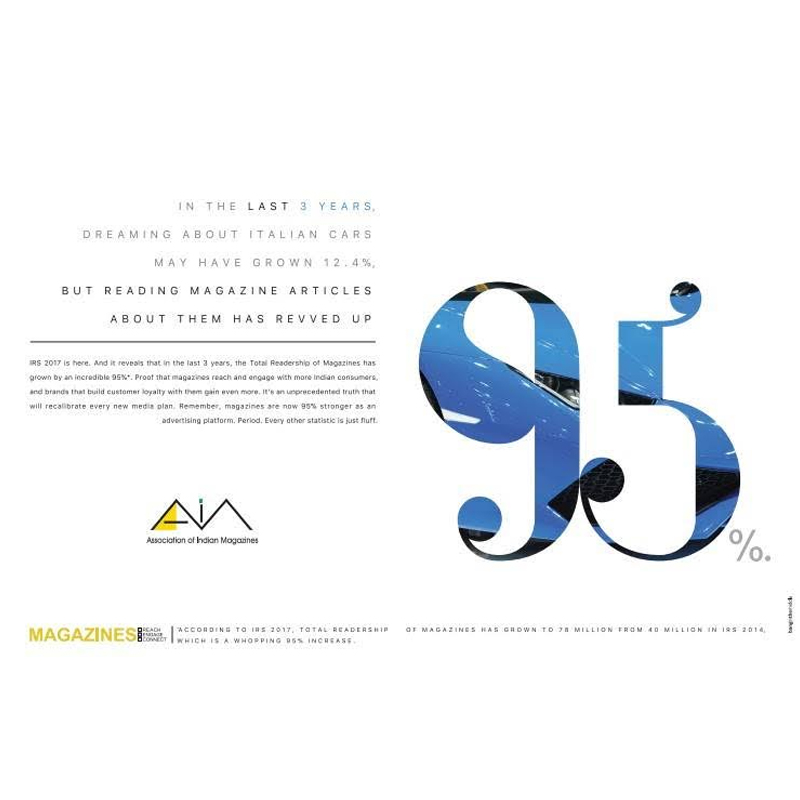
    MUMBAI: The popular belief is that readership of magazines is declining, and is declining possibly faster than newspapers. The new IRS 2017 numbers indicate a stupendous growth in magazine readership. Magazines almost doubled the total readership from 40 million in IRS 2014 to 78 million in the latest IRS 2017. The growth has come from the urban areas, which added 22 million readers; and also rural India added 17 million readers. That is a whopping 95 per cent growth in the total readership of magazines in India, and this growth is coming only from print and does not take into consideration the online portals. The total readership of newspapers also registered a growth during the same period, of 40 per cent.

    Association of Indian Magazines (AIM) briefed agency Bang in the Middle to create a campaign that puts this 95 per cent growth in sharp focus. The campaign is devised to showcase the dramatic growth in readership.

    For the agency, the creative challenge was large, the campaign could not be descriptive that just informed the readers about growth in readership. The campaign has to make the reader stop and drive the feeling that they knew reading magazine had never gone out of fashion.

    The campaign is designed around the intrigue of number 95 per cent. The six ad campaigns build the growth in readership by making the ads contextual to the reader segments.

    Speaking about the campaign, AIM President R Rajmohan says, “We at the association knew that magazine readership is very robust and when the new numbers were released it only added to our confidence. AIM took this opportunity to build on the habit of reading magazines and drive its relevance to both readers and advertisers.”

    Bang in the Middle managing partner and CCO Prathap Suthan adds, “The brief was sharp and singular. Let the world know that total magazine readership has grown 95 per cent. Big growth. Big number. Big picture. Big story. And all of that came alive in the campaign. We didn’t have to get creative for creative’s sake. The number was dramatic by itself. We just had to make sure the number come through bold. With a small witty statistic to add in some wit, and with a hidden image inside the big 95 per cent that hinted and revealed a hidden consumer story. The execution too worked to make it topical for different magazine genres.”

    Association of Indian Magazines (AIM) is the national magazine association in India and is affiliated to the global industry association, International Federation of the Periodical Press (FIPP). AIM members include all the top magazine publishers of the country.

  • Delhi Lokayukta wants DAVP panel to certify circulation figures before giving govt. ads

    Delhi Lokayukta wants DAVP panel to certify circulation figures before giving govt. ads

    NEW DELHI: Delhi Lokayukta Justice Manmohan Sarin has favoured setting up of a panel of Directorate of Advertising and Visual Publicity for empanelment as well as granting of government advertisements.


    The order by the Lokayukta came following a complaint that a local newspaper misrepresented facts about circulation figure in getting advertisement from government agencies and departments in Delhi.


    In his order, Justice Sarin particularly sought a thorough verification of circulation figures of newspapers, journals and magazines owned, edited and published by “public functionaries”.


    “Whenever a public functionary is the owner, editor, printer or publisher or otherwise has a substantial interest in the newspaper, journal, magazine, then the verification of circulation be made compulsory,” he said.


    “A committee of officers of DAVP be constituted for grant of empanelment subject to verification of circulation by Registrar of Newspapers for India (RNI),” the Lokayukta said in the order.


    The complainant had alleged that a local newspaper has printed a few copies with a view to obtain advertisements from government departments.

  • Camera used for Star Wars sells for $ 625 K

    Camera used for Star Wars sells for $ 625 K

    MUMBAI: The camera that was used to film the Star Wars: Episode IV – A New Hope has been sold for a whopping $625,000 at an auction held last Saturday.

    Part of The Debbie Reynolds Collection Part II, the Panavision PSR 35 mm camera was used by George Lucas for principal photography of the film.

    Makers of the upcoming film Star Warriors could continue to use the camera to continue the adventure as the fully functional machine and package included two 1000-foot film magazines, a Panaspeed motor, a matte box, follow focus, a Moy-geared head and a camera dolly and a lens.

  • Magazines lead print sprint

    Circa 1996. A close look at an A H Wheeler newsstand at any Indian railway station reveals hardly 40 magazines on display, and that too in the film and generals interest category.

    Circa 2006. A close look at the same newsstand shows up more than a 100 magazines.

    What‘s up? The Indian print media sector has got into the grip of magazine mania ever since the government permitted foreigners to invest 26 per cent in general interest publications and 74 per cent in special interest ones. Publishers both foreign and Indian have been introducing magazines in genres and targeted at segments which were unimaginable earlier.

    Source: Guide to Indian Markets 2006 by Hansa Research & MRUC

    Hear out Mediaedge:cia general manager Mumbai Manas Mishra: “It‘s boom time for the magazine market and especially so for the niche magazine segment. I think, the market is still going to grow further. So, while the existing magazines will continue to do well and in the coming months, one is definitely going to see many more publications make a foray.”

    Elaborating further, A.C. Nielsen client services director ND Badrinath says, “The game is really to work towards market expansion, with existing publishers launching niche magazines, right from photography to automobiles to food to healthcare.”

    His estimate is that close to two magazines a month have launched in the past year, making it close to 24 new magazines that are out in the market today. “As consumerism is rising, so also is an appetite for special interest magazines. Also, what has made it interesting for the foreigner is the higher ceiling of 74 per cent in special interest non-news publications,” feels Badrinath.

    The major magazine players are not just sitting back and watching the fun. English news magazine leader India Today has jacked up its cover price to Rs 20, a move that has been carried through by rival Outlook as well. The Week from the Malayala Manorama stable, meanwhile, has also upped its price to Rs 15.

    And the tie-ups have been happening apace as well. Consider:

    * Bennet Coleman & Co floated a 50:50 joint venture called World Wide Media – with the BBC last year. Under this, the joint venture will roll out new niche titles from the BBC stable in the Indian market while BCCL will sell ad space. Among the magazines which have rolled out include Top Gear. Others are expected to be introduced soon.

    * Infomedia India Limited, India‘s leading special interest magazine and directory publishing company, set up a 51:49% joint venture with Reed Business Information called Reed Infomedia India Pvt. Ltd. The purpose: license titles from the Reed portfolio for the Indian market including the likes of Variety, JCK, Control Engineering and Logistics Management.

    * In December 2005, Playboy Enterprises announced that it would launch its magazine with its usual fare, except for its name and its nudes. Christie Hefner, the chief executive of Playboy Enterprises had then announced to media that its Indian version “would be an extension of Playboy that would be focused around the lifestyle, pop culture, celebrity, fashion, sports and interview elements of Playboy.” But the magazine would not be “classic Playboy,” she warned. “It would not have nudity,” she said, “and I don‘t think it would be called Playboy.”

    * To add on more to the action, is the Outlook group, publisher of the English weekly newsmagazine Outlook, has tied up with McCGraw Hill to bring out the best selling international newsweekly Newsweek into India. The Outlook management says it will relaunch the magazine (bring out a facsimile edition) this year by pricing it at locally affordable prices with Indian advertising with the content however being international. The magazine will be printed in Singapore, and will be shipped to India.

    Says Outlook president and publisher Maheshwari Peri, “Today it is sold at Rs 80 per copy. To make it a mass product we will have to sell it at the prevailing prices in the country for mass market magazines. We will also undertake a brand promotion exercise.” His goal is to double the magazine‘s circulation in India from the 13,000 copies currently within a year.

    “We will be able to break the price barrier, which is the key in making the product affordable,” Peri says.

    Meanwhile, he has also inked a deal to bring to bring the leading international women‘s magazine Marie Claire to India. And of course, the group has also recently launched a business magazine called Outlook Business, which it is promoting aggressively.

    * The India Today Group has been publishing Readers Digest, Cosmopolitan, Scientific American India and Golf Digest under different licence agreements from their US parents. The group is gearing up to reintroduce Time in India. Earlier it was distributing it along with magazines such as Fortune, but is now looking to take Newsweek head-on by introducing Time at Indian pricing. This apart, it has announced plans to introduce a regional language version of Readers Digest.

    But where the action has really been red hot is in the men‘s lifestyle segment. A few months ago, Maxim publisher, Dennis Publishing licensed the title to speciality publisher Media Transasia. Man‘s World – a publication launched by Anuradha Mahindra – has been in this space for almost half a decade.

    Says Maxim India CEO and associate publisher Piyush Sharma, “India has the most underpenetrated and underleveraged print media sector, especially magazines. In almost every genre there is either zero or just one or two players, as compared to the UK, which has 600 publishers and the US which has 2,000 publishers. And while there are many publications and publishing houses, just about 15-20 of them account for 80 per cent of revenues. We are looking at launching another three publications from the Media Tranasia stable – two of these are focused on travel, and women respectively.”
    The goal, for starters, according to Sharma, is to take circulation of Maxim up to 80,000 copies. The first three issues, according to Sharma, have received a great response and almost all ad pages have been sold out.

    Source: Guide to Indian Markets 2006 by Hansa Research & MRUC

    To take on the fight further, the Malayala Manorama group have gone ahead and launched a niche, lifestyle magazine called The Man. But, is there space for a third and fourth magazine in the genre, with Man‘s World and Maxim already in the market?

    Says Pinaki Chattopadhyay, senior manager marketing, for The Week, “We decided to go ahead with a men‘s magazine, when research proved that there‘s a market for a magazine like this. We‘re printing around 30,000 copies and are also upbeat about the advertising potential of the brand.”

    Adds Chattopadhyay, “The urban Indian man, we felt, needed a publication that understood his informational needs as a person who is evolving in response to changing city life, social roles and attitudes. He needed a publication that knew how to meet his aspirational needs as a consumer who sought a better lifestyle. Hence The Man.”

    “Niche, premium magazines definitely have a lot of scope in the country with foreign brands making a foray and looking for specialized platforms to advertise, ” says Manas Mishra. “Though, the circulation might be less, but brands like Louis Vuitton, Christian Dior, Fendi, Schanel would rather advertise on these premium magazines and not go in with the general interest magazines.”

    And statistics bear this out. According to TAM Research, magazine ad spend grew by 15 per cent in 2005 to reach Rs 7 billion with general interest (39 per cent) and women‘s (21 per cent) categories taking up 60 per cent of spend business, while the remainder 15 per cent was controlled by a large number of special interest titles.

    Observers point out that it is this 15 per cent, which is only going to grow as niche magazines and consumer products wanting to reach out to their niche readers proliferate. Says a media observer, “But care has to be taken that the party does not get spoilt by an overkill of titles. Only the fittest will survive.”

    Hopefully, the wannabe magazine barons are tuned in!