Tag: Madison Media

  • Vishal Chinchankar tapped as CEO of Madison’s Digital & Media Ultra units

    Vishal Chinchankar tapped as CEO of Madison’s Digital & Media Ultra units

    MUMBAI: Madison Media has promoted its chief digital officer Vishal Chinchankar to CEO at Madison Digital and Madison Media Ultra.

    Chinchankar has been involved in shaping the digital arm of Madison Digital since his appointment at Madison Media in 2017. In addition, he has also been given the responsibility to drive a few integrated mandates under Madison Media Ultra, the unit that handles Marico, Atomberg, amongst other businesses. He will continue to be a part of the agency’s Exco and strengthen its value proposition under his leadership.

    With over 22 years of experience in domestic and international markets, Chinchankar has worked across marketing services and business development involving both start-up and growth organisations.

    Madison Media & OOH partner and group CEO Vikram Sakhuja said, “Vishal has been an exceptional leader. His clarity of vision and relentless passion has put Madison Digital right on top over these past three+ years. In addition to strong domain expertise, he has also been highly successful in building the business. As a natural evolution it is only fitting that in addition to leading the agency’s overall digital agenda, he also runs the whole media business of Madison Ultra. I wish Vishal all the best, in building a world class practice for Madison.”

    Chinchankar said, “I am absolutely excited with this opportunity. Clearly, the work done at Madison Digital has been exceptional and completely on the back of an extremely talented team. We’re determined to work towards making Madison Digital bigger and better than it already is, while keeping clients and the Madison values at the core of our work.”

  • After 12-year stint, Madison Media exits Sri Lanka

    After 12-year stint, Madison Media exits Sri Lanka

    MUMBAI: The directors of Media Factory have just announced that they have purchased the majority stake held by Sam and Lara  Balsara of Madison World in Madison Media SriLanka and the company will now become a fully owned subsidiary of Media Factory. With this, the Balsaras have exited the Sri Lanka business. Sam Balsara has also resigned as a director and the company’s name has been changed to Midas Media.

    Both parties have agreed that Midas Media and its affiliates, associates and owners, Media Factory will immediately stop using the Madison name in any manner whatsoever nor claim ownership to the name Madison. It was further announced that Sam and Lara Balsara and Madison in India or Sri Lanka will no longer be liable for any actions or financial liabilities or damages past, present or future of the company nor will they benefit from any financial assets or accruals to the company of the past, present or future for which they have not been compensated. The duo will also not claim any right or ownership to the name Midas Media.

    Madison World India chairman Sam Balsara said, “We entered the Sri Lanka market 12 years ago with the launch of Airtel in the country. Over the years we have built some great relationships both personally and professionally and I hope to continue those. I wish the current directors of Media Factory and Midas Media all the very best.”

    Media Factory director Kapila Vidanagamage said, “Our relationship was based on mutual trust and respect. We understood the expectations at a very early stage and were able to deliver to the complete satisfaction of our local clients, but more importantly our partners in India. I would like to thank Sam and Lara for their trust and eventual friendship and would like to wish them both the best in all their future endeavours.”

  • Madison Media’s Vandana Ramkrishna given charge of Kolkata operations

    Madison Media’s Vandana Ramkrishna given charge of Kolkata operations

    NEW DELHI: Madison Media Ace VP Vandana Ramkrishna has been given the additional charge of the group’s Kolkata operations. Ramkrishna, who is based in Mumbai, will now also oversee the Kolkata office in a bid to strengthen the agency's presence in the region. Her key role for Kolkata will be to focus on strategy, digital, business development and ensuring access to Madison World practices of trading, analytics, activation, retail, OOH, sports and content.

    Madison Media has a strong offering in the Kolkata market and services marquee clients like Bandhan Bank, Joy Personal Care and Ganesh grains, amongst others. With this new role, Vandana will directly report to partner and group CEO Madison Media and OOH, Vikram Sakhuja. 

    “Vandana is one of our strongest business leaders and I am delighted to give her the additional charge of the Kolkata office as we make plans to strengthen our presence in the east,” said Sakhuja.

    Ramkrishna added, “I’m delighted to be given the additional responsibility of overseeing the Kolkata operations over and above my current Mumbai portfolio, and look forward to creating a strong foothold for Madison in the Kolkata market." 

    Madison Media group handles media planning and buying for blue-chip clients including Godrej, Marico, Titan, Asian Paints, Viacom 18, BJP, TVS, Raymond, Pidilite, Ceat, Blue Star, McDonald’s, Gaana.com, Timesjobs.com, Tata Consumer Products, Crompton, Indian Oil, Snapdeal, Abbott Nutrition, Cipla Health, Welspun and many others. Madison Media is a part of Madison World which, through its 11 companies, served as many as 500 advertisers last year.

  • Madison Media wins TV business of RSPL Group

    Madison Media wins TV business of RSPL Group

    Delhi: Madison Media begins the festive season with a bang. The agency has bagged the TV business of RSPL Group, the makers of Ghadi detergent. This part of the TV business was previously handled by Wavemaker, a GroupM company. The account will be handled by Madison Media Plus out of Delhi.

    Madison Media & OOH partner & CEO Vikram Sakhuja said, “Ghadi has been an inspiring Local Brand story that has grown only stronger as MNC brands have entered the market. It is a proud moment for Madison to partner with RSPL.”

    Read more news on Madison

    Madison Media Plus CEO Rajul Kulshreshtha said, “We’re happy to have won the account of RSPL Group, a win that has emerged before the festive season begins. We look forward to a great association.”

  • Welspun appoints Madison Media Sigma as its Media AOR

    Welspun appoints Madison Media Sigma as its Media AOR

    MUMBAI: Madison Media has been appointed as the Media AOR for home textile solutions provider, Welspun. The agency will handle the entire media mandate including print, TV, radio, digital, OOH, and activation. The account was won in a multi-agency pitch and will be handled by Madison Media Sigma in Mumbai.

    Welspun retail business CEO Nemisha Ghia says, “Welspun is very aggressive in its expansion plans in domestic business and we aim to be the market leader in branded home linen market in a short span of time. To take this journey forward, we have selected Madison Media as our media partner. Madison is one of the oldest and respected names in the media business in India, and we are confident that this partnership will really help our brands in their accelerated growth path."

    Madison Media & OOH Group CEO Vikram Sakhuja says, “The Home has become an even more important place in today’s new normal. And Welspun has been adding inspiration to Bedrooms and Bathrooms all these years. We are excited about partnering Welspun to create even more magic inside Consumers’ homes.”

    Madison Media Sigma CEO Vanita Keswani says, “We’re excited to be a part of Welspun’s journey, providing home textile solutions in India and across the globe. Looking forward to strengthening this partnership for years to come.”

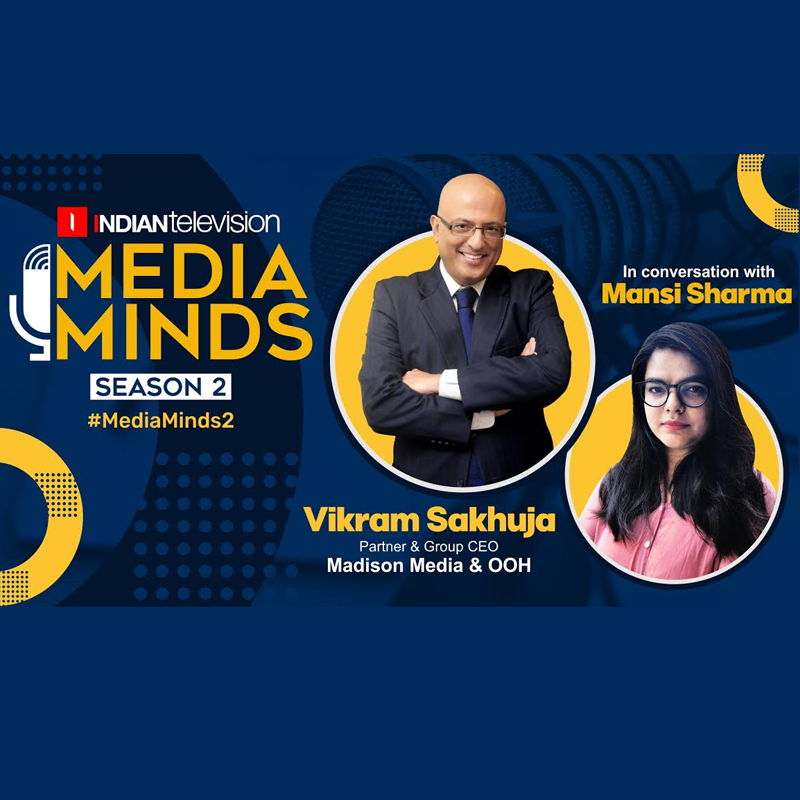
  • #MediaMinds2| Advertisers must make ethical call on pandering to sensationalism: Vikram Sakhuja

    #MediaMinds2| Advertisers must make ethical call on pandering to sensationalism: Vikram Sakhuja

    NEW DELHI: Publishers of today are under more extensive scrutiny than ever. Consumers are far more aware and aren’t hesitant to question the sensationalism that they are peddling in the name of information and entertainment. Even some of the brands, globally, have started taking cognisance of the matter and have started pulling away ad monies from certain platforms like Facebook for hate speech and problematic content. This has given rise to an interesting discussion in the media and marketing ecosphere around what roles can advertisers play to curb this issue.

    Madison Media & OOH group CEO Vikram Sakhuja, addressing the question in Media Minds season two, shared that there are two ways to look at the current scenario from an advertisers’ standpoint: brand health and ethics. 

    Comparing the situation to when he started his career with P&G in the late-80s, he stated that at that time the debate was about quantity v/s quality, which was also based on the core idea of the environment in which an ad is seen.

    “When Aaj Tak started, advertisers used to think that most ads on the channel are of undergarments and whether it’s suitable for my brand health to be visible there. At that point in time, the school of proper marketing told me if a consumer is seeing a particular programming, then they are there for a reason. And if they see your ad, it shouldn’t be a problem. In the case of P&G, in the early 90s, the quantity was always more important than quality.”

    He adds that while in today’s time that quality vs quantity debate has got blurred because of tools like social media where ads are no longer seen as an interruption, but there is another debate that has started around what sort of content is surrounding a brand’s ad or branded content. “It is actually very important to actually raise this question even from a brand health standpoint,” he said.

    Addressing the situation from an ethical standpoint, he shares that advertisers have to make the call around whether they want to pander to sensationalism or fake news.

    “Even though it has, maybe, nothing to do with the brand ad that is placed next to it, the reason this sensationalising (happens) is because advertisers are going to come because of more eyeballs. So, if you take an ethical position on that and say, even if the eyeballs come there, I will not pander to that kind of sensationalism, it will, in fact, dry up the oxygen in that room, rather than give them more oxygen. Then you are actually disincentivising those same publishers from trying to take that strategy to monetise their business,” he added.

    He said that as an agency head he will warn the advertiser if there is inflammatory content on a certain publisher’s channel or website, but he will leave the final decision on the brand head.

    Apart from this, Sakhuja talked about his favourite subject – data, the need for a unified metric system in marketing and his plans for his agency going ahead.

  • Despite spike in viewership, Malayalam news channels record dip of 60% in ad revenues

    Despite spike in viewership, Malayalam news channels record dip of 60% in ad revenues

    NEW DELHI: While Covid2019 has had an unprecedented impact over businesses across the country in the past few months, the media and entertainment consumption witnessed some interesting upward trends during the time period. As per weekly data shared by BARC-Nielsen during the course of the nationwide lockdown, TV viewership peaked by 43 per cent (highest value, at week 13 as compared to pre Covid2019 i.e. Week 2 to Week 4), during the period. Time spent on TV was up by 7 per cent in week 20, as compared to the pre-covid2019 period. News genre was one of the biggest gainers when it came to viewer interest and eyeballs, with total viewership up by 15 per cent in week 20. 

    Malayalam news channels also witnessed a similar trend, recording a 141 per cent hike in viewership, recorded in week 20. However, this growing viewership did not result in the sort of advertising revenue it would have garnered in pre-covid2019 days. 

    While the number of advertisers did not see much of a dip across Malayalam news channels; as shared by TAM AdEx India, the number of advertisers in pre-covid days (Jan-March’20) was 440 and dipped to 352 in covid times (April 20-June 20), the ad revenues went down by as much as 40-60 per cent due to lower inventory pricing, shares an industry insider. 

    Madison Media chief buying officer Vinay Hegde shares with Indiantelevision.com, “Typically with the pandemic and the lockdown becoming the focal point, viewership as in other markets shifted to news and the spike was exponential. A major shift from GECs to news was inevitable and visible and the channels did their best to hold on to their rates and monetise on the spike. This genre managed to rake in some ad revenues, yet inventory fill rate was lower than the normal average. April actually saw a dip in ad spends by almost 25 per cent Q4 of LY, but in May there was a massive spike of 120 per cent.” 

    When it comes to FCTs, Mplan CEO Parag Masteh shares that the numbers were more or less similar for the top channels, as compared to pre-covid2019 times, with some even recording positive growth. 

    TAM AdEx India data reveals that News18 Kerala and Manorama News witnessed positive ad volume growth of 28 per cent and eight per cent, respectively, the ad volumes of channel 24 remained almost similar to pre-covid2019 times. 

    Mathrubhumi News CEO Mohan Nair says, “While we witnessed a 25 per cent spike in viewership during the period, the ad revenues dipped. I may say that because we couldn’t record some of our outdoor programmes and the news coverage was also centred primarily on Covid2019, for nearly two months we had hardly any business. If I look at these three months, we must have recorded a business of around 30 per cent of the pre-covid days.”

    Kairali News’ Suresh Kumar quips, “The FCTs dropped drastically for us and so did the advertiser number. There were very few regular clients from the jewellery segment who were active on our channel and most of the ad space was brought by government ads and the hospitals. Our ad revenues used to touch Rs one crore per month before Covid2019 and for the past three months, the figure stands below 50 per cent. One of the reasons is that we had to bring down our inventory prices by 30 per cent in most cases.” 

    Asianet News Network VP sales and marketing Unni Krishnan shares, “Though we recorded 3x ratings, the advertiser sentiment was really low. If you look at the Kerala ad market, retail clients are amongst the top advertisers on news channels and they were not active at all in the initial days. Though they are trying to make a comeback, it is not with the same budgets as they used to spend earlier. In fact, most of our major clients were not active during the past few months and the only ads we got were from some new clients.” 

    He adds, “These were not big-time clients. To give some numbers, if on a normal day a client used to come with an investment of Rs five lakh to Rs 10 lakh, we were getting billings of up to Rs 50,000 to Rs one lakh only. So, if you look at the number of advertisers, we used to get the same revenue from 10-20 clients earlier, which we got from 40-50 clients now.

    While Kumar, Nair and their teams reworked their inventory prices and announced some discounts to keep up the advertiser sentiment, Krishnan avoided changing ad rates. 

    “While most of our competitors were announcing discounts and combo packages to keep the advertiser sentiment positive, we at Asianet avoided it. It definitely caused us a bit of a loss in the initial days, and we had a slow start in April, but fortunately for us, the ratings improved. We also did not increase our inventory prices when the viewership peaked,” Krishnan highlights. 

    Nair shares, “The good thing that happened during the pandemic is that categories which earlier refrained from advertising on news genre like sanitisers and washing-related products have started advertising on our channels. While I am hopeful that the upcoming monsoon and Onam will bring in some positive movement from advertisers, if you look at Kerala, Covid2019 cases are again rising. And we can’t be sure what the situation will be in the coming months.” 

    Krishnan elucidates, “Kerala was the first state to recover, but if you look at some other markets like Chennai or Mumbai, the lockdown is still in place and the numbers of patients are continuously rising. Even in Kerala, fresh cases are coming up, and while earlier the number was 20-30 cases a day, it has now peaked to 120-130. Our all yoy projections have already gone for a toss. While Onam and monsoon are a good season for us, we can’t be sure of the situation then. Yes, July, which usually is dull for the Kerala news market, has shown signs of improvement for us; going ahead, market sentiments largely will decide our fate.” 

    As the lockdown restrictions ease and the bright festive period approaches, starting August, the channels are expecting their fortunes to improve but they are still apprehensive of the growing cases. 
     

  • Kerala ad market pins hopes on Onam to bring respite

    Kerala ad market pins hopes on Onam to bring respite

    NEW DELHI: The South Indian ad market is a flourishing one, moving on an upward trajectory for the past decade. In 2019, it accounted for 30.7 per cent of the overall ad expenditures in India, as revealed by TAM AdEx’s Southside story report, contributing Rs 21,500 crore to the industry. Kerala market alone contributed Rs 4200 crore to the pie. 

    However, the past two years have been pretty difficult for the Kerala market, which was washed by floods in 2018 and 2019, and then  Covid2019, becoming one of the first states to get impacted by the contagious pandemic. 

    If Mplan CEO Parag Masteh is to be believed, the novel coronavirus alone has led to a 80-90 per cent drop in the investment cycle by advertisers. 

    Madison Media chief buying officer Vinay Hegde tells Indiantelevision.com, “The dip in Kerala ad market due to Covid2019 is roughly estimated to be around 75 per cent and largely in line with most other markets. Expectedly, it was the “essentials” categories like FMCG, foods and CSR for Covid2019-related issues that were active. Retail, a major player in Kerala, was just about present, being reduced drastically to around eight to 10 per cent of regular months.” 

    Maitri Advertising managing director Raju Menon adds, “February to May are the best months for Kerala market because of the tourist and wedding season. Around 30 per cent of the overall yearly sales happen during this time. However, it was a complete washout for us because of the lockdown. There are a few markets that work really well here, including banks, real estate, loans, textile and gold. But the pandemic left a negative impact on everything.”

    He continues, “For us at Maitri, there was a 60 per cent loss in billing during this lockdown. Not only was there a dip in queries, but some of our old bills, from January-February, were not cleared as well.” 

    Menon also shares that a few categories like automobiles, especially two-wheelers segment performed well than others given the market sentiment, but overall the whole industry witnessed a massive dip in revenues.

    In terms of television advertising, GECs saw their revenues down by more than 80 per cent YoY, both due to low inventory sales as well as discounts, reveals Hegde. He adds, “With the pandemic and the lockdown becoming the focal point, viewership shifted to news and the spike was exponential. A major shift from GECs to news was inevitable and visible and the channels did their best to hold on to their rates and monetise on the spike. This genre managed to rake in some ad revenues, yet inventory fill rate was lower than the normal average. April actually saw a dip in ad spends by almost 25 per cent Q4 of LY, but in May there was a massive spike of 120 per cent with retail and other clients making a beeline for the news genre.” 

    However, according to Menon, this growth in ad spends doesn’t necessarily mean more revenue for news channels. “If I give you an example, when the chief minister or the health minister is addressing the state via news channels, you can’t run commercials during that. So, advertisers buy the space on L-band, which costs around 97 per cent lesser than a slot for a video commercial. So, if you would have spent Rs 100 on a channel for video ads, you are spending only Rs 3 for the spot on L-band. Additionally, the inventory prices are kept low as the advertisers don’t have much money to spend. They are more concerned about paying their own people and keep their businesses afloat with the production-supply chain shut for most categories.  In terms of revenues, I believe they must have recorded a minimal growth of three to four per cent at max.” 

    Masteh shares that apart from the news genre, the ad spends from GECs were reallocated to digital media, which became a core part of the marketing strategy for even those brands which earlier refrained from it. He is hopeful that OTT will continue to grow and garner advertisers’ attention from here on. 

    As the lockdown eases, the industry is hoping to witness some progress in the advertiser as well as the consumer sentiment. 

    Hedge states, “Ease of lockdown has definitely seen an improvement in advertiser sentiment accompanied by the many relief schemes announced by the government in an effort to boost consumer sentiment and hence, demand. While the damage in Q1 of FY21 will take some time to heal, the additional forecast of economy contracting also needs to be considered by advertisers going forward. However, not advertising may not be an option as a short-term or long-term strategic call and hence, as the lockdown is being eased, we are seeing advertisers flocking back. TV, OOH and radio may still take more time to recover and as it happens, the competition will follow the competition.” 

    The industry is pinning its hope on the Onam season to bring a much-needed respite. 

    Menon says, “Onam counts for around 60 per cent of sales in the state and we are hopeful that will bring the advertisers back to the market. However, it will depend on the rains that we have. There are predictions for a good monsoon, but if the rains are heavy like the past two years, it is going to be a washout for us again.”  

    Hedge further adds, “August will also see the advent of festive season and it would be imperative for the advertiser to be visible. Also, by that time, lockdown would have eased even further. June is already seeing a much higher level of inquiries from advertisers compared to April and May. With originals making a comeback, July onwards, we should be seeing a fair degree of normal activity in terms of inventory consumption. Onam is an important festival in Kerala and is between 30 August to 2 September. That should be signaling a major recovery.” 

    But this recovery will be tampered by the gloomy forecast by the national and international bodies of contraction and recession, which however does not seem to be on top of the mind of advertisers and they would be looking at the most efficient extraction from media for their brands while the broadcasters/publishers will be looking to monetise demand uplift to also compensate for the loss of the first quarter, Hegde concludes.