Tag: LV Krishnan

  • Indian TV advertising takes a beating as FMCG brands tighten purse strings

    Indian TV advertising takes a beating as FMCG brands tighten purse strings

    MUMBAI: India’s television advertising market has hit the skids. The Economic Times reported that ad volumes plummeted 10 per cent year-on-year in the first nine months of 2025, according to TAM AdEx data, as fast-moving consumer goods companies—the industry’s biggest spenders—slashed budgets in response to anaemic consumer demand. Of course, the ban on real money gaming platforms in end-August added to the shrinkage in ad spends too . 
    The carnage shows up in broadcaster balance sheets. Zee Entertainment’s advertising income tumbled 11 per cent to Rs 3,591 crore. Sony Pictures Networks India posted a nine per cent drop to Rs 2,606 crore. Sun TV Network’s advertising and broadcast slot sales fell four per cent to Rs 1,440 crore. Star India, now merged with the erstwhile Viacom18, kept mum on the split between advertising and subscription revenue.
    The culprit is clear: viewers are ditching appointment viewing for on-demand convenience, leaving linear television scrambling for relevance.
    Food and beverages dominated advertising between January and September, claiming 21 per cent of total ad volume. Personal care, services, household products and retail rounded out the top categories. The top ten sectors hoovered up 88 per cent of all TV advertising—proof that consumer brands still see television as the mass-reach medium par excellence.
    TAM Media chief executive LV Krishnan explained that the “drop is largely led by softening of market conditions, whereby consumption had dipped, resulting in a cut in ad budgets. This is a pre-GST reduction period.
    Among individual advertisers, Hindustan Unilever remained the heavyweight champion, followed by Reckitt Benckiser India and Godrej Consumer Products. The top ten advertisers accounted for 42 per cent of total ad volume.
    General entertainment channels and news outlets continued to attract the lion’s share of advertising, together accounting for 57 per cent of total volume. News, movies and music saw a marginal drop compared with 2024, whilst general entertainment gained slightly—a sign that high-reach programming still packs a punch.

    Krishnan reckons the final quarter of 2025 will see year-on-year growth, thanks to GST rate cuts that kicked in on 22 September. He estimates the reforms will spur consumption and inject Rs 5,400 crore into overall advertising during the festive season, on top of organic festive growth. 

    If the green shoots turn into a proper recovery, television may yet claw back some swagger. For now, though, it’s licking its wounds.

  • TAM Media Research launches Crisp

    TAM Media Research launches Crisp

    NEW DELHI: TAM Media Research has launched CRISP (Consumer Reviews & Influencer Sentiments for Brand Performance) -a robust, intelligence analytics tool to help decode consumer sentiments in the Indian marketplace. The product is specially crafted for marketers to gauge and understand the actual consumer reviews/sentiments and augment the consumer product connect. It answers the need of today – to understand the need and qualitative views of the product user and improvise customer satisfaction so as to further build brand affinity and a loyal consumer. 

    TAM has partnered with Revuze – a leading company that has revolutionized product experience management globally. The AI based dashboard will be available to the users from October 2020. 

    The end consumer of a product makes the most significant contribution to a brand.  Consumer reviews, feedback and suggestions are the mirror to the brand’s image.  Today’s consumer at a click of a button can rave or rant about a product, its performance, customer service, etc. Every marketer knows the need to listen,  understand the feedback and reviews but is struggling. There is a gold mine of non-coded and unstructured information and data available in various forms across e-commerce sites, blogs, etc. Marketers do not have a quick and reliable single window means to decode, mine and analyze the data and know the actual sentiments from their direct users/influencers. 

    Crisp will help marketers with a holistic, unbiased, affordable, AI analytical tool at their fingertips.  

    This AI-based analytical tool provides actual data insights and analytics of the user sentiments. It tracks consumer sentiments across multiple e-commerce portals and decodes unstructured data in turn help marketers with valuable information to make informed decisions. The Analyzer tool is unconstrained by human bias and perception. This proprietary technology deep dives and provides Insights via tracking reviews, opinions, and messages.  

    TAM Media Research CEO LV Krishnan says, “Today’s evolved Indian consumer is not just pragmatic about the products they purchase but extremely vocal and quick to give reviews. For a marketer, this customer feedbacks can help realign product and communication strategy effectively. Hence, it is crucial for marketers to constantly keep track, understand and re-connect while managing consumer sentiments towards brands. TAM has partnered with  Revuze to bring a new age, robust, data analytics tool – Crisp, for marketers to decode the realms of unstructured feedback data from consumers and retrace it back into defining sharper brand strategies. In a fast-paced evolving environment, it can be a crucial weapon for Marketers to win additional brand sales and market shares. Crisp will help build the much-needed superior analytical prowess within  the marketers business and help analyze product usage, identify areas of  product/service improvement based on feedbacks so as to take quick-footed  decisions.”

    Revuze CRO Shai Etzion says, “After showing significant success in the USA, Revuze  is entering the Indian Market partnering with TAM Media, a natural choice being our mutual Nielsen family relationship and their 20+ years’ experience in deep understanding of the Indian media landscape. It will be a compelling product and a  game-changer for India to understand consumer sentiments and reviews.”

  • BARC & TAM JV christened Meterology Data; BARC to hold majority stake

    BARC & TAM JV christened Meterology Data; BARC to hold majority stake

    MUMBAI: The joint venture inked last year between television viewership ratings bodies Broadcast Audience Research Council (BARC) India and TAM Media for a meter management company has been christened Meterology Data Pvt Ltd (MDL).

    The new entity will commence its operations in the next couple of weeks as TAM exits TV viewership measurement business effective 29 February, 2016.

    BARC India will have full management control with a 51 per cent stake in MDL, while TAM India – which includes Nielsen and Kantar – will have a 49 per cent stake.

    As a part of the new system, all TAM India meters will be re-deployed in panel homes selected by BARC India’s sample design. This joint venture will help BARC India in growing its sample size to 34,000 meters covering all of India. 

    MDL’s role will be to run and manage the meter operations and supplying raw data to BARC India. TV viewership data will be computed and disseminated through BMW (BARC India Media Workstation). MDL will manage the panel households and will also be responsible for future TV panel expansions.

    The Spot Monitoring and Channel Monitoring data will be exclusively sold by BARC India to broadcasters, agencies, advertisers and others.

    “The industry was eagerly waiting for this merger to be completed from the time we announced it in August last year. We are happy to state that the joint venture company is complete and all set to kick-off operations,” said BARC India CEO Partho Dasgupta.

    Kantar CEO Eric Salama added, “We will work closely with BARC to ensure a good outcome for the industry and our joint clients. We have worked productively with BARC to get here and under the circumstances, have agreed a good way forward for everyone concerned.”

    “We are happy to collaborate with BARC India. The coming together of BARC India and TAM India has only strengthened the Indian broadcast industry, as they will now be getting viewership trends from a larger panel size,” said Nielsen MD Prashant Singh.

    Up to this point, BARC India and TAM India, both have been generating and reporting TV viewership data individually to the industry. Now, with the completion of this joint venture, BARC India will be the single provider of TV viewership data. 

    TAM Media Research CEO LV Krishnan opined, “I am very happy to see that the JV has finally taken shape. What is even more heartening is that TAM India’s current 12,000 meters, which was built and constructed tirelessly over the last 15 years will get combined to give BARC India a larger and robust TV panel sample base for the industry. We will do our best in providing our expertise to MDL. Meanwhile, TAM India will continue focusing its efforts towards value adding the industry through constant enhancements of its existing businesses.”

    Meanwhile, TAM India will continue providing services like AdEx of TV, Print & Radio AdEx, Daily & Weekly Sales Index Reports, Bollywood & Music Monitoring Dashboards; Audience Measurement in Radio (RAM); Sports Sponsorship ROI Measurement (TAM Sports) and PR Measurement data & Audit services (Eikona) to its clients.

  • BARC & TAM JV christened Meterology Data; BARC to hold majority stake

    BARC & TAM JV christened Meterology Data; BARC to hold majority stake

    MUMBAI: The joint venture inked last year between television viewership ratings bodies Broadcast Audience Research Council (BARC) India and TAM Media for a meter management company has been christened Meterology Data Pvt Ltd (MDL).

    The new entity will commence its operations in the next couple of weeks as TAM exits TV viewership measurement business effective 29 February, 2016.

    BARC India will have full management control with a 51 per cent stake in MDL, while TAM India – which includes Nielsen and Kantar – will have a 49 per cent stake.

    As a part of the new system, all TAM India meters will be re-deployed in panel homes selected by BARC India’s sample design. This joint venture will help BARC India in growing its sample size to 34,000 meters covering all of India. 

    MDL’s role will be to run and manage the meter operations and supplying raw data to BARC India. TV viewership data will be computed and disseminated through BMW (BARC India Media Workstation). MDL will manage the panel households and will also be responsible for future TV panel expansions.

    The Spot Monitoring and Channel Monitoring data will be exclusively sold by BARC India to broadcasters, agencies, advertisers and others.

    “The industry was eagerly waiting for this merger to be completed from the time we announced it in August last year. We are happy to state that the joint venture company is complete and all set to kick-off operations,” said BARC India CEO Partho Dasgupta.

    Kantar CEO Eric Salama added, “We will work closely with BARC to ensure a good outcome for the industry and our joint clients. We have worked productively with BARC to get here and under the circumstances, have agreed a good way forward for everyone concerned.”

    “We are happy to collaborate with BARC India. The coming together of BARC India and TAM India has only strengthened the Indian broadcast industry, as they will now be getting viewership trends from a larger panel size,” said Nielsen MD Prashant Singh.

    Up to this point, BARC India and TAM India, both have been generating and reporting TV viewership data individually to the industry. Now, with the completion of this joint venture, BARC India will be the single provider of TV viewership data. 

    TAM Media Research CEO LV Krishnan opined, “I am very happy to see that the JV has finally taken shape. What is even more heartening is that TAM India’s current 12,000 meters, which was built and constructed tirelessly over the last 15 years will get combined to give BARC India a larger and robust TV panel sample base for the industry. We will do our best in providing our expertise to MDL. Meanwhile, TAM India will continue focusing its efforts towards value adding the industry through constant enhancements of its existing businesses.”

    Meanwhile, TAM India will continue providing services like AdEx of TV, Print & Radio AdEx, Daily & Weekly Sales Index Reports, Bollywood & Music Monitoring Dashboards; Audience Measurement in Radio (RAM); Sports Sponsorship ROI Measurement (TAM Sports) and PR Measurement data & Audit services (Eikona) to its clients.

  • TAM fortifies mobile app with version 2.0

    TAM fortifies mobile app with version 2.0

    MUMBAI: TAM Media Research, which launched its TV viewership app version 1.0 last year, has now packed a punch with the upgraded version 2.0 of the app.


    This new version is fortified with added data sets and customised user friendly features that will make the mobile consumption of TAM’s TV viewership data easier. Some of the new features of version 2.0 are as follows: TV viewership data in GRPs, TVRs for unique TV programmes and data for new two markets – Assam and Orissa. Additionally, this new version can be subscribed for by one and all.


    The TAM India mobile app has set a trend of facilitating speedy, on-the-go access of weekly top line TAM TV viewership data for all TAM subscribers across advertiser, media agency and TV broadcaster categories.


    TAM Media Research CEO LV Krishnan said, “We set a trend last year when we provided this mobile app facility to industry users. We have received tremendous response during the last one year. Version 2.0 is a fortified version that will allow not only existing but even new users to enjoy the benefits. The purpose behind this mobile app, very simply, is to enable users to access viewership information anytime, anywhere on the go so that they can take informed business decisions at the spur of the moment.”


    Highlights of TAM mobile app version 2.0:


    ·         GRP numbers: The new version will have TV viewership GRP data sets for all markets and all genres along with existing data points (GVT, Reach & Relative Shares).


    ·         TVR Data: Along with TVTs for the programmes, TAM India mobile app 2.0 will provide TVR for top unique programmes.


    ·         Addition of Markets: As compared to the earlier version, TAM India mobile app 2.0 will have data sets for Assam and Orissa along with the existing seven markets (Maharashtra, Andhra Pradesh, Karnataka, Kerala, Tamil Nadu, West Bengal and PHCHP).


    ·         Modified TG: Every genre and market will have a TG as per the requirements of each section.


    ·         Modified graphical representation: TAM India mobile app 2.0 will have graphs representing weekly data instead of the earlier format of four weeks average.


    ·         New pay version: TAM India mobile app 2.0 will be accessible even to the non-TAM subscribers at a minimal subscription cost.


    The mobile app will be updated every Thursday immediately after the regular release of TAM data to the industry.

  • Going FTA suits most broadcasters and advertisers

    Going FTA suits most broadcasters and advertisers

    MUMBAI: With increasing number of channels in the country, much of the interior towns have found solace in having free-to-air (FTA) channels. Doordarshan’s own Direct to Home (DTH) service Freedish has found 12 million active subscribers in the interior parts of the country with its list of FTA channels.


    Discussing the FTA market were MCCS India CEO Ashok Venkatramani, TAM Media Research LV Krishnan, Zee Entertainment Enterprises chief content and creative officer Bharat Ranga, Reliance Broadcast Network Limited (RBNL) CEO Tarun Katial and RK Swamy Media group senior VP K Satyanarayana. The session was moderated by Chrome Data Analytics and Media Pankaj Krishna.


    Krishna started off by asking Satyanarayana if advertisers are monetising the platform to which he said that Freedish has very few satellite channels and it is not necessary to look at FTA channels particularly for media planning. However, he stated that research shows that Freedish is able to add 10 per cent incremental reach so it has more monetisation scope.


    Venkatramani heads three channels under the ABP brand name which hasn’t yet gone pay and in fact isn’t available on Freedish either. He said, “We haven’t gone pay because the ecosystem doesn’t allow us to do so. The price at which we sell channels to MSOs is not in our hands. Freedish is too expensive and cost per household is Rs 30.” FTA channels depend heavily on advertising revenue and according to Venkatramani, this is not sustainable and he doesn’t see any incremental reach happening in the news genre.


    Krishna questioned LV Krishnan on how TAM ensured fair representation from houses which were either metre dark or power dark. To which Krishnan said that the important metric is to see who the consumer is. “Is this consumer accepting FTA channels because he is economically unable to graduate to pay? What is the value of this customer for targeting advertising? And is it financially viable to create content especially for this industry?” he questioned. The positive points of this market, according to him, is that this audience doesn’t have any distraction and so time available for entertainment is higher than urban audiences. But the issue they face is frequent power cuts.


    Katial said that in its studies, RBNL has found that the northern market is less penetrated as compared to south or east but it needs a unique distribution for which Freedish fits perfectly. “Many advertisers will pay the delta for it whether it is FMCG or Telecom. Metros are fragmented while these markets have low penetration,” he said.


    Zee Anmol is Zee’s FTA channel that shows handpicked content from its channels. Ranga pointed out that a lot of marketwise and platform-wise research is done before deciding which content from its flagship channel Zee TV will work for this audience rather than just replicating the entire set of shows. He also feels that in future there will be three modes- FTA, pay and premium and soon Freedish will also offer pay channels. “Distribution will be far more competitive in the next 10 years. Currently, there isn’t much difference between FTA and Rs 200 for all channels. In future the gap will be large,” he said adding that he expects average revenue per user (ARPU) to rise up to Rs 1500 to Rs 2000.


    While geotargetted advertising is on the rise, Katial feels that is it more suitable for large MSOs and Freedish can’t do it. But the real winning situation will be when the ad cap regulation is resolved. “Today a radio station in Mumbai takes more ad rate than a national news channel,” he informed.


    Ranga said that when a new channel enters the market it can start off as FTA and then convert to pay, which is what Zee does. Krishnan highlighted that the audience doesn’t care about platform but about content. This was emphasised by Satyanarayana as well that the advertisers look at the audience and not the platform. FTA is not actually FTA, because the customer is paying money for the carrier’s bandwidth. In the future, advertising will be aligned either to content, such as in-branding or to the carrier.


    Katial shared the data that across Europe, there is the phenomenon of cord cutting at the rate of 5-10 per cent every month and every year and then going FTA.


    Krishnan shared data that according to their research, while five years ago 4.5 to 5 members of a home were watching at the same time, this has dropped to 3.8 today. However, the repeat gets about 1.5 members. “Broadcasters have started segmenting by ensuring repeats to cater to various age groups,” he informed.


    So while the FTA market has begun in India, it remains to be seen where it will finally head.

  • TAM woos subscribers with mobile app

    TAM woos subscribers with mobile app

    MUMBAI: Even as it awaits the verdict of the Delhi High Court on the case filed by its parent body Kantar Market Research, media ratings agency TAM has taken a bold move to cement itself in the industry. A new mobile app has been created to facilitate easy data access by subscribers.


    The app, called ‘TAM India’, will provide weekly top line TAM data to subscribers through App Story (iPhone), Google Play (Android) and Blackberry World (Blackberry). It will be updated every Thursday, immediately after the regular release of TAM data to the industry. Subscribers will instantly be intimated about the update.


    Commenting on the launch of the app, TAM Media Research CEO LV Krishnan said, “Our focus, as always, has been to enrich our customers with actionable insights through credible data. With this first ever unique initiative of launching ‘TAM India’ mobile app, we have fortified our service commitment to the industry with that of anytime anywhere access to data and quicker decision making process for clients. I am especially excited about the different ways in which this mobile app will be of value to the senior management across advertiser, media agency and TV broadcast organisations.”


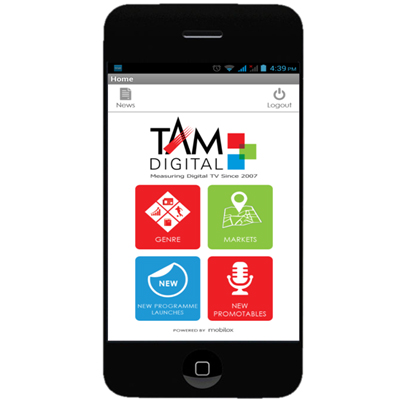
    On a weekly basis, the app will provide insights of different TV channel genres, markets, programmes and new promotables. At any given point in time, it will have data not just for the latest week, but also for the preceding four weeks.


    The following is the kind of data that will be available on the app

    · Channel Genre: Overall genre wise viewership data and five weeks trends for select genres

    · Markets:  Market wise viewership data and five weeks trends for select markets

    · New Programme Launches:  List of new programmes launched during the latest week on respective channels

    · New Promotables: List of new programme promotions on respective channels during the latest week


    The app will also provide a feature to bookmark a favourite market or genre which will be shown as a first screen from the next update. The app is available for download on the TAM website www.tamindia.com.

  • TAM expanding peoplemeter size: Kantar’s Eric Salama

    TAM expanding peoplemeter size: Kantar’s Eric Salama

    MUMBAI: For the past three months, the focus of the entire TV industry has been on the new industry-backed Broadcast Audience Research Council (BARC). It was almost a given that the decade-old viewership ratings agency TAM Media Research would slip away into the night as the newbie had got the government’s and industry’s support.


    But TAM is not disappearing. It got some relief last week as the Delhi High Court adjourned to 26 August the hearing on its parent Kantar Media Research’s  suit against the government-declared regulation on cross holding patterns of TV ratings agencies.


    And unknown to many, TAM is working to comply with the other requirements of TV ratings agency guidelines to continue to exist. A long standing demand of industry and a crucial criterion requiring compliance is the minimum number of peoplemeters. And TAM apparently is coming up to speed on this.


    “We are continuing to increase the size of the panel but haven’t announced exact numbers and timings around it,” Kantar CEO Eric Salama told indiantelevision.com last week.


    According to the ‘policy guidelines for TV rating agencies,’ the minimum peoplemeter sample size has to be 20,000 homes. So Salama’s response to indiantelevision.com seems to imply that TAM will likely aim for that figure.


    TV rating agencies also have to apply for a licence before they can operate in India and there cannot be any cross holding between agencies and TV ratings agencies. The latter regulation is something that Kantar has challenged in the Delhi High Court and TAM can continue to be operational until the court pronounces its verdict.  But it has applied for a TV ratings agency licence to  the ministry of information & broadcasting. There is no word from the ministry on the same, as the guidelines don’t prescribe a deadline for the approval or disapproval of the licence.


    We reached out to but TAM, but none of its officials were available for comment at the time of filing this report.


    Industry however isn’t too concerned whether or not TAM increases it  people meter sample as it is BARC they are banking on and awaiting patiently. Says a senior executive from a news channel, “Who cares whether or not TAM is expanding its meters. Government is backing BARC.”


    Another broadcast CEO stated: “We don’t know what TAM is trying to achieve by increasing its sample size,” he said. “Are they trying to confuse the stakeholders or are they grandstanding?”


    Now the question is if TAM does scale up, and is not shut down by some quirk of fate: can the industry support two ratings agencies? In the past it has not been able to.  Intam was the first TV viewership monitoring service which was set up in 1994 by ORG-Marg. TAM, followed in 1998. But former was merged into TAM in 2001.  aMAP was set up in 2004; commenced operations in 2007, folded up in 2011.  TAM continued to hold ground, despite carping from industry.


    And now we are in a time where another rival has reared its head – BARC, which is set to roll out its ratings by end-2014. Will history be repeated or a new chapter be written?

  • Rebranded Eikona locks its focus on neutral, one stop solution for Earned Media Management

    Rebranded Eikona locks its focus on neutral, one stop solution for Earned Media Management

    MUMBAI: A decade old now, Eikona, the neutral Public Relations Audit arm of TAM Media Research, is embarking on its next journey. After having set many proactive PR measurement & audit benchmarks for the industry, a vibrant and freshly rebranded Eikona is all set to aid the Brand Custodians (Client Organization & its Agencies), with end to end solutions on Brand Management through Earned Media. The objective is to play an intrinsic role in helping Clients & Agencies at every step of their Brand Communications Planning, Execution and Review process.


    Towards this, Eikona shall offer holistic, neutral, one stop research and data solutions for Earned Media management. Eikona’s service span will include helping Brand Custodians Listen to the Mood of the Market, Set Communications Targets, Monitor Execution, Audit & Advisory and finally, establish Earned Media’s impact on (Corporate/Product) Brand Reputation.


    TAM Media Research CEO LV Krishnan said, “Our organization is very uniquely placed. While through TAM & RAM we help the industry understand the TV & Radio consumption patterns & dynamics of Indian consumers, what makes us come a full circle is our ability to not only monitor & correlate a brand’s Paid Media initiatives through ADEX and but also the Earned Media initiatives through Eikona. These data sets help industry scientifically understand and correlate brand’s Visibility as well as its Reputation.”


    Explaining Eikona’s focus on Earned Media management, Eikona Sr. VP,Siddhartha Mukherjee said, “We are living in a Reputation Economy. Here is where, Earned Media is fast moving towards the centre stage of any Brand Building or Sustenance exercise.  While the need to manage this space has become quintessential, it is the methodology of managing & leveraging Earned Media that is becoming a complicated combination of art & science. Eikona will focus its energies in helping Brand Custodians with step by step, end to end solutions starting with Communications Planning, Execution checks, Audits & Advisory, and finally, helping establish Earned Media’s impact on Brand Reputation scores.”


    In India, the definition of Earned Media is quite different from that of the Western markets. Adding on, he said, “The western world has already transitioned deep into the Online world. Web portals, news websites, social media platforms comprising of blogs, chats forums etc. comprise of 70-80% of their average daily time spent on overall media consumption. However, in India, offline mediums like Print (Newspapers & Magazines) & TV News Channels comprise of similar majority numbers! This is what makes Earned media management in India offline skewed. Which is why, the western definition of ORM – Online Reputation Management – should be more appropriately positioned for India as Offline Reputation Management.”

  • TAM’s moment of truth

    TAM’s moment of truth

    MUMBAI: The Ministry of Information & Broadcasting (MIB) has finally put its stamp on the TV rating guidelines and the government order is already out on the Ministry’s website for all those who want to read it. The bottomline of the ratings order coming out is that TAM has to shape up or ship out.


    As per the TV rating guidelines which were given the cabinet’s nod last week, TAM has to work a miracle to meet them in the time frame that it has been given. There are several guidelines, but the most challenging appear to be ownership and expanding the people meter sample to 20,000. That too in a ultra slim  period of just 29 days if it wants to continue to be in the business.


    According to a highly placed industry source, TAM’s stakeholders will have to meet sooner than later to decide on what its next course of action should be. “It is a major decision it has to take: whether to take on the might of the law and the government; its move will have to be very calculated,” says the source.


    Industry insiders think that TAM’s options have narrowed down further as compared to earlier when it was playing the waiting game; waiting to see if the MIB will pursue and pass the order. Today it has two choices: either it approaches the court for some relief and gets a stay on MIB’s diktat, which will give it some more time to try and fulfill the guidelines; or, it will have to wind up its business, which is not going to be easy, considering how much it has invested in ratings, and the number of staffers on its rolls.


    The Broadcast Audience Research Council (BARC) had met the Ministry on Thursday, 16 January to update it on the progress it is making. However, the Council also tabled a request in front of the Ministry to allow TAM to exist till BARC is ready. That’s because with TAM on the blink in 29 days, there will be no ratings till October 2014, when BARC says its ratings will be up and running.


    The industry has been pushing TAM to go to court to get the stay; but it seemed reluctant to move ahead then. Now, with the time bomb ticking away, the urging from industry will only get stronger.


    Whether the ratings agency will move ahead on industry’s goading is a big question mark: its CEO LV Krishnan is sure to have memories of the caning he has been getting from broadcasters over the years. They have always complained TAM ratings are suspect; even as recently as last year, a bunch of them took him to the cleaners, threatening to shut off the subscription pipe to it. Advertisers and agencies kind of stood by him, but he had to face most of the flak.


    Will LVK do it this time too when TAM’s moment of truth has arrived?