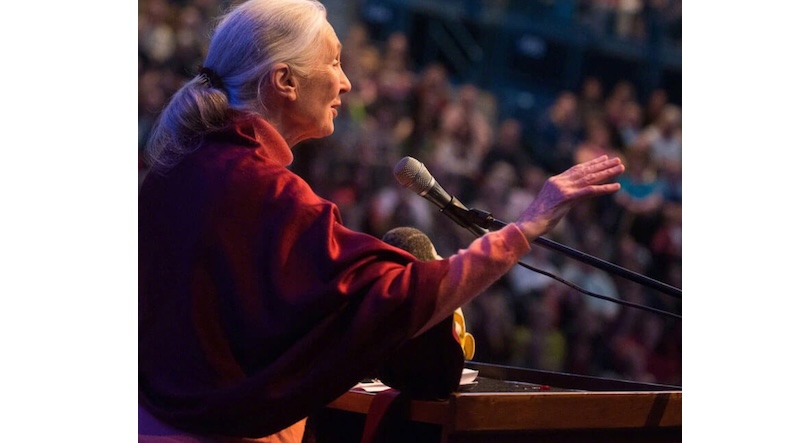
LOSA ANGELES: Jane Goodall, the pioneering primatologist – who was the subject of two dozen documentaries and films and many more books and whose ground breaking observations of wild chimpanzees revolutionised both scientific understanding and public consciousness about humanity’s closest relatives, passed away on 1 October 2025 in Los Angeles. She was 91.
Goodall’s death, from natural causes during a speaking tour in America, ends a remarkable life that began in 1934 in Hampstead and led to the forests of Tanzania, where her patient, meticulous work upended long-held assumptions about what separates humans from other animals.
Her discoveries were elegant and devastating to human exceptionalism. In 1960, watching a chimpanzee she had named David Greybeard fishing for termites with a modified grass stalk, she documented tool use in a species other than our own—a finding that prompted her mentor, Louis Leakey, to declare: “We must now redefine man, redefine tool, or accept chimpanzees as human.”
More uncomfortable revelations followed. Goodall observed chimpanzees hunting and eating other primates, engaging in brutal inter-group warfare, and committing infanticide. “I had believed that the Gombe chimpanzees were, for the most part, rather nicer than human beings,” she reflected. “Then suddenly we found that chimpanzees could be brutal—that they, like us, had a darker side to their nature.”
Her approach was as revolutionary as her findings. At a time when scientific objectivity demanded emotional distance and numerical designations for research subjects, Goodall named her chimpanzees and spoke openly of their personalities, emotions and relationships. The scientific establishment initially recoiled at such “anthropomorphism.” History vindicated her instincts.
Born Valerie Jane Morris-Goodall, she arrived in Kenya in 1957 with no formal training but an abiding love of animals. Working as a secretary, she telephoned Leakey on a friend’s advice. He recognised her potential and, after she spent time at Olduvai Gorge, sent her to Gombe Stream National Park in 1960. Her mother accompanied her—a requirement imposed by nervous colonial authorities.
Cambridge University later admitted her to pursue a doctorate despite her lack of undergraduate degree, making her the eighth person granted such an exception. She became the only human ever accepted into chimpanzee society, developing bonds that would last decades.
In 1977, Goodall founded the Jane Goodall Institute, which grew into a global conservation force with 19 offices worldwide. Its youth programme, Roots & Shoots, now operates in over 100 countries. By 2004, she had largely abandoned field research to become a tireless advocate, travelling nearly 300 days a year to speak on behalf of chimpanzees and the environment.
She was an outspoken vegetarian who became vegan in 2021, a critic of factory farming and animal testing, and a vocal proponent of recognising ecocide as an international crime. Her activism earned her a damehood in 2003, a United Nations Messenger of Peace appointment in 2002, the Templeton Prize in 2021, and the Presidential Medal of Freedom from Joe Biden in January 2025.
Goodall was married twice—first to wildlife photographer Baron Hugo van Lawick, with whom she had a son, then to Derek Bryceson, a Tanzanian parliamentarian who died of cancer in 1980. She remained single thereafter, devoting herself to her work.
Tributes poured in following her death. Prince Harry and Meghan called her “a visionary humanitarian, scientist, friend to the planet.” Leonardo DiCaprio described her as “a true hero for the planet.” United Nations secretary-general António Guterres praised her “extraordinary legacy for humanity and our planet.”
Goodall lived to see primatology transform from a male-dominated field into one with near gender parity—a change she helped inspire. Her insistence on treating animals as individuals with rich emotional lives influenced not just science but popular culture, ethics and law.
She once said she saw no contradiction between science and spirituality, describing a “great spiritual power” she felt most keenly in nature. That sensibility—empirical yet reverent, rigorous yet compassionate—defined both her work and her life.
Jane Goodall showed the world that to understand our closest relatives was to understand ourselves more clearly. In doing so, she changed what it means to be human.