Tag: Lokesh Chauhan

  • TCH 2022: Experts discuss the significance of technology to create authentic content

    TCH 2022: Experts discuss the significance of technology to create authentic content

    Mumbai: The media & entertainment sector is facing an adverse effect of the Covid 19 pandemic crisis. During the lockdown period, most of the film production and entertainment houses had to shut down, in such a scenario, technology played an imperative role in generating quality production work by functioning virtually. The pandemic has accelerated the adoption of technologies. The introduction of virtual productions, VFX, and game engines changed the film production business. The creation of content is improved by technological development and adapting to new trends.

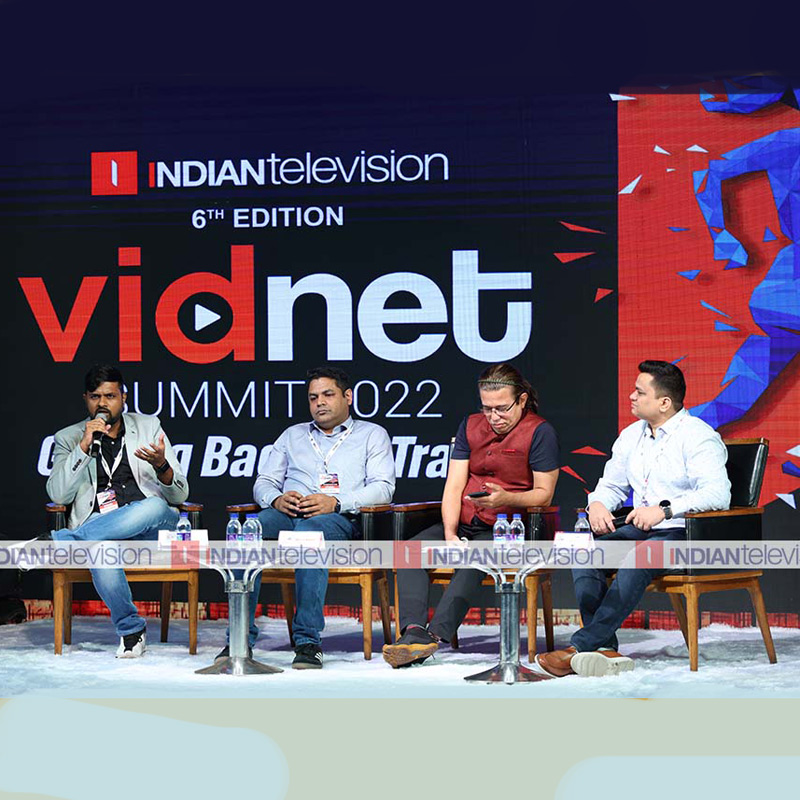
    On the sixth edition of Indiantelevision.com’s The Content Hub Summit 2022 held in Mumbai recently the media and entertainment industry experts shared their insights on the topic, ‘Tech-celeration of content: where have we reached?’

    The session had the presence of Eros Now chief technology officer Lokesh Chauhan; Contiloe Group CFO and Illusion Reality Studios CEO Nitin Dadoo; EPIC ON & Stream-Sense chief operating officer Sourjya Mohanty. 

    The panel deliberated views on the development of tools and techniques for creating incredible content experiences. There has been immense development on the tech front that is changing the way content is consumed. Cutting-edge content is transforming the media & entertainment sector every day. Virtual production capabilities are becoming a key differentiator for content creators. 

    During the Covid-19 pandemic, the entertainment segment leveraged technology throughout the entire virtual production life cycle to enhance the way content is created. It helped to improve production planning, increase shooting efficiency, and reduce the number of expensive reshoots.

    The panel was also moderated by Plug and Play Entertainment media consultant & co-founder Anuj Gandhi.

    The summit was presented by Viacom18, and co-powered by Applause Entertainment and IN10 Media Network. Aaj Tak Connected Stream is the association partner. Industry partners are Fremantle India, Hill+Knowlton Strategies, One Take Media, Pratilipi, Pocket FM and The Viral Fever. The Indian Motion Pictures Producers’ Association (IMPPA) is our community partner.

    Understanding the significance of technology for generating content was the starting point of the conversation.

    When asked, Is content & technology limited to OTT and theatre? What has happened to the good old TV? Dadoo said, “I don’t think that technology is only restricted to OTT! Rather, it is highly helpful to all types of storytellers.” He explained that “the use of new technologies like Unreal and Cam, which provide DOP directors camera tracking as well as onset information with an unreal virtual background, has drawn viewers back to television. The amount of time spent has increased during the past three months.”

    In addition, he also remarked on the availability of talent to handle such technologies, “The talent aspect is quite difficult. We came to the conclusion that we needed to hire a foreign crew since Indians are unprepared for these kinds of technologies. After a month or two of preparing the Indian crew for the new technologies, we had another difficulty: keeping them employed when other opportunities in the market were available.”

    Another member from the panel, Mohanty added, “The problem is omnipresent. There is always a talent crunch in the industry.”

    Chauhan also mentioned, “OTT platforms’ journeys are very distinct from those of traditional platforms.” He continued, “All of these systems, including LG, Samsung, Android, and iOS are constantly evolving. There are continually more changes occurring; these are not coming to an end. There will be immersive experiences that will necessitate the complete rebuilding of many of these services, many of which we currently consider to be quite stable. In light of this, you must constantly develop your skills and learn new things, unlike many other technologies.”

    Sharing his view on the impact of technology on the creative side of the business, Mohanty said, “Today is the era where machines decide what we need to think and what we need to do. The basic recommendation engine which is driven by AI and ML decides the content that audiences would like to watch.”

    Regarding the monetization aspect, Chauhan stated, “Right now in India, there aren’t enough individuals utilising these sites. Most of them run in the red. Players on OTT platforms are attempting to optimize their journey. The ugly truth is that Indian OTT services don’t have as much money as Netflix and Amazon do.” 

    Watch the full session:

  • VidNet 2022: ‘India lags in terms of content distribution security’

    VidNet 2022: ‘India lags in terms of content distribution security’

    Mumbai: The world’s largest streaming service Netflix with 222 million paid subscribers reported that another 100 million subscribers were accessing its services via shared passwords. The OTT platform is effectively losing billions in revenue every year because of password sharing. Similarly, issues like downloadable pirated content, illegal video hosting websites, password sharing and duplication of copyrighted intellectual property (IP) have created a parallel economy on the worldwide web that is hurting the revenues of video-on-demand platforms.

    Recently, IndianTelevision.com’s VidNet Summit 2022 organised a panel discussion on the ‘best practices for securing revenue for OTT platforms’ that included Inka Entworks India global business head Govindraj Basatwar, Epic On and Stream-Sens chief operating officer Sourjya Mohanty and Eros Now chief technology officer Lokesh Chauhan. The agenda of the session was to figure out how OTTs can plug the leakages in their revenue pipeline.

    The two-day industry event was supported by technology partners Dell Technologies and Synamedia, summit partners Applause Entertainment and Viewlift, industry support partners Gupshup, Lionsgate Play and Pallycon, community partners Screenwriters Association and Indian Film and Television Producers Council and gifting partner The Ayurveda Co.

    Epic On’s Sourjya Mohanty started the discussion by explaining that OTT platforms face revenue loss on two fronts. One is the technology front and another is the content front. On the content front, there is the issue of piracy that stems from the fact that certain segment of audiences may not be able to afford the content. “It is important to create protections for the content within the tech stack. This includes an effective digital rights management (DRM) system as well as embedded security features in the video player itself.”

    DRM is the use of technology to control and manage access to copyrighted material. It is a mode of encryption and decryption that determines whether the user who’s accessing the content is authentic or not. “Often platforms ignore these basic security measures and that’s the reason why piracy takes place,” remarked Mohanty.

    On the technology front, it is not just a content leak that causes revenue to be impacted. A platform may come under a variety of attacks ranging from a potential hijack of the app, a distributed denial of service (DDOS) attack, or something as simple as password sharing. Another issue is consumer awareness and education as many believe that it is fine to share password with friends and family.

    Furthermore, Mohanty observed that in the last five years with the proliferation of OTT services the audience is no longer loyal to the platform but rather it chases the content.

    Inka Entworks India’s Govindraj Basatwar was of the view that the best practices in terms of content distribution security are not being followed in India. He stated that distribution also means application security and that 50 per cent of the time subscription business models are hacked at the application level. He explained, “There are MOD APKs of apps available on the internet for download that gives consumers access to the platform’s content for free.”

    MOD APKs are modified versions of android applications. “When you put your application on the Play Store you effectively lose control of who gets to download it. It may be downloaded by an imposter or a genuine user,” said Basatwar. “Hackers usually reverse engineer the application, remove the subscription wall and upload the MOD APK. The MOD APK may be used by consumers without requiring them to share any credentials.”

    Eros Now’s Lokesh Chauhan held the opinion that all platforms are fundamentally prone to attacks and the attacker is constantly evolving. While OTT platforms routinely do jailbreak testing to look for weaknesses in their security but the best way to mitigate attacks is the democratisation of content availability. He said, “The access to content itself should be made readily available at affordable price points. This makes it easier for consumers to access it rather than install something like a MOD APK that is going to infect their system with a virus and make them vulnerable to potential credential hijacks. We have to make people understand that piracy is not worth it.”

    Chauhan also stated that technology infrastructure on an OTT platform has to be dynamically scaled up and down to keep control of costs. This is a big challenge currently for platforms, he said. “The structure for computing, caches, databases etc. should start playing a role in service-level agreements (SLAs).”

    An SLA is the level of service expected by a customer, i.e., the OTT platform, from a supplier i.e., the technology partner. Chauhan noted that these SLAs should factor in the cost of scaling up and maintaining the performance when a spike in usage happens.

  • ITV virtual roundtable on seamless video experience today

    ITV virtual roundtable on seamless video experience today

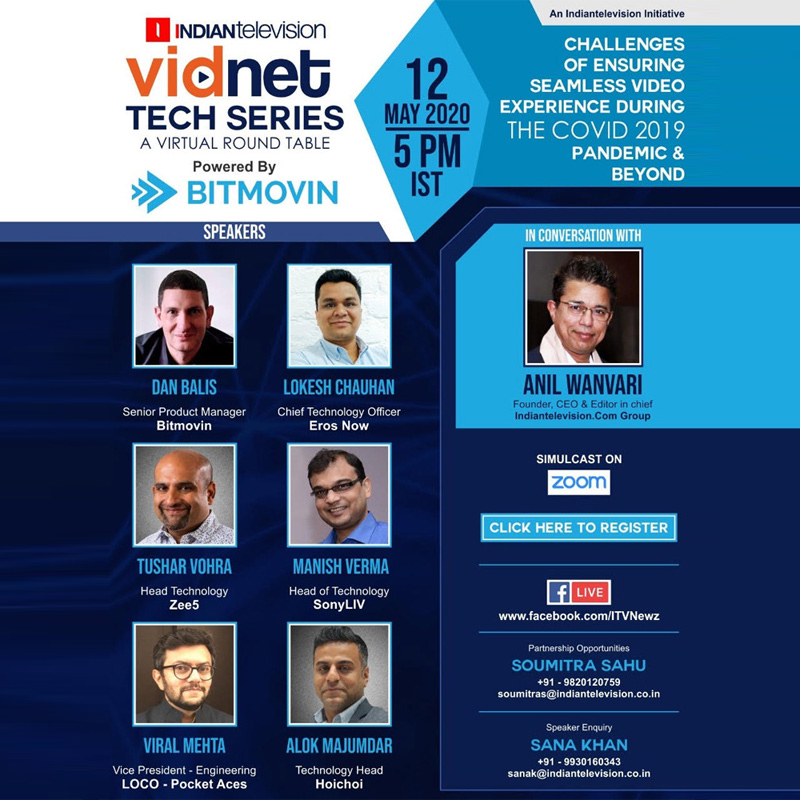
    MUMBAI: The latest roundtable in the Vidnet tech series being organised by Indiantelevision.com will be held today, 12 May, at 5 pm. Powered by Bitmovin, the webinar will discuss the “challenges of ensuing seamless video experience during the Covid2019 pandemic & beyond.”

    The pandemic meant many more people were at home, consuming content, delivered on streaming platforms and television. Data consumption rose to levels not seen before. In India, most of the streamers started delivering videos in the standard definition format as against HD because of the stress on bandwidth. What other lessons has the current crisis and pandemic taught streamers? What else did they do to deliver a better seamless experience to consumers? And going forward what else can be done? The webinar seeks to find answers to these questions, and many more. 

    The virtual roundtable will feature Dan Balis, senior product manager at Bitmovin, and will be moderated by Indiantelevision.com founder, CEO & editor in chief Anil Wanvari. 

    Bitmovin is built for technical professionals in the OTT video market with software solutions to help optimize customer operations and reduce time-to-market. Dan's work at Bitmovin focuses on the Bitmovin Player. He has over 15 years experience launching streaming video products and platforms at scale for media and technology companies that include Viacom, Bright cove, and AOL. His specialties include video platforms, cloud, analytics, SAAS, and ad tech.

    The roundtable will have technology heads of some of the prominent OTTs as delegates. They include: Hoichoi technology head Alok Majumdar, Eros Now CTO Lokesh Chauhan, Zee5 technology head Tushar Vohra, SonyLIV head of technology Manish Verma, LOCO – Pocket Aces VP engineering Viral Mehta, Lionsgate India director of product Mohit Khatwani, and ScoopWhoop Media CTO Vinay Gupta,  

    The event will be simulcast on zoom and Facebook.