Tag: Lok Sabha

  • News Nation: Aap ka Vote Aapki Huqumat-the post poll picture !!

    News Nation: Aap ka Vote Aapki Huqumat-the post poll picture !!

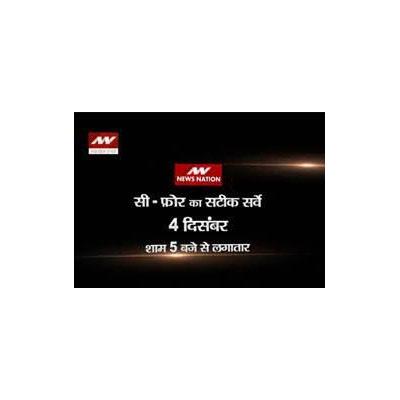
    MUMBAI: With the curtains drawn on polling on 4 December 2013 ,a pertinent question arises as to who will win the semi-final of general election? Which party will get majority and what are the dominating issues prevalent in the five election states. News Nation will unfold the emerging political scenario and equations with multidisciplinary research organization C-Fore which will further reflect the larger picture of the Lok Sabha elections. This would be one the most reliable post poll survey of the country as all the conclusions would be based on statistical analysis of the responses drawn from different constituencies of the states.

    In the five hour long marathon show today 5:00 pm onwards ‘Aap Ka vote Aap ki Huqumat”, News Nation will break down data region wise and will take opinions from experts, eminent and renowned journalists of the country. With the help of brilliantly designed graphics, News Nation will showcase the possible results of the counting day.

    The show will culminate with a candid panel discussion on the likely winning & losing parties & candidates. In a simple yet powerful way News Nation will explain how your vote had made the difference.

  • Against all odds, Prasar Bharati continues to swim upstream : Brigadier V A M Hussain Member (Personnel) Prasar Bharati

    Against all odds, Prasar Bharati continues to swim upstream : Brigadier V A M Hussain Member (Personnel) Prasar Bharati

    An institution that has been the chronicler and mirror of India‘s history is feeling crippled. With a tenacious CEO under a dynamic Minister of Information & Broadcasting, it is striving to reinvent itself to meet the challenges of contemporary media scenario. Many new experiments are on to change the behemoth called Prasar Bharati that cost the exchequer a whopping Rs 150 crore every month. This public service media organisation is one of the oldest statutory bodies with a hoary past. It is under siege and calls for expeditious intervention to revive the glory of the old faithful that is All India Radio. Doordarshan, the audio-visual arm of Prasar Bharati is always in the public eye with viewers asking for more sumptuous and scintillating fare.

    The Organisation is saddled with a disgruntled work force of about 50,000 who did not get a promotion for decades. To make matters worse, there was no attempt to infuse new blood in the system, either. An out-of-the-box solution is inescapable to break shackles of archaic regulation. The definition of autonomy needs to be revisited to meet the upheavals on the audio- visual landscape, in recent years. Section 33 of the Prasar Bharati Act directs prior government approval for all regulations governing conditions of service. Every employee appointed before October 2007 is considered a government servant on deemed deputation and their promotion is in government ambit. Instead of being a nimble, vibrant media organisation driven by merit, seniority and ‘babudom’ rule the roost. Proposal for a Prasar Bharati Recruitment Board as mandated by the Act of Parliament vide Sections 9 and 10 of The Prasar Bharati Act 1990 is gathering dust in files while government persisted in stalling promotions and new recruitments for two decades now. In effect, Prasar Bharati is like a ship caught in the turbulent waters in the mid sea with none to care on the shore for the SOS of the ship-wrecked crew. Merit and flexible structures are essential for a dynamic and extremely competitive media sector. Meeting the content needs of 750 million people through regional and national infra structure and boosting DTH and terrestrial audience are complex challenges, CEO Jawhar Sircar faces, along with ‘Sarkar‘, the real power.

    A recent experiment showed how independence in Prasar Bharati can make an impact. A truly independent team with young professionals in DD News prime time has rattled the industry with ratings showing an upswing.
    _____****_____

    A recent experiment showed how independence in Prasar Bharati can make an impact. A truly independent team with young professionals in DD News prime time has rattled the industry with ratings showing an upswing. Doordarshan launched a big advertising campaign for the revamped time bands of DD News, DD National and DD Urdu. This was the first such campaign in decades. A little more attention and circumspection are needed at AIR too which got maligned unfortunately by recent media reports of alleged harassment of its women Radio Jockeys. It is staring at a PIL now. FM Gold channel, with practically no permanent staff, earns substantial revenue for the entire AIR network while private FM channels are yearning for popularity with smart young professionals even in small towns and villages. The recently appointed Sam Pitroda Committee has set itself tasks suggesting visible changes for reviving Prasar Bharati. There is a wealth of data and content in archives that can propel AIR to the top of the charts. The expert groups are offering many practical suggestions and initiatives on many fronts including technology, content management, financial independence, government relations and human resources. Dr. Pitroda believes that generational change can be brought about by radical thinking instead of mere cosmetic changes.

    The financial situation continues to be precarious for Prasar Bharati with complex legacies. An unprepared bureaucracy opted for accrual system of accounting and enforced income tax while loans in perpetuity and penal interests soared.The government rescued Prasar Bharati by writing off large sums due as segment hiring and space spectrum charges incurred in the course of broadcasting mandated content, non commercial in nature. Income tax claims stand withdrawn while local bodies continue levying the public broadcaster with huge taxes on property of Union of India but Prasar Bharati has just been permitted use of the government emblem. This is a paradox since 50,000 salaried employees of government are using these assets for functions statutorily assigned by an Act of Parliament. Welcome initiatives of the GOM relieved Prasar Bharati from its financial crystal maze for now by converting loans in perpetuity as grants.

    The need of the hour is to professionalise Prasar Bharati with content-driven channels and professional-driven management owing total allegiance to Prasar Bharati to meaningfully accomplish objectives that were originally dreamt and scripted by the authors of an autonomous public service broadcaster. The dream is worth realising.
    _____****_____

    Apprehensions often raised on the need for a government-funded national public broadcaster are ill-founded. We need an unbiased institution to bench mark initiatives on information, education and entertainment. At the same time, the government needs a media window to show case its policies, initiatives and views by running its own video and audio channels. Government staffing of DD News and AIR News Service Division through Indian Information Service is controlled by the Ministry. The easiest course would be to sever the current nebulous association with Prasar Bharati and declare them government channels on the lines of Lok Sabha and Rajya Sabha TVs and leave Prasar Bharati to professionalise with autonomy.

    The efforts of the government to empower through The Sports Broadcasting Signals (Mandatory Sharing with Prasar Bharati) Act 2007 get breached frequently. Private business houses that own broadcasting rights of World Cricket tours use pre-embedded feeds of commercials and cause losses in hundreds of crore to Doordarshan. Expeditious amendments would help Prasar Bharati and the government. Despite its huge work force, Prasar Bharati has inadequate structure of professionals managing its own security, assets, property, content, new media, revenue and marketing at the highest levels. The need of the hour is to professionalise Prasar Bharati with content-driven channels and professional-driven management owing total allegiance to Prasar Bharati to meaningfully accomplish objectives that were originally dreamt and scripted by the authors of an autonomous public service broadcaster. The dream is worth realising.

    Will the Committee of Sam Pitroda be able to persuade the government to truly empower Prasar Bharati? On thoughts like this, we often remember Baba Amte’s saying “Faith is the promise of tomorrow” while the swimming upstream by Prasar Bharati continues.

  • 24 complaints on misleading & surrogate ads

    24 complaints on misleading & surrogate ads

    NEW DELHI: A total of 13 complaints against surrogate advertisements and 11 against misleading advertisements on the electronic media have been received in the recent past, Parliament was told.

    Meanwhile, the Department of Consumer Affairs is holding a series of consultations and workshops with all stakeholders in different parts of the country to create awareness about this issue.

    In 2010-11 and 2011-12, a total of seven and eight complaints respectively were filed about misleading advertisements in the print media, Minister of State for Information and Broadcasting C M Jatua told the Lok Sabha.

    Jatua said the Consumer Protection Act 1986 had ample provisions to act against advertisements making false or misleading representation and these had been duly notified as Unfair Trade practices for which a consumer could approach the Consumer Courts.

    The Press Council Act and the Journalistic Norms drawn up by the Council, and the Cable TV Networks (Regulation) Act apart from the Advertising Standards Council of India also had powers to deal with such complaints.

    In reply to another question, Parliament was informed that a representative of the Department of Consumer Affairs was now represented on the Inter-Ministerial Committee which hears complaints against TV channels.

  • Guidelines to deal with paid news ahead of elections

    Guidelines to deal with paid news ahead of elections

    NEW DELHI: There is some amount of seriousness in tackling the issue of paid news. The Election Commission has issued guidelines to the Chief Electoral Officers of all the states and Union Territories to deal with candidates‘ advertisements on television channels owned by political parties or their functionaries and office bearers during elections. These will come into effect immediately.

    The latest guidelines have been issued to bring better uniformity in dealing with such instances even when no consideration of cash and kind is involved in extending campaign publicity to candidates.

    The guidelines say that six months before the due date of expiry of Lok Sabha or the State/UT Legislative Assembly, as the case may be, a list of television channels, radio channels and newspapers circulated in the State and Union Territory and their standard rate cards shall be obtained by the CEOs and forwarded to the Commission.

    The latest guidelines were issued on 16 August to put in place a mechanism to deal with the problems of ‘paid news‘. The Commission had earlier issued guidelines on 8 June 2010, 23 September 2010, and 18 March 2011 relating to this issue.

    The Commission said in a recent press note that it had been receiving various complaints and references regarding ‘paid news‘ and advertisements on TV channels owned by political parties or their functionaries during the process of elections, thus disturbing the level playing field, as these are not reflected in the candidate‘s election expenses account.

    The Media Certification and Monitoring Committee (MCMC) at district and state level will monitor all political advertisements in relation to candidates, either overt or covert, and will intimate the Returning Officer for issue of notices to candidates for inclusion of notional expenditure based on standard rate cards in their election expenses account, even if they actually do not pay any amount to the channel/newspaper. This will also include publicity by or on behalf of candidate by Star Campaigner (s) or others, to impact his electoral prospects. A copy of the notice will also be marked to Election Expenditure Observer.

    In case of bye-election to Parliamentary or Assembly constituency, the standard rate card will be obtained by the District Election Officer concerned immediately on announcement of the bye-election and MCMC will take due action immediately afterwards.

    Like in the case of paid news, the Chief Electoral Officer and District Election Officers will brief political parties and media houses about the above guidelines before the commencement of the
    election campaign.

    In case of any technical doubt relating to the application of the standard rate card, the matter would be referred to the Directorate of Advertising and Visual Publicity of the Information and Broadcasting Ministry for advice.

    The practice of paid news has to be seen as an attempt to circumvent the provisions of Sections 77 and 123 (6) of Representatives of the Peoples Act 1951 which prescribe accounting and ceiling of election expenses and make exceeding such prescribed limits a corrupt practice in elections.

    The Commission has directed that maximum vigilance may be observed by making use of the existing provisions of law so that the incidence of ‘paid news‘ or surrogate advertisements in print and electronic media in the context of elections is arrested.

    Legal provisions under Section 127A of the 1951 Act make it mandatory for the publisher of an election advertisement, pamphlet, etc., to print the name and address of the publisher as well as printer and failure to do so attracts penalty of imprisonment up to two years and/or fine of Rs 2000/-. Section 171 H of the IPC prohibits incurring of expenditure on, inter alia, advertisement without the authority of the contesting candidate.

    ‘Paid news‘ would also fall in the category of ‘other document‘ liable to be included in ‘election pamphlet and poster‘ and action taken accordingly. Hence, an obvious case of news reporting in the print media dedicated/ giving advantage to a particular candidate or the party while ignoring/ causing prejudice to other candidates and parties would require investigation.
  • Parliamentary standing committee begins study on paid news menace

    Parliamentary standing committee begins study on paid news menace

    NEW DELHI: The Parliamentary Standing Committee on Information Technology, which had late last week announced its intention to probe the menace of paid news, today held a meeting with senior officials of the Information and Broadcasting Ministry to gain the perspective of the government.

    Sources said the Committee, which deals with the I&B Ministry, also worked out modalities for probing into the subject during its meeting held in the premises of the Planning Commission.

    The Committee on 16 December invited comments from the public in general and experts/professionals/organizations/associations and stakeholders on various aspects relating to ‘Paid News‘.

    The matter has gained importance with leakage of telephonic conversations between mediapersons and corporate bosses and politicians.

    The Committee headed by Lok Sabha Member of Parliament Rao Inderjit Singh has decided to go into the subject and has sought the views for wider consultations.

  • Prasar Bharati makes just Rs 581 mn from CWG

    Prasar Bharati makes just Rs 581 mn from CWG

    MUMBAI: Prasar Bharati made Rs 581 million from the Commonwealth Games while it had set itself a target of Rs 1 billion.

    The minister of state for information and broadcasting S Jagathrakshakan informed the Lok Sabha on this yesterday.

    Doordarshan was not allowed to air advertisements during the closing ceremony of the CWG Games following complaints that there were too many ads during the opening ceremony.

    Union Sports Minister MS Gill admitted in the Lok Sabha yesterday that The Commonwealth Games Organising Committee (OC) fell more than 80 per cent short of its revenue target.

    While the OC was expected to generate Rs 17.08 billion, it only managed Rs 3.27 billion. On the other hand, the OC got more money from the government than originally expected, with its expenditure overshooting its budget by Rs 6.38 billion.

    The revenue came in from three sources. The sale of tickets generated Rs 391.7 million. While the contracted value of sponsorship was Rs 3.75 billion, less than a third of that sum was realised, with just Rs 1.14 billion coming in so far.

    Similarly, only Rs 1.74 billion has been received for the sale of the international television rights, against the contracted value of Rs 2.13 billion. That does not include the Rs.230 million withheld as tax deducted at source from the payments of Network Ten in Australia.

    The number of visitors to the Games also fell short of the goal. While the OC had estimated 100,000 visitors and 8,000 participants, the actual numbers were lower.

    The number of foreign tourist arrivals in Delhi in the first two weeks of October — not all of whom were necessarily in the city for Games-related tourism — was 75,606. The total number of participants was 6,572.

  • Cranes sofware to assist CNN-IBN on poll count

    Cranes sofware to assist CNN-IBN on poll count

    NEW DELHI: Even as voters are getting ready to cast their votes in the fifth and final phase of the Lok Sabha elections tomorrow, news television channels are gearing up to give live coverage of the results as they come in and trends that emerge on the counting day, 16 May.

    Cranes Software International Limited (Cranes) will analyse the findings of opinion and exit polls as well as do the analysis of early trends for the CNN-IBN TV news channel on the counting day.

    Dr Rajeeva Karandikar, Cranes Software executive vice president, a former professor at the Indian Statistical Institute, has been driving this exercise along with the team from the Analytics Group of Cranes. The team uses Cranes’ in-house statistical software product Systat and its derivatives to analyse the data.

    In January and February 2009 as a run up to the forthcoming Lok Sabha elections, the Cranes Software team analysed data collected during the opinion poll commissioned by CNN-IBN. The raw data was collected by CSDS – the Center for the Study of Developing Societies under the leadership of noted psephologist Yogender Yadav, while the statistical analysis and implications of the data on the final composition of the Lok Sabha was presented by Karandikar in a TV program anchored by Rajdeep Sardesai on CNN-IBN.

    The Cranes team has been involved in assimilating, analysing and preparing the raw data received from AC Nielsen for use in the graphics that go on air. The team at Cranes uses their powerful statistical analysis and graphics software – Systat, to run statistical models on early counting trends and make early seat projections of the final composition of the house. The graphics team at CNN-IBN then renders the findings into graphs which are then telecast on the CNN-IBN channel along with IBN7 (Hindi), IBN Lokmat (Marathi) and occasionally on CNBC channels.

    This exercise is to take place again during the post election coverage on CNN-IBN between 13 May and 17 May.

  • MIB had directed news channels to exercise restraint in Mumbai terror coverage: Sharma

    MIB had directed news channels to exercise restraint in Mumbai terror coverage: Sharma

    MUMBAI: Keeping in mind the public interest and interest of national security, the Ministry of Information & Broadcasting had directed all the news and current affairs TV channels to ensure that the coverage of the incidents relating to the recent terrorists attack in Mumbai does not focus on or report the location, strength, movement strategy or any related operations being followed by the security forces engaging with the terrorists as it may jeopardize their position.

    The channels had also been directed that close-ups and images of blood or seriously wounded or disfigured limbs or bodies or images of dead or seriously wounded people which may seriously distress a substantial number of viewers or cause panic and incite further violence, may not be carried. 

    The News Broadcasters Association has prescribed its own self-regulation guidelines and has agreed to incorporate an ‘Emergency Protocol’ to supplement these guidelines to address such concerns.

    This information was given by Minister of State for External Affairs and Information & Broadcasting, Anand Sharma in written reply to a question in Lok Sabha today.

    Meanwhile, the Minister said no time limit could be given for implementation of the report of the Committee set up by the Government to review the existing Programmes and Advertisement Codes prescribed under the Cable Television Networks (Regulation) Act, 1995 to containing the adverse effect of programmes and advertisements on viewers, specially children.

    The Committee has already submitted its report. This report is available on the website of the Ministry www.mib.nic.in under the heading “Self Regulation Guidelines 2008”.

    The Minister also said the Inter-Ministerial Committee on specific violations of the Programme and Advertising Codes prescribed under the Cable Act can either suo motu or on receipt of complaints look into the violations and, thereafter, give its recommendations to the Government, based on which action is taken.

    The Minister informed Parliament that under Rule 7(9) in the Advertising Code of the Cable Networks Rules, 1994, the Code for Self Regulation adopted by Advertising Standards Council of India (ASCI) has been given due recognition.

  • ‘We are not a business model-oriented channel’ : Suneet Tandon – Lok Sabha TV CEO

    ‘We are not a business model-oriented channel’ : Suneet Tandon – Lok Sabha TV CEO

     ‘The no-confidence motion against the UPA government last month gave Lok Sabha TV’s ratings the much required boost as well as an opportunity to rake in money by sharing its feed with privately run satellite news channels.


    Indiantelevision.com’s Anushree Bhattacharyya caught up with Lok Sabha TV CEO Suneet Tandon to find out more on his plans for the channel. Interestingly, Tandon was elevated as CEO less than a week before the crucial vote. He was earlier the channel’s executive director-marketing.


    Excerpts:

    How has the channel fared in the two years of its existence? What are major changes that have taken place?
    The first year was devoted at consolidating the position of the channel. And in its second year, we established the channel’s presence. People now know who we are.


    There are channels that spend large amounts on advertising and marketing. We have not gone that route, yet we have carved out our very own position. All this has happened primarily due to the coverage of Lok Sabha sessions as well as other programmes like debates, discussion and documentaries.

    What is the composition of Lok Sabha TV? Apart from Somnath Chatterjee (whose brainchild the channel is), who are members of its governing body?
    The channel owes everything to the Speaker. But the channel is institutionalised under the overall power of the Lok Sabha. Under the Speaker, we are headed by the secretary general. In addition, there is also an advisory council to guide the functioning of the channel and is chaired by the Speaker. The vice chairman of the council is the deputy speaker of Lok Sabha. The council also consists of leaders from all the major parties in Parliament. So there is also that structure which has been set up to help offer the balance.

    How much investment has been made into Lok Sabha TV?
    Well, at this point of time, it is difficult to speak about the figures as I don’t have them with me right now.

    The channel has to depend on the audio-visual unit of the Lok Sabha secretariat for its expenses and infrastructure. Do you face any constraints in funding since you do not have a business model as such?
    We are not a business model-oriented channel. We are a public service channel for which funds are made available by the Parliament from Parliament’s own funds. Though there have been no constraints on our funds, it is our desire that we don’t want to become a burden on anyone. We need to do it in an economical and careful manner and are very conscious of that. We do not try to spend liberally just for the sake of spending.

    How many hours of feed were sold by Lok Sabha TV for the two days (during the Trust Vote)? How was the business on these two days for the channel?
    We did not sell any number of hours of feed as such. News channels picked up largely the important segments. We had earlier informed all the news channels about the rates. We had adopted Doordarshan’s practice of sharing feeds for important events in Parliament.


    We are using the same rates used by DD. Apart from charging Rs 1 mn beyond every five minutes of feed, there is also a provision for a one-time payment. For the one-time payment, a news channel has to pay Rs 3 mn in advance and can use the feed for any three important events, which makes it Rs 1 mn for every event.

    We also try to spread cultural awareness not in terms of entertainment but by spreading awareness for our classical heritage and folk heritage. We also air awardwinning films on our channel

    Since it’s all about garnering TRPs, how does a channel like Lok Sabha TV manage to catch the attention of viewers?
    By being a credible, sensible and balanced channel. We are not trying to attract the attention of viewers and TRPs by showing any sensational news. We like to deal with our viewers intelligently and try to reflect their concerns because this channel is meant for the thinking citizens of this country. We are very conscious that Lok Sabha TV has to reflect and balance all shades of political opinion. And I must say that there is a lot of feedback that we have got saying that people like watching our channel because we don’t sensationalise anything.

    Do you keep an eye on the ratings of Lok Sabha TV? Are the ratings satisfying enough?
    Yes, we do. We have subscribed to Tam (television audience measurement) every week. Considering the niche nature of the channel, it is very satisfying. Lok Sabha TV is neither a news channel and nor is it a GEC, yet our ratings have been consistently more than CNN and BBC. Also in metros like Delhi and Mumbai, our ratings have been better than many of the established news channels. It’s actually a good reason to be happy for a young channel which does not offer any traditional sensation to its viewers.

    The channel’s viewership soared on 21 and 22 July. Do you feel that Lok Sabha would have been able to garner more ratings if you had not shared the feeds?
    Of course. Those two days were extremely important for Indian democracy. And had we not shared the feed, we would have got as much viewership as that of all the channels put together… all those who took our feed and our viewership.

    Apart from covering the Lok Sabha, what else does the channel concentrate on?
    People have begun to look at us as in terms of quality discussions, debates and documentaries on socio-economic, constitutional and government issues. Moreover, we also try to spread cultural awareness not in terms of entertainment but by spreading awareness for our classical heritage and folk heritage. We also air awardwinning films on our channel.

    At any point of time, have any member of the Advisory Council or the Speaker shown an apprehension on maintaining balance while covering any session?
    No within the Parliament the balance is maintained by the Speaker himself or whosoever is in the chair at that time. And our duty is simply to cover what has happened. And as far as rest of the programmes are concerned, we have not yet faced any significant criticism. But if there are any observations, we take corrective actions.

    In terms of programming, what are the changes that you would like to bring about?
    Every television channel has constantly tweak its programming and look for new ideas to develop interesting programmes. I think we need to give a little more emphasis on fresh programming. And I would also like to see if we could have some more involvement from other states and cities. We also have phone-in programmes where we have toll-free numbers and people can call from anywhere in the country.

    Though there is a website dedicated to Lok Sabha, there is no online property for the channel. Any plans to develop a dedicated web portal for Lok Sabha TV?
    Well, that is something that we can certainly consider taking up. During the time of the debate, many people who had logged on to watch a simultaneous webcast had found that our server had reached its maximum capacity as people from all over the world had logged on it. The servers for loksabha.nic.in got jammed. So, yes, may be there is a need to set up a separate website and increase the bandwith.

    What lies ahead for Lok Sabha TV?
    Technically, we are already at power with any other channel. Our visual quality is as good as any other channel. Yes, we would definitely like to have more interesting programmes and would also like to increase our scope of operation.
  • Bill to replace sports telecast ordinance introduced

    Bill to replace sports telecast ordinance introduced

    NEW DELHI: Introducing a Bill making it mandatory for private broadcasters to share the feed of live telecast of sports events with Prasar Bharati, Information and Broadcasting Minister Priyaranjan Dasmunsi told the Lok Sabha the legislation was aimed at replacing an ordinance promulgated last month in the interest of millions of viewers who had the facility of only terrestrial or free-to-air channels to enjoy live sports events of national and international importance.

    The Sports Broadcasting Signals (Mandatory Sharing with Prasar Bharati) Bill 2007 will have retrospective effect from November 2005 when the Uplinking and Downlinking Guidelines had been issued.

    The Bill is expected to come up for consideration and passing towards the end of next week, after the Lok Sabha finishes discussion on the Motion of Thanks to the President to the Joint Sitting of both Houses on the opening day of the Budget session.

    The ordinance was promulgated after Nimbus Communications refused to share live feed of the India-West Indies one-day series with Doordarshan after the Delhi High Court passed an order for a seven-minute deferred telecast signal to the public broadcaster and live broadcast on All India Radio.

    Dasmunsi, in a statement giving reasons for promulgation of the Ordinance, said the government was only reiterating an earlier order making sharing of live feed of sports events with Doordarshan mandatory.

    The statement of objects and reasons appended to the Bill said the public broadcaster Doordarshan covered 98 per cent of the population and was the only network having terrestrial rights of broadcasting.

    Distribution of broadcasting signals of sporting events of public interest in India is characterised by a few dominant exclusive rights holders or broadcasters and distribution platforms. “The end result is that a large number of listeners and viewers in India, especially those who do not have access to satellite and cable TV and most of which are in rural areas are denied access to these events,” the Bill states.

    Under the Bill, television channels that fail to comply would have to pay a penalty up to Rs 10 million and also face possible revocation or suspension of license. It has also been stipulated that no action of the government would be challenged in any court of law.

    The Guidelines for downlinking of TV channels had been issued on 11 November, 2005 and the Uplinking Guidelines had been issued on 12 December, 2005.

    These Guidelines are already the subject matter of the petition in the Delhi High Court by Nimbus Communications on the Indo-West Indies series telecast.

    Nimbus, which owns Neo Sports channel, had expressed apprehensions that the government may resort to coercive methods for sharing their exclusive feed.

    The Bill provides for a revenue sharing formula between private and public broadcasters. Advertisement sharing between private and the public broadcasters would be in the ratio of 75:25 in case of TV coverage in favour of the rights holder and 50:50 in case of radio coverage.