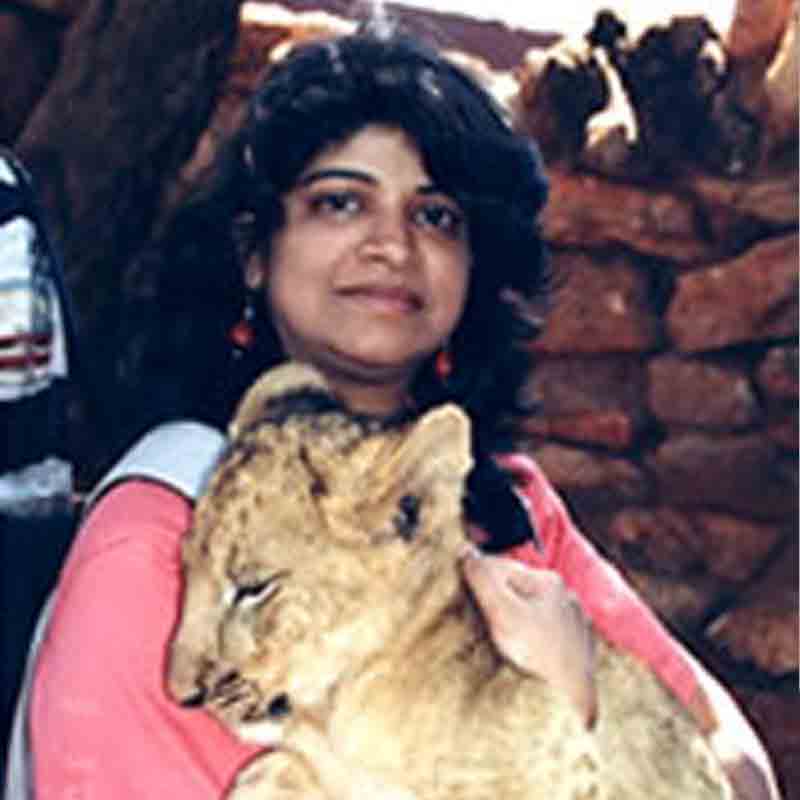
Think Emvies and pop comes Lodestar to your mind and with that comes the image of Nandini Dias. At the helm of the agency since its inception, Nandini and her team have consistently performed at the Emvies year after year. So much so that at this year’s presentations and shortlisting process for the awards, every agency took a dig at Lodestar and Nandini couldn’t stop laughing.
One of her peers from a rival agency introduced himself to the jury as Mr So-and-So from Lodestar. “We really felt we had arrived in life,” she laughs. Such has been the stranglehold of Lodestar over the Emvies and the perfectionist that Nandini is, she is always determined to get it right every time… time after time.
A science graduate, Nandini went on to do her Advertising & Marketing post-graduation from Xavier Institute of Communications (XIC). Around the same time she was selected into Jamnalal Bajaj Institute of Management, and faced with a choice, preferred to jump straight into the deep end and joined advertising. “At that point in time, I didn’t realize that ‘MBA-ness’ would go on to become such a critical label and preferred to get straight to the point with advertising and marketing at XIC,” she ponders, in retrospect.
Though, most of what she has learnt about media, all the tricks of the trade, she avers, has been from hands-on work experience. Albeit with some trial and error.
Today, as vice president of Lodestar, she is a force to reckon with and many clients agree to come on board only if Nandini personally oversees their account. That in itself speaks eons about the kind of commitment and passion she has for her work and the respect she has earned in the industry.
 With no mentor to guide her through her media odyssey, Nandini learnt to tune the strings herself. After XIC, she joined a small agency called Interpublicity (run by Nargis Wadia) and was with them for one and a half years. “I joined them in 1988 and in those days Interpublicity used to be a very creatively inclined agency. Interpublicity had virtually no media department and Mrs Wadia used to keep telling me that I had a very business like mind and that I should actually be on the servicing side of the business. At that time the media stream of the business was really unheralded and the one of the most powerful media departments was housed in the then Lintas, so I decided to join them. While I already had a year and a half of experience, I really didn’t mind learning everything from scratch all over again. ” she says.
The Lintas of those days was structured as autonomous groups like Bombay 1, Bombay 2, Bombay 3 and so on, each functioning as a mini agency within an agency. Nandini used to look after the clients that fell under the Bombay 3 division of Lintas. In her five-year stint at Lintas, she handled clients like Cadburys, Johnson & Johnson, Walls (from Unilever) and Marico amongst others.
Interestingly enough, her quest for a mentor ended with herself. “Thrown into the deep end, I realized that there is only so much that someone can really ‘teach’ you. Beyond that, I realized, that the only way to learn was to learn by yourself,” she recalls.
Inadvertently out on her own, she had to sink or swim. And swim she did, by constantly absorbing information and digesting the wealth of knowledge that she found all around her. From basic sources like books, papers, journals and thesis to the more interactive periods she had with colleagues, peers who were always around when she was faced with a problem. “I just learned it all by myself and figured out the method to the madness,” says she.
 In 1994 Nandini had a winged visitor. The stork came calling and the birth of her first son led to her taking her first break from advertising. “I was in this holiday pregnancy spirit and since it was my first child, I didn’t want to leave the baby to anyone in the early months. After my baby was born, I was debating whether to take a break and then go back to work. Also the fact was that since I had already taken a six month maternity leave, someone else had been servicing my accounts at Lintas. So I thought it would be better to join another organisation. My first child was born on 1 January 1994, and in November the same year, I joined FCB Ulka as media supervisor,” says Nandini.
From media supervisor to vice president, it’s been a long 11 years for Nandini at FCB Ulka and its media independent Lodestar. “Four months after joining the agency I was pleasantly surprised to be promoted to group manager,” she says. And since then she’s been going from strength to strength in the organisation.
For about three years after 1996, Nandini was handling the entire media planning business of FCB under Kalpana Rao while Apurva Purohit was handling the media buying.
But in 1998, the stork came a calling a second time and Nandini had a brief part time stint before being faced with her next big challenge. At that time FCB decided to re-launch its second agency Interface Communications in India and Nandini was part of the core start up team. The agency had already been launched earlier as far back as 1985.
“For three years I had been doing the same thing and this came as a challenge to me at a time when I was thinking about what my next move should be. I thought that running a start up would be easier than running a large organisation. But the reality was totally different. You have to invest so much time to in clients, people, processes and infrastructure apart from putting systems in place to just get the organisation running. The biggest challenge was to get people to join us since most of them want to join large, known organisations as media is very strongly driven by buying power and industry clout. Another thing was also that we were fighting with the biggies and that was a far tougher job,” she says.
“We started from scratch and really struggled to get the organisation up and running. Our aim was to separate it from the existing organisation and give this agency its own identity,” she adds.
 Setting up a new agency is no cakewalk since media is all about clout and about the amount of money being put down on the table. “We were very keen on starting it as a separate organisation. That was a tall task for anyone. I think it was a big high for me to get business on the basis of what I would bring to the table. It was a big responsibility and I was initially very awed when clients began coming on board citing my leadership as one of the reasons,” she narrates.
Four years after Interface Communications was launched, the management decided to bring Lodestar – the brand – to the forefront. And Lodestar became an independent identity. “While there are different divisions and groups under Lodestar to start with, they eventually got integrated,” Nandini informs.
Lodestar came into being around 95-96 but at that point in time it was only a buying and implementation operation. The strategic area was a part of the mainline agency. “It was not a separate media house per se but for the last three – four years, we’ve been running Lodestar as an independent media house,” she says.
How did the transition come about? “It had a lot to do with market forces and also the fact that there were many clients who not aligned to any creative agencies. So there were a lot of AOR clients, which came in. Now, 50 per cent of our clients are pure AOR clients. It made sense to run it as an independent organisation,” says Nandini.
One immediate challenge was that FCB’s global media arm didn’t have any multinational clients that fall into Lodestar India’s lap merely on the strength of international alignments. Unlike, the P&Gs, Pepsis and Unilevers of the world, Lodestar had to brave it on their own and pitch for MNCs in India which were aligned to rival agencies internationally. L’oreal is one such example.
 The team at Lodestar found an approachable leader and a hard taskmaster in Nandini. Her office is a free walkway for anyone who is facing a problem. Being a perfectionist to the T, she has very high expectations from her team and trained them to be perfectionists as well. Lodestar’s performance at the Emvies during her tenure at the top is a testimony to the commitment her team has towards clients. “We may be much smaller but our consistent track record at the Emvies over the last few years has been extremely satisfying. The businesses we handle, the quality of output we deliver and also the team we have all put us ahead of a lot of the competition,” she proudly states.
One of her peers in Group M once said to her, “The best people in the industry are trained under you. So you continue training them and after a couple of years, we will poach them.” To which her reply was, “The more people you pick up, the more I will train. So let’s see who wins the battle – whether you hire more or I train more.”
Lodestar has, over a period of time, become a starting point and a destination for a lot of people who want to do quality work. “As an organisation, we give a lot of importance to the quality of thinking rather than just mindless buying,” she says.
Being a perfectionist, she finds it difficult to accept people who work in a particular place just to earn good money. “Of course money is important but if I don’t find enough involvement and commitment in people, both of us have to work at it that much harder. We try to work with such people and get the entire team on to a common ground. And once you’re alongside them, then it’s very difficult for them not to see things the same way,” says she.
It’s not a much publicized fact that Nandini has been very active in sports during her school and college days. She played badminton at the state level and has won many awards too. Today, she compares herself to a sports trainer… albeit in the media field. Drawing comparison she says, “I push people to work hard just like a sports trainer keeps pushing you. But ultimately, the rewards are yours to keep.”
Her contribution to the industry has been huge in terms of quality of work, research, innovations, tools, etc that the agency churns out year after year, which in turn sets benchmarks for the rest.
One personal grouse of hers is that a lot of new people coming into the industry are irrationally ambitious. Little do they realize that seniority is not achieved via job hopping and getting designation hikes. “Personally it is a big high for me that I joined FCB Ulka as media supervisor and have reached to where I am today in the same organisation,” she says.
|
Strengths
|
|
I will be hard on myself till I know that something is done to the best of anyone’s ability. If I decide to do something, I will do whatever that needs to get done, which is obviously not underhand, to do it. Building relationships with people is my strength. All my clients today are my friends.
|
Eleven years is a long time to stay put in an organisation, especially when rampant poaching of professionals goes on in the ever so competitive media environment… but Nandini has no regrets whatsoever. “There have been opportunities and some of them were tempting. But I’m a person with very basic wants and I’m not into exorbitant living. I work for people and principles and I should like what I’m doing. I have been involved with it for so many years, constantly nurturing it that I’m in no hurry to abandon it. I have been one of the most consistent faces leading Lodestar and you can blame anything good or bad that has happened in the agency to me,” she chuckles.
She however adds, “Unless something really challenging comes my way, I will stay put. Apart from that, my desire is to really grow Lodestar so why would I hop jobs.”
Shashi Sinha once told her, “Nandini, if you have set your mind on something, you will achieve it irrespectively. I can see the kind of determination in you that will not let you stop till the job is done.”
This also rings true for her husband Agnello Dias (JWT senior vice president and executive creative director), points out Nandini.
|
Weakness
|
|
I will call a spade a spade, which is a very tough one. I’m not a ‘Yes Boss’ person. And this trait of mine has put me in a tight spot all the time. But I can’t change myself. And that makes it tougher for me because if you’re not a person who toes the line, to prove yourself you have to work that much harder. I get too involved into people.
|
Passionate about sports, if Nandini was not doing what she is doing today, she would go back to sports and strive to do something for the players for whom sport is bread and butter. “Unfortunately, there isn’t much money in sports except for cricket and those people who are into other games have pursued it at the cost of their education. Hence they find it difficult to get jobs. For me the alternative job would be sports marketing, sports advertising and growing the industry keeping players’ interests in mind,” she dwells.
How does she juggle between home and the ever-pressing demands at work. “It is tough to manage home and professional life. It’s a conscious effort to balance out the two and it can only happen if you are determined to do it. I teach my two sons myself. I teach kids at office so why can’t I do it at home?” she chuckles.
While earlier she was a total workaholic, since the last three years she has been taking her regular one month of privilege leave. “Prior to that, there always used to be something that was important enough so that I couldn’t take off. Now I am making a conscious effort to take time out,” she emphasises.
Being a true blue nature’s person, Nandini loves trekking and camping and her favourite getaways are the Himalayas, Ganges and Beas.