Tag: Local Cable Operators

  • Cable TV lobby slams TRAI’s DTH licence fee waiver call

    Cable TV lobby slams TRAI’s DTH licence fee waiver call

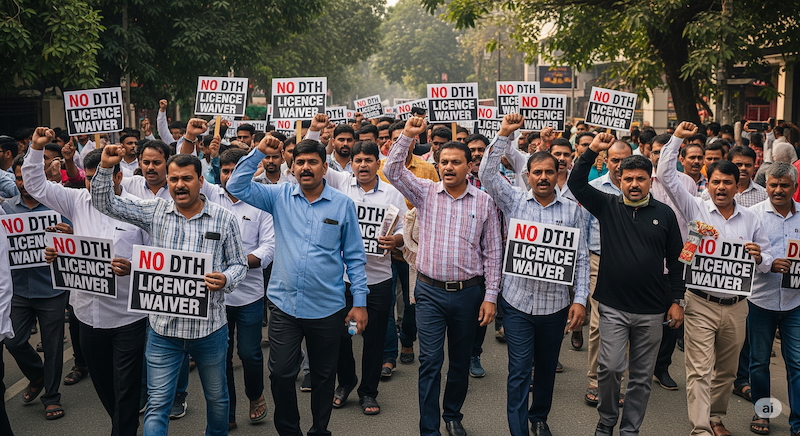
    NEW DELHI – India’s top cable lobby has sounded the alarm over TRAI’s proposal to slash and eventually scrap licence fees for Direct-to-Home (DTH) operators, warning it could wreck the delicate balance in the country’s broadcast distribution ecosystem.

    In a strongly-worded representation to the information and broadcasting ministry, the All India Digital Cable Federation (AIDCF) – which represents over 880 multi-system operators (MSOs) and 1.6 lakh local cable operators (LCOs) – said the move would “deepen regulatory inequality” and “threaten over 10 lakh livelihoods” linked to the cable TV industry.

    The AIDCF accused TRAI of tilting the scales in favour of DTH players who already enjoy “cost-free, administratively allocated spectrum” while cable operators continue to bleed under high Right of Way (RoW) charges and hefty underground infrastructure investments.

    “A DTH licence fee waiver will distort competition and violate regulatory neutrality,” an AIDCF spokesperson said, adding that any cut would hasten subscriber churn from cable to satellite platforms. The body flagged other disruptors like Free Dish, OTTs, Fast TV and digital DPOs as further stress points for the struggling cable sector.

    Rather than easing licence costs for satellite platforms, AIDCF wants the government to implement a fair cost recovery mechanism across distribution platforms, reflecting the true commercial value of spectrum. It has urged the ministry to junk TRAI’s recommendation in favour of a level playing field that safeguards the sector’s long-term viability.

  • Government updates list of mandatory must-carry cable TV channels

    Government updates list of mandatory must-carry cable TV channels

    MUMBAI: The ministry of information and broadcasting has issued a revised notification mandating changes to the list of channels that cable operators, including multi-system operators (MSOs) and local cable operators (LCOs), must carry under the Cable Television Networks (Regulation) Act, 1995. 

    In the latest directive, six existing mandatory channels have been updated, including:
    * DD Assam (Regional Entertainment)
    * DD Odia (Regional Entertainment)
    * Sansad TV-1 HD and Sansad TV-2 HD (Lok Sabha & Rajya Sabha News)

    Additionally, four new channels have been made mandatory:
    * DD National HD (Hindi Entertainment)
    * DD News HD (Hindi News)
    * DD Sports HD (Sports)
    * DD India HD (English News)

    The ministry emphasised strict compliance with the updated requirements, warning that violations would invite punitive action under the Act, associated Rules, and registration terms. Cable operators have been instructed to ensure proper categorisation and transmission of the channels within their network offerings. It issued the advisory to cable ops and MSOs on 30 January 2025.

  • Trai to form committee for smooth rollout of NTO 2.0

    Trai to form committee for smooth rollout of NTO 2.0

    Mumbai: The Telecom Regulatory Authority of India (Trai) has decided to form a committee with representation from leading pay TV industry associations to ensure the smooth implementation of the New Regulatory Framework 2020 and identify impediments with counter-measures for the overall growth of the broadcast sector.

    In a letter dated 22 December, accessed by Indiantelevision.com, Trai had asked the Indian Broadcasting and Digital Foundation (IBDF), the All India Digital Cable Federation (AIDCF), and the DTH association to nominate a maximum of two representatives to be part of the implementation committee.

    Early this November, the regulator had notified stakeholders that implementation of the new tariff order (NTO 2.0) would be delayed until 1 April 2022. This decision was taken after various stakeholders expressed concerns to the regulator with respect to the timeframe for migration of 150 million pay TV consumers and sufficient time for service providers to upgrade their IT systems and incorporate various channels/bouquets before offering the same to consumers.

    In the latest development, Delhi-based Cable Operators Welfare Federation (COWF) has written to Trai to be a part of the implementation committee and include two local cable operator (LCO) representatives from four zones or four representatives from the All India Federation. “LCOs deserve to be treated as frontline workers who touch base with each subscriber at least once a month. During the implementation of the regulatory framework the best way to reach the subscriber is to communicate in person, in their language, using printed handouts to evaluate options and help subscribers make a well-informed decision,” the letter reads.

    The LCOs also argue that market discovery of prices of pay-TV channels and consumption pattern evolution cannot be back-end driven, rather the front-end instructions should drive the backend. “The DPOs manage the back-end that would implement the service requests coming in from the front-end and therefore should not impose any packages and choices on subscribers,” it added.

    COWF has now also written to prime minister Narendra Modi to halt the implementation of new tariff framework, discard NTO 2.0, and consider making “cable-operator friendly amendments” in Digital Addressable Systems (DAS) law. The operators also suggest that linear TV channels no longer be distributed on OTT platforms. They lettered dated 29 November, also says that the NTO 2.0 regulation will increase unemployment and result in the downturn of lakhs of people employed by the cable TV industry.

  • Trai asks broadcasters, DPOs to comply with interconnection agreements regulations

    Trai asks broadcasters, DPOs to comply with interconnection agreements regulations

    Mumbai: The Telecom Regulatory Authority of India (Trai) has asked broadcasters and distributors of TV channels to immediately implement the provisions of the Telecommunication (Broadcasting and Cable) Services Register of Interconnection Agreements and all such other matters Regulations, 2019.

    The regulator has asked broadcasters and distributors to submit the compliance report within 15 days from the date of issue of the letter on 8 December failing which actions would be taken as per provisions of the said regulations and the Trai Act, 1997.

    The regulations were supposed to come into force on 2 January 2020 but were challenged by the All India Digital Cable Federation (AIDCF) in the Kerala high court. The high court in its order dated 9 January 2020 had ordered that no coercive action will be taken by the respondents.

    The court disposed of the said writ petition, in its judgement dated 12 July, and partially set aside the provisions of the said regulations to the extent they require registration of placement/marketing agreements. Thus, all the provisions of the said regulations, except to the extent they require registration of placement/marketing agreements, are in operation.

    The regulator had developed a B&CS integrated portal system (BIPS) for the purpose of filing data/details pertaining to the said regulations. The regulations require broadcasters and DPOs to furnish, via their compliance officer, its reference interconnection offers when the same is published on their websites.

    The regulations are applicable to all commercial and technical arrangements entered into by broadcasters, distributors of television channels and local cable operators for providing broadcasting services. If broadcasters and distributors default in complying with the provisions, then Trai would take action by imposing a financial disincentive.

  • TDSAT rejects 3 LCOs’ application for STB deposit refund from Indusind

    TDSAT rejects 3 LCOs’ application for STB deposit refund from Indusind

    NEW DELHI: The Telecom Disputes Settlement & Appellate Tribunal (TDSAT) has rejected applications by three local cable operators (LCOs) seeking refund from IndusInd Media & Communications Ltd of Rs 1100 per Set Top Box (STB). Of the Rs 1100, Rs 500 for each STB is allegedly the amount towards security deposit paid by respondents and another sum of Rs 600 per STB allegedly charged from the respondents from its customers as activation fee.


    While noting that evidence in this regard would be examined in the three main cases by IndusInd against R S Cable, OM Cable, and Vipin Sehrawat and others, the clause of the agreement relating to security deposit shows it was at the discretion of Indusind. 


    Though the security deposit is refundable, as regards installation and activation charges, there is no clause for the refund of same. The only receipt produced by the applicants mentions a payment of Rs 1,00,000 for 200 STBs. 


    TDSAT chairman Justice Aftab Alam and members Kuldip Singh and B B Srivastava said, “There is nothing to indicate that this payment was for security deposit. On the other hand, the statement annexed by the petitioner (Indusind) in its reply to the applications indicates this to be otherwise.”


    Rejecting the LCOs’ applications, the Tribunal said, “In view of the contrary stands taken by the parties on facts, we feel that evidences will be required in this regard. At this stage, in the absence of sufficient material to support the claim of the applicants/respondents, we do not find that a sufficient case is made for direction to refund any amount. We, however, leave this question open for determination at the time of the trial.”


    Indusind is a multi system operator (MSO) with a pan India presence, the respondents are LCOs. The petitioner came to the Tribunal challenging the migration of applicants/respondents to the network of another MSO. 


    In its interim appeal, it had asked for a direction to the LCOs to jointly return the STBs provided by it.


    The Tribunal, by an order dated 5 November 2015, directed the LCOs to return all the STBs to Indusind. However, the question whether Indusind might be liable to make any payment for the returned STBs to the LCOs or to deposit an equal amount before the Tribunal, was left expressly open. The return of the STBs was to be overseen by an Advocate Commissioner that was appointed for the purpose. The advocate commissioner said the LCOs had returned 2290 STBs.


    It was the case of the LCOs that they had paid a sum of Rs 1100 per STB and for the STBs that have been returned by them, these charges must be refunded by Indusind. 


    The reply to the application filed by Indusind says it only received installation charges of Rs 500 per STB from the LCOs on which it has even paid the service tax and the same is not refundable. In support of its pleadings, the MSO has annexed a statement titled “STB installation charge account” with its reply. 


    The LCOs have not provided any material to substantiate their claim except for a receipt of Rs 1,00,000 for 200 STBs in case of Bunny Cable (respondent no. 1 in one of the three petitions). Indusind said the receipt of Rs 1,00,000 in regard of Bunny Cable is also towards installation charges and already accounted for in the statement annexed by it.


    The LCOs argued that the agreement provides for a security deposit of Rs 500 per STB and the MSO would not have supplied the STBs without taking this. 


    According to clause 3.4 of the agreement between the MSO and the LCOs in all these petitions, the LCO was to collect rent, installment and security deposit in respect of the hardware/STBs from the subscribers and hand over the same to the petitioner. 


    In terms of the “Schedule A II. Standard Terms and Conditions,” the LCOs were required to deposit at the discretion of the MSO, an interest free and refundable security deposit of Rs 500 per STB.

  • TDSAT rejects 3 LCOs’ application for STB deposit refund from Indusind

    TDSAT rejects 3 LCOs’ application for STB deposit refund from Indusind

    NEW DELHI: The Telecom Disputes Settlement & Appellate Tribunal (TDSAT) has rejected applications by three local cable operators (LCOs) seeking refund from IndusInd Media & Communications Ltd of Rs 1100 per Set Top Box (STB). Of the Rs 1100, Rs 500 for each STB is allegedly the amount towards security deposit paid by respondents and another sum of Rs 600 per STB allegedly charged from the respondents from its customers as activation fee.


    While noting that evidence in this regard would be examined in the three main cases by IndusInd against R S Cable, OM Cable, and Vipin Sehrawat and others, the clause of the agreement relating to security deposit shows it was at the discretion of Indusind. 


    Though the security deposit is refundable, as regards installation and activation charges, there is no clause for the refund of same. The only receipt produced by the applicants mentions a payment of Rs 1,00,000 for 200 STBs. 


    TDSAT chairman Justice Aftab Alam and members Kuldip Singh and B B Srivastava said, “There is nothing to indicate that this payment was for security deposit. On the other hand, the statement annexed by the petitioner (Indusind) in its reply to the applications indicates this to be otherwise.”


    Rejecting the LCOs’ applications, the Tribunal said, “In view of the contrary stands taken by the parties on facts, we feel that evidences will be required in this regard. At this stage, in the absence of sufficient material to support the claim of the applicants/respondents, we do not find that a sufficient case is made for direction to refund any amount. We, however, leave this question open for determination at the time of the trial.”


    Indusind is a multi system operator (MSO) with a pan India presence, the respondents are LCOs. The petitioner came to the Tribunal challenging the migration of applicants/respondents to the network of another MSO. 


    In its interim appeal, it had asked for a direction to the LCOs to jointly return the STBs provided by it.


    The Tribunal, by an order dated 5 November 2015, directed the LCOs to return all the STBs to Indusind. However, the question whether Indusind might be liable to make any payment for the returned STBs to the LCOs or to deposit an equal amount before the Tribunal, was left expressly open. The return of the STBs was to be overseen by an Advocate Commissioner that was appointed for the purpose. The advocate commissioner said the LCOs had returned 2290 STBs.


    It was the case of the LCOs that they had paid a sum of Rs 1100 per STB and for the STBs that have been returned by them, these charges must be refunded by Indusind. 


    The reply to the application filed by Indusind says it only received installation charges of Rs 500 per STB from the LCOs on which it has even paid the service tax and the same is not refundable. In support of its pleadings, the MSO has annexed a statement titled “STB installation charge account” with its reply. 


    The LCOs have not provided any material to substantiate their claim except for a receipt of Rs 1,00,000 for 200 STBs in case of Bunny Cable (respondent no. 1 in one of the three petitions). Indusind said the receipt of Rs 1,00,000 in regard of Bunny Cable is also towards installation charges and already accounted for in the statement annexed by it.


    The LCOs argued that the agreement provides for a security deposit of Rs 500 per STB and the MSO would not have supplied the STBs without taking this. 


    According to clause 3.4 of the agreement between the MSO and the LCOs in all these petitions, the LCO was to collect rent, installment and security deposit in respect of the hardware/STBs from the subscribers and hand over the same to the petitioner. 


    In terms of the “Schedule A II. Standard Terms and Conditions,” the LCOs were required to deposit at the discretion of the MSO, an interest free and refundable security deposit of Rs 500 per STB.

  • LCOs can jointly file petitions to air grievances: TDSAT

    LCOs can jointly file petitions to air grievances: TDSAT

    NEW DELHI: In a preliminary observation that may have far-reaching consequences, the Telecom Disputes Settlement and Arbitration Tribunal (TDSAT) has found no legal impediment in local cable operators (LCOs) coming together in an association to raise their grievances.
     
     
    TDSAT rejected the preliminary objection by Siti Cable Networks counsel Tejveer Bhatia that under Section 14 of the Telecom Regulatory Authority of India Act, the Tribunal has the jurisdiction to adjudicate any dispute between (i) a licensor and licensee; (ii) two or more service providers; and (iii) a service provider and a group of consumers. 
     
     
    According to Bhatia, the Jabalpur Cable Operators Welfare Association does not come under any of these three categories. 
     
     
    TDSAT chairman Justice Aftab Alam, member Kuldip Singh, and B B Srivastava said, “We are unable to accept the objection. The petitioner is a registered association of cable operators. It is representing 90 cable
    operators, who are in dispute with the respondent, a multi system operator.”
     
     
    The Tribunal said, “The nature of the dispute between the cable operators and the MSO is the same. Each of the cable operator is a service provider and each of them can approach this Tribunal in respect of its disputes with the respondent. But being small operators they may not have the necessary wherewithall and the resources to agitate its grievances before the Tribunal sited in Delhi. If, therefore, for financial and logistical reasons, the cable operators pool their resources and authorise the association to represent them before the Tribunal, we see no legal impediment in their maintaining this petition. More so, as each of the cable operator by virtue of the
    authorisation given to the association, will be bound by the orders passed in this petition.”
     
     
    Noting that the issues raised in the petition are substantial and need consideration by the Tribunal, it directed the parties to maintain status quo until further orders. In case any payment falls due before the next date in this case, the cable operators (90 in number) will make payment to Siticable at the rate at which each of them made the last payment. Subject to this direction, Siticable will not discontinue supply of its signals to the cable operators.
     
     
    The Tribunal directed Bhatia to file the reply within a week. But it said Bhatia will be free to reagitate the issue of maintainability of the petition, and the point, if so required may be considered in greater detail. 
     
     
    Listing the matter for 6 October, the Tribunal said rejoinder, if any, may be filed within a week from the date of receipt of copy of the reply.
  • TRAI sees role of local cable operators in helping broadband grow

    TRAI sees role of local cable operators in helping broadband grow

    NEW DELHI: The Telecom Regulatory Authority of India (TRAI) has called for an audit by an independent agency of all allocated spectrum, both commercial as well as spectrum allocated to various PSUs/Government organizations. Stressing the urgency, it has said this ought to be a national priority and must be undertaken within three months.


    In its recommendations on “Delivering Broadband Quickly: What do we need to do?” prepared after consultations with stakeholders, TRAI has noted that current availability of spectrum in local service areas (LSAs) is about 40 per cent of that available in comparable countries elsewhere. There is therefore ‘a crying need for assignment of additional spectrum for commercial telecom services.’ There is need to align spectrum bands with globally harmonized bands to achieve interference-free coexistence and economies of scale.


    There is a need to lay down a clear roadmap for spectrum management, which should state the requirement and availability of spectrum for each LSA as well as for the whole country. This roadmap should be made available publicly to ensure transparency.


    Wireless Planning Commission


    In a far reaching recommendation, it has said that Wireless Planning Commission (WPC) should be converted into an independent body by de-linking it from the present Department of Telecom ‘hierarchy and either converting it into a statutory body responsible to Parliament or transferring it to an existing statutory body.’ 


    ‘Even in a more limited role of assigning solely commercially available spectrum, there is a strong case for an institutional overhaul of WPC to realise goals of institutional efficiency, transparency in decision-making and full disclosure of decisions,’ it says.


    Right of Way


    There is a need for enunciating a National Right of Way Policy to ensure uniformity in costs and processes. 


    Role of Local Cable Operators (LCOs)


    In another major recommendation, it said cable television operators should be allowed to function as resellers of Internet Service Provider (ISP) license holders to enable them to take advantage of their cable network to provide broadband. Implementation of digitisation of cable services to Phase II and III cities should be done in a time-bound manner.


    Satellite Regulations


    There is need to separate Licensor, Regulator and Operator functions in the satellite space domain to conform to best international practices of free markets. The issue of coordination of additional spectrum in the 2500-2690 MHz band with the Department of Space needs to be addressed urgently, so that this band can be optimally utilised for commercial as well as strategic purposes.


    NOFN


    The ‘multi-layered structure for decision making’ for national project NOFN for laying optic fibre is ‘just not suitable for a project that needs to be executed in mission-mode’ and the structure needs immediate overhaul.


    There is need for Project implementation on Centre State Public-Private Partnership (CSPPP) mode by involving State Governments and the private sector. The award of EPC (turnkey) contracts by BBNL to private parties through international competitive bidding needs to be planned. Such contracts can be given region-wise with clear requirements for interconnection with other networks, as well as infrastructure sharing with other operators who would like to utilise this network. A commercial model around this will need to be suitably deployed.


    Telecom Towers


    Referring to towers, it said single-window, time-bound clearance should be encouraged for installation of towers to ensure the rapid development of national networks. Extensive consumer awareness and education programmes should be organised so that consumers fully understand the latest scientific information on EMF radiation and its potential impact on health.


    Referring to Right of Way, it said single-window clearance is an imperative for all Right of Way proposals at the level of the States and in the Central Government. All such clearances have to be time-bound so that Telecom Service Providers and infrastructure providers can move rapidly to project execution. Ideally, single-window clearance should be administered online with a defined turnaround time. The reasons for denial of RoW permission should be recorded in writing.


    To promote fixed line BB, the license fee on the revenues earned from fixed line broadband should be exempted for at least five years. The infrastructure of PSUs is lying unutilised and thus they should be mandated to unbundle their network and allow sharing of outside plant (OSP).


    The Government needs to encourage local and foreign companies to build ‘Data Centre Parks’ on the lines of industrial parks, SEZs etc. by providing them land, infrastructure and uninterrupted power supply at affordable rates.


    Both Central and State Governments will have to act as model users and anchor tenants through delivery of e-Government services including e-education, e-governance, m-health, m-banking and other such services. Schools are the ideal and convenient point for early initiation to broadband services. Government schools in the rural and remote areas can be provided subsidy from the USOF for broadband connectivity. The cost of CPE (desktop/laptop/tabs etc) is a major barrier to the adoption of broadband services. TSPs may be allowed to offer CPE bundled tariff schemes. Revenues from such offers ought to be exempted from the applicable license fee at least for a certain number of years (say for three years). 


    In addition, there are a large number of recommendations of the Authority on which decisions of the Government are still awaited. The Government needs to act quickly on these recommendations as we have already lost too much time. These include, inter alia, on Spectrum Trading, Spectrum Sharing, Open Sky Policy, Infrastructure Sharing, Microwave Access and Backbone Spectrum.


    The Authority had issued the Consultation Paper on “Delivering Broadband Quickly: What do we need to do?” on 24 September last year to discuss issues contributing to broadband penetration in India and to solicit stakeholders’ views on action required to be taken both by the Government and the private sector to accelerate the proliferation and use of broadband in the country. The comments and counter-comments received from the stakeholders were placed on the TRAI’s website. An Open House Discussion was held on 30 October 2014 in New Delhi with the stakeholders. 


    The Authority noted with serious concern the slow penetration and adoption of broadband in the country.  India ranks 125th in the world for fixed broadband penetration with only 1.2 per 100 inhabitants having access to fixed broadband; the global average is 9.4 per 100 inhabitants. In terms of household penetration within developing countries, India is ranked 75th with a penetration of 13 per cent. In the wireless broadband space too, India is ranked 113th with a penetration of 3.2 per 100 inhabitants. In terms of ‘ICT access, ICT use and ICT skills’, India ranks 129th out of total 166 countries. Indonesia (106), Sri Lanka (116), Sudan (122), Bhutan (123), Kenya (124) are ranked above India. India is categorised in the Least Connected Countries Group of 42 countries that fall within the low IDI group.


  • Delhi based cable operators form new body to represent case of smaller LCOs

    Delhi based cable operators form new body to represent case of smaller LCOs

    NEW DELHI: Soon after the south based independent multi system operators (MSOs) decided to come together as one to ensure that they were well represented and could reap the benefits of digitisation, the Delhi based cable operators have decided to follow their path.

    A total of 16 registered associations of Delhi cable operators have jointly formed the Cable Operators Welfare Federation. While A S Kohli from west Delhi has been elected chairman, Bhai Surjeet Singh will be the president of the newly formed association.


    Singh told indiantelevision.com that the body had been formed to give a better representation to smaller LCOs so that the government does not ignore their pleas for justice while implementation of digital addressable system.


    It is also learnt that a memorandum will be sent shortly to Information and Broadcasting Minister Arun Jaitley seeking a common tariff for the rates charged by the multi-system operators in Delhi. Furthermore, the memorandum is expected to point out that while the MSOs receive carriage fee, the LCOs should get a share of this, and the LCOs should also be paid a share by broadcasters of pay channels who are earning huge revenue through advertisements.


    The vice-presidents of the association are Raj Kumar Thappa, Dharmesh, Ashok Pandit, Kuldeep Rawal and Satish Bhatia. Vineet Kumar is the general secretary while the joint secretaries are Sudhir Kumar, Narinder Bhagdi, Prem, and Rajesh Pandit. Ramesh Duggal has been appointed as the treasurer.


     The legal advisors are A K Uppadhay, Romesh Zadoo and Jayant Chadda and the media advisors are Parveen Arora, Ram Kishen Tomar and Sanjeev Bhatti.


  • TRAI issues consultation paper on regulating local TV channels

    TRAI issues consultation paper on regulating local TV channels

    MUMBAI: The Telecom Regulatory Authority of India (TRAI) is going to look at putting in place regulations relating to local TV channels now.


    In a consultation paper released today, the TRAI has sought stakeholders’ opinions on the regulatory framework that could be drawn up for local content channels in order to put them on a par with TV channels that are broadcast via satellite.


    The ministry of information and broadcasting (MIB) – through its secretary Uday Kumar Verma (in January 2013) – had asked the regulator to come up with its recommendations for the same.


    The TRAI consultation paper states that MSOs, LCOs, DTH operators, HITS and IPTV service providers (all called as distribution platform operators – or DPOs-  henceforth) are running local channels aka platform services (PS) that don’t have the MIB’s permission. Some channels that are transmitted by the DPOs through the PS channels have content similar to regular TV channels.


    TRAI has made it clear in the consultation paper that DAS has changed the context for DPOs and their PS as far as cable TV operators are concerned. The reason: with digitization, it is only the MSOs who can transmit encrypted signals from their headends on cable TV networks; LCOs can no longer transmit their own local ground based channels.


    The regulator states that there has been a debate on whether PS channels can be considered as a conventional TV channel or a value added service (VAS) because broadcast TV channels are charaterised by continuous dissemination of content in a push mode to all subscribers through DPOs. On the other hand, PS channels provide content in a pull mode triggered by a specific need or demand of consumers.


    TRAI has queried whether stakeholders agree with the following definition of a PS and if not then to suggest an alternative: “PS are programs transmitted DPOs exclusively to their own subscribers and does not include Doordarshan channels and TV channels permitted under downlinking guidelines.”


    Programmes on PS


    PS generally includes music, movies, news, devotional, entertainment, local news, live events, teleshopping, kids programs, serials, documentaries, regional programs, local plays, infotainment, market news, educational, and interactive games.


    TRAI has asked stakeholders to provide their views on whether a PS channel cannot transmit news or current affairs, coverage of political events, programmes already shown on DD or other TV channels, international/national and state level sporting events or games like IPL, Ranji Trophy. Whether what it shows can include programmes such as movies, VOD, interactive games, coverage of local events and festivals,  traffic, weather, educational/ academic programs (such as coaching classes), information regarding examinations, results, admissions, career counseling, availability of employment opportunities, job placement, Public announcements pertaining to civic amenities like electricity, water supply, natural calamities, health alerts etc. as provided by the local administration,  Information pertaining to sporting events excluding live coverage, live coverage of sporting events of local nature i.e. sport events played by district level (or below) teams and where no broadcasting rights are required.


    It has also asked the timeframe for reviewing whether a PS is trespassing into the domain of a regular TV broadcaster.


    Eligibility criteria for PS


    All categories of DPOs, apart from MSOs, are required to be registered under the Companies Act. To ensure uniformity in the legal status of all DPOS, TRAI suggests that a DPO offering a PS must register under the same. Therefore, the process of incorporation as a company has been simplified. Since the act allows even one person to register as a Company, small MSOs that are registered with the MIB can now register under the Companies Act.


    TRAI has asked whether it is mandatory for all DPOs to be registered as companies to be allowed to operate PS or to suggest an alternative.


    FDI limit for PS


    Currently news channels are allowed only 26 per cent FDI and a recommendation to increase it to 49 per cent is pending with the government. On the other hand, MSOs can have FDI up to 74 per cent. The regulator states that exclusion of ‘news and current affairs’ category of programmes from a PS channel would address this unevenness. It asks views on the same.


    Other issues


    As per the downlinking guidelines, an applicant company needs to have a minimum net worth of Rs 5 crore to downlink of its first TV channel and Rs 2.5 crore for any additional channel. It asks if there is a need for a minimum net-worth requirement for offering PS channels. Additionally, it also seeks to know if such channels should be subject to similar security clearances as applicable to private satellite TV channels.


    The TRAI also requests inputs on registration of PS channels with the MIB for which it would introduce a time bound centralised online registration system. Registration can be for 10 years with renewal for another 10 years. At the time of registration, the DPO should also declare the type of programmes it will transmit and any changes should be informed 30 days prior to a change.


    Although TRAI feels market forces would compel the DPOs to restrict transmission of channels to a local geographical area, it still asks for stakeholders’ views on should there be any limit in terms of geographical area for PS channels. Also, if there should there be a limit on the number of PS channels which can be operated by a DPO.


    Inputs on other obligations/restrictions that need to be imposed on DPOs for offering a PS such as non-sharing of a PS with another DPO and compliance with the programming and advertising code and TRAI’s regulations on quality of service and complaint redressal are also sought.


    Certain DTH operators transmit radio channels while some radio stations provide it through the net as over the top services. It asks whether a DPO should be permitted to re-transmit already permitted and operational FM radio channels under a suitable arrangement with the FM operator and if there should be a limit on the number of such channels.


    In order to monitor the kind of content that is being transmitted through the PS channels, DPOs may be mandated to keep a record of programmes for 90 days and produce it as and when required. The regulator asks for a monitoring mechanism.


    Whether a PS should be penalised in a manner similar to TV broadcasters, is also asked. Lastly, it seeks a timeframe for the registration of existing PS channels  once it is notified by the MIB.


    Comments are required to be submitted by 14 July and counter comments by 21 July.


    Click here to read the TRAI consultation paper on regulating local TV channels