Tag: Lifebuoy

  • FY-16: Challenging markets push HUL marketing spends up 16.9 percent

    FY-16: Challenging markets push HUL marketing spends up 16.9 percent

    BENGALURU:  Indian FMCG giant Hindustan Unilever Limited (HUL) spent 16.9 percent more towards Advertisement and Promotions expense (marketing spends, ASP) in the year ended 31 March 2016 (FY-16, current year) as compared to FY-15 on a standalone basis. HUL’s standalone ASP in the current year was Rs 4,526.17 crore (14.1 percent of Total Income from operations or TIO) as compared to Rs 3872.40 crore (12.6 percent of TIO) in the previous year.

    Note: (1) The unit of currency in this report is the Indian rupee – Rs (also conventionally represented by INR). The Indian numbering system or the Vedic numbering system has been used to denote money values. The basic conversion to the international norm would be:
    (a) 100,00,000 = 100 lakh = 10,000,000 = 10 million = 1 crore.
    (b) 10,000 lakh = 100 crore = 1 arab = 1 billion.
    (2) All numbers mentioned in this report are standalone numbers of HUL, unless stated otherwise.

    HUL chairman Harish Manwani said, “In challenging markets and a deflationary cost environment, we have delivered another year ofcompetitive and profitable growth. The consistency of our performance is a result of managing our business dynamically, and executing ourstrategy with even greater rigour and discipline. Our sustained focus on investing behind brands, sharpeningour executional capabilities anddriving market development has enabled us to keep winning with consumers in a rapidly changing market.”

    Trends:

    This year, HUL’s marketing spends have been the highest in terms of absolute rupees. Over a four year period starting FY-13 until FY-16, HUL’s ASP has been the highest in terms of percentage of TIO at 14.1 percent. Even on a y-o-y basis, its ASP has been higherin terms of absolute rupees as well as on a percentage of TIO basisacross all the four quarters in fiscal 2015-16 as compared to the four quarters of fiscal 2014-15.

    For Q4-16 (quarter ended March 31, 2016, current quarter) ASP was 6 percent more year-over-year (y-o-y) at Rs 1,089.95 crore (13.7 percent of TIO) as compared to Rs 1,027.89 crore but was 4.2 percent lower quarter-over-quarter (q-o-q) as compared to Rs 1,137.79 crore (14.3 percent of TIO).

    During a sixteen quarter period starting Q1-13 until Q4-16, the Indian FMCG major’s ASP in Q1-16 was the highest in absolute rupees at Rs 1,153.39 crore (14.2 percent of TIO), while in terms of percentage of TIO in current fiscal, it was highest in Q2-16 at Rs 1,145.04 crore (14.6 percent of TIO). Please refer to Fig A below. ASP shows linear increasing trend, both interms of absolute rupees as well as in terms of ASP as percentage of TIO during the sixteen quarter period under consideration in this report.

    It is seen from Fig A, that HUL’s ASP is generally the highest in absolute rupees in Q1 of a fiscal, the only exception being FY-14, when Q2-14 and Q3-14 ASP were higher that Q1-14 ASP. However, Q1 ASP has always been higher in absolute rupees than the previous year’s Q4 ASP. Based on this trend, it is likely that HUL’s ASP in Q1-17 will be more than or equal to Rs 1,090 crore

    The company’s TIO in the current year increased 3.8 percent to Rs 31,987.17 crore as compared to Rs 30,805.62 crore in FY-15. TIO in the current quarter increased 3.5 percent y-o-y at Rs 7,945.66 crore from Rs 7,675.63 crore andwas almost flat (declined by 0.4 percent) q-o-q as compared to Rs 7,980.99 crore in Q3-16. Please refer to Fig B below. TIO shows a linear increasing trend during the sixteen quarter period under consideration in this report.

    HUL’s Profit after Tax (PAT) in FY-16 declined 5.4 percent to Rs 4,082.37 crore (12.8 percent margin) as compared to Rs 4,315.26 crore (14 percent margin). PAT in the current quarter increased by 7 percent y-o-y to Rs 1089.59 crore (13.7 percent margin) from Rs 1,018.08 crore (13.3 percent margin) and increased 12.2 percent q-o-q from Rs 971.40 crore in Q3-16. PAT shows a linear decreasing trend in terms of percentage of TIO, but indicates a linear increasing trend in terms of absolute rupees during the sixteen quarter period under consideration in this report.

    HUL’s Q1-16 report about categories

    During the quarter, the Domestic Consumer business grew at 4 percent, with 4 percent underlying volume growth. Growth in the quarter was impactedby the phasing out of Excise Duty incentives, a one-time credit for excise duty refund in the base quarter and marginal price de-growth.

    Soaps and Detergents: Volume growth partially offset by price deflation. Skin Cleansing was driven by strong volume growth on Dove, Lifebuoy and Hamam. In Laundry, growth was led by the premium segment,with Surf maintaining its strong double digit growth momentum. Comfort Fabric Conditioner delivered another strong performance on the
    back of sustained market development. Household Care performance was led by Vim liquids.
    The quarter witnessed price deflation in this segment, albeit at lower levels, arising from actions taken earlier to pass on the benefit of lowercommodity costs to consumers.

    Personal Products: Healthy underlying performance

    The reported growth for this segment was impacted by the phasing out of Excise Duty incentives, a one-time credit for excise duty refund inthe base quarter and the residual impact from the re-alignment of channel spends.

    Skin Care delivered broad based volume growth across Fair & Lovely, Pond’s and Vaseline. The performance of Fair & Lovely was led by BBcream, whilst growth in Pond’s and Lakme was driven by the premium portfolio.

    Hair Care registered another quarter of volume led growth, with Dove and TRESemmé leading the category performance.

    In Oral Care, Close Up continued to do well, while Pepsodent core was relaunched in the quarter.

    Color Cosmetics sustained innovation led double digit growth with Lakme Absolute and 9 to 5 strengthening its position in premium makeup.

    Beverages: Consistent growth

    Tea registered broad based growth, driven by market development and strengthened brand equities across the portfolio. Lipton Green Teamaintained its strong growth momentum. Bru Coffee delivered another quarter of double digit growth.

    Packaged Foods: Double digit growth sustained

    Market development continues to be a key driver of growth for this segment. Kissan delivered another robust quarter on both ketchups andjams, while the solid growth on Knorr was led by Instant Soups. Ice Creams registered double digit growth driven by sharper in-marketexecution on Kwality Walls and the extension of Magnum to new cities.

    Water: Innovation led growth

    Pureit delivered double digit growth led by the strong performance in the ‘Reverse Osmosis’ segment. The portfolio was further strengthenedwith the launch of the ‘PureitUltima with Oxytube’ device in quarter.

    Click here for HUL’s investor release.


  • OgilvyOne India names Vipul Salvi as executive creative director

    OgilvyOne India names Vipul Salvi as executive creative director

    MUMBAI: OgilvyOne Worldwide India has named Vipul Salvi as executive creative director with effect from 16 November, 2015.

    Salvi said, “In the communications domain, customisation is the next big leap and digital media is the vehicle that will allow us to deliver tailor made campaigns for individuals, not just groups or categories of consumers. OgilvyOne is India’s No. 1 Digital Agency that has been consistently delivering award winning campaigns in this space, so to be apart of OgilvyOne’s future is very exciting.”


    OgilvyOne Worldwide India president and country head Vikram Menon added, “We have very ambitious plans for OgilvyOne, and Vipul’s mix of skills across advertising, activation and digital, clubbed with his enthusiasm to try new things is just what we need to infuse a fresh lease of creative energy across our offices, and get them working closer together to deliver better programs for our clients Vipul joins OgilvyOne from Geometry Global, where he led the transition of Ogilvy Action to Geometry Global, and helped build a completely new and contemporary reputation for the division across its offerings of Shopper, Rural and Experiential Marketing.”

    At Ogilvy, Salve’s most recognised work was ‘The Lifebuoy Roti Reminder’ program, which won a Silver Clio, a bronze Lion and several other regional and international awards. Outside of advertising, he devoted a couple of years of his life to art starting with his first showing as an artist in 2007, and was nominated the year after under ’50 best artists of modern India’ at a Delhi art show.

  • India’s Top 50 brands are worth $92.2 billion: BrandZ report

    India’s Top 50 brands are worth $92.2 billion: BrandZ report

    MUMBAI:  On the back of government’s efforts to create a more conducive business environment and brands’ successful response to the rising sense of empowerment among Indian consumers, India’s top 50 brands are now worth $92.2 billion from just under $70 billion in 2014. The finding comes from the second annual BrandZ Top 50 Most Valuable Indian Brands report released by WPP and Millward Brown.


    The report also indicates that the total value of India’s strongest brands has risen by a third (33 per cent) over the last year. This is the highest rate of growth achieved by any BrandZ ranking in the 10 years, exceeding that of the Global Top 100 as well as the rankings for China, Latin America and Indonesia.

    “The 2015 study shows that India is a market of great opportunities where consumers are feeling empowered, and this is increasingly reflected in their brand choices. The new Modi government is committed to creating an environment in which brands can flourish. Any brand intending to compete in India must gain deep insights into its nuances – such as the need to modernise while respecting the past, and the desire to remain fundamentally Indian,” said WPP’s The Store CEO David Roth.

    Millward Brown south Asia managing director Prasun Basu states that even with this growth there is no room for complacence.  “The top four had to grow their value by 37 per cent on average to hold on to the same positions as last year, and close to 10 per cent of the brands that made the Top 50 in 2014 have dropped out,” he pointed out.


    “To benefit from the continuing rise in consumer confidence and optimism brands need to understand the changing consumer, respond with innovative products and breakthrough communication, and experiment and invest in new media that reflect the spirit of the country today,” he added.

    Brands in the financial sector (+49 per cent growth) made the largest contribution to the overall increase in value, but significant lifts were also seen across most other sectors. Home and personal care brands achieved a combined increase of 32 per cent, followed by the auto aftermarket sector (28 per cent), automobile brands (27 per cent) and telecom providers (21 per cent).

    52 per cent of the brands in the Top 50 are privately-owned, evidence of India’s entrepreneurial energy. 30 per cent of the brands are owned by multinationals, which have successfully adapted to the needs of Indian consumers, becoming so embedded in their lives that they are perceived as ‘local’.

    Key highlights of the 2015 BrandZ Top 50 Most Valuable Indian Brands study are as follows:


    .   Financial brands dominate: With 13 brands in the Top 50 accounting for 41 per cent of its value  the financial sector has built brand strength by making a consistent effort to serve consumers better. Biggest risers: Union Bank of India (no.46, +72 per cent), Punjab National Bank (no.22, +61 per cent) and IndusInd Bank (no.13, +46 per cent).


    .   Home and personal care brands grew 32 per cent: Thanks to increased disposable income and spending on premium products and investment by marketers across traditional and new media. These 12 brands hold 15 per cent ($13.4 billion) of the ranking’s total brand value. Fastest risers: Lakme (no.44, +69 per cent), Lifebuoy (no.31, +49 per cent) and Colgate (no.26, +44 per cent).


    .   Brands with a purpose:  Indian consumers expect brands to actively participate in building a better society, and those that do have a higher brand value. Examples include Lifebuoy (no.31)  and Asian Paints (no.5) .  


    .   The trust factor:  In stark contrast with other markets, trust in brands is growing steadily. 33 per cent of Indian consumers say they trust brands. Among the most trusted are jeweller Tanishq (no.21) and Colgate.


    .   New entrants: Axis Bank, Canara Bank, MRF (tyres) and Royal Enfield are of Indian origin. The three are privately owned, and one is an SOE.


    .   Disruption is on the horizon – from e-commerce and mobile brands that are building scale and connecting with consumers at a frenetic pace. These are not yet eligible to be ranked in the Top 50 because they are not publicly traded.


    .   The BrandZ India Top 50 outperforms sensex. It has a weighted index of 30 stocks on the Bombay Stock Exchange, showing how valuable brands deliver superior returns. A stock portfolio comprised the Top 50 increased their share value 18.6 per cent between August 2014 and July 2015, while India’s sensex index increased only 1.5 per cent. The ROI produced by the BrandZ portfolio was over 12 times greater.

  • Lowe Singapore names Ranjit Jathanna as CSO & global planning lead on Lifebuoy

    Lowe Singapore names Ranjit Jathanna as CSO & global planning lead on Lifebuoy

    MUMBAI: Lowe Singapore has welcomed back Ranjit Jathanna to the newly created position of chief strategy officer (CSO) at the agency. 


    Jathanna takes up this role in Singapore after two years as chief client officer on the Unilever business at Lowe China.


    In his new position, Jathanna will also take the global planning leadership role on the Unilever brand Lifebuoy. As CSO, he will be responsible for the development, capability building, and management of the planning function within the advancing Singapore agency. The role is effective immediately.


    Jathanna is no stranger to Lowe Singapore, where he previously held the role of associate global planning director on the Unilever laundry brand platform Dirt is Good. With a career spanning over 16 years and a MBA in marketing, Jathanna has held senior planning roles across the Lowe network – based in India, Dubai, Bangkok, Singapore – as well as the management role in China.


    Lowe Asia Pacific regional president Rupen Desai said, “We’re delighted to have Ranjit back in Singapore in a significant management role. He is a superb leader, a brilliant planner and most importantly a great human being; all of which were critical in the search for the agency’s CSO role.”


    Jathanna added, “Obviously this is a great opportunity for me professionally. Lifebuoy is an exceptionally powerful brand around the world, and taking up a key management position at a business headquarters like Singapore is both an honour and a challenge.”

  • Lowe Singapore hires Vinay Vinayak as global business director on Lifebuoy

    Lowe Singapore hires Vinay Vinayak as global business director on Lifebuoy

    MUMBAI: Lowe Singapore, part of the Mullen Lowe Group, has appointed Vinay Vinayak as global business director for Unilever’s health and hygiene skin cleansing brand, Lifebuoy.


    Vinayak will assume the responsibilities of Lowe Singapore’s previous Lifebuoy lead, Virat Tandon, who was recently appointed CEO of the advertising network’s new agency Mullen Lintas, in India.


    Vinayak comes to Singapore after five years with Lowe’s Lifebuoy team in Mumbai. At Singapore headquarters, he will lead and develop the brand across markets in South East Asia, South Asia, Middle East, Africa and Latin America.


    He has over ten years across both agency and client-side in the advertising industry, directing brands such as HSBC, Cadbury (now Mondelez), Samsonite and BBC World. With Lowe in Mumbai, he was part of the core Lifebuoy team that among various brand initiatives also conceptualised and implemented the multi-award winning social mission programme – Help A Child Reach 5.


    Lowe Asia Pacific regional president Rupen Desai said, “Lifebuoy is an amazing brand where the purpose and profit both work in perfect sync. We’re delighted that Vinay agreed to take up this challenge leading the team here in Singapore. He has a great track record with the brand, and working with the client and agency teams globally. Lifebuoy is one of our most lauded partner brands, so it was crucial that we had exactly the right fit for this senior position.”


    Vinayak added, “The Lifebuoy brand is on an interesting trajectory, and is deeply committed to improving the hygiene habits of families and especially children, everywhere. Coming to Singapore means that I can not only be a strong part of the brand’s journey, but help shape it as well. Singapore also means being at the vortex of some of the newest opportunities for content – as it is a key centre for Asia, and also because it offers the ability to lead integrated work for the brand, alongside specialists like Lowe Open and Lowe Profero.”

  • “We need leaders who have a point of view on future:” HUL’s Harish Manwani

    “We need leaders who have a point of view on future:” HUL’s Harish Manwani

    MUMBAI: At the 82nd Annual General Meeting held at Mumbai today, Hindustan Unilever Limited (HUL) chairman Harish Manwani informed shareholders about the imperative for companies to adopt an inclusive approach to serve and thrive in a country as diverse as India.


    He also underlined the need for corporate India to be a part of the solution for the many challenges that lie ahead to reap the rewards of the India opportunity.


    HUL – a part of the India growth story


    In the speech titled ‘Serving Many Indias’, Manwani spoke about how HUL participated in India’s growth agenda over the years with the firm belief that ‘what is good for India is good for HUL.’


    He spoke about how HUL’s growth and evolution has reflected the needs and development of India. He elaborated on how the company took the lead at critical junctures when the country needed the support of businesses to contribute to the national cause, be it its pioneering initiatives towards integrated rural development or manufacturing investments in backward areas as well as its renowned leadership and skills development programmes.


    Manwani said, “At HUL, we have a simple model to ensure that we leverage the full opportunity that India presents by serving the many Indias within the country. This is essential for the long term growth of the company and more importantly it also fulfils our commitment to contribute to India’s growth and development in an inclusive and sustainable manner.”


    Serving many Indias


    Manwani argued that serving many Indias essentially requires having a portfolio of brands that reach out to a wide section and ensures that everyone has access to the brands – rich or poor. “Through our operations, we create a virtuous circle which benefits every geography of India, and we build talent both in terms of leadership as well as skills across the value chain of our operations,” he said.


    Speaking about the need to serve diverse consumers, he stated, “Our approach of developing innovations with consumer price as the starting point is at the heart of our inclusive innovation strategy.”


    He stressed on HUL’s extensive sales and distribution network which helps the company reach diverse markets in India making its brands available in every single town and most villages in India. HUL, while is leveraging technology to reach out to consumers in the most remote and media dark villages, it is also engaging with the digital media savvy urban youth who are increasingly making their buying decisions online.


    Speaking about the recently introduced operating framework ‘Winning in Many Indias’ (WiMi), he said that this was a major organisational transformation that HUL embarked on with the underlying objective of winning in all parts of the business and across channels and geographies.


    Under this framework, HUL has segmented the market into 14 consumer clusters that are homogeneous and added a fifth branch in Central India, an underpenetrated but high-potential region.


    “This model helps us serve our diverse consumer base in a more differentiated and relevant way across the country,” he said. He also gave the example of how West Bengal enjoyed a higher concentration of consumers of premium beauty products. “This knowledge allows us to differentiate our marketing efforts in each of the regions and meet the needs of our consumers more effectively,” he added.


    Serving diverse communities


    Manwani further spoke about how HUL’s wide manufacturing base of 30 factories across India has helped create industrial ecosystems and enhance livelihoods in the communities around them. 
     

    “Our wide manufacturing footprint has opened up unique opportunities to reach out to communities and build on our larger purpose, which is to make sustainable living commonplace,” he said.


    He spoke about ‘Prabhat’, a community development initiative running across HUL’s manufacturing units, which focuses on promoting health and hygiene, enhancing livelihoods and water conservation in and around HUL factories.


    “HUL’s experience of developing the local ecosystems around its manufacturing units, offers a perspective on just how well the ‘Make in India’ agenda can be scaled across the country to make a difference,” he added.


    Developing inclusive talent


    In his speech, he also addressed the issue about the need for companies to have an inclusive people agenda to be able to successfully serve the many Indias. “Building employable talent is key to securing the long-term socio-economic progress for India. This is an agenda that has to be addressed by the government as well as corporate India. We need to equip the youth with the required skills to enable them to reap the economic benefits of India’s development,” he said. 


    Manwani highlighted how HUL was endeavouring to develop skills and capabilities of people across its value chain, from the smallholder farmers to its suppliers, distributors and factory workers. He gave examples of various programmes that the company has taken up for capability building among factory workers.


    He cited the example of ‘Stepping into One’ programme that develops technical and leadership skills among shop floor employees, providing them with career advancement opportunities into supervisory roles. “It is initiatives like these that help to drive our efforts to develop talent in an inclusive and sustainable manner,” he added.


    He further argued for the need for leaders who have the vision to understand the challenges and leverage the opportunities that a country as diverse and complex as India presents. “We need leaders who have a point of view on the future. We need leaders who can combine the right values and vision to drive inclusive growth so that we not only deliver sustainable growth but also serve the many Indias at the same time,” he said.


    Serving India through sustainability


    He mentioned about how the low human development index in India was a barrier for socio-economic progress which denied millions of people access to a decent standard of living. “Fundamental to inclusive growth and serving many Indias is providing the basic needs of health, hygiene, nutrition and a clean environment,” he said.


    Manwani spoke about how businesses, which work alongside the government to address social and environmental challenges, will thrive in the long term. “It is this belief that led us to launch the ambitious Unilever Sustainable Living Plan (USLP) in 2010 which aims to double the size of our business while decoupling our growth from our environmental impact and increasing our positive social impact. The USLP lies at the heart of our business model and is firmly embedded across every part of the organisation,” he said.


    Manwani elaborated on the various social and environmental initiatives that HUL has taken up as a part of USLP and how these were helping address some of the basic challenges that India faces.


    Speaking about Lifebuoy’s behaviour change model for handwashing with soap to help prevent child mortality due to diseases like diarrhoea and pneumonia, he said, “We have already helped over 60 million people through our various handwashing programmes. Last year, we entered into a partnership with Children Investment Fund Foundation and the Government of Bihar to promote handwashing behaviour change among children in Bihar. The main aim of the programme is to help prevent childhood illness and mortality. We piloted the programme in two districts of Bihar – Begusarai and Khagaria, reaching out to nearly one million people. We are scaling up this initiative and over the next three years, we expect to reach out to an additional 45 million people,” he concluded. 

  • Lowe Lintas + Partners wins Agency of the Year at APAC Tambuli Awards

    Lowe Lintas + Partners wins Agency of the Year at APAC Tambuli Awards

    MUMBAI: Lowe Lintas + Partners has won the Agency of the Year award for the second year at the ninth Asia-Pacific Tambuli Awards. 


    The agency picked up a haul of 21 awards including the special Carmencita Esteban Platinum Award, two Grand Prix, 14 Golds, three Silvers, and one Bronze. With this, Lowe Lintas + Partners has tripled its own tally as compared to the past year.


    Driven by the agency’s performance, Lowe Lintas + Partners’ holding company, IPG was named Network of the Year, while Hindustan Unilever Ltd. (HUL) was declared the Advertiser of the Year. In all, Mullen Lowe Group bagged 33 metals in the final tally.


    The only regional award of its kind, the Asia-Pacific Tambuli Awards honours brands that deliver business results while promoting a positive societal value— brands from around Asia that celebrate human truths, inspire purpose, and effect real change.


    Lowe Lintas + Partners CMO Vikas Mehta said, “Given our focus on effectiveness and brand building philosophy of doing-well-by-doing-good, Tambuli remains a special award for us. Agency of the Year, two years in a row is humbling. We have our clients and the Tambuli jury to thank. I’d like to congratulate the University of Asia & Pacific for another successful edition of the Tambuli Awards.”


    Lowe Lintas + Partners picked up these awards for its work across a large spectrum of brands including Havells, Tata Tea, Kissan, Lifebuoy, Clinic Plus and Kan Khajura Tesan.


    Lowe Lintas + Partners national planning director S Subramanyeswar added, “What we have achieved this year is truly special, and we have the jury to thank for acknowledging our work. We have been perfecting our performance across effectiveness awards consistently and our achievement at Tambuli is testimony of the unmatched competence that we had been dreaming of for some time.”


    Click here for list of winners

  • AMES 2015: Lowe Lintas + Partners bags 10 awards, Maxus India wins 5

    AMES 2015: Lowe Lintas + Partners bags 10 awards, Maxus India wins 5

    MUMBAI: The Asian Marketing Effectiveness & Strategy (AMES) Awards 2015 declared Lowe Lintas + Partners as the Agency of the Year in the Effectiveness category.

    After bagging the maximum number of shortlists from India (17), the agency managed to win a total of 10 awards comprising four Silver and six Bronze trophies.

    In all, the Indian agencies put out a sterling performance by winning 31 trophies this year. The Indian contingent was led by Lowe Lintas + Partners, who with a rich haul of 10 trophies emerged as the agency with the largest number of wins from not just India but also in the Asia Pacific region.

    The awards tally of Lowe Lintas + Partners includes:

    Commenting on the performance put up by the agency, Lowe Lintas + Partners CEO Joseph George said, “After being declared earlier this year by WARC as 2014’s Most Effective Agency in the World, this performance at the AMES last night is a further confirmation of what we and juries around the world believe what we are good at – delivering disruptive creative solutions that work in the mind and in the market. We look forward to carry this momentum and performance right through the year!”

    Lowe Lintas + Partners national planning director S Subramanyeswar added, “We thank the jury for acknowledging our work and giving it due recognition from a host of entries across the Asia Pacific. This appreciation for effective work gives us the opportunity to do more. We would like to build on this momentum and hope to beat ourselves next year again.”

    On the other hand, global communications consultancy firm Maxus won five awards at the Asian Marketing Effectiveness and Strategy Awards. The ceremony, which took place on 3 June, saw over 600 entries. India had a total of about 15 shortlists across different agencies out of which six were from Maxus India. Maxus India won two silvers and one bronze award for Tata Tea Power of 49 Campaign and two bronze awards in the data analytics and retail analytics categories too.

    Maxus south Asia managing director Kartik Sharma said, “Maxus has always made strong, enthusiastic and consisted efforts to achieve the best and future ready in a digitally competitive market where every agency is striving for better than the best. We at Maxus believe these wins have given us an overall and stronger edge in the market, helping us bring unlimited satisfaction to our existing clients and bring new clients into the fold. We are of course ecstatic about the wins! We would like to share the credits with Tata Tea who have believed in the idea and the entire team who has put in the hard work over the years. These wins also prove beyond doubt that Maxus has an undying spirit of wanting to deliver the best for our clients always and keeping them involved at the levels without any hesitation.”

    This year, out of a total of 1100 entries and 289 shortlists, the juries awarded trophies to 144 winners from 10 countries – three Platinum, 26 Gold, 45 Silver, 75 Bronze trophies. Country-wise, it was India that took the lead with 31 wins followed by China at 26 and Australia with 24 wins. 

  • Turning boring into fun, while spreading a message

    Turning boring into fun, while spreading a message

    MUMBAI: The brand which follows its corporate social responsibility (CSR) to the T has launched another campaign to promote healthy lifestyle.

    After ‘Help a child reach 5’ campaign from Lifebuoy, germ protection soap from the house of Hindustan Unilever (HUL), comes ‘Jump Pumps’. An on-ground activation to raise awareness about hand washing was based on the insight that more than 2 million children losing their lives to diarrhea every year.

    Time and again, Lifebuoy has implemented several innovative programs to create a habit change for hand washing amongst children as well as to raise awareness about the five critical hand washing occasions in a day.

    HUL general manager (skin cleansing) George Koshy says, “Lifebuoy has a proud history of being a brand that stands for saving lives. It is indeed our mission to ensure that hand washing with soap becomes a habit for children, as a step to reducing diarrheal mortality. The ‘Jump Pump’ activation is an innovative approach that is appealing to children by making it fun and enjoyable.”

    In April 2014, Lifebuoy chose the occasion of the mid-day meal to convey this message. India’s mid-day meal scheme feeds over 120 million children a day, making it the perfect opportunity to address the maximum number of children across schools, at the actual moment of truth.

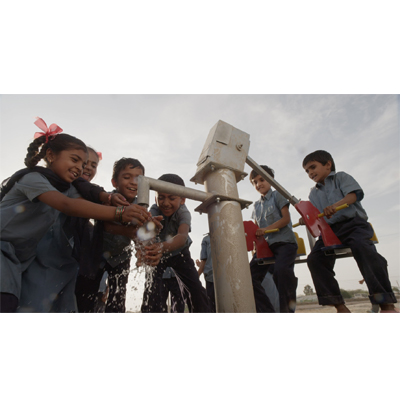
    Across many rural schools, the FMCG giant in the country found that children were not washing hands before having lunch, despite the availability of soap. The old & heavy hand-operated pumps are the only way to access water in these schools, and hence young children find it difficult and tiresome to operate them.  The challenge before the company was to create an intervention on this key barrier.

    Click here to watch the video

    So, it came up with a simple idea – turn the boring and cumbersome hand pump into a fun game!

    HUL installed specially-crafted rocking horse, made from a combination of wood and metal with a simple screw-on mechanism, on to the handles of these hand pumps in schools – transforming them into ‘Jump-Pumps’.

    At lunchtime, when children headed out of class for their meal, they were taken by surprise by this colourful addition to their school premises. The concept and the proper technique of washing hands with soap along with putting up posters at prominent spots in the school to explain the “Jump Pump” game was then explained to the kids. Apart from this, Lifebuoy soap was also provided to ensure soap availability throughout the activation period.

  • Effie Awards: It’s a honey-bunny win for Lowe Lintas

    Effie Awards: It’s a honey-bunny win for Lowe Lintas

    MUMBAI: It was a night of many firsts for the Effie Awards, 2013. The Awards, organised by the Ad Club, that honours the advertising agencies and the clients just didn’t get the highest number of entries this time – which rose up to 415 from last year’s 315, it was also webcast live on the Advertising Club website while the award ceremony was in progress on Friday night.


    Moreover, the year also witnessed the highest number of attendees at the event with more than 12,000 passes sold. Plus, two new categories – Effie for Good and Effie for Experiential Marketing – were added this year.


    Lowe Lintas & Partners and Ogilvy & Mather that were leading the list of the shortlisted case studies with 51 and 31 shortlisted entries respectively, were in for a close competition at the award ceremony. While the former took home the Agency of the Year Award for the second time (earlier one being in 2006), the men in black – Ogilvy & Mather – bagged the Grand Effie to stand at the second position.


    Lowe Lintas bagged 16 awards in total including six Gold to lead the chart with 160 points for clients including Idea (Honey Bunny, Telephone Exchange), Lifebuoy (Help a child reach five), Tanishq (Tanishq and Sridevi – Coming Back Home), Hindustan Unilever (Kissan 100 per cent natural seeded).


    O&M also managed 130 points and three Gold Effies for clients including Vodafone (Made for you, Earmuffs) and Bournvita (Aadat).


    Lowe Lintas’ chairman and chief creative officer R Balki along with his team couldn’t stop smiling after the grand victory. The agency that is not really known for participating in award shows looked delighted with its performance. “My team is happy and they are here to party,” says Balki as he remarks that he personally doesn’t believe in awards and it is his teams’ happiness and hard work that matters to him the most.


    And though the men in black lagged behind with few points, their enthusiasm at the ceremony was infectious. The close competition with the rivals and the hunger to do better is what keeps the industry motivated year after year, thinks O&M’s executive chairman and creative director Piyush Pandey. “For a long time now, there hasn’t been a close fight and I wish Lowe Lintas the very best. It is their night tonight,” he says.


    However, the third spot in the list of winners was taken by McCann Erikson that bagged one gold and 60 points. The Gold came in for Coca Cola (how Coca Cola won the battle for Indian teens).


    And it was Hindustan Unilever (HUL) that was credited with the Client of the Year award. HUL executive editor, home and personal care was happy to have won the award, he says, “These awards are about industry recognition and effectiveness.”


    The nip in the air didn’t bother the ad world much as they all came in to become a witness to the grand ceremony that was opened by MC Brian Tellis. Pratap Bose took the stage for the first time after official taking the charge of the Ad Club as the president and proclaimed that the country has some of the best advertisements/campaigns in the Asia Pacific. “The quality of our work is only improving with every coming year and we have only bettered our standards set last year,” Bose remarked in his opening speech.


    However, this year, few categories didn’t see a Silver or Gold Effie being handed over. All India Bakchod’s Rohan Joshi didn’t take much time to take a pot shot at the situation by sharing a joke on Hussain Bolt coming third even when nobody claimed the second or first position!


    But still the event ended on a “high” note with lots of fireworks to celebrate the victory as the attendees whispered that the Lintas’ win was well-deserved.