Tag: Licence Fee

  • Dish TV receives MIB notice for payment of Rs 4,164.05 crore

    Dish TV receives MIB notice for payment of Rs 4,164.05 crore

    KOLKATA:The Indian ministry of information & broadcasting (MIB) and  direct to home television provider Dish TV have been at loggerheads over this matter for sometime now. And the latter has informed the Bombay stock exchange (BSE)  that the former has brought up its demand to pay up long disputed licence fees totalling Rs 4,164.5 crore once again.  The amount includes interest and the demand from the MIB is that Dish TV pay it up within 15 days.

    The Jawahar Goel headed firm says that the MIB has clarified that the amount  is further subject to verification and audit and the outcome of various court cases pending before the TDSAT, the high court of Jammu and Kashmir and the supreme court.

    “In this regard, we would like to inform that the ministry of information and broadcasting had issued a demand notice in the year 2014 for the licence fee pertaining from the date of issuance of DTH License till financial year 12 – 13. The said demand notice was challenged by the company before the TDSAT and the said demand has been stayed by the TDSAT, which stay continues to be in force,” Dish TV said in the regulatory  filing with the BSE. .

    Further, the company's petition is also pending before the  Jammu and Kashmir high court where it has challenged  inter alia the quantum / applicability of licence fee and imposition of interest. Similar writs are also pending before the apex court.

    Dish TV informed that it is studying the communication to determine its next steps. The DTH licence  fee matter has already been through several rounds of litigation, the final outcomes of which are yet to be argued and concluded, it added. It would update the stock exchanges on any material developments.

    The notice has come at a time when the government has opened up 100 per cent foreign direct investment in DTH, extended the duration of licences given to operators.

  • TRAI simplifies definition of AGR for license fee  and  spectrum  usage

    TRAI simplifies definition of AGR for license fee and spectrum usage

    NEW DELHI: After several months of dispute and even court proceedings, the Telecom Regulatory Authority of India (TRAI) on 6 January agreed that the licence fee (LF) and spectrum usage charges (SUC) should continue to be computed based on adjusted gross revenue (AGR).

     The regulator clarified that gross revenue shall comprise revenue accruing to the licenced entity by way of all operations/activities and inclusive of  all other revenue/ income on   account of  interest, dividend, rent, profit on sale of fixed assets,  miscellaneous income etc. without any set-off for  related items of expense.

    However in the recommendations on ‘Definition of Revenue Base (AGR) for   the Reckoning of License Fee and Spectrum Usage Charges’, TRAI introduced the  concept of Applicable Gross Revenue (ApGR). ApGR would be equal to total gross revenue of the licensee as reduced by:

    (i)   revenue from operations other than   telecom   activities/ operations as well  as revenue from activities under a licence/ permission issued by the Information and Broadcasting Ministry; receipts from the USO fund; and items of ‘other income’ as listed in  the ‘positive list’ issued by the regulator.

     Following disputes/litigations between licensor and licensees on definition of  gross revenue and  adjusted gross revenue under  licence(s) granted  by  Department of Telecommunications for  different telecom services and the need to rationalise taxes as stated in the National Telecom Policy  2012, the authority has suo motu decided to  review the  existing  definition of revenue, licence fee  rate and other related matters under section 11(1)(a)(ii) of the TRAI Act.  

     Further, there was also a reference from DoT in last July requesting TRAI to   submit recommendations for delinking of  licensing of networks from delivery of  services by  way  of virtual network operators,  etc., including associated issues such as AGR,  terms  of sharing of  passive and active infrastructure, etc., under the unified licensing regime. A separate consultation paper had been issued in this regard on 5 December 2014 dealing with the issues under reference other than AGR.

     The authority earlier issued a consultation paper on “Definition of Revenue Base (AGR)  for   the    Reckoning  of   License  Fee   and   Spectrum Usage Charges on 31 July 2014”.

    Comments   and   counter   comments were received from the stakeholders and an open house discussion was conducted at New Delhi by TRAI with the stakeholders.

     Under the new recommendations, AGR would be arrived by deducting pass through charges from ApGR.  No change is recommended in   the existing definition of pass through charges (i.e.  deductions)  under  different licences to  arrive at AGR  for  the computation of LF and sue except the inclusion of access charges paid by  TSPs providing international calling card services and toll-free charges.
     
    SUC should be levied on AGR of respective telecom services which use access spectrum in operations or providing services.

     Share of USO  levy  in  LF should be  reduced from the present 5 per cent to  3 per cent of   AGR   for   all   licences  with  effect  from    1  April   2015.  With    this reduction, the applicable uniform rate of licence fee would become 6 per cent (from   the present 8 per cent)  of  AGR  viz.  the 3 per cent  of  LF  that directly accrues currently to  the Government will not  change.
     
    ISPs having AGR  less than Rs  5 crore in  a year shall pay  licence fee of Rs 10  lakh or  actual LF based on  the applicable rate, whichever is less.
     
    Minimum presumptive AGR for  the   purpose of LF and SUC should not be  made  applicable  to   any  licence(s)  granted   by   Government   for providing telecom services.
     
    IP-I  services may not be  brought under the licensing regime.
     
    For  simplicity of administration, ease of verifiability and to avoid higher transaction and compliance costs, any netting of amounts paid  to other entities should not be  permitted for  the computation of  AGR  so  as to meet with the  licence condition that  does not   permit setting off  any related item of expense.
     
    Accounting of deductions of pass through charges from ApGR  to  arrive at the relevant revenue base (i.e.  AGR)  for  the computation of  LF and SUC   should be  allowed on  an accrual  basis.  However, in  the   case  of service tax  and sales tax/  VAT collected on  behalf of  the   Government, deductions  from    revenue  should  be   allowed  only  for   the    amount actually paid to the  Government.
     
    (xii)    Intra-circle roaming charges should not   be  allowed as deduction from ApGR   for   calculating  AGR   of   the    telecom  service  provider  for   the purpose of computation of LF and SUC.
     
    The DoT   should  introduce  a  standardized  process of  verification  with   a unique code assigned to each item of revenue and PTC,  along with  clear codal instructions   to    be    uniformly   followed  by    all    licencees  and Controller of Communication Accounts.


  • One more week to respond to TRAI paper on resolving issue of the controversial AGR for broadcast, telecom

    One more week to respond to TRAI paper on resolving issue of the controversial AGR for broadcast, telecom

    NEW DELHI: The Telecom Regulatory Authority of India (TRAI) has decided to give one last opportunity to stakeholders to respond to its consultation paper on a review of the definition of Gross Revenue (GR) and the permissible deductions to arrive at Adjusted Gross Revenue (AGR) in the context of the National Telecom Policy 2012 in view of a multitude of cases by both telecom and broadcast operators.


    Stakeholders have been given one extra week and can respond to the 24 questions raised by the Authority by 8 September with counter comments if any by 15 September. This is being done in view of the important issues involved, but TRAI said no further opportunities would be given.


     The Authority will also examine the components of GR, AGR and minimum presumptive AGR, rates of licence fee and spectrum usage charges, formats of statements of revenue and licence fee, and audit and verifiability of revenue and licence fee.


    The paper on ‘Definition of Revenue Base (AGR) for the Reckoning of Licence Fee and Spectrum Usage Charges’ will also examine the changes made in the licensing regime, the transition from the administrative allocation regime towards market-determined prices for spectrum, and the conclusion of tenure of many licences. The paper provides the relevant background information on the subject covering various issues involved.


    On the definition of AGR specifically, the Authority had in 2012 recommended that only the revenue from the wireless services shall count towards AGR calculation for the limited purpose of calculation of Spectrum Usage Charges (SUC) that would continue to be determined on service area basis, and should be levied only in respect of those service areas where the Licensee holds any access spectrum.


    TRAI wants to know whether there is a need to review/revise the definition of GR and AGR in the different licences at this stage; the guiding principles for designing the framework of the revenue sharing regime; and whether the rate of licence fee (LF) be reviewed instead of changing the definitions of GR and AGR, especially with regard to the component of USO levy In the interest of simplicity, verifiability, and ease of administration.


    The paper also wants to know whether the revenue base for levy of licence fee and spectrum usage charges include the entire income of the licensee or only income accruing from licenced activities if the definitions are to be reviewed/revised.


    It has asked whether LF be levied as a percentage of GR in place of AGR in the interest of simplicity and ease of application, and should the revenue base for calculating LF and SUC include ‘other operating revenue’ and ‘other income’.


    The government prepared a draft licence agreement for International Long Distance (ILD) services in September 2000 containing a provision that LF was payable as a percentage of revenue. For the Public Mobile Radio Trunk Service (PMRTS) too, the revenue share regime was made applicable from 1 November 2001.


    The definition of AGR has been litigated since 2003. TSPs questioned the inclusion of various components of revenue in the reckoning of AGR as well as the legality of the definition before TDSAT. In 2006, TDSAT, after noting that revenue from non-licensed activities needed to be excluded from the reckonable revenue, asked TRAI to make recommendations on the inclusion or exclusion of the disputed items in the AGR. TRAI made its recommendations on 13 September 2006 and the Tribunal gave its final order in the matter on 30 August 2007 after accepting most (but modifying some) of TRAI’s recommendations.


     In the course of finalising the recommendations of the Authority on the reference from TDSAT, the views of DoT were obtained by the Authority through its representative and incorporated in the “Recommendations on components of Adjusted Gross Revenue” dated 13 September 2006. The Authority was informed that the basic rationale adopted by the government while formulating the definition of AGR was that it should be easy to interpret – so as to pose fewer problems in application and less disputes and litigations, and to make it less prone to reduction in LF liability by way of accounting jugglery; and it should be easy to verify.


    The TDSAT’s judgment of 30 August 2007 was taken in appeal by DoT to the Supreme Court and was set aside by its judgment on 11 October 2011 on the grounds, among others, that TDSAT had no jurisdiction to decide the validity of the terms and conditions of the licence including the definition of AGR incorporated in the licence agreement. It was for DoT – and not TRAI and TDSAT – to take a final decision on the definition of AGR. The Supreme Court also held that a licensee can raise a dispute about the computation of AGR relating to a particular demand and that TDSAT can then examine whether the demand was in accordance with the licence agreement and the definition of AGR. 


    The judgment of the Supreme Court settled important points of law and has clarified the nature of the contractual relationship between the government as licensor and the TSPs. The judgment also laid down the parameters of institutional responsibility in arriving at the contractual terms and conditions; it held that: Litigation regarding the computation of LF continues before the TDSAT in the case of individual demands made on TSPs. It has also been reported that writ petitions re-agitating the revenue share definition have been filed by TSPs in different High Courts.

  • TRAI extends DTH licence period to 20 years

    TRAI extends DTH licence period to 20 years

    MUMBAI: The Telecom Regulatory Authority of India (TRAI) has released its recommendations for a new DTH licensing regime today. As part of this, the period of DTH licence has been extended from the current 10 years to 20 years, renewable by 10 years at a time.


    The Regulator has said that the existing licence fee will be reduced from 10 per cent of gross revenue to 8 per cent of adjusted gross revenue, in line with the telecom licences.


    Also, the existing DTH licensees will be permitted to migrate to new regime at any time during the currency of the existing licences. Meanwhile, the one time entry fee has been retained at Rs 10 crore.


    The salient features of the recommended new DTH licensing regime are as follows:


    The   period   of  DTH  license  to  be  increased  from   10  years to  20  years, renewable by 10 years at a time.


    One time entry fee to be retained at Rs 10 crore.


    Existing license fee to be reduced from 10 per cent of gross revenue (GR) to 8 per cent of adjusted gross revenue (AGR) in line with the telecom licenses.


    The existing DTH licensees to be permitted to migrate to new regime at any time during the currency of their existing licenses.


    BIS   to    come     out    with     updated     specifications for     STBs in consultation with TRAI which should be complied by DTH licensees.


    The DTH licensees to be mandated to comply with the tariff order  scheme prescribed by TRAI for commercial inter-operability.


    The salient features of the Recommendation on Cross Holding/Control in the Broadcasting and Distribution Sectors are as follows:


    Policy on Cross-holding/Control to be restructured to bring in uniformity in the broadcasting and distribution sectors.


    Comprehensive definition of ‘control’ to be uniformly adopted in all segments of broadcasting and distribution sectors.


    Relevant market for DTH to be the   entire country and   for MSO /HITS – State.


    Broadcasters and Distribution Platform Operators (DPOs) – MSO /HITS  and DTH operators to be separate legal entities.


    Rationalised and regulated vertical integration to be permitted between broadcasters and DPOs.


    Vertically integrated broadcaster(s) and DPO   to   be   subjected   to additional set of regulations.


    A vertically integrated broadcaster to be permitted to control only one DPO.


    A vertically integrated DPO to be restricted from controlling any other DPO of other category in the relevant market.


    A vertically integrated DPO not to be permitted to acquire more than 33 per cent of the market share in the relevant market.


    The additional regulations for a vertically integrated broadcaster to include:


    The   agreements with   the   DPOs   to be non-discriminatory and   on charge-per-subscriber (CPS) basis.


    To file the   Reference Interconnect Offer (RIO) for approval by the Authority. All Interconnection Agreements to be only on the terms specified in the RIO.


    To make disclosures as prescribed by the Authority.


    The  additional regulations for a vertically integrated DPO would  include:


    DPO to declare its channel carrying capacity and not to reserve more than 15 per cent of this capacity for its vertically integrated broadcaster(s). Rest of the capacity to be offered to other broadcasters on non¬ discriminatory basis.


    DPO   to   publish the   access fees   for carriage of channels over   its network.  The    charging of   the    access fees    should be   on   non­ discriminatory basis.


    To make disclosures as prescribed by the Authority.


    The   Authority  to  come   out   with   appropriate  Regulations/Orders for  the regulatory  framework  and  disclosures  after    the   government   takes  the   policy decision on  the  recommendations.


  • Dish TV’s appeal to the Finance Minister

    Dish TV’s appeal to the Finance Minister

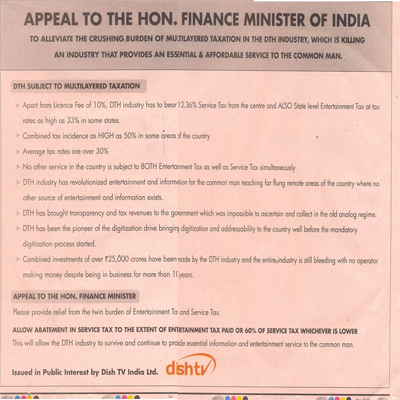
    MUMBAI: The Direct to Home (DTH) industry has been vehemently opposing the heavy taxation being levied on the various operators in the country. In view of the same, the country’s oldest DTH operator Dish TV has appealed to the new Finance Minister Arun Jaitley.


    The DTH operator in its appeal has requested the Minister to alleviate the crushing burden of multilayered taxation in the DTH industry which is in turn killing the industry. The operators are subject to several taxes such as 10 per cent licence fee, 12.36 per cent service tax from the centre and the state level entertainment tax which is as high as 33 per cent in some states. While the average tax rates in most states is 30 per cent, in some it is as high as 50 per cent.


    The appeal states that no other service in the country is subject to both service as well as entertainment tax at the same time. “DTH industry has revolutionised entertainment and information for the common man reaching far flung remote areas of the country where no other source of entertainment and information exists. It has brought transparency and tax revenues to the government which was impossible to ascertain and collect in the old analogue regime,” states the appeal.


    Dish TV says that the entire industry has made investments of over Rs 25,000 crore but is still bleeding with no operator making money despite being in business for more than 10 years.


    The request by the operator on behalf of the entire industry is to provide relief from the twin burden of entertainment tax and service tax. It requests to allow abatement of service tax to the extent of entertainment tax paid or 60 per cent of service tax whichever is lower.   

  • TDSAT adjourns DTH licence fee case to 22 May

    TDSAT adjourns DTH licence fee case to 22 May

    NEW DELHI: The petition by private direct-to-home (DTH) operators challenging the notice of the government for clearing arrears of licence fees was adjourned by the Telecom Disputes Settlement and Appellate Tribunal (TDSAT) to 22 May.
     

    The DTH operators were given time by chairman Aftab Alam and Kuldeep Singh to file their rejoinders following the reply by the government.


    TDSAT also noted that the earlier assurance by the government that it will not pressurise the operators in this regard till the case is taken up for hearing will continue.

      
    Even as the petitioners have alleged that the demand by the Information and Broadcasting Ministry is contempt of court as the matter in this regard is pending in the Supreme Court, I&B secretary Bimal Julka had earlier told indiantelevision.com that the apex court had not issued any stay order.

     
    However, conscious that the TDSAT or the Supreme Court may be moved in the matter, a caveat had been filed by the Ministry in this regard.

     
    The Ministry had recently sent a notice to the six private DTH operators with regard to licence fee dues amounting to Rs 2,066 crore. The private operators are Tata Sky, Dish TV, Airtel Digital TV, Reliance Big TV, Sun Direct and Videocon d2h.

    According to the notice, the six private operators had been asked to pay the amount within 15 days.

     
    However, most of the operators contacted said they had cleared the dues of licence fee.

     
    The operators say the licence fee as demanded under the rules is on gross revenue (GR) whereas they have been asked to pay the fee on the basis of Actual Gross Revenue (AGR). The operators have said the fee should be only on subscription revenue and not on allied earnings such as dividend and interest income. 


    Meanwhile, Tata Sky late last month made a payment of Rs 383 crore to the Ministry to cover its license fee and other dues. A demand draft of the amount was submitted to the Ministry. Even as other operators had said that they would prefer to wait till the next hearing.

     
    This amount covers license fee for the year 2013-14 according to the rate specified for license as well as past dues, for which the Ministry had raised a demand note recently.


    TataSky MD and CEO Harit Nagpal had earlier said in a statement: “We hope that this will end the long standing dispute on the subject and pave the way forward for a constructive rationalisation of taxes with the support of our parent Ministry.”