Tag: Leo Burnett

  • Digital agencies eye GoaFest 2014

    Digital agencies eye GoaFest 2014

    MUMBAI: While the 2013 edition wasn’t exactly the best, with the controversy around ‘scam ads’ and a couple of heavyweights like Ogilvy and Creativeland Asia bowing out, this year’s Goafest promises to be a definite improvement over its predecessor.


    The ninth edition has been postponed to May because of the ongoing elections and will revolve around the theme ‘Brand Baaja Baraat’. The fest will focus on macro-economic issues affecting advertising. There will be a first-of-its-kind leadership summit addressed by an interesting line-up of speakers. Among other changes, Goafest 2014 will have a new category ‘promo activation and PR’ while adding Broadcaster and Publisher Abbys to the existing list of awards.


    Speaking of awards, taking a cue from last year’s fracas, the committee has introduced changes to the judging process after feedback from creative professionals. The selection process will comprise two rounds with a gap of 10 days in between. Short-listed entries from round one will be put up on the Goafest official website. Complaints backed by evidence will be considered for review by jury chairman for that particular category.


     Significantly, the ‘digital’ category – which caught the industry’s attention last year – promises to be even bigger this year. Goafest 2014 chairman Srinivasan Swamy said he would be able to give the exact number of digital entries post 23 April, the extended deadline for submission of entries.


    It can be noted that in the Media Abbys’ category which received 660 entries, 40 – 45 per cent of them came from digital-related categories. The organisers had expanded the digital category to include relevant sub-categories in the 2013 edition. This year there are around nine sub-categories in digital, two in mobile, six in digital craft and nine in best use of digital media


     Though the likes of Leo Burnett, Ogilvy and Creativeland Asia are not participating, lots of digital agencies are really looking forward to the fest.


    Ahead of Goafest 2014, ad2campaign co-founder and managing director Madan Sanglikar tells indiantelevision.com, “Last year’s Goafest got everyone talking about the burning issue of ‘scam ads’ rather than brush it under the carpet. Scam ads are a reality and we need to have regular debate and discussion to keep them under control.”


    Sanglikar went so far as to suggest ways to curb scam ads. “Firstly, by creating a separate category called ‘proactive ads’ that would showcase ads which were never released but could have made a difference because of their innovative appeal. This would give creative people due recognition while acknowledging that these ads did not constitute real campaigns. Secondly, by instituting an open rating/meter which shows how many brands have been participating in questionable tactics. The assumption here is that clients are usually in cahoots with creative people in the making of scam ads,” he explains.


    Speaking of digital agencies, Sanglikar says, “Digital is main-stream by now. So digital agencies are no different from other agencies and if there is a fest for the advertising industry, it cannot be complete without digital agencies. Having said that, there have lately been too many award shows for digital agencies, so Goafest will also have to create a better differentiation.”


    ibs, which won the Grand Prix last year for its Tata DoCoMo digital campaign, is eager to participate in Goafest this year too.  “We are letting the younger lot to lead this year. We are allowing them to enter their work and make the submissions with absolute freedom and empowerment. Given this change, we are hopeful that the rank and file of the agency will get more deeply involved in the Goafest. While we are optimistic of some of our work getting noticed, winning awards is not the most important objective for us at Goafest this year”, says ibs MD Sabyasachi Mitter. He adds that success at Goafest would help draw the immediate attention of the entire advertising fraternity.


    According to sources, while a few mid-sized digital agencies are giving the fest a miss as they are cutting down budgets and will be selective while entering awards. On the other hand, a few big digital agencies are submitting a good number of entries and are positive about being recognised for their good work.

  • RajDeepak Das joins Leo Burnett as chief creative officer

    RajDeepak Das joins Leo Burnett as chief creative officer

    MUMBAI: Last week, the industry got the news of KV Shridhar (Pops) moving on after 17 years with Leo Burnett.


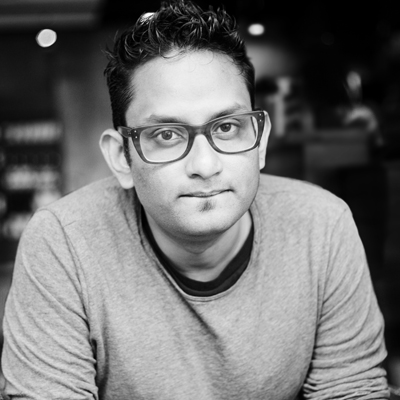
    Today, the agency announced the appointment of RajDeepak Das as the chief creative officer (CCO), Leo Burnett India. In his new role as CCO for India, he will be looking at operations across Mumbai, New Delhi, Bengaluru and Chennai.


    Das will be based in Mumbai and will work closely with CEO Saurabh Varma. He said, “I always believed that ‘Agencies don’t create iconic brands, people do.’ And that is what Leo Burnett stands for. In Leo Burnett I want to bring in new trends of communications to make our brands future ready.”


    Leo Burnett Worldwide chief creative officer Mark Tutssel who was personally involved in the recruitment process that spanned several continents, said that Das, with his proven track record behind world-class, award-winning work for global brands including P&G, Pepsi, Visa, Pizza Hut and Tesco among others is a new breed of creative, modern-day leader, a holistic thinker with sharp business acumen.


    “Raj brings with him an exuberant amount of global experience, creativity, focus and best-in-class leadership.  He understands today’s creative landscape is always-on and always integrated. The decision to bring Raj on board as our CCO holds immense promise for our clients and our creative product. I strongly believe that Raj, alongside Saurabh will form a perfect unity of creative and strategy, making the agency, one of India’s leading creative agencies today, the best integrated agency in the region going forward,” Tutssel said.


    “The appointment of Raj and his partnership with Saurabh represents a new beginning and milestone for Leo Burnett India. India’s growing importance as an economic force on the world stage and its rapid change from a traditionally print and TV dominated market to one that will see online ad market reach $1.12 billion next year are key indicators of transformation in our clients’ businesses. We are focused on ensuring that Leo Burnett is at the forefront of this change, with the agility to meet the needs of today’s marketers. I have no doubt that under the combined power of Saurabh’s strategy and Raj’s creative leadership, they will be able to jointly take the agency to the next level and evolve into the new model of HumanKind communications company. Both of them will have the full support of the network to make Leo Burnett the fastest growing and most creative integrated agency in India,” said Leo Burnett Asia Pacific president Jarek Ziebinski.


    Varma added, “Five months back we communicated our intention to be the best integrated communication company in India. With the appointment of Raj, we have made a decisive step in that direction. Raj and I will partner to create work that is not only human, but also participative by design. We will focus on work which brings out the purpose of our brands. Ultimately, the route to building the most popular brands is in creating work which creates believers not just consumers.”

  • Vote! Because you must

    Vote! Because you must

    MUMBAI: For every Indian citizen, who is escaping the power to use their own weapon for change, ET NOW India’s #1 Stocks and Business News channel has launched an election special initiative by Brand Equity called ‘Vote, India! with an intent to mobilize voters to cast their franchise.


    Under the initiative, three impactful TV films (created by India’s finest advertising agencies – McCann Erickson, Publicis and Leo Burnett) urging India to cast their vote, are now up in the race to be Voted as the Best one.


    Practicing democracy to the last bit, the best TV film will be adjudged basis people’s votes; all one needs to do is to log onto the ET NOWs Brand Equity FB page on www.facebook.com/brandequity and cast their vote for the campaign they deem as most effective on or before 1st April.


    Along with, the films will be judged by a panel of esteemed jury comprising Akshay Raut, Director General, Election commission of India, Milind Deora – Minister of State Ministry of Communications and Information Technology (India), Anupam Kher – Actor, Amitabh Kant –Secretary, Dept of Policy & Promotion & Piyush Pandey, Executive Chairman & National Creative Director Ogilvy & Mather India.


    Hosted by Sonali Krishna, the election special Brand Equity episode, announcing the winning Film will feature on Wednesday, April 02 at 10.30 pm followed by repeats on Saturday 2.30 pm & Sunday at 11 am.

  • I will return after ‘Bhootnath Returns’: Nitesh Tiwari

    I will return after ‘Bhootnath Returns’: Nitesh Tiwari

    MUMBAI: After his first directorial debut, Chillar Party, Leo Burnett’s chief creative officer (CCO) Nitesh Tiwari’s second film Bhootnath Returns, starring Amitabh Bachchan, will hit the screens in April, this year.


    And it is after this that the man will return to the creative agency.


    “I was supposed to join back in February and because of the film it got a little delayed,” says Tiwari rubbishing the various speculations about him not coming back to Leo Burnett.


    “I will be back in April once the film releases,” says Tiwari.


    Another rumour doing the rounds in the industry is that of Leo Burnett’s chief creative officer India subcontinent KV Sridhar (Pops) leaving the agency.  


    “I’m not going anywhere. It is all rubbish,” says Pops to indiantelevision.com. “If I stand for elections for Aam Aadmi Party, I will let people know,” he adds in humour.


    In 2012, both Pops and Tiwari were handed over the additional roles of looking at the subcontinent and pan-India, respectively, with an aim to better and grow the agency.


  • Leo Burnett’s Arvind Sharma grills Group M south Asia CEO CVL Srinivas

    Leo Burnett’s Arvind Sharma grills Group M south Asia CEO CVL Srinivas

    It was in early 2012 that CVL Srinivas (fondly called Srini) succeeded Vikram Sakhuja as GroupM South Asia CEO. At the time, GroupM AP CEO Mark Patterson and Srini’s boss had said that he was their first choice for the role, and that he had the skills, personality, relationships and attitude to build the business on strategy, and with his own style and ideas as well.


    For Srini, it was an opportunity to go back to an organization where he had learnt the ropes and mastered the rules of the game. Since Srinivas took charge, a lot of changes were made in the agency to up the ante in the competitive market scenario. Indiantelevision.com’s Guest Editor of the day, outgoing chairman of Leo Burnett, Arvind Sharma spoke to his old friend, Srini, to see how the agency has done so far…


    Srini, it has been just over a year since you took over as CEO of Group M in the country. What was the strategy and what were the priorities you set as the new CEO?


    Clearly, our agency brands are the real heroes in the market. GroupM is only the support structure that leverages the overall scale of the business. The first priority was to help our agency brands to leverage the knowledge and expertise of GroupM, support them with best practices, and help push their business further.


    The next priority was and still continues to be our focus on the New Core, that is,  Digital, Content, Trading, Analytics and Experiential Marketing, with a greater focus on Digital. Digital is no longer a ‘nice to have’ but is an integral part of a brand’s communication strategy, content and plans. We started our digital practice 12 years ago, and have the early mover advantage. However, in 2013, we really scaled it up to a much higher level with the ‘New Me’ initiative, beginning with a change in mindsets. We laid out a three-year plan, and we have made incredible progress in year one.  It is a continuous effort that integrates traditional core media practices with the new core like digital and social media, content, search, analytics, etc.


    Our third focus area has been our younger employees, who really are the future of the industry.  We introduced the YCO (Youth Committee) last year that works very closely with the EXCO (senior leadership) at GroupM. This project was in fact piloted in India. The YCO has made a significant contribution in the very first year. These bright young minds from our agencies and specialist practices are now part of the decision-making process. They are really our feet on the street, bringing in a slew of fresh ideas and insights.


    Did execution of this strategy involve structural changes at the agency? What were they?


    Keeping in mind our ‘New Me’ vision in 2013, there was greater organizational focus on the New Core- Digital, Content, Trading, Analytics and Experiential Marketing. We began embedding New Core talent within our agency brands and will continue the effort in 2014 as well.


    We also looked at a more simplified structure to ensure focus on new core areas. For example, as our business evolved, we realized that certain units need to be restructured to create a lean and agile team. We merged two of our units, Dialogue Factory and Dialect, to build a single activations powerhouse – Dialogue Factory. Today, Dialogue Factory has the expertise to plan and execute any and every aspect of experiential marketing, ranging from high-end luxury events to focussed rural outreach programs.


    Would you share the progress Group M has made in terms of the strategic priorities set by you?


    Our agencies and specialist units have had a significant year. We won over 80 new businesses in 2013 and managed to retain some key clients. We dominated the domestic and international industry awards last year, with our agencies and specialist units winning an award every other day.  All our agencies rank high as per the recent 2013 RECMA ratings. To cap this performance, last year, we were awarded the Porter Prize, making us the ‘only’ media and advertising agency to win the Award.


    Keeping in mind our focus on digital and the new core via ‘New Me’, our digital contribution grew by 50 per cent last year.


    We have rolled out several unique initiatives in the talent space. Over the years, GroupM Aspire has established itself as a best-in-class training and development programme. We have introduced several interesting programmes in Aspire and have linked it to our new vision.  Basis the inputs we got from our Y-Co, we brought in several new welfare measures. We were recently crowned the “Dream Company to Work for” in the Media & Entertainment sector at the World HRD Congress.


    One and a half years later, do you see the need for any tweaks in your strategy?


    In today’s market, GroupM’s agility, coupled with our deep understanding of the market is what is keeping us ahead. Having said that, evolution is the only constant, and as the media landscape changes, bringing us new opportunities and challenges, we will need to evolve ourselves and some of our practices.


    2013 was generally a tough year for the industry. How do you see 2014 panning out?


    While 2013 was a challenging year, it did bring in a lot of opportunities. The slowdown of the economy and uncertainties  surrounding policy put a lot of pressure on our clients and their media budgets, and we did take a lot of course corrective action in the middle of 2013. The year also gave us the opportunity to see some great innovation across planning and buying, developing new proprietary tools, diversifying our talent and building some interesting partnerships.


    We are cautiously optimistic about the media industry in 2014. The GroupM TYNY 2014 forecasts the AdEx to grow at 11.6 per cent with the highest growth percentage for Digital at 35 per cent followed by Television at 12 per cent. Sectors like FMCG, Auto and Retail will continue to be stable. We will see an increase in rural spending by several sectors like FMCG and Telecom, and with that, we also plan to expand GroupM’s offerings geographically. The first half of the year will continue to be uncertain, given the general economic and political environment, however, we foresee a stronger second half with an upsurge in ad spends across categories.


    We will continue to focus on our New Core offerings including Digital, Content, Trading, Analytics and Experiential Marketing. Our agencies have already done some ground-breaking work in the first quarter with branded content and digital media.

  • There is a Government in my TV

    There is a Government in my TV

    From the days of a single Doordarshan channel where one had to watch Krishidarshan and pretend that one is enjoying it, Indian TV has come a long way.  The choice of channels is awesome, sometimes even exhausting. There is music. There are movies. There are soaps. There is news. There is education and there are a host of special interest programmes and channels. TV is no longer just colour. If one is willing to pay for it, it is full HD with Dolby Surround Sound.


    Indian Government in general and a succession of Ministers of Information and Broadcasting have played a stellar role in this progress. They have been supported by outstanding bureaucrats – from Secretaries of I&B at the top to Joint Secretaries. They have been friends of the Indian public and accessible to the industry. How much the industry values the caliber and integrity of these people individually is reflected in the fact that a couple of years ago, by popular vote the industry picked Mrs Ambika Soni as the Impact Person of the year.


    That said, government actions in the last year or two have raised a question in many minds about the role the Government should be playing in the world of media. Not many will debate that Government has a role to play in setting the policy for media. And that the policy has to cover a number of areas.  Content to the extent it can impact law and order or public’s sense of decency for one.  Foreign investment for another. These two policy areas are relevant to all media. The third are where TV, Internet and probably radio are unique is the pace of technological advancement.  Various components of the industry have to move forward in unison to commercialize technological innovations and make them accessible to all. And to that extent government must be involved in setting these technological standards.


    Beyond that, Government’s involvement in issues like adcap and TV audience measurement in truth is hard to justify.  In the courts and tribunals, one can advance arguments referring to clauses of acts to justify these ‘policies’. Examples of anything can be found if one looks at government regulations around the world to support a government’s stand.


    But let us pause and look at some of these questions dispassionately, honestly.  What is not so unique about TV that it has advertising. If the government does not prescribe the max percentage of advertising a newspaper can carry or a website can carry, why should it prescribe a limit in the case of TV?


    What is not unique about TV is that advertisers want audiences of each media vehicle measured so that they may rationally decide the price they will pay for it. If the government does not prescribe guidelines for print readership measurement or internet engagement measurement, why should it be involved in setting guidelines for TV ratings measurement?


    Fewer regulations in important areas of policy and their strong enforcement make for a healthy, economically vibrant society.  Government’s involvement in setting ‘policy’ in dozens of micro-areas makes for a high-cost uncompetitive economy. Perhaps the incoming Government will take heed and pull out of regulating these micro-areas that are best left to the market forces.


    (Arvind Sharma, outgoing chairman of Leo Burnett, was the Guest Editor Of the Day at Indiantelevision.com)

  • Raising iBrows launches operations in Mumbai

    Raising iBrows launches operations in Mumbai

    MUMBAI: Raising   iBrows,   a   leading   Audience   Engagement   Specialist   with   a   wide   range   of   services, announced today the launch of its operations with the opening of its new office in Mumbai.  
     
    Raising iBrows’ Audience Engagement Services have enabled brands across a wide range of businesses to transform the way they engage with their prospects and customers. With multiple points of engagement  in a connected world, Raising iBrows brings deep understanding,  insight and expertise of user experience, user interface design, technologies and applications for brands to offer the best possible experience to their audiences at the point of engagement, no matter what the size of the screen. This improves the experience of those engaging with them, increases productivity, and growth in customers and revenues.

     
    Speaking on the launch of operations in Mumbai, David Appasamy, Chairman, Raising iBrows, said, “We are excited  to launch  our services  in Mumbai  and look forward  to partnering  with brands and businesses to transform the experience they provide across multiple points of engagement. Ganapathy Vishwanathan, with years of experience in marketing, advertising and communications,  heads the team, while Carl Noronha,  our Head of Engagement  Strategies,  is based in this office. Together, they bring years of expertise and experience to bear on the brands we are entrusted with.”

     
    Ganapathy  Viswanathan,  Head-­?Mumbai  Office, Raising iBrows, has many years of marketing, brand and business management experience with Ogilvy & Mather, RMG David and 20:20 MSL. Speaking on the launch of operations, he said, “Mumbai has always been a vibrant centre for businesses and brands in India, and we look forward to expanding our client base in the city. Our cutting edge design, technology and services will give an edge to companies and brands as they have to our clients across verticals.”

     
    Carl Noronha, Head-­?  Engagement Strategies, Raising iBrows, has over 25 years of experience in marketing and advertising, and was Creative Director at Leo Burnett, Sify and Dzine. He was in charge of design for Sify’s consumer portal, and the architect of India’s first and largest online community.  Commenting  on the Mumbai  Launch,  Carl  Noronha  said,  “Our  expertise  is relied upon  by  clientele   across   real  estate,   finance,   media,   healthcare,   information   technology, educational  institutions,  lifestyle  and jewelry,  foods,  fashion,  automobiles  and paints.  We are happy to be able to offer our experience and services to brands and businesses in Mumbai”.
     

    The  company  currently  has  offices  in  Chennai  and  Mumbai,  with  plans  to  expand  its  footprint  further in India and overseas.

  • Now, health on call!

    Now, health on call!

    MUMBAI: What if you called a friend and heard a celebrity sharing health tips instead of the usual caller tune? Would you get annoyed, give a good ear or better still, make it your own to spread awareness.


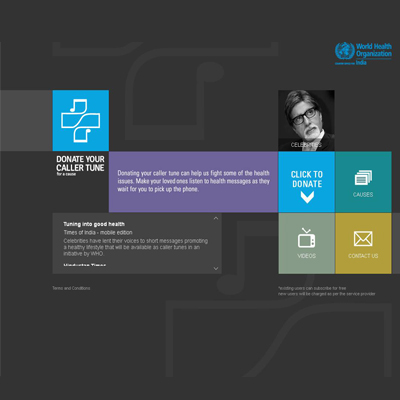
    Well, Leo Burnett and World Health Organisation (WHO) certainly seem to think you will change your caller tune. Which is why the duo has created a campaign titled ‘Donate your Caller Tune’ which lets you hear health advice from a celebrity and activate the same on your mobile phone in a bid to keep up the good work.


    The initiative, being promoted on digital platforms, covers 12 diseases with 12 celebrities talking about them, including the likes of Amitabh Bachchan, John Abraham, Cyrus Broacha, Parineeti Chopra and Shankar Mahadevan.


    Easily the world’s biggest mobile health campaign, ‘Donate your Caller Tune’ has been kicked off in India and will travel to other countries only after strengthening base here.


    So why was India chosen as the launch pad? Because non-communicable diseases (NCDs) are presently the leading cause of death across the globe and in 2008, India alone accounted for 53 per cent of all such deaths worldwide. Also because India has a record 600 million mobile phone users and WHO aims to reach all of them through this campaign.


    WHO India representative Dr Nata Menabde says: “Donate Your Caller Tune is an idea where people take responsibility and ownership to spread awareness of health concerns voluntarily. To us, this simple idea of using a caller tune to create mass awareness appealed a lot when presented by Leo Burnett. Caller tunes are very popular in India and it made perfect sense to leverage the power of the mobile phone to create awareness about health issues.”


    Leo Burnett NCD K V Sridhar who himself suffers from diabetes, believes the campaign will benefit millions. “Diabetes runs in my family so when I got a chance to educate people, I jumped on it,” he says, giving the example of actor Imran Khan who chose to become an ambassador for cancer awareness because he lost his near and dear ones to the disease. “I usually get 40-50 calls in a day and I’m sure others do too. So, instead of hearing a song or a joke, wouldn’t it be better if we created awareness about various health related issues by donating our calling tunes for the cause?” he questions.


    Apart from roping in 12 celebrities, the other herculean task for Leo Burnett was to get all mobile service providers on board. The campaign was launched in November last year with just two service providers VSNL and Airtel and it is only now that others have joined the fray.


    People interested in participating need to SMS their service provider to activate the caller tune for the cause they wish to support and spread awareness about. Charges vary as per the service provider.

  • AAP a big draw for media professionals

    AAP a big draw for media professionals

    MUMBAI: As a fledgling party which emerged from the larger ‘India against Corruption’ movement, the Aam Aadmi Party (AAP) had already captured a nation’s imagination.


    But when it made a splash at the Delhi Assembly Elections, going on to form the government in the national capital, it made seasoned politicians sit up and take notice as well.


    And just in case you thought there was no public relations mechanism behind the phenomenal success of AAP, you couldn’t be more wrong. The party has been a magnet for media professionals ever since its inception with many known names coming forward to support it and in some cases, even going on to join politics.


    For instance, the media campaign for the Jan Lokpal Bill was the brain child of former media professional Shaizia Ilmi. Manish Sisodia, who played a key role in the foundation of the anti corruption bill and went to jail with activist Anna Hazare is a former journalist who worked with Zee News and All India Radio. Ditto for Rajan Prakash, who worked as a journalist in TV, print and radio for more than a decade apart from helping write the scripts of over 12 documentaries as well as radio programmes before finding his political calling. At 26, former journalist Rakhi Birla, who won Delhi’s Mangol Puri constituency, is the only woman in Arvind Kejriwal’s cabinet and the youngest one at that. The much talked about addition to AAP has been that of Ashutosh, former IBN7 managing editor who left a high-profile job to join the party.


    So what is it about AAP that is encouraging the media fraternity to enter the political circus?


    “It’s their honesty which I support,” says Leo Burnett NCD K V Sridhar (Pops) who tweeted and facebooked his support to AAP and joined it through its massive ‘Mai bhi Aam Admi’ campaign that lets anyone be a part of the ‘change’. “Until and unless they make mistakes or become like the others, they have my support,” he adds.


    Former COO of Star Network now turned media entrepreneur Sameer Nair, who joined AAP last year, believes any professional with the right principles would support the party. “We all want corporate governance, financial stability, anti corruption amongst all the correct ingredients to run the country in a better way,” he says, pointing out that the Right to Recall is a basic right as one shouldn’t take his/her seat lightly once elected for five years by the junta. “Every day, media professionals walk into the AAP office to support it or help in whatever way they can. We need such enthusiasm from people,” Nair says, stressing that the party needs the expertise of professionals from all walks of life to work together and create a better nation.


    Political analyst Dr Suhas Palshikar feels AAP is a refreshing change from the rest. “There are many who want to see a change in the country and the new party brings with it new ideas. It has provided people, especially the middle class, a platform to be part of a change and voice their opinion,” he says.    


    Writer-entrepreneur-youth expert Rashmi Bansal, who met Kejriwal in 2009 and featured him in her 2011 book ‘I have a Dream’ feels that media professionals have a close-up view of such issues which is why they get more drawn to it. “Media professionals know what goes on behind the scenes and they see AAP as a different entity which will not only hear them but also give them a voice and a platform to make the change they want to see,” she says.


    And the list of supporters keeps growing… Late Jaspal Bhatti’s wife Savita Bhatti, Mallika Sarabhai, Tejaswini Kolhapure, Aamir Khan and Salman Khan all believe the party can bring about a change…