Tag: leadership

  • FCB India announces its newly elevated C-Suite leadership team

    FCB India announces its newly elevated C-Suite leadership team

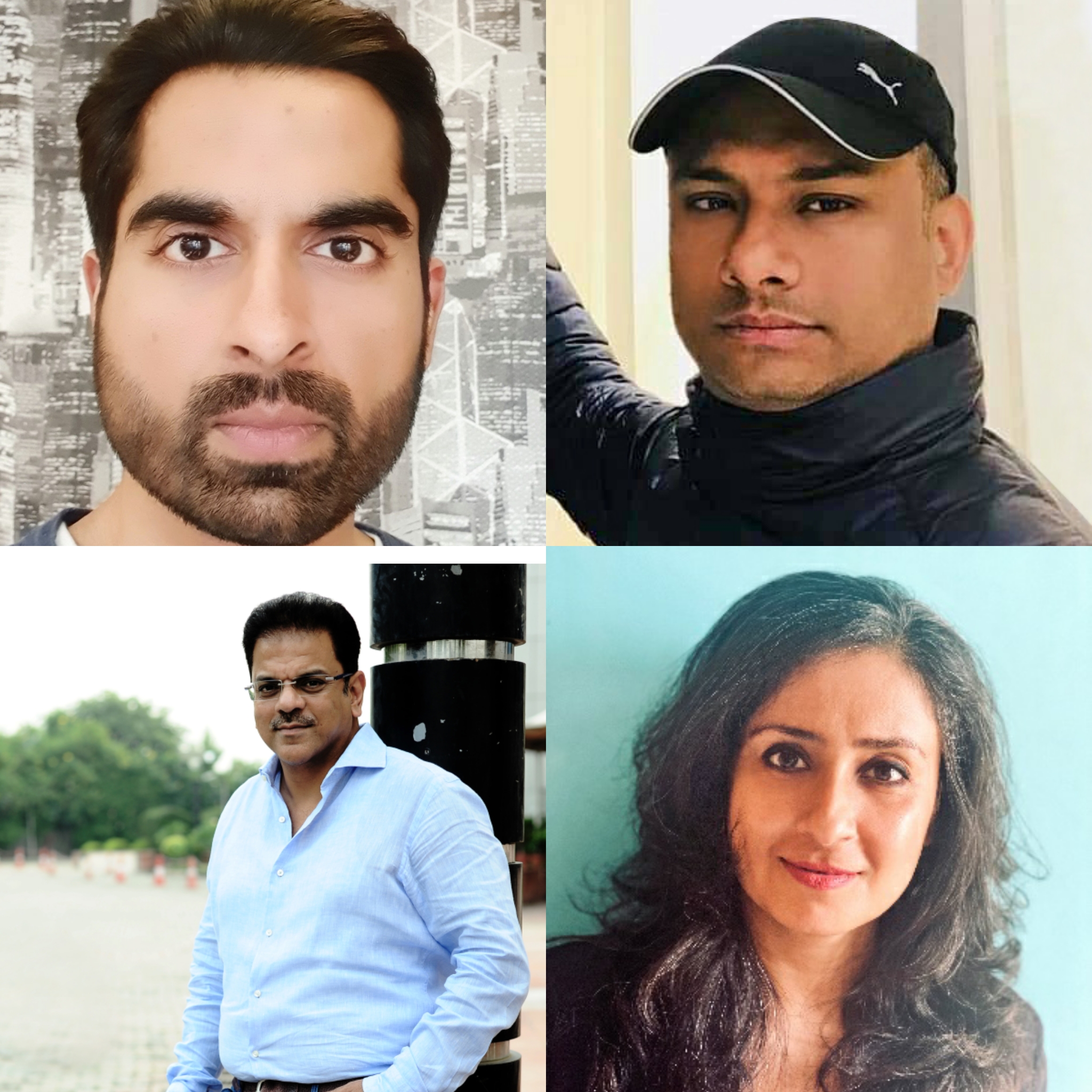
    MUMBAI: FCB Group India recently announced the restructuring of its creative agencies and a new three agency structure – FCB Ulka, FCB Interface and FCB India. FCB India, the newest agency in the fold, led by Swati Bhattacharya as the creative chairperson, has now announced its newly elevated C-Suite leadership team. FCB India will be led by Debarpita Banerjee as chief executive officer, Surjo Dutt as chief creative officer and John Thangaraj as chief strategy officer.

    In an increasingly digitised marketplace of ever-increasing options, influencing consumer choice has become more complex than ever before. It is this tremendous complexity that informs FCB India’s belief system: that siloed, medium-first thinking is no longer enough to build powerful brands in today’s world. FCB India aims at bringing a multi-disciplinary approach to creative ideation, drawing from fields as varied as design and data to media and marketing, the company said in a statement on Thursday.

    FCB India creative chairperson Swati Bhattacharya, said, “When Debbie, Surjo, and John enter the room to solve a problem…you know it will be done. Very rarely do you see such chemistry and energy in the boardroom. They can afford to be terribly honest with each other, and that directly makes the idea shiny and the brand shinier!”

    Debarpita Banerjee joined FCB in 2016 as president- North & East and now heads the agency as the CEO. A seasoned business leader with prior experience in both marketing and advertising, she headed marketing for National Geographic India in her previous role. She is a content enthusiast and also leads Fuel- the branded content and production arm at the agency.

    Surjo Dutt joined FCB in 2016 as national creative director. In his previous role, he was heading creative for specialist digital agency Sapient Nitro. Dutt combines over two decades of advertising experience across both mainline and digital with a strong focus on filmmaking and creative disruption.  

    John Thangaraj joined FCB in 2016 as executive planning director. In his previous role, he was head of strategy- North for Mindshare. Thangaraj brings close to twenty years of marketing communications expertise to the table, having worked across the ecosystem- from qualitative research & brand marketing to account planning, media strategy, and advertising.

    Speaking on this new developement, FCB Group India chairman & CEO Rohit Ohri said, “Hybrid thinking truly begins with hybrid talent. Debbie, Surjo and John’s diverse experience across content marketing, media strategy and digital storytelling, respectively, uniquely positions them to deliver to the challenges of building and growing brands in today’s complex, ever-changing marketplace”.

    “Debbie, Surjo & John have been instrumental in growing the FCB brand across new clients, categories and markets. Having spent half a decade working with each other, they play off each other’s strengths, bring multiple perspectives to the table and form a formidable base from which to further consolidate the tremendous equity they have already built. I wish them the best in their new roles and have no doubt that they will lead FCB India into a new era of success,” Ohri added.

  • Havas Group India appoints Anjali Gupte as CFO

    Mumbai: Havas Group India has appointed Anjali Gupte as chief financial officer, further bolstering its senior leadership team. Based out of Mumbai, Gupte will report to Havas Group India CEO Rana Barua and also Asia Pacific Group CFO Brice Pinoncely.

    Gupte has over two decades of experience across industries spanning advertising, financial services, manufacturing and real estate. In her previous role as CFO at Grey Group, she oversaw financial operations of the agency’s creative, digital and activation businesses in South Asia and was responsible for driving profitable growth across India, Bangladesh and Pakistan.

    Prior to Grey, she worked at Thomson Reuters for 17 years in the financial risk division. She is also an Independent director on the Board of Astec LifeSciences Limited, part of the Godrej group, where she also had a four-year stint.

    Havas Group India CEO Rana Barua said, “Havas Group India is now totally integrated and has over 1000 people working across 10 specialist agencies in 3 Villages (Bangalore, Delhi and Mumbai). We also have ambitious acquisition plans and multiple ongoing conversations for both media and creative groups. I welcome Anjali as Group CFO at this crucial juncture as we stabilise operations and action our growth plans. Anjali is a highly accomplished professional with leadership and people skills that have stood her in good stead as a business partner and strategist in her previous roles.”

    On her new role, Anjali Gupte said, “I am delighted to join the Havas Group, which in a very short while has built a fantastic reputation and stature in the Indian advertising market. With an extremely progressive vision of growth, strong leadership, and a wide spectrum of specialist agencies ranging from creative, media, health, data, design and entertainment all under an integrated Village model, this will truly be an exciting opportunity for me. I am looking forward to my role at Havas Group at such a challenging time and am confident that we will make a meaningful difference as we go forth.”

  • Scaler onboards Rahul Karthikeyan as the CMO

    Scaler onboards Rahul Karthikeyan as the CMO

    MUMBAI: Edtech startup Scaler on Wednesday announced key leadership appointments in its marketing and creative verticals. Rahul Karthikeyan was appointed as the chief marketing officer. Karthikeyan moves from upGrad where he was the head of marketing.

    Arnav Gupta has joined as product and strategy lead. Gupta is a serial entrepreneur and has worked with Zomato in the past. Anu Nair joins as creative head, and Ranjeet Kumar and Manmeet Singh Akali as co-heads of brand and content.

    Scaler and InterviewBit co-founder Abhimanyu Saxena said, “As we prepare ourselves for the next phase of growth, industry knowledge and experience will be even more crucial across all aspects. I am, therefore, extremely delighted to have some of the brightest minds in the business join us as we journey to become a world-class virtual tech university. We are also looking to expand our presence beyond metros, and plan to hire over 100-150 people in the current fiscal across functions to support this expansion.”

    The company, which offers software programming courses, had raised $20 million in Series A funding from Sequoia India, Tiger Global, and Global Founders Capital in January.

    “We want to build a quality education platform that is constantly upgrading based on trends in the market, to ensure that our students are up to date. It is an exciting time for the brand, and I am happy to be part of this journey,” said Karthikeyan on his new role.

  • CarDekho empowers Product and Tech leadership teams

    CarDekho empowers Product and Tech leadership teams

    MUMBAI:  The CarDekho Group has fortified its leadership team through five engineering and product leadership appointments at their Gurgaon office.

    Sandeep Singh and Mayank Kapoor joined as vice presidents – Engineering, Manjeet Dahiya is vice president – Artificial Intelligence, Machine Learning and Data Sciences, Dharmesh Gandhi joined as vice president – Products, and Aditya Kumar as vice president – Product Strategy and Analytics. They will all report directly to CarDekho Group’s chief product & technology officer, Vivek Srivastava.

    On the new appointments, CarDekho Group chief product & technology officer Vivek Srivastava said, “Customer delight and innovation are at the core of CarDekho. We are aggressively strengthening our product and tech teams to build world class technology products. We are strategically getting the right talent to achieve our vision of CarDekho. We welcome Sandeep Singh, Mayank Kapoor, Manjeet Dahiya, Dharmesh Gandhi, and Aditya Kumar to the CarDekho group.  Their experience and ability in anticipating market dynamics to create new products and segments will help us drive innovation at a higher velocity.”

    Sandeep Singh has 14 years of experience in building deep technology and highly scalable products. He possesses a unique combination of technical, business and analytical skills and has a rich experience of working in technology companies where he has built products from scratch. In the past, he has led products, grown teams and scaled up user base by hundreds of millions of users. Earlier, he was with Walmart Global Tech as director of Engineering in San Francisco. Sandeep is also a former entrepreneur and has also worked with Yahoo, AT&T and is an IIT Kanpur alumnus.

    Mayank Kapoor has more than a decade long experience in building and managing technology products. An engineering graduate from IIT Delhi and an MBA holder from MIT Sloan, Mayank has worked with Reliance Jio as VP, Engineering, where he led Cloud Consumer Products, Services and Cloud Platform. He has also worked at Apple, Amazon and Alstom Power. Mayank is highly experienced in engineering leadership, business expansion and project execution. He has developed large-scale products that are used by millions of people across the globe.

    With over 14 years of experience, Manjeet Dahiya is an expert in Artificial Intelligence, Machine Learning and Data Sciences. Before joining CarDekho he was the Head of Data Science and Machine Learning at Airtel Digital. Manjeet is skilled in studying data and deriving qualitative results from it that can help in forming result-oriented strategies by the company. Manjeet is a PhD in Computer Science from IIT Delhi and BTech from IIT Kanpur.

    Dharmesh Gandhi has over 16 years of experience in product management, marketing and engineering roles for e-commerce, digital advertising, video and smartphone products. Dharmesh has previously worked in product leadership roles at Rentomojo, Uber, Amazon and Cisco, where he took products from concept to market, covering aspects of monetization, product design, customer development and marketing. Dharmesh is an IIM Bangalore and IIT Kanpur alumnus.

    An IIM Ahmedabad and IIT Kanpur alumnus, Aditya Kumar has 13 years of experience in business strategy, data strategy, and operations strategy. Aditya was a co-founder of CliffJumper Technologies where he built a proximity marketing and sales platform for SMBs. He specializes in conducting research and building strategy with a data-led approach. Aditya has also worked with Gartner, IDG Ventures and A.T. Kearney.

  • Leadership secrets & wisdom from Viacom18

    Leadership secrets & wisdom from Viacom18

    MUMBAI: A few months ago,  during the thick of the lockdown due to the pandemic, Viacom18 CEO Sudhanshu Vats announced that he was moving on from the organisation he led for around eight years. Earlier, in 2019, his deputy COO Raj Nayak too departed from a company he was associated with for seven years. Both  the leaders have left a long-lasting impact on Viacom18. And especially the senior team which is currently being led by the new CEO Rahul Joshi, who also heads the news operations under TV18.

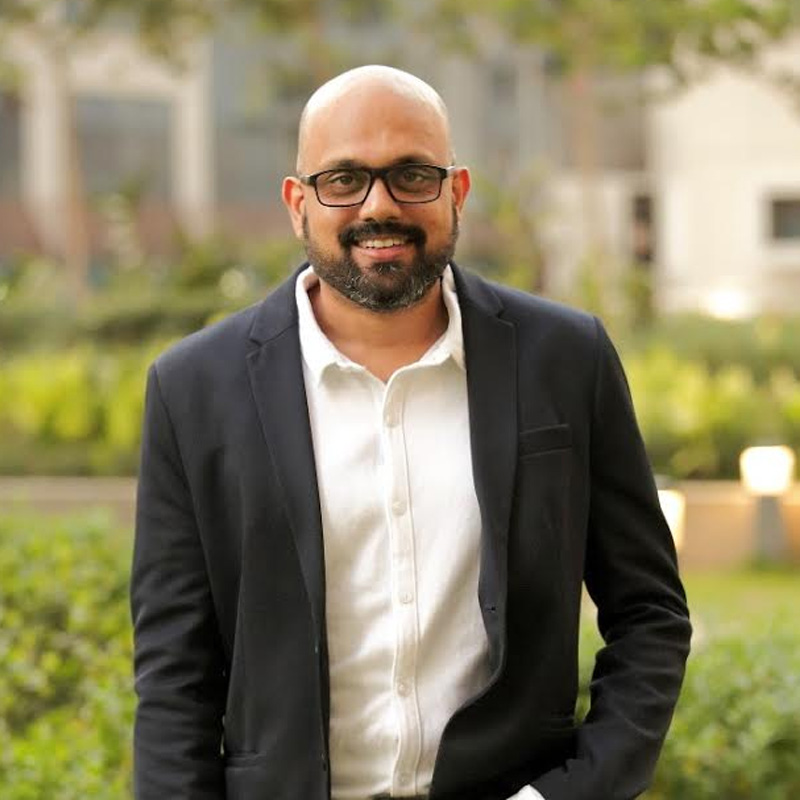
    In a fireside chat with Indiantelevision.com founder, CEO & editor-in-chief Anil Wanvari last week, Viacom18 network head of ad sales Mahesh Shetty recalled the days when he had an opportunity to work with both  Raj Nayak and Sudhanshu Vats and his bond with his current CEO Rahul Joshi. And he shared the leadership and management styles of the two senior execs. 

    Watch the virtual fireside chat with Mahesh Shetty

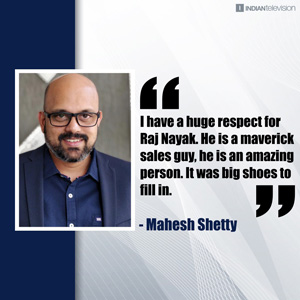
    “I have huge respect for Raj Nayak. He is a maverick sales guy, and an amazing person. It was big shoes to fill in. I have done deals with him in the past when I worked at Radio Mirchi for Mirchi Music Award that used to come on Colors. He is someone who enjoys huge respect in media and entertainment industry,” Shetty shared during his conversation…

    Shetty was hired by Vats to look after ad sales and revenue for the whole network – both regional and Hindi channels. “Raj was COO and he looked after direct sales for Colors,” said Shetty. “He built and left behind a fabulous sales team. There is not much of a change that has happened in it. It is not like that the new leaders have come in and they have changed the entire team, most of the team leaders are the same.”

    He further highlighted that Raj had this attitude to think scale, to think big in sales efforts. “It is a great legacy that Nayak has left behind. The team is aware of the fact that they are selling big impact properties. So, I don’t have to go out and tell the teams how to sell.”

    Read more news on Raj Nayak

    Recently, long-timer Simran Hoon stepped down from her role as Viacom18 EVP and ad sales head after nearly 13 years with the organisation.

     “I don't have control over things which are above me,” said Shetty referring to Vats’ exit a few months ago. “But it’s to his credit that he handled my hiring the way he did. And how he kept the morale at the company high, during the tough times. The fact is that if you look at the past 18 months there are not too many exits. All the key people are there in the company.  it is a journey that all of us as a team have gone through. We all have tough times,” he shared.

    He has been focused on building and strengthening the sales team, getting their trust, and bringing in processes and data mining and management into the sales efforts. Said he: “I think I have a job and a challenge at hand. My boss (Rahul Joshi) is a person who helps me in this journey, Rahul is also great person, he has a different kind of experience than what Sudhanshu Vats had. The last six months with him have s been good.”

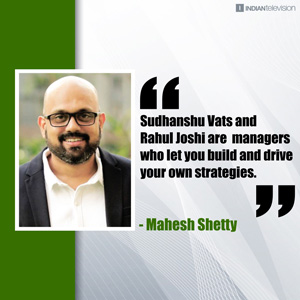
    He further added, “Both Sudhanshu Vats and Rahul Joshi are managers who let you build and drive your own strategies. Because then the onus is on you to deliver and it’s not like you can put your monkey on your boss’ back.”

  • Ashish Bhasin thinks advertising needs to find the balance between optimism and realism

    Ashish Bhasin thinks advertising needs to find the balance between optimism and realism

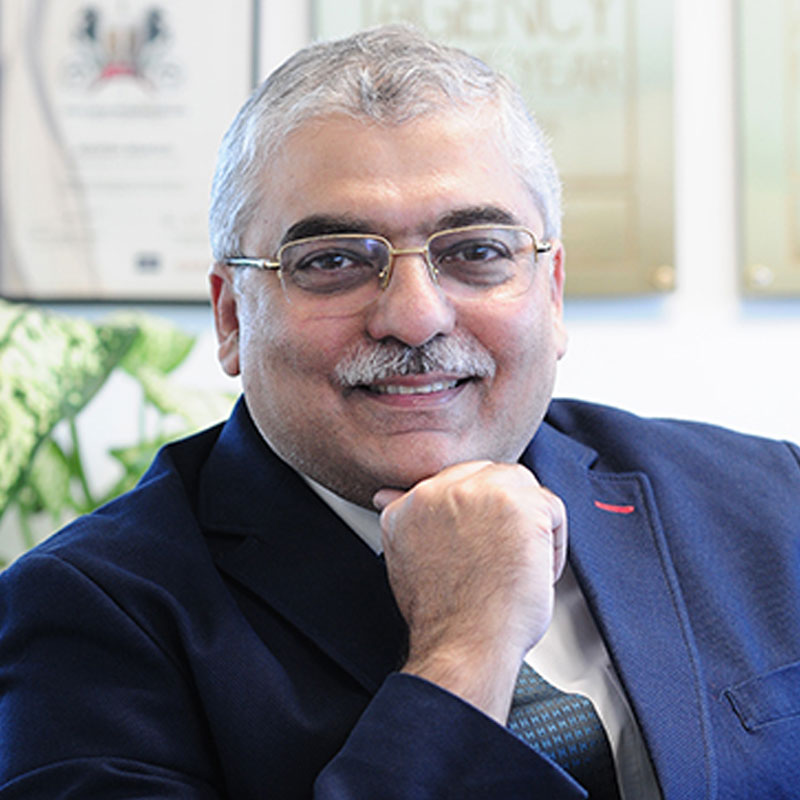
    NEW DELHI: A movie buff, a chess lover, and a businessman with great intuitions and understanding, Ashish Bhasin is one of the easiest persons to talk to in the industry. An excellent leader with a future-focused vision, he might now be called the Nostradamus of the advertising world as his prediction of digital becoming the pack leader of marketing pies has been coming true amazingly, though in a scenario that neither him nor any other agency head, for that matter, could have predicted.

    The CEO of Dentsu Aegis Network’s APAC operations & chairman for India, Bhasin is currently heading a number of markets, including the origin of the Covid2019 pandemic, China, as they set their sails for the ‘new normal’. Recently, in a virtual fireside chat with Indiantelevision.com founder CEO & editor-in-chief Anil Wanvari, he talked about his experiences in the industry, how he is handling the lockdown and managing his national and international teams, and his thoughts on the economic slowdown we are in. Edited excerpts follow

    So, have you been going back to your favourite classics, Gone With The Wind and The Sound Of Music during the lockdown or agency work is keeping you busy?

    Well, the days are surely busy and longer for me now. It’s even hard for me to remember if it’s a weekday or a weekend. I start my day around 6:30, that’s when calls with the Australian team happen, and then as most of our senior management is in the UK now, the time stretches till late in the night sometimes. But I am not complaining. I love my work. I find it extremely satisfying that you have something that you're passionate about and you get paid for it.

    So yes, I did not have much time to go back to these movies but still, I managed to watch The Sound of Music twice or thrice in these months. You can draw parallels from this film to your own personal and professional life. The whole movie is just about how you manage to keep your focus and enjoy working even in tough times. 

    What I love about Gone With The Wind is that it takes you to a whole different cultural era and shows human beings at their best. How with changes some hang on to older ideas and how some adapt. Also, it is one of the few movies that are as good as the book. Another such example is the Godfather. 

    And what about chess?

    Chess, yes, I keep playing regularly. It’s something that both I and my son enjoy and there is always a healthy competition going on. And now with digital, I sometimes play it against other competitors too. 

    You said you love your work. But had you not been in the profession, what career choice would you have made? 

    I think I would have been a lawyer. But whenever I sit and think about my life and would have done anything differently if given the chance to restart, 9.9 times I feel that I would do exactly the same things that I have done. I would get into the same profession, I would marry the same person, and I would want to spend each day as it has been. 

    What do you love the most about advertising? What keeps you going? 

    One is that I am very passionate about my work. I love what I do and I have a sense of ownership. And the second thing is that no two days or I may say that no two hours are the same in the advertising business. Every day is a new challenge. 

    Also, I am a social person. I love interacting with people. And you get to meet and work with so many interesting and intelligent people in advertising. You find people who dropped out of school and college formal education but are so bright and so smart. So I think just the pure variety of people that you get to work with and the joy and enthusiasm that they bring in that keep me going. 

    I have always seen it as a great business. I think that’s what most of the industry misses right now. Advertising is not seen as a business; as much as creative talents are valued or planning leaders are valued, business leaders are not valued as much. I agree that advertising is more than just numbers but if you don’t run it as a business, you will get out of it soon. 

    That’s the only area that confuses me about the profession. 

    Who have been your role models?

    Certainly, Alyaque Padamase, who was my super boss at my first job in Lintas. Then Prem Mehta, who was then the chairman of Lintas. I worked with him closely and learned a lot. Also, Martin Sorrell is one of the finest we have ever seen. 

    But I think at the end of it, you have to develop your own style, and you can just draw (energies, ideas) from people. 

    And what is your personal leadership style? Are you an optimist or a realist?

    See, I am an optimist in the sense that I see opportunities in adversities. Like right now, I am not seeing any sudden V-shape recovery happening, but I am sure that things will start getting better from here, month-on-month. So, I plan according to the real scenario but my goals are more optimistic. 

  • Guest Column: Life’s biggest stand-out success lesson

    A ship is safe in the harbour. But, that is not what ships are built for: John A Shedd. Why does stand-out success elude the early achievers from making it finally in the game of life. Did they learn this ONE thing!

    Think of that brightest one in your class back in school or college. Did they change the world or achieve extraordinary success?

    Umpteen number of studies from time to time throw up statistics to show that achievers of the highest grades in schools and colleges as a ratio of proportion of overall extraordinary achievers almost always is weighed in favour of those who did not have those fancy grades and did not walk away with a gold medal at the passing out graduation ceremonies.

    In his new book “Barking Up the Wrong Tree,” Eric Barker explores the maxims we use to discuss success. He finds that just as nice guys don’t always finish last, valedictorians rarely become stand-out successes.

    Not to be misled – by standards of ordinary success, they do well and find good lives but they do NOT achieve extraordinary success to become billionaires who change the world.

    Barker writes:
    There was little debate that high school success predicted college success. Nearly 90 per cent are now in professional careers with 40 percent in the highest tier jobs. They are reliable, consistent and well-adjusted, and by all measures the majority have good lives.

    But how many of these number-one high school performers go on to change the world, run the world or impress the world?

    The answer seems to be clear: zero
    Many academically brightest are acknowledged (even by themselves) to be as not the smartest students in their class but simply the hardest workers. Smartness is restricted to delivering against a teacher expectation rather than true ‘imbibing’ of the knowledge.

    In fact, research demonstrates that students who truly enjoy learning the most often struggle in school, trying to trade off attention given to subjects about which they’re truly passionate with the demands of their other distractions (read coursework). While intellectual students struggle with this tension, grade achievers excel.

    The most valued traits in school are self-discipline, conscientiousness and the ability to comply with rules. The ability to disrupt the world or make extraordinary breakthroughs however requires NOT these traits.

    The education system thrives on and rewards (remember the class monitor/rep) developing ‘promising ones’ with a positive trait of ‘trying to please everyone’. It is also the key to failure.

    I can’t give you a sure-fire formula for success, but I can give you a formula for failure: try to please everybody all the time — Herbert Bayard Swope.

    The high-grade achievers make it their business to be the best. ‘Best’ in real life is a label. It’s something someone decides for you – the ‘educational institution’ in case of students. ‘Better’ is more personal which pushes you to embrace ‘highs and lows’ to find that unique attribute called ‘individuality’ as the key to success while the graduation ceremony sees hundreds of them in identical caps and gowns.

    While the schools produce the best and the brightest to go and change the world, the achievers forget to unlearn to challenge notions and embrace uncertainty. The one thing that stands out is the inability of these ‘brightlings’ to encounter and treat real life’s chaos as a part of the deal.

    The ability to ‘shake things up’ is not a particularly well appreciated quality taught in schools.

    That one thing that keeps these ‘lives of promise’ from making it as truly THE ONE therefore is

    Unlearning is as important at all points in life as learning.

    Anyone whose goal is ‘something higher’ must expect someday to suffer vertigo. What is vertigo? Fear of falling? No, Vertigo is something other than fear of falling. It is the voice of the emptiness below us which tempts and lures us, it is the desire to fall, against which, terrified, we defend ourselves  ― Milan Kundera, The Unbearable Lightness of Being

    Education system mostly is akin to a ‘control experiment’ in science. Lots of mediocre students thrive outside a ‘controlled’ scholastic environment.

    In the school, rules rule life.  In the messy game called life, Chaos rules everything!  Unlearn and embrace it for your success.


    public://Untitled-3_17.jpg

    (Piyush Sharma, a global tech, media and entrepreneurial leader, created the successful foray of Zee Entertainment in India and globally under the ‘Living’ brand. The views expressed here are of the writer’s and Indiantelevision.com may not subscribe to them.)
  • Guest Column: Dear Me…Be a good loser!

    I failed often, failed bitterly, had my fair share of ups and downs. I had my apprehensions and my faults. I share here the positive convictions I have gained. May be they hold some wisdom for the millennials of today too as they venture for their first inclines.

    A line in a poem by Czeslow Milosz that’s always stuck with me: “Love means to learn to look at yourself/ The way one looks at distant things/ For you are only one thing among many.” The key to happiness, the poem suggests, is to understand that you need to become less self-obsessed – so that you can better relate to the world around you.

    I was fortunate to rise to the job of a CEO within 11 years of take-off.

    24 years since I started and as an athlete at the peak of his game today, here are 7 things I would want my younger self to take care of. 

    1. Seize the moment. Carpe Diem. I would volunteer for the next responsibility and rise to the occasion. I would not make ‘best’ the enemy of ‘better’. No work is too small. I would relish the opportunity to work. If you’re not progressing, you’re regressing; so, keep moving forward. The key to success in any field or endeavor is to keep moving forward. In the block-buster Indian movie Baahubali, the Hero gives the dark horse a piece of advice – “Zindagi Ek Baar Sher banane ka mauka sabko zaroor deti hai” (Life gives you the chance to become a Hero at least once). This one moment must be seized. Also as goes the popular Hindi saying “Behta paani nirmala” – translated into English which is “Rolling Stones gather no moss”.

    2. Take care of myself. Your body is the greatest instrument you will ever have. I would keep it in fit condition. You are beyond your body. The quality and power of your mind will determine how you well you would fare in the wake of challenges. I would train my mind. The importance of constant upgradation of your intellect cannot be emphasised enough.

    3. Kill my ego. Adapt to the world. You need them. They don’t. Simple. Adapt to the situation or the challenge. Not even a whiff of entitlement. Please. Half of my problems is me. The other half is the circumstances. I would find the best combination.

    4. Choose to be happy. I would not be rigid about my wants. I would awake to the truth that I can change my wants. Happiness does not depend on anything but me. Wants are changeable.

    5. Save money. I would start early to create wealth by saving money. A dollar yesterday is bigger than one today. Money grows. The power of the exponential function is one of the most misunderstood!

    6. Be a good loser. I would rise every time I fall. You only fail if you do not get up. I would fail fast, fail often, fail uninhibitedly and fail – not quit – till I succeed. And again… A progressive mentality doesn’t mean that you’ll never experience major setbacks, or even utter failure–which can deliver vital lessons and invaluable experience. Additionally, reflecting on how far you’ve come can provide necessary motivation. Remember, there are no shortcuts. True success is as much about hard work as about resilience–the ability to keep getting up when you’re tempted to throw in the towel. Never give up. Ever.

    7. Find my spiritual center. I would involve myself in spirituality much earlier than I did. To know how to live better, be content and spend life so that it is worthwhile.

    Some of the above are convictions because they invariably stood me in good stead. Some of them I did not practise but would be wise to – were I to do it again! Happy Living.

    public://Untitled-4_3_0.jpg

    (Piyush Sharma, a global tech, media and entrepreneurial leader, created the successful foray of Zee Entertainment in India and globally under the ‘Living’ brand. The views expressed here are of the writer’s and Indiantelevision.com may not subscribe to them.)


  • Guest Column: Start-up hacks: A cheat sheet for success

    With the convergence of technology and media, we are witnessing tremendous activity in the start-up space.  From content to distribution to broadcast to affiliate opportunities, there is no dearth of new ideas and their backers.  Surprisingly not all of them are covering all their bases to crack the start-up success code.

    Having been a part of four start-ups in leadership positions along with all the insights gained through studying hundreds of others, here are 9 ways that help us better understand them and reasons that make them succeed.

    1. Start-ups are not smaller versions of large organisations. Bonsai have a different life and game plan as compared to large trees. The two should not be compared and start-ups should not be expected to emulate the large organisation. 

    2. Start-ups do not adhere to a ‘set’ business plan – in most of the cases the challenge is to find one. As Mike Tyson famously said on his opponent’s pre-fight strategies: everyone has a plan till they get punched in the face. Business Plans are a necessary evil but for a start-up they are nothing more than fictional plans and rarely do they survive their first contact with customers.

    3. Customer Plan is much more important than the business plan. This may include customer engagement, customer stickiness, brand advocacy score, net promoter score, etc. “Your most unhappy customers are your greatest source of learning,” said Bill Gates.

    4. Data is the new oil. Data undergirds everything. Period.

    5. Start-ups need to fail fast, fail often, fail cheap and fail better. Constant experimentation and continuous learning is the name of the game rather than elaborate planning. Start-ups need to keep their persistence levels high. “You don’t learn to walk by following rules. You learn by doing and falling over,” as famously told by Richard Branson.

    6. Iteration is the key word for every aspect of the business. Launch and iterate. And again. Everything is changeable except the intent to give one’s best to making it big.

    7. Repeatability and scalability are two pivots to search in the early life cycle stage. Investing in growth in stage 0 is almost a sure-shot pre-requisite. Mostly start-ups are dealing with a new concept and/or a habit change. This may initially require selling only on the strength of price (not the brand or anything else) and may call for disproportionate investments and therefore profitability may be a long way off.

    8. Turmoil and chaos are integral to the existence of a start-up. Those who cannot stand the heat, need to get out of the kitchen.

    9. Lastly as Jeff Bezos said – Entrepreneurs must be willing to be misunderstood for a long time.

    The M&E industry as much needs start-ups as the rest of the economy.  As research shows, the success quotient can go up if the above factors are kept in mind.

    public://piyu.jpgPiyush Sharma, a global tech, media and entrepreneurial leader, created the successful foray of Zee Entertainment in India and globally under the ‘Living’ brand. The views expressed here are of the writer’s and Indiantelevision.com may not subscribe to them.
  • TIMES NOW completes 10 impactful years of action-oriented leadership and success

    TIMES NOW completes 10 impactful years of action-oriented leadership and success

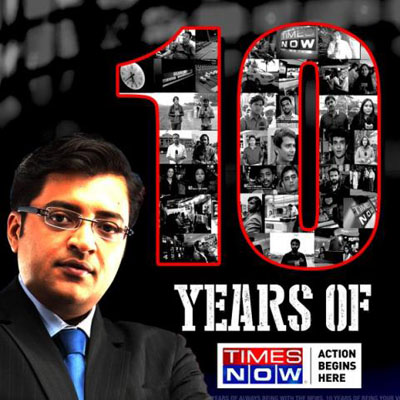
    MUMBAI:  India’s No 1 English News Channel has completed 10 successful and momentous years. Over the last 8 years, it has remained the most popular and impactful channel, because of its action-oriented approach to news, driven by the highest standards of professional journalism. The channel was launched on 31st January 2006.

    Within just two years of its 2006 launch, TIMES NOW raced away to become the biggest English news channel, and ever since, has remained India’s most popular and impactful television news channel – one that has delivered for the consumers and business associates, and most importantly for society and the Nation.

    M K Anand, CEO&MD – Times Network, says, “TIMES NOW is a truly iconic news channel respected for its committed, action-oriented, professional and impactful journalism. TIMES NOW, NewsHour and Arnab Goswami are household names. It’s hard to imagine that just a decade ago, we did not have this mega brand. TIMES NOW like other young global mega media brands is a reflection of what has changed in human society in the 21st century and what still endures as true and good. Over the last 10 years, TIMES NOW has led the nation’s discourse by stimulating collective national thought and resultant action and has become a strong agent of change. It is this drive that has not only made TIMES NOW India’s most impactful News Channel, but has also taken it to over 80 countries around the globe.”

    Arnab Goswami, President, News, Editor-in-Chief of TIMES NOW, ET NOW and Magicbricks NOW, the original architect of the soul of TIMES NOW, its content,  says, “Ten years ago, when we set about planning to create TIMES NOW, we questioned the old belief that news should remain just reported and hence a monologue. We asked ourselves: Why shouldn’t news be information plus added perspective of different news makers and thought leaders thrown in? Even as we innovated on strategy, questioned old formats, and infused news with speed, throughout, we have remained unwavering in our mission to maintain the highest ethical and professional standards of news reportage. We are committed to ensuring that relevant news does not remain hidden from the public, and that it sparks opinion, debate, and corrective action.”

     “Through our approach to television news journalism, we have changed, forever, the way news was presented in India. As a result, TIMES NOW boasts of an exceptional top-of-mind recall. 

    “I am grateful to my entire team for their belief, abilities, commitment and dedication, and for all the hard work they put in unfailingly each day, which has helped make TIMES NOW the incomparable channel it is.”