Tag: LCOs

  • Cable TV lobby slams TRAI’s DTH licence fee waiver call

    Cable TV lobby slams TRAI’s DTH licence fee waiver call

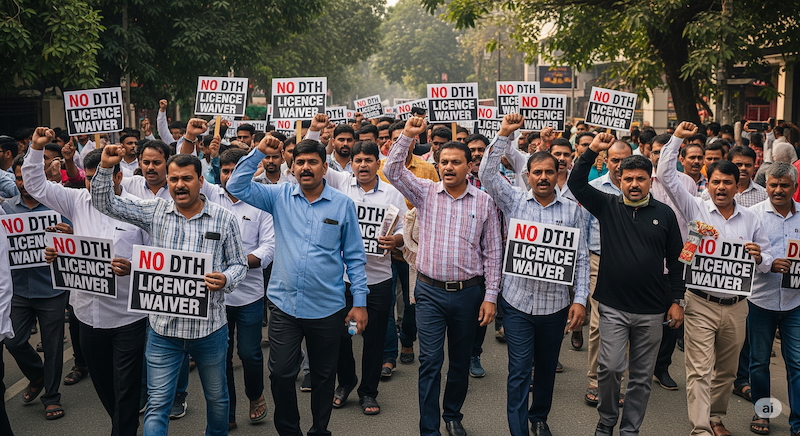
    NEW DELHI – India’s top cable lobby has sounded the alarm over TRAI’s proposal to slash and eventually scrap licence fees for Direct-to-Home (DTH) operators, warning it could wreck the delicate balance in the country’s broadcast distribution ecosystem.

    In a strongly-worded representation to the information and broadcasting ministry, the All India Digital Cable Federation (AIDCF) – which represents over 880 multi-system operators (MSOs) and 1.6 lakh local cable operators (LCOs) – said the move would “deepen regulatory inequality” and “threaten over 10 lakh livelihoods” linked to the cable TV industry.

    The AIDCF accused TRAI of tilting the scales in favour of DTH players who already enjoy “cost-free, administratively allocated spectrum” while cable operators continue to bleed under high Right of Way (RoW) charges and hefty underground infrastructure investments.

    “A DTH licence fee waiver will distort competition and violate regulatory neutrality,” an AIDCF spokesperson said, adding that any cut would hasten subscriber churn from cable to satellite platforms. The body flagged other disruptors like Free Dish, OTTs, Fast TV and digital DPOs as further stress points for the struggling cable sector.

    Rather than easing licence costs for satellite platforms, AIDCF wants the government to implement a fair cost recovery mechanism across distribution platforms, reflecting the true commercial value of spectrum. It has urged the ministry to junk TRAI’s recommendation in favour of a level playing field that safeguards the sector’s long-term viability.

  • Government updates list of mandatory must-carry cable TV channels

    Government updates list of mandatory must-carry cable TV channels

    MUMBAI: The ministry of information and broadcasting has issued a revised notification mandating changes to the list of channels that cable operators, including multi-system operators (MSOs) and local cable operators (LCOs), must carry under the Cable Television Networks (Regulation) Act, 1995. 

    In the latest directive, six existing mandatory channels have been updated, including:
    * DD Assam (Regional Entertainment)
    * DD Odia (Regional Entertainment)
    * Sansad TV-1 HD and Sansad TV-2 HD (Lok Sabha & Rajya Sabha News)

    Additionally, four new channels have been made mandatory:
    * DD National HD (Hindi Entertainment)
    * DD News HD (Hindi News)
    * DD Sports HD (Sports)
    * DD India HD (English News)

    The ministry emphasised strict compliance with the updated requirements, warning that violations would invite punitive action under the Act, associated Rules, and registration terms. Cable operators have been instructed to ensure proper categorisation and transmission of the channels within their network offerings. It issued the advisory to cable ops and MSOs on 30 January 2025.

  • MIB simplifies process of registration for India’s cable TV operators

    MIB simplifies process of registration for India’s cable TV operators

    UMBAI:  India’s ministry of Information and broadcasting has issued an advisory on 17 January outlining significant changes to the registration process for local cable operators (LCOs) and multi-system operators (MSOs) under the Cable Television Networks (Regulation) Act, 1995.

    The advisory highlights that, as per Section 3 of the Act, operating a cable television network without registration is prohibited. Applicants are now required to register or renew their registration online through the newly established Broadcast Seva Portal. This modernised approach addresses long-standing concerns regarding the cumbersome manual registration processes previously employed.

    Pursuant to the above, the central government has now introduced key amendments to the Rule vide Notification S. 0. No. 65(E) dated 17  January2025. Further, in exercise of powers conferred under clause (h) of Section 2 of the CTN Act, 1995, a notification vide S.O. No.315(E) dated 17  January , 2025 notifying the section Officer and additional  joint secretary to be the registering authorities for LCOs and MSOs respectively, has been issued.

    Key amendments outlined in the advisory include:

    Online Registration: LCO registration will be facilitated online via the Broadcast Seva Portal.
    Validity Extension: The registration will now be valid for five years, increased from one year.
    Processing Fee:  The registration fee has been set at Rs 5,000.
    National Registration Number: Registered LCOs will receive a unique National Registration Number valid throughout India.

    The new registering authority for LCOs will be designated section officers handling digital addressable systems (DAS) in the ministry. Additionally, applicants will need to verify their identity online using PAN, Aadhaar, and other required documents, with Aadhaar sharing being voluntary.

    Current LCOs are urged to apply for their registration renewal at least 90 days before expiration. Those with applications pending at local head post offices must withdraw and reapply through the Broadcast Seva Portal.

    The Ministry encourages all interested parties to take immediate action and offers support via a dedicated helpline (011-23381707) and toll-free number (18002127307), which are also available on the portal.

    These changes aim to streamline the registration process and enhance the operational framework for cable television networks in India.

    The advisory can be downloaded from this link b clicking on the word advisory
    The notification of the process of registration can be downloaded by clicking on the word notification
    The notification empowering the section officer for LCOs and the additional joint secretary in the case of MSOs can downloaded by clicking on the word notification.

  • TRAI notifies amendments to regulatory framework for broadcasting and cable services and releases

    TRAI notifies amendments to regulatory framework for broadcasting and cable services and releases

    Mumbai: Telecom Regulatory Authority of India (TRAI) has issued Telecommunication (Broadcasting and Cable) Services (Eighth) (Addressable Systems) Tariff (Fourth Amendment) Order, 2024 (1 of 2024);  Telecommunication (Broadcasting and Cable) Services Interconnection (Addressable Systems) (Sixth Amendment) Regulations, 2024 (4 of 2024); the Telecommunication (Broadcasting and Cable) Services Standards of Quality of Service and Consumer Protection (Addressable Systems) (Fourth Amendment) Regulations, 2024 (3 of 2024) and also recommendations to Ministry of Information and Broadcasting (MIB) on ‘Listing of channels in Electronic Programme Guide and Upgrading DD Free Dish platform to an Addressable System’. These amendments, except for a few clauses, shall come into force after 90 days from the date of its publication in the official gazette.

    In consonance with the complete digitization of the cable TV sector, TRAI on 3 March 2017 had notified the Regulatory Framework for Broadcasting and Cable services. The framework was further tuned to the need of the broadcasting ecosystem and to address the concerns of stakeholders through amendments issued in 2020 and 2022.

    The stakeholders namely, broadcasters, MSOs, DTH operators and LCOs had taken up further issues for the consideration of the Authority from time to time.

    To address such issues, the Authority issued a consultation paper on “Review of Regulatory Framework for Broadcasting and Cable services” on 8 August 2023 seeking stakeholders’ comments.

    The consultation paper sought comments and suggestions from various stakeholders, on several issues which included Network Capacity Fee (NCF), discount limit on sum of MRP of a-la-carte channels for fixing MRP of bouquets by the distributors of TV channels (Distribution Platform Operators-DPOs), equivalence of an HD channel in terms of SD channels for capacity calculations, mandatory FTA News Channels in all packs formed by the DPOs, level playing field with DD Free Dish, amendment to Reference Interconnect Offer, listing of channels in Electronic Programme Guide (EPG), revenue share between MSO and LCO, carriage fee, removal of channels after expiry of existing interconnection agreement, issues related to billing cycle, regulation of platform service channels, review of prescribed charges, consumer corner, establishment of websites by DPOs, manual of practice, etc.

    The Authority analysed the comments of the stakeholders and the discussion held during the open house discussion and noted the level of competition in the market due to the presence of multiple Broadcasters, DPOs (MSO/DTH/HITS/IPTV) and LCOs. Accordingly, there is a need to provide flexibility to the service providers for enabling them to adopt to the dynamic market conditions while at the same time safeguarding the interest of consumers and small players through transparency, accountability and equitability.

    Based on the above considerations, TRAI has notified the amendments to Tariff Order 2017, Interconnection Regulations 2017 and QoS Regulation 2017. The primary objective of these amendments includes the following:

    a  Facilitate growth of the broadcasting sector by reducing regulatory mandates and compliance requirements.

    b  Provide flexibility to the service providers to adopt a market driven approach while safeguarding the interest of the consumers and small players through transparency, accountability and equitability.

    c  Promoting ease of doing business by simplifying the regulatory provisions.

    The salient features of these amendments include the following:

    A. Tariff Order

    i  Ceilings of Rs 130 for 200 channels and Rs 160 on more than 200 channels have been removed on Network Capacity Fee (NCF) and is kept under forbearance to make it market driven as well as equitable. Service provider may now charge different NCF based on number of channels, different regions, different customer classes or any combination thereof. To ensure transparency, all such charges have to be mandatorily published by the service providers and communicated to the consumers besides reporting to the TRAI.

    ii  DPOs have now been permitted to offer discount up to 45% while forming their bouquets to enable flexibility for them in forming bouquets and to offer attractive deals to the consumers. Earlier this discount was permitted only up to 15%.

    iii  A pay channel available at no subscription fee on the DTH platform of the public service broadcaster has to be declared free-to-air by the broadcaster of the channel for all the addressable distribution platforms also so as to have a level-playing field.

    iv  DPOs have been mandated to declare tariff of their platform services.

    B. Interconnection Regulations

    i  With the proliferation of HD television sets and to encourage transmission of high-definition content, distinction between HD and SD channels has been removed for the purpose of carriage fee.

    ii  Carriage fee regime simplified and made technology neutral by prescribing only single ceiling for carriage fee, thereby, providing the DPOs with the option to charge a lesser carriage fee as deemed appropriate.

    iii  The above measures are expected to not only simplify the offerings of the service providers to the consumers but also promote the availability of high-quality channels.

    C. QoS Regulations

    i    Charges for services like installation and activation, visiting, relocation and temporary suspension which were prescribed earlier under regulation have now been kept under forbearance. DPOs have to publish the charges of their services for clarity and transparency to consumers.

    ii  Relaxation of certain regulatory compliances for small DPOs.

    iii  Duration/Term/Validity of all prepaid subscriptions to be specified in number of days only for greater clarity to the consumers.

    iv  DPOs may display Distributor Retail Price (DRP) in the electronic programme guide (EPG) along with MRP for channels.

    v  DPOs to categorise platform service channels under the genre ‘Platform Services’ in the EPG.

    vi  DPOs to display respective MRP of the platform service channel in the EPG against each platform service to ensure transparency.

    vii  DPOs provide an option of activation/deactivation of any platform service.

    D. Financial disincentives have been introduced for contravention to provisions of the Tariff Order and certain other provisions of Interconnection Regulation and QoS Regulation to ensure accountability of service providers.

    E.  Service providers publish all the information related to tariff and other charges which have now been kept under forbearance, on their websites. Moreover, they need to communicate the tariff and other charges to the subscribers, pertaining to the plans being subscribed.

    Further, the Authority also issued recommendations to MIB on certain issues covered in the consultation process. These issues include ‘Listing of channels in Electronic Programme Guide’ and transition of ‘DD Free Dish’ to an addressable system. The salient features of these recommendations are as follows:

    A.  Listing of channels in EPG:

    While giving permission to each channel, MIB to seek information from broadcasters about primary language of each channel and sub-Genre of every non-news channel as per Interconnection Regulation 2017 and display the same on Broadcast Seva portal of MIB to enable DPOs to place the channel at appropriate place in the EPG for easy navigation by the consumers, in accordance with the present regulation.

    B.  Upgradation of DD Free Dish platform to an Addressable System:

    i  In order to ensure quality of viewing experience, prevent unauthorized re-transmission of television channels to combat piracy and maintain the record of subscribers, Prasar Bharati to take steps to convert DD Free Dish platform from a non-addressable system to an addressable system and make a beginning by encrypting the signals of private satellite television channels at DD Free Dish head end before uplinking. Subsequently, all other channels of DD Free Dish may also be transmitted in encrypted form.

    ii  Public service broadcasters will be provided with the requisite exemptions of TRAI Regulations, once such notification is issued by MIB.

    iii  Prasar Bharati may utilize indigenous technologies for Conditional Access System (CAS), Subscriber Management System (SMS) and interoperable Set Top Boxes (STBs).

    iv  Prasar Bharati should adopt interoperable STBs for DD Free Dish to act as catalyst for transitioning the entire ecosystem from operator-based STBs to interoperable STBs to empower consumers’ choice. This will eliminate the need for changing STBs every time the service provider is changed.

    v  A roadmap for transition of DD Free Dish from non-addressable to addressable platform along with authorizing manufacturers and distributors by Prasar Bharati for sales and aftersales service of STBs, has been suggested to MIB.

    vi  MIB may direct private DPOs to adopt and implement interoperable STBs.

    TRAI in the present amendments, addressed those issues which were covered in the consultation paper dated 8 August 2023. However, during the consultation process for these amendments, certain other issues were also raised by various stakeholders which need to undergo a detailed consultation process for the consideration of TRAI.   These issues and suggestions have been noted and TRAI will come out with a comprehensive consultation paper shortly to address the relevant issues.

  • Trai has to play a balancing role: advisor of broadcasting & TCSR DG Anil Bhardwaj

    Trai has to play a balancing role: advisor of broadcasting & TCSR DG Anil Bhardwaj

    Mumbai: In an interaction with independent consultant Anuj Gandhi at Ficci Frames Fasttrack 2022, Trai advisor (broadcasting) and TCSR DG Anil Bhardwaj said that the regulator has to play a balancing role. He compared it to making a decision about what to do with a screw. One either loosens or tightens it, he said.

    In addition, he also mentions that a consultation process is going on regarding NTO 2.0. One side wants everything controlled, while the other does not want the regulator to control anything at all. The industry, he said, needs a regulator because they cannot sort out their issues. The aim is to have as light a touch of regulation as possible. That is Trai’s ethos.

    While saying that Trai has done some good things, he admitted that some bad things may have been done. But Trai is willing to review, consult, and come back. He also noted that while content is king, distribution remains extremely important. For the linear TV ecosystem to sustain, the stakeholders have to nurture and support each other. There are 1,00,000 LCOs in the country. Each has two to three people on the ground. That is the kind of distribution power available. “Ignore them at your own peril. Everybody is at a crossroads with everybody else. A linear TV channel needs a content creator, an aggregator, or a broadcaster. You need an integrator and then the last mile operators. If someone is dying and someone else is making money as a result, ultimately, who will suffer? Linear will be dead if one arm starts killing the other. Linear TV will grow if people are willing to nurture and sustain each other,” he noted.

    He said that regulation does not put a cap on pricing. One can charge Rs 100 for a channel. What he is against is the mirage of pricing that happens with bundling. That results in consumers being misled, which is what Trai is completely against. Certain channels, he said, are sold at Rs 6 through reverse deals and have fixed the MRP (maximum retail price) at Rs 19. Privately, he has asked them why this is being done. As a regulator, data is obtained and almost everything comes to Trai. The reason given is that the channel level will go down if it is not priced at that rate. “This is the mentality of the distribution head of one of the largest broadcasters in our country. In that situation, you need a regulator. We have not asked a niche English channel not to price themselves at Rs 50 or Rs 100. They have shut down because they could not sustain their model. They were showing ads and they also wanted to charge a certain fee. Previously, this was being driven through deals done with the distributor, which today is not possible because there is transparency in the system. For bundling, we said a mirage of price was created. So we will have some semblance. We tried Rs 19. We thought of Rs 12. The purpose is not to tell the industry what to fix. It is to avoid misleading the consumer. We are again reviewing that in the consultation. We have kept postponing the implementation of NTO 2.0 till we are through with this consultation process. We want to know if the price of Rs 12 is okay or not.”

    He further said, “We have done certain good things. Maybe we have done some bad things. That is why nothing is cast in stone. We are willing to come back and consult. We are willing to forego regulation provided the market matures. If we reduce or remove regulation, we will find that the market is not functioning as it should.” He noted that in the current consultation, one side says control everything and the other side says do not control anything. One side desires a minimum level of assurance regarding distribution effort. So a balancing role has to be played by Trai. The market is not mature. There are issues, he noted, with broadcasting, with channels shutting down. He also noted that channels are sometimes shut down by distribution as a certain show or content might cause a problem for some people. “This is the kind of country that we live in.”

    He said that as a regulator, Trai has to act strongly, but it cannot be done tomorrow or people will complain of high-handedness. The market has to mature to a level where certain things are known and numbers and facts are known. He gave the example of hundreds of MSOs getting audits done themselves by one of the 52 auditors chosen by Trai. That is, until you reach a certain place. “Without distribution, no ecosystem can survive.” On the content front, he said that Arpu is Rs 273. The ecosystem decides this, not the regulator. “If the industry is dying, please raise prices. Content is king, which is why digital media is paying five times more for content production compared to linear broadcast. So, if broadcasters need more revenue for content investment, then please review your models. Trai has never said not to invest in content. Broadcasters should make models in such a way that the money invested comes back. We will not stop you. Please make good content.”

    He added that numbers for the broadcasting industry are coming down, which could be due to a combination of factors, including OTT, DD Freedish, and Covid. Today, there are 900 or so TV channels. There are 1,000 odd MSOs. DTH is 70 million homes, and cable is not at 70 million. The balance is DD Freedish, which is growing. “Linear TV is finding its own new paradigm, new place. The punch is with OTT. It is important to understand why. Content is king, but distribution remains extremely important,” he said.

    He stated that some consumers believe that content is better on digital or OTT apps. That is why some have cut the cord. A broadcaster should allow a user to have five screens at the same cost or at a much lower cost than what is charged for linear TV. Then users will not go elsewhere. There are millions of smart connected TVs today.

    He also noted that India is unique in many ways. He gave the example of the mandatory content sharing bill for events of national importance. That applies to some sports events, even if the acquisition price is high. The aim is to have the events seen by the masses, and it goes beyond the ambit of commercial deals done. This is something that the Supreme Court has agreed with. “We are a very different country. It is an evolution. I am not saying that we are 100 per cent correct or that the US is correct,” he concluded.

  • FY 2022-23 will be a transformational year for the company: Hathway Cable & Datacom MD Rajan Gupta

    FY 2022-23 will be a transformational year for the company: Hathway Cable & Datacom MD Rajan Gupta

    Mumbai: On building a profitable business, Hathway Cable and Datacom managing director Rajan Gupta stated that he believes FY 2022–23 will be a transformational year for the company.

    The provider of Cable and Internet services in its annual report mentioned the annual gross revenue up by 4 per cent to Rs 1,793 crore in FY 2022 as compared to FY 2021. After this, Gupta seems confident in increasing the company’s market share.

    Gupta said that with the worst of the pandemic effect seemingly behind us, and sports & other live entertainment events fully back in action, the environment looks favourable for the revival of the cable TV business currently.

    The company is confident that the efforts being made to prepare the platform for making deeper inroads into the market will significantly yield benefits in the increasing market share in the cable TV segment, going forward. It is focussed, committed and motivated to play a pivotal role in helping India’s media and entertainment industry bounce back, stronger than ever.

    Simultaneously, he also mentioned that the company acknowledged the current business environment has changed dramatically in the post-Covid world. In this difficult year, the company invested in building organisational competencies to align them with the evolving market and consumer demands & aspirations. “We have focussed on developing our capabilities in crisis management, enterprise agility, cost management, workforce resilience and innovation, which we believe to be the pillars of our growth-centric business model. Initiatives are also underway to leverage digital platforms to enhance the competencies of our partners in the cable TV business, as more than 90 per cent of our consumers in this segment are being serviced through our local cable operators,” Gupta added.

    He further noted that with the pandemic catalysing a new surge in demand, the FTTH (fiber to the home) segment of the business saw a healthy 20 per cent growth in revenue earning customers in these challenging times. “However, our cable TV business health was challenged due to a multitude of extraneous consumer and environmental factors. Limited original content, financial stress experienced by consumers in the Covid world, and multiple lockdowns led to many of them moving from metros to their home towns in this period. This, in turn, caused the bottom of the pyramid consumers to shift to value offerings, thereby limiting our ability to monetise this business,” Gupta said.

    Armed with in-depth industry knowledge and consumer understanding, Hathway responded to the situations with a powerful thrust on cable TV network expansion and transformation. Coupled with digital innovation, customer delight and workforce agility, the company is able to navigate successfully these unprecedented times.

    In line with this strategy, the company rolled out more than 140 new towns and added more than 3,000 kms of fibre network during the year under the community antenna television (CATV) business. With innovative next-generation high-definition (HD), high-efficiency video coding (HEVC) and over the top media service (OTT) set-top boxes delighting customers, Hathway scaled its consumer proposition for millions of new TV consumers. “These boxes host many new exciting industry-first features, such as time-shift – enabling users to watch a programme on one channel while recording a programme on another, radio channels, among others. We have also initiated a cable TV network transformation project, aimed at ensuring that our network is benchmarked to telco standards in terms of uptime, redundancies, resiliency and proactive monitoring,” he said.

    In the annual report, the company said that at the heart of its strategic thrust on continuous innovation lies a strong ambition to empower customers. “We invest in modern technologies, including artificial intelligence (AI) and machine learning (ML) applications and tools, to stay connected with our customers at all times. This helps us foster meaningful interactions with our customers,” he quoted.

    Taking its local cable operators (LCO) partnerships to the next level, the company also noted that amid the challenges of the year, Hathway’s marketing team pushed its efforts to improve communication with its LCO partners and assist them in growing the business. As part of these efforts, it identified the pain points of its LCOs, devised exciting ideas to pique their interest, and launched initiatives to raise awareness of its products and services.

    As part of these efforts, it identified the pain points of its LCOs, innovated exciting ideas to grab their attention, and took initiatives that helped create awareness about its products and services. According to the report, this triggered a new level of LCO activation and re-energisation of the stalled engagement.

    On the content front, the company plans to launch Kflicks, a dedicated channel for Korean content with dubbing in Kannada and Telugu languages for Karnataka, Andhra Pradesh, and Telangana markets. There will be English subtitles for the rest of the markets.

    The move is aimed at catering to the high demand from the new generation and the millennials. It also plans to launch an app, LCO LightHouse, to raise awareness about the LCO portal’s underutilised features, provide the necessary information, promote new or existing schemes & increase engagement.

  • MCOF demands TRAI resolve pending grievances by 2 October

    MCOF demands TRAI resolve pending grievances by 2 October

    Mumbai: The Maharashtra Cable Operators’ Foundation (MCOF) has written to the chairman of the Telecom Regulatory Authority of India (TRAI) and minister of information and broadcasting (I&B) Anurag Thakur to resolve pending grievances of local cable operators (LCOs) before 2 October.

    According to the association, the inaction of TRAI has resulted in a loss of Rs 600 crore per year for LCOs. “The LCO fraternity will take steps to protect itself no matter the consequences on the rest of the value chain,” the letter reads.

    The LCOs had sought TRAI intervention in the matter of unilateral imposition of inter-connect agreement by multi-system operators. It alleged that MSOs leveraged their portals to impose prepaid terms on LCOs while offering post-paid services to subscribers, and called for redefining the shareable revenues between broadcasters and cable operators, and asked TRAI to clear ambiguity in set-top-box ownership.

    “Our subscribers and we are wondering as to why TRAI has not taken any step to implement the NTO 2.0 after the SC verdict refusing interim relief to broadcasters’ pleadings,” said MCOF. “The broadcasters and MSOs continue to milk the disempowered customers through packaging tricks and also deny a level playing field for standalone broadcasters. On a conservative basis, the forced excess payment towards content that subscribers do not want is Rs 50 per month.”

    Model interconnection agreement (MIA) and standard interconnection agreement (SIA) are signed between MSOs and LCOs for the retransmission of TV signals. MIA ensures that there is a mutual agreement in the terms set between LCOs and MSOs in line with the regulatory framework, to avoid disputes and ensure a level playing field. SIA provides for standard terms and conditions prescribed by regulation that may be adopted by MSOs and LCOs if they fail to mutually agree on an MIA.

    During NTO 2.0 litigation, LCOs claimed that TRAI has incorrectly portrayed them as a conduit between MSOs and subscribers undermining the role they have played as last-mile owners bringing connectivity to lakhs of homes. LCOs fear that subscriber ownership may be transferred to the MSOs and will lead to broadcasters and MSOs benefitting disproportionately at the cost of LCOs.

    LCOs have adopted a prepaid billing model for cable TV subscriptions to bring transparency and plug leakage of revenues. However, LCOs claim that while MSOs impose prepaid terms on the LCOs, they continue to offer post-paid services to TV subscribers by leveraging their portals. This has impacted their revenue collection.

    “The payout of pay-TV channels to cable operators for retransmission of TV signals is much lower than the amount billed to the customer,” said MCOF. “This fact is visible at a glance at the P&L statement of MSOs who disclose Netted Content Costs,”, said the letter.

    LCOs have asked TRAI to clear ambiguity on set-top-box ownership resulting in unilateral pricing without invoicing or service level agreement (SLA) to the subscribers.

    The LCOs service 10 crore homes and employ five lakh semi-skilled personnel. The letter states that the sector is at a make-or-break point with thousands of crores invested in fibre infrastructure at risk of disuse and economical infotainment to 40 crore viewers. It said that LCOs’ long list of grievances has been brushed aside by TRAI without any justification.  

  • LCOs fire back at TRAI for ‘conduits’ remark before Bombay HC

    LCOs fire back at TRAI for ‘conduits’ remark before Bombay HC

    KOLKATA: Local Cable Operators (LCOs) appear to be agitated with industry regulator Telecom Regulatory Authority of India (TRAI) for portraying them as ‘conduits’ between the multi-system operators (MSOs) and subscribers. According to sources, TRAI has overlooked the role played by LCOs as last mile owners in a reply to ongoing litigation against NTO 2.0 in the Bombay high court.

    The Maharashtra Cable Operators Federation (MCOF) is of the view that it might lead to subscriber ownership transferred to the MSO. While the TRAI may indicate it is not concerned about LCO’s revenue, it also portrays LCOs as mere recharge operators in the mobile business.

    “TRAI has worsened our situation by making assertive statements going against our interests,” the MCOF said in a memo.

    In another statement, TRAI has conferred the credit for creating infrastructure to the MSOs. Despite putting lakhs of kilometres of a network together, the LCOs may stand to lose over Rs 1,00,000 crore worth of infrastructure due to the incorrect statement, the MCOF asserted.

    According to the federation, TRAI has overlooked the imbalance where benefits flow to broadcasters and MSOs at the cost of LCOs regardless of whether the subscriber pays more or less than pre-NTO days under compulsion to justify its judgemental errors. The unsubstantiated justification for reducing NCF on additional STB completely discounts the fact that most of the STBs are serviced by the LCO who incurs per visit costs that are not billed for.

    The federation has urged the operators to raise their voices and protest the statement to make TRAI file a revised affidavit before the high court.

  • The challenges & opportunities before incoming TRAI chairman PD Vaghela

    The challenges & opportunities before incoming TRAI chairman PD Vaghela

    KOLKATA: As the extended five-year term of Ram Sewak Sharma as chairman of the Telecom Regulatory Authority of India (TRAI) concludes today (30 September), industry will be looking closely at his replacement, PD Vaghela. The Gujarat cadre 1986 batch IAS officer is the outgoing  pharma department secretary who celebrated his sixtieth birthday on 22 September. Prior to that, he was the chief commissioner of commercial tax in Gujarat. He is also believed to have played an important role in the roll out of the goods and service tax in 2017. Also

    Vaghela is taking the chair at what can be termed a very crucial time for both the telecom and broadcasting sectors. While his predecessor has been widely criticised by stakeholders for over-regulating, Vaghela will have to bring more balance if he wants to narrow down the gap and sense of distrust between industry and the regulator.

    A task which could be challenging as he apparently has not had much to do with the broadcasting sector during his 34 years of being a civil servant. A B.Com graduate from Gujarat, he has masters degree from an institute in the The Hague, a post-graduation in business administration and finally a doctorate in sociology.

    Vaghela has held senior positions in the Kandla Port Trust, with Gujarat tourism, with the industries and mines department, the rural development department, as municipal commissioner (Bhavnagar), and in the home ministry.

    Read more news on TRAI

    One school of thought in the industry is that given his background and the circumstances during his appointment, Vaghela will mostly follow Sharma’s path during his tenure.

    At this moment, broadcasters are indulged in legal battles with the industry watchdog on many fronts including the ad cap and the amended new tariff order.

    A senior executive at one of the big four broadcasters says while the court’s verdict will have to be implemented by both broadcasters and the TRAI, Vaghela’s first challenge will be the direction TRAI will take once the litigation between industry and the regulator is adjudicated upon.  According to him, the new chairman has to also look after the viability of small cable operators who are worried about their future.

    The executive also adds that everyone is now perceiving broadband, not broadcasting, as the future of entertainment. Hence, he adds that the new chairperson can play an important role in carefully steering the future of the broadcasting industry.

    While there is a high chance that a number of consumers will shift to IP-based streaming content via OTT services, Vaghela will have to tread carefully, balancing digitisation and safeguarding traditional broadcasters’ interests.

     “The RS Sharma regime has failed broadcasters. He served an important role in UIDAI implementation. Hence, we had huge expectations from him but we have been disappointed at the end,” a senior industry source states. 

     Although the executive is not very optimistic about the new chairman being able to dilute this sentiment, he thinks the industry should at least observe him for the next few months, before pronouncing any judgements.

    However, another industry veteran claims Vaghela is quite likely going to continue to carry on in the same vein as Sharma. Like his peers in the industry, he acknowledges that there have been frequent changes in regulation which have been challenging, but he also credits Sharma for bringing in some semblance of order in to the TV distribution ecosystem.

    Read more news on NTO 2.0

    “There was so much of scrapping between MSOs, LCOs and broadcasters,” he says. “By pushing cable TV digitisation and mandating some sort of price standardisation through regulation, he forced the industry’s hand to try and work together, which they are doing currently. Yes, there is some irritation from time to time, but the value chain is working closer together, keeping rules modernisation, upgradation and customer service in mind.”

    The veteran also adds that Sharma played a large role in pushing ahead the Narendra Modi-led government’s digitisation agenda, by allowing new pricing models as far as mobility is concerned. “The Jio phenomenon of cheap data, free calls, has been a game changer for the spread of the internet where incumbents such as Airtel and Vodafone and Idea were working with legacy business and consumer models.”

    The CEO of a TV network points out that even though the court cases against NTO 2.0 continue in the courts, Vaghela will very much have to “balance value for consumers with the interest of broadcasters along with operators. He will also possibly play a significant role in OTT legislation as the government is gearing up its efforts to regulate this rapidly growing vertical.”

    “Along with working on major rollouts like 5G implementation, enhancing fibre-to-home broadband connectivity across the country on the telecom side, Vaghela can choose to leave his mark as far as cable TV amendments, a national broadcaster policy, DTH licensing are concerned. Additionally, he could things take a step further and start looking at drawing up a national video policy encompassing TV, streaming, and possibly mobile delivery of video,” says the CEO.

    On the telecom side, Vaghela has contentious issues like super high 5G pricing (at Rs 492 crore per MHz in the 3500 Mhz band) which could deter the ailing telecom service providers(TSPs)  from making a bid. The adjusted gross revenue ruling has gone against at least two of them who have been reeling courtesy the price war that Jio has waged for the past few years. The consultation paper on whether a floor price needs to be put in place for telecom services will also take up his attention. Then, he will have to decide on interconnect usage charges that TSPs charge each other for calls made by customers. They are due to be scrapped by early next year.

    Of course, he will have a bunch of old hands who have been at the regulator for a few years. There’s the TRAI secretary Sunil Gupta, and numerous other advisers who provided back end support for almost every decisive direction, recommendation, and regulation the watchdog has given over the years. How he takes their advice and inputs and formulate these into law for broadcasting and telecom will decide whether he will be blessed or vilified by the industry.

    (This piece has been penned following conversations with real executives from the business of television. Most of them requested that their identity be kept secret while using their quotes and views in this piece) 

  • NXT Digital does a financial turnaround in FY 2020

    NXT Digital does a financial turnaround in FY 2020

    MUMBAI: Among the early movers in the cable TV industry, the Hinduja group run – NXT Digital has turned out impressive financials for the financial year 2020. The topline has shown significant growth, it has turned EBIDTA positive and how; the red ink on its bottomline has been replaced by fat profits and to top it all it has even declared a dividend of 50 per cent. And it's all thanks to its subsidiary IMCL, which has declared a robust performance over the past four quarters. 

    On a consolidated basis, revenues grew by 65 per cent over FY19, from Rs 704.62crore to Rs 1,162.10crore; operating EBIDTA rose significantly to Rs 218.01crore against a loss of Rs 72.61crore; its PAT is a healthy Rs 110.05 crore as against a loss of Rs 303.43 crore in FY19. Buoyed by the great showing, a dividend of 50 per cent has been declared to the joys of many a shareholder. 

    NXT Digital announced that its HITS platform today has five million subscribers through local cable operators (LCOs) and smaller multisystem operators (MSOs) in 1500 towns all over India, and even in remote places such as Ladkah, Kargul, the far north east and the Andaman, Nicobar and Lakshwadeep islands. The technology, using C-band is not affected by rain or adverse weather and customers in these areas continue to enjoy digital services, uninterrupted. 

    "This kind of outstanding performance consistently over the last four quarters speaks volumes on our commitment towards our subscribers through strong value creation," says IMCL CEO Vynsley Fernandes."We firmly stand committed to further our endeavor of creating an integrated platform for digital services, offering cable TV, satellite, broadband and other digital media, all under one roof. Building an effective framework along with our product bundling strategy has been crucial for our business turnaround in FY20. With close to a 100 per cent prepaid base and a substantial presence in phase 3 and 4 markets, IMCL expects to continue on its digital growth path."

     The company says it has continued to focus on key drivers through FY' 20. Some of these include: 

    * Targeting the the fastest growing segments of semi-urban and rural India. Over 60 per cent of its subscriber base is in these markets which continue to see increasing pay TV penetration as well as growing average revenue per user (ARPU).

     *Growing ARPU through value added services and differentiated products in the cities. Launching innovative products like layering cable TV with broadband and value-added services, coupled with 24X7 services on ground.

     * Successfully implementing the new regulatory framework, set out by the TRAI (Telecom Regulatory Authority of India) in early 2019. The visionary framework which brought in much needed transparency to the pay TV ecosystem and enhanced subscriber choice has buoyed the business model and set out a clearly defined level playing field for the industry. 

    * Maintaining pre-paid collections at nearly 100 per cent, whilst ensuring low churn through a focused E&R (engagement &retention) model for subscribers and franchisees. 

    * Leveraging its leadership position in technology, whilst improving cost efficiencies. Recently moved to 32APSK technology, that improves satellite throughput by over 30 per cent. 

    * Working closely with its 9,000 plus franchisees to remain focused on the subscriber through continuous enhancement of the quality of service and viewership experience. 

     This apart, the company is working on developing an indigenous set top box keeping in mind the government's Make in India mandate; it has been conducting digital online training for its LCOs; it has built a robust digital payment collection platform, and even rolled out a proactive business continuity plan to ensure that its subscribers get top class service even during cyclone and the ongoing Covid2019 pandemic that has rocked India and the world. 

    Going forward, it plans to expand on its managed services model and has signed on additional MSOs; that should double its subscriber base to 10 million. The company says the model effectively supports these smaller MSOs and LCOs several of whom are unable to sustain their businesses due to increasing costs of connectivity and technology obsolescence. 

    Fernandes adds that the idea is to expand the services its franchisees can offer, making them multi-product and multi- service providers; offering customers a whole range of services from FMCG products to digital and financial solutions. 

    "This will help our franchisees not only sustain their businesses, but diversify and grow their earnings portfolio, across the country," he says. "We remain focused on delivering integrated services to customers, bundling television with broadband services from our ISP subsidiary OneOTT iNTERTAINMENT, which has a presence in over 40 cities."