Tag: last mile operator

  • Is IPTV DASH mechanism the way forward for cable operators in India?

    Is IPTV DASH mechanism the way forward for cable operators in India?

    KOLKATA: Cable television service, the biggest video service provider in India, now needs to look at new technologies for cutting down cost of operations as well as simpler content delivery. At a time when multi-system operators (MSOs) are extending their offerings to broadband services, IPTV network can be the way forward, experts opined at a session at the Video and Broadband Summit (VBS) 2021.

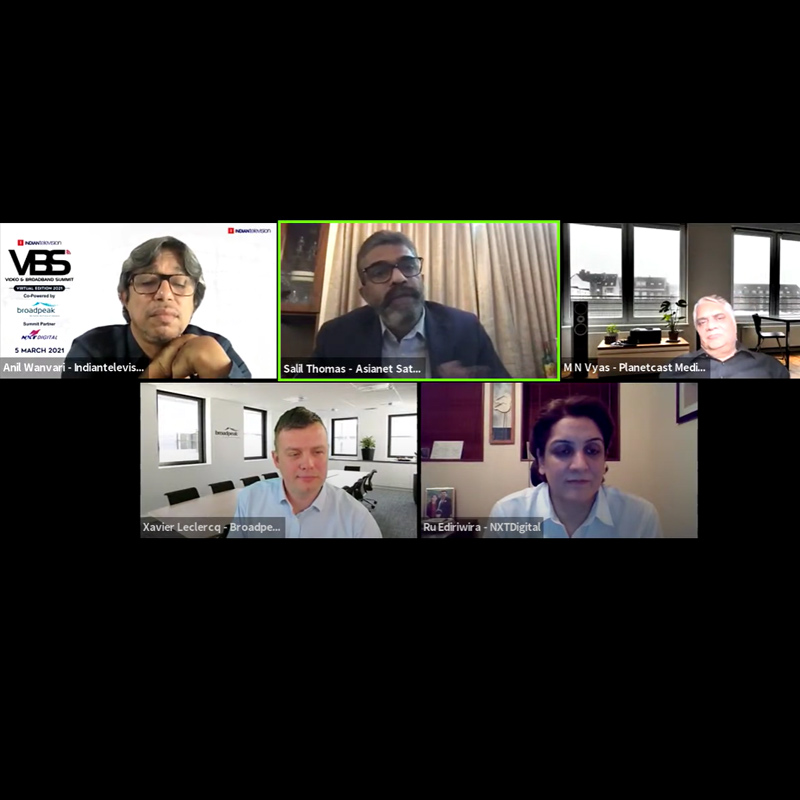
    The panel discussion, ‘Future proofing DPOs on video delivery solutions’ included NXTDigital group CTO Ru Ediriwira, Asianet Satellite Communications Ltd vice president & technology head Salil Thomas, Broadpeak Business Development vice president Xavier Leclercq, and Planetcast Media Services founder director MN Vyas and was moderated by Indiantelevision.com founder and CEO , editor-in-chief Anil Wanvari.

    Although 100 per cent future-proofing is hard to achieve, any organisation should be future-ready in terms of technology, Ediriwira said. “You don’t know what new technology will come around the corner and completely disrupt your industry, way of working. Look at social media, more kids watch YouTube than TV. You have to keep abreast of what is going on and how future generations are changing their content habits, viewing habits,” she added.

    Vyas agreed to the view that futureproof is something that is never possible. But the companies have to look at what is really needed at least in the next five years. According to him, a sea change is needed in the current distribution system. Broadcasters and DPOs have to realise that their role has to be minimal now and TV has to be more intelligent, he stated. The operators need to take an approach where they can take and leverage the existing resources along with adding new things.

    While looking at the future is important, working on the right technology at the right time is also crucial. Thomas explained that they launched a 4K Android TV set-top box three years ago but the boxes are still sitting in their inventory as consumers are not ready for that. Hence, catching up is important rather than jumping ahead of time, he explained.

    “There is a transition happening which is trying to focus more on new users, young audiences and having the ability to reach more screens. We are sort of moving away from the traditional broadcaster domain. This is an interesting turning point,” Leclercq noted.

    According to Ediriwira, the cable industry is seeing logical progression. However, while the industry is nine years into DAS, MPEG-2 slots are still around. While operators are making a push for MPEG-4 and HD boxes, they are a long way off from adopting 4K boxes. MSOs have the advantage, unlimited bandwidth to push 4K and 8K, but there is no content, she said. Moreover, if the industry is not able to sell a huge amount of HD boxes, take off of 8K or 4K boxes will not be possible either.

    “We are seeing people are moving to different devices like fire stick, Chromecast, plug it into TV and install an app and deliver to content. This is a relatively cheaper and cost-effective way of adding new devices and adding streaming applications. On top of it, the difficulty with this is some of the HD, 4K channels have trouble growing in ninjas. This is basically heavy for the networks, for each individual session coming from one of those set top boxes back to the network. You will basically load the network with unicast traffic,” Leclercq mentioned.

    Broadpeak has introduced a technology called MABR that can be used to push multi-screen ABR content (DASH, HLS) over an ISP network. That can be a cable MSO network for example, he added. This content can be pushed all the way to set top box and then it can be consumed by the end device. Operators are starting to build this multicast ABR proposition, he said.

    According to Thomas, IPTV DASH and multicast broadcast is a way forward. IPTV DASH replaces the traditional MPEG-2 TS video structure with a more flexible and adaptive technology. It essentially offers the best of both worlds – the greater flexibility offered by OTT combined with the scalability and low latency at stake with IPTV. It can reduce the huge cost of maintenance for cable networks.

    He added that the aging of cable networks is a big factor that should be considered. Rather than incurring high maintenance cost, it is better to go for fibre-based IP network which will cater to both cable and broadband services. It is better to move TV on the same platform, he stated. Vyas also agreed that someday the industry has to really get into IP deliveries.

    “It is a possibility and we most MSOs have now converted our network to fibre on which we are running both broadband as well as cable. The move to run a full IPTV network that is something any of us have not considered yet. It is very easy for us to drive everything as a broadcast mechanism on Radio Frequency box. But it is definitely worth considering as a potential future capability but at the moment most of us are focusing on trying to upgrade our networks to IP . We have to think about the last mile level also. That requires huge investment from each of the cable operators. We have to help them,” Ediriwira mentioned.

    She added that until that does not happen, the MSOs have to use current technologies. The operators are anyway upgrading their networks and moving to fibre. While she believes that operators should look at transitioning from cable broadcast mechanism to IP network mechanism, she is not certain how helpful it will be for rural areas.  

  • Separate Broadcasting Policy, use last mile operator for broadband spread: TDSAT seminar

    Separate Broadcasting Policy, use last mile operator for broadband spread: TDSAT seminar

    NEW DELHI: There should be a separate Broadcasting Policy analogous to the National Telecom Policy, and the existing laws and regulations should be enforced more stringently before drafting new ones.

    This was one of the recommendations on regulatory issues in broadcasting and distribution sector at a seminar by the Telecom Disputes Settlement and Appellate Tribunal (TDSAT) held early this year.

    The last mile cable network should be leveraged to provide broadband services, according to the recommendations placed on the website of TDSAT yesterday.

    A general consensus also said the government needs to ensure that the amendments in existing regulations do not lead to confusion and ambiguity with regard to the original objectives of the legislations.

    A more effective consultation process should be designed so that the stakeholders do not need to resort to the adjudicatory system, and there should be a more pro-active approach on the implementation of recommendations of the policy makers, the recommendations relating to broadcasting said.

    The seminar on the ART (Adjudication, Regulation, Telecommunication) of Convergence on 6 and 7 February 2016 was attended by government, policy makers, adjudicatory body, and service providers to deliberate suggestions to prepare for challenges that arise with a converging digital environment.

    The seminar was inaugurated by Information and Broadcasting Minister Arun Jaitley, Supreme Court’s Justice J. Chelameswar presided over the function, and Attorney General Mukul Rohatgi was the guest of honour.

    Jaitley stressed the need for an adjudicatory mechanism for telecommunications and broadcasting which is agile and responsive to deal with emerging challenges.

    The seminar was held with the support of Department of Telecommunications (DoT), Department of Telecommunications and Information Technology (DeitY), Telecom Regulatory Authority of India (TRAI), Justices from the Supreme Court and High Court, and representatives of the industry. Ernst and Young was the knowledge partner for the seminar.

    Regulatory and Licensing Regime in a converged environment

    The conclusion was the need to frame a simplified, resilient and comprehensive convergence law and regulation encompassing all activities and sections of the industry, which are currently governed by myriad laws and regulations.

    Separate mechanisms are needed for content and carriage regulation, with independent bodies for each of them. There needs to be converged licensing regime for telecommunications and broadcasting.

    It was also stated that there needs to be a clear and well-defined separation of regulatory and adjudicatory powers, with the adjudicatory powers vested in an independent authority. Strategic spectrum should be under the control of the government, while the commercial spectrum should be under the control of the regulator.

    The governance mechanism should be digitized and the processes should be made simpler to use. The existing laws should be amended keeping in mind their compatibility with other regulations and processes. Legislations should be made technology agnostic to provide a level playing field for all the stakeholders.

    Adjudicatory mechanism — issues and way forward

    It was stated that the law needs to be amended to bring more clarity regarding jurisdictional powers of TDSAT mandated in the TRAI Act apropos writ jurisdiction of the High Courts.

    A separate mediation centre is required for resolving minor cases, both pre-trial as well as post-trial, which do not require the specialized expertise of the judges of the Supreme Court.

    The original character of the TDSAT needs to be restored; in addition whether certain types of disputes should be entrusted to TRAI for resolution in order to improve the efficacy of the overall adjudicatory mechanism.

    There should be a fully integrated electronic tribunal and innovative technologies should be used to deal with cases rapidly and efficiently, the recommendations said.

    Training should be provided to all the stakeholders in the sector to eliminate the digital divide. Regulations need to be updated in accordance with the changing technology.

    Content distribution in next generation networks

    There should be clear, defined and uniform regulations for broadband, net neutrality, advertising, patents, and competition and pricing matters.

    There was unanimity that net neutrality should be ensured to safeguard the interest of all stakeholders in the internet ecosystem.

    A suitable patents and copyright system should be developed for India keeping in mind the specific concerns of the domestic industry.

    It was felt that the industry should not be over-regulated as this would dis-incentivize stakeholders and hamper the interests of both the content creators and the consumers.

    The behaviour of the stakeholders in the industry should be regulated instead of the economics of the industry, since regulation of the latter destroys business models while the former adds to both the consumers’ and the industry’s welfare.

    “I-way of the Future”

    It was felt that the challenge of slow implementation should be overcome through enhanced co-ordination among the stakeholders and the policy makers.

    A broadband highway needs to be built that ensures accessibility of high speed internet for everyone.

    Cyber security and privacy issues that arise due to the cross sector convergence and have standardized legislations for dealing with it needs to be addressed.

    A pro-active approach needs to be followed in policy making to speed up the creation and adoption of the next generation highway infrastructure.

    There should be a conducive business environment through policies that incentivize entrepreneurs and private participation. The expertise of the private sector should be leveraged. Start-ups needs to be encouraged to develop their capabilities and help build a compact, connected and coordinated network of smart cities.

  • Separate Broadcasting Policy, use last mile operator for broadband spread: TDSAT seminar

    Separate Broadcasting Policy, use last mile operator for broadband spread: TDSAT seminar

    NEW DELHI: There should be a separate Broadcasting Policy analogous to the National Telecom Policy, and the existing laws and regulations should be enforced more stringently before drafting new ones.

    This was one of the recommendations on regulatory issues in broadcasting and distribution sector at a seminar by the Telecom Disputes Settlement and Appellate Tribunal (TDSAT) held early this year.

    The last mile cable network should be leveraged to provide broadband services, according to the recommendations placed on the website of TDSAT yesterday.

    A general consensus also said the government needs to ensure that the amendments in existing regulations do not lead to confusion and ambiguity with regard to the original objectives of the legislations.

    A more effective consultation process should be designed so that the stakeholders do not need to resort to the adjudicatory system, and there should be a more pro-active approach on the implementation of recommendations of the policy makers, the recommendations relating to broadcasting said.

    The seminar on the ART (Adjudication, Regulation, Telecommunication) of Convergence on 6 and 7 February 2016 was attended by government, policy makers, adjudicatory body, and service providers to deliberate suggestions to prepare for challenges that arise with a converging digital environment.

    The seminar was inaugurated by Information and Broadcasting Minister Arun Jaitley, Supreme Court’s Justice J. Chelameswar presided over the function, and Attorney General Mukul Rohatgi was the guest of honour.

    Jaitley stressed the need for an adjudicatory mechanism for telecommunications and broadcasting which is agile and responsive to deal with emerging challenges.

    The seminar was held with the support of Department of Telecommunications (DoT), Department of Telecommunications and Information Technology (DeitY), Telecom Regulatory Authority of India (TRAI), Justices from the Supreme Court and High Court, and representatives of the industry. Ernst and Young was the knowledge partner for the seminar.

    Regulatory and Licensing Regime in a converged environment

    The conclusion was the need to frame a simplified, resilient and comprehensive convergence law and regulation encompassing all activities and sections of the industry, which are currently governed by myriad laws and regulations.

    Separate mechanisms are needed for content and carriage regulation, with independent bodies for each of them. There needs to be converged licensing regime for telecommunications and broadcasting.

    It was also stated that there needs to be a clear and well-defined separation of regulatory and adjudicatory powers, with the adjudicatory powers vested in an independent authority. Strategic spectrum should be under the control of the government, while the commercial spectrum should be under the control of the regulator.

    The governance mechanism should be digitized and the processes should be made simpler to use. The existing laws should be amended keeping in mind their compatibility with other regulations and processes. Legislations should be made technology agnostic to provide a level playing field for all the stakeholders.

    Adjudicatory mechanism — issues and way forward

    It was stated that the law needs to be amended to bring more clarity regarding jurisdictional powers of TDSAT mandated in the TRAI Act apropos writ jurisdiction of the High Courts.

    A separate mediation centre is required for resolving minor cases, both pre-trial as well as post-trial, which do not require the specialized expertise of the judges of the Supreme Court.

    The original character of the TDSAT needs to be restored; in addition whether certain types of disputes should be entrusted to TRAI for resolution in order to improve the efficacy of the overall adjudicatory mechanism.

    There should be a fully integrated electronic tribunal and innovative technologies should be used to deal with cases rapidly and efficiently, the recommendations said.

    Training should be provided to all the stakeholders in the sector to eliminate the digital divide. Regulations need to be updated in accordance with the changing technology.

    Content distribution in next generation networks

    There should be clear, defined and uniform regulations for broadband, net neutrality, advertising, patents, and competition and pricing matters.

    There was unanimity that net neutrality should be ensured to safeguard the interest of all stakeholders in the internet ecosystem.

    A suitable patents and copyright system should be developed for India keeping in mind the specific concerns of the domestic industry.

    It was felt that the industry should not be over-regulated as this would dis-incentivize stakeholders and hamper the interests of both the content creators and the consumers.

    The behaviour of the stakeholders in the industry should be regulated instead of the economics of the industry, since regulation of the latter destroys business models while the former adds to both the consumers’ and the industry’s welfare.

    “I-way of the Future”

    It was felt that the challenge of slow implementation should be overcome through enhanced co-ordination among the stakeholders and the policy makers.

    A broadband highway needs to be built that ensures accessibility of high speed internet for everyone.

    Cyber security and privacy issues that arise due to the cross sector convergence and have standardized legislations for dealing with it needs to be addressed.

    A pro-active approach needs to be followed in policy making to speed up the creation and adoption of the next generation highway infrastructure.

    There should be a conducive business environment through policies that incentivize entrepreneurs and private participation. The expertise of the private sector should be leveraged. Start-ups needs to be encouraged to develop their capabilities and help build a compact, connected and coordinated network of smart cities.

  • Ortel Communications makes below par debut on bourses

    Ortel Communications makes below par debut on bourses

    BENGALURU: Ortel Communications Limited (Ortel) debuted at Rs 160.05 per share on the National Stock Exchange (NSE), about 11.6 per cent below its listing price or Rs 181 per share on 19 March. The company had issued its shares at Rs 181 each early this month in its initial public offer (IPO), which was under subscribed by about 25 per cent.


    The high for the day was Rs 168.05 and it closed at Rs 162.25 on the NSE. Close to 26520 shares traded on the NSE at traded value of about Rs 43.90 lakh. 


    Note: 100,00,000 = 100 lakh = 10 million = 1 crore. 


    On the Bombay Stock Exchange (BSE), the stock breached the lower circuit of Rs 171.95 with a turnover of Rs 5.11 lakh and a total traded quantity of 2964 shares.


    Financial industry sources explain that though the company is in the last mile connectivity business, its performance over the last few years has been dismal and hence the poor opening.


    The Ortel IPO opened on 3 March, 2015 for up to 1.2 crore (12 million) equity shares of face value of Rs 10 each including a share premium per equity share. The price band was fixed from Rs 181 to Rs 200 per equity share. The issue constituted 39.25 per cent of Ortel’s fully diluted post-issue paid up equity share capital and included up to 60 lakh fresh issue shares and 60 lakh shares by the selling shareholder NSR-PE Mauritius LLC. Facing a lukewarm response, the company had to cut the offer size by 36.7 lakh shares, pruning the NSR component from the IPO to that extent.


    The company had allotted 25.57425 lakh equity shares (28.416 per cent of QIB portion) at the rate of Rs 181 per share aggregating Rs 46.29 crore to Axis Mutual Fund and ICICI Prudential Life Insurance, before the IPO opened.


  • Ortel IPO opens amidst buoyant stock market conditions

    Ortel IPO opens amidst buoyant stock market conditions

    MUMBAI: The Ortel Communications issue opened on 3 March. At  the price band of Rs 181-200, the cable TV last mile operator (LMO) is offering 9.5 million shares to the public. National Stock Exchange data showed that the issue had been subscribed 0.15 times by end of day one of the offer. The company plans to use the money  raised through the issue to deepen the penetration of its cable TV and broadband offering in the geographical regions it is present i.e. Odisha, Chhattisgarh, Andhra Pradesh and West Bengal ; increasing digitisation of its cable TV subscriber base (currently 20 per cent of its analogue universe has been digitised), upgrading technology for its broadband service; buying out of local cable operators and networks, and leasing fibre infrastructure to corporates.

    At the time of writing, the IPO had received a mixed response from the investing community and research analysts. While one group says the price band is too high, another bunch has expressed that the Ortel stock has long legs and could go far. 

    Says a bullish observer: “The Ortel IPO offer is at 10 times EBIDTA for FY 2015. That’s pretty fair compared to 17 times EBIDTA for Hathway Cable & Datacom and seven times EBIDTA for DEN Networks,” says a research analyst. “We see the share appreciating after listing.”

    However, a bear stated that Hathway was quoting in the Rs 60-65 range, while DEN was in the Rs 120 band. “The Ortel price is too high when you compare it to what these stocks have notched up,” she said. “We expect to pick up Ortel after listing when we believe the overpricing will get corrected.”

    An ICICI Direct IPO review pointed out that Ortel’s low subscriber base of 0.5 million cable TV homes puts it at a competitive disadvantage against national MSOs such as DEN and Hathway which have 12 million subscribers each. 

    But another industry expert  points out that Ortel owns most of its subscriber base, aka as the last mile, which means it will reap the digital dividend and the moolah will straightaway accrue to its top line, and bottom line as it digitally connects more of them.

    He also points out to the low floating stock of Ortel that is on offer, which is likely to keep the price buoyant.

    At the time of writing, a positive sentiment had been ruling on the stock market with the National Stock Exchange Nifty  crossing an important threshold that of the 9,000 barrier which it did during intraday trading only to fall back to 8996 by close.

    The anchor investors for the IPO are Axis Mutual Fund (900,000 shares) and ICICI Prudential Life Insurance (1.657 million shares), while Kotak Mahindra Capital is managing the issue.

    The next two days (the issue is slated to close on 5 March) will throw clarity on which sentiment will hold its sway on investors during Ortel’s offering.