Tag: Laqshya media group

  • Tata Tea Gold introduces ‘Banglar Noksha Pujo’ campaign with Laqshya Media’s Dual-Screen 3D Display in Kolkata

    Tata Tea Gold introduces ‘Banglar Noksha Pujo’ campaign with Laqshya Media’s Dual-Screen 3D Display in Kolkata

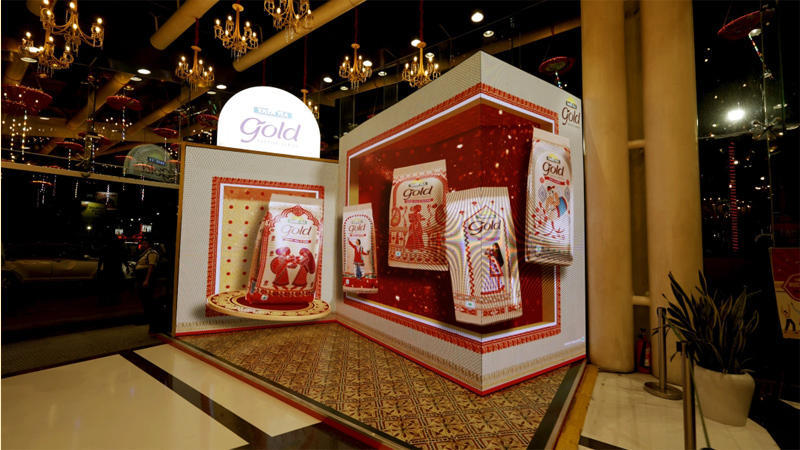
    Mumbai: As the radiant festivities of Durga Pujo envelop West Bengal in an aura of vibrancy, Tata Tea Gold, the beloved tea brand of the region, magnificently commemorates the spirit of the occasion with an innovative twist. In a first-of-its-kind collaboration, Laqshya Media brings to life an extraordinary dual-screen 3D Anamorphic Display at South City Mall, Kolkata, showcasing the quintessential handloom heritage of West Bengal through a captivating fusion of technology and tradition.

    The awe-inspiring installation, on display from 14 to 21 October 2023, eloquently depicts the splendour of Durga Pujo through an intricate tapestry of Bengal’s five distinct handlooms. From the vivid conch blowing on the Jamdani-inspired packaging to the enchanting rhythms of the Dhaki depicted on the Kantha-inspired designs, the display seamlessly weaves a mesmerising tale of Bengali pride and festivity. Symbolising a tribute to the region’s rich cultural craftsmanship, this groundbreaking initiative by Tata Tea Gold and Laqshya Media Ltd promises to captivate the hearts of onlookers and tea enthusiasts alike.

    Commenting about the successful 3D anamorphic outdoor installation, Tata Consumer Products president – packaged beverages (India and South Asia) Puneet Das said, “Durga Pujo is a cultural extravaganza transcending the boundaries of celebrations by amalgamating culture, traditions, artistry, and devotion of people. Handlooms are an integral part of festive celebrations, and with our Banglar Noksha Pujo campaign, we aim to pay tribute to the resplendent cultural craftsmanship of the region. By leveraging cutting-edge technology for contemporary storytelling, we endeavour to celebrate West Bengal’s acclaimed handlooms, creating resonance with our consumers. Further, our limited-edition festive packs persist in recounting the awe-inspiring handloom heritage of the state.”

    Laqshya Media Group chief strategy officer Yuvrraj Agarwaal said, “Embracing Tata Consumer with gratitude, we embark on an extraordinary journey during the Durga Puja festivities, harmonising the elements of Tea, Tradition, and Technology to create an unparalleled experience. Durga Pujo, a grand cultural symphony, orchestrates a seamless fusion of culture, traditions, artistry, and devotion, with handlooms as a vital part. Through this campaign, we pay homage to the region’s rich cultural craftsmanship, weaving our story with consumers through the threads of never-seen-before technology.”

    He added, “Our hearts brim with excitement as we unveil our role in illuminating West Bengal’s cultural vibrancy with our cutting-edge Dual-Screen 3D Anamorphic Display. As the pioneering execution of its kind in India by any brand, it stands as a testament to our relentless pursuit of industry-first innovations, underscoring our unwavering commitment to pushing the boundaries of creativity and technology. We are unwavering in our quest to make out-of-home experiences more captivating and immersive, and this project embodies that very philosophy.”

    Laqshya Media Group company – Inventech CEO Sommnath Sengupta joyously reflects on the success of the Tata Banglar Noksha Pujo campaign, emphasising the triumph of the 3D Anamorphic Display from conceptualisation to installation. “With our successful 3D anamorphic outdoor installation and groundbreaking Dual-Screen 3D Anamorphic Display, we celebrate West Bengal’s cultural craftsmanship beyond the ordinary. Our commitment to pushing creative and technological boundaries is evident in every thread, creating immersive connections. We’ve woven an experience that transcends tradition, leaving an indelible mark on consumers’ hearts during the Durga Puja festivities,” he said.

  • Priyanka & Suresh Raina’s ‘maate’ announces integrated marketing partnership with Laqshya Media Group

    Priyanka & Suresh Raina’s ‘maate’ announces integrated marketing partnership with Laqshya Media Group

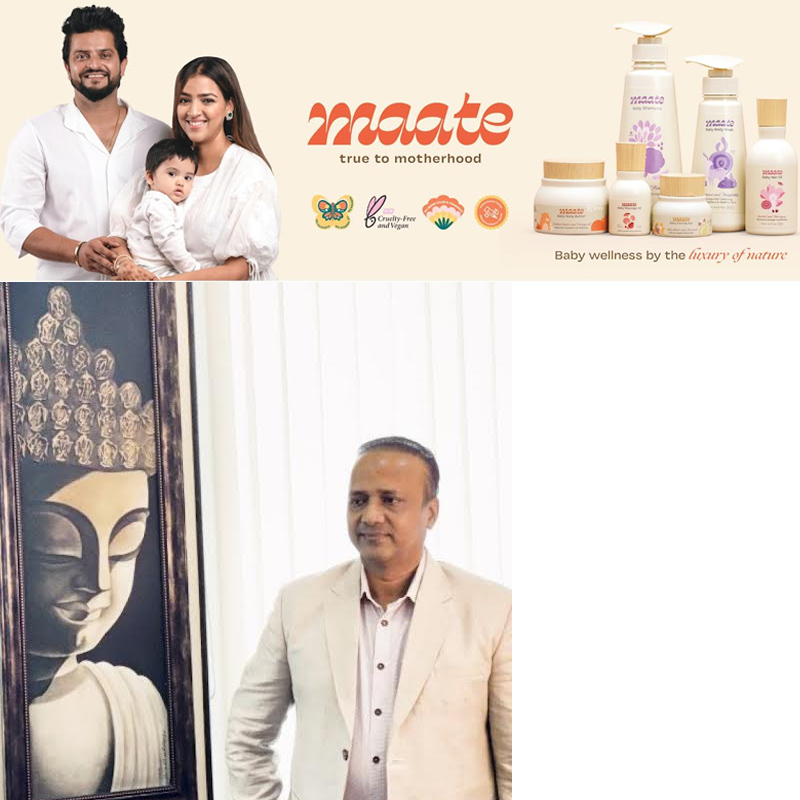
    Mumbai: Laqshya Media Group has won the integrated marketing mandate for ‘maate,’ a premium babycare brand co-owned by Priyanka Raina and legendary cricketer Suresh Raina, in a multi-agency pitch. The group will be entrusted with 360-degree marketing duties, including OOH, TV, print, radio, digital, PR, live experiences, and beyond, for the brand.

    “We are delighted to partner with one of India’s most innovative marketing communications groups, Laqshya Media, as we strive to make ‘maate’ the premium and safe choice for mothers and babies worldwide. The agency resonates with our vision and has innovative ideas and communication strategies that will enhance brand awareness and establish the brand as a front-runner in the premium baby care segment. maate has grown organically on its own so far, but with Laqshya on board, we are hoping for more targeted marketing and to speed up our expansion plans. As a truly homegrown brand, ‘maate’ is committed to ensuring a superior and safe experience for new mothers and babyhood,” said maate co-founder Priyanka Raina.

    On this occasion, Laqshya Media Group managing director Alok Jalan said, “We are thrilled to join hands with ‘maate’ and are truly excited to work in this growing baby care category. ‘maate’ is among the few companies in the segment that have exhibited a long-term vision and have developed very premium and safe products for baby care. As a 360-degree marketing agency, Laqshya Media Group is committed to crafting out-of-the-box, purpose-driven integrated campaigns to build strong brand awareness and CTAs.”

    The development comes after ‘maate’ revealed a new brand identity to reaffirm its commitment to motherhood and foster a connection with couples who have recently become parents. It has also recently forayed offline with the launch of its entire range of products across Delhi NCR.

    Launched in 2019, ‘maate’ is a truly homegrown brand. When Priyanka Raina returned from Amsterdam to India after becoming a mother, she could not find safe and effective baby care products in the Indian market. This led to the birth of ‘maate,’ a consciously designed 360° wellness brand. All ‘maate’ products have been formulated with the highest quality natural ingredients after years of research and are completely safe and effective for babies. Motherhood is at the core of the company’s essence.  ‘maate’ products are completely natural, toxin-free, vegan, and cruelty-free. Inspired by the luxury of nature, the brand aims to bring the potency of the highest quality natural ingredients into an improved formulation through constant research and innovation.

  • Tanishq debuts hyper-realistic 3D DOOH billboards with new installation

    Tanishq debuts hyper-realistic 3D DOOH billboards with new installation

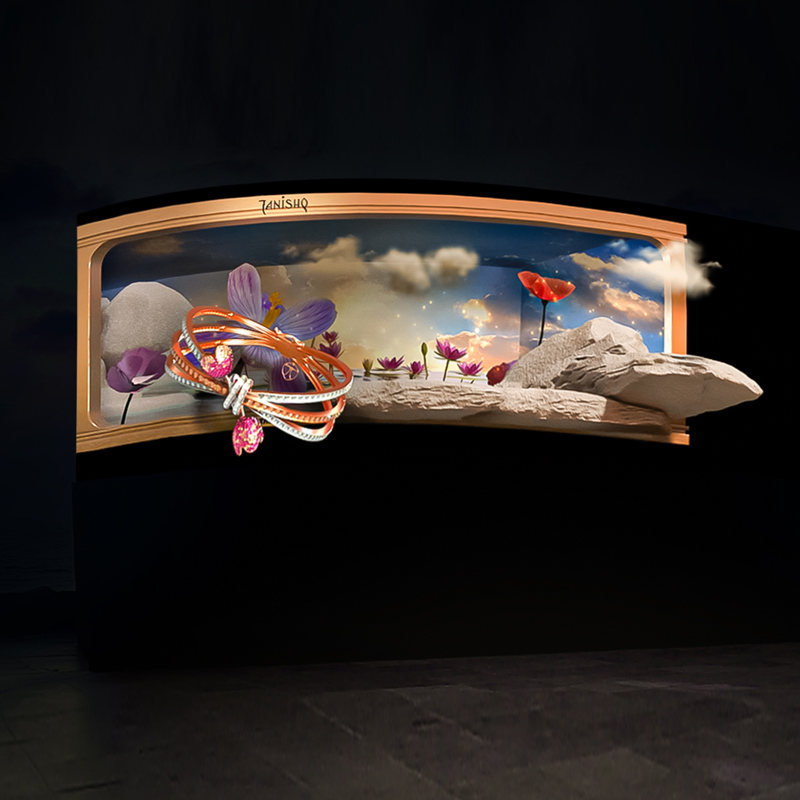
    Mumbai: Hyper-realistic 3D digital out-of-home (DOOH) billboards have been stunning passers-by on busy streets in Japan, South Korea, the US, the UK, Kuala Lumpur, Singapore, China and now it has debuted in India with Tanishq’s latest installation. Laqshya Media Group executed ‘India’s first immersive 3D anamorphic’ installation for Tanishq’s season of bloom collection – Live a Dream. 

    The display, installed at Mumbai’s Bandstand Promenade in Bandra, is called an anamorphic illusion or anamorphosis, which is a distorted projection that reveals itself once you occupy a specific vantage point.

    The brief for this campaign was to do something “dreamy, paradisal, surreal and larger than life” and introduce the collection to a broader set of audience in a way that is accessible, engaging, and celebratory, according to the agency. The attention-grabbing OOH execution highlights ‘a distinct diamond jewellery that mirrors desire.’ Seeing the optical illusion effect on the billboard in real life creates a unique experience for the viewer.

     “We at Laqshya Group are excited to execute and display India’s first 3D anamorphic DOOH installation for Tanishq’s special collection – Live a Dream,” said Laqshya Solutions COO Amarjeet Hudda. “Using a technique called ‘Anamorphosis’ to create optical illusions for the viewer has happened in India for the first time. We see it as a powerful new tool for creatives. The installation is hard to describe but incredibly easy to view, with the correct perspective, lighting and shadows, which require no fancy eyewear, mirrors or technology.”

    “We are always looking for new ways to surprise consumers with exciting, imaginative, and meaningful experiences. This project has hit the benchmark for sure. Through this impactful DOOH branding exercise, we are taking brand immersion to a different level. It is stimulating strong interest and demand in the advertising community,” he further added.

    As technology progresses, the push for immersion and for a blended reality with our everyday screens is what will define most of the future trends in the advertising industry and beyond. It started with virtual reality (VR) and Augmented reality (AR) and now it is moving to out-of-home.

    Since its launch over the weekend, the installation with its innovative technology and its eye-grabbing visuals has been garnering appreciation in the city and the brand hopes to take the installation to other major markets as well, according to the statement.

    Speaking about the partnership with Laqshya Media Group and the campaign, Titan Company GM of marketing for Tanishq Ranjani Krishnaswamy said, “Tanishq has forged to create new paradigms in the jewellery category. Keeping our consumers at the centre of all conversations, we would like to create new narratives with innovation, collaboration, and imagination. This April we are exploring the launch of our collection ‘Romance of Polki’ in an immersive metaverse experience and today we are glad to bring another immersive experience for yet another special collection ‘Live a Dream’.”

    “This first 3D installation is a senatorial experience to the surreal world of dreams and brings alive the beauty, intricacy, and craftsmanship of the collection. Special thanks to our partner Laqshya who have worked alongside to bring this imagination alive,” she further said.

    Watch the brand film of the immersive 3D DOOH installation here:

  • Laqshya Media Group executes OOH campaign for Tanishq’s latest collection

    Laqshya Media Group executes OOH campaign for Tanishq’s latest collection

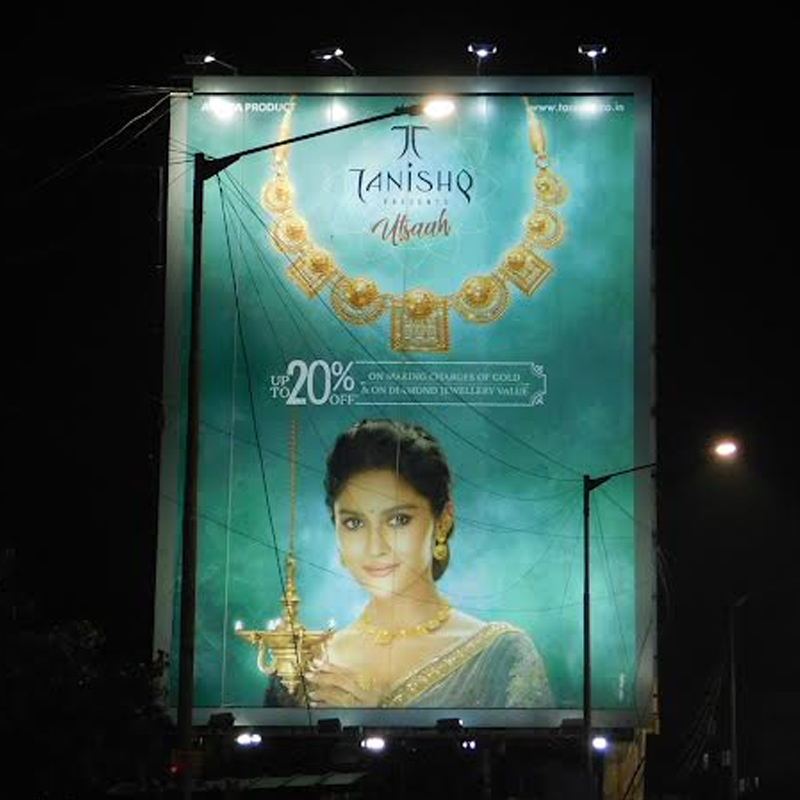
    MUMBAI: As the country slowly gears up to fully ‘unlock’ post the second wave of the pandemic, outdoor advertising has also begun to see an uptick. Marketing communications group Laqshya Media Group is among the latest to execute a mega OOH campaign for Tanishq’s festive collection ‘Utsaah’ – The Festival of Life.

    The 30-day campaign encompasses a mix of large format media units with new-gen digital mediums, cluster brandings, and other unconventional mediums across all cities to create maximum impact and reach for Tanishq’s target audience.

    The multi-city high decibel campaign was planned through AI-powered OOH planning tool “SHARP”- the data and tech-led planning tool helped to get the most appropriate locations in each city to reach out to core TG of the campaign, said the group. The tool also gives the metrics to evaluate the performance of the campaign, be it campaign Nett reach, OTS, CPT, frequency and impact score of the campaign, shared the agency.

    Foreseeing the festive trends this year, ‘Utsaah’ by Tanishq offers a seamless blend of intricacy, heritage, and old contemporized designs with modern sensibilities, giving a new life to traditional craftsmanship, said the brand in a statement.

    “With the past, that’s been tough and a future that’s cautious, it is the ‘today’ that really holds the promise, that implores us to cherish, rejoice in the biggest festival called ‘Life’. The power of ‘Now’ is directing our lives and becoming the biggest source of our happiness. These everyday celebrations have been the inspiration for our collection,” said Tanishq, Titan Company Ltd – Marketing GM Ranjani Krishnaswamy.

    Elaborating on the partnership Krishnaswamy added, “It only seemed befitting to work with a partner who understands OOH as a medium and our objective to reach out to consumers across the country with this message of celebrating ‘Life’ as a festival this Diwali. And, Laqshya Media Group became our preferred choice, with a massive campaign spread across prominent sites, high footfall TG touchpoint, Airports, high traffic arterial roads, prominent retail commercial areas that ensure last-mile visibility to deliver maximum impact and reach the right audience this season.”

    “We at Laqshya Group are proud to execute this campaign for Tanishq’s festive collection that brings us the beautifully designed products crafted to perfection by their Karigars that add to our festivities. Through this impactful OOH branding exercise, we have tried to create a long-lasting impression in the minds of our consumers,” said Laqshya Solutions COO Amarjeet Hudda.

  • Laqshya Media Group Exclusive Research -136 districts (comprising 139,641 villages) in the top 9 states can lead the economic revival process

    Laqshya Media Group Exclusive Research -136 districts (comprising 139,641 villages) in the top 9 states can lead the economic revival process

    According to the National Sample Survey Organisation (NSSO) ‘rural’ is an area with a Population Density of 400 per sq km and villages with clear surveyed boundaries but no municipal board. Min 75% male working population has to be involved in agriculture & allied activities. RBI defines rural areas as those areas with a Population less than 49,000 (tier -3 to tier-6 cities). This definition governs the agricultural credit given by banks and NBFCs.

    Laqshya Media Group’s latest report gives us a sneak peek into startling data about the growth and innovation in Rural India and its industries, including agriculture, fertilizers, tractors, building materials and FMCG. It highlights the geographical areas that hold potential, even as the urban markets are slowed down by the pandemic. It spotlights the districts that have low infections and high GDP values and it showcases the infrastructural opportunities that the private sector should consider for long term profitability. 

    Agriculture in India has come a long way. India is a massive producer of food grains, horticulture, cash crops, milk and livestock-related products, resulting in India being self-sufficient in feeding its 1.37 billion population. Along with the growth in agriculture and livestock, there is also a quantum jump in India’s investment in Rural Infrastructure, which is a huge opportunity for all the mainline industries.

    India is the largest producer of milk, pulses, jute, etc. and the second largest in crops like rice, wheat and tea. Agriculture contributes 17% to the Indian GDP and 45% to employment generation. India is home to the world's highest-selling Tractor brand (M&M) and the world's largest fertilizer cooperative (IFFCO). It is also the 2nd largest producer of cement. 

    In India approx. 270 Mn rural consumers (35%) have discretionary spending powers, helped by improved agricultural practices and better access to markets. Rural Market constitutes the following
    40% of FMCG sales – estimated to rise to USD $100 billion by 2025
    50% of motorbike sales
    38% of Cement Sales (out of residential cement)
    ~8-10% of e-commerce estimated to rise to $10-$12 billion by 2025

    GOI’s intent to double farmers’ income in 7 years (from 2015-16 to 2022-23) – GOI’s intent marked a significant departure of the past when the emphasis had been only on production rather than its marketability. In addition, public funding on infrastructure and food grains procurement will give a significant boost to the rural population.

    The report also talks about case studies of initiatives carried out by big brands in rural India. It talks about ITC’s e-choupal Baareh Mahine Hariyali, Mahindra’s Rural Housing Finance with easy loans, Amazon’s Handmade initiative and Rural Distribution Centres, Flipkart’s Motorola for Rural Markets initiative and IFFCO’s Indian Cooperative Digital Platform.

    Opportunities in Rural India are wide and varied. Brands can grow by capitalizing on the currently increasing incomes and aspirations of the rural buyers. 
    The momentum in the rural economy can be built on by fulfilling the need gaps that are holding back higher growth of the rural economy including higher productivity of crops and more capacity for processing of crops.

    Engagement with the Rural population should be customized with hyperlocal solutions.

    “Rural India constitutes 66% of the country’s population. Over the last few years Rural India’s contribution to the overall GDP has dipped but there are also innumerable opportunities for growth. Good monsoons have boosted crop production in the last year and much investment has been made for improving infrastructure. Many gaps are noticeable which if fulfilled can give a great boost to the Indian economy. In the current Covid-19 situation we have also looked into the top districts in 9 states of India. 126 out of 281 districts across 5 states has less than 1000 active cases and contributes nearly 60% to the GDP. These 126 districts constitute 139,641 villages with great potential for an increase in production and consumption. So, with the correct planning, huge opportunities lie here for marketers.” Atul Shrivastava, CEO, Laqshya Media Group.

    Follow Tellychakkar for the consumer facing news & entertainment

  • OOH to reach 50-60% of last year’s billing by festive season: Laqshya Media Group’s Atul Shrivastava

    OOH to reach 50-60% of last year’s billing by festive season: Laqshya Media Group’s Atul Shrivastava

    NEW DELHI: Remember those hoardings from a few days ago, which led to much curiosity and speculation across Delhi and Mumbai?  FMCG brands including Maggi, Cadbury Dairy Milk, Red Label Tea and Amul Lassi put up hoardings that read: “#13thKiTayyari Kijiye. __ Stock Kar Lijiye” with each brand telling people to stock its product. It was Laqshya Media that executed the campaign for Zee TV's upcoming shows. 

    Laqshya Media Group is one of the largest comprehensive marketing communications group In India functioning primarily in outdoor, events and digital ecosystem. The group was praised on social media for its latest campaign with Zee TV.

    While there is no denying that the whole world is reeling from the major upheaval caused by the Covid2019 pandemic, the OOH industry has taken the maximum hit. In a candid conversation with Laqshya Media Group CEO Atul Shrivastava shared about the company's revival plan and more.

    Edited excerpts:

    With unlock 2.0, have you witnessed an uptick in the OOH industry? 

    We have already received queries from brands waiting to resume advertising – particularly those who had long-term contracts with us and had put their campaigns on hold. We are also seeing demand from regional brands who rely heavily on OOH for advertising.

    We are anticipating a healthy rebound during the festive season, extending to the end of the calendar year. Since several brands have a huge inventory pile-up, they will be looking at liquidating that inventory during the festive season. And sales are very much dependent on visibility and marketing.

    What has been the impact on the out-of-home media industry?

    As the easing phase has begun, we have regained our sites (from the government’s Covid2019 awareness campaigns) and advertising has started.

    The March-June 2020 quarter saw an estimated 20 per cent of the previous year’s billings. If there are no further restrictions from the government, the sector will see a revival during the festive season. It is expected to reach 50-60 per cent of last year’s billing by that time.

    What is your plan on revival? It seems the next 6 months will also be grim? 

    Our plan on revival has been in the works since day one. Our team has been dedicatedly involved in deep market research. We have created research reports that were focused on OOH’s revival. We have analysed which sectors were going to invest in OOH advertising once the lockdown was over. In addition, we did a lot of consumer research. We studied aspects like – will people take public transport or private? Are people going to buy gold? Which products will people buy more? Are people only thinking about buying essentials? What was their food eating patterns and are they willing to eat out after lockdown?

    The aforementioned questions helped us to sketch a figure of our potential client base. Apart from rigorous research since the initial days of lockdown, we worked on brand building and PR activities.

    This helped us in carving a niche and helped us in deepening our already existing niche in the market. We, as a team never paused during the lockdown.

    It is understood that to overcome the current landscape some hardcore strategies are required. The next six months are crucial for us. We are working on connecting the dots, doing market research, reaching out to the potential clients who are working to start business immediately and keeping a track on people who are up for buying.

    How drastic is the impact on ad rates?

    Advertising rates for OOH inventory have declined. Since fewer people were on the roads, advertisers were unwilling to pay the same rates as they were in January and February. Brands were certainly looking for discounts. Ad rates for the next quarter will continue to be challenged for a little longer.  However, we are not reducing the rates of super-premium displays that have exceedingly high visibility and demand, too.

    How much uptake do you foresee for inventory at metro stations, suburban stations and shopping malls?

    Even though the government has initiated a phased opening of markets, people may be hesitant to visit them. For the next three months, demand for ambient media will continue to be muted.

    Footfall in malls that have opened in cities like Bengaluru, Hyderabad and Noida has been about 10 per cent that of pre-Covid2019 numbers. Therefore, media owners are focusing on occupancy, rather than looking for better ad rates in places like malls.

    Sites inside metro stations are still off since the services are not functional, but outside branding of stations is already making a difference. Since brands have begun showing interest in airports, even though airlines are not running at full capacity, we expect similar demand for inventory in metro and local train stations when operations resume.

    Which categories are going to be back on OOH? 

    We expect all sectors to come back and embrace OOH now that the country has embarked on the unlock phase. Many brands like Apple, Vivo, Asian Paints, Kotak, etc., have already started and are gaining first-mover advantage. Our research study stated that more than 84 per cent of consumers across our metros will notice OOH as much or even more after the lockdown period and that they will reduce the consumption of conventional media, post lockdown.

    A few categories that gained prominence during the lockdown are going to be bigger spenders on OOH. For example, e-commerce firms and digital payment gateways have greater demand now. We are also expecting a surge in advertising from manufacturers of two-wheelers and entry-level cars.

    While OTT video streaming platforms were booming in terms of consumption during the lockdown, we expect a slowdown in OOH advertising from this category over the next few months because they are out of fresh content. However, we are expecting them to return with a bang soon.

    Mobile phone brands that used to be fixtures on hoardings in and around airports, continue to advertise even now. However, real estate brands, which were also keen on airport display, are hesitant. Since airport media is priced at a premium, brands may take longer to return.

    With domestic air travel slowly picking up are you gearing up to resume advertising at airports?

    Air travel is seen as the safest mode of travel at the current times. With the opening up of domestic flights, brands are looking to quickly re-engage with their high-value customers. The time spent at airports has increased with not much to do once they reach the airports. So, advertising at strategic locations, like at the entry gate, waiting areas, etc. will ensure greater visibility and brand recall. Airports are an important medium, especially since the use of DOOH is more here. So, more investments at airports will garner greater benefits for the agencies.

    What is the big shift you have witnessed during the lockdown? 

    Our transformation from an OOH to a multi-media conglomerate has followed a carefully coordinated strategy of delivering the most optimised consumer-contact solution to our clients by combining digital, OOH and experiential. Another exciting transition has been the transformation of business models within the media verticals that we operate in. In order to make our OOH and experiential offerings more interactive, we added a digital marketing company to our network, which gives us the bandwidth to offer our clients an unbeatable offline-online combination. Though the current situation is challenging, our events teams have created and conducted large-scale online seminars and performance-arts events which have been well received by some of our blue-chip clients. It creates an opportunity for us to give a bundled offering to our clients, which is unique and distinct from what any other media company is offering in India.
  • Vikram Hemdev joins Laqshya Hyderabad Airport Media as COO

    Vikram Hemdev joins Laqshya Hyderabad Airport Media as COO

    MUMBAI: Laqshya Media Group has announced the appointment of Vikram Hemdev as COO – Laqshya Hyderabad Airport Media Pvt Ltd (LHAMPL), the joint venture between Laqshya Media Limited and GMR group.

    He comes with 18 years of rich experience across the Media & Advertising landscape, Sales & Marketing, Business Operations and P&L Management. Prior to joining Laqshya Media Group, Hemdev’s last assignment was with Times OOH as the business head – traditional OOH and trading. He also successfully handled the Delhi Airport & Mumbai Airport advertising business during critical junctures.  

    He has been associated with the Bennett & Coleman Group for more than a decade handling multiple responsibilities across radio, activations, airport advertising and traditional OOH. In the past, he has worked with organisations such as Mercedes-Benz, McCann, Ogilvy, Indian Express and Mphasis. 

    Hemdev is coming in place Mr Shashi Sinha who has helmed this business for over 10 years. Sinha has had a 12 years long and successful stint at Laqshya Group with all their business divisions – media assets, OMI and Hyderabad Airport. He moves on to a new assignment and we wish him all the very best in all his future endeavours. 

    Hemdev said, “I am very happy to be a part of Laqshya, especially at a time when the OOH industry is going through a reset. The next few months are the most challenging and all our collective experiences are going to get thoroughly tested. I am looking forward to add value, rebuild the airport advertising business, move it in a positive direction and hopefully set new benchmarks.”

    Laqshya Media Group CEO Atul Shrivastava said, “Laqshya Media Group is very happy to welcome Vikram Hemdev as the COO of LHAMPL. Post lockdown the demand for travel is seeing a steady increase and air-travel is seen as one of the safest modes of transport. The dwell time at airports has increased significantly & consumers are more alert than ever. A lot of brands have already positioned themselves at Hyderabad Airport keeping the new normal in mind & it is only poised to increase further, very soon!

  • Post-lockdown perceptions, aspirations and anticipations of Indian millennials

    Post-lockdown perceptions, aspirations and anticipations of Indian millennials

    MUMBAI: The current lockdown is a dark phase, something that the world has not witnessed in decades. But there is always a silver lining in any adverse situation. Laqshya Media Group  has found a bit of that silver lining by conducting a research study to help marketeers figure out the perceptions, aspirations and anticipations of the Indian Millennial via-a-vis the ‘New Normal’ that the world faces today.

    An online study was conducted reaching 1104 respondents across the primary cities in India. The target group belonged to the age group between 18 and 39, across genders and representing both NCCS A andB. Summarising all the reports and survey results has helped Laqshya assess the perceptions, aspirations and anticipations of the Indian millennials. The good news is that not only are the IMF and the RBI confident of India bouncing back – so are the Indian Millennials. A few findings of the report are excerpted below.

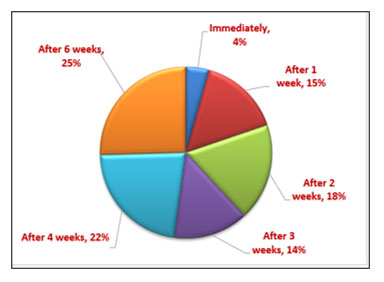
    The research talks about customer behavior as per two primary age groups 18-25 and 26-39. Analysis shows that each cohort responded differently to some of the questions posed to them, while they were statistically similar in response to others. For example, one of the questions was whether people will wait to visit malls, restaurants or any public places right after the lockdown is lifted. 75 per cent of the entire respondent base responded that they will be back within four to five weeks. The younger people, 18-25, shared that they will hit the malls in an average of 23 days while the 25-39 cohort’s average wait time was 29 days!

    But 31 per cent of the targeted group is more likely to use personal travel more frequently as compared to earlier. A sneak peak of this data can be seen in the pie chart given below that shows the time people will wait to go out post the lockdown.

    It is interesting to realise that people have different mindsets towards outings, investing and traveling. Similar to the aforementioned question, a series of questions were asked to the people from different ages, genders, backgrounds and professions. Majority of people responded that they want to meet friends and family after the lockdown. It was noted that younger people and women had a major inclination towards eating out.

    The millennials are optimistically cautious especially in investing money or procuring assets. 53 per cent of the respondents want to invest in fixed deposits, but more than 40 per cent of them continue to have faith in mutual funds, and more than a quarter anticipate investing in the stock market. The millennials also want to invest more in education and development of their skills, which will surely give a boost to the education sector.

    In the advertising world, print and outdoor media have taken a major hit as people during the lockdown had little option but to move to digital news portals and OTT platforms. Most of the population is binge watching on all the major OTT platforms. Video calling apps have also gained great popularity thanks to official meetings and social hangouts being restricted to our laptop/mobile screen. Will these trends stay after the lockdown ends? On that note, 36 per cent of the respondents said that their online shopping will increase, and whopping 86 per cent say that they will notice OOH advertising as much or more than they did before!

    References from the reports by The Reserve Bank of India, The International Monetary Fund and McKinsey and Company were also taken into account while making the report.

    Laqshya Media Group CEO Atul Shrivastava believes that people in India are committed to fight and win over the current situation. He said, “There is a huge consumption of every product in India and there will be eagerness amongst the brands to become the first choice for every consumer. This is likely to fuel the demand for the advertising sooner than most nay-sayers predict.”

    Laqshya Media Group MD Alok Jalan is positive of the way ahead, “Although some industries have taken a major hit, others like the e-commerce businesses have a lot of scope ahead. This is also a good opportunity for the traditional businesses to evolve their digital presence. If we are able to contain the pandemic shortly then there is a scope for the market to bounce back and show growth.”

    Follow Tellychakkar for the consumer facing news & entertainment

  • Laqshya Media Group’s OOH agency OMI bags Global Marketing Excellence Award

    Laqshya Media Group’s OOH agency OMI bags Global Marketing Excellence Award

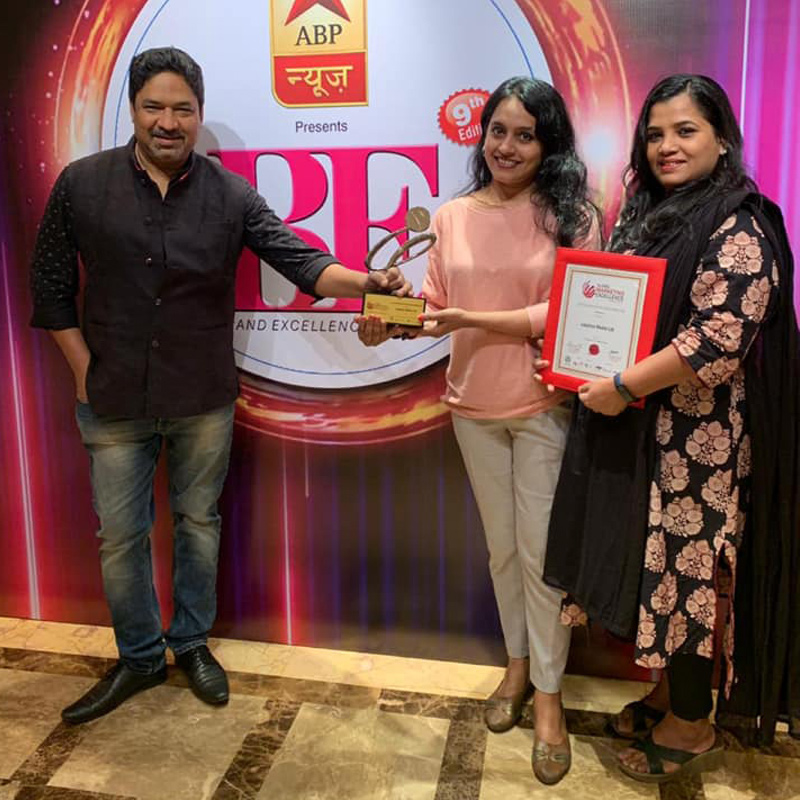
    MUMBAI: The Global Marketing Excellence Awards organised by the World Brand Congress concluded last week in Mumbai and honoured the best work in the field of marketing across various categories. Laqshya Media Group’s OOH Agency arm OMI executed Tanishq Campaign on OOH was adjudged the Best Outdoor and Location Based Marketing.

    The prestigious award admired the entire year OOH campaign planned for them and their impact it had on their brand. The various campaigns throughout the year that were strategically planned to keep the brand’s image and stature high on OOH helped bag this honor. This award for brand excellence celebrates all the hard work and efforts that goes in the campaign from the brand and from the agency side.

    Commenting on this award, Laqshya Media Group OMI COO Naresh Bhandari said, "We are extremely proud to have won the Best Use of Outdoor and Location based Marketing for Tanishq’. Every campaign executed by us from them throughout the year was a great success in terms of visibility. The brand scores high on the top of mind recall as compared to its competitors. Congratulations to team Tanishq for all the joint efforts and for being a valuable partner for us throughout. It is always a pleasure to be associated with them and awards like these are a testimony of this great association we have with them. Am sure we will have many more exciting and interesting campaigns to portray in the future too.”

  • No marketing communication can target the entire universe: Digitalabs CMO Agam Chaudhary

    No marketing communication can target the entire universe: Digitalabs CMO Agam Chaudhary

    MUMBAI: With a decade of experience in shaping the digital lifespan of firms like Jaquar Lighting, Hindustan Times, Religare, Patanjali, Lenovo, amongst others, Digitalabs is a wing of 21-year-old conglomerate, Laqshya Media Group. Responsible for managing the campaigns of TLC channel during its launch, the digital agency has been quite successful in the industry and has clients spanning globally.

    Speaking to Indiantelevision.com, CMO Agam Chaudhary contributes this success to the solution-driven approach it follows to tackle client needs.

    “When my partner and I started this company, we saw a clear gap in what agencies were delivering vis-a-vis what is required by the clients for a longer period of relation. So, we started Digitalabs and our key DNA has been offering solutions and not services. For instance, when a client comes to us asking us to design a website, instead of giving him different pricing options, I try and discuss with him if he genuinely needs the website in the first place,” says Chaudhary.

    He goes on to give the example of recent The Tribal Cooperative Marketing Development Federation of India (TRIFED) show that his agency conceptualised for the Ministry of Tribal Affairs to support their e-commerce ventures. “We wanted to show the stories behind those beautiful handcrafted products; what kind of work goes behind getting a saree out of tribal art, how much time and effort it takes, and thus justify the sort of prices they are sold at,” he mentions.

    He adds that this approach has helped him in maintaining long-standing relationships with his clients, some of whom have been with him since the inception of the brand.

    Chaudhary goes on to explain that the gap between client expectations and an agency’s deliveries also exist because most brands today are confused and want to be present on a particular medium just because their competitors are there. They don’t know how to leverage those channels. “Brands need to understand that at the end of the day if you want to target the right audience, you can’t target the entire universe. No marketing communication can target the entire universe,” he says.

    He insists that instead of just targeting the consumers through ads, a brand should also work on its overall image. Citing an example of Apple, Chaudhary explains that the UI/UX of a website also plays a key role in establishing a brand image.

    Digitalabs is also working on similar lines for many of its clients to improve the look and feel of their websites. One of the most amazing specimens of this is their work on Jacquar Lighting. “We don’t design anything for the sake of it. We believe in analytics and every element on that site has a thought process behind it.”

    Another thing that Digitalabs is keenly focussing on is voice commands. He says, “Till now we are capable enough to give commands to Alexa for, say, getting a coffee. Now, the same order has to be processed by a third-party vendor, which we are trying to fix out. Once that happens, we will be going out to food delivery platforms like Zomato, Uber Eats, Foodpanda, etc., to implement it in their systems.”