Tag: language

  • Reverie Language Technologies’ video campaign appeals for language equality

    Reverie Language Technologies’ video campaign appeals for language equality

    Mumbai: Reverie Language Technologies, a leader in Indian language localisation and user engagement technology solutions, has launched a video campaign to raise awareness about India’s digital language divide.

    Today, enterprises want to engage with the next billion digital citizens, but a majority of the non-English-speaking Indian population may find the internet has little to offer in the languages they speak at home. Reverie is bridging this gap with its state-of-the-art technology, powered by AI and ML, by providing all 22 official Indian languages with a presence on the Internet.

    The video highlights how most of the Indian population is unable to fulfil even their fundamental rights like the right to education and the right against exploitation because the internet is really siloed for them.

    The brand campaign is headlined by a video delineating how demarcated the Indian internet is for Indian language-literate Indians, limiting basic rights for almost 90% of the population.

    The New Education Policy 2020 recognises all Indian languages as ‘Bharat Bhasha’ and acknowledges the role of mother tongues in schools as a cornerstone in enabling access, retention, and preventing dropouts. Reverie Language Technologies aims to facilitate this by ensuring that the content is contextually localised, keeping in mind the aesthetics of Indian languages.

    “The video campaign is our humble effort to bring out that while the growth of the Indian Internet rides on our Indian-language literate digital citizens, the kind of Internet they deserve is a far cry. If we view the larger picture, the citizens are either categorised as browsers or ones that depend on OTP or QR verification, depriving them of the seamless Internet that English-literate citizens experience. Despite the massive strides India has made in the digital world, our natively literate citizens are still struggling to bridge the digital language divide and reap the benefits of the Internet and all it has to offer. Significant changes will not occur if languages on the Internet are not implemented through India-owned standards for our native languages. Through our campaign, we hope to build an equitable Internet for India,” said Reverie Language Technologies co-founder and CTO Vivekananda Pani.

    Amongst the nine pillars the government’s vision of a ‘Digital India’ infrastructurally thrives on are data, devices, and languages. With the advent of smartphones and cheap data plans, the first two have been achieved. However, language equality is the key to digital transformation – it must be accessible without any entry or engagement barriers.

    Imbalances in the information available in different native languages online affect who and what gets represented, and by whom. By partnering with businesses and government organisations, Reverie is filling this void by retaining the essence and nuance of all 22 official Indian languages across industries such as banking, fintech, education, healthcare, and gaming.

  • PFT launches CLEAR AI to lower cost of operation of media services

    PFT launches CLEAR AI to lower cost of operation of media services

    MUMBAI: Prime Focus Technologies (PFT), the technology subsidiary of Prime Focus, a global leader in media and entertainment services, has unveiled CLEAR AI. It offers transformational AI-led technology and media services powered by the cloud that help streaming platforms, studios, and broadcasters lower their Total Cost of Operations (TCOP) by automating their content supply chain.

    The Enterprise Resource Planning (ERP) software, CLEAR, has been put in place to streamline the foreign language mastering process and is designed for the media and entertainment industry.

    Multi-platform content fulfillment demand from the library continues to grow exponentially. Fulfillment encompasses activities that include the most appropriate content identification, determination, and creation of missing material, aligning all pieces of content, including video, audio, and text artifacts, and developing ready-to-distribute masters. PFT’s clients find these activities to be highly laborious, time-consuming, and expensive when done at scale as this includes custom work and massive coordination between internal studio teams and global vendors, resulting in an extended timeline, a slower go-to-market, and delayed monetization.

    Introducing CLEAR AI to simplify the Foreign Language Mastering process:

    · Assisting the mastering team in creating international masters with AI tools to help human mastering efforts offering convenience, speed, efficiency, and faster time to monetization.

    · Automatically identifies languages in dubs, subs, and on-screen text

    · Identifies metadata and segments to master from multiple versions

    · Compares versions and determines the best master to conform

    · Helps conform foreign language assets (dubs and subtitles) even across multiple frame rates

    · Automatically creates forced narration files that can be localised

    · Identifies and packages foreign language master in the specified format

    “A powerful combination of identifying languages and content segments, comparing versions, conforming, and packaging masters using AI boosts operational productivity by at least 3X. This makes the process simple and as easy as possible for both businesses and editors,” said PFT senior vice president and head of product management Murali Sridhar. “With an AI-driven approach, foreign language mastering works at an exceptional scale and speed like never before.”

    One can utilise CLEAR AI to create fully localised foreign language file masters for distribution in multiple international territories. It helps experience 60-75 per cent reduction in editorial/conform effort, gain efficiencies, speed, and faster time to market. It is basically mastering made easy.

    PFT works with major media and entertainment companies like Walt Disney-owned Star TV, Hearst Television, Channel 4, Sinclair Broadcast Group, A&E Networks, Warner Media, PBS, CBS Television Studios, 20th Century Fox Television Studios, Lionsgate, Showtime, HBO, NBCU, TERN International, Disney+ Hotstar, Cricket Australia, BCCI, Indian Premier League and more.

  • Bumble’s language badges enable users to make more meaningful connections

    Bumble’s language badges enable users to make more meaningful connections

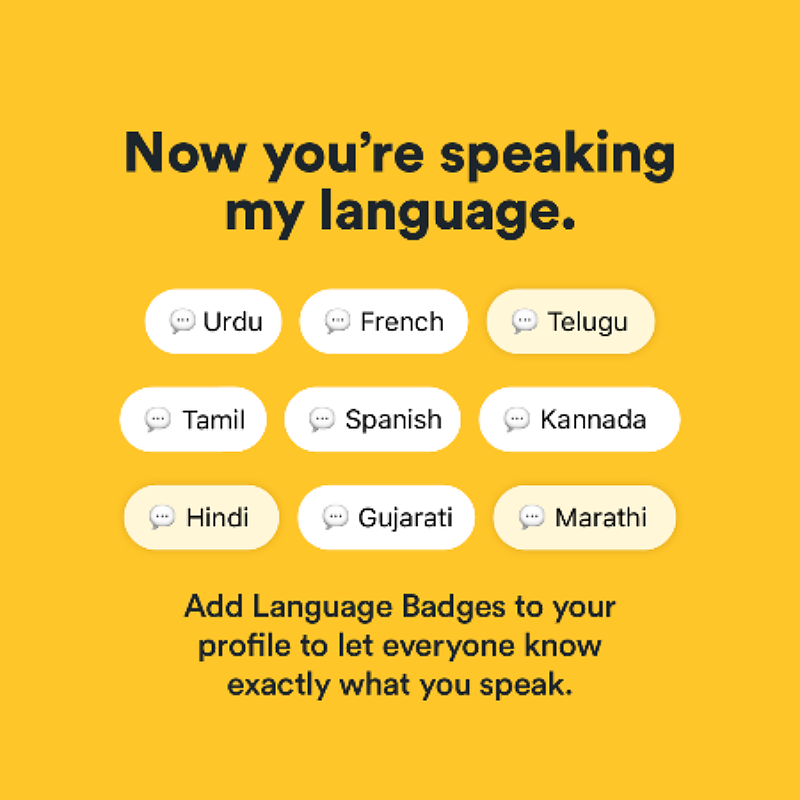
    Mumbai: Bumble, the women-first dating and social networking app, has added Language Badges to help its community showcase which languages they speak on their profiles to make more meaningful connections. The dating app’s community of users can now select up to five badges from over 100 languages globally and over 30 languages in India.

    As per Bumble’s internal study, people who have added at least one language badge witnessed 34 per cent increase in their matches than those who have not. Since the launch, in India, the top five most widely used language badges on Bumble profiles are English, Hindi, Marathi, Punjabi, and Tamil. 

    “With the launch of Language Badges single Indians will now be able to showcase their language preferences and communicate more easily with their potential matches. This is another way in which Bumble continues to offer single Indians opportunities to find people they are most compatible with, to make more meaningful connections,” shared Bumble India communications director Samarpita Samaddar.

    Over the past year, Bumble has made several updates to its platform, including introducing 150 new interest badges in dating profiles and launching its ‘Night In’ feature, where two people can participate in an interactive game during a video chat. The company also recently launched Snap’s AR Lenses within Bumble video calls and launched video notes that utilise Snapchat’s technology.

  • Dekkho expands regional language content offering

    MUMBAI: Dekkho has partnered with some of the top online content creators in the country such as ScoopWhoop, Pinkvilla, 9X Media, Put Chutney, Being Indian and East India Comedy. In a bid to create an entirely alternate destination and divergence from YouTube and Facebook, and to increase its reach in tier II and III cities, Dekkho will expand its regional language content offerings through these collaborations in addition to mainstream content in English and Hindi.

    Through a long-term content strategy, Dekkho aims to reach 100 million users over the next five years, focussing on the vernacular segment of viewers who do not consume videos on Facebook or YouTube. It will also venture into content translation, dubbing, and voiceover of content for this segment, creating a new, non-overlapping market for creators. Additionally, Dekkho will localise its UI for different markets as well as the newsfeed for regional content.

    Commenting on its strategy, Tanay Desai, co-founder, said, “Dekkho’s initial strategy, which focussed on young urban viewers, has helped us carve a niche in the online entertainment market. Our next phase of expansion is targetted at a much larger viewer base that resides in the smaller towns, highlighting our larger focus at becoming a default social video network for the masses. Unlike incumbent platforms like Facebook and YouTube, which are highly fragmented in terms of content, we want to position Dekkho as a hyper-local, curated video platform. This will be supplemented by an engaging social layer aiming to represent India’s first large-scale video network. To effect, the platform will have a unique, localised avatar for each region and leverage the rising digital penetration across tier II and III towns in India.”

    Around 65 per cent of users on Dekkho belong to tier II and III cities. Around 30 per cent of these users have been acquired through focused regional marketing and do not consume videos on YouTube. As part of its marketing strategy, Dekkho has tied up with leading telecom operators and original equipment manufacturers (OEMs) to offer greater exposure to content developed by independent creators. Users streaming videos through Jio Internet subscriptions constitute nearly 30% of the total video consumption on the platform, contributing significantly to the growth among this demographic.

    ALSO READ :

    Brightcove expands into India, counts Republic, SonyLiv, Dekkho & Hero among clients

    Dekkho to identify non-production house talent, plans four web series in Sept-Oct

  • Doordarshan to explore ‘Dastan-E-Urdu’ – the story of a culture and language

    Doordarshan to explore ‘Dastan-E-Urdu’ – the story of a culture and language

    NEW DELHI:  A new series on the story of Urdu as representing the evolution of India’s secular, syncretic identity is to be telecast on Doordarshan’s national channel every Sunday from this week.


    The 13-episode docudrama Dasten-e-Urdu series with music by the renowned singer Shubha Mudgal has been directed by Aparna Srivastava Reddy and produced by eminent Urdu activist Kamna Prasad and will be telecast on Sundays at 9:30 pm.


    According to the makers, languages reveal the history of a civilisation and the texture of a culture, then.


    The series brings alive the fascinating history of this language, breaking the myths by unveiling several interesting cross-cultural connections.


    Dastan-E-Urdu explores the journey of Urdu language and its mushtarqa tehzeeb. Be it literature, journalism or popular culture that is expressed in recent times through theatre, films, television or the new media, Urdu language has retained its eminent place in the mind and hearts of people.


    In order to showcase the language’s grandeur and its tehzeeb in purest sense, the producers have deployed deep research into Urdu’s language journey while conceptualising it. The show takes the viewer on a pan-India journey, capturing all the aspects and nuances that underscore Urdu’s poetic opulence, its Ganga-Jamuni syncretic essence as well its everlasting, universal appeal.


    ‘Understanding the evolution of Urdu, gives fresh insights into who we are as Indians’ is the bottom line of the show. Covering myriad shades and influences of Urdu language, the programme is being shot all over the country – from Kashmir to Kerala. It delves into dramatisation of key personalities and reconstructions of key periods in the history of the language.


    A galaxy of experts including professor Gopi Chand Narang, Javed Akhtar, professor Shamim Hanfi, Shamsur Rehman Farukhi, Pandit Gulzar Dehlvi, professor Mushirul Hasan, Dr Karan Singh and Farooq Sheikh among other stalwarts creates a panoramic view of Urdu’s evolutionary journey for the viewer.  

  • Language can turn ideas into magic or dust: Tim Love

    Language can turn ideas into magic or dust: Tim Love

    VARCA, GOA: In today‘s diverse world compressed by an overwhelming digital presence, language is the most powerful technology around.

    “Language is a technology in itself,” Omnicom Group vice chairman and Omnicom Asia Pacific India Middle-East and Africa (APIMA) CEO Tim Love said, presenting a new facet to the debate of the relevance of technology in a post-digital World.
    Quoting McLuhan, Love said that once you master technology, it becomes invisible. As human beings have more or less mastered their respective language – verbal and non verbal, it is becoming invisible. Every advertising professional needs to bear in mind that this technology is omnipresent and affects the reception of the message globally.

    As a consequence, we have also started focusing on electronic technology and started undermining the potential of “human technology”. The potential of human insights and understanding still plays a major role in determining the effectiveness of an ad message.

    Speaking at Goafest 2012, Love went on to give the example of an automobile brand Nova which was to be launched in the Latin American countries. While in some cultures and languages the word Nova refers to something new, in this particular country it had a negative connotation. The local agency professional pointed this out to the brand. It did not deter the brand from going ahead with the name, but it did make for a good study of the multicultural fabric we operate in and how marketers and ad professionals need to be sensitive to the language difference that exists in the world.

    “The worst thing you can do is to presume we all think the same,” Love warned. “Respecting the difference in the languages and culture and moulding your communication accordingly makes for a better strategy. Even sign language is not universal.”

    It is necessary to keep in mind the syntax of different languages as well. For example, Japanese use their verb at the very end. Also, the intonations in the language make it slowly spoken. Hence, while communicating to a Japanese audience, the message should keep these things in mind for the audience to better assimilate and comprehend the matter.

    Cultural agility also needs to be maintained to gauge the preferences and choices of the audience in this case. While some factors like language, environment and symbols may be evident, there are many aspects like religion, history, superstitions, values and attitudes that are more covert.

    “I would give three tips for maintaining cultural agility. First, treat language with more reverence. Second, when using an interpreter slow down and use crisp sound bytes and third, learn how to say hello, please and thank you in the language of your communication partner,” Love said.

    An idea is not an idea till it drives innovation and explores new realms of understanding and conversation. In this context, Love concluded that an idea can be turned into magic or dust depending on the hand that rubs against it. Using the linguistic and cultural context while planning and executing a campaign can make that difference between dust and magic.

  • Nick celebrates 10th anniversary of ‘Blue Clues’

    Nick celebrates 10th anniversary of ‘Blue Clues’

    MUMBAI: US kids broadcaster Nick Jr. invites preschoolers, parents and educators alike to join in commemorating the 10th anniversary of the show Blue’s Clues.

    Nick Jr. will kick off a celebration of the show that it says changed the way preschoolers watch TV, by introducing the audience to a new character — Blue’s brother — on the hour-long primetime movie Meet Blue’s Baby Brother on 10 September 2006.

    Blues Clues explores advanced subject matter such as sign language, geography, physics, emotions and anatomy.The earlier mentioned special blends the two worlds of Joe and the classic animated world of Blue’s Clues with the puppets on Blue’s Room. Meet Blue’s Baby Brother will feature a special game of ‘Gold Clues’ as preschoolers help search for Blue’s baby brother and share another milestone with their favourite blue puppy.

    Nick Jr. also announced that it has commenced production on a new, 10-episode season of Blue’s Room, the half-hour Blue’s Clues spin-off series. Blue’s Room, which originally premiered as five, half-hour specials on Nick Jr. takes preschoolers into a live-action playroom featuring Joe and Blue as a puppet who has the ability to talk directly to the viewers at home.

    Nickelodeon Preschool Television executive creative director Brown Johnson says, “We are proud to be celebrating ten years of Nick Jr.’s classic hit which has become a huge part of preschoolers and their parents’ lives. Blue’s Clues is a groundbreaking series that continues to entertain and captivate viewers with its landmark interactivity, while also serving as an important educational tool for young audiences.”

    In Meet Blue’s Baby Brother, preschoolers at home will join Blue, Joe and their friends in a special game of ‘Gold Clues’ to meet the newest member of Blue’s family — his baby brother Sprinkles! It all begins during a family celebration with Joe and the gang, when Blue announces she has a baby brother who will be joining the celebration.

    Blue cannot wait to meet him, but first she and Joe must embark on an interactive quest in PuppyVille to discover which puppy is her brother. In a classic Blue’s Clues style, Joe and Blue search for three gold clues that will lead them to Sprinkles.