Tag: L.V. Krishnan

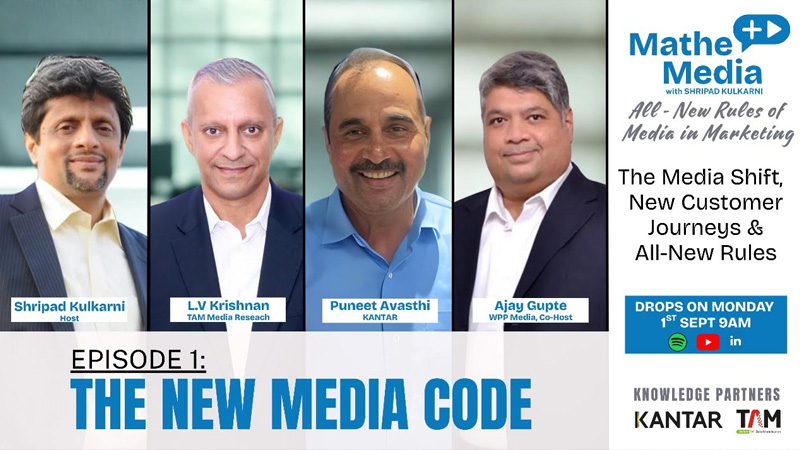
  • Mathemedia: Shripad Kulkarni launches podcast for media’s next era

    Mathemedia: Shripad Kulkarni launches podcast for media’s next era

    MUMBAI:  Shripad Kulkarni, veteran media maven and former ceo of Vizeum, is launching MatheMedia, a first-of-its-kind podcast that promises to crack the code of India’s fast-changing media landscape.

    Streaming from 1 September 2025, the long-format series blends a CMO briefing with a masterclass, featuring over 25 industry heavyweights from advertising, tech, publishing, and brand leadership. The opening episode, aptly titled ‘The New Media Code’, will bring together voices such as L.V. Krishnan (TAM Media Research), Puneet Avasthi (Kantar), and Ajay Gupte (WPP Media) to decode the seismic shifts shaking the industry.

    “We live in a world of channel chaos, with more platforms and fragmented audiences than ever before,” said MatheMedia, founder, Shripad Kulkarni. “Gone are the days when we could think & work linear & measure with a linear mindset. Today’s marketer faces multiple challenges. With more category entry points, brand assets & personalised messaging needs, brand strategy is being redefined. Brand custodians face growing pressure from a crowded network of channels and partners. It’s time for new rules in strategy, media, measurement, and collaborations.”

    The podcast’s 12-episode debut season will tackle hot-button issues: the rise of AI in advertising, quick commerce, evolving consumer journeys, and the urgent need for unified, privacy-compliant measurement systems. Expect candid debates, sharp insights, and a dash of storytelling to simplify complex industry jargons.

    Guests lined up include Schbang’s Akshay Gurnani, Google India’s Priya Choudhary, Dentsu Creative Isobar’s Sahil Shah, and India Today’s Vivek Malhotra, to name just a few. Think of it as a roundtable where India’s top media minds redraw the playbook for marketers navigating chaos.

    Kulkarni, who has advised marquee brands from Fevicol and BMW to Airbnb and Yes Bank, brings his three-decade expertise and signature wit to the mic. His goal is to help professionals not just adapt to disruption, but shape it.

    Episodes will drop every Monday across Spotify, YouTube, LinkedIn and Instagram. So, whether you’re a CMO, a curious marketer, or just wondering why your ads keep following you around the internet, MatheMedia might just be the formula you need.


  • TV’s desi power play: How regional storytelling is uniting a billion hearts

    TV’s desi power play: How regional storytelling is uniting a billion hearts

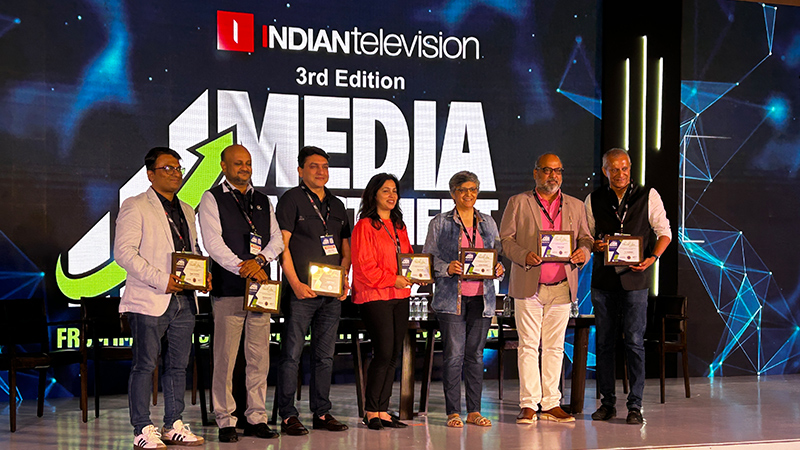
    MUMBAI: At the 2025 edition of the Media Investment Summit by Indiantelevision.com, a potent mix of data, drama and desi sensibilities took centre stage. In a session titled ‘From Regional to National: How Television Unites & Influences Billions’, top executives from insurance, FMCG, media, and broadcast peeled back the layers of India’s most underrated soft power—television.

    Chaired by Tam Media Research CEO L V Krishnan the panel drove home a core truth: in a country as complex as India, regional is not a stepping stone to national—it’s the soul of it.

    Zee Entertainment chief growth officer Ashish Sehgal opened the session with a clear stance on storytelling. “We’re looking at a command-level segmentation exercise in a vast, culturally diverse country. The same storyline can vibrate differently across states, languages and values”, he said. The key, he noted, was not translation—but transcreation. What works in Maharashtra needs rethinking for Manipur.

    Sehgal highlighted how television continues to command trust, “People spend more time watching TV in the living room than browsing online in isolation. That communal screen-time is where influence breeds”.

    Britannia GM – media Riya Joseph added flavour with paint ads and biscuits. “If we use one ad template for Rajasthan and another for Karnataka, we’ve already lost the battle. Paint colours, biscuit flavours—even the tone of a jingle—need localisation”, she said. In Joseph’s world, the biscuit is serious business. “The challenge isn’t just shelf space—it’s shelf recall in a noisy media universe”, she added.

    Britannia’s hyperlocal campaigns often start as social experiments and end up earning massive engagement with minimal media spends. “When we celebrated pronunciation quirks around ‘croissant’, it went viral. Because it came from their lives, not ours”, she quipped.

    For insurance brands, the entry barrier isn’t price—it’s comprehension. “In a culturally vibrant and diverse country like India, where every corner celebrates its own festivals and traditions across different languages and cultures, marketers have a unique opportunity to connect deeply with consumers through festive storytelling. These festivals, rich with emotion, symbolism, and values, offer a goldmine of inspiration— but to create an impact that lasts, the story must not only reflect the festive spirit but also stay true to the brand’s core message.”, said Edelweiss Life Insurance CMO Abhishek Gupta.

    Gupta pushed for story-first advertising. “Across India, every region holds real stories of loss, hope, aspiration and renewal. These aren’t fictional narratives—they’re lived realities. Marrying those with brand promise creates resonance and trust”, he said, adding that regional storytelling builds both loyalty and local advisory networks.

    Shemaroo Entertainment business head – Hindi GEC Sagar Hosamani leaned into faith-based programming as a vehicle for localisation. “Every festival must reflect the cultural nuance of its origin. Devotion isn’t one-size-fits-all”, he said.

    Hosamani highlighted that storytelling isn’t just about language but ritual, colour, iconography and emotional pace. “If we shoot a Navratri segment in Mumbai and call it pan-Indian, we miss the mark. It must feel local to be loved nationally”, he said.

    Madison Media Sigma CEO Vanita Keswani offered a sharp media planner’s take, “There’s no ‘national vs regional’ anymore. It’s both. Every brand plan today has multi-layered targeting—regional, hyperlocal, and mass”.

    Measurement, she stressed, is now possible down to the taluka level. “We can measure Sun TV’s performance in Madurai versus Chennai versus Coimbatore. From search queries to WhatsApp bot data, the tools are in place”, she added. Keswani emphasised that regional content is increasingly outperforming national content in engagement-led metrics.

    Live Times founder Dilip Singh closed the discussion with a rousing pitch for television’s credibility. “There are 400-plus channels in India, yet audiences still turn to TV for breaking news. During high-stakes events, TV rooms become war rooms”, he said, citing the post-India-Pakistan strike coverage where mobile viewership dipped but TV soared.

    Singh called for fact-first newsrooms. “It’s not about being the fastest. It’s about being the most accurate. Truth is our only product”, he said.

    All panellists agreed that India’s complexity demands cultural fluency, not marketing convenience. As Sehgal concluded: “You speak my language, my brain listens. You speak my culture, my heart responds”.

    At a time when digital fragmentation is rising, the session underscored how television—through regional storytelling—remains India’s most unifying screen.

  • Pradeep Hejmadi quits TAM; to join Zee TV

    Pradeep Hejmadi quits TAM; to join Zee TV

    MUMBAI: He is going back to his broadcasting roots. After close to a decade with TAM Media, senior vice president- S group and marketing Pradeep Hejmadi, is moving on to a business head role at Zee TV. Prior to TAM, Hejmadi had stints with MTV Networks as Nickelodeon India director-business and operations, Turner Broadcasting director research and Discovery Communications director, research and planning.


    Hejmadi who has been associated with TAM since 2005 was reporting into TAM CEO L. V. Krishnan and was responsible for revenue generation, client management, new business development and new product development. He also focused on enhancing the value associated with TAM data/services by way of integrating TAM products/services into day-to-day functional areas of TAM’s clients.


    “It was nice having Praddy with TAM for almost a decade. The journey we crafted together as a team that included the rest of TAM unit heads was pioneering and heralded a new era of work in areas like S-Group, AdEx products, News Track and TAM Sports. As he steps into a new shoe to handle a new portfolio in one of TAM prestigious client’s organisation, we wish him the very best. The younger team of S-group that he had groomed over these years has stepped in to take the responsibilities of S-Group, Client Service and Marketing into future,” said TAM Media Research CEO L. V. Krishnan.


    “Working with TAM and the team members in each unit was a lifetime experience. The decade was full of opportunities with proactive initiatives in Client Servicing, new product development and innovation undertaken by the team during my tenure. I leave TAM with a sense of pride for not only contributing to TAM’s achievements but also in a way, changing the working dynamics of the TV industry,” concluded Hejmadi.

  • Regional television struggles to find its voice

    Regional television struggles to find its voice

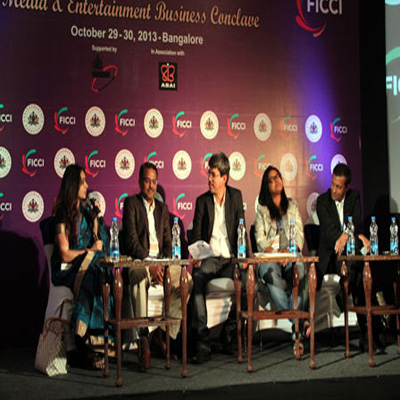
    BENGALURU: What good would a FICCI MEBC event be in Bengaluru without a discussion on the current status of regional TV, ratings, content and formats? The session moderated by indiantelevision.com CEO and editor in chief Anil Wanvari saw four personalities – TAM CEO L V Krishnan, Asianet and Star Suvarna Business Head Anup Chandrashekaran, TV serials director Shruthi Naidu and actress Malavika Avinash – talk about the evolving genres in the south TV market and the tussle that that the industry has with the TAM ratings.

    According to the FICCI Deloitte report, the south Indian TV industry was valued at Rs 13, 470 crore in FY 2013 and is set to grow at an estimated CAGR of 20 per cent over the next four years. TAM’s Krishnan added that it also accounts for 20 per cent of national viewership. To top it all, south Indian viewers are glued to their TV sets almost 30 per cent more than their northern cousins. The former spend 150-200 minutes a day watching soaps, series, movies, drama and non-fiction as compared to HSM viewers who spend 100-110 minutes disclosed Krishnan.


    Kannada TV is in a strange predicament and its viewership is eroded because of the fact that the state shares its borders with others such as Tamil Nadu, Andhra Pradesh, Kerala and Maharashtra which means viewers in these regions watch TV shows in the languages prevalent in those states. To make matters worse, only 35-40 per cent of Bengaluru’s populace speaks Kannada. This despite, Krishnan is optimistic that Kannada TV will do well. “It has grown by 25 to 30 per cent in the last five years in terms of engagement and the next four years will see the viewership increase by 20 to 25 per cent,” he says.

    Chandrashekaran said that the south TV industry is experiencing changing consumption patterns. “Fiction consumption is growing here as compared to HSM where non-fiction is taking over,” he said. “There has been de-growth of film consumption in the states of Karnataka, Andhra Pradesh and Kerala. Movies are unviable on TV today everywhere else except in Tamil Nadu,” he said. “We pay Rs 2.5 crore to acquire a title; but we spend around Rs 70,000 to Rs 80,000 an episode for fiction and we get the same or better viewership. Then, big ticket formats are also slowly spreading such as the Kannada and Tamil versions of KBC,” he added. “Then ETV produced Bigg Boss in Telugu and Kannada.”

    Both Avinash and Naidu bemoaned the fact that budget restrictions in Kannada have led to creativity and innovation being stifled in the region. “The protagonists in most shows are becoming younger – in their late teens or early twenties, which leaves limited scope for actors like us who have been around for 15 years,” wailed Avinash. She, however, added that her Oprah Winfrey-like conflict resolution show has given her a good platform for her to exploit her creativity.

    Chandrashekaran said that the younger protagonist strategy is being resorted to because broadcasters are trying to draw in younger audiences – apart from the plus 45 year olds – to watch television. Krishnan pointed out that the broadcasters strategy is on the button as TAM Media research has shown that boys 14 and above tend to follow what their fathers are watching, mainly sports while girls follow their mothers and watch serials.

    Chandrashekaran said the economics of programming dictate that higher budgets for shows will work in a broadcast network scheme. “If we can produce and amortise our costs over various languages like Tamil, Telugu, Malayalam and Kannada it will make our shows viable,” he explained.


    Naidu agonised over the fact that Kannada broadcasters are increasingly resorting to making adaptations of successful Hindi shows rather than encouraging and experimenting with original stories from Karnataka. Chandrashekaran said that this was happening because there is a paucity of scriptwriters in the region and the novelists and literature writers from the state tend to look down on TV as below their creative dignity. “We do a lot of interactions with our viewers and we only focus on filling whatever our focus group studies throw up as viewing need-gap.” Avinash pointed out that emotion and drama work very well with TV audiences which is why adaptations of Hindi shows in the form of soap, drama and series are working on regional television.

    The topic also shifted to the credibility of TAM with her asking whether TAM data is rigged due to inconsistent ratings as compared to the popularity and visibility of shows. To this, Krishnan said that they have checks and balances in place to prevent any penetration or doctoring of the data. “Yes, I am honest enough to say, one can reach out to our people meter sample, but we have policing mechanisms in place which will immediately penalise anyone who is trying to do that,” he emphasised.

    Niche genres are missing in the south with most of the channels being GECs or film channels. But Chandrashekharan says that the potential to harvest niche genres is there.

    “With the 10+2 ad cap coming in, we will see a lot of advertiser funded programs (AFPs) specially in Tamil Nadu because its base is huge,” he said. “I am very optimistic about our future and I can only see rosy pickings for everyone.”

  • TAM spots changes in digital landscape

    MUMBAI: The television broadcasting landscape is set to change in India as consumers tend to pay for the channels they like to watch. Kids, sports and general entertainment channels will provide television networks the entry points into television homes as India shifts to digital delivery across the country.

    “Kids, sports and GECs will be the staple entry points into homes,” said L V Krishnan, CEO of TAM Media Research, while releasing the findings and learnings from the implementation of the first phase of digitisation in the four metros of Mumbai, Delhi, Kolkata and Chennai.

    Niche and smaller channels will be beneficiaries and long tail channels will come into play. “There is an opportunity for small and niche channels. Marketing and sticky content will be key,” said Krishnan.

    Network channels will have a distinct advantage in the digital play as they can “cross-pollinate” their individual channels through their other channels. Standalone channels would be at a disadvantage as they do not have a platform to cross promote through network usage.

    “The independent channels will want to join a network. The trend will be for channels to bunch up,” said Krishnan.

    Dwelling on some trends around the digitisation deadline, Krishnan said television viewing remained stable during the period the data was not published but digitisation led to a spike in the time spent on television. Niche and smaller channels gained from digitisation.

    How does the digital universe pan out?

    According to the TAM survey conducted in the four metros, 93 per cent of television homes in Mumbai have been digitised (up from 35% when TAM and industries suspended reporting on ratings for nine weeks), 97 per cent in Delhi (from 26%) and 70 per cent in Kolkata (18%). The digitisation in Chennai has remained at 26 per cent (16%) as the Madras High Court had initially stayed digitisation in Chennai and will be hearing further arguments on petitions against digitisation in the last week of this month.

    “Chennai is a peculiar case as digitisation has not moved up. We don‘t know what the situation look like. But overall, there has been a massive stride into digitisation. Mumbai and Delhi have a small portion left but this is because of non availability of set-top boxes,” explained Krishnan.

    Krishnan said the universe of television homes shrinking on account of some TV homes not being digitised is estimated to be 5 per cent in Mumbai, 3 per cent in Delhi and 10 per cent in Kolkata. The total cable and satellite TV homes in Mumbai are 4.5 million, in Delhi 3.8 million, in Kolkata 3.2 million and in Chennai 1.9 million.

    TAM has installed its peoplemeters in 525 television homes in Mumbai, 470 in Delhi, 370 in Kolkata and 280 in Chennai. Starting Q1 2013, the panels in Mumbai and Delhi will see an additional fresh recruitment of 400 homes in SEC AB segment. Other centre’s – Bangalore, Kolkata, Hyderabad and Chennai – together will add another 250 homes in SEC AB segment.

    Krishnan said,, “The concentration on Sec AB is probably because that is the segment the advertisers are interested in. Since the advertisers are looking at the topline, the broadcasters are doing that too, and thus, that is where research is headed.”

    The second phase of digitisation is already showing an upward swing. Markets like Bangalore, Hyderabad, Punjab, Gujarat and Kerala are seeing increasing penetration. “We will capture this when we release our update on digitisation across the country in the first week of January,” Krishan said.

    TAM‘s reporting to resume

    TAM, India‘s sole television measurement ratings agency, had suspended reporting of viewership data for a period of nine weeks starting from 7 October (week 41) and ending on 8 December (week 49), as the government implemented the digitisation deadline of 1 November in the four metros. The data for this period would be released on 19 December along with the data for 9-15 December (week 50).

    TAM will not be reporting viewership data on analogue homes in Mumbai, Delhi and Kolkata from now on (areas where digitisation falls in first phase. Non-metropolitan areas in Mumbai and Kolkata do not fall in this phase and will continue to get ratings data on analogue systems), but continue to provide the data from Chennai where analogue television signals continue to be delivered to television homes.

    Channel Viewing Changes:

    • Small or niche channels were net gainers of share following digitisation at the cost of bigger channels.
    • Nearly 60 per cent of channels with a pre-DAS share between 0 and 0.5 per cent had about 4 per cent net share gain, while bigger channels lost more than 2 per cent share in Mumbai.
    • Delhi channel share movement is very similar to that of Mumbai but ‘net share‘ distribution sharper at the ends.
    • 255 channels in Mumbai have some non-zero viewership in at least one of the two periods (pre and post DAS).
    • Around half the channels both in Mumbai and Delhi have gained share.

    MUMBAI


    DELHI

  • Sample parameters more crucial than size: TAM

    NEW DELHI: Brushing aside allegations of corruption in its television audience measurement system, TAM Media Research CEO L V Krishnan on Friday said the parameters of judging viewership and not headcount mattered as far as television ratings were concerned.

    Defending the method of functioning adopted by the TAM, Krishnan said that an adequate number of TV households were being covered all over the country to provide a good sample to the industry.

    As an example, he said one did not need to count every person who is left-handed to know how many people wore their watches on the left hand.

    Speaking at a round-table on “Current Scenario of Television Audience Measurement (TAM) in India”, he, however, admitted that there was less coverage in rural areas.

    He also said that TAM was in the process of increasing its sample size in both the rural and urban areas of the country.

    He said that TAM today had a reach to 36,000 individuals, and said its technology was keeping pace with the latest technologies for giving accurate rating samples.

    The PHD Chamber had organized the round-table bringing the Central Government and other stakeholders to come together on a common platform, evaluate the current rating system and prevent diluting the importance and essence of TAM.

    Others who took part in the roundtable included Bharat Bambawale, Vice Chairman – North, The Indian Society of Advertisers and Director, Global Brand, Bharti Airtel Ltd.; Ravi Dixit, Director – Research, Disney UTV; Centre for Media Studies Director P N Vasanti; and Nagesh Alai, immediate past president, Advertising Agencies Association of India.

  • Hindi GEC viewership down 6.5% in 2011: TAM

    Hindi GEC viewership down 6.5% in 2011: TAM

    MUMBAI: The Hindi GEC (general entertainment channel) genre has seen a 6.5 per cent fall over the prior year due to audience fragmentation particularly in the metro cities of India, according to a study by television ratings agency TAM.

    Delhi, Maharashtra, UP and Gujarat have been the Top performing markets for Hindi GEC genre across years and the viewership returns from Metros have seen a slight drop.

    Titled Impatient Generation, the report was released during the IMC Fusion 2012. It said that the Hindi GEC genre in 2011 has shown a consistent growth in 1-hour special fiction episodes during prime-time on Weekends.

    Another interesting finding is that the share of Hindi News genre jumped 10 per cent in 2011, after decreasing in 2010. Returns from news bulletins have witnessed an increase while viewing proportion from telecast of review/reports has witnessed a decline across years.

    In the Hindi movie channels space, the number of unique movies aired in 2011 has decreased by 10 per cent. Both airtime and viewership of South dubbed movies has seen a clear growth in the year 2011.

    The days of watching the epics on pubcaster Doordarshan decades ago in the living room by an entire family huddled together are unlikely to happen again, because of the increasing fragmentation of viewership in Indian homes.

    According to TAM CEO L V Krishnan, “This new phenomenon has emerged because of the rise of the assertive, impatient and highly articulate generation of today in most Indian families, thanks to newer media and broadcast technologies, increasing diversities of content, and of course, advancement of new age mediums, that are able to cater to the differing tastes and preferences simultaneously.”

    Krishnan believes that people‘s dependency on TV as an effective communication medium has been escalating. Also, the common man’s TV viewing behaviour can no longer be predicted with certainty. Time spent on TV watching by all sections of people varies in a wide range. Viewing behaviour increasingly differs across a spectrum of gender, age, geography, and social mores and cultures.

    TAM launched the third edition of an annual report on TV viewing patterns.The report is a compilation of the past year’s TV viewing trends across various channel genres and regions in India. This attempts to update advertisers and marketers. TV broadcasters and production houses can know when and how TV audiences are changing in their tastes and preferences, what they are rejecting as programme offering, and what is getting accepted.

    The report shows that GRPs (gross rating points) in English entertainment have increased by almost 50 per cent with reach and time spent contributing to the gain. Increase of digital penetration in key metro markets has also led to greater access for the channels. The growth in consumption led by time spent is showing a 15 per cent-20 per cent increase.

    Kids Channels genre with 18 per cent share seems to be on a growth path with new channel launches in 2011. Today, 14 channels constitute the genre. The reach levels for 10-14 years age band has improved in 2011. With the increase in number of channels, kids’ genre witnessed a continuous increase in viewership share since 2008. Homes with kids are faster in adapting to Digital TV platforms with growth rate touching almost 60 per cent in 2011.

    Sports genre witnessed 200 million unique viewers in year 2011. There has been 18 per cent rise in Sports content on TV during Year 2011. Live sports coverage continued to garner over 50 per cent of the viewing for any sports content. 2011 saw 35 per cent growth in advertising volumes, but 70 per cent of volumes continued to be garnered by cricket.

    In the regional space, Digital penetration in Tamil Nadu increased by 17 per cent. Increase in viewership is because time spent levels increased by 3 per cent in Tamil Nadu market. Also, Tamil GECs, Music and Sports witnessed increase in viewership.

    In Andhra Pradesh, the digital penetration has touched 8 per cent. While overall time spent on TV is high (over 3 hours daily), its growth is just 1 per cent over 2010.

    Kannada GECs and news are primarily on a growth track in viewership. While serials have provided almost 3 times ROI, the growth in viewing for this genre in Karnataka has continued to be with an average of almost 20 per cent in 2011.

    In Kerala, fall of time spent by 6 per cent was seen. It has resulted in overall TV viewing coming down in 2011 but the introduction of new channels has resulted in a growth in viewing again the last few weeks of 2011.

    Malayalam GECs have a share of 50 per cent with news, movies and music following. Malayalam Kids Content saw a viewership rise with the launch of a new channel –Kochu TV.

    Viewership of Bangla regional has witnessed a steady and fast growth from 5 per cent share in the year 2000 to 43 per cent as of 2011. There has been a growth in ratings for regional movies and events in West Bengal as compared to Hindi movies and events.

    In Maharashtra, although total TV viewing remained steady, viewership of Marathi regional has seen a growth over last year. The growth is seen maximum on digital TV platforms (31 per cent), as compared to analogue set of viewers (13 per cent). Unlike 2010, the Marathi GEC genre had prioritised the airtime mostly for the higher ROI generating contents like fiction, movies and reality shows. Chat shows/ interviews (in Marathi News Channels) now constitute about 12 per cent of airtime contributing about 14 per cent of total viewership.

  • NBA to put in place content code based on self-regulation within 4 weeks

    NBA to put in place content code based on self-regulation within 4 weeks

    NEW DELHI: The News Broadcasters Association (NBA) will put systems in place for a content code based on self- regulation for news television channels within four weeks.

    “The Information and Broadcasting ministry is only entitled to give the licence and the rest should be left to the industry. NBA has worked out an answer to the Content Code where it has dealt with redressal mechanism, the details of which would be released in another four week’s time”, said TV Today Network CEO and NBA president G Krishnan while speaking at the second edition of the NT Summit, organised by Indiantelevision.com.

    The morning session on “The Commercial Imperative” focused on striking the right balance between the editorial and commercial imperatives.

    Distribution was emerging as a large cost that was hurting news broadcasters, speakers at the session agreed.

    “News channels are paying Rs 5 billion as carriage fee. The surge in distribution costs is killing the industry,” says Krishnan.

    The news TV business is raking in over Rs 10 billion in revenues and is employing over 25,000 people directly,” Krishnan added.

    The distribution issues, however, need to be sorted out. Times Now CEO Chintamani Rao blamed the huge pressure on cost of distribution as the major force impeding the growth process of the industry.

    Digicable CEO Jagjit Singh Kohli said digitalisation through Headend-In-The-Sky (HITS) and Cas was the only way out. “In analogue mode, a cable operator has a capacity to carry 70 to 80 channels. However the numbers of channels are increasing every day. So till the time complete digitalisation takes place, the situation will remain grim.”

    Kohli blamed the government for not coming out with policies on Cas extension and HITS. “We applied for HITS licence but the government said the policy was not ready yet,” he said.

    The market was being spoilt by new entrants from across all sectors. The ministry of information and broadcasting ministry recently cleared 33 licences for news channels.

    “A multi-media approach can only help succeed in this clutter. Single news channels will find it very difficult to exist,” said CNN IBN and IBN7 editor-in-chief Rajdeep Sardesai.

    While the commercial aspect is imperative, it should not be forgotten that news is a unique product which is built over a period of time and is known for its credibility and genuineness, Sardesai added. “The ‘Chinese wall’ between content advertisements and content should be maintained.”

    Star News CEO Ashok Venkataramani added, “Commercial side of the news business is very important..”

    The market has to rule. Zee News CEO Barun Das said that there was space for real news, evident from the success that the relaunched Zee News channel is enjoying.

    Tam India CEO L V Krishnan stated that news channels have drawn in new audiences and advertisers. The afternoon slot, for example, used to barely have any viewership. But now it has opened up women audiences. “Almost 44 per cent of viewership in the afternoon comes through women. There are 3400 new advertisers that have flocked in.”

    India TV COO Rohit Bansal stressed on the reason behind showing news and non news programmes, “The family audiences have certain choices, likes or dislikes; depending on that we create our programmes. We are also scoring on real news. The ministry of Information and Broadcasting looks at us as hard as it looks at any channel. And till date we have never faced a situation where we had to apologise for showing distressing content. As a news channel our job is to satisfy the regulator, advertisers and viewers and we are all trying our best to maintain the balance.”

  • Ratings: Star Movies tops English film genre despite absence in Mumbai

    Ratings: Star Movies tops English film genre despite absence in Mumbai

    MUMBAI: With Cas having come into the Metros, the niche channels will have a better fix on what the audience prefers. Tam data for the last six months paints an interesting picture of what the viewers are likely to go in for.

    Tam data c&s 15+ all India shows that in the English film genre Star Movies has a clear lead. In fact it has widened the gap between itself and arch rival HBO. This, one must note, is despite the fact that it is not present in Mumbai which each week contributes an average of 15 per cent to the viewing of this genre.

    ENGLISH
    MOVIES
    – TG: CS
    15 years
    15 JULY-15 AUG 15 AUG-15 SEP 15 SEP -15 OCT 15 OCT-15 NOV 15 NOV-15 DEC 15 DEC-30 DEC 01 JAN – 13 JAN 07
    Hallmark
    Channel
    0 0 0 0 0 0 1
    HBO 38 33 33 32 33 35 33
    PIX 9 10 8 9 8 9 9
    Star Movies 42 40 44 45 47 41 49
    Zee Studio 11 17 16 14 13 15 9

    For the period 15 July – 15 August 2006 Star Movies had a share of 42 per cent followed by HBO with a share of 38 per cent. Zee Studio has a share of 11 per cent and Pix which had recently launched had a share of nine per cent. For the period 1-13 January 2007 Star Movies boosted its share to 49 per cent compared to 41 per cent in the last two weeks of December.

    Star Movies’ gain in January is Zee Studio’s loss which shows that there is some overlap despite the fact that while the former focusses on blockbusters the latter focusses on niche films. In fact Zee Studio has recently been doing initiatives on world cinema. Zee Studio’s share fell from 15 per cent in the last fortnight of December to 9 per cent bringing it on level terms with Pix. HBO’s share fell by four to five percentage points in August but has since stayed steady at 33 per cent.

    Star India GM content Harsh Rohatgi gives the credit for Star Movies’ leadership position to the compelling movie library it has. “Even if you look at the Metro market to which Mumbai contributes 35 per cent viewership we are still ahead. We have done initiatives like a Bond festival, creature festival.

    “Mind you Star Movies in the past six months did not do anything special in terms of marketing besides on-air promotions. So the content sold itself. We are doing an Oscar festival at the moment. Our clients have supported us despite concern about Mumbai. We expect to be back on air within the next one week to 10 days.”

    As had been pointed out earlier, HBO’s main concern now is to ensure that it is in the priority list of channels in homes which are getting the set top box. So it ran a campaign last month educating people on what the channel is offering. Its message for this year is Bigger and Better.

    The challenge, Shruti Bajpai, country manager, HBO, notes, comes not only from more television competition but also from outside in the form of multiplexes, gaming etc. As Tam CEO L.V. Krishnan had pointed out in a recent interview, in the Elite group which comprise the bulk of the English film channels audience, the more technology options there are for entertainment like the DVD, the more their viewing of television drops.

    So there is all the more reason for this genre to be on its toes as its core audience will become even more choosy. Bajpai is counting on the strength of the HBO brand which has been built over the years to see it through this period of change. Going forward for this year it will try to build up the non primetime block through slots like It’s A Guy Thing for men. Last year HBO built on its thematic, festive blocks. So there was a full one month special for Diwali which had different themes depending on the daypart.

    This year HBO, Bajpai notes, has upped the marketing ante. A case in point is what was done with King Kong where there was radio, online and an outdoor presence. “It is not a question of having a huge budget. It is a question of optimising the different avenues which is what we have been able to do. The reason why we have not fallen in share despite not being present in Mumbai for a while is that the mini Metros are growing. They are hip and happening and you are getting viewership from a place where there was none earlier.”

    Media planners feel that each channel has its own USP. As Starcom’s Rahul Panchal points out, “Pix has its USP in that it targets an older set of viewers 25+. HBO on the other hand has a lot of teens tuning in which is why it has blocks for that set. Therefore there will be some difference in the brand profile.

    “Brand saliency is also what one looks at vis-a-vis just numbers. Pix and Zee Studio offer an environment that is less cluttered. They are also more flexible on the rates. Therefore though I put money on the two leaders (Star Movies and HBO) I would not ignore the other two players.”

    Panchal adds that Star Movies’ distribution in the small towns is probably better in terms of the frequency it is on. Clearly it’s gain there has more than offset the loss of Mumbai. One also has to consider the fact that with Cas coming in, putting in money will not be such a gray area.

    There will be better clarity also with Tam having launched its Elite Panel. Media planners also point out that in English films there is better stickiness compared to say, general entertainment. If someone likes a film he/she will stay with it. The question now is whether viewers will choose a channel like Pix when there are three competing channels.

    Pix business head Sunder Aaron says that Pix has carved a niche space which has been due to films being carefully chosen. “We have built up our programming by focussing on slots like 8 pm and 10 pm. Our stance has been that of telling a good story. Viewers who see value in this will, I am confident, choose us in their basket. To add variety we have also done original content like Framed, which saw director Aparna Sen being interviewed. We will be doing audience research this year to find out more in terms of preferences. We are doing a marketing campaign in Bangalore as we felt we needed to boost our visibility there.”

  • Regional television struggles to find its voice

    Regional television struggles to find its voice

    BENGALURU: What good would a FICCI MEBC event be in Bengaluru without a discussion on the current status of regional TV, ratings, content and formats? The session moderated by indiantelevision.com CEO and editor in chief Anil Wanvari saw four personalities – TAM CEO L V Krishnan, Asianet and Star Suvarna Business Head Anup Chandrashekaran, TV serials director Shruthi Naidu and actress Malavika Avinash – talk about the evolving genres in the south TV market and the tussle that that the industry has with the TAM ratings.


    According to the FICCI Deloitte report, the south Indian TV industry was valued at Rs 13, 470 crore in FY 2013 and is set to grow at an estimated CAGR of 20 per cent over the next four years. TAMs Krishnan added that it also accounts for 20 per cent of national viewership. To top it all, south Indian viewers are glued to their TV sets almost 30 per cent more than their northern cousins. The former spend 150-200 minutes a day watching soaps, series, movies, drama and non-fiction as compared to HSM viewers who spend 100-110 minutes disclosed Krishnan.


    Kannada TV is in a strange predicament and its viewership is eroded because of the fact that the state shares its borders with others such as Tamil Nadu, Andhra Pradesh, Kerala and Maharashtra which means viewers in these regions watch TV shows in the languages prevalent in those states. To make matters worse, only 35-40 per cent of Bengalurus populace speaks Kannada. This despite, Krishnan is optimistic that Kannada TV will do well. It has grown by 25 to 30 per cent in the last five years in terms of engagement and the next four years will see the viewership increase by 20 to 25 per cent, he says.


    Chandrashekaran said that the south TV industry is experiencing changing consumption patterns. Fiction consumption is growing here as compared to HSM where non-fiction is taking over, he said. There has been de-growth of film consumption in the states of Karnataka, Andhra Pradesh and Kerala. Movies are unviable on TV today everywhere else except in Tamil Nadu, he said. We pay Rs 2.5 crore to acquire a title; but we spend around Rs 70,000 to Rs 80,000 an episode for fiction and we get the same or better viewership. Then, big ticket formats are also slowly spreading such as the Kannada and Tamil versions of KBC, he added. Then ETV produced Bigg Boss in Telugu and Kannada.


    Both Avinash and Naidu bemoaned the fact that budget restrictions in Kannada have led to creativity and innovation being stifled in the region. The protagonists in most shows are becoming younger – in their late teens or early twenties, which leaves limited scope for actors like us who have been around for 15 years, wailed Avinash. She, however, added that her Oprah Winfrey-like conflict resolution show has given her a good platform for her to exploit her creativity.


    Chandrashekaran said that the younger protagonist strategy is being resorted to because broadcasters are trying to draw in younger audiences – apart from the plus 45 year olds – to watch television. Krishnan pointed out that the broadcasters strategy is on the button as TAM Media research has shown that boys 14 and above tend to follow what their fathers are watching, mainly sports while girls follow their mothers and watch serials.


    Chandrashekaran said the economics of programming dictate that higher budgets for shows will work in a broadcast network scheme. If we can produce and amortise our costs over various languages like Tamil, Telugu, Malayalam and Kannada it will make our shows viable, he explained.


    Naidu agonised over the fact that Kannada broadcasters are increasingly resorting to making adaptations of successful Hindi shows rather than encouraging and experimenting with original stories from Karnataka. Chandrashekaran said that this was happening because there is a paucity of scriptwriters in the region and the novelists and literature writers from the state tend to look down on TV as below their creative dignity. We do a lot of interactions with our viewers and we only focus on filling whatever our focus group studies throw up as viewing need-gap. Avinash pointed out that emotion and drama work very well with TV audiences which is why adaptations of Hindi shows in the form of soap, drama and series are working on regional television.


    The topic also shifted to the credibility of TAM with her asking whether TAM data is rigged due to inconsistent ratings as compared to the popularity and visibility of shows. To this, Krishnan said that they have checks and balances in place to prevent any penetration or doctoring of the data. Yes, I am honest enough to say, one can reach out to our people meter sample, but we have policing mechanisms in place which will immediately penalise anyone who is trying to do that, he emphasised.


    Niche genres are missing in the south with most of the channels being GECs or film channels. But Chandrashekharan says that the potential to harvest niche genres is there.


    With the 10+2 ad cap coming in, we will see a lot of advertiser funded programs (AFPs) specially in Tamil Nadu because its base is huge, he said. I am very optimistic about our future and I can only see rosy pickings for everyone.