Tag: Kyoorius Design Yatra

  • Unlocking the path to brand building and transformation in advertising careers: Rajesh Kejriwal

    Unlocking the path to brand building and transformation in advertising careers: Rajesh Kejriwal

    Mumbai: Since the last in-person Designyatra in 2019, the world has spun on its head.

    The pandemic prompted a re-evaluation of not just how we work, but the kind of work we’re creating as well. With massive shifts in nearly every aspect of life, it triggered the need for new design narratives to match the flux of life. We had to reimagine how we engage and communicate with everything from brands and businesses to art, entertainment, and activism. Mindsets changed. And so did the tools available to us. It was time for a reset.

    A reset.
It’s not just about starting over; it’s about reimagining, realigning, and redrafting some of the rules. It’s about rethinking conventions, challenging norms, and creating fresh narratives.
All to remain relevant.

    Since its establishment, Kyoorius, under the guidance of creative advocate Rajesh Kejriwal, has been dedicated to empowering the creative community in India. Kyoorius offers a diverse portfolio of initiatives, including ZEE MELT, Kyoorius Creative Awards, and Kyoorius Design Awards. As a non-profit organisation, Kyoorius remains committed to fostering excellence within the creative industry through its various endeavours.

    On the sidelines of the Kyoorius Design Yatra Indiantelevision.com caught up with Kyoorius Group founder & CEO Rajesh Kejriwal on DesignYatra this year after a gap of 3 years, the theme, and much more…

    On the response received since the announcement of this event

    After three years, we finally made it happen. We skipped the previous year because the only ones who would have benefited from it would have been the hotels, airlines, delegates, and speakers. The hotel rates were at 25,000 rupees, and lunch rates were 4,000 rupees. It’s not fair to blame them because they had also suffered for two years without making any money. They were struggling, so we had to consider their situation. However, supporting them shouldn’t come at the expense of others. Delegates typically spend around 60,000 rupees to attend our design event, including all expenses related to travel. If that cost were to become one lakh rupees, it wouldn’t be worth it for them. So, we decided to skip a year.

    This year, we tried to level the playing field, but it was a bit late. We negotiated and confirmed the venue and date in February, and we had to hold the event in July. We had only a two-month window to organise everything. Despite the time constraints, we managed to attract 983 delegates through curation, discussions, announcements, and promotion.

    This year, we introduced something new, which we called the “Blind Date with Design.” In August, we hadn’t confirmed any speakers yet, but we had tentative agreements from many because we had contacted them previously without specifying the date. With the dates set, we needed fresh confirmations, and some of them dropped out. Even with no confirmed speakers, we announced the event as a “blind date with design.” We provided the dates and venue and offered a special, reduced price for early registration. We had 383 delegates sign up without knowing any speaker names. This shows the trust people have in Design Yatra’s ability to bring in quality speakers.

    In the end, people are investing their money in this event. If we don’t provide good speakers, curate the event well, and ensure diversity in various aspects, we will be short-changing our attendees. They are not just spending money; they are also investing their time away from their families and work. Cheating them is not an option.

    I always emphasise four key aspects of event organisation: first, how does the audience benefit from it? Second, how do the speakers benefit? Third, how do the sponsors benefit? And lastly, how does the event itself benefit in the long run? These are the pillars we consider.

    On Design Yatra being curated and creating the event

    We begin with our team. For instance, if our theme for this year is “Reset,” we examine every potential speaker from around the world, creating a list of about 200 names. Next, we delve into their backgrounds to see if they’ve gone through any significant resets in their lives. This process is like a reset within a reset for them. Starting with the theme, we assess the body of work of all the potential speakers, aiming for diversity. We don’t need to include only lighting designers or architects; we seek a variety of perspectives. This process eventually led us to a selection of 22 speakers.

    Gender diversity is also a crucial consideration. I came across an AIGA report in 2018, which stated that from 2000 to 2015, only three festivals worldwide consistently featured 50 per cent or more female speakers. Design Yatra was one of them. Interestingly, from 2006 to 2010, gender diversity was not a widely discussed topic, but I embraced it intuitively because I recognised the importance of providing a platform for female voices. To ensure that the audience benefits, we look at it from their perspective. The path forward becomes clear when you focus on what the audience needs.

    On the thought behind Design Yatra

    This is a remarkable journey to share, considering our background as a paper merchant specialising in fine creative papers. To introduce our paper into the market, we needed to connect with designers. Meeting designers was crucial because when they saw our paper, they were often impressed and chose it for their projects. They designed around our paper, and once they specified it, changes were challenging to make, so price was not the main concern. Our paper business thrived through this approach.

    I realised that to connect with designers, I needed to transition from being a mere paper supplier to being their friend. I coined the term “return on relationship” instead of “return on investment.” To build a strong relationship, I had to offer something that benefited them. I identified a gap in the Indian design community: exposure to their design heroes. These heroes were rarely brought to India, and many designers couldn’t afford to attend international conferences to meet them. It required a substantial amount of money.

    So, I decided to bring these design heroes to India in a conference, solving two problems at once. Designers flocked to the event to meet their heroes. For three days, we provided opportunities for networking through meals and socialising. This strengthened the relationship between me, my team, and the designers. I made valuable connections, and in that year alone, our business saw a 300% growth.

    Around the same time, Goafest was initiated, which I hadn’t known about as I was not part of the advertising world. However, I continued with Design Yatra as it was driven by love and passion rather than profit.

    As time passed, the paper business began to decline, and there was a question in 2010-11 about whether to continue Design Yatra. With the paper business dwindling, the original purpose of the event was in question. However, we had become deeply passionate about the design community. Many success stories emerged from Design Yatra, with lives transformed, new talent discovered, and studios expanding. It had become a significant event.

    In 2018, 383 people signed up for Design Yatra without knowing the details. We decided to make the transition from a not-for-profit organisation to a not-for-loss initiative. We aimed for sustainability, taking some sponsorship funds and delegate fees to break even or make a slight profit.

    A noteworthy point is that in 2014, we purchased a piece of land in Chikmagalur and planted 30,000 trees. Since 2014-15, Design Yatra has been the only event in the world to achieve carbon neutrality, even before it became a popular concept.

    On ensuring every stakeholder who comes to Design Yatra benefits

    I’m someone who values feedback. I actively seek input from people and encourage them not only to tell me when I’ve done something well but also when they’ve noticed something I’ve done wrong or something that isn’t right. I genuinely appreciate it when people sit down with me, including speakers, to provide feedback. Continuous improvement is essential because the world is constantly evolving. Even something like the impact of COVID has reshaped how people perceive the need for physical conferences. People attend in person because they seek inspiration and often leave with a sense of purpose.

    We listen to the audience and adapt accordingly. For instance, this year, we’ve embraced an “anti-disciplinary” approach. In the past, our focus was primarily on the visual aspect, which made sense considering our background in the paper business. We ensured that the visual community received the attention it deserved. However, the world has changed since then.

    To put it in perspective, imagine swim lanes where you have graphic designers, fashion designers, furniture designers, architects, and interior designers, each in their own lane. With the internet and evolving design practices, these boundaries have blurred. Now, it’s like one big pond where a graphic designer might be working on murals, designing a restaurant, or even creating furniture. A furniture designer might explore architectural facades. The design landscape has become more interconnected.

    By listening to a diverse range of speakers, we offer our attendees a rich and varied experience. When you listen to speakers from different backgrounds, you get inspired in various ways. You absorb insights from each of them, and even though you might not immediately know how you’ll use that knowledge, it accumulates and influences your work. An architect’s words can indeed inspire a graphic designer, and a graphic designer’s insights can benefit a product designer. This is what I mean by embracing an “anti-disciplinary” approach, and we’ve curated the best possible diversity of speakers this year.

    We don’t overwhelm the event with too many sponsors, and we ensure there are no conflicting sponsors. Our focus is on delivering value to the audience.

    On Design Yatra over the years helping recognise Indian talent

    All creative professionals in advertising have their roots in design backgrounds. However, along the way, advertising professionals sometimes develop a perspective where they see advertising as the big brother and design as the small brother, not realising that many designers have emerged from within this field. Some argue that the advertising industry is much larger, while the design industry is smaller. Nevertheless, what some advertising professionals fail to grasp is the importance of investing in the growth of their teams.

    Senior members of the industry may not need to attend events like Design Yatra, but it’s crucial to allocate resources for the development of junior professionals. Without this investment, it’s unreasonable to expect junior talent to excel. The advertising industry often complains about talent shortages, but one must ask, “What have you done to attract and nurture talent?” It’s not necessarily about sending them to a specific event but about providing them with opportunities to learn and grow. When they acquire new skills and knowledge, they will share their experiences with peers and juniors, eventually promoting the industry.

    If you neglect upskilling your team, they will stagnate and produce work that falls short of expectations. Complaining about the declining quality of work without proper mentorship and investment in training is counterproductive. Advertising agencies should allocate resources not only to awards but also to the development and growth of their teams. Regrettably, advertising agencies often overlook this aspect, while design companies tend to prioritise it. For example, this year, there were 20 design students at our event, which presented an excellent opportunity for them to learn and advance in their careers.

    On avenues opening up for young talent in India

    There’s another compelling reason why advertising agencies should participate in Design Yatra. We offer sponsorship opportunities at very low costs, mainly covering the expenses for lunch and dinner. We don’t believe in providing freebies; instead, we ask attendees to pay for their meals while enjoying complimentary drinks. Unlike other events, we don’t create exclusive lounges or areas for different groups. Everyone, including senior creative professionals, mingles in the same space.

    I believe that senior creative individuals should attend events like Design Yatra, engage with students and young talent, and understand their needs and aspirations. It’s true that advertising doesn’t typically offer high salaries at the entry-level, but have we made the advertising field attractive enough for young design school graduates? Have we taken the initiative to present the value of advertising as a career?

    In my experience, advertising professionals often fail to convey the broader impact of their work. They tend to focus on individual projects, like showcasing a great ad or film, without discussing the significant work that goes on behind the scenes. We should inspire young talent by highlighting the role of advertising in brand building, cultural change, and long-term company growth. Advertising isn’t the sole driver of these processes, but it plays a crucial role.

    To attract new talent to the advertising industry, we need to demonstrate how a career in advertising can help individuals contribute to building brands and transforming small companies into major brands. It’s about showcasing the inspiring journey and opportunities that lie ahead. I’m not criticising advertising alone; this issue is prevalent in design studios as well. People become designers because they are driven by creativity and a passion for art and design, not solely for monetary reasons. To attract and retain talent, we must reach out and provide a clear understanding of what a career in advertising or design entails. This is our responsibility.

  • Creating an IP in events is tough: Kyoorius’ Rajesh Kejriwal

    Creating an IP in events is tough: Kyoorius’ Rajesh Kejriwal

    MUMBAI: At a time when content, technology and disruption are mentioned in the same breath in every marketing and digital summit, design often takes a backseat. It’s an open secret that several marketers, traditional or digital, neglect design, so much so that a couple of years ago the art of creating the right design and its role in aiding brands was practically non-existent. Feeble efforts were undertaken to boost the conversation around design and innovation.

    Things would have remained the same were it not for Rajesh Kejriwal who came up with the concept of Kyoorius, a common ground for designers, brands, creatives and every stakeholder in between.

    Now, the Kyoorius Creative Awards is in its fifth edition and has the likes of Arun Iyer, Nandini Dias, Tarun Katial and Kainaz Karmakar on board as jury members. The awards this year are scheduled on 1 June 2018 at Mumbai following a two-day disruptive marketing conclave Zee MELT on 30 and 31 May.

    In a candid chat with Indiantelevision.com, Kyoorius founder and CEO Rajesh Kejriwal spoke about a range of topics, including his journey, the paper business, the struggle, Kyoorius awards and design in India. Excerpts:

    You started off with a fine paper business but eventually moved into events. How has that journey been for you and how did that happen?

    The core of our Kyoorius business is paper merchandising and the creative community and design community are a large influencer on the choice of paper. Instead of targeting print guys who are always bothered about price, we thought of targeting designers because if they specify our paper, we are good to go. Then I thought that if I have to change my relationship with the creative and design community from being a vendor to a friend, I have to do something that helps them in their professional life and that is when we started Kyoorius as a not-for-profit organisation.

    But a lot has changed since you started off…

    The paper business grew by around 75 per cent year-on-year till 2010. Then China entered the market and the industry went downhill and the way paper was used changed completely. Back in 2004, 80 per cent of our business came from papers used for stationary sale but today stationary only contributes to two per cent of our business and everything has gone to brochures and catalogues. From being a premium fine paper business, it has now become a paper commodity business. My paper business continues to run but the influence of design on papers has come down drastically. But, because Kyoorius is running, we continue with the business and that’s why it is a non-profit non-loss organisation. We hadn’t evangelised this scenario when we started with the paper business but it has come to this. Had Kyoorius been a CSR activity, we would have stopped doing it in 2011.

    But why non-profit?

    I actually prefer referring to the organisation as ‘not for loss’ because the idea was that initially everyone starts awards thinking of it as a marketing exercise and then at some point in time when business goes up and down, the marketing budget also goes up and down. When it goes down, you stop doing marketing activities and I didn’t want Kyoorius to stop doing what it was doing. That is when the idea of not-for-loss organisation came about, thinking that whatever we do, we should at least sustain and be able to carry on even if the paper business goes in any direction.

    How have the entries been this year since there is a global decline in agency participation in awards due to budget cuts?

    We have just finished with our entries and we received 20 per cent more entries as compared with last year while most others are seeing a decline. The number of entries received this year is 2100 whereas we received 1800 entries last year, which is quite an encouraging number.

    Any new sponsor on board? Do you think sponsors are now more cautious about which events they associate with?

    All our sponsors that came on board have stayed with us, including Colors, Lokmat, Surewaves, Times Group and Kinetic. This year, Honda and Nestle have also come on board as sponsors for three years. All our sponsors have associated with us not only for Kyoorius awards but also for Zee Melt and Design Yatra. Our sponsors show faith in us and keep coming back to us because we don’t allow two sponsors from the same category. Today, sponsors look at events and awards with a business objective and whether they need to support industry events. It is no longer about just advertising your brand at any irrelevant event.

    Do you have to micromanage things for the awards?

    No, I don’t and I can’t because if you want to grow you have to let other people take charge and if they make mistakes, you correct them. If every year you make the same mistake, people will stop coming to your event. We are very clear that sponsors can’t have speaker slots. This year, we let go of Rs 30 lakh because someone wanted to sponsor us only if we gave them a speaker slot.

    Do you think events have become a harder business to be in over the years?

    Events are anyway not easy to do but if you want to create an IP, that is hard. Everyone keeps saying, ‘I have an IP’ and that is just silly. An IP happens when your sponsors stay with you, your participation increases year-on-year, people feel proud to be associated with you and other event guys want to copy you. Anyone can do an event today and every publishing house or broadcaster keeps doing an event every now and then with a budget of Rs 10-20 lakh. Those are events and not IPs. While they may say they are IPs but they are just events and that is not hard to do. If people are talking about your event a month before and after the event, then that is an IP.

    Is there anything new that you are bringing to Kyoorius this year?

    We have a team flying down from Amsterdam to design the stage and creative for the awards. Kyoorius has the largest LED screen for an award show in India. Moreover, we are the only award show globally to be carbon positive for three consecutive years. This year, we have created 503 tonnes of carbon emission for Kyoorius awards and to offset this carbon emission, we had to plant 11,000 trees. National Geographic is our green partner for Kyoorius and Zee Melt. Also, since we want to limit our plastic waste, we are bringing in a shredder to the venue that will turn the plastic into granules, which will later be shipped to Pune and converted into biofuel. I think people need to think about the sanctity of their act whether it’s right or wrong. 80 per cent of the ads today talk about social messages and water conversation and there you have people wasting water at the award venue!

    What is your view on creativity and design in India? Do you think we are doing a better job than the West or do we have our own challenges?

    I think people keep talking about how great international creativity is but they keep forgetting that their ad budgets are two to three times higher than ours. They spend a million dollar on a campaign whereas, in India, the best agencies get Rs 2 crore to make a film. Most of the times, the CEO or the CMO wants five films but the budget is of only Rs 1.5 crore, which results in silly films and then they wonder why their work didn’t win. Clients need to understand that less is more but I don’t think the scenario will change anytime soon.

    Do you see digital budgets increasing in the next few years? Have we truly understood the essence of digital and how much money is to be put in the medium?

    The digital budgets may or may not increase but they will become more rationalised with time as five years ago nobody understood digital in India but everybody said ‘I want to be on digital’ and they spent money on the medium without even understanding it or what it is doing for them. Brands have now learnt digital and are spending wisely. It is an effective medium and brands cannot avoid it but they just need to be wise about their investment.

    Which has been the most creative campaign that you’ve come across in recent times?

    The Sindoor Khela campaign has been the most creative campaign for me as it was not only about a social cause but was brought out effectively and with a great message. It was executed beautifully. Also, some of the Tanishq ads are beautifully executed as they do not hammer on the social cause and the company is not doing it to win awards. This year, the Aditya Birla Capital campaign stood out for me which is predominantly outdoor along with the classic Amul campaigns, which have been the most tactile. They are short and creative. Why can’t creative people think of that? I think outdoor in general is becoming too cluttered and brands and agencies continue to make the mistake of putting too much in too little space.

    So, what’s next for Rajesh Kejriwal?

    Doing more well by doing more better! We will kickstart a few training programmes for the industry from July, which will focus on personal development, body language and negotiation skills. We are also looking at starting a portal for jobs where you just upload all your work and anybody can browse through them and hire you. There is a huge gap between designers/creative people and agencies and this portal will help in that regard.

    Also Read :

    KYOORIUS CREATIVE AWARDS 2018 ANNOUNCES ITS MEDIA JURY

    KYOORIUS CREATIVE AWARDS ANNOUNCES ITS JURIES FOR ADVERTISING, DIGITAL AND MEDIA

    Shashi Sinha named Kyoorius media jury foreman

    Zee melt, largest convention forming synergies between mar-comm-tech is back with its 4th edition

  • Kahani Designworks and Ek Type win Black Elephants

    Kahani Designworks and Ek Type win Black Elephants

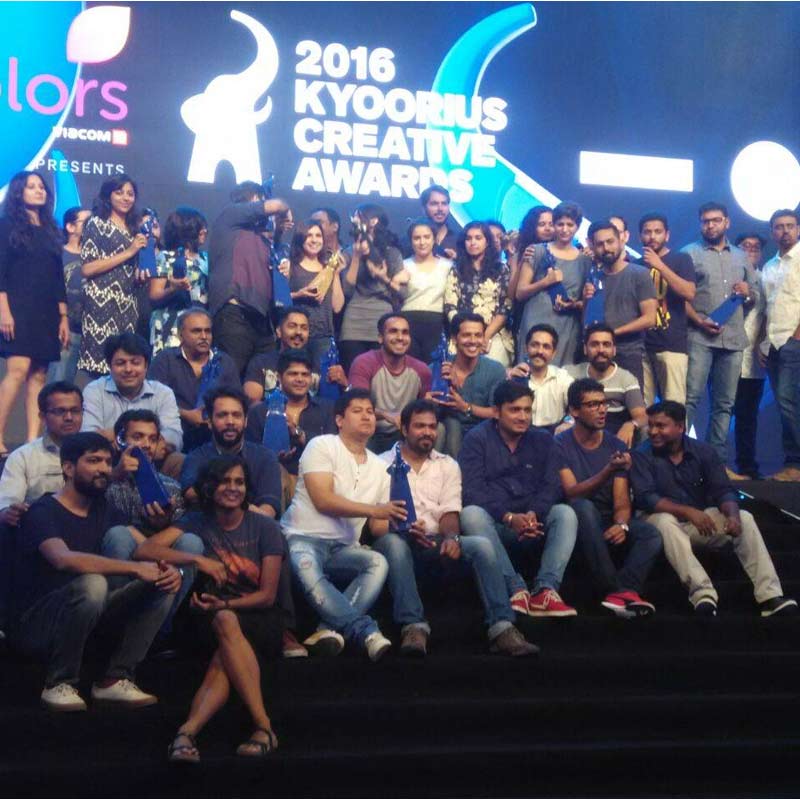
    JAIPUR: The three day creative extravaganza of design and visual communication, Kyoorius Designyatra, reached its crescendo with the Kyoorius Design Awards 2016. On its 11th edition, a total of 22 Blue Elephants were awarded to those who have done remarkable work in the field, out of which Ogilvy & Mather took home four, followed close at heel by Open Strategy & Design with three Blue Elephants to their name.

    Two Black Elephants (equivalent of a grand prix) were also won.

    Kahani Designworks took home a Black Elephant, on top of their Blue Elephant, in the Design For Space category for ‘The State of Architecture’ which was done for Urban Design Research institute. The second winner of the prestigious Black Elephant was Ek Type in the Deign Craft category for their work titled ‘Baloo,’ which was done for Open Source through Google Fonts. This year Kyoorius Design Awards had received a total of 468 entries out of which 43 were the In-Book winners.

    Five Blue elephants were won in the Branding & Identity category, with O&M and NH1 Designing claiming two each and BLOK winning one. Design for Packaging category saw two winners – Open Strategy & Design and Fitch — for their consumer packaging designs.

    Four Blue Elephants were awarded in the Design for Communication category with winners including Ogilvy & Mather, Publicis Communication, Famous Innovations and Open Strategy and Design.

    Design for Spaces saw four Blue and one Black Elephant, while three Blue Elephants and one Black Elephant were awarded in the Design Craft category. Open Strategy and Design and Dynamite Design each won one Blue Elephant in the writing for design category. Design for Good and Design for Book each had one Blue Elephant.

    Kyoorius also awarded some of the future creative stars with the Kyoorius Young BloodAwards, which 353 entries with 14 Red Elephants being rewarded and 27 In-Book winners. “This year at Kyoorius Designyatra we aimed to bring together a group of divergent thinkers to encourage interactions and creativity. We hope people will go back inspired and with a new passion and vigour towards why they are a part of this ever-growing industry,” said Kyoorius CEO  Rajesh Kejriwal , who organises this non-for-profit initiative with D&AD.

    The awards were a culmination of the event on creativity and design that sparked fresh and new ideas among the attendees.  The final day of Kyoorius Designyatra 2016 had an incredible speaker line-up that included Jon Marshall, Co-Founder & Creative Director, MAP, Singgih Kartono, Founder & Designer, Magno Design, Alex Daly, Founder, Vann Alexandra, Ronald van Schaik, Founder, Kaliber Interactive, Ayappa KM, Co-Founder, Early Man Film, Tap Kruavanichkit, Creative Director, Farmgroup, Ruchita Madhok, Principal, Kahani Designworks, Sameer Kulavoor, Founder, Bombay Duck Design and Sarang Kulkarni, Founder WhiteCrow. The speaker sessions ended with an interactive discussion with the legendary Michael Wolff, Founder, Michael Wolff & Co.

    Designyatra is presented by Zee, and powered by The Patrika Group and has various partners such as Absolut, Zindagi, Colorplan, Nicobar, myPaperclip and many more.

    Kyoorius Design Awards 2016 Winners List :

    Kyoorius Young Blood Awards Winners List : 

  • Kahani Designworks and Ek Type win Black Elephants

    Kahani Designworks and Ek Type win Black Elephants

    JAIPUR: The three day creative extravaganza of design and visual communication, Kyoorius Designyatra, reached its crescendo with the Kyoorius Design Awards 2016. On its 11th edition, a total of 22 Blue Elephants were awarded to those who have done remarkable work in the field, out of which Ogilvy & Mather took home four, followed close at heel by Open Strategy & Design with three Blue Elephants to their name.

    Two Black Elephants (equivalent of a grand prix) were also won.

    Kahani Designworks took home a Black Elephant, on top of their Blue Elephant, in the Design For Space category for ‘The State of Architecture’ which was done for Urban Design Research institute. The second winner of the prestigious Black Elephant was Ek Type in the Deign Craft category for their work titled ‘Baloo,’ which was done for Open Source through Google Fonts. This year Kyoorius Design Awards had received a total of 468 entries out of which 43 were the In-Book winners.

    Five Blue elephants were won in the Branding & Identity category, with O&M and NH1 Designing claiming two each and BLOK winning one. Design for Packaging category saw two winners – Open Strategy & Design and Fitch — for their consumer packaging designs.

    Four Blue Elephants were awarded in the Design for Communication category with winners including Ogilvy & Mather, Publicis Communication, Famous Innovations and Open Strategy and Design.

    Design for Spaces saw four Blue and one Black Elephant, while three Blue Elephants and one Black Elephant were awarded in the Design Craft category. Open Strategy and Design and Dynamite Design each won one Blue Elephant in the writing for design category. Design for Good and Design for Book each had one Blue Elephant.

    Kyoorius also awarded some of the future creative stars with the Kyoorius Young BloodAwards, which 353 entries with 14 Red Elephants being rewarded and 27 In-Book winners. “This year at Kyoorius Designyatra we aimed to bring together a group of divergent thinkers to encourage interactions and creativity. We hope people will go back inspired and with a new passion and vigour towards why they are a part of this ever-growing industry,” said Kyoorius CEO  Rajesh Kejriwal , who organises this non-for-profit initiative with D&AD.

    The awards were a culmination of the event on creativity and design that sparked fresh and new ideas among the attendees.  The final day of Kyoorius Designyatra 2016 had an incredible speaker line-up that included Jon Marshall, Co-Founder & Creative Director, MAP, Singgih Kartono, Founder & Designer, Magno Design, Alex Daly, Founder, Vann Alexandra, Ronald van Schaik, Founder, Kaliber Interactive, Ayappa KM, Co-Founder, Early Man Film, Tap Kruavanichkit, Creative Director, Farmgroup, Ruchita Madhok, Principal, Kahani Designworks, Sameer Kulavoor, Founder, Bombay Duck Design and Sarang Kulkarni, Founder WhiteCrow. The speaker sessions ended with an interactive discussion with the legendary Michael Wolff, Founder, Michael Wolff & Co.

    Designyatra is presented by Zee, and powered by The Patrika Group and has various partners such as Absolut, Zindagi, Colorplan, Nicobar, myPaperclip and many more.

    Kyoorius Design Awards 2016 Winners List :

    Kyoorius Young Blood Awards Winners List : 

  • Indian design should have its own identity: Michael Johnson at KDY 2016

    Indian design should have its own identity: Michael Johnson at KDY 2016

    JAIPUR: After building a functional formula or template, creative minds often challenge themselves by breaking out of the same mould. Michael Johnson, who set up the London-based design consultancy Johnson Banks, is a follower of this school of thought, because ‘why not?’

    After giving a good 10 years to designing for big name brands, Johnson had taken on the lack of proper branding in non-for-profit sector, and asked himself if design solutions can actually make a tangible difference in the field.

    Addressing a room full of graphic designers, artistes and branding professions at day one of Kyoorius Design Yatra 2016, Johnson asked if designs can really make a difference or it is a self satisfying and misplaced expectation.

    Johnson then went on to answer the question with a glimpse of his team’s works since they started off.

    The problem, Johnson said, lay in how graphic designers and advertising agencies handle non-for-profit work. “They treat it the same way old Catholic churches would treat indulgences: a little act of good will for their smooth sailing to heaven, or to pacify their conscience. They don’t do it to actually make it work.”

    After familiarising the audience with the idea of design solutions for non-for-profit organisations that actually helped them raise significant funds, Johnson titillated them with the idea of open source rebranding – to the point of sharing their design’s first draft in a public domain to be criticised by the world at large.

    For those who don’t know Johnson and his team at Johnson Banks has been invading many trade publishers’ headlines for its partnership with Mozilla to rebrand the company’s identity on a public domain.

    Later, speaking to indiantelevision.com, Johnson shared he had great expectation from the Indian design community to carve a unique identity; and a part of it brings him back to Kyoorius Design Yatra.

    Having participated in Kyoorius Designyatra first in its 9th edition, Johnson feels it has grown a great deal over the years “A proper design conference was very much a new concept in India back then. It was more of ‘famous designers presenting their works and the Indian counter parts lauding. It was obviously very appreciated but there was very little interaction, and engagement from the audience. And here we are, almost 10 years later and the property has grown so much. It has a clear theme that resonates very well with me. Instead of ‘here’s what I do’ presentation, speakers can talk about why they do what they do,” Johnson shared, adding that from his last year’s experience as a judge of Kyoorius Design Awards 2015, he could gauge that the design industry is being seriously taken in the country.

    But it’s not quite there yet, Johnson admitted.

    “It’s hard to track Indian designs in other markets. You hear big names from India in thr advertising circle but it gets a little tricky from design perspective,” he said.

    “I have often questioned why Indian design should be reflective of western works. Why can’t they do their own unique branding when India has such a vibrant culture to draw inspiration from? There is no need to copy the trends that the UK and the USA have been doing for the past 50 years,” he simply stated. Giving Indian designers the benefit of doubt he added that it could be the result of western works dominating the design industry for years and becoming a benchmark for the young Indian professionals joining in now.

    “I strongly believe that Indian design should have its own identity, much like the Japanese who have made a staunch distinction in their work that is world apart. I have started to see someone of that since the last time I was here, thus looking forward to the winning entries of this year’s Kyoorius Design Awards,” Johnson added in parted.

  • Indian design should have its own identity: Michael Johnson at KDY 2016

    Indian design should have its own identity: Michael Johnson at KDY 2016

    JAIPUR: After building a functional formula or template, creative minds often challenge themselves by breaking out of the same mould. Michael Johnson, who set up the London-based design consultancy Johnson Banks, is a follower of this school of thought, because ‘why not?’

    After giving a good 10 years to designing for big name brands, Johnson had taken on the lack of proper branding in non-for-profit sector, and asked himself if design solutions can actually make a tangible difference in the field.

    Addressing a room full of graphic designers, artistes and branding professions at day one of Kyoorius Design Yatra 2016, Johnson asked if designs can really make a difference or it is a self satisfying and misplaced expectation.

    Johnson then went on to answer the question with a glimpse of his team’s works since they started off.

    The problem, Johnson said, lay in how graphic designers and advertising agencies handle non-for-profit work. “They treat it the same way old Catholic churches would treat indulgences: a little act of good will for their smooth sailing to heaven, or to pacify their conscience. They don’t do it to actually make it work.”

    After familiarising the audience with the idea of design solutions for non-for-profit organisations that actually helped them raise significant funds, Johnson titillated them with the idea of open source rebranding – to the point of sharing their design’s first draft in a public domain to be criticised by the world at large.

    For those who don’t know Johnson and his team at Johnson Banks has been invading many trade publishers’ headlines for its partnership with Mozilla to rebrand the company’s identity on a public domain.

    Later, speaking to indiantelevision.com, Johnson shared he had great expectation from the Indian design community to carve a unique identity; and a part of it brings him back to Kyoorius Design Yatra.

    Having participated in Kyoorius Designyatra first in its 9th edition, Johnson feels it has grown a great deal over the years “A proper design conference was very much a new concept in India back then. It was more of ‘famous designers presenting their works and the Indian counter parts lauding. It was obviously very appreciated but there was very little interaction, and engagement from the audience. And here we are, almost 10 years later and the property has grown so much. It has a clear theme that resonates very well with me. Instead of ‘here’s what I do’ presentation, speakers can talk about why they do what they do,” Johnson shared, adding that from his last year’s experience as a judge of Kyoorius Design Awards 2015, he could gauge that the design industry is being seriously taken in the country.

    But it’s not quite there yet, Johnson admitted.

    “It’s hard to track Indian designs in other markets. You hear big names from India in thr advertising circle but it gets a little tricky from design perspective,” he said.

    “I have often questioned why Indian design should be reflective of western works. Why can’t they do their own unique branding when India has such a vibrant culture to draw inspiration from? There is no need to copy the trends that the UK and the USA have been doing for the past 50 years,” he simply stated. Giving Indian designers the benefit of doubt he added that it could be the result of western works dominating the design industry for years and becoming a benchmark for the young Indian professionals joining in now.

    “I strongly believe that Indian design should have its own identity, much like the Japanese who have made a staunch distinction in their work that is world apart. I have started to see someone of that since the last time I was here, thus looking forward to the winning entries of this year’s Kyoorius Design Awards,” Johnson added in parted.