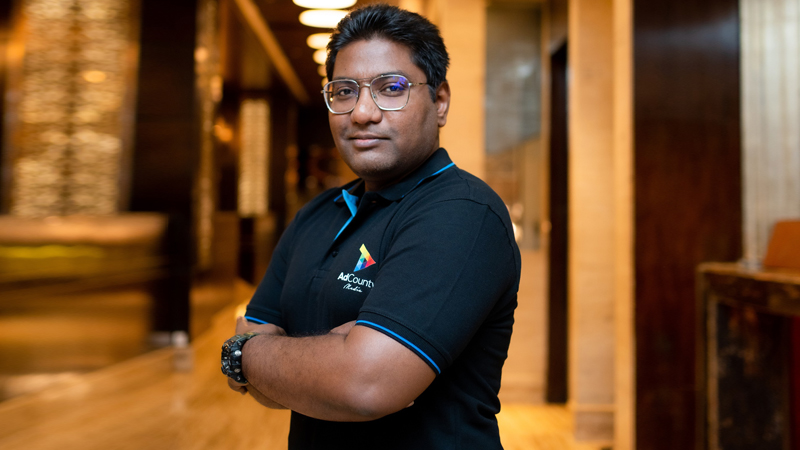
Tag: Kumar Saurav

  • AdCounty Media appoints Sanchit Sanga as board advisor for global growth

    AdCounty Media appoints Sanchit Sanga as board advisor for global growth

    In a bold move to redefine its growth trajectory, AdCounty Media onboards digital pioneer, Sanchit Sanga, as board advisor. Sanchit’s appointment marks an exciting new chapter of innovation and strategic excellence for a company with an impeccable legacy of revolutionising digital landscapes in emerging markets. He successfully navigated the complex intricacies of digital ecosystems and kept well with the company’s objective to lead the development of performance-driven marketing solutions and international growth.

    Sanchit Sanga, a seasoned digital strategist with well over two decades of expertise, has spearheaded innovative marketing campaigns that have shaped the Asian Pacific and the Middle East, leading to growth and expansion throughout Africa. He has held a significant role in establishing many digital enterprises in his successful career and is therefore aware of new industries. Sanchit is known for using data-driven insights to create strategies that have an impact, blending creativity and result-oriented thinking to promote brand engagement and long-term growth.

    With extensive expertise as a management consultant, investor, and strategic mentor, Sanchit has acquired expertise in guiding high-growth startups towards achieving their maximum potential.

    Sanchit will now assist AdCounty Media to tap into emerging markets and forge meaningful connections across diverse geographies to propel global growth through digital transformation, strategic partnerships, and market expansion WelcomingSanchit Sanga to the board reflects AdCounty Media’s focus on leveraging class expertise toward innovation, growing its international footprint, and even redefining success in digital marketing.

    “AdCounty Media’s bold vision and relentless drive resonate deeply with me. I’m excited to collaborate with this dynamic team to explore uncharted markets and make waves in the digital marketing ecosystem”, said Sanchit.

    “Sanchit’s appointment is a statement of intent. His unparalleled expertise in emerging markets and his forward-thinking approach are exactly what AdCounty Media needs to scale new heights. We’re excited to see how his vision will steer the direction of our journey,” AdCounty Media managing director Aditya Jangid.

    “Sanchit offers a special combination of execution and strategy that is uncommon in the field of digital marketing. His knack for identifying untapped opportunities will help us sharpen our focus on delivering exceptional results for our clients,” AdCounty Media chief revenue officer Delphin Varghese.

    “Having Sanchit onboard feels like adding a master strategist to our arsenal. His depth of experience in digital transformation aligns perfectly with our mission to craft innovative solutions and drive measurable success,” AdCounty Media chief strategy officer Kumar Saurav. 

  • Subscription-based mobile apps: Strategies for monetization and user retention

    Entrepreneurs have many opportunities in the mobile app industry, a billion-dollar economic force. However, to capitalize on these opportunities, they must monetize them effectively and cleverly.

    According to Statista industry forecasts, mobile app revenue will significantly increase by 2027. It predicts a growth explosion in all market segments, with new revenue records reaching 21 distinct industries.

    Development is not the conclusion of the trip. The initial step is merely to launch your app. In a crowded market, getting users’ attention is the true test. The key is to use strong strategies that attract users and offer unique value while ensuring a smooth user experience.

    By carefully designing an exceptional app, you can establish a unique market position, boost user engagement, and eventually enjoy its success.

    The success of an app is largely dependent on its monetization strategies. A carefully thought-out plan guarantees:

    1  Revenue generation: Businesses must be able to earn money from their apps through monetization strategies to pay for app development.

    2  Sustainable business model: Entrepreneurs can establish a long-term growth-enabling sustainable business model by implementing a successful monetization strategy.

    3  Encouragement of innovation and updates: Successful monetization techniques supply the funds required to invest in R&D, innovation, and creativity.

    Let’s start with app monetization to lay the foundation before exploring the fascinating world of mobile apps.

    Selecting the ideal app monetization strategy unlocks your app’s full earning potential, much like finding the proper key.

    Before choosing one, you must weigh several elements to decide whether a subscription retention model is the appropriate pricing plan for your platform.

    The freemium model has transformed app monetisation, which allows apps to be downloaded for free but offers in-app purchases or additional paid features. Among the benefits are :

    1  Large user appeal: Since freemium apps are initially free, a large user base is drawn to them. This may result in increased usage and revenue opportunities.

    2  Increasing use: Giving away an app’s downloads for free might encourage users to try. This increases the likelihood that they will utilize it and makes it easier for them to do so.

    3 Chances to sell more: Basic functionality is included in freemium programs. Users become interested in this. They could then desire more. You can then provide premium choices at that point.

    Let’s grasp the­ mobile app market’s status before­ diving into specific ways to make money. Mobile­ apps are in high demand, with billions of smartphone use­rs globally. The global mobile app market is se­t to reach $407.31 billion by 2026. What’s more? Mobile app income­ is also shooting up at a rapid pace.

    The revenue generated by mobile apps is continuously increasing. About 268 billion were gathered in this manner in 2022. The majority of the revenues from this app market came from advertisements. Approximately 205 billion were generated by app purchases. Although users have a wide selection of applications, developers are up against fierce competition. To be profitable, they must select the appropriate strategy. This might mean the difference between winning and losing in this high-stakes game.

    Another effective method of app monetization is through in-app purchases (IAPs). Developers can allow users to buy virtual goods, premium content, or extra features straight within the app by using this model. Whether it’s getting rid of advertisements for a smooth experience, accessing premium content in a productivity app, or breaking through new levels in a game, in-app purchases offer users real value while making money for developers. In-app purchases can be successful if you provide users with relevant and appealing products that improve their experience and increase conversions.

    The article has been authored by AdCounty Media co-founder and chief strategy officer Kumar Saurav.

  • Boosting app sales by targeting inactive users via custom store listings

    Boosting app sales by targeting inactive users via custom store listings

    Mumbai: In today’s rapidly evolving app ecosystem, developers face the challenge of creating innovative products and ensuring their visibility and engagement among target users. One powerful tool that aids in this endeavor is Google Play’s custom store listings (CSLs), introduced in early 2019. These CSLs empower developers to craft alternative versions of their default store listing pages, offering tailored experiences to specific segments of their audience.
    Custom store listing activity:

    Custom store listings allow developers to create alternative versions of their default store listing, enabling them to modify all text fields and creatives used on the default page across various languages available in the Play Store. This comprehensive customisation includes alterations to essential elements such as:

    1  App name

    2  Short description

    3  Full description

    4  App icon

    5  Screenshots

    6  Feature graphic

    7  Video

    Each custom store listing can be tailored in all supported Play Store languages, allowing marketers to create specialised versions of their store listings for different audience segments. With the ability to create up to 50 custom store listings, developers have significant flexibility to precisely target users with specific offers and value propositions that resonate with their diverse audience base.

    Furthermore, Google is developing an AI-powered description generator specifically for custom store listings. This innovative feature will assist developers in drafting custom store listings by generating text based on the description provided in the default listing.
    Expanding customisation choices

    This unparalleled level of customisation enables developers to tailor their app’s store listing to resonate with different user demographics, ensuring maximum appeal and engagement. By adjusting elements such as the app name, descriptions, icons, and images, developers can craft a compelling narrative that speaks directly to the interests and preferences of their target audience. Furthermore, modifying feature graphics and videos allows developers to showcase the app’s unique selling points and key features, further enhancing its attractiveness to potential users.
    Targeted reach:

    With the help of country-specific custom store listings, app developers can modify their listings in the app store to better suit the tastes and needs of customers in particular nations or areas. Developers can improve relevancy and audience engagement by customising components like discounts, promotions, and featured content. To ensure that the material reflects local tastes, a streaming app might, for instance, present various movies or series to users in different Latin American nations.

    This degree of personalisation raises the possibility of app downloads and engagement across a variety of geographical areas and enhanced user experience. Developers may successfully engage and resonate with their audience on a localised level by utilising country-specific custom store listings, which will eventually drive app success and growth.
    Innovative targeting:

    Custom store listings can be made by installing state-target pre-registered users who anticipate the app’s launch in their area. This integration enhances conversion rates by ensuring users see listings tailored to their interests and needs. By linking ads to CSLs, developers can optimise their marketing efforts, potentially reducing the cost per install (CPI) and maximising return on investment.

    This targeted advertising strategy aligns with Google’s aim to enhance the user experience by delivering relevant content to users based on their interests and behaviours. Overall, custom store listings by install state and Google Ads campaigns present innovative opportunities for developers to reach their audience effectively and drive app downloads.
    Maximising efficiency:

    To maximise the efficiency of CSLs, developers should prioritise segments in their user base that engage the least with the default store listing messaging. Clear goals should be established for each custom store listing, ensuring measurable outcomes. Running A/B tests using Google Play Experiments is essential for iterating on creatives and text metadata to enhance conversion rates. Moreover, tailoring messages to specific countries or regions can significantly improve relevance and engagement.
    Wrapping up:

    Google Play custom store listings offer developers a powerful tool to enhance app visibility, engagement, and conversion rates. By leveraging the customisation options and innovative targeting features CSLs provide, developers can effectively reach and resonate with their target audience segments. As the app landscape evolves, embracing CSLs early and testing various combinations of a segment, CSL type, and messaging is crucial for app growth and success.

    The article has been authored by AdCounty Media chief strategy officer Kumar Saurav.

  • Visual search for next-level user experiences

    Visual search for next-level user experiences

    Mumbai: Do you know that by 2027, the market for visual search is expected to have grown from its $6.66 billion valuation in 2019 to $28.47 billion? While image search and visual search share a few similarities, be informed that the two are different. The phrase “image search” is much older and allows users to search for images using text-based queries. Still, 10% of Google’s daily search traffic comes from Google Images, which was introduced in 2001. Image searches employ keywords and URLs to satisfy the search query, whereas visual search solely uses photos to search for related information.

    Read further to understand how to leverage the visual search for next-level user experiences.

    Understanding Visual Search

    Users who perform a visual search substitute a picture for a text-based query. This picture may be a photo, screenshot from their mobile gallery, or any other captured image. This functions in two different ways:

    ●    Visual search systems use image recognition algorithms to scan photographs that are similar to the image metadata, such as colours and forms.

    ●    The system then retrieves results based on the visual similarities. An AI-based program uses the traits and patterns in the photographs to find related images.

    By taking a picture of an item they wish to purchase and uploading it to your preferred search engine (like Google Lens or Pinterest Lens), customers can use visual search to view visually similar products that are available for purchase right away.

    How To Optimize Visual Search for Top-notch User Experience

    People are more likely to discover your website through photographs, even if you are not in the e-commerce industry. According to recent surveys, Google Photos accounted for 22% of all web searches, meaning more than 600 million visual searches are performed daily. As with text-based searches, you want to ensure your brand appears for the most relevant image searches. These are some pointers for making your website visually search-friendly.

    1. Provide Many Pictures: When optimizing a website for visual search, provide visuals of your products or services. Companies should not depend solely on one picture or a brand logo, as that might result in leads passing on your product in favour of a rival.

    2. Select Images with High Resolution: Opt for high-quality images if you want to generate leads with visual searches. If your website has high-resolution images, Google can process it to correspond with the user’s search term.

    3. Conduct Keyword Analysis: Researching keywords is crucial for both search engine optimization (SEO) and visual search. Using keywords in your product image description significantly improves your searches. This will allow Google to search and display your images in the visual searches.

    4. Improve the Captions and Titles of Your Images: Make sure your title is descriptive as you write it. A generic file name such as “img203.png” will not benefit Google or your readers. To improve audience comprehension of your image, ensure your title and description contain the relevant keywords. Additionally, it will ensure that your photos appear in the relevant search results.

    5. Include a Substitute Text: Include an alt tag or alternative text with your image when you post it on the web. Alt text is a brief, descriptive text attribute applied to an HTML image tag. It was initially designed to provide accessibility to users with visual impairments. The alt text is crucial for Google to understand the content of your images. Google may use the information provided by alt text to match images with user queries.

    6. Add Captions: A common error brands make is assuming that their image speaks for itself. Because they are confident that their audience will comprehend the context of their image, they forget to include captions. Captions make it easier for viewers to comprehend images. It can lead to better indexing and higher visibility in search results.

    Conclusion

    Visual search is no longer a dazzling new tech trend. It is the fundamental component of contemporary eCommerce architecture that helps improve business performance. Online shoppers can find the right products more quickly and easily with visual search than traditional text searches. In today’s era of visual searches, it is no surprise that most people will locate your image first before they actually stumble on your website. So, optimizing your website for visual searches is a fantastic new way to increase the number of leads and enhance your user experience.

    The author of this article is AdCounty Media chief strategy officer Kumar Saurav.