Tag: Kumar Ketkar

  • Bad news dogs Mi Marathi journos: work without pay

    Bad news dogs Mi Marathi journos: work without pay

    MUMBAI: There’s some amount of chaos reigning in the office of the 24 hour Marathi news channel Mi Marathi. With owner Mahesh Motewar – who acquired it from HDIL in 2012 – cooling his heels behind bars since December 2015, it’s bound to be.  A cash crunch has forced it to stop churning out original news programming and run archival content.

    Moreover, on 20 March 2016, Mi Marathi’s senior managers called a meeting at which reporters and editors were informed that they would have work without pay until further notice.

    A senior reporter present at the meeting told Indiantelevision.com, “We were shocked when the announcement was made. We were asked to raise our hands if we were okay to work without being paid. Only three hands went up.”

    Another senior official informed us on condition of anonymity, “The salaries have been delayed for a long time now. Three days back all the staff got their January pay, while their emoluments for February are still due. There is a crisis at our parent company, but the irony is revenue wise we are doing good. ABP and Zee are the only ones above us. I just hope the company can resolve its issues soon or it may be on course to shut down.”

    Another senior journo disclosed that he has been calling his friends in other news channels and newspapers to hire some of the mid and junior level reporters from Mi Marathi. He further clarified:  “A large chunk of the employees has already moved on. The way it is functioning; I don’t see the channel running for long. We senior guys get the salary last. We ensure that the younger reporters and editors get their wages first as they are the one’s most needing them.”

    However, Mi Marathi managing editor Tulsidas Bhoite was pretty emphatic that the channel would continue and there was no question of shuttering it. “Yes there are certain issues but there is no shutting down. Yes we have stopped our bulletins but that is because of some technical issues,” he said. “The reporters are there and we will  resume our original programming again in a week or two.”

    Observers say it will require a miracle of sorts to turn things around. Motewar is reportedly currently lodged in Yerwada jail after being found guilty of allegedly defrauding investors through a chit-fund scam under Prosperity Agro or Samruddha Jeevan. Motewar is allegedly politically well connected hence his broadcast venture could find a white knight.


  • Bad news dogs Mi Marathi journos: work without pay

    Bad news dogs Mi Marathi journos: work without pay

    MUMBAI: There’s some amount of chaos reigning in the office of the 24 hour Marathi news channel Mi Marathi. With owner Mahesh Motewar – who acquired it from HDIL in 2012 – cooling his heels behind bars since December 2015, it’s bound to be.  A cash crunch has forced it to stop churning out original news programming and run archival content.

    Moreover, on 20 March 2016, Mi Marathi’s senior managers called a meeting at which reporters and editors were informed that they would have work without pay until further notice.

    A senior reporter present at the meeting told Indiantelevision.com, “We were shocked when the announcement was made. We were asked to raise our hands if we were okay to work without being paid. Only three hands went up.”

    Another senior official informed us on condition of anonymity, “The salaries have been delayed for a long time now. Three days back all the staff got their January pay, while their emoluments for February are still due. There is a crisis at our parent company, but the irony is revenue wise we are doing good. ABP and Zee are the only ones above us. I just hope the company can resolve its issues soon or it may be on course to shut down.”

    Another senior journo disclosed that he has been calling his friends in other news channels and newspapers to hire some of the mid and junior level reporters from Mi Marathi. He further clarified:  “A large chunk of the employees has already moved on. The way it is functioning; I don’t see the channel running for long. We senior guys get the salary last. We ensure that the younger reporters and editors get their wages first as they are the one’s most needing them.”

    However, Mi Marathi managing editor Tulsidas Bhoite was pretty emphatic that the channel would continue and there was no question of shuttering it. “Yes there are certain issues but there is no shutting down. Yes we have stopped our bulletins but that is because of some technical issues,” he said. “The reporters are there and we will  resume our original programming again in a week or two.”

    Observers say it will require a miracle of sorts to turn things around. Motewar is reportedly currently lodged in Yerwada jail after being found guilty of allegedly defrauding investors through a chit-fund scam under Prosperity Agro or Samruddha Jeevan. Motewar is allegedly politically well connected hence his broadcast venture could find a white knight.


  • Times Now preps for Bihar election battle with 3 new data analytics salvos

    Times Now preps for Bihar election battle with 3 new data analytics salvos

    MUMBAI: At a time when all national news channels are going in full throttle to win the ratings race as the high octane drama unfolds for the upcoming Bihar Assembly election day, Times Now has armed itself with technical innovations and three proprietary live analytic data tools namely Cluster, Firewall and Spectrum.


    Starting at 7 pm on 7 November, the news channel will launch 36 hours of discontinuous live reporting led by editor-in-chief Arnab Goswami. Along with a team of experts, Goswami will analyse the news, exit poll indications and results through exclusives and hard hitting interviews.


    Joining Goswami on the panel will be experts such as Sunil Alagh, Saba Naqvi, Sankarshan Thakur, R Rajagopalan, Kumar Ketkar, Hartosh Singh Bal, Ajoy Bose, Arati Jerath, Shahid Siddiqui and Neerja Chowdhury.


    Goswami decodes the three proprietary live analytic data tools one at a time. Speaking about them he says, “Cluster is a graphical tool, which analyses results on the basis of social, demographic or political similarities and the profile of a constituency. The second tool Firewall, gives live data analysis that tells you whether any individual constituencies are bucking the overall trend,” informs Goswami.


    “For example,” Goswami explains, “if there is a constituency that, say, the Janata Dal has won three times in a row, it is a ‘firewall’ constituency — because for anyone to breach that constituency from the other side will be doubly difficult. So if the exit polls indicate that trend is being bucked, Firewall throws it up, with details of the candidate or party challenging the favourite, and the others in the constituency. While people do this kind of an analysis 10 to 12 hours after the results, on Times Now, it will be done live.”


    The third tool in Times Now’s inventory is Spectrum, which has been designed to emulate the concept of a spectrum, putting the result out literally on a band and colour-coding it.


    “For example, saffron for the NDA and green for JDU. So the band is colour coded, and as the results come in, the band gets filled with colour. So you can compare the band of this election to the band of last elections and visually a viewer can understand if colour-wise this election is looking like the last election or otherwise,” explains Goswami, adding that the info-graphic will simplify the exit poll analysis for the viewers.


    Also keeping the channel on top of its game is its recently announced exclusive partnership with social media giant Twitter to launch a global video service. Understanding the need of the hour, Goswami has no qualms in even dumping full shows on the Twitter owned video curation service Periscope.


    “In India, the PMO site and Times Now alone were chosen partners for global video launch of Twitter. In fact, I will be doing the first ever exclusive news show on Periscope, that will go live before the TV coverage commences this Saturday (7 November, 2015) evening,” Goswami reveals in parting.

  • Mi Marathi’s secret recipe for success in regional news space

    Mi Marathi’s secret recipe for success in regional news space

    MUMBAI: Marathi news channel Mi Marathi, which was eyeing the number one spot on the ratings chart after its late entry a year back, has finally hit bull’s eye.  


    In order to stay above the rest, Mi Marathi has designed a content strategy different than the other Marathi news channels. “We have never had a regional approach towards the channel. Mi Marathi has always been shaped as a global Marathi channel,” Mi Marathi editor in chief Ravindra Ambekar tells Indiantelevision.com in an exclusive chat.


    The differentiating factor for the channel when it launched, according to Ambekar, was that while other Marathi news channels were only catering to the Maharashtrains in Maharashtra, Mi Marathi took to representing the non-Marathis. “So while others were idolizing Raj Thackeray, we went against him. The programming of Mi Marathi has always revolved around people’s agenda,” says Ambekar.


    Ask Ambekar the recipe of reaching the top, and he proudly says, “We have never stuck to the studios. We believe in reporting from the ground and that’s how we connect to the viewers. People like to know the news from the ground and that is what has helped us reach the number one position.”


    The channel, which is working on a whole new look that it will soon be launching, is also concentrating on differentiated programming to attract more viewers and retain its number one position.


    Programming strategy


    Mi Marathi has roped in some big names… right from Kumar Ketkar to Nikhil Wagle, the channel has some of the top guns of journalism on its side.


    With its programming, the channel is also trying to bring a perceptional change that Marathi channels cannot cater to international news. It recently launched World News hosted by Kumar Ketkar, where he analyses major international news. “We must come out of the regional identity and boundaries,” opines Ambekar.


    That apart, it also has a show Local to Global hosted by newly appointed Nilesh Khare along with Shreerang Khare and Mayank Bhagwat. The show currently is the highest rated for the channel.


    Mi Marathi, through its content, is trying to connect to the new generation and that explains the English titles for most of its shows. “If we want to connect with the new generation, we will have to speak in their language,” says Ambekar, adding that the channel also does bulletins in languages spoken in the interior part of Maharashtra like a Malwani bulletin, all this to form a connect with the audience. 


    According to Ambekar, in Mumbai, Mi Marathi faces stiff competition from Hindi news channels. “The issue here is that when there is big news, people shift to Hindi news channels,” he says, adding that regional channels too need to come up with shows, which are at par with the quality of an English news channel.


    The channel is focusing on strengthening its morning primetime band, which currently airs half an hour recorded bulletins and shows. It will soon be launching a 7 am to 8:30 am non-stop super fast news bulletin catering to local and global news. “We have realised that people don’t have the luxury of sitting and watching news early in the morning and so we will be launching speed news in the morning band with the theme: ‘Don’t read newspapers, listen to them’,” informs Ambekar.


    Mi Marathi also has had a different approach for the afternoon band compared to the others in the space. While others prefer airing cooking shows in the afternoon band, this Marathi news channel chooses to air shows, which caters to social and health issues. “We understand that women would not want to watch a cooking show in their free time and so we air shows, which cater to issues relating to commuting, heath, government etc,” he says.  


    The evening band on the channel caters to remote areas of the state. Called the Zilla Parishad News, the programme covers issues at the zilla level. “We have total nine live bureaus and two – three  correspondents in every district of the state. This adds to the depth of stories we do,” informs Ambekar.


    Realising a void of business programmes in the Marathi news channel space, Mi Marathi has launched two business related shows: Khisa Pakit by Bharat Kumar Raut, which was a pre-budget show and will now continue featuring interviews of CEOs and Mi Marathi Bigg Boss by Nilesh Khare, which will go on floors next month. 


    The channel is also in discussion with Wagle for another show, after the successful Point Blank


    “We need to go above the competition and only then will we succeed,” opines Ambekar, who is hoping to financially stabilise the company in the next one year.


    “We are currently mostly dependent on corporate advertising currently. However, we are now moving towards retail marketing and events,” he informs.


    Events in the pipeline


    The channel is planning mega events like Agricultural Awards and educational seminars to boost its revenues. “We are focusing on revenue from events and retail client. There is limited space for advertising on television, since we need to concentrate on content and so we are focusing on events,” he says.


    While the Agricultural Awards will take place in October, the first educational seminar will be held in May at Kolhapur. 


  • Nikhil Wagle joins Mi Marathi as consultant

    Nikhil Wagle joins Mi Marathi as consultant

    MUMBAI: After a brief hiatus of a month, former IBN Lokmat editor in chief Nikhil Wagle has now assumed the role of a consultant with Mi Marathi. He will host a new show called Point Blank at 9pm from Monday to Friday.


    Wagle’s expertise in political news will be leveraged by the channel for the upcoming state elections in Maharashtra. He will also be anchoring an interview based show very soon. In his new capacity, Wagle is free to appear on other Hindi and English news channels but not on any competing Marathi channel.


    Recently, the Marathi news channel underwent a few changes. It got on board Ravindra Ambekar as chief editor, veteran journalist Kumar Ketkar as media consultant and Bharat Kumar Raut as consulting editor.


    Wagle has worked with Doordarshan as well as newspaper Aapla Mahanagar and has been with IBN Lokmat since its launch in 2008.

  • Senior journalists scrutinise media at RedInk Awards 2014

    Senior journalists scrutinise media at RedInk Awards 2014

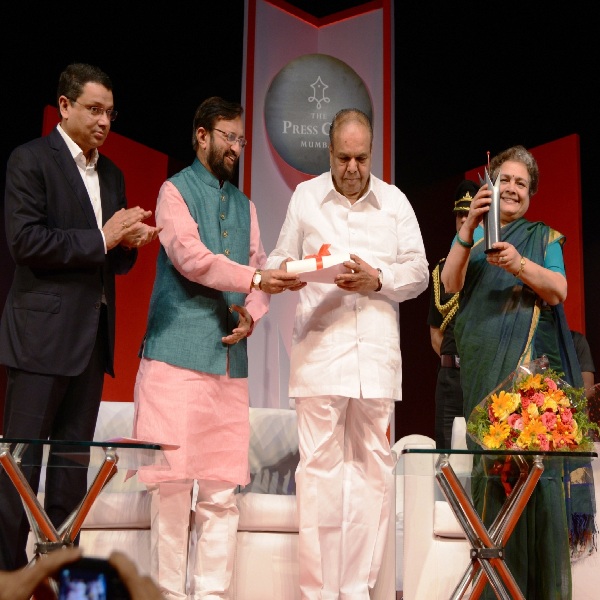
    MUMBAI: It was an awards night, albeit not for celebrities, but for the hard working journalists aka the fourth estate of the country. The fourth edition of the RedInk Awards organised by the Press Club of Mumbai saw 30 journalists from print, broadcast and online media receiving awards in various categories for their outstanding writing and research.


    Press Club of Mumbai president Gurbir Singh opened the ceremony with a few thoughts on the state of media in the country today. “Media today is in crisis. Retrenchments are happening, companies are closing, new ones are starting. There is something wrong with the way media is conducting itself. Is it a shortage of funds or the way the business is being done,” he questioned.


    His voice was not alone. A discussion followed on ‘Elections 2014: Were we fair or did we stoke the NaMo wave’ which involved IBN18 editor-in-chief Rajdeep Sardesai, Times Now editor-in-chief Arnab Goswami and Divya Marathi chief editor Kumar Ketkar alongside O&M creative director Piyush Pandey and moderated by former journalist and current Star India CEO Uday Shankar. While Sardesai and Ketkar remained critical of the role of media today, Shankar and Goswami agree that the future is very bright.


    Maharashtra governor K Sankaranarayanan and new Information and Broadcasting Minister Prakash Javadekar were the guests of honour for the evening. While Javadekar said that he would look into establishing a law to prevent attacks on press, the governor had some personal anecdotes to share regarding the media.


    “Today, as a politician, just serving the people isn’t enough. You have to be friends with journalists,” he said in what appeared to be an answer to Goswami’s earlier comment that journalists should not be emotionally connected with politicians. “Paid news is much talked off. I ask the media why do they show it and they say they don’t have money. If you ask a thief why are you stealing he says ‘I don’t have money’,” he said.


    Sankaranarayanan said that the media world in India is so competitive that if one person isn’t there another will come in his place. “I watch Arnab’s debates sometimes. Today at 9:00 pm I don’t know what has happened. He is not there. It is a great loss to the people,” he added amidst loud applause.


    Mrinal Pande who was the first woman editor of the Hindi daily Hindustan and who retired recently as the chairperson of the Prasar Bharati was honoured with the RedInk lifetime achievement award. 

  • Rajdeep Sardesai and Arnab Goswami poles apart on future of journalism

    Rajdeep Sardesai and Arnab Goswami poles apart on future of journalism

    MUMBAI: The venue: the National Centre of Performing Arts auditorium in south Mumbai. The occasion: a panel discussion that preceded the Press Club of India’s Red Ink Awards. On stage were IBN18 editor-in-chief  Rajdeep Sardesai, Times Now editor-in-chief Arnab Goswami, and Dainik Divya Marathi chief editor Kumar Ketkar, O&M national creative director and chairman Piyush Pandey. And for a change it was they who were grilled by Star India CEO Uday Shankar, a former journalist himself. The topic: Elections 2014: were we fair or did we stoke the NaMo wave?’

    Shankar set the pace for the panel when he spoke first, stating that it is he who would be asking the questions and no one would be allowed to answer – in all probability taking a jab at Arnab. As the audience burst into laughter,  he then told Rajdeep to open the debate by speaking his mind.

    Dressed as casually as one can get, in a red kurta, simple trousers and chappals, Sardesai delivered a hard hitting monologue on Modi and the kind of journalism that exists in India now.

    “Modi had the most  innovative and sustained campaign that we have ever seen in an Indian election,” he said, while pointing out that Congress president Rahul Gandhi was like a kid in kindergarten in front of Modi. But he also said that it was unfair to blame the media for creating the NaMo wave.

    “Some channels have abandoned the basic role of media. They are now doing cheerleading or supari journalism to get more viewers and ratings. Modi was not subject to the intense scrutiny in the last two years that the others were subject to. While he was brilliant with his social media strategy and communication he was spared the ignominy that others were subject to. Some channels elevated Narendra Modi to God. He is a good politician and communicator but not a messiah. Some journalists need to ask themselves if they want to do journalism or hagiography,” he added.

    On the other hand, Arnab instantly put himself and his channel in the spotlight by stating that one of the positives of being located in Mumbai, far away from the hub of channels (Noida) was that it keeps him disassociated with politicians.

    “I am not romantically involved with any political party so I don’t end up having a bitter break up with them. My distance with politicians is both physical and psychological. We in India are overawed by them. Modi was the focus because there was no competition. We are not dependent on politicians for ratings. There is no scientific evidence that Modi gets ratings,” he said while also stating that he wasn’t aware of this supari journalism that Rajdeep referred to.

    “The next 10 years of journalism to me are very bright,” said Arnab. A view that Shankar totally endorsed. Said he: “The future of journalism is bright because we do something that is essential to the society. We should not be cynical about the media, without them the country would not have been what it is.”

    However, Arnab’s view seemed to have irked Rajdeep who in the latter part of the discussion said, “We can state that in 10 years things will be great and things are going to change, but arrogance is the downfall of every journalist! At our time, it was never that what the anchor said would matter more than what the guests said.”

    Ketkar who comes from the print side of the media and was the senior most scribe on the panel let loose his spleen as he lambasted the electronic media for sidetracking and sideswiping print publications.

    “It is the electronic media that sets the tone for the next day’s morning headlines in the paper by these discussions. The people don’t set the agenda, the media does. The media has covered how miserable Bihar is but no mention of the Gujarat floods when Modi was campaigning at the height of his campaign trail. So, it is not just that you have to speak more about something, but by also not showing something you can stoke the fire,” he said.

    While the three editors did not refrain from taking digs and potshots at each other for the kind of journalism that is being resorted to, it was Piyush Pandey – the man behind the Narendra Modi election campaign –  who gave his insights on what led to NaMo wave. He pointed out that no matter what Modi did, he never gave the media a chance to ignore him; he made sure he was in the public eye, consistently giving out the right message that the public wanted to hear. “The media rode the Modi wave. It did not create it,” he said.

    While the very topic was sidelined, the editors were deeply engaged in pontificating on the state of journalism in the country with Goswami being the most optimistic about it.

    Having recently taken a month long break from his editorial duties, Rajdeep was the most vocal about the fact that news television needs to find its bearings quickly.

    “The idea that the television makes or breaks will not hold anymore. I really think that we have lost the capacity to go beyond the dramatic headline. We have lost our nerve. We need to introspect and ask ourselves : are we willing to do a serious interrogation of the Gujarat model, positive and negative?” he questioned. The fact that the BJP did well in places where cable TV did not reach efficiently was also brought out by Shankar and Sardesai.

    While the discussion didn’t see any real conclusion, it did end with a valuable point to ponder: whether journalists were getting too emotionally involved with politicians?

    Shankar had the last word on this. Said he:  “I think there is too much reverence even now in Indian media and on the other hand, there is too much emotional attachment. Either we are just cynical or when we go there we get sucked in. There has to be a balance in between. Overall, I think we shouldn’t be cynical about media. We have lots to capture and improve but without the media, this place, this country would be much worse.”

  • Assembly Elections: Waiting for the Verdict

    Assembly Elections: Waiting for the Verdict

    MUMBAI: After months of campaigning and hectic election activity, people of Delhi, Madhya Pradesh, Rajasthan, Chhattisgarh and Mizoram have spoken. The assembly elections witnessed people coming out to vote in large numbers. Now, it’s up to the Counting Day on December 8 to decide the fate of these states.

    On the day of the results, CNN-IBN & IBN7 will bring to its viewers a special day-long programming. ‘Battle for the States’ & ‘Mera Vote Meri Sarkar – Counting Day’ will provide the most precise and comprehensive coverage leading up to the final results.

    The shows, featuring exclusive updates and in-depth analyses, will have the most formidable political analysts and commentators of the country: Swapan Dasgupta, Dr. Ramchandra Guha, Manini Chatterjee, K S Sachidananda Murthy, Dr. Sandeep Shastri, Dr. Suhas Palshikar, Kumar Ketkar, Dipankar Gupta and Prof. Rajeeva Karadikar on CNN-IBN; and Harivansh, Sanjay Kumar, Rakesh Sinha, Vivek Kumar and Purushottam Agrawal on IBN7.

    Rajdeep Sardesai, Editor-in-Chief, CNN-IBN, IBN7 and IBN-Lokmat, said, “Our counting day special programming aims at givingour viewers the most decisive verdict and the credible reporting on the poll. Our exhaustive and insightful analysis on the counting day will provide the most comprehensive coverage leading up to the final verdict in the five states.”

    Ashutosh, Managing Editor, IBN7 said, “IBN network has always been upfront in covering elections. With our day-long counting day special programming we intend to bring to our viewers the most precise and comprehensive coverage as the winners names come in.”

    Don’t miss the day-long counting day drama catch the special counting day programming on CNN–IBN & IBN7 on December 8, all day.
     

  • The Election Battle

    The Election Battle

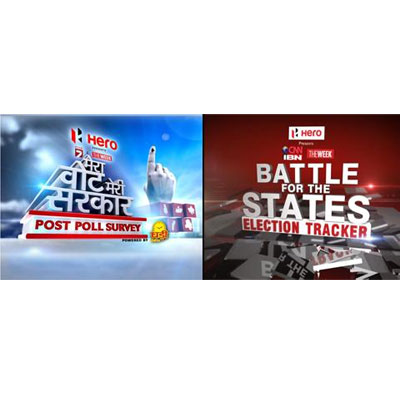
    MUMBAI: As the Assembly Elections in Delhi, Madhya Pradesh, Chhattisgarh, Rajasthan and Mizoram enter the final phase, CNN-IBN & IBN7, in partnership with THE WEEK, brings you ‘Battle For The States – Election Tracker’ & ‘Mera Vote Meri Sarkar – Post-Poll Survey’, a comprehensive post-poll study conducted by the Centre for the Study of Developing Societies (CSDS).

    Time and again, the IBN Network has proved to be accurate when it comes to predicting election results and trends. This special programming will try to capture the mood of the electorate in each constituency, likely voting trends and patterns, and give seat projections. An expert panel of analysts including Swapan Dasgupta, Dr. Ramchandra Guha, Manini Chatterjee, K S Sachidananda Murthy, Dr. Sandeep Shastri, Dr. Suhas Palshikar, Kumar Ketkar, Dipankar Gupta and Prof. Rajeeva Karadikar on CNN-IBN, and Harivansh, Sanjay Kumar, Rakesh Sinha, Vivek Kumar and Purushottam Agrawal on IBN7 will discuss the key factors that are going to impact the polling results and government formation.

    Rajdeep Sardesai, Editor-in-Chief, CNN-IBN, IBN7 and IBN-Lokmat, said, “When it comes to the elections programming, IBN Network has been a front runner. It is our endeavour to give our viewers the most accurate voting percentage and trends through this post-poll survey.
    Ashutosh, Managing Editor, IBN7 said, “Our scientific and comprehensive post-poll survey will help the viewers understand the present political and social scenario and the voting trends in the poll-bound states.”

    Philip Mathew, Managing Editor, THE WEEK, said, “THE WEEK is known for its unbiased and insightful political coverage. Our poll predictions, over the years, have always hit the bull’s-eye. I am sure our successful partnership with CNN-IBN will deliver yet another hit with this exit poll.”

    To know the findings of this survey, tune-in to ‘Battle for the States – Election Tracker’ on CNN-IBN and ‘Mera Vote Meri Sarkar – Post-Poll Survey’ on IBN7, on Dec 4 @ 6 PM to 10 PM & Dec 6 @ 8 PM to 10 PM.

    You can also read the detailed results and analysis of the survey in the issue of THE WEEK, hitting the stands on Dec 6, 2013.