Tag: KS Sarma

  • Marar replaces KS Sarma as Maa TV CEO

    Marar replaces KS Sarma as Maa TV CEO

    MUMBAI: Maa TV Network, which owns and operates Telugu general entertainment channel Maa TV, has appointed Sharradh Marar as its chief executive officer. He replaces former Prasar Bharati CEO KS Sarma who has been in charge for only a few months.

    Marar has a long association with the film industry and is said to be close to superstars Chiranjeevi and Nagarjuna. Late last year the company restructured its shareholding with Chiranjeev, Nagarjuna and Matrix Laboratories Ltd (a listed company) promoter N Prasad acquiring 60 per cent stake.

    Sarma was then roped in to head the company. He will, however, continue as advisor to Maa TV Network. “I have taken over as CEO and Sarma will stay as advisor to the company. My immediate focus will be to consolidate our channel’s position and try out ways to increase our market share,” says Marar.

    Marar was heading the southern operations in Amitabh Bachchan’s company ABCL. Later he floated a media company, South Parade, that was into buying and branded content. He has also produced TV serials for Gemini and has 15 years of TV exposure.

  • Former Prasar Bharati chief KS Sarma takes charge as Maa TV CEO

    Former Prasar Bharati chief KS Sarma takes charge as Maa TV CEO

    MUMBAI: Soon after restructuring its shareholding, Maa TV Network Ltd has roped in former Prasar Bharati CEO KS Sarma to head the company.

    Sarma will chalk out the company’s expansion plans. Maa TV Network, which owns and operates a Telugu general entertainment channel, had plans to launch a music channel and spruce up the programming of its existing channel.

    “I have joined Maa TV Network as the CEO. We are in the process of formalising our expansion plans. We would be ready with it (the plans) in a month’s time,” Sarma tells Indiantelevision.com.

    The company will have a fresh infusion of Rs 500 million with the original promoter Murali Krishna Raju putting in Rs 100 million. Superstars Nagarjuna and Chiranjeevi have walked in as new investors along with Matrix Laboratories Ltd (a listed company) and will together be holding 60 per cent in a purchase deal worth Rs 400 million.

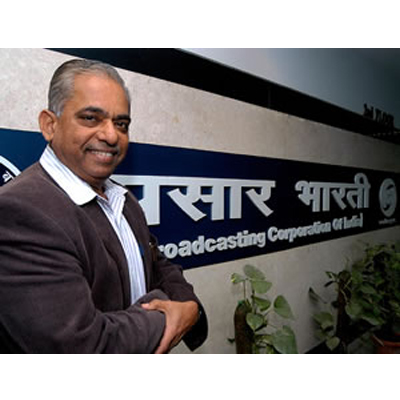
    Sarma, an Indian Administrative Service (IAS) officer from the Andhra Pradesh cadre, recently retired as Prasar Bharati CEO. During his stint, Prasar Bharati launched a direct-to-home (DTH) service, DD Direct+, comprising free-to-air channels. Doordarshan also came out with a fine tuned self-financing scheme (SFS) and handled marketing of cricket, serials and movies.

  • Navin Kumar appointed interim CEO of Prasar Bharati

    Navin Kumar appointed interim CEO of Prasar Bharati

    NEW DELHI: Doordarshan director-general Navin Kumar will be the interim CEO of Prasar Bharati till a selection panel zeroes down on a full time candidate for the post being vacated by KS Sarma.

    Sarma served as the CEO of Prasar Bharati, which manages DD and All India Radio, from March 2002 to June 2006. Kumar’s appointment too would be a short one as the government official is slated to revert to his home cadre in August after a stint in New Delhi.

    As Kumar will be functioning as the CEO of Prasar Bharati, senior-most deputy director-general, LD Mandloi, will be the acting DG of Doordarshan.

    Interestingly, before Sarma took over the reins at Prasar Bharati, the then additional secretary in the I&B ministry, Anil Baijal, served as the acting CEO for about 18 months.Chief executive of the publicly funded Prasar Bharati is chosen by a panel headed by the Vice-President of India and comprising the chairman of the Press Council of India and a government nominee.

    Sarma’s over four-year term had its ups and downs, but he is credited with successfully launching DD’s subscription-free DTH service DD Direct+, and steering Prasar Bharati’s annual revenues to over Rs 10 billion for the first time in FY06 ended March 2006.

    It was also during Sarma’s tenure that DD News was relaunched and an in-house marketing team set up to market programmes aired on DD and AIR instead of outsourcing the activity, which, more often than not, ran into legal problems.

    Though Sarma would not like to take much credit for it, but he is said to have successfully lobbied with the ministry to bring about changes in sports broadcasting, which resulted in the downlink law being formulated that makes it mandatory for private broadcasters to share feeds of listed events with the pubcaster.

  • Govt official tipped as interim CEO of Prasar Bharati

    Govt official tipped as interim CEO of Prasar Bharati

    NEW DELHI: With the government yet to decide on a chief executive for pubcaster Prasar Bharati, an information and broadcasting ministry official is slated to take over the reins from the outgoing chief in the interim.

    Additional secretary in the I&B ministry P Singh, a government representative on the board of Prasar Bharati, would be the interim chief of an organization that manages Doordarshan and All India Radio.

    KS Sarma retires from the post of CEO on 30 June after an over four-year tenure, being the longest serving chief executive.Though it is unlikely that Singh would be a permanent appointee, the lack of urgency on the part of the I&B ministry to find a replacement for Sarma could see the government official at the helm of affairs for a longer duration than generally expected.

    Some of the names doing the rounds in the corridors of power as likely candidates to succeed Sarma include former I&B ministry official Vijay Singh and a human resources development ministry official who’s said to be close to I&B minister Priya Ranjan Dasmunsi.Another candidate, SY Querishi, whose name was being bandied round as a likely CEO of Prasar Bharati, was named by the government on Thursday to go to the Election Commission.

    Querishi had served as the director general of Doordarshan during Sushma Swaraj’s tenure as I&B minister in the Bharatiya Janata Party-led coalition government in the early 2000s.

    Considering that the post of CEO of Prasar Bharati — still regarded as an extension of the government propaganda division despite autonomy granted to it some years back — would prove to be both sensitive and crucial for New Delhi with elections scheduled in some states next year, it’s unlikely that Dasmunsi and company will decide in a hurry on a successor to Sarma.

    As the CEO, Sarma has had his ups and downs, but managed to retain his post despite changes in the ministry and the government.
     

  • Sarma retires in June; govt. yet to move on replacement

    Sarma retires in June; govt. yet to move on replacement

    NEW DELHI: Indian pubcaster Prasar Bharati would soon be headless unless the government, too busy with other issues like reservation for backward classes in educational institutions, hurries up.

    On 30 June 2006, Prasar Bharati CEO KS Sarma retires after serving an over five-year term that can be easily termed a roller-coaster ride.

    Following Sarma to the revolving door – sooner rather than later – is director-general of Doordarshan Navin Kumar whose term as a bureaucrat in Delhi ends in August. After that he has to revert to his parent state of Bihar.

    Kumar was appointed as the DG of Doordarshan in February of 2005. Prasar Bharati, an autonomous organization, manages pubcasters DD and All India Radio.

    While the CEO of Prasar Bharati is selected by a three-member panel headed by the vice-president of India, the DG is shortlisted by the board of Prasar Bharati that includes the chief executive and chairman.

    The present chairman of Prasar Bharati, veteran journalist MV Kamath, was appointed during the tenure of previous government, headed by the right-wing Bharatiya Janata Party.
    Prasar Bharati sources said that apart from Sarma and Kumar, there were several other senior officials who are on their way out and would have to be replaced.

    Meanwhile Sarma, a veteran of Prasar Bharati (he officiated as the DG of Doordarshan when he was a joint secretary in the I&B ministry in the mid to late 1990s) has seen over five ministers at the information and broadcasting ministry, which controls the purse strings for the publicly funded Prasar Bharati.

    Despite allegations of nepotism during a time when DD used to outsource marketing of big events, including the money-spinning cricket matches involving India, a wily Sarma has come out unscathed.

    It was during Sarma’s tenure as the CEO that DD floated its subscription-free DTH service, which raced ahead of the country’s first pay TV DTH service, Dish TV, in terms of subscribers.

    For the financial year ended march 2006, for the first time Prasar Bharati clocked a gross revenue of Rs 12.38 billion with Doordarshan clocking Rs 9.68 billion and All India Radio 2.7 billion that signified a growth of 67.67 per cent.

    Some of the achievements during Sarma’s tenure included the following:

    1. Increased focus on pro-active in house marketing of properties.
    2. Successful execution of media campaigns on behalf of government departments.
    3. Rationalization of rate cards to suit the changing market conditions.
    4. A strategic shift from Sponsored Programmes to Self Financing Scheme.
    5. Introduction of blockbuster Hindi Feature Films on DD National and marketing them in-house.
    6. Leveraging AIR’s vast network and unprecedented reach.
    7. Narrowcasting programming strategy.
    8. Publicity support for programmes to create awareness, especially among C & S audience.
    9. Improved billing and housekeeping efforts.

  • Private broadcasters resist fee proposal for DD Direct+

    Private broadcasters resist fee proposal for DD Direct+

    NEW DELHI: Indian pubcaster Prasar Bharati’s bid to demand carriage fee from broadcasters to be on its DTH platform, DD Direct+, has met with initial resistance from private sector players.

    This was amply clear in a meeting that was held today at the Prasar Bharati headquarters here to discuss the fee issue with private broadcasters who are already present on DD Direct+.

    The private sector channels, which have been on DD Direct+ for over a year now, feel that the demand for a carriage fee on the pubcaster’s DTH platform is “unjustified.”

    According to a representative of a private broadcaster, “We had assisted Prasar Bharati to launch its DTH service keeping national interest in mind. Now that the service is doing well, this sudden demand is unjustified.”

    Early April, Prasar Bharati CEO KS Sarma, while making a presentation before the media during the announcement of its annual financial result, had said there is a proposal to charge private channels on DD Direct+ an annual fee of Rs. 10 million from May when the total number of channels would be increased to 51.

    The private broadcasters on DD Direct+ are understood to have argued today at the meeting that as a gesture of goodwill towards them and their contribution in the success of the DTH Platform, they should not be charged any fee.

    “If at all Prasar Bharati wishes to charge a carriage fee, it should do so from newcomers who join the platform now,” a general entertainment channel representative said.

    Prasar Bharati is India’s public service broadcaster and manages Doordarshan and All India Radio. The DTH service, which has over 900,000 subscribers as per claims made, doesn’t charge the consumer any monthly subscription fee. The hardware comes at a cost of approximately Rs. 4,000.

    Publicly funded Prasar Bharati has said there’s a long queue of Indian and foreign broadcasters waiting to hop on to DD Direct+ in an efforts to establish their presence in a market where all TV homes number over 90 million. Of this, 61 million are C&S homes.

    The proposal to levy a fee to ride the DD Direct+ bandwagon is also an effort of the pubcaster to increase its annual income, which falls much short of its total yearly expenditure. For the year 2005-06, ended 31 March, the pubcaster’s revenues stood Rs. 12.38 billion, up a whopping 67 per cent from the Rs 8.31 billion it earned previous year.

    Of this, national broadcaster Doordarshan accounted for Rs 9.6 billion riding heavily on cricket and Hindi movies. Most significant was the growth on the radio side though, with All India Radio registering a 59.6 per cent jump in revenues at Rs 2.7 billion.

  • In the brave new digital world, content could really be king

    In the brave new digital world, content could really be king

    “If content is King and distribution is God, then God save the King!” That was Prasar Bharati CEO KS Sarma speaking at a recent industry seminar.

    In these times of increasing channel influx onto already overloaded analogue cable systems, the distribution God is certainly making the content king do the merry carriage dance. Reminds one of the ever-worsening infrastructural mess that is Mumbai actually, where people are paying more and more for less and worse but with a big difference. Mumbai’s is a story that is looking more hopeless by the day, while in this case there is much optimism about the future.

    True, for the short to medium term, it will be the distribution God in whose hands will lie the fate of the content King. But once the dust has settled on all of this and the new platforms like digital cable, DTH, IPTV and mobile TV have reached critical mass, then it will be content that will hold sway, and how.

    True, for the short to medium term, it will be the distribution God in whose hands will lie the fate of the content King
    _____****_____

    Disney’s ABC network is already pointing one of the ways forward with its new online service of free programming. As part of a two-month-long experiment, Disney-ABC Television Group will be offering ad-supported, full-length episodes of four ABC primetime series online at www.abc.go.com.

    What’s the logic working here? Is ABC getting Get ‘Desperate’ and ‘Lost’ as regards its online strategy. Not at all. It all makes sense if we keep in mind that if there is one place where the dominant culture is to access content for free, it is the Web.

    So if ABC is trying to transpose the “traditional advertising driven network model” onto the Web there is already an inbuilt advantage over television. It is that while the whole TiVo, time-shifting, DVR mentality is now carrying over to the Web, the consumer cannot zap out the ads. And since many of the ads will be interactive, advertisers will be guaranteed even greater value.

    The content creators that stay ahead of the curve and the distribution platform providers most alive to the challenges and opportunities that the digital world offers will be the ones who will reap the benefits
    _____****_____

    Closer to home, companies like Reliance and Airtel expect to start IPTV services by the end of this year. And for a basic package they are promising rates as cheap as your current cable TV charges. No one is trying to say there won’t be teething problems (and knowing the ground realities here, these would probably be pretty severe). In India the biggest problem is going to be unbundling of the so called last mile, which basically means that incumbent operators like BSNL or MTNL should allow other operators to use their copper wires.

    With the imminent arrival of Tata-Sky DTH, Zee’s Dish TV ramping up and the big telecom players aggressively pushing ahead with IPTV and mobile TV, the value of quality content can only go up. We see some sort of shakeout — both on the content as well as the technology side by 2008.

    In the meanwhile, the content creators that stay ahead of the curve and the distribution platform providers most alive to the challenges and opportunities that the digital world offers will be the ones who will reap the benefits.

    There could well be a lesson in this for the cable fraternity too. Market forces could soon make the whole CAS debate irrelevant and the MSOs may well end up “missing the addressability bus”.

    Maybe MSOs should instead be focussing their efforts on attractively packaging and marketing CAS to their direct points to begin with and concurrently convincing their franchisees of the need to get CAS going, government or no government.

    The cable fraternity has a huge first mover advantage vis-?-vis pushing addressability because they own the last mile. Maybe they should as aggressively be chasing market-driven addressability as they are the mandating of CAS. A twin strategy would better cover their bases one would think.

    As for the content game, to quote John Hendricks, chairman of Discovery Communications Inc, from a recent report: “Newly empowered TV consumers will drive networks to improve their offerings, putting a ‘great squeeze’ on ‘marginal quality content’. They’re in control now.”

    Not in India, they’re not. But they will be. Of that nobody need have any doubt.

  • DD to demand carriage fee from broadcasters for DTH service

    DD to demand carriage fee from broadcasters for DTH service

    NEW DELHI: Prasar Bharati has decided that it would demand an annual carriage fee of Rs.10 million from private broadcasters to be on its DTH platform, DD Direct+.

    “We have written to some broadcasters on this and are awaiting their response,” Prasar Bharati CEO KS Sarma said today during an annual Press meet.
    According to him, after DD Direct+ increases its capacity to 51 television channels from May, a fee would be taken for being aboard the world’s first subscription-free DTH service, which on last count had approximately 1.1 million subscribers.

    Over 40 broadcasters, including some Indian and foreign religious channels, German pubcaster DeutcheWelle and the proposed AlJazeera International English news channel, are waiting in the queue to hop on to DD Direct+ seeing its obvious advantages.

    “We don’t anticipate any problems regarding drop-outs from the present lot as many channels are waiting with the requisite fee in hand for our nod,” Sarma said, adding some entertainment channels, including South Indian ones, too have evinced interest.
    However, charging a monthly subscription from the subscribers has been ruled out. “We want to remain free for some more time,” Sarma explained.

    To subscribe to DD Direct+ DTH service, a consumer has to buy the hardware for approximately Rs. 3,000, which can be considered as one time investment. No monthly subscription is charged from subscribers.

    Apart from DD Direct+, the other DTH player in the country is Subhash Chandra-controlled Dish TV. A Rupert Murdoch and Tata joint venture is proposing to launch Tata Sky DTH service later this year in market that might yield 15 per cent to DTH services over the next two-three years.

    Meanwhile, Prasar Bharati informed that a low-cost DTH set-top box has been launched in the market for radio channels.

    “We are quite excited by this and would strengthen our services to take advantage of this low-cost receiver,” All India Radio DG Brijeshwar Singh said.

  • Prasar Bharati revenues cross Rs 12 billion in FY06

    Prasar Bharati revenues cross Rs 12 billion in FY06

    NEW DELHI: “We have been doing quite well this financial year and expect to close our books in March 2006 with Rs 10 billion (Rs 1,000 crore) in total revenue.” This was what KS Sarma, the CEO of Indian pubcaster Prasar Bharati, said in an interview to Indiantelevision.com late last year.

    Well, the pubcaster has crossed that figure by a good distance. Prasar Bharati’s revenues for the fiscal 2005-2006 ended 31 March are Rs 12.38 billion, up a whopping 67 per cent from the Rs 8.31 billion it earned last year. Of this, national broadcaster Doordarshan accounted for Rs 9.6 billion (Rs 968 crore) riding heavily on cricket and Hindi movies. Most significant was the growth on the radio side though, with All India Radio (AIR) registering a 59.6 per cent jump in revenues at Rs 2.7 billion (Rs 270 crore).

    In the FY 2004-05 fiscal, Prasar Bharati mopped up revenues of Rs. 8.31 billion with DD contributing Rs 6.70 billion and AIR’s share being Rs 1.61 billion.

    In a true corporate style at a press conference organised at five-star hotel here today, Sarma grandly — and proudly— said, “We have managed to establish systems that will make it (revenue) happen.”

    Pointing out that the revenue target for 2006-07 is Rs 15 billion, Sarma said sustained initiatives on various front, including marketing and programming, has helped the organisation cross the magical Rs. 10 billion revenue mark.

    “This, in spite of lax implementation of regulatory framework relating to mandatory carriage of three DD channels on prime bands on all cable networks,” he added.

    Concurring with Sarma on programming front, DD director-general Navin Kumar said the organization took upon itself to “work on viewership of DD in C&S homes.”

    Hammering in a point, Kumar flaunted TAM figures (TG: CS 4+; HSM; Period: 2004 and 2005) that shows DD national has a market share of 57 per cent amongst all Hindi language general entertainment. The nearest rival was Star Plus, which had a share of 23 per cent.

    But what is surprising as per TAM data quoted by Kumar was that during the period under review, while DD National share rose marginally by one percent, the likes of Star Plus, Sony and Zee TV shed market share.

    “This makes it clear that in a scenario when others were slipping primarily due to market share being taken away by news channels, DD National actually registered a small growth in viewership,”Kumar said.

    FILMS, CRICKET MAJOR EARNERS

    How does some of the major segments stack up as far as their revenue share go?

    Though during 2005-06 the gain in viewership because of cricket on DD has been marginal — as per Kumar’s own admissions — the game contributed slightly over Rs 3 billion (Rs 300 crore) to the overall kitty.

    The government and other non-profit organisations like National AIDS Control Organisation (NACO) contributed almost Rs 1.91 billion to Prasar Bharati kitty as part of the development communication division of share.

    Feature films, aired five days every week on different slots under a variety of themes, garnered revenues worth Rs 1.1 billion. “Even a dead slot like Sunday mid-day has started yielding revenue on films,” Prasar Bharati deputy director general Vijaylakshmi Chabbra said.

    Under the self-finance commissioned scheme introduced by DD middle of 2005 where the organisation markets programmes after paying outside producers their remuneration, DD managed to mop up about Rs 500 million.

    According to Chabbra, “DD is doing in-house marketing of programmes has had phenomenal affect on our revenues. We have successfully managed to arrest the trend of under selling of DD air time in the market by private producers.”

    POLICY INITIAIVES DURING 2005-06

    According to Sarma, the all-round improvement in performance of Prasar Bharati is the culmination of various policy initiatives taken over a period of time.

    Following are some of the major initiatives taken by Prasar Bharati:

        Increased focus on in-house marketing of properties.
        Successful execution of media campaigns on behalf of government departments.
        Rationalisation of rate card to suit the changing market conditions.
        A strategic shift from sponsored programmes to self-financing scheme.
        Leveraging AIR’s vast network and unprecedented reach.
        Improved billing and housekeeping efforts.

    Year
    AIR
    Doordarshan
    Prasar Bharati
    (AIR +Doordarshan)
    2001 -02
    966.9 mn
    6.15 bn
    7.12 bn
    2002 -03
    1.32 bn
    5.54 bn
    6.86 bn
    2003 -04
    1.41 bn
    5.33 bn
    6.74 bn
    2004 -05
    1.61 bn
    6.7 bn
    8.31 bn
    2005 -06
    2.68 bn*
    9 bn *
    12.4 bn*


    *Provisional figures

    (Rs 45=1US$)