Tag: KPMG

  • Housing.com appoints KPMG’s  Dilip Tuli as strategy and new business initiatives SVP

    Housing.com appoints KPMG’s Dilip Tuli as strategy and new business initiatives SVP

    MUMBAI: Housing.com has appointed  former KPMG director Dilip Tuli as Strategy & New Business Initiatives  SVP to assist with strategy and oversee new business initiatives, such as transaction facilitation and fulfilment services. The appointment of Dilip Tuli closely follows the recent addition of Vineet Singh, ex-business head of 99acres, who joined the company in a senior advisory role and invested an undisclosed amount into Housing.com.

    Dilip brings with him nearly 15 years of consulting experience of working across many different businesses. Over the course of his experience, Dilip has been involved in over 100 projects in various industries, including some of the leading real estate developers and brokerage firms, where he gained strong real estate sector knowledge and expertise. During the last two years, Dilip was a senior member of the sector team responsible for logistics and industrial markets at KPMG. 

    Dilip started his career at PwC, in the audit and process improvement team and transitioned to the deal advisory practice before moving to KPMG. 

    On the development, Housing.com CEO Jason Kothari said, “Housing.com is rapidly growing in popularity as a platform and in revenue generation, and Dilip will be focused on developing new business initiatives to fuel growth further.  He is a seasoned leader who brings strong business strategy and model development capabilities, results-oriented managerial skills, deep knowledge of the real estate space, and a passion to build a revolutionary real estate company in line with Housing.com’s vision.” 

    “In the recent months, Housing.com has witnessed an exciting transformation and is aggressively growing in line with its dynamic business model focused on buying and selling homes. I look forward to working closely with Jason and the rest of the team to build new revenue streams and accelerate the momentum of business growth even further,” Tuli added.

  • Housing.com appoints KPMG’s  Dilip Tuli as strategy and new business initiatives SVP

    Housing.com appoints KPMG’s Dilip Tuli as strategy and new business initiatives SVP

    MUMBAI: Housing.com has appointed  former KPMG director Dilip Tuli as Strategy & New Business Initiatives  SVP to assist with strategy and oversee new business initiatives, such as transaction facilitation and fulfilment services. The appointment of Dilip Tuli closely follows the recent addition of Vineet Singh, ex-business head of 99acres, who joined the company in a senior advisory role and invested an undisclosed amount into Housing.com.

    Dilip brings with him nearly 15 years of consulting experience of working across many different businesses. Over the course of his experience, Dilip has been involved in over 100 projects in various industries, including some of the leading real estate developers and brokerage firms, where he gained strong real estate sector knowledge and expertise. During the last two years, Dilip was a senior member of the sector team responsible for logistics and industrial markets at KPMG. 

    Dilip started his career at PwC, in the audit and process improvement team and transitioned to the deal advisory practice before moving to KPMG. 

    On the development, Housing.com CEO Jason Kothari said, “Housing.com is rapidly growing in popularity as a platform and in revenue generation, and Dilip will be focused on developing new business initiatives to fuel growth further.  He is a seasoned leader who brings strong business strategy and model development capabilities, results-oriented managerial skills, deep knowledge of the real estate space, and a passion to build a revolutionary real estate company in line with Housing.com’s vision.” 

    “In the recent months, Housing.com has witnessed an exciting transformation and is aggressively growing in line with its dynamic business model focused on buying and selling homes. I look forward to working closely with Jason and the rest of the team to build new revenue streams and accelerate the momentum of business growth even further,” Tuli added.

  • The vehemently tailored factual entertainment genre in India

    The vehemently tailored factual entertainment genre in India

    The factual entertainment channels’ genre in India has seen rapid growth over the last couple of years. While the big daddies of factual entertainment like Discovery,National Geographic Channel and HistoryTV18 have already carved out a niche for themselves with a balanced mix of international and localised content,a few new channels have also sprung up,which are trying to make their mark. What’s more,with a handful of more channels slated to launch soon,the genre is poised to get a huge impetus.

    The genre has shaped effectively due to key factors like digitisation,change in lifestyle and localised content amongst others. Breaking away from the soaps and movies,it is observed that the demand for non-fiction and reality content is on the rise.

    The entire genre,both in terms of share and viewership has grown exceptionally,by providing a great breeding ground for advertisers to effectively target a larger number of niche audience. Viewers now are demanding good quality entertainment with a blend of enrichment and learning.

    According to the FICCI-KPMG M&E report 2015,the factual entertainment genre enjoys a viewership share of 1.3 per cent of the total market,higher than the 0.9 per cent of English Entertainment and 0.1 per cent of English News,while the genre’s AdEx share stands at two per cent of Rs 175 billion ad spends for 2015.

    India is a young and diverse country,where viewers have a high demand for inspirational programming. They want to be informed and entertained at the same time. Television viewing in India has undergone a dramatic shift over the last decade. The change has come into play owing to factors like tastes and preferences of the audience,competition in the TV entertainment industry as well as changes in regulation. Though the factual entertainment genre is not that diverse,apart from the pioneers in the space,newer channels like Travel XP,Insight Channel,Living Foodz are also catering to the needs of the audience. Additionally,channels like Sony BBC Earth,Living Travelz,Living Rootz and Living Homez are all waiting to launch and further expand the genre.

    Discovery Networks has many firsts to its credit. Discovery has pioneered the factual entertainment genre in India since 1995 and has also introduced a refreshing new wave of programming. It also led dubbing of international content with multiple language feeds in the country.

    Discovery was the first mover in bringing the best of non-fiction programming across genres like science,exploration,survival,natural history,sustainability of the environment,technology,anthropology,health and wellness,engineering,adventure,lifestyles and current events. Lately,the channel has expanded its portfolio to include reality television and pseudo-scientific entertainment.

    Discovery Channel has maintained its leadership in the factual entertainment genre. The new rural rating released by BARC has reiterated viewership trends amongst urban and rural audience alike. The channel showed a viewership increase of 84 per cent from 2014.

    The channel has played an important role in shaping the entire infotainment genre in India.

    Discovery Networks Asia Pacific executive vice president and general manager – South Asia Rahul Johri tells Indiantelevision.com,”We have also witnessed increased demand for genres such as adventure,wildlife,survival,technology,travel,cuisine,auto and science. The channel runs with original content globally as well as in India. The channel airs shows like Man v/s Wild,HRX Heroes and How Do They Do It,etc.’

    Observing that India has a significantly diverse viewer base with differentiated tastes and preferences,Johri says,”While local content finds more appeal,there is demand for a mix of international and localised content from our network. Discovery Networks offers viewers a window to the world.’

    Viewers expect to see unique facets of India from the prism of such infotainment channels and hence,localisation forms the bedrock of the India growth strategy.

    The channel has very well stuck to its localised content by airing a new India series every month like Tiger Sisters of Telia,Story of Yoga,India’s Wandering Lions,India Emerges,1965: A Visual History,Jai Ho with A.R. Rahman and HRX Heroes with Hrithik Roshan. While Investigative Discovery saw Indian shows like Khooni Saaya with actor Rohit Roy and Shaitaan with Sharad Kelkar,the Discovery Kids channel contributed with series like Kisna and Luv Kushh amongst others.

    While some channels have advanced to the 4K format,Johri is of the opinion that 4K is still in its nascent stage in India. “We continue to explore new opportunities to make a strong connect with our viewers. 4K is at its nascent stage in India and as technology evolves,we shall assess the prospects,’ he says.

    The channel claims to have evenly distributed the revenues across both advertising and affiliate business. Emphasising that the network values both cable as well as DTH subscriptions due to their respective advantages,Johri adds,”While cable is cheaper,it gives wider penetration to the channels. On the other hand,DTH offers more value to its consumers viz. variety,clarity,service and offers high growth in revenues for broadcasters.’

    The channel claims to have nearly three billion cumulative subscribers in more than 220 countries and territories. In the Asia Pacific region,Discovery’s reach is at 209 million subscribers.

    “Our vision moving forward would be to bring best in class content and offer distinct value to all our stakeholders. We shall also relentlessly explore new opportunities of growth. India content has been a key focus for the network and we shall continue to produce path-breaking programs to suit Indian viewers’ tastes. Our aim is to continue to innovate and deliver value to viewers,advertisers and affiliates alike,’ says Johri.

    While in 2015,Discovery took its focus a notch up with an intensive slate of India shows across all brands,in 2016 plans are to keep the momentum high with new formats,exclusive accesses,topical shows and refreshing hosts in a bid to satisfy the curiosity of Indian viewers.

    Cable television digitisation has been a major change that the industry has witnessed,which has also helped drive up the value of differentiated and high quality content. “Backed by digitisation,we launched eight new channels including three high-definition channels,a kids channel (Discovery Kids),a regional (Discovery Tamil) and a Hindi entertainment channel (ID) in the last five years. Each of these channels has garnered tremendous response from the viewers,advertisers and affiliates alike,’ says Johri.

    Catering to a specific audience segment,Animal Planet has climbed up the ropes in the factual entertainment genre and is successfully surging ahead of competition. The channel offers entertainment-focused programming tapping people’s primal instincts with compelling stories,engaging characters and the innate drama of the natural world.

    The channel aims to bring refreshing television content for Indian audiences making for family entertainment. Beyond just animals,the channel will continue to offers different perspective to the animal kingdom. It will immerse viewers in a rich range of wildlife content – from blue chip natural history to adventure,conservation to extreme expeditions,and intimate stories of wildlife enthusiasts to bizarre creatures; catering to audience across age groups.

    Animal Planet has sharpened its claws and is ready for 2016 with a new programming line-up including series and specials to strengthen its content slate. In the first quarter of the year,the channel will launch Masters of the Jungle,which will be aired every night at 9 pm. The band is one of the highly rated time bands that will bring exciting new adventures of the channel’s hosts and wildlife experts. Animal Planet will also bring the fifth edition of Where Tigers Rule,an initiative to shine spotlight on the importance of tiger,which will be aired every night at 9 pm starting from March.

    “We have a well-entrenched portfolio that provides high-quality and differentiated audience through the year for advertisers across categories. Our brands offer consistent and targeted viewers,which is what the advertisers look for. This is evident from the fact that our channels have a wide range of advertisers and product categories across markets,pan India,’ adds Johri.

    The channel will also introduce two new shows namely Rann Bhoomi,which will be aired every night at 10 pm uncovering the lives of the world’s most elusive predators and Return of the Lions,which will air every Monday at 8 pm,honouring the majestic lion. The channel will also be bringing the new season of its popular series The Wildlife of Tim Faulkner,River Monsters,etc this year.

    “In a cluttered television environment,the challenge remains to establish unique and differentiated proposition and we have succeeded in our mission to provide the highest quality entertainment across our 11 brands,’ asserts Johri.


    As per data provided by Discovery Network, the channel in AA 4+, All India market is placed at second slot.

    Another channel that enjoys a strong foothold in the space is National Geographic Channel (NGC). The channel is owned by Fox Cable Networks,which had seen its inception in 1997. It airs non-fiction television programs and also features documentaries with factual content involving nature,science,culture,history,reality and pseudo-scientific entertainment programming. The channel ranks third in the genre in Week 1,2016 all India (U+R) data from Broadcast Audience Research Council (BARC) India with 4090 (000Sums).

    With the digitisation wave in India,the channel has witnessed a shift in the audiences’ TV viewing habits. There is an increasing demand for specialised content,which in turn has created an opportunity for special interest channels. The other significant impact of digitisation has been a gradual demand for quality and localised content. “Infotainment channels like National Geographic are slowly but steadily commanding a much larger viewership pie compared to what they were commanding earlier. Competition is making sure that everyone has enough and more to keep the audience hooked on to TV,’ says National Geographic and Fox International Channels India business head Swati Mohan.

    “Viewers expect content to be world class,distinctive,informative and awe inspiring. Nat Geo takes pride in continuing to deliver on this promise,’ adds Mohan. Even as the genre has seen an increase in the local content hours,Mohan is of the opinion that there will always be room for stories,facts,innovations from across the world that Indian viewers will continue to want to see and learn about.

    Content creation for the infotainment genre is definitely not inexpensive,but at the same time the channel also believes in the unique access it provides,the conversations it creates,and the evergreen nature of the content as priceless. Maintaining a balance between what the viewers want and what will the advertisers be interested in,is NGC’s core are of focus.


    Travel XP,the home-grown travel channel owned by Celebrities Management Private Limited,flagged in 2011 and enjoys good viewership in India. The channel features shows like Xp Guide,Great World Hotels,Great Indian Hotels,Bada Weekend,Foodicted,Strictly Street,Xplore World,etc and is known to provide 100 per cent original content to viewers as well as license its shows to several networks outside India.

    Travel XP believes in localising content for the Indian trade. “The sensibilities and requirements of the Indian consumers are different and so are the consumption patterns. Audiences have to identify with the content and we think local content is what they would relate to,’ says Travel XP CEO Prashant Chothani. The channel is aggressively investing in 4K and will be soon migrating its complete production from HD to 4K.

    The channel is widely available across India,Sri Lanka,Africa,Canada and the Middle East. The ad free channel effectively reaches out to viewers through DTH and cable and rakes in revenue from domestic as well as international subscription. The channel syndicates its content to over 50 networks across various geographies and licenses content to over 15 airlines for in-flight entertainment.

    “There has been a lot of activity in the genre in recent times. Niche has its own distinct audience and advertisers. Original content will help the genre grow in terms of viewership but the quality cannot be compromised. Overall,I see the genre doing well,’ says a media planning and buying veteran,who did not wish to be named.


    One of the factual entertainment channels enjoying success in India is History TV18,which began its sprawl in 2011. The channel is jointly owned by A+E Networks and TV18 and broadcasts programmes related to historical events,infotainment and persons. It is available in eight languages across all major markets in India. The channel ranked second in Week 1,2016 all India (U+R) data from BARC India with 5143 (000Sums).

    “The entire factual entertainment genre lacked some action and was operating in a niche space before the launch of History TV18,concentrating more on GEC,sports,etc. Post our channel’s launch,the entire genre grew by 30 per cent,’ informs A+E Networks | TV18 vice president and head marketing Sangeetha Iyer. “With more players in the fray,the entire genre expands with a larger number of audience sampling the genre,’ she adds.

    Even though History TV18 runs with original content,Iyer believes that there is not much local content to dramatically change the landscape of the genre yet. “Players run with only 10-15 per cent of original content and are cautious about localising it. If you don’t invest in original content and not talk the language that the local market understands,the business opportunities won’t grow,’ voices Iyer.

    The channel is strategising to invest more in storytelling,idea,innovation and uniqueness of the story by talking about things that are rooted in people’s culture,lifestyle and choices.

    The newest player in town is Trilogic Digital Media and iTV Network’s Insight,which is a linear and non-linear channel. The channel is focussed on technology with an emphasis on showcasing talent to its viewers. It claims to change the ordinary television viewing experience and has a strategically planned line-up that will upgrade the level. “We are working towards taking the interaction and integration on TV to an entirely different podium globally. We are working on how the product is coming out and how will it work in the market,” says iTV Network MD Kartikeya Sharma.

    “Subscription revenue is a contending contributor and a lot depends on the implementation of Conditional Access System (CAS) for this to become a larger contributor.Currently,the subscription revenue is in the range of 20-30 per cent overall and about as high as 35 per cent for infotainment at this point. Infotainment has higher reach through cable therefore,the implementation of CAS is critical for their overall growth,” informs Madison Media COO Karthik Laxminarayan.

    The ad free channel,Insight,has been positively received by DTH players and expects to yield up to 30 per cent subscription revenue in year two of operations. “We are aiming for a 35 per cent hike in subscription revenue in our third year,” says Trilogic Digital Media COO Shivani Jaisingh.

    Insight idealises that growth depends on the content available and claims to reach out to 80 million viewers. The channel has laid down content for the entire year exclusively for a splendid 4K experience. “Talking about ad spends,the figure has been growing quite highly and is in the 15 per cent range,while the infotainment spends are growing at 10-12 per cent annually,” adds Jaisingh.

    The infotainment channels are expecting a drastic change with the phase III of digitisation and have rolled up their sleeves in preparations. With more channels poised to enter the market soon,the genre’s growth will be interesting to watch. “The phase III of digitisation will be a milestone achievement for the country and will generate higher value for all stakeholders,especially the viewers. It will also be crucial for broadcasters and will see a substantial growth in the reach and revenue,” adds a media observer.


  • Will Mukesh Ambani’s Reliance Jio do what Bill Gates’ Windows did?

    Will Mukesh Ambani’s Reliance Jio do what Bill Gates’ Windows did?

    MUMBAI: Computer in its early days was only used by government organisations for various defence purposes. The size of the device kept getting smaller as generations passed by and now, deemed as a necessity, it is omnipresent in almost every house. But what opened the floodgates for computer in every house almost twenty years ago in 1995 was Bill Gates’ Windows 95.

    Cut to 2015 and the present scenario in India. The current fad, which might just be here to stay, are Over The Top (OTT) players. Media and entertainment content companies are bullish on the OTT scenario and multiple apps have mushroomed left, right and centre over the last few months. However, they haven’t yet managed to augment a revolution of sorts by their services, thanks to the poor infrastructure support in the country. The broadband or mobile internet bandwidth is, on the one hand, too slow to offer a good viewing experience and on the other, it is also very expensive.

    The country currently has more than 350 million internet users and the number is expected to reach 640 million by 2019, of which 528 millions are estimated to be wireless consumers as per a report by KPMG.

    The growth rate of smartphones and tablets is also very encouraging for the video on demand (VOD) ecosystem. The number of tablets in India is is expected to be more than 18 million by 2019, according to the US-based firm’s Visual Networking Index (VNI) global mobile data traffic forecast for 2014 to 2019.

    The report said that in India, the number of smartphones grew 54 per cent during 2014, reaching 140 million in number and the number of smartphones will grow 4.7-fold between 2014 and 2019, reaching 651 million in number.

     What Colors CEO Raj Nayak has to say is by far the most apt depiction of the Indian OTT ecosystem in the current scenario. “The only reason why digital has not yet taken off in  India is because of the bandwidth issue. If any service can resolve that issue, it will be a complete game changer. There will be a leapfrogging of content consumption in mobile devices be it smartphones or tablets,” he opines.


    And addressing that issue soon will be Mukesh Ambani’s ambitious project Reliance Jio.

    Reliance Jio is Ambani’s visionary mission of spreading internet to every nook and corner of the country. Industry watchers say that the organisation in entering the market with a ginormous corpus fund of approximately Rs 70,000 crore. Under the able leadership of cable industry veteran K Jayaraman as CEO of Reliance Jio, the company has now started to take the aerial route to fast forward proceedings. It is now connecting pole to pole through cable in order to spread deep and fast.

    Jio is also teaming up with multiple last mile owners (LMOs) to expedite execution. As was reported earlier by Indiantelevision.com, Reliance is planning to carry out Jio’s soft launch on the occasion of Dhirubhai Ambani’s birth anniversary on 28 December this year. 

    Speculations are also rife that Reliance Jio is planning to unleash its services with affordable pricing, which will no doubt disrupt the market. “The focus with Jio is not money but the vision that we have. The pricing and speed will surprise many,” said a source close to the development.

    The question on every one’s lips is: Will Reliance Jio resolve bandwidth issues in the country? Moreover, will Mukesh Ambani’s Jio do what Bill Gates’ Windows did?

    Indiantelevision.com spoke to multiple industry stakeholders to ascertain their expectations. Here’s what they had to say: 

    Spuul Global CEO Subin Subaiah says, “Give a consumer higher speed at lower costs, and it gives him a huge incentive to consume more content – especially video – online. We  are watching Reliance Jio’s launch with keen interest, which should lead to other service providers following suit – creating a market where data costs and speeds are not an  impediment to consumption.”


    Reliance Industries’ latest AGM grabbed Eros Now COO Karan Bedi’s attention. “Mr Ambani in their AGM announced that they are rolling out Reliance Jio in December and that’s  a very positive move. The statement made Airtel roll out their 4G services immediately and the service is good. Other telcos are also planning to unleash their services soon. So  overall it’s certainly a move towards the positive side,” he says.  


    ”Bandwidth has been an issue for OTT services and we are looking forward to the new launch of Reliance Jio. Hope it turns out to be a consumer friendly proposition. Any improved internet service will certainly help the ecosystem,” asserts Zee Digital Convergence Limited CEO and India web portal CEO Debashish Ghosh.


    #Fame CEO Saket Saurabh adds, “We are waiting for the launch. Let’s see how it goes. If the internet infrastructure develops, it will be good for the entire ecosystem.”  


     “From a consumer perspective, 4G would more be a network bandwidth problem solver and hence would immensely expand the experience of browsing and interacting with  mobile internet products. And from a digital and mobile player perspective, I expect 4G to significantly enhance the reach and innovation in the mobile video ecosystem. Today,  Indian online users watch approximately 40 per cent of YouTube videos on their mobile phones even when the experience is not the best and I am really looking forward  to Reliance Jio’s launch. Any new player disrupting the mobile ecosystem adds a new dimension to the environment. So from a consumer perspective, just as Monsoon Dhamaka  was a massive disruption to making mobile phone accessible to all, I expect 4G launch of Reliance to be also a dhamaka for the consumer and the mobile marketing,” opines Madhouse South Asia COO Milind Pathak.


    Ping Network CEO Rajashree Naik adds, “Even a marginal shift in internet speeds will have a significant impact in data consumption – for us in the video space, there is a relevant link between consumption and speeds. For everyone in the internet and content space, if the consumer experience is enhanced because of speeds much of our own    business metrics will change. So whether it is Jio or any other data options that will make it cheaper to consume and remove the buffering hurdle, will certainly be something to look forward to.”  

    Even as the stage is set for Reliance Jio’s disruptive entry into the Indian telecom market, rivals are gearing up to fire their respective salvos. While India is waking up to some interesting times ahead in the telecom space, what each one does to change the ecosystem, only time will tell.

  • IPL is the largest reached sports event in 2014: FICCI KPMG Report

    IPL is the largest reached sports event in 2014: FICCI KPMG Report

    The global sports industry is estimated be worth of $600 – $700 billion. Revenue generated from the industry is estimated at $80 billion globally and is growing at Compound Annual Growth Rate (CAGR) of 6.5 per cent over 2009 to 2014, which includes revenues from media rights, sponsorships and ticketing.

    The market for advertising in sports in India was estimated at Rs 41 billion in 2013 growing at a CAGR of 14 per cent from Rs 21 billion in 2008. It consists of on ground advertising, team sponsorship, athlete sponsorship and media ad spends on sports. Licensing and merchandising contribute Rs 2 billion to the industry in India. Gate revenues make up another revenue stream but its contribution to the sports market in India is relatively low compared to media ad spends and sponsorship.

    Sporting events have been popular throughout history, and have gained greater viewership with bigger stadiums and TV broadcasting of domestic and global events. Annual sports viewership in India reached 276 million in 2014. But the sports genre accounts for only 2.4 per cent of total TV viewership and 4.3 per cent of AdEx (Advertisement Expenditure) revenue in the Indian TV industry, much smaller than the general entertainment genre.

    The median age in India is around 27 years and around 64 per cent of the population is expected to be in the working age group by 2020. This provides a large and growing target segment for sports in India. Moreover, an increase in percentage of middle class and rich households (households with annual income greater than Rs 2,00,000) from 6.1 per cent in 2001-02 to 14.5 per cent in 2009 -10 has increased the number of people with an appetite for sports consumption. The middle class alone is expected to increase to 41 per cent of the population by 2025. There has also been an increase in the average share of educational and recreational activities in the annual household consumption and it is estimated to increase from five per cent in 2005 to nine per cent by 2025.

    A good start to non cricket sports is one interesting to look at the growth of sports other than cricket in India. Many sports have grown well over the last half decade. A survey on the popularity of sports in the Indian online community reports that while 85 per cent of respondents followed cricket in some manner, an estimated 44 per cent followed tennis, 41 per cent followed football (soccer) and 32 per cent followed badminton. With economic development, sports viewership in a country usually moves from single sport to multi sport. Africa and the Indian subcontinent have been traditionally dominated by football and cricket respectively. However, with greater economic development, India is seeing a growth in other sports as well. 

    League formats have helped in increasing popularity of sports Globally

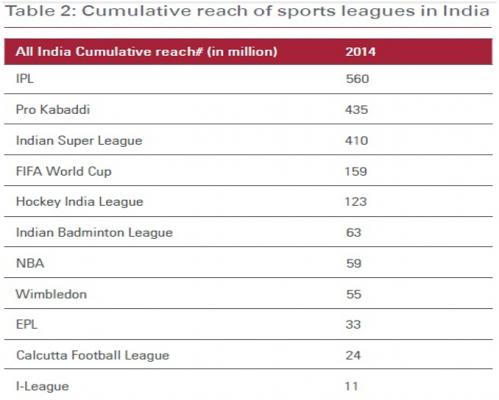
    The leagues system has served as an important way for companies to enter the sports sector. A sports league creates several opportunities for private companies in domains such as league management, franchisee, broadcasting and sports videos production houses, advertising, sports infrastructure such as multipurpose venues, player management, licensing and merchandising. One of India’s most successful leagues in terms of viewership and revenues has been the Indian Premier League (IPL), which is based on the English Premier League (EPL) format. The league was launched in 2008 by the Board of Control for Cricket in India (BCCI) with eight city franchisees. Though it is still small in comparison to some of the biggest leagues of the world, it has been able to achieve success in a short span of time, which other mature leagues could not manage to do. The evolution of IPL as a brand is an example of successful product innovation, which effectively combined entertainment and sports. The Twenty20 (T20) format of IPL has made the sport more popular and convenient to watch for cricket enthusiasts. The success of the IPL, which is estimated to have had a viewership of 191 million people and ad revenue of Rs 8 billion in 2014 has led to the creation of several other league-format sporting events, such as the Indian Badminton League, Hockey India League and the recently launched Pro-Kabaddi League. The inaugural season of football’s Indian Super League has been fairly successful as well. Cumulative reach of Pro Kabaddi League was 435 million compared to 560 million for IPL in 2014. Football’s Indian Super League was close with 410 million cumulative reach. The new domestic sports leagues however require significant management efforts over a period of time to get established and be successful. 

    Viewership refers to sum of weekly GVTs, which is a factor of number of viewers and frequency.

    IPL leads the cumulative reach chart amongst sporting events held in 2014

    Cumulative reach refers to the number of individuals within the target group who viewed the tournament over a certain period of time, including duplication.

    Ecosystem to support sports development in India

    However, in order to sustain the growth in sports and sports-related businesses, a flexible regulatory and policy framework that is able to realise synergies between various segments of sports needs to be developed. This in turn requires the sports ecosystem and its stakeholders to be recognised under the purview of a dedicated industry of sports which can provide impetus to an organised and professional business environment for sports in India.

    Sports Broadcasting in India

    There has been a surge in the number of sporting events broadcast in the past few years. These events include tournaments and leagues played at state, national and international levels. Several international tournaments and leagues played at the regional or global level are now telecast in India bringing in a larger and much diverse audience. Males form around 60 to 65 per cent of viewers and are expected to continue to be the main target segment. However, the number of female viewers has been increasing. About 57 per cent of the viewership of ISL and 53 per cent of the viewership of Pro – Kabaddi League was made up of women and children. Broadcasters are supplementing the sports with other entertaining and informative pieces to make the program more inclusive.

    Getting to the right content mix

    With the rise in number of sporting events, sports channels are covering several sporting events in their annual calendar. It consists of a mix of marquee events from domestic and international leagues, major tournaments along with minor domestic leagues and tournaments.

    Star Sports has revamped itself with uniformly branded eight channels to showcase a variety of domestic and international sports both cricket and non – cricket and in English as well as Hindi. While international cricket matches featuring India will make up 65 per cent of Star Sports 1, Ranji matches, university and women’s cricket and international cricket matches not featuring India will form 50 to 60 per cent of content on Star Sports 2. This will enable Star to nearly double its cricket content, which is the major revenue driver for sports channels in India. Star Sports 4 will feature other sports, which include international football (soccer), European soccer leagues, badminton, tennis and Formula-1 racing.

    The new Indian leagues, which include hockey, badminton and soccer, will be telecast on Star Sports 1 to 3 to reach a larger audience. Such a strategy enables Star Sports to increase its cricket content as well as broadcast non – cricket sports, which are seeing increasing traction. There is also an increasing trend towards multi-sports channels, as the viewership of different sports are increasing and sports channels are vying for TV rights across sports. Star has seen a shift from having a cricket specific channel in its cluster to multi-sports channels. It enables Star to broadcast both international and domestic cricket content simultaneously as well as gives it flexibility to show different sports across different channels. This can be attributed to the large investments made by Star to purchase rights for domestic and international cricket, football, tennis, badminton etc.

    On the other hand, Neo has rebranded its cricket specific Neo Cricket to Neo Prime on account of reduced live cricket properties and surge in volume of several sports.

    Ten however, has sports specific channels with Ten Cricket for cricket, Ten Action for football and Ten Golf for Golf broadcasting. Availability of sufficient single sport media rights and a definite viewership base for that particular sport drives the presence of sports specific channels. This helps advertisers to target a specific audience, for example luxury products have tied up with Ten Golf. Although, digitization and lower costs of distribution make single – sport channels more viable than before, it can take some time to evolve in India and reach the popularity of golf and tennis channels in some developed countries.

    Regional language boost to broadcasting

    Another strategy to target a specific audience is the language of telecast. Hindi and other regional languages increase the audience reach for sports as English has a limited audience. Star Sports 3 replicates Star Sports 1 in Hindi. In 2014, it telecast the domestic football league – Indian Super League in five languages. Its regional TV channels were used to telecast the league in Bengali, Kannada and Malayalam apart from English and Hindi broadcasts. During FIFA World Cup 2014, Bengal accounted for half the country’s viewership mainly because of regional language feed by Multi Screen Media (MSM) on its Bengali general entertainment and film channel Sony Aath. Hindi broadcast of the Pro Kabaddi League on Star Gold also helped take the cumulative reach to 435 million for the event. Other than using regional sister channels for feed in local languages, sports channels may spin off separate regional language sports channels if the demand picks up.

    Revenue and Profitability model

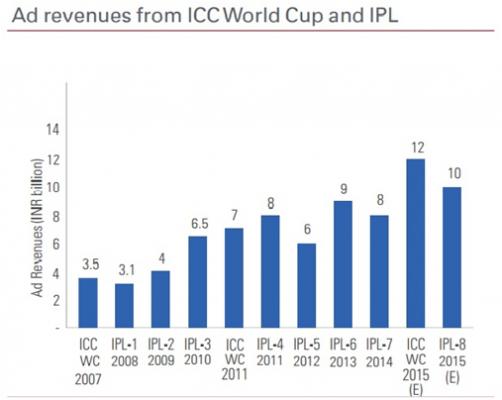
    Sports industry is still an ad driven revenue model. Media spends on sports, most of which is on TV, increased from Rs 11.5 billion to Rs 22.5 billion over 2008 to 2013 at a CAGR of 14 per cent. In mature markets, subscription is the main revenue driver for sports channels, contributing nearly 60 to 90 per cent of the revenues. However in India, advertisements still account for nearly 60 per cent of the revenues of sports channels, mainly driven by cricket, which is the largest revenue spinner and accounts for nearly 80 to 85 per cent of the total television sports media revenue. Non-cricket sports provide live sports content around the year, which gives advertisers a regular touch-point to their target segments. Revenues from advertisements in any year vary depending on the tournaments and series held during the year. Cricket mostly forms the peaks whereas the troughs are being evened out with non–cricket sports and non-live cricket content. In 2011, ad spends on TV for cricket was estimated to have crossed Rs 20 billion. In 2015, ad spends from the ICC World Cup and IPL 8 alone are expected to be around Rs 22 – 25 billion. Ad revenues for non-cricket sports are only a small fraction of cricket revenues. In 2013, ad revenues from Indian Badminton League and Hockey India League were Rs 0.9 billion and Rs 0.7 billion respectively.

    Key challenges facing the spurt of non-cricket leagues in India includes:

    • Poor investor confidence

    For instance the Indian Badminton League (IBL) suffered a loss of Rs 25 crore in the opening season in 2013 owing to investors pulling out casting doubt on the return of IBL with its second season. However, despite no play in 2014, the IBL is set to return in 2015.

    • Lack of industry status

    Provision of industry status could lead to an organized sports industry leading to higher available capital, newer sports businesses, additional revenue streams for stakeholders making leagues commercially viable ventures.

    • Lack of a culture for sports

    Sporting leagues in India are designed to last just a couple months every year. However, many major sporting league seasons in the world last for longer durations every year. Sporting leagues need to become year round (or at least three – four months a year) ventures. Apart from the benefit of a longer engagement with viewers (allowing the building of a larger fan base and culture for the game), this also touts the idea of sport becoming a year round profession furthering the advent of sports businesses.

    Revenue model in leagues

    Major sources of revenue for any league come from media rights, sponsorships and revenue from franchisees. Share of franchisee consideration in IPL has increased from 30 per cent in 2010 -11 to 37 per cent in 2012- 13 with a corresponding decrease in the revenues from sponsorship rights. Income from media rights and other sources have nearly the same share in 2012-13 as in 2010- 11.

    Major Sources of revenue for a League Franchisee

    Major sources of revenue for any league franchisee are share of the central revenues, local revenue and performance revenue.

    • Share of central revenue

    This includes a percentage of the revenue to the league from media rights and central sponsors like Pepsi in the IPL. In India, media rights are a major revenue sources both for the league and the franchisees. Channels are expected to further increase the subscription revenue for sports channels.

    • Local revenue

    Local revenue for a franchise entails revenue from match day ticket sales (gate revenue) and commercial revenue that includes funds from franchise sponsors, merchandise sales and revenue generated from membership with the franchise club if any. However, revenue from franchise sponsors makes for a majority of the commercial revenue. Sports merchandise sales is a fast growing segment with Rs 2 billion in retail sales in 2013. Moreover, contribution of gate revenue to overall revenue of franchises is low due to inexpensive ticket pricing, especially in non-cricket leagues. This is in contrast to leagues abroad where gate revenues are a significant contributor to a franchisee’s revenue.

    How can leagues be further popularised/ monetized?

    Some of the critical success factors of a league in India are identified below:

    • Players

    Involvement of top players of the world creates interest in the viewers and increases the quality of the game. The IPL is a successful example of the same. On the other hand, I-League is struggling to attract top players resulting in poor viewership.

    • Marketing

    An effective marketing campaign is another critical factor in making the league popular. Again, the involvement of various celebrities as brand ambassadors or owners in the IPL contributed to generating larger viewer interest in the league. In fact, the marriage of the Indian entertainment industry and cricket has aided in making IPL a commercial success.

    • Governance framework

     It is seen that leagues, which are run with the support of the approved federation have been able to sustain. The ICL failed due to lack of support from BCCI and World Series Hockey (WSH) is facing similar troubles due to non-recognition of the founding federation as the official national sports federation of hockey itself.

    • Stadium Infrastructure

    Quality of stadium infrastructure improves the viewing experience, hence increases the level of interest in the sport. It is important to create supporting infrastructure like restaurants, bars, fast-food chains, merchandise, stores, books and music stores, etc. to develop stadiums into popular entertainment spots for the family. Hike in ticket prices subsequent to rise in viewership, organizing multiple sporting events and entertainment shows wherever possible can help monetise stadium infrastructure.

    • Fan base

    An effective strategy to increase a franchisee fan base is engagement of respective franchises with local community. This helps generate greater TV viewership, increase attendance of matches and sale of merchandise. Performance of national team or players at international level increases the interest in the game, hence the league.

    League timing

    The tournament should be held at a time when there is no clash with international tournaments that could divert a significant section of the viewers, many players are available and weather is suitable for holding matches. The length of games and timing of matches (conducive for family viewing) are also important factors to consider, both having further helped significant viewership of the IPL. Other factors may include spectator friendly broadcasting such as better viewing angles and broadcasting in Hindi and English.

  • BECIL asked to audit Den Networks’ systems following dispute with Sun Distribution Services

    BECIL asked to audit Den Networks’ systems following dispute with Sun Distribution Services

    NEW DELHI: The Telecom Disputes Settlement and Appellate Tribunal (TDSAT) today directed the Broadcasting Engineering Consultants India Ltd (BECIL) to undertake an audit of the systems of Den Networks following a dispute with Sun Distribution Services.


    TDSAT chairman Aftab Alam and member Kuldip Singh said that KPMG engaged by Sun had undertaken an audit of Den’s head-end in Delhi following an earlier order of the Tribunal, but the report of the auditing agency cast some doubts with regard to the working of Den’s system. 


    The Tribunal therefore said: ‘Without going into the details of that report, we think it would be fit and proper to have an audit of the petitioner’s system made by BECIL as provided under the provison to clause 3.4 of the Telecommunication (Broadcasting & Cable Services) Interconnection (Digital Addressable Cable Television Systems) Regulations 2012. ‘


    The Tribunal also noted that Den ‘undeniably failed to submit any subscribers’ reports whatsoever’ to Sun, with regard to its various channels for the period November 2012 to July 2013. It also noted that Sun’s counsel had said Den was supplying all its channels without any restriction to all the set top boxes seeded by it to its subscribers, the number of which would run into several lakhs.


    After July 2013, the petitioner has been submitting on a monthly basis certain figures relating to the subscribers’ base of the respondent’s different channels, but those too do not conform to the statutory requirements concerning the monthly subscriber management system (SMS) reports, counsel said.


    Listing the matter for 29 August, TDSAT listed the issues that BECIL may examine during its audit:

    – Whether or not the CAS and the SMS systems at the petitioner’s head-end are properly integrated and whether or not, it is possible to verify the SMS figures with reference to the data generated from the CAS system.

    – Whether it is technologically possible to find out the true subscriber base for the different channels of the respondent for the period November 2012 to July 2013 by retrieving the relevant data from the petitioner’s CAS system or by any other means.

    – In case it is not possible to find out the true subscriber base for the different channels of the respondent for the period November 2012 to July 2013 with reference to the data retrievable from CAS, what process BECIL might suggest for arriving at a reasonable estimate of the subscriber base for the respondent’s different channels for the period November 2012 to July 2013?

    – Whether or not it is possible to verify the correctness of the subscribers’ figures supplied by the petitioner to the respondent for the period August 2013 to June 2014 with reference to the data retrievable from the petitioner’s CAS system or by any other means. 

    – In case those figures are not verifiable with reference to the data retrievable from the petitioner’s CAS system, what should be the approach for verifying their correctness?


    Having regard to nature of the controversy, the BECIL is requested to complete the audit and submit its report within two weeks from the date of receipt of the copy of this order.  Needless to say that Den shall accord full cooperation to BECIL in conduct of the audit and shall also bear the entire cost of the audit. 


  • Self-regulation is fine, but there is a need for govt backing: Parida

    Self-regulation is fine, but there is a need for govt backing: Parida

    NEW DELHI: Even as it acknowledges the role of self-regulation in curbing misleading advertisements, the government feels there is a role for powerful execution backed by a government authority.


    Consumer Affairs Ministry joint secretary Manoj Parida said that the Advertising Standards Council of India (ASCI) should have ex-officio members as part of its consumer complaint council meetings.


    At the outset, Parida said an advertisement is one that ‘gives casual leave to human intelligence’. Addressing a round-table on the subject of misleading advertisements organised by the Federation of Indian Chambers of Commerce and Industry (FICCI), he said the biggest problem in India was the low rate of literacy which resulted in the average consumer falling for any promises made through advertisements.


    While he acknowledged the role of the ASCI, he said it was a ‘friendly organisation’ of a few business houses. He said this was why self-regulation had not worked very well. There is a need to create an army of ‘ad monitors’.


    Even the courts have suggested setting up of an inter-ministerial committee for the purpose of checking misleading advertisements, he noted. He said the newly-formed inter-ministerial monitoring committee which is being constituted with the sole aim of monitoring misleading advertisements for protecting consumers could serve as the missing executive arm to ASCI. The committee will monitor misleading advertisement and unfair trade practices and suggest steps accordingly, he added.


    He noted that one major lacuna in the Consumer Act was that it only gave judicial remedy and therefore many consumers did not complain as court processes take much longer and there is no consumer protection agency.


    He also said there was need to put more money into creating consumer awareness.


    Elaborating on the role of ASCI and its future plans, ASCI Chairman Partha Rakshit said the council had been working since 1985. Since the Information and Broadcasting Ministry had given it recognition for hearing complaints, any direction given by it through the ministry’s IMC also applied to non-members. The ASCI worked on the three principles of honesty, decency and fairness.


    It was also incorrect to say that it only worked through friends since its Consumer Complaint Committees (CCC) had members of the civil society as well and the complaints were therefore heard by laymen. There were two CCC meets every week, each having around 14 members.


    In any case, two-thirds of the advertisements that appeared in the media were given out by ASCI members, though he admitted that this may work out to just around ten per cent of the companies in the country. He claimed that there was 85 per cent compliance with ASCI directions. He stressed that ASCI does not always wait for complaints and also takes suo motu action and some ads are suspended even before telecast.


    He said the bulk of countries around the world worked through self-regulation and India was no exception. Its 350 members included advertisers, advertising agencies, media and consultants.


    He said there was need to obtain legal authority for enforcing compliance of ASCI decisions by the print media, since the Cable TV Networks Regulation Act 1995 took care of TV.


    ASCI plans to cover print and social media (in internet) more extensively and Google and Yahoo had already come on board. It is also launching an online training programme on ASCI regulations targeted at young copywriters, agency executives and product managers in manufacturing/service companies.


    Speaking on consumer rights and remedies with regard to misleading advertisements, Germany’s GIZ consumer policy & protection Ruth Anna Buettner said that misleading and unfair practices were a global phenomenon. She added that the purpose of regulation should be proper functioning of markets and protection of individual consumer, mainly his contractual rights. Worldwide there are two ways of enforcement, one via public authority the other via courts, both accompanied by self-regulation institutions.


    Deliberating on the regulatory framework for misleading advertisements, Aazmeen Kasad and Law Practice Consultant owner Aazeen Kasad  said that to keep a vigil on the increasing incidents of misleading advertisements, the Central Consumer Protection Council (CCPC), apex body for consumer protection in India, has recently decided to draft guidelines to safeguard consumer interest from false advertisements in the country and set up a sub-committee to suggest strategies to deal with celebrity endorsements.


    FICCI FMCG Committee chairman & ITC ED Kurush Grant said all stakeholders – the NGOs and consumer forums, industry, self-regulatory body and the government – had unanimously agreed to work towards similar solution of empowering self-regulation. FICCI would work closely with ASCI and the Ministry of Consumer Affairs to tackle the menace caused by misleading advertisements.

  • Sports industry a key to sports development in India: CII-KPMG report

    Sports industry a key to sports development in India: CII-KPMG report

    MUMBAI: KPMG under the aegis of CII released a report titled Business of Sports – Shaping a Successful Innings for the Indian Sports Industry. The report identifies key issues in the sports ecosystem and explores measures to develop a private-investment led sporting scenario in the country – one that helps imbibe a sporting culture and achieve the country’s vision of excellence in sports.


    The report states that resource scarcity in India makes it difficult for the government to attain the above objectives and calls for collaborative efforts of both the government and private sector towards strengthening the sports ecosystem. Long term sustainability of commercial ventures in the Indian sports sector would require sustained audience interest driven by India’s winning performances at international sporting events.


    Sports not only boost the youth and instil pride among citizens, but also facilitate social and economic development of a nation. Sports sector is seen to have a significant socio-economic impact worldwide contributing to 1-5 per cent of national GDP.  This can be achieved by building a sporting culture in the country.


    However, in India sports is not recognised as an industry yet, limiting corporate investments except in cricket and a few other leagues. Being home to various upcoming leagues and the youngest population in the world, India’s sports sector offers tremendous growth potential.


    Ministry of Youth Affairs & Sports Secretary Ajit M Sharan, released the CII – KPMG report at the Scorecard 2014, CII’s National conference on Sports. 


    Earlier CII National Committee on Sports and Group (Asia) president and Coca Cola Company chairman Atul Singh highlighted Industry’s role of ‘going beyond Sponsorships and CSR activity and the need for a policy shift to recognize Sports as an industry’.  He said: “This would help actualise the India@75 vision for broad-basing sports in India, and promote excellence in Sports, by promoting infrastructure development, providing technical support for athletes, as well as grooming talented sportspersons”.


    “Corporate funding in sports may be the answer to ignite sports development in India. The gestation period for realizing return on such investments may be long, but global experience shows us that it could be potentially rewarding”, added KPMG partner in India Jaideep Ghosh.


    Global sports industry is estimated to be worth around $ 600 billion and growing at a rate higher than national gross domestic product rates around the world. While direct sports revenues are dominated by gate collections, sponsorships, media rights, the sports sector may comprise several segments such as sports tourism, sporting equipment manufacturing and retail, sports apparel, recreational sports, high school and college athletics, as well as associated businesses such as sports marketing, sports medicine, venues & infrastructure, hospitality and merchandising.


    Click here for the Key issues and recommendations

  • InMobi study reveals that Indians love mobile phones more than TV

    InMobi study reveals that Indians love mobile phones more than TV

    MUMBAI: The Indian television industry which is pegged at a humongous Rs 37,000 crore (KPMG at India analysis 2012) may have some reason to worry if the latest study by Bangalore based independent mobile advertising network InMobi is to be believed. The study which is part of its – Mobile Media Consumption Report – claims that Indians prefer mobile phones over TV! It covered 2,004 respondents nationally.

    According to this InMobi study, dual or second screening, the phenomenon of users spending time on additional electronic devices while watching TV, continues its upsurge. This implies that the number of hours a consumer spends on his mobile phone is rising rapidly and is also invading his TV viewing space. Take a look at some of the intriguing revelations.

        63 per cent of users now actively spend time on a mobile device while watching TV, compared to 26 per cent in 2012. Now, that is quite a jump.
        57 per cent users engage in social networking while watching TV.
        79 per cent of Indian mobile web users plan to conduct m-commerce in the next 12 months.
        65 per cent of Indian mobile web users are now as comfortable with mobile advertising as they are with TV or online advertising
        80 per cent noticed mobile ads on their smartphone, while a majority of 48 per cent users experience these ads on mobile apps specifically.

    Observing these trends, InMobi vice president & general manager India and south east Asia Phalgun Raju stated: “The tiny mobile phone has overtaken the mighty TV in India from a media consumption perspective. With over 850 million active mobile connections in India, the mobile marketing channel presents marketers an unprecedented opportunity to engage with the always-connected consumers. The onus is now on brands and content agencies to create compelling, engaging mobile rich media to capture consumers‘ attention.”

    The study, developed with Decision Fuel, finds that mobile web users in India are increasingly influenced by mobile, with nearly a third of their media consumption time being spent on mobile devices.

    Raju concludes: “The Indian app market is showing strong growth, as smartphone penetration continues to accelerate with lower and lower price points and mobile consumers turn to apps. Our research shows that on an average 7.1 apps are actively used by Indian consumers over a 30-day period. This has huge implications for both publishers and advertisers as they seek to garner an audience for their offerings and monetise through advertising.”

    Interestingly, most broadcasters are now engaging with their viewers on social networking platforms like Facebook, Twitter, YouTube and have also launched several mobile apps to seek the attention of the ever so easily distracted audience.

  • BroadcastAsia2013 returns with an integrated offering for the Indian broadcast industry

    BroadcastAsia2013 returns with an integrated offering for the Indian broadcast industry

    MUMBAI: BroadcastAsia2013, a media and communications event is set to feature “groundbreaking” technologies, and spotlight hottest industry trends for the broadcast and film value chain. It is to be held at the Marina Bay Sands Singapore from 18 – 21 June.

    The Indian Media and Entertainment industry grew from Rs 728 billion in 2011 to Rs 820 billion in 2012, registering an overall growth of 12.6 per cent. Given the impetus introduced by digitisation, continued growth of regional media, upcoming elections, continued strength in the film sector and fast increasing new media businesses, the industry is estimated to achieve a growth of 11.8 per cent in 2013 to Rs 917 billion. Going forward, the sector is projected to grow at a healthy CAGR of 15.2 per cent to Rs 1,661 billion by 2017, according to the FICCI – KPMG Media & Entertainment 2013 report.

    The report also states that although television will continue to be the dominant segment, strong growth is posted by new media sectors, animation/ VFX and a comeback in the Films and Music sectors on the back of strong content and the benefits of digitisation.

    Film digitisation and TV distribution infrastructure, growth in new media like increase in mobile and wireless connections; greater sophistication of and segmentation in content with digitisation and finally encouraging regulatory and policy support has been a key enabler of growth for the Indian media sector. The continued cable DAS rollout, Phase III licensing for Radio and 4G rollout this year will spur growth from the medium term.

    The report further stated that by 2017, newer media segments such as digital advertising, gaming, animation and visual effects will post double-digit growth. While digital advertising at present accounts for Rs 2,170 billion, it is expected to increase to Rs 87.20 billion by 2017. The Indian film industry is also expected to grow from Rs 112.40 billion to Rs 193 billion by 2017.

    BroadcastAsia2013 registers strong Indian participation.

    Speaking at the press conference held in Mumbai Calvin Koh, who is assistant project director for BroadcastAsia from organiser Singapore Exhibition Services (SES) said, “With the advent of innovative technology and the recent large scale digitisation, Indian broadcasters and consumers are both at a threshold of a technology revolution. As demand grows for advanced technology and content for the dynamic Indian audiences, the industry, like never before, is embracing world class practices and formats. BroadcastAsia2013 is an ideal platform for the Indian players to partner with world leaders as well as reach out to clients beyond India.”

    The Indian companies exhibiting at BroadcastAsia2013 include Further Broadcast Automation Systems, Canara Lighting Industries, Diversified Communications India, Essel Shyam Communication, Indiasign, Rudraksha Technology and WASP3D.

    Indian experts including Zeel business head – new media Vishal Malhotra and Shemaroo Entertainment director, owner Jai Maroo will be part of a panel at the BroadcastAsia2013 International Conference.

    With the rise of Smart TVs and the blurring of the boundaries between TV and social networks, consumers will be watching TV within social networks and vice versa, impacting the way they engage with TV. BroadcastAsia2013 will be addressing this latest phenomenon with showcases from leading industry bigwigs, as well as up-to-date conference topics, such as 4K TV, OTT, Multi-Screen Streaming, DVB-T2, Satellite/Terrestrial/Cable Broadcasting, Production and Post-Production Software.

    New and returning top-notch exhibitors, including Axon, Dalet, Canon, Envivo, Evertz, Ericsson TV, GoPro, GrassValley, Harmonic, Harris, Hitachi, Ikegami, Miranda, Orad, Panasonic, PCCW, Playbox Technology, Quantel, Sennheiser, Snell, Sony, Quantel, Wasp3D, Yamaha will demonstrate their competencies in: future tv / ott / cloud broadcasting, multi-platform broadcasting, satellite / terrestrial / cable broadcasting, digital media asset management / file-based production, DVB-T2, digital tv / hbbtv / hdtv / internettv, broadcast automation, infrastructure and facilities, production / post production software, content editing / colouring restoration, pro audio technology, video content delivery network, broadcast it networking and security.

    To complete the entire value chain, ProfessionalAudioTechnology2013 will see professional audio companies showcasing the latest audio products and services for the broadcasting and film ecosystem.

    The highly anticipated Cinematography/Film/Production Zone will once again return this year to provide visitors with comprehensive updates on featured technologies such as Animation and Video Effects, Motion and Film Production, Camera, Lenses and Tripods and beyond.

    As Asia‘s film and TV industry continues to flourish, the BroadcastAsia2013 International Conference progresses to the next level with four new tracks, four specialised sessions and for the first time, a half day workshop. This will focus on the shift in consumer demand for high quality content on-the-go, on multiple platforms and the emerging business opportunities for OTT in Asia. More than 100 speakers from 31 countries/regions will lead the numerous discussions over four days.

    Some of the key confirmed speakers include Peter Hutton (managing director of ESPN Star Sports), Dato Amrin Awaluddin (group managing director of Media Prima Berhad), Graham Kill (CEO of Irdeto), Kurt Hoppe (director of Smart TV Innovation of LG Electronics), Benjamin Grubbs (APAC head of partner marketing of YouTube) and Jay Fulcher (CEO of Ooyala).

    The Creative Content Production Conference, back for its fourth successful year, is themed “Producing and Distributing Successful Content in Asia.” The conference will address the challenge of producing appealing and high-quality content for global audiences. Numerous industry stalwarts – AETN All Asia Network, Fox International Channels, Lucas film Singapore, Sony Pictures Television and Viacom International Media Networks will provide their insights on the future of the industry at the two-day conference. A series of new topics and speakers including a ‘Producers Dialogue‘ have been developed to serve as additional forums for participants to address and anticipate the upcoming trends and demands of the industry.

    CommunicAsia2013 and EnterpriseIT2013, held alongside BroadcastAsia2013 at the Marina Bay Sands, will feature a complete range of key technologies, such as cloud computing, enterprise mobility, mobile broadband and applications, developments in LTE/4G as well as Over-the-Top (OTT) and more. EnterpriseIT2013 will also highlight the latest technology solutions for enterprises from different vertical industries such as banking and finance, education, government, healthcare, hospitality, and logistics and transportation.

    The last edition of BroadcastAsia, together with CommunicAsia, attracted close to 2,000 exhibitors and over 50,000 professional attendees from around the globe.