Tag: Kotak Mahindra Bank

  • Women entrepreneurs driving change in a so-called men’s world

    Women entrepreneurs driving change in a so-called men’s world

    Mumbai: Women entrepreneurs are accelerating India’s business growth story. Ventures led by women entrepreneurs are expected to grow by 90 per cent in the next five years. But will this translate into a better and more inclusive corporate world led by women?  What will it take to build a more enabling work culture? Will the change be achieved in isolation from society or will it require a complete shift in mindsets? Who will drive this change – men or women? What support systems do women need, beginning with managing their personal lives and challenges, to sponsors and mentors at work to opt for and then stay in top roles?

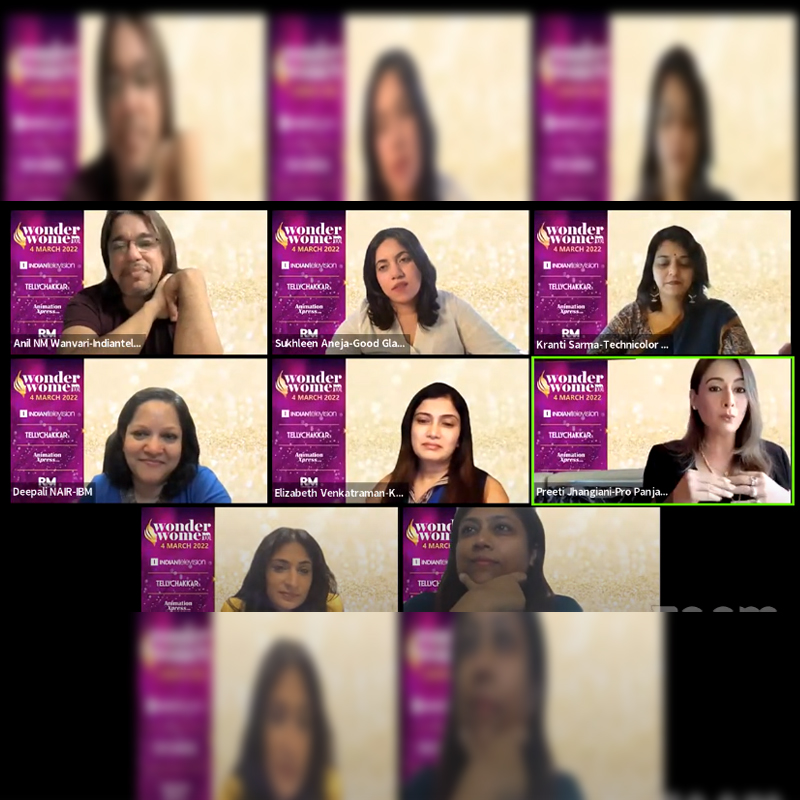
    All this and more, was discussed at the roundtable organised during Wonder Women 2022 conference to explore the possibility of women entrepreneurs driving the next wave of business and economic growth in India. A day-long virtual event was organised by IndianTelevision.com on 4 March to recognise and honour remarkable women leaders, entrepreneurs and change-makers for their outstanding contributions in the arena of media, entertainment and marketing industries.

    The panel comprising Anika Parashar (The Woman’s Company founder and CEO), Sukhleen Aneja (Good Glamm Group’s CEO of beauty and FMCG brands division), Deepali Naair (IBM director – digital sales, India & ASEANZK digital sales centre, Bangalore ), Elizabeth Venkatraman (Kotak Mahindra Bank joint president – consumer, commercial and wealth marketing), Kranti Sarma (Technicolor Creative Studio India head of studio), Neha Kant (Clovia founder and director) and Preeti Jhangiani (actress, model and Pro Panja League’s founder-director) was moderated by IndianTelevision.com founder, CEO and editor-in-chief Anil NM Wanvari.

    Answering the big question, Technicolor’s Kranti Sarma and IBM’s Naair put forward a positive viewpoint, but with a hint of realism. Sharing her experience at Technicolor, Sarma stated, “There are huge opportunities in the creative space right now, but for some reason, women are not coming forward to take them up; the small percentage who do, do not stay. There has been a lack of self-motivated and self-driven women in the field. This is why we have taken to a women-oriented hiring policy.”

    Quoting studies that showed more women leaving the workforce than men, and the pipeline of women who will move into senior leadership roles getting shorter, IBM’s Deepali Naair said, “The real challenge to bringing about inclusion is in building a gender-agnostic society. In the last few years there has been this narrative for women by women, but the larger part of the corporate world is run by men. It is they who need to be convinced to get involved as sponsors and angels etc.”

    Talking of plausible solutions she added, “Moving towards a gig economy in terms of how you solve for people coming and working for gigs, how you pay them, how does that unit economics work, will create a truly inclusive future for both men and women.”

    The speakers unanimously agreed on the need for a more holistic societal and cultural change to encourage women to follow their dreams and passion. The collaborative effort, they said, will involve everyone, beginning with the parents and teachers to mentors and bosses.

    “Education is key for women to understand, acknowledge and appreciate their rights. That’s where the journey begins. Moving ahead, big companies will have to drive the change by creating a culture of diversity where women feel more comfortable in bringing their perspective to the table,” said Preeti Jhangiani of Pro Panja League.

    Good Glamm Group’s Aneja insisted on the need for more positive stories being told by women about their sponsors, as well as people and processes that aided their professional journeys. “The involvement of men in this initiative is extremely important simply because they are the majority. We need more positive stories about them, and how they encouraged women to come forward. How they managed expectations, priorities and careers to enable a flexible workplace environment.”

    For Elizabeth Venkatraman, financial independence is the most crucial requirement for women empowerment. “While a lot of glass ceilings are being broken, bringing more and more women into formal financial services is the sign of true independence, which is something we are working towards,” she said

    Adding on to the point, Clovia’s Kant remarked, “The society has skewed us to think it’s okay to not be financially independent; to take the backseat and allow the men to lead. This needs to change. As parents we will all have to be careful of the cues we pass on to the children.”

    Anika Parashar, whose professional journey has been all about supporting women through her entrepreneurial ventures, noted, “Today, women in India and around the world are taking strides in business. While there were many who dropped out in absence of support, there are also several examples where help has come in various forms – as sponsors, angels, evangelists who believed in them. Women need to stop apologising and speak with pride.”
  • ‘Enormous opportunity’: Brands upbeat about TV advertising in 2021

    ‘Enormous opportunity’: Brands upbeat about TV advertising in 2021

    MUMBAI: It would be safe to conclude from the BARC TV Universe 2020 figures that television remains our favourite form of video entertainment across India. The report, which showed that the number of TV viewers had gone up by more than 50 million to 892 million in the last couple of years, highlights how the power of television and consequently, television advertising remains steadfast and there’s nothing to halt its run! Little wonder then that advertisers are ready to bet big bucks on this old-fashioned medium. As these growing numbers prove, the ‘idiot box’ has proven remarkably resilient in an era of immense disruption, despite the threat of pandemic and emergence of new SVoD platforms.

    At the virtual panel discussion The Television Boardroom- organised by Indiantelevision.com Friday, brands across sectors ranging from F&B to automobiles spoke about the whys and hows of TV still taking the biggest slice of the advertising pie. The panel, moderated by Indiantelevision.com's Anil Wanvari  comprised Kotak Mahindra Bank’s Elizabeth Venkataraman, PepsiCo India’s Om Jha, id Fresh Food’s Rahul Gandhi, ITC’s Sanjay Singal and Maruti Suzuki India’s Shashank Srivastava. 

    Brands buoyant about 2021

    While the uncertainty and turmoil caused by the pandemic leading to a virtual halt of film and television shoots in the country was a dampener, marketers remained optimistic about prospects of advertising on television, especially as compared to 2020. The panel tried to explore the mindsets of the TV-viewing consumers and also shared what their expectations from the medium are.

    Kotak’s Venkataraman made note of the unusual consumer viewing behaviour in the year gone by, which needed to be watched carefully to learn whether it sustains going ahead, as we come out of the pandemic. So while all agreed that TV viewership will be higher than 2019, there was a doubt on whether the levels that we see now would continue going ahead, with lockdowns being phased out and work and life calling.

    Srivastava shared his data on projections for TV ad spend in 2021 which are 12 to 13 percent higher than previous year’s. Overall hope and optimism from this year was that it will not be an out and out disruptive year like the year before. With expectations from vaccination drives and/ or herd immunity impact, the world is expected to settle in by mid-2022. Consequently, both viewership and marketer’s spending should improve this year on, was the general opinion.

    Role of branded content & impactful advertising

    Discussions also revolved around the roles branded content and impactful advertising can play in upping the television adex game. ITC’s Singhal spoke about its tie-up with Star during the pandemic called ITC Masterchef, which had insights from five star hotel chefs on how to cook up five-star-like fare, using ingredients already available in one’s kitchen. This got a lot of mileage, so there is definitely a space for branded content, but the need has to be there first, or it could fall flat, he felt.

    TV advertising consists of very short formats of 30-odd-seconds slots, hence to convey a larger picture of what the brand wants to talk about, branded content could help weave a brand story within the content very subtly so that the brand appears organically to the viewer. Brand integration can make it more relatable, without making it look like marketing -oriented.

    Brand association, integration and branded content gives one extra arsenal to marketers to push your product and gain brand recall, while telling the story of the brand, Srivastava said.

    However, contextual or relevance value along with understanding consumer’s needs is crucial for branded content to succeed. So, while TV offers the opportunity, for a brand to make it work is the challenge. That fear needs to be addressed for investment to come in this area. The impact also needs to be felt in numbers for it to be feasible.

    TV stands out for marketers with its impact and reach, and with third party organisations like BARC doing the measurement for the brand on TV modelling analytical capability on television has evolved to a different level. All the impactful advertising in IPL is a case in point – brands associated with IPL 2020 have become household names. Srivastava cited the IPL viewership touching a high of 400 billion viewing minutes in 2020. “There is no debate on the glory and size of TV advertising’s impact” stated Kotak’s Elizabeth.

    Alongside hard data it is also heavily intuitive, while being dependent on the brand objective. Hence there is also a role for a marketer’s gut instinct alongside the measurable impact was agreed overall.

    On looking at sports content beyond cricket

    Nothing beats or even comes close to cricket when it comes to sports in India is unanimously accepted. For television or brands to pick a sport and develop it, the nation must first adopt that sport, opined Jha. He cited instances to prove his point. Sony has been broadcasting football leagues for ages, while Star did a fantastic job with pro-kabaddi but the viewership is nowhere comparable to that of cricket.

    Panelists concurred that brands have been shy of investing in other sports for the same reason, unless it’s a niche region. There were hopes from Football and Kabaddi in this context. Maruti Suzuki is eyeing football as the next massy sport to look forward to in TV advertising, Srivastava shared. Venkataraman deemed Kabaddi as a local sport and also showed promise. There was a feeling that building up hype and hoopla around a sport league could help the sport, as transpired with kabaddi.

    All said and done, TV remains the best pick for a marketer today in India for ROI. And while it may not always be cheap, it is cost efficient for the kind of scale and resilience that the medium offers.

    Also, with television reinventing itself by evolving into smart TVs, which can be connected to the home Wi-Fi or an Amazon firestick, it will continue to remain relevant to consumers and the viewership can only grow from here. And with 90 million households yet to own a TV set in India, according to BARC data, that indicates enormous opportunity for brands in times to come.

  • Why TV remains the preferred mode of advertising for brands

    Why TV remains the preferred mode of advertising for brands

    MUMBAI: Cord-cutting may be a thing in the west, but in India, television still rules the roost when it comes to at-home entertainment. Consequently, there’s a tremendous amount of money spent on TV content and advertising on the medium. However, the Covid2019 pandemic altered this TV-centric state of affairs; now, with changing world scenarios and consumer behaviour, we have already seen and can expect further shifts in the way viewers and advertisers interact with content on TV. 

    Indiantelevision.com organised The Television Boardroom- a virtual panel discussion that explored how to fully understand TV audiences as well as the brand journey through TV today.

    The panel comprised esteemed representatives from the industry – Kotak Mahindra Bank joint president-consumer, commercial & wealth marketing Elizabeth Venkataraman, PepsiCo India head media and partnerships Om Jha, id Fresh Food chief marketing officer Rahul Gandhi, ITC chief operating officer- dairy and beverages Sanjay Singal, Maruti Suzuki India executive director – marketing and sales Shashank Srivastava and Indiantelevision.com's founder, CEO and editor-in-chief Anil Wanvari presided over the session.

    Why TV takes biggest slice of brands’ adex pie

    Maruti Suzuki’s Srivastava took the discussion ahead, sharing the company’s advertising spend – the auto-maker blows 40 per cent of its budget majorly on print, television is a close second at 30 percent and digital is at 25 per cent with the balance being split by radio, OOH and cinema.

    “We are using TV at the top end of the funnel for the reach, brand awareness and brand salience KPIs. Clearly television stands out as a huge medium of importance when it comes to these points,” he added.

    The executive director also shared how the growth in TV audience has been all-encompassing – not just in rural but also urban regions. Citing the example of how e-commerce giant Amazon was the third largest spender in advertising on TV in 2017-18 in India, he asserted that India is proving to be different from other countries when it came to the reach of television.

    Id’s Rahul Gandhi spoke about how the rhetoric question of ‘Who even watches TV?’ should be done away with because “out of the 133-crore people in India a sizeable 100 crore use TV as their primary source of entertainment still”. Thus, “there are many Indias within India with different indicators, which could come as a shock to the naysayers.”

    Also, with television reinventing itself by evolving into Smart TVs, which can be connected to the home wifi or an amazon firestick, it will continue to remain relevant to consumers and the viewership can only grow from here, was Gandhi’s opinion.

    Pepsi’s Jha agreed that “TV remains indispensable to not only consumers but also to marketers” who wish to leverage their brand’s advertising. A large part of marketing that happens in India is centred around TV, for most of the brands and product categories. Speaking about the soft drink brand, Jha said they cater to both spectrums of consumers- from the lowest socio-economic strata to the deepest pockets of our society. And television helps them to reach the last mile of this wide-ranging audience from the two ends of the spectrum. Hence the bulk of the beverage company’s spends would remain in television, he said.

    Where would a brand prefer to advertise on TV

    Recently released BARC stats have shown an upward mobility in TV viewing. The panel theorised that the pandemic seems to have increased the value consciousness of the average Indian. Jha pointed out that “if one had to communicate with 90 per cent of the audience in this country” you will have to go to a mass-heavy medium like television. And that this will only further improve with improving affluence of societies in lower GDP markets like Jharkhand, Bihar and Orissa – which presents a great opportunity for brands like Pepsi for which these are untapped markets.

    Even when it came to high value items like automobiles, Srivastava said that they still prefer television for more strategic brand building, launch and reaching even the interior vernacular regions, while print would be for tactical and lower end of the funnel. All agreed that these stats are highly encouraging, even for high value products. As, not only have the numbers but also the viewing time has spiked.

    “Which is a big vindication of the automaker’s investment of 300 crores currently in television- of which GEC takes up 100-120 crores,” Shashank shared, referring to the IPL viewership touching a high of 400 billion viewing minutes.

    Kotak’s Venkataraman made note of the unusual consumer viewing behaviour in the year gone by, which needed to be watched carefully to learn whether it sustains going ahead, as we come out of the pandemic. So while all agreed, TV viewership will be higher than 2019, but it will probably not remain at the levels that we see now.

    Perspective on TV advertising in 2021

    The jury is out on how many more covid waves the world has to contend with, before it can settle back into pre-Covid “normalcy”. It is apparent we need to learn to manage the waves, while learning to live with it without letting economic activity come to a complete standstill.

    The outlook for 2021 is more optimistic, that it will be more like 2019 rather than the previous year. Herd immunity or vaccination impact also bodes well for settling in by mid-2022. So both viewership and marketer’s spending should improve this year on, was the general opinion.

    “Projections for spending on TV adverts this year is 12 to 13 percent higher than previously,” Srivastava shared. There was overall hope and optimism from 2021 that it will not be an out and out disruptive year like the year before.

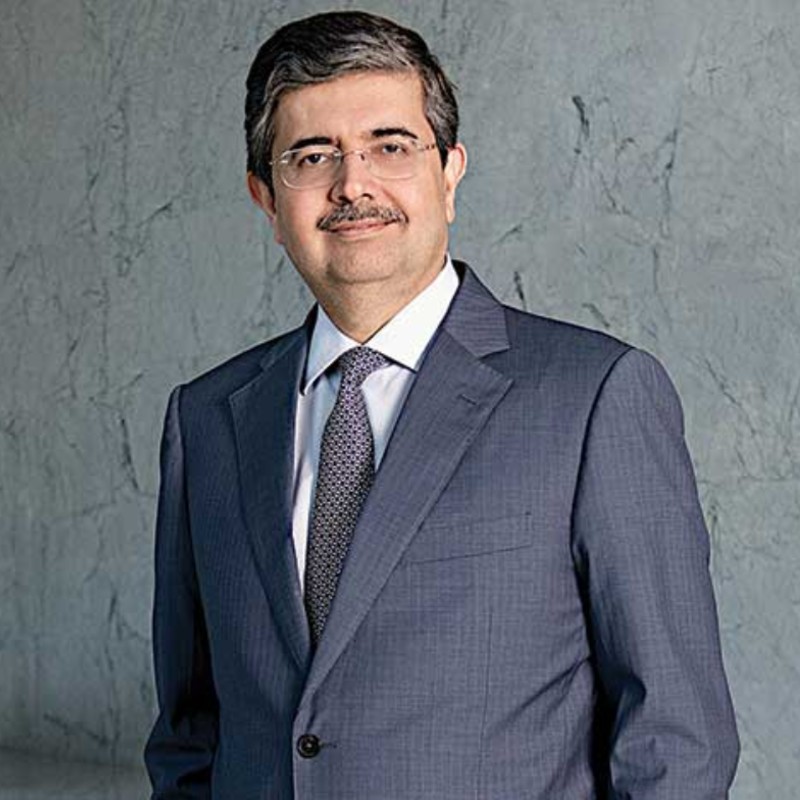
  • RBI approves re-appointment of Uday Kotak as MD & CEO of Kotak Mahindra Bank

    RBI approves re-appointment of Uday Kotak as MD & CEO of Kotak Mahindra Bank

    New Delhi: The Reserve Bank of India has approved the re-appointment of Uday Kotak as the managing director and chief executive officer of Kotak Mahindra Bank for a period of three years with effect from 1 January 2021, according to a filing.

    Kotak is the founder managing director and promoter of the bank and has already served as the head of Kotak Mahindra Bank for the past 17 years.

    RBI also granted approval for reappointing Prakash Apte as part –time chairman and Dipak Gupta as joint managing director for a period of three years with effect from January 2021.


  • Colors Tamil’s ‘Kodeeswari’ ropes in Colgate as presenting sponsor

    Colors Tamil’s ‘Kodeeswari’ ropes in Colgate as presenting sponsor

    MUMBAI: Viacom18’s Tamil general entertainment channel, Colors Tamil is all set to launch Kodeeswari starting 23 December. The show adapts the popular television game format of Who Wants To Be A Millionaire to have only female contestants with the aim of empowering women from all walks of life, and give wings to small dreams. The show has bagged Colgate as the presenting sponsor, with overall seven sponsor in their bucket. On the video-on-demand platform VOOT, the show has roped in Medlife as the online pharmacy partner while Nippon Paint has come on board as the co- powered by sponsor.

    Last week the channel has announced six sponsors coming on board of Kodeeswari- Nippon Paint, Arun Excello and RIN as powered by sponsors; Kotak Mahindra Bank as the banking partner; and Tamil Matrimony App and Helo App as special partners.

    The show will be hosted by the iconic superstar of Tamil Cinema, Radikaa Sarathkumar and in a first ever, there will be only women on the Hot Seat. Even before the launch, the show has witnessed a lot of attention from brands across categories.

    Viacom18  network sales head Mahesh Shetty says, “Who Wants To Be A Millionaire has been a trailblazer on television and has been loved by audiences across the world and in India. Being the first ever all-women edition, our endeavour through this show is to encourage strong willed women to challenge stereotypes and live their dreams. Kodeeswari has garnered a lot of attention and interest even before its launch, not only among viewers but also brands. The purpose of this show is so focused and powerful that we have a plethora of brands which have jumped on board across platforms. We have roped in seven sponsors for the show on Colors Tamil. For VOOT, the show has caught the attention of brands with two sponsors. We have also secured five sponsors for our international feed which will take this show to Tamil audiences in Singapore, Malaysia and USA.”

    VOOT will keep its digital viewers attuned with  various opportunities to Watch, Play Along and Win every day! With interactive offerings such as Play Along on VOOT , presented by Medlife, the users can enjoy the thrill of the game show by participating and simultaneously matching their power of knowledge with the contestants on the hot seat, and win prizes every day. Furthermore, viewers will get a chance to win Ghar Baithe Jeeto Jackpot, sponsored by Nippon Paint.  The viewers will have to log on to VOOT to answer the question and the first person to answer will be chosen as the winner.

    For its international feed, Colors Tamil has roped in Sivanesan Company (Premier Range of Products) as the Title sponsor, while the show is being powered by Gits (Gits Foods). In addition to this, Tamil Nadu Tourism- Enchanting Tamil Nadu and GMT (GMT Jewellers) have come on board as Special Partners while Gooday Beauty Parlour has been roped in as the Grooming Partner.

    Kodeeswari will go on-air starting 23 December at 8 pm from Monday-Friday on Colors Tamil and Viacom18’s video-on-demand platform VOOT.

  • Kotak Mahindra Bank launches campaign with Ranveer Singh for 811 account

    Kotak Mahindra Bank launches campaign with Ranveer Singh for 811 account

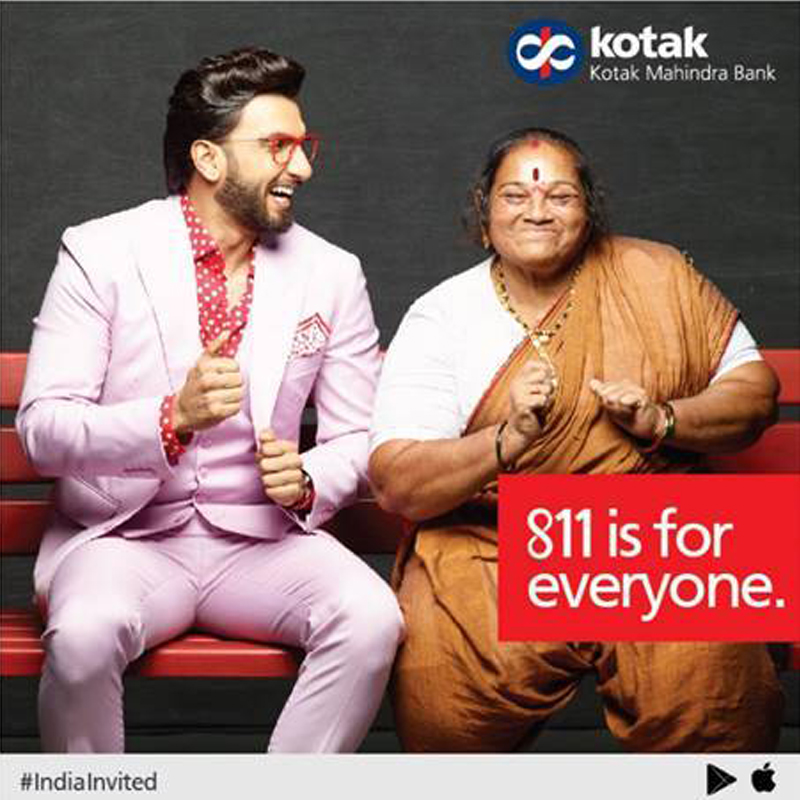
    MUMBAI: Kotak Mahindra Bank has launched its 811 campaign – #IndiaInvited. The campaign features Bollywood actor Ranveer Singh along with people from all walks of life, across age, gender, profession, religion, physical appearance, including an acid attack survivor, among others.

    Collaborative efforts over the years by the Reserve Bank of India (RBI), the Government’s Pradhan Mantri Jan-Dhan Yojana (PMJDY) and banks have immensely contributed in improving financial inclusion in every nook and corner of the country. However, even today, only around 2 per cent of Indians own a mobile money account, as per the World Bank, leading to low engagement with the formal financial ecosystem. The need of the hour is to bring about a change in mindset to make banking digitally inclusive, so that banking services are made accessible to every Indian.

    811 is an anywhere, anytime digital bank account and much more. It is a one-of-its-kind truly inclusive account. The only requirement for opening an 811 digital bank account is being an Indian, which is the underlying message of the #IndiaInvited campaign.

    The 811 campaign is shot at the iconic Chhatrapati Shivaji Maharaj, a UNESCO world heritage site located at Fort, Mumbai, to capture real life nuances. The protagonist of the story is ‘the bench at the railway station’ and Ranveer Singh dons the role of the bard (Sutradhar). The story voices similarities between 811 and a bench at a railway station. Anyone and everyone – irrespective of caste, creed, religion and abilities, are welcome to rest and take a breather at any bench at any railway station in India. Similarly, 811 offers unconditional access to a full-service, zero-balance digital bank account which gives up to 6 per cent p.a interest to every Indian.

    Kotak Mahindra Group chief marketing officer Karthi Marshan says, “ With 811, we simplified banking in India and in a year since launch, 811 has been embraced by Indians. In our endeavour to make banking more accessible and widespread, we realised that people from different walks of life tend to get intimidated to walk into a branch for the fear of being judged. The #IndiaInvited campaign builds on this insight, and draws attention to how 811, just like a bench at the railway station, does not discriminate against anyone on the basis of personal or physical characteristics.”

    Kotak Mahindra Bank executive vice president of marketing Elizabeth Venkataraman mentions, “Inclusion is not only the right thing to do, it is also necessary for a country as diverse as India. Digital is a great equaliser, especially in banking, providing equal access to everyone. And 811 represents those very qualities of equality and inclusiveness. 811 is truly for everyone.”

    “We wanted someone who embodies the spirit of individuality and success while being comfortable in their own skin to be the face of the campaign. And who better to lead the campaign than Ranveer Singh, an actor who has made a mark with his unique and unconventional style and appearance, someone who has succeeded in Bollywood on his own terms”, adds Marshan.

    The campaign will be amplified across all platforms including TV, print, outdoor, digital and through on-ground engagements across the country.

  • BFSI’s changing communication in the digital era

    BFSI’s changing communication in the digital era

    MUMBAI: BFSI equals boring. That is usually what people think about anything to do with banking, financial services and insurance (BFSI). You may have witnessed how their ads tend to be dull and monotonous. But, lately, the BFSI companies have been the forerunners in the digital revolution and the drab tones have given way to smarter messaging.

    The sector comprises of commercial banks, insurance companies, non-banking financial companies, cooperatives, pensions funds, mutual funds and other smaller financial entities. This industry’s clear shift toward digitisation and virtualisation of communication, despite the highly regulated market, is transforming the banking experience for consumers and representatives. BFSI sector was one of the earliest entrants to leverage digital medium to connect with consumers by proving online banking and insurance facilities.

    IDBI BANK true friendship ad:

    The BFSI sector has seen a shift in behaviour and communication plays a part in both capturing and supporting the change. Over the years, as digital caught pace, BFSI companies have tried to leverage it differently from offline. At the forefront was building communication and conversations that speak to the attitudes and trends of online consumers. Moreover, digital also allows the sector to have direct contact with the consumer in a controlled and transparent way, which the traditional model limits.

    BankBazaar #GoPaperless ad:

    Lately, the sector has experimented with creative and innovative ads through good storytelling rather than just promoting the product, which was the case earlier. Businesses are opening their eyes to the value of using video for their marketing and communications. This involves breaking down information into easily digestible sound-bites and not having customers pour over hundreds of words to understand the technical aspects of the products/services they are purchasing. Kotak Mahindra Bank even came up with India’s first downloadable bank account – 811, which has made opening a fully functional bank account a matter of 5 minutes or less.

    The tough task for BFSI is to make a low-involvement area a very attractive one for customers. Kotak Mahindra Bank executive vice president Elizabeth Venkatraman points out, “The effectiveness of the communication depends on the apt choice of media. Marketers have been closely observing the changing customer segments and their behaviour, and have been trying to create distinctive ideas, each time.

    #LaterMaybeLate – Kotak Life Insurance ad:

    With fin-tech startups like BankBazaar.com and paisabazaar.com trying to change the market, customers can get instant loan or policy online without having to step out of the house.

    Today, banks and insurance companies are ardent social media users to communicate to customers about their offerings like credit card offers, life insurance policies or home loans. While Aegon Life Insurance spends more than 90 per cent of its brand money on digital media, Kotak Mahindra and IDBI Federal Life Insurance shell out 40-50 per cent of their advertising budget on digital platforms.

    BFSI ads work best when the communication is two-way, which is restricted on TV. Unlike FMCG, where a brand can mass-target, BFSI needs to focus on individual needs. In-cinema advertising, a favourite spot to pick customers, may soon wither as the spends in this area are already being reallocated to other mediums.

    Aegon Life Insurance chief digital officer Martijn De Jong says, “We tried using in-cinema couple of years back and the medium is not very cost effective compared to other forms. The only advantage is its localised reach.”

    On a similar note, IDBI Federal Life Insurance CMO head product & strategy Karthik Raman believes that in-cinema advertising is not as effective as it was earlier because the cost of advertising has risen but the effect has reduced. Venkatraman points out that though the medium gives quick impact and is less cluttered, the effectiveness still depends on perception as there is no industry metric for measurement.

    Print, a medium that has been around for centuries is starting to lose its sheen among the BFSI sector as the cost per ad is very high, forcing the industry to shift to cost-effective mediums such as OOH (Out Of Home), digital and BTL (Below The Line).

    It is left to see whether BFSI can make it to the top of the memory rank of customers when recollecting their most memorable ads.

  • Kotak Mahindra partners with author Amish’s latest book ‘Scion of Ikshvaku’

    Kotak Mahindra partners with author Amish’s latest book ‘Scion of Ikshvaku’

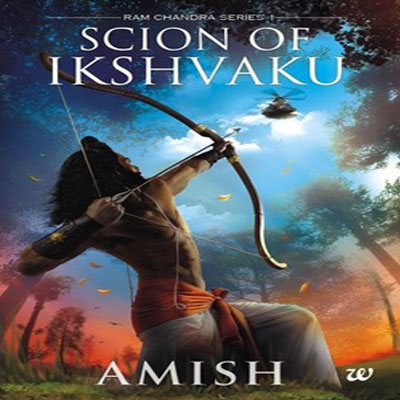
    MUMBAI: Kotak Mahindra Bank (KMB) has partnered with blockbuster author – Amish Tripathi’s latest book Scion of Ikshvaku to launch a special themed debit card.


    The card featuring the cover of Scion of Ikshvaku offers discount on any book purchased at Crossword.


    The Bank also launched ‘Tweet to Order’, where KMB customers registered for Hashtag Banking can order Tripathi’s book via Twitter by simply tweeting #Book Scion 262 @KotakBankLtd. Customers can also order the book from KMB’s website and avail an additional discount.


    KMB is carving out unique set of services for its customers by going beyond the purview of conventional banking. In addition to offering complete retail financial solutions including a variety of savings and loan products and innovative digital solutions, KMB is enabling its customers indulge in passions like books and movies. The success of KMB’s co-branded credit card with PVR Cinemas is testimony to customers’ preference for such lifestyle propositions from the bank.


    Kotak Mahindra Bank president – consumer banking Shanti Ekambaram said, “Movies and books are soul candies. They not only entertain, but have the power to inspire, motivate and uplift. We have India’s most successful co-branded card in partnership with PVR Cinemas, which delivers superior entertainment experiences to our customers.”


    “Our partnership with Amish’s latest book is a step towards enabling our customers to enjoy what they like and thereby, build a stronger connect with them. We want to partner our customers to not only meet their financial goals but also offer myriad lifestyle experiences,” added Ekambaram.


    Kotak Mahindra Bank senior EVP, head – personal assets Sumit Bali stated, “The special themed debit card is a unique addition in our cards portfolio, and a prized possession for any book lover. We will continue offering exclusive propositions in areas of lifestyle and passion, and make banking with us more delightful.”


    Tripathi added, “I am confident that the special themed debit card and Tweet to Order will provide an enriching experience to KMB’s customers. It is indeed a wonderful service for book lovers.”

  • You’ve got trolled: Brands wars unleash on Twitter

    You’ve got trolled: Brands wars unleash on Twitter

    MUMBAI: With the social media explosion, everyone has access to everyone today and freedom of speech has taken on a completely different meaning. Not so long ago, there was no way you and I could tell an Amitabh Bachchan or a Shah Rukh Khan what we thought of their performance in a particular movie. Today, each one of us is a self-proclaimed critic thanks to social media.

    While we’ve witnessed squabbles galore on social media… some big, some small… between celebrities or politicians, now even brands have taken to this medium to poke fun at rivals.

    Surely gone are the days when brand wars happened on television. Twitter has now become the new battlefield for interesting and hilarious episodes of mudslinging between brands.

    Trolling amongst brands is unique and hadn’t been witnessed much in India until recently. Such banter is open in markets like the US and the UK where TV ads show competition brands and demean them or for that matter verbal war on Twitter or on social media. However, the Indian market is slowly warming up to Twitter wars.

    Here’s a look at how some giants picked on and trolled their competitors on Twitter:

    Amazon vs. Zomato

    In April this year Amazon sarcastically picked on Zomato saying, “Zomato loved all the logos you used in the last 6 months. Was #AurDikhao the brief to your designer? :)”

    To which Zomato wittily replied “@amazonIN you should’ve seen the ones that didn’t make the cut ;)” Attached with the tweet was a mock Zomato logo with an arrow pointing from Z to A, clearly mimicking the arrow from A to Z that features in the Amazon logo.

    What’s more other brands like Flatchat and Urban Ladder too joined in it banter, which made for some witty and cheeky reading.

    The repartee between Amazon and Zomato also led to a lot of Twitter interactions among fans and followers of both the brands.

    Snapdeal vs. Flipkart

    India’s e-commerce giants, Snapdeal and Flipkart have also entered into a war of words on Twitter. Following Snapdeal founder Rohit Bansal’s interview with a US publication, the war broke open on Twitter about the talent India has and doesn’t.

    It all began with Rohit, who said that India didn’t have the programmers it needed. To this, Flipkart’s Sachin Bansal reacted by tweeting, “Don’t blame India for your failure to hire great engineers. They join for culture and challenge.”

    The statement was indeed misunderstood by Flipkart. Rohit clarified the attack in a blog post last week where he said that he had been quoted out of context. He clarified that while India has “some of the smartest engineers on the planet,” building large technology product firms is a more recent phenomenon.

    He said Snapdeal would continue to hire technology talent locally and bring on board “some select folks from around the world who have had the experience of building technology at scale.”

    He signed off saying, “An Indian engineer who’s trying to make the country a better place with a rock star team.”

    Asus vs. Apple

    In case you thought that only BlackBerry picked on Apple, think again! This time it’s Asus and how? In an attempt to mock Apple (which is really lame), Asus has picked on Apple’s Mac Book by sticking two pen drives in a real apple.

    Apple’s recently launched new Mac Book has only one USB port, which has restricted users. Asus is trying to strike at the Mac Book’s armour by giving consumer a host of ports ranging from a microphone-in jack to three USB 3.0 ports to card readers in its recently launched Zen book UX305.

    Kotak vs. ICICI Bank

    Not all brands appreciate that competition is healthy. In February this year, Kotak and ICICI Bank picked on each other on Twitter. Kotak Mahindra Bank started the Kotak Jifi saver campaign #hashtagbanking in February. Soon after the launch of the social media banking service, ICICI Bank came up with their #icicibankpay on Twitter.

    Gone are the days when brands used to pick on each other with their television commercials. In modern times like today, Twitter seems to be the platform for brands that are open about criticizing and also appreciating sarcasm. In the end, it all boils down to being a sport and taking bouquets and brickbats from competitors with a pinch of salt and dollops of humour.

    Speaking to Indiantelevision.com about brand wars on Twitter, Ogilvy and Mather executive creative officer Sumanto Chattopadhyay says, “It’s interesting how brands engage in the war of words with each other on social media. In the US it is a common thing as brands openly criticize other brands in their TVCs and otherwise. India is slowly going that way. As a consumer, it is interesting as we enjoy how brands have silly wars. Not only that, Twitter is a medium that is more public and hence gets noticed a lot more than any other media, so it might be to grab more eyeballs as well.”

    An industry veteran tells us on condition of anonymity that it depends on the aggression of the brand as to where to take the war. “Yes, probably Twitter is the new war place,” she adds.

    Opining on the same, Leo Burnett chief creative officer Rajdeepak Das says, “It’s fun to see brands pick on each other in a very healthy manner on Twitter. Earlier it used to happen on television and due to restrictions of the medium, it is now happening on social media.”

    Das further says that because Twitter is a public platform, a large number of engagements happen. Additionally, the medium doesn’t have restrictions. Hence it is fun to see brands pick on each other. Another point is that both brands understand the sarcasm and take it sportingly.

    Shop CJ marketing head Donald Kwag said that with “Twitter wars” breaking out left, right and centre, it’s hard to ignore the growing trend – and lately, more and more brands are joining in on the fun. “Given the time and effort dedicated to defining a brand’s social tone of voice, it makes sense for marketers to use that voice effectively – and one way to do this is to make the most of opportunities to engage other brands across social communities. By capitalizing on borrowed equity – when appropriate – brands will be able to showcase an authentic, playful side and, by doing so, reach entirely new audiences online,” Kwag says.

    There’s a thin line between healthy banter and below the belt slugging. When it comes to brands, reputation, values and perception matters more than anything especially when battle lines are drawn publicly on a free-to-all platform.

    In the end, there’s no love lost as long as they can get away by simply saying, “No hard feelings bro.”

  • Kotak Mahindra Bank gets new head of corporate and investments

    Kotak Mahindra Bank gets new head of corporate and investments

    MUMBAI: TV Raghunath has been appointed as the new head of corporate and investment banking at Kotak Mahindra Bank. His new position will see him focussing on covering the larger corporates in India in an integrated manner, with the help of the current Kotak Investment Banking senior executive director, Chetan Savla, as well as continuing to oversee Kotak Mahindra Capital Company (Kotak Investment Banking).


    Raghunath’s former post as managing director and CEO of Kotak Investment Banking is now taken up by S Ramesh — a veteran in the capital markets with extensive experience in handling marquee transactions, who can be credited with introducing many landmark initiatives in the Indian capital markets.


    In addition, Sourav Mallik has moved up to become the joint managing director of Kotak Investment Banking, while the Equities business will be headed by V. Jayasankar. Pankaj Kalra is expected to play a significant leadership role in coverage and ideation for corporates in the Corporate Advisory Group of the investment bank.


    Investment Banking corporate president KVS Manian said, “As I contemplate the future, I am excited about the significant opportunities that exist for us as a group to build a high-quality corporate franchise. With these organizational changes, I am confident that we are well structured to achieve the next level of growth.”