Tag: Kishore Lulla

  • Eros Media World clears $56 million debt, strengthens financial position

    Eros Media World clears $56 million debt, strengthens financial position

    MUMBAI: Eros Media World PLC (EMWP) just hit a blockbuster financial milestone—becoming debt-free in India. Over the past three years, the global Indian film entertainment powerhouse has successfully repaid its outstanding bank debt, including principal and interest, totalling approximately $56 million at current exchange rates.

    At its annual general meeting on 28 February 2025, the company’s Indian subsidiary, Eros International Media Ltd (EIML), confirmed to shareholders that the full repayment had been completed during Q3 of the 2024-25 fiscal year. This financial feat follows EIML’s successful implementation of its debt resolution plan under the Reserve Bank of India’s “Resolution Framework for COVID-19 Related Stress” circular, introduced on 6 August 2020. Notably, EIML had first announced the implementation of this plan on 22 June 2021, covering an aggregate debt of Rs 468.07 crore at the time.

    This achievement isn’t just about numbers—it’s a game-changer for Eros Media World’s financial stability. With a clean slate, the company now has greater flexibility to invest in its strategic priorities, expand its global footprint, and double down on high-quality content production.

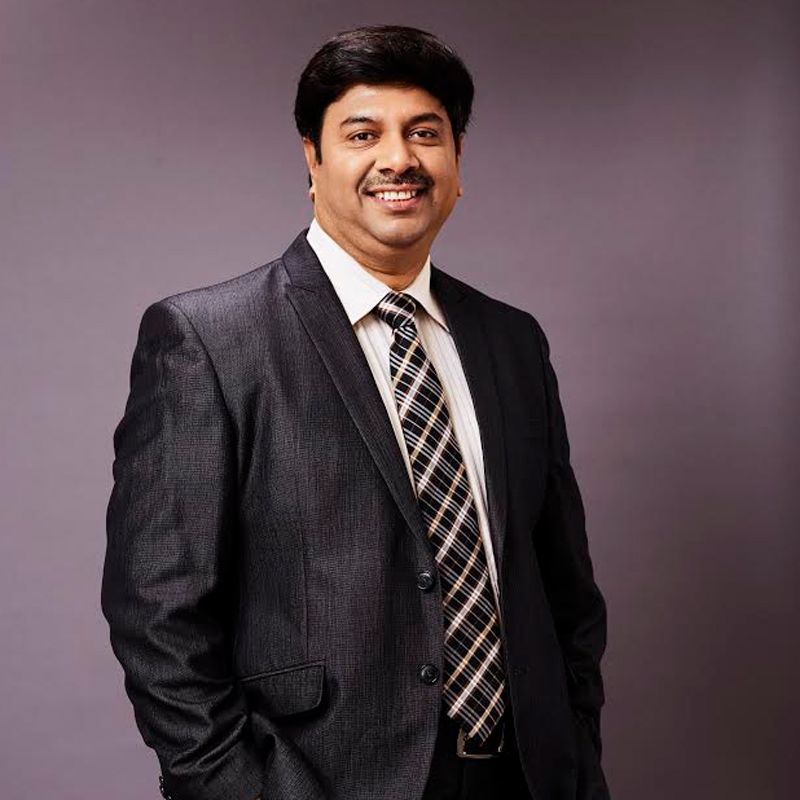
    “With the successful repayment of our bank debt in India, we have significantly strengthened our financial health, reinforcing our long-term commitment to financial discipline. This achievement allows us to focus on growing our entertainment business and unlocking new opportunities for value creation,” said Eros Media World PLC director Kishore Lulla.

    With India’s debt burden off its books, Eros Media World can now channel resources into growth, innovation, and content development. The company remains committed to producing premium entertainment and pushing boundaries in the global entertainment industry.

    As streaming wars heat up and the demand for high-quality content skyrockets, Eros Media World stands well-positioned to leverage its strengthened financial footing for bold new ventures.

  • US SEC closes perusal into Eros Media World with no enforcement action

    US SEC closes perusal into Eros Media World with no enforcement action

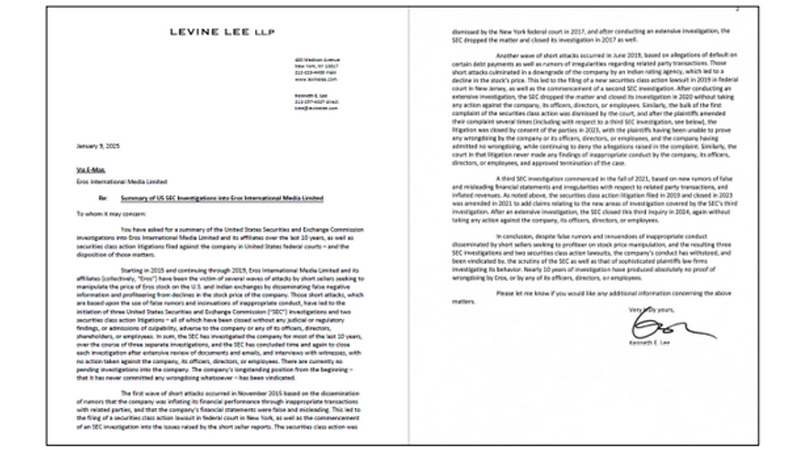
    MUMBAI: Eros Media World plc (EMW) can finally breathe a sigh of relief. Following a thorough internal review and multiple investigations by the United States Securities and Exchange Commission (SEC), the company has emerged unscathed, with the SEC officially closing its inquiry without recommending any enforcement action.

    An internal investigation by EMW’s audit committee concluded that the company’s accounting practices and internal controls were sound. The review found that:

    1    No revenues for the fiscal year ending 31 March 2020, were improperly recognised.

    2    No impairments existed in intangible assets or goodwill as stated in the company’s Form 6-K dated 31 March 2021.

    3    No material weaknesses were identified in internal controls over financial reporting.

    These findings marked a decisive end to allegations of inflated revenues, misleading financial statements, and improper related-party transactions, which had triggered three separate SEC investigations.

    Eros Media World has faced waves of criticism and short attacks from entities like Hindenburg Research, which itself recently announced its closure. However, the conclusion of these investigations without any adverse action underscores EMW’s commitment to transparency and compliance.

    “We are most pleased to have these issues behind us as we look forward to a new future for the company,” said Eros Media World group founder & ED Kishore Lulla.

    Lulla extended gratitude to the company’s legal team for their exceptional representation throughout this challenging period:

    1    Levine Lee LLP, Kenneth E. Lee led litigation and outside counsel.

    2    Cravath, Swaine & Moore LLP, Rachel G. Skaistis SEC counsel.

    3    Cleary Gottlieb Steen & Hamilton LLP Victor Hou.

    With the investigations closed and the company cleared of allegations, EMW is charting a new course for growth and innovation in the media and entertainment space. The closure of these cases allows the company to refocus on its core mission while reinforcing its commitment to ethical practices and transparency.

  • Eros Investments and Xfinite partner with Calvin Cheng to launch XelebX

    Eros Investments and Xfinite partner with Calvin Cheng to launch XelebX

    Mumbai: Eros Investments and Xfinite have partnered with veteran entertainment and tech entrepreneur Calvin Cheng to launch XelebX, a web 3.0 members-only celebrity fan club.

    With the use of NFTs and fan tokens, the alliance will introduce over 200 million existing followers of global influencers and celebrities linked to the Eros ecosystem and its group companies to the new metaverse.

    Only NFT members will be able to access XelebX. They will have access to a number of advantages, such as exclusive access to virtual meet-ups with influencers, exclusive material, virtual backstage passes, and celebrity NFT collectibles.

    Speaking on this partnership, Eros Investments chairman Kishore Lulla said, “Over five decades, Eros has built one of the largest media and entertainment businesses, enthralling millions of fans and launching some of the biggest stars in India. One of the key reasons for our success is our ability to embrace change—from film to TV to the Internet and now web 3.0 and the readiness to lead it from the front. The metaverse and the immersive Internet are the technological tides that will carry us forward for the next 50 years. Eros is committed to being at the forefront of its adoption.”

    Furthermore, XelebX will introduce fan tokens that measure an influencer’s popularity and can be traded on significant exchanges, enabling holders from various fandoms to freely trade and swap value. As a result, influencers and celebrities will be able to work together and expand their fan bases in a manner that is naturally compatible with web 3.0 interoperability and composability. Xfinite’s Mad Influence, a well-known influencer marketing business, has joined XelebX.

    Xfinite CEO Swaneet Singh said, “With Xfinite, Eros has already gained invaluable experience in media built upon virtual assets and the blockchain. XelebX is the next natural innovation to bring the global community of entertainment fans into the metaverse and unlock immersive interaction with the influencers they follow.”

    Calvin Cheng added, “Web 3 is all about community building. Other platforms have tried this in the past. They built the tech but struggled to build the community—the key to web 3’s success. We already have the tech expertise and an amazing community of hundreds of millions of fans. We will now onboard them into the metaverse using the latest digital asset and web 3 technologies.”


  • Eros Investments acquires ENT global, partners with L3COS

    Eros Investments acquires ENT global, partners with L3COS

    Mumbai: Eros Investments on Tuesday announced the acquisition of ENT Global to form a strategic partnership with L3COS for the mass adoption of the web3 creator ecosystem.

    Later this month, L3COS will launch the world’s first ever fiat-on-chain (FoC) with three initial currencies-EUR, GBP, and USD-all of which are fully one-to-one cash backed and safeguarded by central banks.

    FoC will be used for payments and transactions by launch partners AgriDex, the global supply chain marketplace for the agriculture and food industry, and ENT Global, the digital rights management company now owned by Eros Investments.

    Eros Investments said that this partnership with L3COS will pioneer technological disruption of two trillion dollars in the sports and entertainment industry

    The closed-loop native marketplace for celebrities and creators will be live soon, with an initial $500 million of FoC deposits. Every participant transacting on the L3COS platform will have a KYC/AML screened unique and verified digital identity, to enable individuals, businesses, and governments to interact and trade in a safe and regulated way on a global scale. This frictionless trade is facilitated using smart contracts and the currencies of the end user’s choice. Revolutionary FoC technology delivers real-time settlement (real-time gross settlement) of all transactions within the L3COS ecosystem.

    Eros Investments and ENT Global will power the entertainment and sports marketplace with digital rights management in partnership with L3COS. The collaboration allows the companies to collaborate to build the first web-based entertainment ecosystem, allowing creators and fans to interact directly for the purchase, sale, and trading of various digital assets.

    Eros Investments chairman Kishore Lulla said, “As we ready ourselves for this industry evolution, Eros is pleased to be able to create a first-of-its-kind worldwide marketplace that eradicates barriers to entry for consumers transacting on a blockchain ecosystem. With central bank safeguarding, consumers will be able to confidently, for the first time, transact in an entertainment digital marketplace with fiat on chain capability. This is the next stage of evolution in commerce, and we are excited to pioneer disruption with L3COS.”

    “We are extremely excited about our new partnership with Eros Investments and ENT Global to offer our web3 solution for the entertainment and sports industries, which brings together creators, athletes, and entertainers and allows them to develop and trade digital intellectual properties – from event tickets, art, games, and merchandise – directly with their fans worldwide, without any middlemen or risk of fraud,” added L3COS founder Zurab Ashvil.

  • Eros Investments partners with Stability Ai

    Eros Investments partners with Stability Ai

    Mumbai: Eros Investments and Stability Ai announced a strategic partnership to form a joint venture for the South Asian geography.

    Stability Ai is dedicated to designing and implementing solutions in various sectors of life that are accessible to all through collective intelligence and augmented technology.

    Their solutions affect a range of sectors, from entertainment to business, health, and other social initiatives.

    Eros Investments chairman Kishore Lulla said, “Emad and the fabulous team at Stability.ai have developed this visionary technology with the capability of super-computing that is amongst the top 10 in the world. Users now have an opportunity for creative expression at a pace that didn’t exist before.”

    He further added, “We also plan to deploy this technology across Eros Investment’s affiliate company, Eros Now, which has access to a registered community of over 200 million users. In addition to this, there are use cases for the technology across the metaverse and the creator economy for mass adoption. Deep AI technology will be the future of product differentiation, and we are excited to lead this revolution.”

    Eros Investments will use Stability Ai’s “Stable Diffusion” model, which includes open-source image generation, to manifest ideas and dreams as flawless art pieces using words.

    Stability Ai battles the norm set by big tech companies by using this form of image generation to challenge the barriers that prevent people from accessing artificial intelligence and its benefits.

    Eros and Stability are working to bring this technology that was only privileged to a few, to every Indian to reflect their creativity and imagination.

    Eros Investments intends to use this technology for its subsidiary Xfinite, which has access to a 12,000+ movie asset library, to launch generative NFT and make the tool available to creators for self-expression on Mzaalo, Xfinite’s watch to earn blockchain platform.

    Satbility.ai founder & chief executive officer Emad Mostaquesaid, “India is a fascinating digital market with over 600+ million users and immense creative capability across users. Our vision for this technology is to provide the base layer to the sectors of entertainment, education, healthcare and others and to allow for innovation by the users and peers from business. Eros is the perfect partner for this technology as premium experiences at mass adoption and innovation is core to their ethos of the group. This partnership will help transform not only how we deliver personalization to consumers but also re-orient our lifestyle between the offline and online world.”

    Deep Ai technology and its applications extend far beyond the realm of entertainment, and this joint venture will concentrate on three key areas of collaboration with industry sectors and other partners.

    Generative Meta-Humans: This technology’s evolution is suited to developing 3D rendering of individual avatars, with use cases in immersive AR/VR content, gaming, and the Metaverse. This collaboration will enable the creation of fictional content as well as dynamic individual identities on a daily basis.

    Education: This sector will be a stepping stone in the transformation, with each child learning at their own pace in the language of their choice. For progressive learning at scale, the AI model will allow each student to customise content based on their adoption of the materials.

    Healthcare: This AI model will be tailored to each individual, allowing them to identify their current health vitals, methods for improvement, and track them on a regular basis.

  • Eros Media to raise fund, board approves issue of 22.5 crore equity shares

    Eros Media to raise fund, board approves issue of 22.5 crore equity shares

    Mumbai: Eros International Media has announced its plans to raise funds, a change directorate and management on Thursday. Kishore Lulla resigned as the executive director of the company.

    The company’s board of directors approved an increase in the authorised share capital of the company from Rs 125 crore divided into 12.5 crore equity shares of Rs 10 each to Rs 350 crore divided into 35 crore equity shares of Rs 10 each by creation of additional 22.5 crore equity shares of face value of Rs 10 each ranking pari passu (same rate) in all respects with the existing equity shares of the company.  

    The board also approved the issue of up to Rs 13.5 crore convertible warrants for Rs 30 per warrant with a right to the warrant holders to apply for and be allotted one equity share of face value Rs 10 each of the company at a premium of Rs 20 per equity share for each warrant within 18 months from the date of allotment of warrants, for an amount up to Rs 405 crore for cash and in such form and manner and under Chapter V of the Securities and Exchange Board of India (SEBI), subject to the approval of members of the company and such regulatory/statutory authorities as may be applicable.

    The board appointed Vijay Jayantilal Thaker as an additional director of the company subject to shareholder approval in the ensuing annual general meeting. Thaker resigned from the role of the chief financial officer of the company.

    The company announced the appointment of Rajesh Chalke as chief financial officer.

    In April, the company had announced several additions to the board including the appointment of Rishika Lulla Singh as executive chairperson, Pradeep Dwivedi as new CEO and Rajesh Chalke as chief financial officer. It also changed the corporate name of the entity listed on New York Stock Exchange from ErosSTX Global to Eros Media World Plc after completing the previously announced sale of STX subsidiary. 

  • Eros CEO Pradeep Dwivedi on the Eros-STX merger

    Eros CEO Pradeep Dwivedi on the Eros-STX merger

    “Nowhere in the history of Bollywood has any studio really merged with a Hollywood producer in a manner like this.” This statement by Eros International Media Ltd (EIML) CEO Pradeep Dwivedi succinctly sums up the significance of the recent Eros-STX merger. The new global entertainment company will leverage the 40-year-old legacy of Eros and the strength of STX as one of the prominent Hollywood producers. In an interview with Indiantelevision.com, Dwivedi dwells at length on the significance of this merger, its strategic intent, the financial nitty-gritty of the deal, how the new entity will find common ground and tap the combined market of India, China, and the US, the OTT business and the effects of Covid2019 lockdown on the entertainment industry, among other things.

    Edited excerpts:

    The merger deal comes at a time when the entire movie production sector is shut due to the Covid2019 pandemic. So how challenging is the situation for you?

    We have been working on this merger transaction for nearly six months. The timing with respect to the production stoppage is a bit odd; it happened during the last one month. We eventually believe that in the next couple of months as and when the lockdown is lifted in phases and people get back to production work, the work on the ground in terms of production slate and shoots will resume. We had, even before the lockdown, a significant inventory of content that we had built up. So, in a phased manner we are pushing it out to the digital platform. Obviously no studio releases are possible as theatres are completely shut down, not just here but in the US as well.

    In this merger, what we were always planning as a strategic fit was the fact that you have STX, which is a Hollywood studio, which has been doing decent movies with top-of-the-line stars. The bottomline is that they have successfully created a content machine which is delivering good content with top-built star cast into the US market. We have had a similar ecosystem in Eros for nearly 40 years now; look at some of our hits like Vicky Donor. We had our own range of success.  

    Nowhere in the history of Bollywood has any studio really merged with a Hollywood producer in a manner like this.

    Can you elaborate on the structuring of the merger?

    There is a structuring of the transaction. It takes about eight weeks for all regulatory approvals to come in and then the two companies become one. At the merger, only one company will survive, which is Eros STX Global Corporation. In the interim, all of STX will be moving into a subsidiary which is incorporated in the US. That subsidiary merges into a 100 per cent owned subsidiary of Eros PLC, and that subsidiary eventually merges back into Eros. Today, Eros is listed at the New York stock exchange. In fact, if you see the stock value right after the merger announcement, it jumped almost 60 per cent in terms of value. We are getting strong analysts’ support. Just now I was talking to an investor in New York. There is huge excitement in the US and the overseas investor community on this deal.   

    The transaction works like this: STX, an unlisted company, has merged into Eros, a listed company, and Eros STX is the surviving company. So essentially what is happening is that the shareholders of STX will initially get what is known as contingent value rights (CVR). So effectively, we will own about 43 per cent of the surviving company. STX partners will hold another 43 per cent. Put together, it comes to around 85 per cent.

    Now, let me speak about the strategic intent. We want to take the best of Hollywood and Bollywood and create a big impact in China. There, we will be looking at the creation of content, by leveraging the Chinese talent in areas like acting, directing, photography, VFX, production, post-production, music, sound, etc.

    In China, who will be the partner of STX?

    In China, STX has Tencent Films and Alibaba Films as the partners on the production side. On the investment side, Tencent Holdings has invested money. They were already investors in STX to begin with. Eros has two partnerships in China for distribution. Because as you know, we made serious returns on movies like Bajrangi Bhaijaan. Other Indian movies also did really well in China, for example Dangal or Andha Dhun, which we distributed in China and did a fantastic business. We have a huge distribution model, not a production/co-production model in China. We work with Shangai Film Corporation and China Film Distribution Corporation. These two are our distribution partners.

    So you are looking at the Chinese market in a bigger way. What will be the roles of STX and Eros there?

    It will be a combined entity; there is not going to be any difference. In fact, this merger has got nothing to do with the India business per se. Eros International Media Ltd (EIML), a Bombay Stock Exchange- and National Stock Exchange-listed company, is a subsidiary of Eros International PLC.

    Eros International PLC is the holding company, which is Isle of Man-incorporated and listed in New York Stock Exchange and has multiple subsidiaries all over the world. For example, whatever OTT business we do in India is housed within Eros now, which in turn is part of EIML. The worldwide business that we do is housed in Eros Worldwide Digital which is based out of the UAE. We have distribution subsidiaries in Australia called Eros International Australia, we have one in Fiji, one in the UK, and in the US called Eros Incorporated USA, which is a distribution arm. They do the distribution business in all of those markets.  

    Please give an idea about the post-merger entity and the changes at the top level.

    Kishore Lulla, who is currently the CEO and chairman of Eros International PLC, becomes executive co-chairman of the combined company. Robert Simonds who has done about 70-odd movies as producer will be the CEO of the combined company. He will be my boss in that perspective. He has done almost 13-14 Adam Sandler’s top-selling movies.

    I will run all of the India business and there is the worldwide studio business including the collaboration that we will do with STX. So at the base level, STX Studios continues to make movies for the US market and Eros continues to make movies for the Indian market, which covers almost 60-70 per cent of our production output.

    Kishore Lulla is the executive co-chairman of the new company. Rishika Lulla, part of the management, is the co-president at the global management team of Eros-STX Global. Rishika will continue to lead the entire digital business worldwide, including what is coming from STX. Bob Simonds is the co-chairman and chief executive officer of the company. Andy Warren is the CFO of the combined company. I am running India business plus global studio collaboration. Adam Fogelson is running a global studios business. Noah Fogelson is going to manage the entire business from a US perspective. Ridhima is currently head of content – strategy for Eros. She is going to work very closely with the content leadership of STX.

    About 20-25 production output will be Indo-US collaboration that Adam Fogelson, as the president of the studio business in the US, and I will collaborate and jointly work out. Then there is about a 10 per cent layer on top of that. That will be all the Chinese movies that we want to make, with a focus on mainland China; movies that reflect their ethos, culture, science fictions, action, contemporary issues, etc.

    At the end of this exercise, there is no difference between STX and Eros. That’s the whole concept of the merger. We are one team.

    What about Eros’ OTT business?

    Ali Hussein, the CEO for the OTT business, will run the OTT business worldwide. STX worldwide does not have an OTT play, but it has a large content play. So it will obviously be selling some content to Amazon Prime, Netflix, etc. Today, Eros Now OTT has the access to Amazon, Netflix and exclusive access to Apple TV. Any India-Bollywood content you see on Apple TV will be coming from the house of Eros. The advantage it allows is that whatever the STX content is getting produced afresh we have the ability to take a call on whether we should park it in Eros Now, monetise and increase our subscriber base or to part it for Amazon, Apple, or Netflix and monetise better there. It will really depend on the financial equation there. But it gives us a tremendous amount of flexibility to be able to do both. That is one of the advantages we have on the OTT side coming from this merger.

    Will there be more dubbed versions of Bollywood and regional language films for the Chinese audience?

    There is a two-pronged strategy in this regard. As far as the digital front is concerned, we already have partnership with Wuzhou, one of the largest distributors in China. We are looking at other teleco partnerships, too. All the existing content, with dubbed and subtitled versions, will be available to the Chinese audience.

    Then there are the originals and the new movies that we do, which will be done in collaboration with the Chinese studios. It depends on who we want to work with: Huayi Brothers, Tencent, Alibaba, etc. All of these are existing partnerships. We will take a call depending on a particular project idea, which studio or investor on their side is more comfortable with or most excited by the idea.

    To answer your question specifically, yes, we will make sure that our stories are presented as an opportunity to be remade for China. We will look at China's original stories and make movies around that. And we will also look at building strong distribution strategies. So, movie production is one, distribution is another and we want to make sure that we are doing well on both the fronts in the Chinese markets. If you look at the sheer size of the market we are addressing with this joint venture, India already has 1.4 billion people, America has another population of 38 crore, and then you add China on top of that: 1.2 billion people.  So close to 3 billion people in the world is the potential market. And I am not counting other markets like Europe. Essentially, half the population of the world typically will be covered by the footprint of what we are doing right now. And we intend to make sure that we create world-class content. We have a huge reserve of stories that are original and genuine to India. For example Ramayan and Mahabharat. These stories, while they are set in Indian cultural and social context, are universal in many ways, about challenges in family, difference between right and wrong, etc. These are universal values. We intend to do this Indo-US-Chinese collaboration with the best of technology on science fiction, visual effects, etc. to create world-class content. We also wanted to showcase the slate of some of the content that we are going to make, but due to the Covid2019 situation we don’t want to do that. However, by around the end of June, when the merger deal will be closed, we will present a slate of the movies that we are going to produce.

    We believe that we will get all the regulatory approvals in the next eight weeks.

    Theatres are not going to be opened until September or October. When do you expect the production to resume?

    We believe that by middle or end of May some level of production activities will resume. Whatever can be done inside studios, not outdoor shoots, can typically start in a controlled environment in sets with the right level of hygiene, control, safety and distancing, etc., for our studio-related works to start off. I’d expect it to stabilise only by the end of June or early July.

    We still can’t say definitely when theatres will reopen. My hope is that by the end of August or early September some theatre releases will start.  

    The merged entity will have half a billion in cash, right?

    We already have about $195 million cash with us. We have secured $125 million fresh equity capital investment. We have got a limited sanction from JP Morgan in the US, which is leading a syndicate of six banks, to get another 350 million on the debt capital side. In addition, we have close to $300 million of predicted revenue from the 2019 slate of STX.

    Now, let me explain the efficiencies in the deal. Manpower costs as a percentage of our overall costs are not outside the industry norm. What that means is that these efficiencies will come largely on account of financing integrations and on account of financing/ process integration. For example, there are a lot of VFX/post-production works that STX movies need to do. We have negotiated – because we have this typical Indian approach of doing things in a more efficient and cost-sensitive manner – we will be transferring a lot of post-production works from the US studios to the Indian studios. So, that has efficiencies in savings. There is a significant saving opportunity on the financial efficiency and post-production work side. And we believe that as we integrate some of our offices we will have some savings on that side as well. We don’t expect this merger to have any large impact on any kind of reductions simply because these are very diverse universes. In our case there is a strong fit in what we do and what they do, so it is complementary. To that extent, the two teams come together, the efficiencies can be better utilised on the operation side than on the manpower side.

    How will the OTT releases work? You can’t raise the kind of money from OTT like you do through theatre releases. How will you monetise in times of shutdown?

    The film and entertainment industry is going through a cataclysmic shift due to the Covid2019 situation. Theatres are likely to remain shut for the next six months, perhaps even longer in some markets.

    If you look at the value chain of any monetisation for any studio, theatrical release is the largest chunk, followed by television syndication, digital and then DVD, cable and local TV distribution, in-flight distribution, etc. For six to nine months, theatrical will remain zero; it is a hit all companies will take in the top line. The market valuations of companies like Disney, Comcast, Warner Brothers, etc. have come down only because the theatrical revenues are not going to be there and that is true for everybody.

    It is like an airline industry business. If you are not flying for two months, your revenues will be reduced next year and you can’t fly more in the coming time to make up for the flight that you have not done. So it is the same for the theatres; that loss is real; it is going to hit our current year financials. Fortunately, it happened in the last week of March, so we didn’t lose much from last year’s financial standpoint. So we didn’t see the impact in FY 19 books. But in 2021, all studios across the world at an industry level will be hit.

    So if you are investing $100 billion in a film, you can’t get $100 billion back unless you do theatrical?

    No, that is not true. That’s what I was trying to come to. The model itself is now going to shift significantly towards digital. So, as a first step, digital or OTT will overtake television as the second port of call. As and when the theatres come back next year, you will have the releases that are there. The standstill is there on both the fronts in terms of releases and production. If there are no new movies being produced you are creating a lag in the equation completely. Once the theatres start opening up, the existing, ready-to-release movies will first get released. And we are evaluating the release of the movies that we have. We have big, multi-language movies waiting to be released. We are already sitting on some content, which we will release as soon as the theatres open up. In the meantime, we will try and monetise them on OTT. Will there be any audience in theatres for the movies which have been shown on OTT? Perhaps there will be a decline. But that’s the risk you have to take. But none of our movies are mega budget movies where we need to worry about huge dependence on the theatrical.

    So will you release on OTT first and then on theatres?

    It’s a product-by-product call. Our current strategy is to ensure that whatever content is ready with us, we will release them in OTT, because what we want to do is to give fresh content to the OTT audience. Today, the OTT audience has increased exponentially because of the lockdown. You are stuck at home and you don’t have a choice. Old movies are now popular because there is a limitation on new content that is being produced. Here, we will release and promote our old movies in OTT.

    And monetisation will definitely go up. Between last month and this month our paid subscriber base has been growing at 20 per cent per week.

    Will you be selling to other OTT platforms?

    We currently have partnerships with Amazon, Netflix, etc. We market movies to them. In the US, we have an exclusive partnership with Apple TV for Bollywood content. Same goes for STX. Eros-STX combined entity will evaluate every movie, a financial call which will have one of the two factors. We will see whether we are getting good price by selling/marketing it to one of the OTT platforms like Amazon or Apple TV or instead of putting it on a competitor platform, it is better to put it on Eros Now and monetise.  So, that is the kind of financial call that we have to make on every single movie that we make.

    While OTT is definitely the flavour of the time and everyone is talking about it, television syndication is a big deal, which is the second largest revenue stream. Theatrical accounts for 30-35 per cent, television another 30 per cent, digital used to be 20 per cent and rest 10-15 per cent is DVD and local cable TV distribution. So, only the top 30 per cent is impacted. Rest of the 70 per cent is not impacted. And the third category, OTT, is actually expanding.

    Look at an adverse scenario. If theatres don’t open for the next two years, what will you do? You need to figure out a way for the industry to monetise the content. Two things are likely to happen: studios that are agile, nimble, and mid-sized that make budgeted movies will actually do well. Look at the impact. The situation is such that the larger your studio is, the bigger the risk is, because you are putting in tonnes of money and you can’t get the money back from OTT alone. But if you are making here in India, the chances of getting the money back are much higher.

    As far as OTT expansion is concerned, we have seen extraordinary growth in the last couple of weeks.

    Were any of your projects halted because of the ongoing lockdown? And how do you communicate in these times?

    We suspended productions by the end of June.
    As far as communication is concerned we use platforms like Zoom, etc. The positive side is that a rhythm is being set. Now it starts to feel natural with all the Zoom and Skype calls. We can plan, strategise, ideate, work on script ideas, script validations, find out which projects to work on, etc. Those kinds of work can go on. But the works that have physical execution on the ground is obviously held up.

  • ErosNow targets subscriber base of 5 cr; fuels Eros International growth

    ErosNow targets subscriber base of 5 cr; fuels Eros International growth

    BENGALURU: Eros International Plc (Eros International) reported its strongest quarterly performance ever over two year for the three months ended 31 December 2018 (Q3 2019). The company in its investor release says that it closed Q3 2019 with a paying subscriber base of 15.9 million or 1.59 crore. The company says that it is targeting 50 million (5 crore) paying subscribers in the next three years.

    “Our digital & ancillary business generated $35.6 million in revenue, a growth of 31.4 percent over last quarter, and represented 46.4 percent of our total revenue this quarter – the largest proportion ever. Eros Now achieved 15.9 million paid subscribers this quarter, which represents growth of 218 percent year-over-year, and registered users grew to more than 142 million, (14.2 crore) a 78 percent increase versus the prior year period.

    Eros International is currently at an inflection point transforming itself into a holistic content and digital ecosystem. As we continue to undergo this shift we expect the skew of digital and ancilliary revenues to increase relative to our traditional theatrical and TV syndication businesses. The shift to digital will increase the visibility of our earnings as we move towards a more annuity-type business model – higher quality of earnings and more sustainable growth.” Eros International is listed in the New York Stock Exchange.

    To that extent the company says that it has built its digital catalogue on the Eros Now Platform to over 12,000 movies across 10 Indian languages and counting.

    The company is also looking at music to help ramp up revenues. The music ecosystem in India has been growing exponentially over the past few years. In India there are currently over 100 million (10 crore) digital audio streaming users, a number which is growing rapidly says Eros International. Music is integral to its films and its premium content offering to consumers claims Eros. Film music is often marketed and monetised separate from the underlying film, both before and after release. The company says that its deep music library comprises a key component to our unique ErosNow offering, being the only app combining both video and music entertainment. Eros International feels that its  music content also represents significant value in the form of intellectual property rights, the value of which is set to grow over time.

    Company speak

    Eros executive chairman and CEO Kishore Lulla commented, “We grew quarterly revenue 21.0 percent over last quarter and expanded our Adjusted EBITDA margin to 40.9 percent. Our foresight into creating a diversified slate, both linguistically and by budget, helped deliver strong television sales as well as theatrical and digital results. Our ErosNow OTT platform has continued to grow rapidly and reached 15.9 million paid monthly subscribers as of December 31, 2018, a 22.3 percent increase over last quarter. We have achieved our previously announced year-end target of 16 million paying subscribers in just nine months. This tremendous achievement in a relatively short period of time demonstrates that we are well on our way to achieving 50 million (5 crore) paying subscribers in the next three years. Our balance sheet remains conservative and we are well-capitalised, with net debt of $159.1 million, a decrease versus the second quarter of FY 2019."

    Let us look at the numbers reported by Eros International as mentioned in its earnings release.

    Eros reported gross revenue for three and nine months ended 31 December 2018, respectively are $86.6 million and $225.6 million compared to $67.5 million and $193.7 million for the three and nine months ended 31 December 2017, respectively. Gross revenue for the three and nine months ended 31 December 2018, respectively, have been adjusted towards significant financing component on account of adoption of new accounting pronouncements says Eros International.

    Eros reported revenue for three and nine months ended 31 December 2018 are $76.7 million and $200.4 million, respectively, compared to $65.2 million and $189.3 million for the three and nine months ended 31 December 2017, respectively.

    For the three months ended 31 December 2018, the aggregate revenues from digital and ancillary increased by 55.5 percent to $35.6 million from $22.9 million for the three months ended 31 December 2017 and in the nine months ended 31 December 2018, revenue increased by 41.0 percent to $89.4 million, compared to $63.4 million for the nine months ended 31 December 2017. The increase in revenue is primarily on account of contribution from catalogue revenues and digital business.

    Revenue from India increased by 27.4 percent to $28.4 million in the three months ended 31 December 2018, compared to $22.3 million in the three months ended 31 December 2018 and in the nine months ended 31 December 2018, revenue from India increased by 3.8 percent to $75.8 million, compared to $73.0 million for the nine months ended 31 December 2018. The variation is due to mix of films.

    Revenue from Europe increased by 141.2 percent to $12.3 million in the three months ended 31 December 2018, compared to $5.1 million in the three months ended 31 December 2017 and in the nine months ended 31 December 2018, revenue from Europe increased by 118.8 percent to $43.1 million, compared to $19.7 million for the nine months ended 31 December 2017. This was due to higher contribution from the monetisation of catalogue films.

    Revenue from North America increased by 700.0 percent to $0.8 million in the three months ended 31 December 2018, compared to $0.1 million in the three months ended 31 December 2017 and in the nine months ended 31 December 2018, revenue from North America increased by 114.3 percent to $1.5 million, compared to $0.7 million for the nine months ended 31 December 2017.

    Revenue from the rest of the world decreased by 6.6 percent to $35.2 million in the three months ended 31 December 2018, compared to $37.7 million in the three months ended 31 December 2017 and in the nine months ended 31 December 2018, revenue from rest of world decreased by 16.6 percent to $80.0 million, compared to $95.9 million for the nine months ended 31 December 2017. This was due to lower catalogue sales during the period.

    For the three months ended 31 December 2018, adjusted EBITDA increased by 21.2 percent to $31.4 million compared to $25.9 million in the three months ended 31 December 2017.

    The increase in adjusted EBITDA was on account strong catalogue sales which was partially offset by increases in amortisation, marketing, advertising and distribution costs for three months ended 31 December 2018.

    In the nine months ended 31 December 2018, adjusted EBITDA increased by 39.0 percent to $81.9 million, compared to $58.9 million for the nine months ended 31 December 2017.

    Releases reported by Eros in its earnings release

    In the three months ended December 31, 2018, the Eros film slate was comprised of 25 films, of which two were medium budget and 23 were low budget as compared to four films in the three months ended December 31, 2017, of which all were low budget films. In addition, Eros Now released three original series titled Smoke, Date Gone Wrong and Paisa Fek Tamasha Dekh during the three months ended December 31, 2018.

    In the three months ended December 31, 2018, the Company’s slate of 25 films comprised of six Hindi films, 17 regional films and two Tamil/Telugu as compared to the same period last year where its slate of four films comprised three Hindi films and one regional film.

    In the nine months ended December 31, 2018, the Eros film slate was comprised of 56 films of which seven were medium budget and 49 were low budget films as compared to 16 films in the nine months ended December 31, 2017, of which one film was high budget, three were medium budget and twelve were low budget. In addition, Eros Now released four original series titled Side Hero, Smoke, Date Gone Wrong and Paisa Fek Tamasha Dekh during the nine months ended December 31, 2018

    In the nine months ended December 31, 2018, the Company’s slate of 56 films comprised of 14 Hindi films, five Tamil/Telugu film and 37 regional films as compared to the same period last year where its slate of 16 films comprised of eight Hindi films, one Tamil/Telugu films and seven regional films.

  • Eros International senior management bag prestigious awards at ‘Pride of India Awards’ 2018

    Eros International senior management bag prestigious awards at ‘Pride of India Awards’ 2018

    MUMBAI: India’s leading global film and digital studio, Eros International has added further feathers to its cap. At the recently concluded ‘Pride of India Awards’ by WCRC Leaders Asia, Mr. Kishore Lulla (Chairman and CEO, Eros International) and Mrs. Rishika Lulla Singh (CEO, Eros Digital) have bagged the ‘Most Responsible Leader 2018’ and ‘India’s Most Trusted CEO’s’ awards respectively for their proven leadership in the industry.

    With over 35 years of experience in media and entertainment industry, Kishore Lulla has been instrumental in spearheading Eros International’s growth and expansion since 1980s. Being a visionary, Mr. Lulla has set revolutionary trends in Indian cinema and today Eros is poised to become India’s largest digital entertainment company.

  • Eros Now driving Eros International growth

    Eros Now driving Eros International growth

    MUMBAI: The popularity of digital content has got traditional media scrambling to understand and shift to newer mediums. Leading production house Eros International’s digital arm is gradually emerging as the driving factor for the company’s growth given its Q1 result while its theatrical business revenue declined. Eros Now has not only seen a huge subscriber jump but also largely contributed to the record revenue digital and ancillary business. After gaining momentum in India, the company is seeing an influx of B2C subscribers from international markets boosting the platform’s overall growth.

    “International is starting to track in line, we just started with some independent state campaigns in the US and the UK over summer. So we are going to start seeing a lot more action from international,” Eros Digital CEO Rishika Lulla said in an earnings call. Along with international, India’s B2C conversions are happening earlier than expected since B2B2C was targetted first.

    Eros Now stands with 10.1 million paying subscribers as of 30 June. Initially, it did not opt for advertising so that people get accustomed to subscription. However, the company is also very confident about reaching its target of 16 million subscribers by the end of FY 2019.

    It is now looking at nonintrusive brand integration. Lulla said that though it has not integrated with any brand yet, the initial conversations with several brands are on. “We’d probably see something being rolled out within the next quarter and hopefully we will start seeing a bit more revenue recognition from that post one quarter,” she said.

    To scale up the digital business, the company is looking at a robust library including movies and originals. The target is to premiere minimum one to two movies in each week of a month leading to a total of 50 to 100 movies a year. In terms of originals, it is looking at 18 to 20 flagship originals, which is minimum one a month, and then two in some months. Other than flagship shows, the platform will have ‘normal originals’ also.

    While the number of originals will be increased, the cost will be adjusted from the allocated $250 million capex. The content production powerhouse is looking at a mix between the movie and digital content production. Since Eros Now is helping margins to build the scales may be tiled in favour of more original shows.

    “[For] the big tenfold movies, the cost has doubled and the box office of those movies are going down and thereby the other movies, the good script and the star cast, which are not being paid more are performing well and hence you have seen increase in the margins for those movies and less capex. That’s the reason [for] the less capex for those movies. Between that Rs 250 million allocated, we could allocate the capex for the originals,” Eros international executive chairman and CEO Kishore Lulla explained the strategy.

    Eros International is looking at spending $750 million for all its businesses in the next three years. Though the amount may seem huge but cash flow from the studio business, Eros Now, gives the company the confidence that it won’t enter negative cash flow in the average of three years.