Tag: Kids channels

  • Sony YAY! to telecast first tele movie of ‘Taarak Mehta Kka Chhota Chashmah’

    Sony YAY! to telecast first tele movie of ‘Taarak Mehta Kka Chhota Chashmah’

    MUMBAI: After two seasons of its show Taarak Mehta Kka Chhota Chashma, kids broadcaster Sony YAY! brings a new season of the show on Monday.

    The channel will also launch the first television movie of the Gokuldham society called – “Tapu and the Big Fat Alien Wedding”. The movie will teleport kids to Tapu’s animated universe where they will witness aliens coming down to earth for a rib-tickling wedding celebration.

    To bring the toons closer to the young audiences Sony YAY! celebrated a watch party in association with KidZania, Mumbai. Here kids got a preview of exclusive content, the chance to engage in fun activities and win prizes, while they shook a leg with their favourite toons.

    Sony Pictures Networks India business head kids’ genre Leena Lele Dutta said, “Taarak Mehta Kka Chhota Chashmah has seen a successful journey on Sony YAY! To see it become widely popular among children has been absolutely special. Following the massive success and huge fan-following of the first two seasons, we wanted kids to enjoy the show’s enigmatic characters in a larger format with the release of the first telemovie.”

    Neela Film Productions founder, managing director Asit Kumarr Modi said, “Over the past 14 years, TMKOC has become one of the most loved shows. Our characters have become part of the audience’s family and daily lives. Turning these characters into animation and receiving the same love has been overwhelming to say the very least. With the third season on the anvil, our commitment to providing seamless entertainment and exploring more options to portray our characters to our viewers has only grown deeper.”

  • Disney Kids Network bolsters animation slate with two new shows

    Disney Kids Network bolsters animation slate with two new shows

    Mumbai: Disney Kids Network has strengthened its local content slate with the acquisition of two new home-grown animation shows – Bhaiyyaji Balwan and Twinkle Sharma #0007.

    For Bhaiyyaji Balwan, the network has tied with Reliance Animation, which has been delivering IP driven content across multiple Indian languages with the help of latest and licensed technology in animation and VFX. While, Twinkle Sharma #0007 is created by Ssoftoons, a studio known for creating its storylines keeping their viewers’ mindset in mind, and integrating the cultural flavours with a blend of creativity, experience & consistency.

    “Both the shows are set to bring wholesome entertainment for kids and families with relatable characters and a special focus on everyday stories, ” said the network on Thursday. Over the last year, the network has entertained kids and families with a range of local narratives from Gadget Guru Ganesha, Bapu, Guddu along with bringing in new episodes of their existing favourite –Selfie with Bajrangi.

    “At the heart of what we do is tell great stories and introduce memorable characters that appeal to kids and families everywhere. The stories and characters represent our audiences in the best manner – indulging their creativity, imagination and their world. The two new additions in our local animation slate are an extension of this philosophy as we keep adding stories and characters that are varied, distinctive and have the ability to resonate with kids and adults alike. We are happy to be partnering with Reliance Animation and Ssoftoons and will continue to associate with local studios to present many such fresh, unique and best-in- class narratives for our beloved fans,” said a Disney Kids Network spokesperson.

    Set against the backdrop of Gomtipur which is home to a charming young street smart Bhaiyyaji loved by the villagers for his shrewd simple problem-solving abilities. He rolls through the fun and frolic of rural life but works towards the betterment of their village.

    While the second series Twinkle Sharma #0007 is a story of a girl protagonist – the smart and savvy 10-year-old girl Twinkle who seems like an ordinary girl- next-door but always protects her group of seven friends – only through her wit, intelligence and presence of mind.

    “We have been striving to enhance the culture of story-telling by characterising animation in the world of fantasy and with the unique narrative like Bhaiyyaji Balwan, we hope to win the hearts of young audiences across the country,” said Reliance Animation CEO Tejonidhi Bhandare.

    “We have been consistently working towards creating constructive animation content, bringing quality animation that people could easily relate to and that was the vision behind creating a girl protagonist and a hero in Twinkle Sharma #0007. We are really looking forward to associating with Disney Kids Network and presenting our creation through their powerful platform and reach,” said Ssoftoons CEO Sourav Mondal.

  • Nickelodeon’s Kids’ Choice Awards 2020 goes virtual

    Nickelodeon’s Kids’ Choice Awards 2020 goes virtual

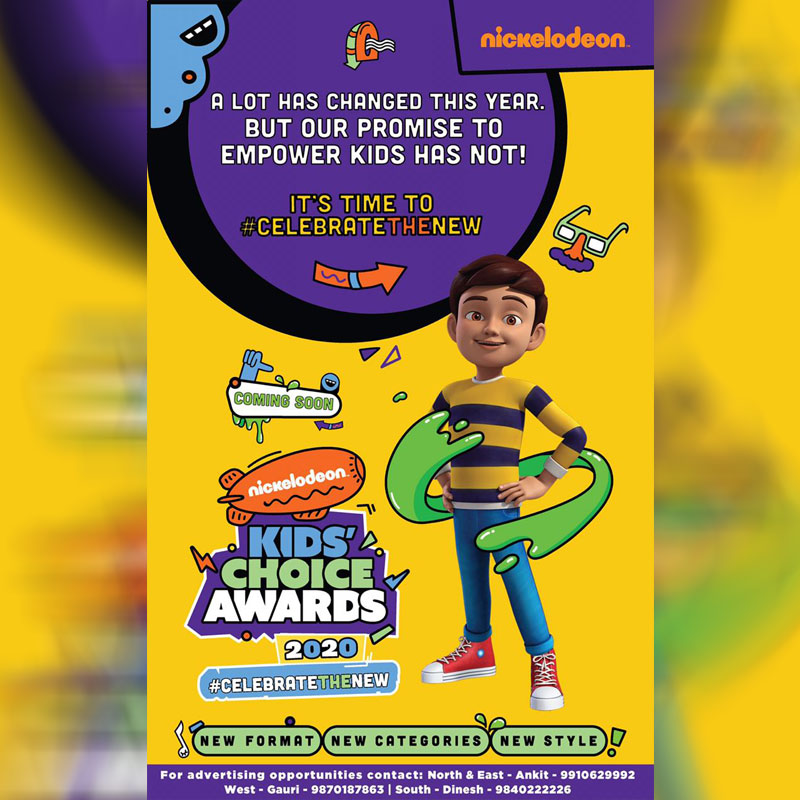
    KOLKATA: The one-of-a-kind award show that is for the kids and by the kids – Nickelodeon Kids’ Choice Awards 2020 is back. While this year has been unprecedented, Nickelodeon follows through on its promise to entertain and empower kids.

    This year with Nickelodeon Kids’ Choice Awards the promise is to present the show in a whole new format, focused on taking it virtual and getting kids to not only vote but also get closer to their stars in a never seen before avatar. That’s not all, KCA 2020 will witness six new and relevant categories for kids to vote for their favourite entertainers during the lockdown and decide who takes home the coveted Nickelodeon Blimp.

    Over the years, Kids’ Choice Awards have featured a glittering host of celebrities gracing the orange carpet and with our iconic Nicktoons. With mind-blowing performances by renowned celebrities like Sara Ali Khan, Varun Dhawan, Alia Bhatt, Ranveer Singh and more, as well as raking in more than 5 lakh votes, kids had a gala time at the award show. This year’s edition will witness nominees that have come through a special online research to determine who entertained children the most during the lockdown. Always turning lemons into lemonade, kids will get a chance to vote for a whole lot of nominees across several new categories such as favourite online learning apps, Youtubers, Instagram personalities, sportspersons, food enjoyed during the lockdown, amongst others. The voting starts on 4 January, 2021 exclusively on www.voot.com and the Voot App.

    Viacom18 Hindi mass entertainment and kids TV network Nina Elavia Jaipuria said, “In these challenging times our commitment is to ensure that our young viewers remain entertained and positive. Keeping this in mind we at Nickelodeon are going to celebrate all that is new with Kids’ Choice Awards 2020. In the virtual format, with the introduction of new categories, we aim to encourage and empower kids to cast their vote and choose their favourites who kept them going through the lockdown. Nickelodeon will also support Teach for India to help provide smart devices to children to enable online education.”

    The uniquely curated awards will support a cause that has emerged during the pandemic while emphasising the need to celebrate the new normal. Due to the ongoing social distancing and the shift to e-learning, India’s education system is going through a reform. The prolonged closure of schools to maintain social distancing has caused an educational inequality, especially due to limited access to internet and technology.

     To bridge the digital education divide and enable a smooth transition for all strata of society, Nickelodeon has partnered with Teach for India, for the latter’s existing program Sponsor A Device. The partnership will kickstart during the voting process of the Kids Choice Awards 2020 where Nickelodeon will donate Re 1 for every vote garnered. Teach for India is a non-profit organisation that works towards educational equity at all levels of the education system. Under the existing program, the community aims to enable the new form of learning by raising funds for putting a gadget in the hands of every student who needs one.

    KCA’s marketing campaign is being promoted through a robust digital and social media plan, interesting online interactivity, support across the Nickelodeon franchise and social media challenges along with a push from the entire network. There are various innovations lined up on the digital front, including tons of quirky communication on YouTube. There will be a #KCAsquad with influencers giving the audiences all the latest updates on #KCAIndia2020. Further adding to the slime-tastic experience will be slime inspired digital games, contests, AR filters, virtual face offs and series of engaging and interesting online interactivity that will create fun experiences for kids.

  • Kevin Vaz appointed Star & Disney India infotainment & kids CEO

    Kevin Vaz appointed Star & Disney India infotainment & kids CEO

    KOLKATA:  Star & Disney India has appointed Kevin Vaz as CEO of infotainment & kids genre. However, he will continue to lead the regional entertainment channels as well. He has been given the responsibility following the stepping down of  Anuradha Aggarwal who was head of English, infotainment & Kids cluster at the company. 

    Vaz has been associated with the broadcaster for a long period. He joined as a sales executive in 1996 and went on to become the sales manager in 2000. By 2009, he was promoted to president – ad sales, where he built the monetisation engine that allowed Star to invest more aggressively in content and remain profitable at the same time.

    Read more news on Kevin Vaz

    Back in 2018, he was elevated to CEO of regional entertainment and was given the charge of heading Star India regional channels portfolio across Maharashtra, Bengal, Tamil Nadu, Andhra & Telangana, Kerala and Karnataka.

  • Should junk food ads be banned on kids’ channels?

    Should junk food ads be banned on kids’ channels?

    MUMBAI: Just a few days ago, there were whispers of a possible ban on junk food ads on kids’ channels that were quickly rebutted by information and broadcasting minister Smriti Irani. Though the ministry has clarified that such a stand hasn’t been taken, it would be worthwhile to consider the pros and cons of such a move.

    There’s a need to worry about all kids who watch television frequently are susceptible to bad eating habits. According to studies, teenagers who watch television for more than three hours daily are twice as likely to eat more snacks like crisps, biscuits, fizzy drinks and chocolates thanks to the commercials they watch along the way.

    At present, Britannia’s Treat cream biscuits and Fruity Fun cake, Waffy, Rich Feast Yum Pie, Diamond Rings, McDonald’s Snoopy Meals, ITC’s Bingo No Rulz and Dark Fantasy biscuits are some of the brands that are running campaigns on kids’ channels.

    Looking at the situation from a broadcaster’s point of view, a blanket ban on junk food advertisements will hamper their monetisation ability. These ads, however, are likely affecting the health of children. When Indiantelevision.com reached out to kids’ channels, none of them were willing to speak up on the issue.

    FMCG brands will be the hardest hit since kids these days are the driving force behind the purchase choices of parents. The demand may dwindle if they are asked to put a full stop to the advertisements and the market share of their products may nosedive to a certain extent.

    When asked about the merits and demerits of this proposal, Harish Bijoor Consults Inc brand-expert and founder Harish Bijoor says that kids’ channels are meant for kids. “Any brand that is not considered kid-friendly in terms of health, attitude development, learning or frivolity of use, must not be allowed on such channels. That wouldn’t be responsible advertising.” 

    Stratagem Media director Sundeep Nagpal also has the same view as Bijoor. According to him, such proposals are made keeping in mind the welfare of our country’s future. “The eventual outcome would only benefit the children of this country, several millions of whom are getting progressively affected by the consumption of junk food.”

    A news report in 2017 stated that Britannia had around 35 per cent share in premium cream biscuits and the idea was to build the share to 50 per cent in two years. The company will be investing Rs 50 crore on Treat in the next nine to 12 months while the total investment for the premium cream biscuit category would be Rs 100 crore for the same time frame. The company is planning to achieve this through multiple activities, straddling between Pure Magic, Bourbon and Treat.

    Bijoor says that some of the FMCG brands will get affected whereas others will not. Brands that appeal to children without the harmful effects of junk food will find a platform on such channels to advertise. FMCG players that create such products will, therefore, remain unaffected. Nagpal, however, recommends that one shouldn’t fall for the plight of the manufacturers.

    When asked whether the creative and storytelling need to change, Nagpal says, “The powers that be on issues like these should put a stop to such hypocritical practices. Any change in storytelling for such products would be an attempt to sell something harmful under a guise. So, this should not even be allowed under the garb of surrogate advertising.”

    Bijoor believes that the product must be first analysed as being fit for kids’ consumption and only after that should any other development happen.

    According to another media report, ITC expects the chocolate category to contribute to 10 per cent to its food division revenue in the next five years. The company will extend the Sunfeast brand to all core biscuit segments, like Marie (an English tea biscuit), glucose, milk, and crackers. Dark Fantasy, meanwhile, will span the indulgence space and cover products across biscuits and cakes (including Yumfills). Farmlite, catering to the health space (biscuit segment), and Mom’s Magic, in the cookies segment, will be the other two brands.

    Children today are increasingly susceptible to obesity and the growing trend of unhealthy food habits and lifestyles are major offenders. Going by the current trends, the World Health Organisation contends that nearly 70 million children will be overweight or obese by 2025. That’s a scary prediction considering the serious health risks are associated with obesity. Considering the fact that the government told Parliament that nine major operators in the food-processing business have voluntarily decided not to advertise products with high fat on children’s channels while the Food and Beverage Alliance of India (FBAI) is already instituting mechanisms to restrict advertising of food and beverage items concerning children voluntarily, the tide seems to be turning.

    Another approach to reducing the intake of commodities such as pre-packed foods with high salt and fat content, sweetened beverages, chips and among others maybe to impose additional taxes.

    It is clear that a ban on junk food ads on kids’ channels will have far-reaching ramifications for the advertiser-broadcaster ecosystem. At a time when child obesity rates and lifestyle diseases are on an alarming rise, it would be prudent for FMCG players to take a step back and re-examine their advertising strategy and build goodwill in the long run. 

    Also Read :

    No proposal to ban junk food ads on TV: Smriti Irani

    Kids’ candy segment: Communication sees a shift

  • Kids channels’s NICK TV and its show ‘Motu Patlu Mission Moon’ top ratings

    Kids channels’s NICK TV and its show ‘Motu Patlu Mission Moon’ top ratings

    MUMBAI: Viacom’s 18 NICK maintained its first position in Broadcast Audience Research Council (BARC) All India (U+R): NCCS All : 4 – 14 years Individuals, week 15 rating, with 89806 impressions (000s).

    POGO TV garnered second position with 79196 impressions (000s). Hungama followed in third position with 699048 impressions (000s).Disney channel with 66595 impressions (000s) and Cartoon network 59779 impressions (000s) held fourth and fifth position respectively.

    NICK also lead with its show Motu Patlu Mission Moon with 950 Impressions (000s), while the same channel’s Motu Patlu in Wonderland (2013 – Animated) grabbed third place with 607 Impressions (000s).

    Chhota Bheem And Krishna In The Rise Of Kirmada (2012 – Animated) of POGO TV was at second position with 689 Impressions (000s) .  Hungama TV’s Doraemon The Movie: Ye Bhi Tha Nobita, Woh Bhi Tha Nobita (2014 – Animated) with 585 Impressions (000s) was in fourth position followed by Doraemon Movie: Galaxy Super Express (1996 – Animated) of Disney channel with 587 Impressions (000s). 

  • Kids channels’s NICK TV and its show ‘Motu Patlu Mission Moon’ top ratings

    Kids channels’s NICK TV and its show ‘Motu Patlu Mission Moon’ top ratings

    MUMBAI: Viacom’s 18 NICK maintained its first position in Broadcast Audience Research Council (BARC) All India (U+R): NCCS All : 4 – 14 years Individuals, week 15 rating, with 89806 impressions (000s).

    POGO TV garnered second position with 79196 impressions (000s). Hungama followed in third position with 699048 impressions (000s).Disney channel with 66595 impressions (000s) and Cartoon network 59779 impressions (000s) held fourth and fifth position respectively.

    NICK also lead with its show Motu Patlu Mission Moon with 950 Impressions (000s), while the same channel’s Motu Patlu in Wonderland (2013 – Animated) grabbed third place with 607 Impressions (000s).

    Chhota Bheem And Krishna In The Rise Of Kirmada (2012 – Animated) of POGO TV was at second position with 689 Impressions (000s) .  Hungama TV’s Doraemon The Movie: Ye Bhi Tha Nobita, Woh Bhi Tha Nobita (2014 – Animated) with 585 Impressions (000s) was in fourth position followed by Doraemon Movie: Galaxy Super Express (1996 – Animated) of Disney channel with 587 Impressions (000s). 

  • “Our carriage bill is down 30-35%; subscription up 14-15%”: Nikhil Gandhi

    “Our carriage bill is down 30-35%; subscription up 14-15%”: Nikhil Gandhi

    2015 will be remembered as a memorable year for Disney India’s TV biz. The mouse house took its TV channel distribution in its own hands when it terminated its joint venture with the Viacom outfit Indiacast.  For several years it had experimented with other distribution partners like Sun Distribution Services to Star Den, both of which are non-existent now.

    A new venture Disney Media Networks was set up and media vet Nikhil Gandhi – who was responsibile for revenue and profitability across Disney India media channels comprising of youth channels – Bindass and kids channels – Disney Channel, Disney Junior, Disney XD and Hungama TV, movies channels – UTV Movies and UTV Action –  was given its charge.

    His challenge: to jiggle out distribution and subscription  revenues from India’s fragmented cable TV ecosystem, while keeping affiliate fees under control even as he ensured carriage of Disney India’s eight channel bouquet.

    Six months down the line, Gandhi seems to have done well, if one goes by this exclusive interview to indiantelevision.com’s Anirban Roy Choudhury.  He speaks about the challenges he has and continues to face, and why he is still optimistic.

    Excerpts:

    How has the journey been so far? What made Disney decide to distribute its TV channels on its own?

    It has been a fabulous six months. The market has been receptive to whatever we are doing, which has been a major boost for us. We have been in the business for over 10 years now and we have been distributing through different partners. We started with Star, then we went to Sun and then to IndiaCast, following which we were on an agency relationship with them. Therefore we needed to take a call on what we really wanted to do.

    I think our network is one to reckon with. We have six per cent viewership share which is probably five or six times compared to the one following us. So we are the fifth largest broadcast network. That’s why we thought we could go out and take the business in our hands and see what we could do at the distribution level.

    One, it was also important to get our carriage fee bill down, which each  broadcaster is trying his level best to do. Two and the most important one was to get the subscription business in order. 

    What are the challenges that you faced and how did you counter them?

    We had to inform the ecosystem – the MSOs’ and the DTH players about Disney Media Networks, that we have eigh channels, we have very high premium brands. We had to tell them what we are and what value we could add to them. I think that at certain point after our initial efforts, they did realise that they had never seen Disney as an entity in its own right. They began to understand the value that we brought to the table in terms of packaging. They realised we were the leaders in kids and youth channels and we had a sizeable movie business. We were not just another bouquet, we were leaders of sorts. The challenge was to communicate that and the team did a fantastic job.

    I think that the deals that we have struck are our biggest achievement. We have reached very big milestones in the first year itself. To begin with we have got our carriage bill down by 30 to 35 per cent and at the same time we have taken our subscription revenue up 14 to 15 per cent and it happened after rounds of negotiations and discussions with our carriage partners.

    When you talk about distribution success, do you mean a pan India success or is it a particular market?

    It is a pan India success for us. We are distributed nationally. Our channels reach east, west, north and south. And that is because of the fantastic work done by our teams on ground. We got a fantastic bunch of talented people from across different fields. They have successfully communicated what really Disney Media Networks stands for, and most of the negotiations are done by them. So whenever we talk about success or numbers, it is pan India that we are talking about, and not a particular market.

    What is your opinion about the CPS model? If rolled out properly, will it enhance your subscription revenue?

    CPS is there…and yet it’s not there as a whole. In phases I and II, we know what is going on. Phases III and IV will take shape with time. It’s good that we’ve digitized, now what really matters is how it is being addressed, how the CAF is filled up and how it is packaged. 

    It is a great move forward, and as a broadcaster and content provider, we can only add value to the process by giving superior content and a brand which will enhance ARPUs.

    CPS will happen as the progression of packaging happens and the progression of addressability happens.

    The MSO-LCO equation needs to change and become more mature. Yes, the moves are very positive, but we are still not there, there are areas where we need some amount of investor players to come and change the game at least from a mind-set point of view. CPS will go up with ARPU going up.  And when there is a transparent system in place that enables addressability, subscription revenue will move up in the right direction.

    What is your opinion on the regulators stand so far?

    The regulators have been very pro industry, which is a great thing. We have seen how there was a hard stance when it came to the phase III deadline. So I think it’s a very bold move, because for them also, it’s about getting the industry which is so big in size organised and deriving the maximum out of it in terms of entertainment tax and other revenue generating propositions. And an organised platform is always more transparent, and transparency is the need of the hour for the industry. So I think the regulator’s stand so far has been immensely pro industry.

    Do you think content, if paid for in India, will grow?

    ARPUs’ have been flat for last 10 years. So obviously India is not paying for content, but the moot point is that India is capable of paying more. We, at Disney, are manufacturers; we are content providers. There are platforms and there are wholesalers and retailers involved.  It is the retailers and the wholesalers who need to drive the ARPU and there are many elements on which it all depends.

    At a pricing level we are restricted by the RIO model, and then on the ground level there is the LCO who by no means is interested as it might hurt him. I think to drive payment for content, the LCO – MSO equation needs to change, DTH needs to play its role and it all needs to happen in a collaborated manner.

    I think there is a need for standard pricing similar to any other industry. You buy toothpaste the price is the same everywhere.  In India there is a legacy involved in the way it has been run. The legacy needs to change. It is changing, we expected it to change fast, but it’s actually changing at a snail’s pace.

    Can the broadcasters not play a role in ensuring higher ARPU?

    Look at what the broadcasters are offering these days. Look at the quality of the content. It’s premium content created with superior sophistication. There are HD channels offering HD content. A few of them have rolled out 4K channels.

     So while ARPU has remained same over the last 10 years, the investment on content did not stop. It kept on going. New formats, acquisitions, new and bold ways of storytelling have been explored, and then there are the additions in the number of channels every year.

    Rs 300 for 50 channels 10 years ago, has now become 250 channels of superior quality for the same old price. We have witnessed a few ARPU movements at least in the metros with DTH and a few MSOs, but these are minuscule movements. The movements need to happen much faster because that’s where the motivation is. From a broadcaster’s point of view, there is nothing that we can do but play the game as per the nature of the business.

    You spoke about collaboration, recently we witnessed switching off of signals, what is your opinion on such acts?  

    Firstly, the switching off of services and disturbing the consumer at a fundamental level is very unfair, it should not happen. There could be differences on the negotiation table, but that by no means should disturb the end consumer. 

    The fact that the consumer is deprived of a service in itself is very sad.  I don’t subscribe to such negotiations. We have also gone through highs and lows in our negotiation process but, at the end of the day, you cannot starve your consumer of superior content, or any content for that matter, because the consumer has subscribed for it. The ecosystem is such that the business is dependent on ad sales, and that is why the switch offs’ happen.

    What should lead the business, subscription or ad revenue?

    Ad sales should be an icing on the cake, subscription revenue should steer the business. Look at the mature markets – subscription revenue is leading the business, the negotiations that happen there are at a different level.

    Fundamentally the broadcast business has to be a subscription led business. You can have an advertising-based play that we are seeing with the FTA’s and that’s majorly because of the huge population of our country and the market size and the reach that TV offers. But a premium pay channel creating original superior content needs to be pay first.

    What is your take on the growing OTT business?

    At the heart of the OTT ecosystem is bandwidth and the bandwidth needs to improve.  What will be interesting to see is if it becomes subscription based (SVOD) or advertising based video on demand (AVOD). 

    Now if you are providing superior content for an AVOD model you are not creating a great environment as such. It’s all about how you form the habit. Consumers who consume OTT content are paying about Rs 1,000 for data, and we tend to think that the same consumer will not pay for  content. This mentality is not a long term one, we need to think 10 years ahead and then take steps.

    Smart TVs are in place; people are talking about 8K.  There are great leaps in terms of technology, but if we don’t take the correct steps, we won’t be able to get value out of the OTT business.

    Will you make yourself available on OTT platforms? Star has Hotstar, SPN has Sony Liv, ZEE has a couple of them and Viacom is launching VOOT. Is Disney also looking towards launching an OTT platform?

    Anywhere where consumption is there, we will make ourselves present. That’s the way forward for us. We do have plans, but we are at a very nascent stage as far as OTT is concerned. As a linear service we will be available on all OTT platforms, but when it comes to launching our own venture we will evaluate when the time is right.

    Where are you generating more subscription revenue from, DTH or cable?

    DTH has a slight edge over cable when it comes to our subscription revenue. We are gradually moving towards level contributions from both the platforms. Now with DAS phase III, I think the headroom for growth is massive in the case of cable. At this stage I think that DTH, given its organised and transparent nature, has the edge.

    Is it the bouquet mode of distribution that you are looking at, at this stage?

    Most of our deals are all bouquet offerings, if there is any platform that requires a youth offering or kids offering or a movie offering, such deals happen at a very high CPS price and we create those packages. We are there on a la carte as an offering, but there is a very small set of consumers who subscribe to the service. So it’s largely all bouquet.

    What is it that Disney Media Networks is looking for in the foreseeable future?

    I have mandated the team in Disney that the subscription business needs to overtake the ad sales business over the next three years’  and that will change the entire ecosystem. An MSO cannot then threaten me with a switch off and that’s what we are targeting. We were at about 65:35 ratio, now we have become 60:40 so we are moving towards that direction. Over time the target is to make it 40:60 or 30:70 for that matter.


  • “Our carriage bill is down 30-35%; subscription up 14-15%”: Nikhil Gandhi

    “Our carriage bill is down 30-35%; subscription up 14-15%”: Nikhil Gandhi

    2015 will be remembered as a memorable year for Disney India’s TV biz. The mouse house took its TV channel distribution in its own hands when it terminated its joint venture with the Viacom outfit Indiacast.  For several years it had experimented with other distribution partners like Sun Distribution Services to Star Den, both of which are non-existent now.

    A new venture Disney Media Networks was set up and media vet Nikhil Gandhi – who was responsibile for revenue and profitability across Disney India media channels comprising of youth channels – Bindass and kids channels – Disney Channel, Disney Junior, Disney XD and Hungama TV, movies channels – UTV Movies and UTV Action –  was given its charge.

    His challenge: to jiggle out distribution and subscription  revenues from India’s fragmented cable TV ecosystem, while keeping affiliate fees under control even as he ensured carriage of Disney India’s eight channel bouquet.

    Six months down the line, Gandhi seems to have done well, if one goes by this exclusive interview to indiantelevision.com’s Anirban Roy Choudhury.  He speaks about the challenges he has and continues to face, and why he is still optimistic.

    Excerpts:

    How has the journey been so far? What made Disney decide to distribute its TV channels on its own?

    It has been a fabulous six months. The market has been receptive to whatever we are doing, which has been a major boost for us. We have been in the business for over 10 years now and we have been distributing through different partners. We started with Star, then we went to Sun and then to IndiaCast, following which we were on an agency relationship with them. Therefore we needed to take a call on what we really wanted to do.

    I think our network is one to reckon with. We have six per cent viewership share which is probably five or six times compared to the one following us. So we are the fifth largest broadcast network. That’s why we thought we could go out and take the business in our hands and see what we could do at the distribution level.

    One, it was also important to get our carriage fee bill down, which each  broadcaster is trying his level best to do. Two and the most important one was to get the subscription business in order. 

    What are the challenges that you faced and how did you counter them?

    We had to inform the ecosystem – the MSOs’ and the DTH players about Disney Media Networks, that we have eigh channels, we have very high premium brands. We had to tell them what we are and what value we could add to them. I think that at certain point after our initial efforts, they did realise that they had never seen Disney as an entity in its own right. They began to understand the value that we brought to the table in terms of packaging. They realised we were the leaders in kids and youth channels and we had a sizeable movie business. We were not just another bouquet, we were leaders of sorts. The challenge was to communicate that and the team did a fantastic job.

    I think that the deals that we have struck are our biggest achievement. We have reached very big milestones in the first year itself. To begin with we have got our carriage bill down by 30 to 35 per cent and at the same time we have taken our subscription revenue up 14 to 15 per cent and it happened after rounds of negotiations and discussions with our carriage partners.

    When you talk about distribution success, do you mean a pan India success or is it a particular market?

    It is a pan India success for us. We are distributed nationally. Our channels reach east, west, north and south. And that is because of the fantastic work done by our teams on ground. We got a fantastic bunch of talented people from across different fields. They have successfully communicated what really Disney Media Networks stands for, and most of the negotiations are done by them. So whenever we talk about success or numbers, it is pan India that we are talking about, and not a particular market.

    What is your opinion about the CPS model? If rolled out properly, will it enhance your subscription revenue?

    CPS is there…and yet it’s not there as a whole. In phases I and II, we know what is going on. Phases III and IV will take shape with time. It’s good that we’ve digitized, now what really matters is how it is being addressed, how the CAF is filled up and how it is packaged. 

    It is a great move forward, and as a broadcaster and content provider, we can only add value to the process by giving superior content and a brand which will enhance ARPUs.

    CPS will happen as the progression of packaging happens and the progression of addressability happens.

    The MSO-LCO equation needs to change and become more mature. Yes, the moves are very positive, but we are still not there, there are areas where we need some amount of investor players to come and change the game at least from a mind-set point of view. CPS will go up with ARPU going up.  And when there is a transparent system in place that enables addressability, subscription revenue will move up in the right direction.

    What is your opinion on the regulators stand so far?

    The regulators have been very pro industry, which is a great thing. We have seen how there was a hard stance when it came to the phase III deadline. So I think it’s a very bold move, because for them also, it’s about getting the industry which is so big in size organised and deriving the maximum out of it in terms of entertainment tax and other revenue generating propositions. And an organised platform is always more transparent, and transparency is the need of the hour for the industry. So I think the regulator’s stand so far has been immensely pro industry.

    Do you think content, if paid for in India, will grow?

    ARPUs’ have been flat for last 10 years. So obviously India is not paying for content, but the moot point is that India is capable of paying more. We, at Disney, are manufacturers; we are content providers. There are platforms and there are wholesalers and retailers involved.  It is the retailers and the wholesalers who need to drive the ARPU and there are many elements on which it all depends.

    At a pricing level we are restricted by the RIO model, and then on the ground level there is the LCO who by no means is interested as it might hurt him. I think to drive payment for content, the LCO – MSO equation needs to change, DTH needs to play its role and it all needs to happen in a collaborated manner.

    I think there is a need for standard pricing similar to any other industry. You buy toothpaste the price is the same everywhere.  In India there is a legacy involved in the way it has been run. The legacy needs to change. It is changing, we expected it to change fast, but it’s actually changing at a snail’s pace.

    Can the broadcasters not play a role in ensuring higher ARPU?

    Look at what the broadcasters are offering these days. Look at the quality of the content. It’s premium content created with superior sophistication. There are HD channels offering HD content. A few of them have rolled out 4K channels.

     So while ARPU has remained same over the last 10 years, the investment on content did not stop. It kept on going. New formats, acquisitions, new and bold ways of storytelling have been explored, and then there are the additions in the number of channels every year.

    Rs 300 for 50 channels 10 years ago, has now become 250 channels of superior quality for the same old price. We have witnessed a few ARPU movements at least in the metros with DTH and a few MSOs, but these are minuscule movements. The movements need to happen much faster because that’s where the motivation is. From a broadcaster’s point of view, there is nothing that we can do but play the game as per the nature of the business.

    You spoke about collaboration, recently we witnessed switching off of signals, what is your opinion on such acts?  

    Firstly, the switching off of services and disturbing the consumer at a fundamental level is very unfair, it should not happen. There could be differences on the negotiation table, but that by no means should disturb the end consumer. 

    The fact that the consumer is deprived of a service in itself is very sad.  I don’t subscribe to such negotiations. We have also gone through highs and lows in our negotiation process but, at the end of the day, you cannot starve your consumer of superior content, or any content for that matter, because the consumer has subscribed for it. The ecosystem is such that the business is dependent on ad sales, and that is why the switch offs’ happen.

    What should lead the business, subscription or ad revenue?

    Ad sales should be an icing on the cake, subscription revenue should steer the business. Look at the mature markets – subscription revenue is leading the business, the negotiations that happen there are at a different level.

    Fundamentally the broadcast business has to be a subscription led business. You can have an advertising-based play that we are seeing with the FTA’s and that’s majorly because of the huge population of our country and the market size and the reach that TV offers. But a premium pay channel creating original superior content needs to be pay first.

    What is your take on the growing OTT business?

    At the heart of the OTT ecosystem is bandwidth and the bandwidth needs to improve.  What will be interesting to see is if it becomes subscription based (SVOD) or advertising based video on demand (AVOD). 

    Now if you are providing superior content for an AVOD model you are not creating a great environment as such. It’s all about how you form the habit. Consumers who consume OTT content are paying about Rs 1,000 for data, and we tend to think that the same consumer will not pay for  content. This mentality is not a long term one, we need to think 10 years ahead and then take steps.

    Smart TVs are in place; people are talking about 8K.  There are great leaps in terms of technology, but if we don’t take the correct steps, we won’t be able to get value out of the OTT business.

    Will you make yourself available on OTT platforms? Star has Hotstar, SPN has Sony Liv, ZEE has a couple of them and Viacom is launching VOOT. Is Disney also looking towards launching an OTT platform?

    Anywhere where consumption is there, we will make ourselves present. That’s the way forward for us. We do have plans, but we are at a very nascent stage as far as OTT is concerned. As a linear service we will be available on all OTT platforms, but when it comes to launching our own venture we will evaluate when the time is right.

    Where are you generating more subscription revenue from, DTH or cable?

    DTH has a slight edge over cable when it comes to our subscription revenue. We are gradually moving towards level contributions from both the platforms. Now with DAS phase III, I think the headroom for growth is massive in the case of cable. At this stage I think that DTH, given its organised and transparent nature, has the edge.

    Is it the bouquet mode of distribution that you are looking at, at this stage?

    Most of our deals are all bouquet offerings, if there is any platform that requires a youth offering or kids offering or a movie offering, such deals happen at a very high CPS price and we create those packages. We are there on a la carte as an offering, but there is a very small set of consumers who subscribe to the service. So it’s largely all bouquet.

    What is it that Disney Media Networks is looking for in the foreseeable future?

    I have mandated the team in Disney that the subscription business needs to overtake the ad sales business over the next three years’  and that will change the entire ecosystem. An MSO cannot then threaten me with a switch off and that’s what we are targeting. We were at about 65:35 ratio, now we have become 60:40 so we are moving towards that direction. Over time the target is to make it 40:60 or 30:70 for that matter.


  • No kidding! Kid’s TV channels get serious about Diwali

    No kidding! Kid’s TV channels get serious about Diwali

    MUMBAI: It’s that time of the year again when television channels in the kids’ genre go full throttle to appease their tiny tot viewers.


    With a viewership of 7.3 percent of the total television audience in India, kids’ channels enjoy advertising revenue of 3.8 per cent, which is predicted to hit Rs 6650 crore as per FICCI’s Industry report 2015, which expects the total ad spends on television to be Rs 17,500 crore in 2015. A major chunk of this revenue is generated during the third quarter, thanks to a sudden increase in viewership.


    “During Diwali northern states and the western parts of India have holidays so naturally viewership on kids’ channels goes up. Therefore there is a spurt in investment in kids genre as well,” says a veteran media planner, who adds that though there is a definite increase in viewership from last year, it is hard to put that into figures as TAM and BARC ratings use different mechanisms of viewership measurements.


    Kids channels’ look forward to the third quarter as it generates the highest viewership for them after the April May June time which is usually when schools have summer vacation. With this surge in viewership, advertisers too plan in advance to make the most of their television spends through these kids channels.


    It is needless to say that channels heavily invest to promote their existing shows and also grab eye balls with new exciting content, and 2015 is no exception.


    From new show launches to extensive on ground activities, kids channels have pulled out all stops on whatever services they have at their disposal, be it on the marketing front or content. Keeping in mind the excitement surrounding Children’s day, some are conducting city wise on ground promotions, while others have brought in fresh local content to appeal to urban as well as rural viewers.


    For the same reason, Turner International India’s kids’ channels Cartoon Network and Pogo planned week-long celebrations with new movies, specials and contests to make the most of the holidays.


    Cartoon Network has celebrated the birthday of one the network’s most popular character Kris from the Roll No. 21 series with a week-long stunt in a special program titled Kris ka Dhamakedar Birthday from 9 to 14 November at 10.30 am.  Following which the channel airs Lights Camera Roll No. 21: Kris in Bollywood, a brand new movie featuring Kris making his Bollywood debut, on 14 November 2015 at 10:30am.


    The channel has also organized a special promotional contest to win an invite to Kris’s birthday party.


    Pogo’s Diwali week ending in 13 November saw back to back Chhota Bheem movies and specials that aired throughout the week from 9am onwards and a brand new movie titled Chhota Bheem: Dinosaur World at 12pm on 11 November.


    The genre’s leader Nickelodeon hasn’t been complacent with its number one rank and has invested heavily in on ground promotions for this year’s Children’s day. The Viacom 18 owned network will bring down their toon stars to interact with children in Delhi and Kolkata on D Day, with Shivaji and Ninha making special appearances on the venue.


    “In Delhi, there will be dedicated games that would be played at the set-up, including a Squap integration with toons giving them away to lucky winners over and above Nickelodeon merchandise that would be distributed,” reveals Viacom18 EVP and business head – kids cluster Nina Elavia Jaipuria.


    “Kids in Kolkata get a chance to not only meet Motu Patlu but also engage at the carnival with loads of games. The entire City Centre mall will get the look of Furfurinagar and kids will get a chance to win super cool Motu Patlu merchandise as well. This has been promoted though ads, TV astons, radio and online,” she explains, adding that the initiative is a joint venture between ABP and Viacom 18, with TeleKids as partners in the event.


    The channel also plans to take these promotions digital in order to reach out to as many kids and mothers as possible. At the same time it will reinforce their merchandising stronghold in the market.


    “This Children’s Day we’re unveiling the new look of Squap, that is, Squap 2,” shares Jaipuria excitedly, “The wittiest and the funniest comment on the new Squap will be a cool way to Squap,” she adds.


    Commenting on the importance of this quarter in terms of ad revenues, Jaipuria further adds, “October November and December is as busy as April, May and June for us. This is the time when kids’ channels see a lot of traction both in terms of viewership as well as ad revenue. Our viewership as well as ad spends increase by 29 to 30 per cent during this time.” She also adds that there has been considerable increase in ad rates this year.


    In terms of programming, Sonic will air a movie special featuring Pakdam Pakdai Doggy Don Vs Billiman at 7:30pm on 14 November, while Nick will celebrate children’s day with Motu Patlu Kung Fu King Returns at 11.30 am.


    The network’s biggest offering to their little viewers this season is undoubtedly Shiva, their third home grown animated series which went on air on 9 November, and has already garnered positive reviews.


    Another channel which is out to win new audiences and treat old viewers with fresh content is Discovery Kids with their brand new show Luv Kushh that also went on air on 9 November.


     “Discovery Kids continues to entertain kids with its variety of programmes and genres, endearing characters and exciting storylines. The new series, Luv Kushh will take kids back to the era of gurukuls and recreate the age-old traditions of the student-teacher relationship,” said Discovery Networks Asia-Pacific EVP and GM, Rahul Johri on their new show.


    Given the timing for the launch one can wonder if the move was deliberate on the part of the channels to go head to head to competition for viewership. Either way, this quarter looks busy, exciting, and content heavy for the kids’ entertainment channels.