Tag: Khelo India

  • India needs quality sports infrastructure at the grassroots level: Gallant Sports’ Nasir Ali

    India needs quality sports infrastructure at the grassroots level: Gallant Sports’ Nasir Ali

    Mumbai: Despite India’s impressive economic growth, the sports sector continues to lag behind international standards. With an 11 per cent annual growth rate, the sector is still underperforming, highlighted by the Sports Ministry’s marginal budget increase of ₹45.36 crore this cycle.

    As a leading player in sports infrastructure, Gallant Sports is making significant strides through innovative projects and partnerships with Khelo India and the Sports Authority of India, while also emphasizing sustainability. The company, poised for substantial growth, aims for a 25 per cent annual increase and a target of ₹1000 crore in the next five years, reflecting its commitment to transforming India’s sports ecosystem.

    Indiantelevision.com’s Arth Chakraborty caught up with Gallant Sports CEO and founder Nasir Ali who provides valuable insights into bridging this gap, and the dynamics of sports infrastructure industry dynamics.

    Edited Excerpts:

    On the challenges in bridging the gap between India’s sports sector growth and international standards

    India faces several challenges in aligning its sports sector with international standards. The primary challenges are:

    A. Quality infrastructure: One of the critical barriers is the lack of high-quality, injury-free sports surfaces at the grassroots level. We need to provide international-standard facilities for various sports in each district, tailored to the popular sports of that region. For instance, Haryana’s success in wrestling, athletics, and boxing can be replicated in other regions by identifying and nurturing local potential.

    B. Cultural shift towards sports: There is a need for a cultural shift where sports become an integral part of our daily lives. Parents should engage in sports for fitness, serving as role models for their children. This cultural change will ensure that sports become a natural part of children’s lives, fostering a sporty and healthy lifestyle from a young age. Family outings centered around sports can significantly contribute to embedding sports in our DNA.

    C. Increased exposure and training: Exposure to more tournaments at every age group is crucial, including opportunities for international competition. Additionally, our coaches need continuous training and exposure to modern coaching techniques, including mental strength training. A robust “Train the Trainers” program is essential to ensure our coaches are equipped with the latest skills and knowledge, similar to how doctors continuously upscale their expertise.

    How has partnering with Khelo India and the Sports Authority of India impacted Gallant Sports’ projects and growth

    Partnering with Khelo India and the Sports Authority of India (SAI) has significantly impacted Gallant Sports’ growth and projects. Khelo India and SAI have been the backbone of government infrastructure development in India, especially at the grassroots level. Their efforts in pumping projects into districts have laid a strong foundation. However, to compete with the top ten economies globally, we need to increase the number of smaller, localized projects and secure more funding for sports infrastructure.

    SAI primarily focuses on supporting players and has been doing an excellent job. However, we need more SAI centers of excellence in every state and major district that excels in sports. Gallant Sports is proud to be a part of this journey, having built around 10 FIFA-approved football fields and three FIH Global hockey fields. These accomplishments have earned us the title of FIH Field Builders. We are now venturing into constructing world-class athletic tracks for the Government of India, further contributing to the nation’s sports infrastructure.

    On the specific changes or initiatives that you’d like to see from the government to better support the sports infrastructure industry

    To better support the sports infrastructure industry, we need a more strategic and expert-driven approach. Gallant Sports has recently established the Sports and Field Builders Association of India (SFBA), which aims to play a pivotal role in policy advocacy and planning. We need to involve more experts in the planning stages to ensure that the projects implemented meet the specific needs of each district. Smaller, injury-free world-class facilities should be prioritized to make quality sports infrastructure accessible to more people.

    Additionally, increasing the budget for sports infrastructure, teams, and athletes is essential. This includes not only constructing new facilities but also maintaining and upgrading existing ones. Collaboration with the government is crucial to developing a comprehensive plan that addresses the diverse requirements of our vast country.

    On the role of the private sector, including Gallant Sports, in supplementing government efforts to boost sports infrastructure in India, given the Sports Ministry’s budget has seen only a marginal increase

    The private sector, including Gallant Sports, can play a crucial role in supplementing government efforts to enhance sports infrastructure. One effective strategy is to focus on developing smaller, specialized fields that cater to various sports at the grassroots level. Ensuring that sports facilities are available in high schools and universities can make a significant difference, as it provides young athletes with the opportunity to practice and compete regularly.

    Additionally, implementing a mandate that sports facilities are compulsory for educational institutions, similar to China’s approach, could be transformative. Corporate social responsibility (CSR) initiatives in sports development and grassroots projects are also vital. By collaborating with corporations, we can secure funding and support for building and maintaining sports infrastructure in underserved areas.

    On Gallant Sports contributing to the “Make in India” initiative, and the advantages this brings to your projects

    Gallant Sports is actively contributing to the “Make in India” initiative by focusing on manufacturing athletic tracks and sports tiles domestically. We are collaborating with raw material manufacturers in India and abroad to produce high-quality, cost-effective alternatives to expensive European imports. This initiative not only supports the “Make in India” mission but also ensures the availability of injury-free, high-durability sports surfaces.

    By producing these materials locally, we reduce dependency on imports, lower costs, and promote the growth of the domestic manufacturing sector. This approach aligns with the government’s vision of making India a global manufacturing hub while also addressing the specific needs of the sports infrastructure industry.

    On the emerging trends in sports infrastructure that you are excited about, and Gallant Sports positioning itself to leverage these trends

    We are excited about several emerging trends in sports infrastructure, including India’s potential to host the Olympics and its journey towards becoming a global sports leader. The prospect of winning more medals and establishing India as a powerhouse in the global sports arena is thrilling. Gallant Sports is positioning itself at the forefront of this transformation by continuously innovating and developing top-tier sports infrastructure.

    We are committed to contributing to this vision by constructing world-class facilities, implementing sustainable practices, and leveraging advanced technologies. Our goal is to ensure that India is ready to host major international events and to support the development of athletes who can compete at the highest levels.

    On Gallant Sports ensuring environmental sustainability in its projects, and do you think current sustainability efforts in the sports infrastructure industry are truly effective, or do you see them as more of a cost-cutting measure

    Gallant Sports is dedicated to ensuring environmental sustainability in all its projects. We have pioneered the use of 100 per cent recyclable, permeable turf that promotes water conservation and reduces environmental impact. Additionally, our non-concrete, dynamic bases facilitate groundwater recharge through sumps and rainwater harvesting systems.

    These initiatives are not merely cost-cutting measures but essential steps towards creating a sustainable future for sports infrastructure in India. We believe that true sustainability requires a commitment to environmental stewardship, and we advocate for incorporating these practices in all school, college, university, and corporate real estate projects.

    On the upcoming projects or expansions that Gallant Sports is planning, and their contribution to the sports ecosystem in India

    Gallant Sports has several exciting projects and expansions in the pipeline. We are heavily investing in football projects in Northeast India, a region with immense talent and potential. Additionally, we are introducing affordable floodlighting solutions to extend play hours, making sports facilities more accessible during the evenings.

    Our passion for building sports infrastructure in schools drives us to continue expanding in this area. We have already built sports facilities in over 200 schools across India, making us the largest sports infrastructure company in the country by volume. Each year, we install nearly 300,000 square meters of sports surfaces, contributing significantly to the development of the next generation of athletes. These efforts ensure that young talent has the facilities and opportunities they need to thrive, ultimately strengthening the sports ecosystem in India.
  • Khelo India Youth Games, Maharashtra 2019 is Bigger and Better!

    Khelo India Youth Games, Maharashtra 2019 is Bigger and Better!

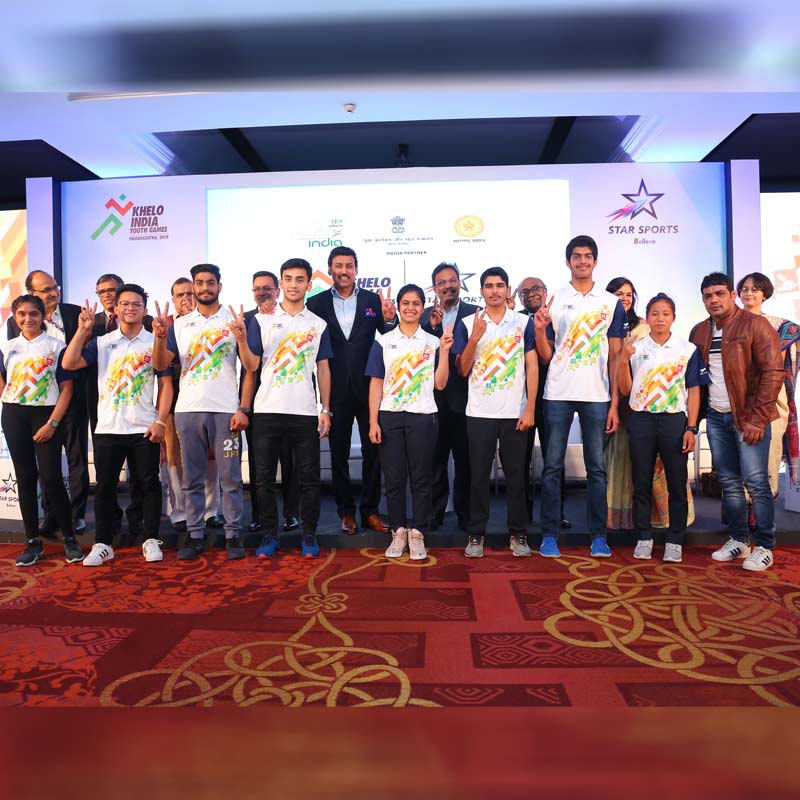
    MUMBAI: Building on the roaring success of the inaugural edition of the Khelo India School Games, Ministry of Youth Affairs and Sports along with Star Sports kick started the countdown to Khelo India Youth Games, Maharashtra 2019 with an appeal to encourage India to play more- with the evocative ‘#5MinuteAur’ campaign.

    The campaign has a strong call to action, taking the Khelo India movement forward, featuring – Manu Bhaker, Jeremy Lalrinnunga, Saurabh Chaudhary, Lakshya Sen, Esha Singh, Tababi Devi, Srihari Natraj and champions Mary Kom, Sushil Kumar amongst others bringing childhood playground memories to life. The #5MinuteAur campaign created this year has a simple insight, we are all born with an inherit instinct to play, kids and adults alike.

    In its inaugural edition, Khelo India had a strong message “Kheloge Kudoge Banoge lajawaab” encouraging more kids to play every day, it was an effort towards changing an age-old belief. Building on the core of this message through the #5MinuteAur campaign, Star Sports and the ministry want India to encourage kids to play for those extra 5 minutes.

    The 5 minutes is symbolic, with an assumption that if each child plays a little bit longer, we will add a billion minutes of play everyday, that has the potential to translate into 50 medals for the country.

    Portraying this five-minute agreement between a mother and a child, the aim with #5MinuteAur is to spark a fire in every enthusiast in India to strive for better through sports. Establishing the message that sports builds and defines our personalities, the more we play the better we get. The manifesto, “Hum Aaj Aur Khelenge Toh Kal Aur Jeetenge” is true not just for the sport we play, but for life itself.

    Scheduled to take place at Shree Shiv Chhatrapati Sports Complex in Pune from 9th to 20th January 2019, Khelo India Youth Games, Maharashtra 2019 will see over 10,000 participants from 29 states and 7 Union Territories. The games will bring to life by over 6200 athletes, 1800 Technical Officials, 1000 volunteers and 1000 personnel working behind the scenes.

    Conceptualised to revive the sports culture in India at grass-root level by building a strong framework for all sports played in our country, the upcoming season of Khelo India Youth Games will be held across 18 sporting disciplines in the Under-17 and Under– 21 age categories.

    “The success of Khelo India School Games is a testimony to the hunger and multitude of sporting talent in India. Buoyed by the terrific response for Khelo India School Games and with an aim to increase participation in sports across all age groups, we have not just added two sports this year but the games will also be played under two age categories U-17 and U-21 to allow even more enthusiasts to participate and flourish. The ‘5 minute aur’ campaign for the Khelo India Youth Games 2019 to be hosted in Pune, Maharashtra is a reflection of the immense strides we’ve made and the journey that lies in front of us to make India a truly sporting nation. We hope it will inspire India to work towards incorporating sports as a way of life.”  Said, Col.  Rajyavardhan Singh Rathore, Minister for Sports and Youth Affairs (IC)."

    To support the Khelo India initiative by the Ministry of Youth Affairs & Sports, Star India has doubled the level of promotion and broadcast coverage for Khelo India Youth Games, Maharashtra 2019. The coverage of the upcoming season will include live telecast in 5 languages (Hindi, Tamil, Telugu, Kannada and English) and telecast of all 18 disciplines for both age groups.

    Mr. Sanjay Gupta, Managing Director, Star India said, “The first edition of Khelo India exceeded expectations and instilled an aspiration for sports amongst the youth in India and now, with “5 minute aur”, we are aiming to trigger more pro sport conversations to make India adopt sports as a way of life. The campaign calls for the Indian sports enthusiast to not only support their heroes, but also work towards emulating their feats.”

    “Staying true to our commitment of bringing the best in class sports experience to the passionate Indian sports fan, we will broadcast Khelo India Youth Games in 5 languages this season along with LIVE telecast of 9 disciplines, he further added.”

    Khelo India Youth Games, which are a part of the Khelo India programme, will be held from 9th to 20th January 2019 in Pune, Maharashtra. The games will be telecast live across Star Sports Network and Hotstar.

  • Comment: Why it’s important for Rathore at MIB to walk the (sports) talk

    Comment: Why it’s important for Rathore at MIB to walk the (sports) talk

    He may have started the #HumFitToh IndiaFit campaign that went viral on social media last month and had celebs and plebs posting images of their health routine. He may also be a comparatively low-profile minister in the PM Modi cabinet who has delivered on various fronts, including being proactive on issues relating to sports. But Minister of Information & Broadcasting and Youth Affairs & Sports Rajyavardhan Rathore now needs to bring his Olympian attitude-to-succeed and political astuteness to marry the various causes his two ministries espouse.

    Though he has been around at MIB for some years now, acting as a junior to more high-profile ministers like Arun Jaitley and Smriti Irani, Rathore’s rise at MIB has lot to do with his success as minister of Youth Affairs and Sports. And, India’s broadcast and entertainment industry, still reeling under the after-effects of a slow economy and some economic policy decisions taken by the federal government, believed they may have found a messiah in Rathore when he was given independent charge of MIB a couple of months back. The arrival in the ministry of a new Secretary (Amit Khare) raised hopes further of removal of many artificial roadblocks created by the previous regime.

    Many of the earlier and controversial moves by the Ministry, headed by former TV actress-turned-politician Smriti Irani had the broadcast industry, especially, in a bind and hindered unencumbered growth and expansion. Policy decisions like introduction of hiked processing fees, new classification of `regional’ channels, unofficially nudging TV channels and teleport operators to move operations from foreign to Indian satellites, centralization of regular approval processes, etc. sent the industry into a tailspin.

    What was intriguing that though justified by the former minister and some bureaucrats, such moves in the MIB flew in the face of the present BJP-led government and PM Modi’s repeated assertions that India was taking policy steps to improve the country’s global ranking in the `Ease of Doing Business’ index. So much so that the Prime Minister’s Office  had to intervene and order a rollback of a MIB decision under Irani on online content and fake news.

    Col. (retd.) Rathore as both the Sports and MIB Minister has all the powers at his command to take right steps for the development of sports culture in the country that has produced only a handful of Olympian medalists in individual sports — he himself shot at a silver medal successfully. He has proved his determination in revamping school games with the successful conduct of `Khelo India’ (Play India), which is a holistic approach to prepare athletes from schools to Olympics.  It is aimed at achieving the twin objectives of mass participation and promotion of excellence in sports through competition on ground and slick packaging through TV sports channels to give the much needed exposure to emerging Indian talents in the sporting arena.

    However, some critics have questioned his commitment to promote sports through media as despite being the Sports Minister, he didn’t protest when his senior at MIB  introduced in December 2017 a whopping Rs.100,000 as processing fee for channels telecasting live sporting events.

    Given the fact that for the first time he has freedom and a free run to integrate promotion of sports with industry-friendly media policies, it is hoped that he uses the time wisely and work to fulfil the Prime Minister’s ambitious goal of making India both a global media and entertainment hub, and a sporting power.

    The lifeline of a sports channel is to have at least three or four live sports properties in a day and channels like Star Sports and Sony-ESPN excel in such a lineup. But a high processing fee per channel per day for live telecasting sporting events could soon make such business decisions unviable for sports channels; especially when they not only invest in telecast rights, but also building up properties from the scratch — Pro Kabaddi League, Pro Wrestling League and Ultimate Table Tennis are prime examples of this model. High fees, which also include temporary uplinking costs incurred on government permissions and technologies, not only put heavy burden on sports channels but also act as a dis-incentive to invest in other non-cricket and emerging sports like badminton, table tennis, weightlifting, boxing, basketball, gymnastics, football and athletics.

    Unlike in developed countries, the governing bodies in India that are running these non-cricket sports mostly survive on government grants and fail to attract major sponsors or TV channels as partners for promotional activities. Some of the recent policy decisions of MIB (in the form of high processing fee and creation of artificial barriers) have further disincentivized TV sports channels in joining hands with sports federations to showcase sporting competitions with a view to give a platform to emerging talents and bring more audience to the television screens and also on the ground.  

    If the government — and the MIB —believes that those managing and telecasting games like cricket can afford to pay the high processing fees and, thus, should be taxed is an argument that’s flawed. It is like in aiming to punish a high performer — also admittedly a bit controversial —for its success, the government has, in reality, managed to end up pushing those low-profile but potential target-sports further down. Controversies and opaqueness notwithstanding, it cannot be wished away that India’s cricket administrative body BCCI has successfully managed to promote the game in India and abroad with resounding success — and in turn making the country a global force to reckon with.

    Even the sector regulator, TRAI, had opposed formally introduction by MIB of processing fee for live telecast by non-news and current affairs TV channels and questioned the government as why such a step was taken without due consultation process. Now that the regulator has come out with some progressive recommendations relating to Ease of Doing Business in the Broadcast sector and issues relating to uplink and downlink of TV channels, instead of acting on those suggestions, another move has upset the industry — a recent MIB reference to the regulator to study the matter of temporary uplinking has not gone down too well with the industry that was hoping some respite under Rathore at MIB.

    The Sports Minister, who is also the MIB Minister, has a rare opportunity to showcase his talent — to promote sports in India through mass media by easing regulations and lessening the burden on the broadcast sector through administrative reforms, which will very well be in line with PM Modi’s vision. Khelega nahin India, toh champion kaise banega India (If India doesn’t play and gets a chance to showcase talent, how would champs be created)?