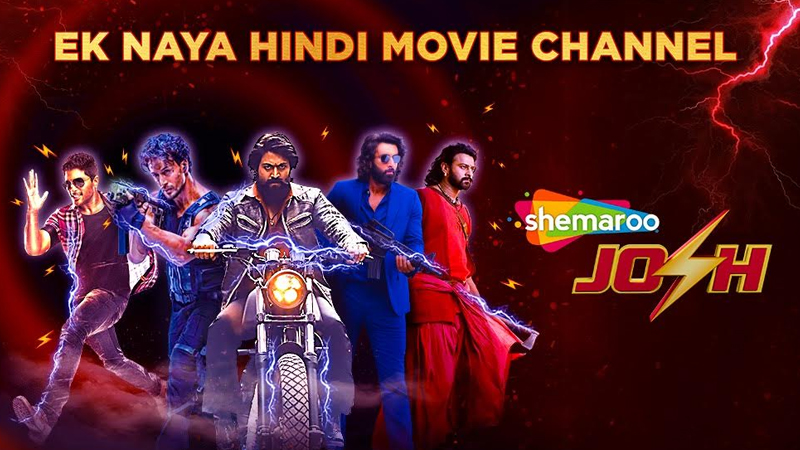
MUMBAI: Lights, camera, Josh! Bollywood buffs, get ready for a full-throttle film fest on your TV. Shemaroo Entertainment, the six-decade-old powerhouse of Indian entertainment, has launched Shemaroo Josh: its first dedicated Hindi movie channel.
Formerly known as Chumbak TV, the channel has now morphed into a high-energy movie destination, promising back-to-back blockbusters across action, drama, romance, comedy and everything in between. Available on DD free dish, all major DTH platforms, and cable networks, Shemaroo Josh is set to beam the big screen straight into living rooms across India.
The line-up is a cinephile’s dream: PK, Animal, Kantara, KGF, Bahubali, Waltair Veerayya, 12th Fail, Bade Miyan Chote Miyan, Bhool Bhulaiyaa 2 and many more, ensuring that every evening can feel like a Friday release.
“Shemaroo has been an integral part of India’s cinematic journey,” said Shemaroo Entertainment, CEO, Hiren Gada. “With Shemaroo Josh, we bring renewed energy and a sharper focus on what excites the masses, strengthening our commitment to keep India entertained every single day.”
Echoing this, Shemaroo entertainment, COO – broadcasting business, Sandeep Gupta added, “In a world of endless choices, the joy of watching a blockbuster with family on TV remains unmatched. Shemaroo Josh is our tribute to that timeless habit, turning every film into an event.”
With a splashy line-up, massy storytelling, and a name that screams energy, Shemaroo Josh looks set to add serious power to India’s most loved TV genre. After all, in a nation where cinema is a religion, there’s always room for one more screen idol. This time, in the form of a channel.
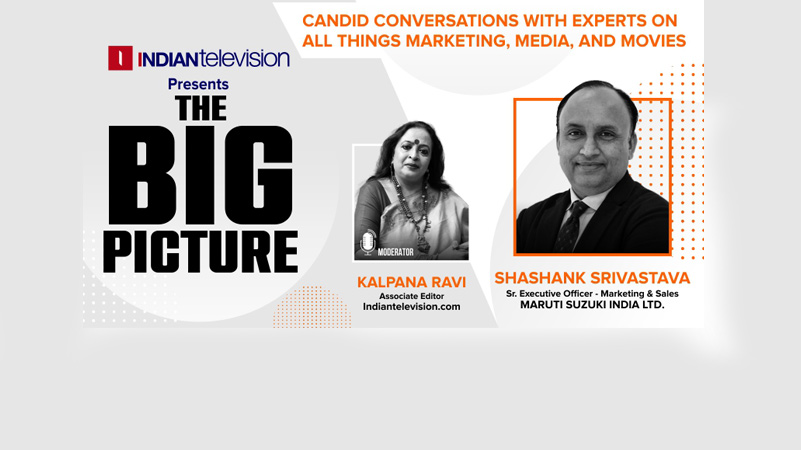
Mumbai: The power of movies on television, often referred to as “The Big Picture”, has impacted how we consume entertainment, making it an essential part of our lives. Not only that, the synergy of Movies and TV has also proven to be lucrative for brands who want to reach India at large and impact their daily lives. In a series of chats with marketers and media veterans, we discuss all things related to marketing, media and especially movies. I am your host, Kalpana Ravi, Associate Editor Indiantelevision.com and today my guest today is Shashank Srivastava – Senior Executive Director of Sales and Marketing – Maruti Suzuki India Ltd.
Edited excerpts
On your early life, about how you grew up and what has been your experience.
My hometown is Bhopal and I did my initial schooling there. Then I did my engineering, I was always out of Bhopal after that. I did my MBA from IIM Ahmedabad, post which I joined Maruti Suzuki. And that was a long time back, just out of college. And this is actually 33 years I have been in this industry. People asked me this question as to why the how, and why this long innings in Maruti Suzuki? The clear answer is that this is one industry, which I really love. It’s always cars, it has always been my passion, starting from my school days. Therefore, I wanted to join an organisation, which was in this industry. Maruti Suzuki, of course, has been leading organisations for a very long time. That’s how I came into Maruti Suzuki. It gave me a lot of good experiences across different areas of work. That’s how I kept on with Maruti Suzuki. I’m glad because we did contribute a lot to the industry. I feel that I have also been a part of that contribution to the Indian economy.
On your connection with cars
I started driving the car when I was in the seventh standard. My father used to have an Ambassador car. In those days, cars had these radiators, so we had to fill the water to cool the engine down. I was given the task of cleaning the car every morning and putting that water on the radiator. Once in a while I started, I started the car as well, and started driving a little bit just about 10 metres. I’m not sure that my father ever knew about this. But my mother clearly knew about this activity of mine. I’m not sure whether she told this to my father because he didn’t say anything. That’s how I started driving the car and started getting to have the feel of the car.
On choosing to be a marketer in the automobile sector.
It’s basically a consumer perspective and I thought that as a consumer, what should be what product it should be, what it should mean to a consumer. So, I got interested in the technicalities of the car in the mind of the consumer of the car, and that is how I started thinking about the products especially automobiles from a consumer perspective. For that obviously, during my course, in my MBA at the at IIM Ahmedabad but I mastered in you know, there was a subject I had to choose to specialise in and I chose marketing and it gave a very structured sort of knowledge a very structured approach to the entire consumer behaviour, consumer mind and how companies should make products and how to market them and that is how I chose marketing.
On sharing some highlights from your journey so far
There are many actually. Starting from the early 90s, you had a very high tax structure, the penetration of cars was just around two cars per 1000 people. Today it is 32. When I joined Maruti Suzuki, we had two other car manufacturers in the industry, the total sale was about 50,010 per annum. Today, we are selling 50,000. Maybe in the industry, we are selling almost 40 lakh this year. From about 50,000 to 40 lakhs, I have seen these changes happening in the last 30 years, not only in terms of volumes, which I just mentioned, also in terms of the different segments which emerged earlier. The Maruti 800 was being used by everybody, the bureaucrat, the businessman, the family guy, the young boys and the girls. But today, you see a lot of segmentation. So, you have family cars like the Ertiga, the Sedan’s then you have the SUVs, which were earlier a rougher sort of thing as technology has changed immensely. While volumes have changed, segments have changed and the consumers themselves have changed. You see a lot of digitalization in the industry today, which means the consumer buying process itself has changed. The type of buyer also has changed and the income level of the buyers has changed. In that sense, there has been a complete change from what it was 30 years ago, and each of these changes has been a highlight. For example, when the new Swift came in, it started a new segment which people thought would never exist, but it did then we had the Esteem. It was also a segment which suddenly came in. Therefore, each of these moments are like highlights of the last 30 years and I have been very lucky to be a witness to almost all of them.
On some of the memorable campaigns you have worked on work
One good thing about the large experience is also that I have been part of most of the memorable campaigns actually, because Maruti’s a 40-year-old company and I have worked for more than 33 years. In essence, the theme of those campaigns also defines how the consumer has been changing. So initially, there was a campaign about fuel efficiency. There was one Sardar Ji campaign that became a rage because it really defined in a very nice way how fuel efficiency is so dear to consumers. Those times consumers were obviously the first criteria for car purchase was the running cost and therefore, the second campaign on the network, which was about a guy who goes up to Ladakh somewhere, and he says, Is there a hotel? There is no hotel and he says there is a Maruti Suzuki service station. And they say yes, there is. So even in remote areas, that was a great campaign on fuel efficiency. Of course, some really good campaigns on the products as well. Like the new alto campaign, we had a blue-eyed boy campaign and so on and so forth. So, there are and there is one other campaign which is the corporate car campaign, which was about how Maruti Suzuki cars are integral to Indian consumers. It was a campaign which had a lot of elements of the brand being ubiquitous as it was everywhere. So that was another campaign, which I really loved and the consumers loved them too. And it became a talking point in the advertising world as well. So, some of these campaigns are really memorable. Even after 20-25 years, when I think about them, they really lift my spirits, because I’ve been part of them.
On your thoughts on Bollywood movies making record-breaking numbers this year
Indian consumers are really big movie fans. If you see this year, some of the movies have really done well in the theatres like Pathaan, Gadar 2, Jawaan, Kantara etc. Then down south KGF and RRR, have all done business in excess of 500 crores. So it’s encouraging not only for the film industry but also if you look at it from an advertisers’ point of view, it’s really very encouraging. In fact, when a movie does well at the theatre, you also have a high anticipation of the OTT and Television as well, because there will be a World TV premiere of these blockbusters as well. They tend to garner a lot of buzz because of them doing well in the theatre. Some of the movies have delivered extremely good numbers on television. Obviously, in a media strategy, we have tried to leverage these movies for our brands and going forward, I think we will continue to do that. One point about this is obviously the evolution of the OTT, there is a lot of content which are now available to consumers. So of course, he’s spoilt for choice in that sense, but even OTT premieres are big, and hence for the advertisers, I think we need to analyse the ROI very diligently and invest on both TV and OTT to get the best ROI. And that’s what Maruti Suzuki has been doing.
On watching movies on television creating value and impact that offer your brands?
It creates immense value because it is about memory structure as they say. It is not just about one advertisement or FCT that you put on. Of course, if you look at marketing as an investment and not as an expense, then what it does is build a longer-term brand value and these values come from these memory structures like watching a movie together with the family so, that becomes a brand conversation, which happens because of the family watching together. There are other memory structures like logos for example, or the packaging design, or, the visual treatment of the product itself, if you look at our Maruti Nexa product, for example, the design language is different. So there is also brand communication through the design language, we call it crafted futurism. So, therefore, I think these memory structures are extremely powerful, and very valuable for any brand. So, therefore, these memory structures are extremely powerful and very valuable for any brand. What it does is, it probably requires a small investment to keep the brands on top of the mind, because the investments have grown over time. That’s how those memory structures have evolved. These are the things which have a greater cultural relevance. Brands that see the advantage of this approach, will succeed and their ROI will grow. And we at Maruti Suzuki, feel that these occasions such as the ones that you mentioned, are really great opportunities for marketers.
On the current media spectrum of TV and digital contributing a winning mix for a marketeer and on the overall effectiveness of TV plus digital advertising
I’m glad that you said what is the ideal mix, rather than a lot of people who asked this question, which is better, is it TV or is it digital, because obviously, you have to strike the right balance between television and digital and find out the best way to reach the TG. For example, television is great, because for automobiles, if you really want to create imagery, the stickiness of the imagery is good on television, because you can have a large video format there. That’s essential, especially when you are launching a product. Also, the television media today in India has got a larger reach. So, if you’re trying to build a quick reach, and if you want to create imagery for brand positioning, initially, television is a great medium. However, in the funnel, if you look at the marketing funnel, as you go down for consideration and the actual conversion, then you need to have a more personalized message for consumers, their digital becomes more accurate, better, and less wasteful. Therefore, digital platforms obviously have got unparalleled, targeting capabilities because it allows marketers to reach specific audience segments and send personalized messages. That’s great for converting to an actual sale. And therefore, you need to have a mix of both television as well as, digital. It depends on the product category. A category such as car, imagery is very important. Because the category is different from the finance product, it also depends on the specific target audience, if you’re looking at really young consumers, who consume a lot of media in the digital sphere, obviously, you have to spend more money on digital. It also depends on your campaign objective, or even on the creative integration, the creative which is there. If you’re looking at performance measurement, obviously, that’s also one important thing because you can have a better measurement of the digital thing. It also depends on budget constraints. So, I would say that the media effectiveness and the mix are determined by the reach & engagement, if you want reach then TV. It definitely provides that broader reach and mass appeal, digital channels offer targeted engagements and personalised interactions. If you look at brand building, obviously, TV excels in brand building and emotional storytelling, digital platforms, drive performance marketing and maybe measurable results. So, a synergistic effect is what we are looking at. Therefore, a mix is good. In our case, the mix currently is about 30 per cent digital, television is about 40 per cent and the rest is print, radio, OOH and cinema.
Mumbai: While the fiscal second quarter June-September has been subdued due to the underperformance of Bollywood (apart from “Brahmastra”), multiplex operator PVR is counting on a much better performance during the festive season. It is planning a slew of initiatives to cash in on the season, which will see a return to normalcy in this period after a gap of two years.
Speaking to Indiantelevision.com PVR CEO Gautam Dutta said, “With an objective to encash on the blockbuster releases during the festive period, PVR will be running many promotions from 10–31 October across its products and services. This would entail special offers on ticket booking, PVR e-gift cards, Diwali gift hampers, and ‘V Pristine’ by PVR for its loyalty base of 1.46 crore privilege members. These will be announced on the PVR social media handle and in our cinemas.”
Talking about the growth in revenue that PVR expects during the festive season compared to the same period last year, he says that after a rousing start of FY23 with Q1 doing amazing numbers and breaking all-time records in the history of cinemas, Q2 has become subdued, marked by the underperformance of some movies. “We are extremely optimistic about the festive season ahead, as this will be the first time in two years that cinemas will be operating without restrictions. Substantiating these expectations is a big line-up of movies that would hit the theatres, and the rolling back of the usual eight-week theatrical window that has been reintroduced since 1 August.”
When asked about inflation being a challenge, he said that in the first quarter of FY23, there has been a strong growth of 23 per cent in average ticket price (ATP which is Rs 250) and 32 per cent growth in average F&B spend per patron (which is Rs 134) as compared to the pre-pandemic period. He added that the spending ratio of F&B to ATP has also increased from 49 per cent to 54 per cent. “This shows that patrons have accepted the increase in ticket prices and there has been an increase in their spending on F&B. The contribution of recliner seats to overall footfalls and occupancy has also increased, indicating that patrons are willing to pay a premium for a more luxurious moviegoing experience. There was a strong bounce-back in theatrical admissions with 2.5 crore patrons visiting our cinemas during Q1 FY23.”
Festivals, Gautam explained, are a time when families bond with each other, while cinema is primarily a family entertainment medium, so they complement each other. What encourages him is the fact that there is a festive atmosphere and people are in a buoyant mood and like to eat out and watch movies with their families. Speaking about the big releases lined up across languages, he noted, “There is an exciting movie line up in the October to December period covering all languages and genres, released in multiple formats and appealing to all segments of the audience. These include “Vikram Vedha” (Hindi), “Kantara” (Kannada), Mani Rathnam’s “Ponniyin Selvan” (Tamil, Hindi, Telugu, Malayalam, Kannada), “The Woman King” (English), “Ticket to Paradise” (English), “Goodbye” (Hindi), “Doctor G” (Hindi), Warner Bros “Black Adam” (English), “Ram Setu” (Hindi), “Har Har Mahadev” (Marathi, Hindi, Tamil, Telugu, Kannada), “Prince” (Tamil, Telugu), “Thank God” (Hindi), “Phone Bhoot” (Hindi), Disney’s “Black Panther – Wakanda Forever” (English), “Uunchai” (Hindi), “Drishyam 2” (Hindi), “Bhediya” (Hindi), Disney’s “Avatar; The Way of Water” (English), “Cirkus” (Hindi).””
When queried about the scene in terms of in-theatre advertising, he pointed out that there has been a gradual improvement in advertising revenue with a 68 per cent recovery in Q1 FY23 as compared to the pre-pandemic Q1 FY20. “Given the fact that we have some big films slated to release in the upcoming festive season, it will serve as an opportunity for us to revive advertiser interest and drive brand partnerships and retail opportunities. Q3, which includes the holiday season, is traditionally a good quarter for advertising surges, and we expect the same this year. We expect cinema advertising to reach close to 80 per cent of its pre-pandemic level and will bounce back and hit pre-Covid levels by the end of Q4.”
Offering further perspective, he said that PVR plays with fair equivalence vis-a-vis traditional media in terms of enjoying brand confidence and presence across various sectors of product categories. “Mostly all the relevant and sizable categories are on board with us. FMCG, telecom, e-commerce, ed-tech, BFSI (including fintech), consumer durables, automobiles, apparel, accessories, and jewellery, media entertainment, real estate, and so on are dominant categories. Some mainstream brands include Apple, Oppo, Cred, One Plus, Facebook, Whatsapp, Pepsico, Coke, Dyson, Kotak, Pepsi, Coke, Tata CliQ, Dettol, HDFC, Nippon , WOW etc.”
On the ticket price front, he pointed out that the pandemic caused unprecedented damage to the film exhibition industry. It has practically remained shut or been allowed to operate partially for two years. In normal course, there would have been a marginal increase in ticket prices every year to match inflationary trends. There has been an increase in ticket prices since there was no increase in ticket prices for two full years. “Our average ticket price for FY 21-22 has been Rs 235, which is marginally more than Rs 204 in the pre-pandemic FY 19-20. Ticket prices are capped in three states, namely, AP, Karnataka, and Tamil Nadu, where we can’t do much. Moreover, they vary as per the category of the movie, show times during the day, weekdays and weekends.”
In terms of where the growth is coming from, he reveals that over the last decade, the number of malls has increased dramatically. Previously, the development was happening in metros and tier I cities—they are now finding their way into tier II cities as well. “The expansion of multiplexes will also be aided by this deepening footprint. Moreover, there is a lack of out-of-home entertainment options in tier II and III as multiplexes continue to remain the cheapest form of similar leisure activity in India as compared to theme park visits, dining out, and vacations. With such indicators in place, our recent expansion to Narsipatnam, Rourkela, Patiala, and Nizamabad clearly shows our vision and commitment to strengthen our presence beyond metro cities.”
He added that the company has revived its capex plans in a significant manner and is on track to open a total of 125 new screens during FY23. “We have opened 20 screens across four properties since the start of FY23. We recently opened our six-screen cinema at Hinjawadi, Pune, which includes a P[XL] auditorium that marks Pune’s first multiplex with an extra-large screen. About one-third of the new screen additions in this fiscal year will be in tier II and III cities. The company plans to enter nine new cities during the year.”